1
POWER AWARE ENTROPIC HIDDEN MARKOV CHAIN
ALGORITHM FOR CODE BASED
TEST DATA COMPRESSION
1S. Rooban and 2R. Manimegalai
1Department of Electronics & Communication Engineering, Sri Krishna Institute of Technology, Chennai, India. 2Department of Computer Science & Engineering, Park College of Engineering and Technology, Coimbatore, India
ABSTRACT
Even though the scan architectures generally utilize advanced designs for testing reason, most of them remain an expensive design in test data volume and power consumption. A novel software based test data compression technique for testing System on Chip (SoC) is proposed in this paper. The proposed technique concurrently addresses the problem of reducing large test data volume and reduction of power consumption for scan testing on embedded Intellectual Property (IP) cores. In comparison to the aim of reducing only test data volume by recognizing the appearance of vector patterns and thereby eliminating don't-care bits using entropic Hidden Markov Chain (HMC) algorithm, here we address the task of decreasing power consumption. The proposed power proficient test data compression method is tested using the Verilog model of ISCAS'89 and ITC'99 benchmarks.
Index Terms: Automated Test Equipment, Circuit under Test, System on Chip, Built-in self-test, low power test, Test data compression
I. INTRODUCTION
Intellectual Property (IP) cores are currently commonly utilized as a part of large System on Chip designs. In general, IP cores posture two difficult test challenges. First, recent rise in design intricacy and the assimilation of embedded cores in SoC has prompted a massive growth in test data volume. Industry specialists predicted that this tendency will continue throughout the next couple of years [1-2]. Owing to the increase in volume of test data, design for testability and testability analysis plays a major role in testing of digital circuits and devices [3-4]. Second, the switching activity of IP cores is substantially higher amid test than that of functional mode. The resulting inordinate power consumption might bring about structural harm to IP cores or serious decline in reliability of the circuit under test [5-6]. High test data volume prompts an expansion in testing time. Additionally, vast test data volume might likewise surpass the limited memory depth of Automated Test Equipment (ATE). Multiple ATE reloads are tedious because data transfers from a computing terminal to the ATE memory or from the ATE memory to ATE channels are relatively moderate; the transfer time spans from minutes to hours [7]. Test application time can be decreased by using countless scan chains. The quantity of ATE channels which can candidly drive scan chains is restricted because of pin count constraints and ATE capabilities. To effectively test these systems, every intellectual property centre must be adequately practiced with a set of pre-computed test patterns given by the core vendor. Test data compression presents assuring solution to the issue of expanding test data volume. A test set
represented by TD for the Circuit Under Test (CUT) is
packed to a much lesser data set TE, which is stored in
the ATE memory. An on-chip decoder is utilized to
regenerate TD from TE amid test application. Various
test data compression techniques have been proposed for decreasing SoC test data volume [1, 8-11]. Results demonstrate that reductions up to 23% in test data volume and 20% in test application time are accom-
plished while applying this solution. Nonetheless, although it decreases drastically test data volume and test time, it doesn't consider test power usage when cramming doesn’t care bits.
As a starting point, we have picked the solution presented in [1] as it offers a high-test data volume reduction factor. This technique is adjusted so that the don't-care bit assignment is done in an approach to decrease not only test data volume but additionally test power consumption. We demonstrate that we can significantly diminish power usage by adjusting the initial compression method while maintaining the same request of magnitude in test data volume reduction. The rest of the paper is sorted out as takes after. In the next section, we present the literature review of code based test data compression technique. Section 3 discusses the proposed methodology. Section 4 presents simula-tion based experimentasimula-tion results obtained for ISCAS' 89 and ITC'99 benchmarked Verilog model [12] and for various industrial circuits to tackle issue of power consumption with this compression technique. Section 5 gives concluding comments.
II. RELATED WORK
In the context of scan testing, the issue of unwarranted power amid test is a great deal more serious as the application of every test pattern requires countless operations that contribute to superfluously expanding the switching activity [6]. High power consumption amid test might affect the circuit reliability but might likewise prompt its damage. Elevated test power consumption might be responsible for yielding noises and thus causing damages such as IR-Drop or Ground Bounce [5, 13].
2
design flexibility, diminished design cycle, and length-ened SoC product lifetime significantly by permitting gadgets to adapt with the changing standards and extra features [16]. Another real advantage of this type of SoC is that the embedded processor can be utilized to run software for decompressing the pre-compacted test data rather than utilizing exceptional decompression hardware circuitry. The compression process is utilized for compact the test data volume before downloading the data into the processor memory along with the decompression process. The processor executes small decompression software, and after that the test vectors are connected to individual cores in the SoC. It should be noted that compression of test data does not have any direct effect on the testing time. Compression of test data should be done well before downloading the test set into the embedded processor for testing. Notwithstanding, the compression technique must be sufficiently efficient not only to decrease the total test data volume, but additionally allows in avoiding unnecessary power usage.
Some other methods have been proposed to simulta-neously address the issue of test data compression and power consumption. The technique presented in [17] depends on Golomb code and a particular assignment of don't-care bits to decrease test data volume and power consumption. The segmented addressable scan architecture presented in [18] adjusts the Illinois Scan Architecture [19,20] to decrease the power consum-ption. Hamzaoglu et al., have proposed the test data compaction technique [21], which reduces the volume of test data transferred from the workstation to the ATE. While these methodologies effectively diminish the volume of test data, they don't decrease the ATE bandwidth requirements. Embedded Deterministic Test (EDT) which is a novel test-data volume-compression methodology is proposed in [22]. It diminishes manu-facturing test cost by reducing scan test data volume. But these methodologies might experience the ill effects of inefficient tester channel utilization. Iyengar et al., [9] have proposed another built-in plan for testing sequential circuits in view of statistical coding but this method is suitable only for circuits with little number of essential inputs.
The selective Huffman coding [23] eliminates the disadvantage of statistical coding. This method splits the test vectors into altered length input patterns of size
b (where b is a square size), and applies Huffman
coding. But these methods expand the computational complexity and large zone overhead. Following that the selective Huffman coding is not optimal, Kavousianos et al., have proposed the optimal Selective Huffman coding [24] with low hardware overhead and better compression. The Golomb coding allocates a variable-length Golomb code, size of group, to a keep running of ‘0’s as depicted in [25]. But these Golomb codes are optimum only for a particular pattern distribution. A methodology called, Frequency directed run-length (FDR) coding is proposed in [26] form two parts, a
prefix and a tail, where both parts have the same length. But the FDR code requires more complicated decoder with altered region overhead. Gonciari et al., [27] have proposed the variable-length Huffman coding. This method diminishes the ATE memory and channel capacity requirements by obtaining great compression ratios. Nourani et al., proposed RL-Huffman coding in [28].This method blends two encoding techniques to diminish power dissipation, test data volume and test pattern conveyance time in scan test applications. Eventhough this method is pertinent to the condition, the number of don't care bits is high. Nine code words used for test data compression technique is presented in [29]. Stuffing the bit column wise and reordering of vectors based on hamming distances proposes better solution in run length based data compression codes in [30]. One more technique which capitalizes on the fact that numerous consecutive squares of the test data can be combined together is presented in [31]. Compression is accomplished in this plan by storing the consolidated piece and the quantity of squares combined. These techniques offer a high reduction in terms of power consumption, i.e., from 70% to 80%. Unfortunately they offer only a little reduction of test data volume, i.e., from 2x to 5x. This paper focuses on reducing the power consumption and test data volume simultane- ously by utilizing code based compression technique.
III. METHODOLOGY
A. Experimental Setup
Keeping in mind the end goal to exhibit the viability of the proposed test compression technique, independent simulations were conducted on different ISCAS 85 and ISCAS 89 HDL benchmark model of Verilog. An automatic test generation process is first utilized for obtaining a set of test vectors giving 100% fault scope [15]. The proposed compression algorithm is imple-mented in MATLAB programming environment on a Windows machine having Quad-center 2.5-GHz Ultra processor with 8GBs of RAM. On account of space constraints, only some partial results on ISCAS'89 and ITC'99benchmark circuits are given. All the test vectors required for testing the SOC are first compacted in software mode. The packed test vectors and an efficient decompression system are then stacked into the simulation of embedded handling core of the SOC. The processor executes the decompression process, and afterward applies all the uncompressed unique test vectors to every last center of SOC for generating and breaking down the output responses.
B. Model for Test Data Compression
3
blocks/bits that exhibits difference with it. This will allow us to compress and recover the whole set of test vectors during the decompression process. The entropy of the test data is compressed using the estimated weighted factors obtained using the proposed algorithm. It is applied for compression on test data set
as a matrix of size m x n. Here, each of the rows
belonging to C is divided into blocks of equal size.
Owing to the structural relationships among the faults there tends to be lots of similarities between test vectors. Hence, this test vectors can be ordered opti-mally such that the successive test vectors experience differences by just a fewer number of blocks. Thereby, reducing the amount of information is requisite for storing these differences will comparatively fall beyond the size required for storing the entire test vectors.
Let 𝐶𝑘, be the test vectors where k=1,2,3,…n of size m
x n and N is the block size of data. Thus, the entropy of
this test vector can be represented in equation 1.
𝐸(𝐶𝑘) = − ∑𝑛𝑖=1𝑝𝑖∗ log2𝑝𝑖 (1)
Where, 𝐶𝑘= {𝐶1, 𝐶2, … 𝐶𝑛} and 𝑝𝑖= 𝑝𝑖−1+ 𝑏𝑘 is the
index of bits where 𝑏𝑘 is the weighted indices distances
corresponding between the adjacent blocks of the test vectors. Since, the distribution changes with time, therefore it is necessary to use an encoding scheme with respect to the changing time. Thus, the distance frequency for the distribution of indexes needs
opti-mum parameters for each 𝐶𝑘&𝑏𝑘 respectively. This
correspond to the hard problem because of the increase in size relegates the necessity of general solution. Thus,
for a given k distance of good vectors, the problem is
that how to encode each section of the scan vectors and what is the best parameter for reducing the size of encoded data that is derived using the proposed Entro- pic Hidden Markov Chain Algorithm EHMCA. The data needs to be pre-processed or divided into scan lines of test vectors using equation 2.
𝐶𝑘 = ∑ 𝐶0(𝐾𝑖)
𝑚
𝑖=1
+ ∑ 𝐶0(𝑏𝑖)
𝐾1
𝑖=1
+ ⋯
+ ∑𝐾𝑖=𝐾𝑚−1+1𝐶𝑚(𝑏𝑖) (2)
In equation 2 𝐶𝑖(. ) is the required size to encode the
indices value at each section. Here the optimum weighted parameter is determined using the proposed EHMCA algorithm.
It is assumed that the P(𝐶𝐾|𝐶𝐾−1) is independent of K,
which leads to the definition of the stochastic transition
matrix 𝐾 = {𝐾𝑖𝑗} = 𝑃(𝐶𝐾= 𝑗|𝐶𝐾−1= 𝑖)
The initial state distribution of the primary test vector
(i.e. when K=1) is given in equation 3.
𝜏𝑖= 𝑃(𝐶1= 𝑖) (3)
The observation variables 𝑂𝐾can take one of K possible
values. The probability of a certain observation at K
index for state j is given in equation 4.
bi(𝑜𝐾) = 𝑃(𝑂𝐾= 𝑜𝑡|𝐶𝑡= 𝑗) (4)
Taking into account all the possible values of 𝑂𝐾 and
𝐶𝐾 we obtain the weighted 𝑏𝑘 i.e., indices distances
corresponding between the adjacent blocks by N matrix
𝑏𝑘= ∑𝐾𝑗=1𝑏𝑗(𝑜𝐾)
An observation sequence is given by 𝑂 = (𝑂1=
𝑜1, 𝑂2= 𝑜2, … , 𝑂𝐾= 𝑜𝐾)
Thus we can describe a hidden Markov chain by
initializing the computing with 𝜃 = (𝐶, 𝑂, 𝜏) iteratively
updating for local weighted maximum for 𝜃∗=
arg max 𝑃(𝑂|𝜃).
Algorithm: Entropic Hidden Markov Chain Algorithm (EHMCA) for Test Data Compression Input:𝐶𝑘= {𝐶1, 𝐶2, … 𝐶𝑛} entropy based divided test
vectors
Output: 𝑂𝑘 = {𝑂1, 𝑂2, … 𝑂𝑛} compressed test vectors
&𝑏𝐾∗ is the expected weighted indices distance
corresponding between the adjacent blocks of the test vectors.
Step 1: Set 𝜃 = (𝐶, 𝑂, 𝜏) with random initial
conditions by using prior information of primary test vector.
Step 2: Recursively determine the probability for the
continued manifestation of bits. Let 𝛼𝑖(𝐾) = 𝑃(𝑂1=
𝑜1, 𝑂2= 𝑜2, … , 𝑂𝑇 = 𝑜𝑇, 𝐶𝐾= 𝑖|𝜃), the probability of
appearing the 𝑜1, 𝑜2, … , 𝑜𝐾and being in state i at time K
and j at time K+1 is represented in equations 5 and 6.
𝛼𝑖(1) = 𝜏𝑖𝑏𝑖(𝑜1) (5)
𝛼𝑗(𝐾 + 1) = 𝑏𝑖(𝑜𝑡+1) ∑ 𝛼𝑖(𝐾)𝛼𝑖𝑗
𝑁
𝑖=1
(6)
Step 3: Calculate the temporary variables from the test vectors, by evaluating the transition probability of bit
being in state i at time K given the spotted sequence O
and the parameters 𝜃 (using the Bayes' theorem) is
given in equation 7.
𝑇𝑖(𝐾) = 𝑃(𝐶𝐾= 𝑖|𝑂, 𝜃) (7)
Step 4: Calculate the probability of being in state i and j
at times K and K+1 respectively given the observed
sequence O and parameters 𝜃 by the equation8.
𝜑𝑖𝑗(𝐾) = 𝑃(𝐶𝐾= 𝑖, 𝐶𝐾+1= 𝑗|𝑂, 𝜃) (8)
Step 5: Update 𝜃 in order to resolvethe expected
number of transitions from state i to state j in
comparison to the expected total number of shifts away
from state i using equation 9.
𝜏𝑖∗= 𝑇𝑖(1)Expected frequency spent in state i at time 1
𝑡𝑖𝑗∗ =
∑𝐾−1𝐾=1𝜑𝑖𝑗(𝑡)
∑𝐾−1𝐾=1𝑇𝑖(𝑡)
(9)
Step 6: Compress the bits by replacing 1 or 0 with r and
simultaneously determining the final weighted vectors
for the number of shifts away from state i that do not
mean transitions to a different state j, but to any state
including itself using equation 10. This is
corres-ponding to the no. of times state i is detected in the
4
𝑏𝐾∗(𝑟) =
∑ 1𝑜𝐾=𝑟𝑇𝑖(𝐾)
𝐾 𝐾=1
∑𝑇−1𝑡=1𝑇𝑖(𝐾)
(10)
Where, 𝑏𝐾∗ is the expected weighted indices distance
corresponding between the adjacent blocks of the test vectors; such that the number of times the
output observations have been equal to 𝑟 while in
state i over the expected total number of times in
state i by equation 11.
1𝑜𝐾=𝑟 = {
1, 𝑖𝑓 𝑜𝐾= 𝑟
0, 𝑜𝑡ℎ𝑒𝑟𝑤𝑖𝑠𝑒 (11)
Step 7: Repeat Steps 4-6 iteratively until
𝑃(𝑂|𝜃𝑓𝑖𝑛𝑎𝑙) > 𝑃(𝑂|𝜃) is reached.
Step 8: Recalculate the entropy of the compressed test vector using equation 12.
𝐸(𝑂𝑘) = − ∑ 𝑝𝑖
𝑛
𝑖=1
∗ log2𝑝𝑖
//𝑓𝑜𝑟 𝑂𝑘 = {𝑂1, 𝑂2, … 𝑂𝑛} (12)
Where 𝑝𝑖= 𝑝𝑖−1+ 𝑏𝐾∗
Step 9: Stop
IV. EXPERIMENTAL RESULTS
A series of experiments were performed on ISCAS'89 and ITC'99 benchmark circuits. The experimental out- come of these benchmark testing are presented in Table 1 and 2 below. We’ve listed the data volume, compre- ssed bits, the compression ratio and the power
reduc-tion. TD alludes to the initial test data volume and TE to
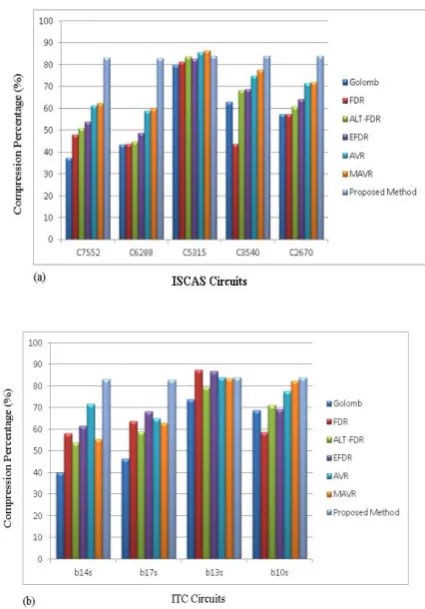
the packed test data volume. These results are given without repetition of ATE pattern. The results demons-trate that compression percentage obtained with ISCAS is most of the time higher and consistent than that obtained with ITC. The comparison plot of test data reduction between the proposed method and that of several other techniques namely, Golomb, FDR, ALT-FDR, AVR, MAVR, EFDR for ISCAS and ITC circuits are represented in figure 1 below [25,26,30, 32, 33].
TABLE 1: Compression& Power Reduction Percentage of
Experimented ISCAS'89Benchmark.
Circuit Total Origin al Bits
Output Compressed
Bits
Compres sion (in
%)
Power Reduction
(in%) C7552 2934 573 80.45 64.5 C6288 2342 366 84.34 65.03
C5315 3032 505 83.32 65.4 C3540 2786 411 85.22 64.9 C2670 3789 587 84.49 65.4
Figure 1: Comparison plot between the proposed method and other techniques for various run length based codes on (a) ISCAS & (b) ICT.
Test power consumption has additionally been evaluated with ISCAS and ITC. The reduction in power is estimated by utilizing the total number of weighted
transition metric 𝑏𝐾∗(𝑟). We have evaluated the power
reduction with initial arrangement generated with an irregular assignment of don't-care bits and afterward contrasted it with ISCAS and ITC. These results demon -strate the effectiveness of the proposed power reduc-tion while compressing test data. With the presented technique we have achieved power reduction of up to 65% with ITC when differentiated with ISCAS; a little fluctuation is noted in the results. For a majority of benchmarking circuits, the heuristic performs better than the others as it guarantees less activity in the scan affix contrasted with ITC. On the other hand, the little reductions obtained for a few circuits can be clarified by the high percentage of power reduction obtained with ISCAS contrasted with an irregular fill solution. In
other words, when ITC accomplishesadecentreduction
inpower consumption, there is not much opportunity
for additional reductions with ISCAS.
TABLE 2: Compression & Power Reduction Percentage of Experimentation on ITC'99Benchmark
Circuit Total Origin al Bits
Output Compressed
Bits
Compression (in%)
Power Reduction
5
V. CONCLUSION
In this study, we have proposed a software based test data compression technique. The technique is completely lossless and efficient in terms of both time and space on account of its higher compression percentage (83%) and quick decompression process. Experimental results demonstrate that contrasted with an irregular filling solution, up to or above 83% reduction in test data volume and up to 65% of power reduction is achieved with the proposed technique. Thus, it decreases both the amount of test storage and testing time, thereby diminishing the tester memory and channel capacity requirements. As the proposed method is predominantly software based, the hardware requirements and cost of ATE are minimized. In addition, this method does not require detailed structural information about the IP circuit under test and utilizes a non-specific on-chip decoder that is independent of the IP center and the test set. Future work of the study will be concerned with automatic application of test vectors for investigating test fault scope.
REFERENCES
[1] Y. Zorian, E. J. Marinissen, and S. Dey, Testing Embedded-Core based System Chips, in Proc. International Test Conference pp.130-143 (1998). [2] P. S. Zuchowski, C.B. Reynolds, R. J. Grupp, S. G.
Davis, B. Cremen, and B. Troxel, A Hybrid ASIC and FPGA Architecture International Conference Computer Aided Design Pp. 187-194 (2002). [3] S.C. Seth, and V.D. Agarwal, A Review of Testing
of Digital VLSI devices. IETE Technical Review 2: 363-374 (1985}.
[4] A. Ahmed, and A. H. AI-Habsi, Design of a Built in Multi-Mode ICs Tester with Higher Testability Fatures – A Most Suitabe Testing Tool for BIST Environment. IETE Technical Review 15: 283-288 (1998).
[5] A. Jas, J. Dastidar and N. A. Touba, Scan Vector
Compression/Decompression using Statistical
Coding, in Proc. VLSI Test Symposium Pp. 114-120 (1999).
[6] A. Jas and N. A. Touba, Deterministic Test Vector Compression/Decompression for Systems on a Chip using an Embedded Processor. Journal of Electronic Testing: Theory and Applications 18: 503-514 (2002).
[7] A.Jas and N.A.Touba, Test Vector Decompression via Cyclical Scan Chains and its Application to Testing Core-based Designs, in Proc. International Test Conference Pp. 458-464 (998).
[8] M. Ishida, D. S. Ha and T. Yamaguchi, COMPACT: A Hybrid Method for Compressing Test Data, in Proc. VLSI Test Symposium Pp. 62-69 (1998).
[9] V. Iyengar, K. Chakraborty and B. T. Murray, Built-in Self Testing of Sequential Circuits using Precomputed Test Sets, in Proc. VLSI Test Symposium Pp. 418-423 (1998).
[10] A. Chandra and K. Chakrabarty, Test Data Compression for System-on-a-Chip using Golomb Codes, in Proc. VLSI Test Symposium Pp. 113- 120 (2000).
[11] A. Chandra and K. Chakrabarty, Efficient Test Data Compression and Decompression for System-on-a-Chip using Internal Scan Chains and Golomb Coding, in Proc. Design Automation and Test in Europe Pp. 145-149 (2001).
[12] ISCAS'89 and ITC'99 benchmark Verilog model,
http://ddd.fit.cvut.cz/prj/Benchmarks/
[13] A. Chandra and K. Chakrabarty, Frequency-Directed Run-Length Codes with Application to System-on-a-Chip Test Data Compression, in Proc. VLSI Test Symposium Pp. 42-47 (2001).
[14] SemiconductorIndustry Association, International
Technology Roadmap for Semiconductors (ITRS) (2005).
[15] A. Khoche, and J. Rivoir, I/O Bandwidth Bottle neck for Test: is it Real? Test Resource Parti-tioning Workshop (2000).
[16] M. L. Bushnell and V. D. Agrawal, Essentials of Electronic Testing, Kluwer Academic Publishers, (2000).
[17] M. R. Nelson, Data Compression with the Burrows Wheeler Transform, Dr. Dobb's Journal 22: 46-50 (1996).
[18] M. Burrows and D. J. Wheeler, A Block Sorting Lossless Data Compression Algorithm, Digital Equipment Corporation. Palo Alto, CA, Res. Rep. 124 (1994).
[19] I. Hamzaoglu, and J. H. Patel, Test Set Compac-tion Algorithms for CombinaCompac-tional Circuits, in Proc.International Conference on Computer-Aided Design Pp. 283-289 (1998).
[20] L. Chen and S. Dey, Software-based Self-Testing Methodology for Processor Cores. IEEE Trans-actions on Computer-Aided Design 20: 369–380, (2001).
[21] I. Hamzaoglu and J.H. Patel, Test Set Compaction Algorithms for Combinational Circuits. IEEE Transactions on Computer Aided Design of Inte-grated Circuits and Systems 19(8): 957–963 (2000).
[22]. J. Rajski, J. Tyszer, M. Kassab and N. Mukherjee, Embedded Deterministic Test, IEEE Transactions on Computer-Aided Design of Integrated Circuits and Systems 23(5): 776–792 (2004).
[23] A. Jas, J.G. Dastidar, J.Mom-Eng and N.A. Touba, An Efficient Test Vector Compression Scheme using Selective Huffman Coding. IEEE Trans-actions on Computer-Aided Design of Integrated Circuits and Systems 22(6): 797– 806 (2003). [24] S. Mitra and K. S. Kim, X-Compact: An Efficient
Response Compaction Technique. IEEE Trans-actions on Computer Aided Design of Integrated Circuits and Systems 23(3): 421–432 (2004). [25] A. Chandra and K. Chakrabarthy, System on a
6
on Golomb Codes. IEEE Transactions on Computer Aided Design of Integrated Circuits and Systems 20(3): 335-368 (2001).
[26] A. Chandra and K. Chakrabarty, Test Data Compression and Test Resource Partitioning for System on a Chip using Frequency Directed Run-Length (FDR) Codes. IEEE Transactions on Computers 52(8): 1076– 1088 (2003).
[27] P. T. Gonciari, B. Al-Hashimi and N. Nicolici, Variable Length Input Huffman Coding for Sys-tem on a Chip Test. IEEE Transaction on Computer Aided Design of Integrated Circuits and Systems 22(6): 783–796 (2003).
[28] M. Nourani and M. Tehranipour, RL-Huffman Encoding for Test Compression and Power Reduction in Scan Application, ACM Transaction on Design Automation Electronic Systems 10(1): 91–115 (2005).
29] M. Tehranipoor, M. Nourani and K. Chakrabarty, Nine-Coded Compression Technique for Testing Embedded cores in SoCs. IEEE Transcriptions on Very Large Scale Integration(VLSI) Systems
13(6): 719–731 (2005).
[30] S. Usha Mehta, S. Kankar Dasupta, M. Niranjan and Devashrayee, Hamming Distance Based Reordering and Column Wise Bit Stuffing with Difference Vector: A Better Scheme for Test Data Compression with Run Length Based Codes, in Proc. 23rd International Conference on VLSI Design Pp. 33-38 (2010).
[31] A.H. El-Maleh, Efficient Test Compression Tech-nique based on Block Merging. IET Computers and Digital Techniques 2(5): 327–335 (2008). [32] J. Lee and N.A Touba, LFSR-Reseeding Scheme
Achieving low-Power Dissipation during Test. IEEE Transaction on Computer-Aided Design of Integrated Circuits and System 26(2): 396-401 (2007).
[33] A. H. El-Maleh, Test Data Compression for System on a chip using Extended Frequency Directed Run-Length Code. IET Computers and Digital Techniques 2(3): 155-163 (2008).