Promising Micro- Nano-Technologies and Materials for
Joining Precision Parts of Optics-and-Electronics Devices
Volodymyr Maslov
V. Lashkaryov Institute of Semiconductor Physics NAS of Ukraine, Kyiv, Ukraine 41 pr. Nauki, 03028 Kyiv, Ukraine
*Corresponding Author: [email protected]
Copyright © 2014 Horizon Research Publishing All rights reserved.
Abstract
The investigations have shown the following promising tendencies in technologies for joining materials used in precision techniques: Removal of the damaged surface layer by chemical etching the joined surfaces allows, up to 6-fold enhancing both durability of part and glue conjunction between it. To modify properties of silicon-organic epoxy glue not only near the surface of combined parts but over the whole thickness of the glue joint, offered have been glue compositions based on thermo stable silicon-organic glue with embedded in it filler in the form of powder consisting of nano-dimensional (15 to 20 nm) particles of zirconium oxide in the amount up to 20 mass. %. The developed diamond-glue composition enables to shorten the duration of cooling the glue conjunction leucosapphire-copper to cryogenic temperature (from the room one down to 80 K) by 1.5 times and obtain the 6-fold increased durability, as well as higher reliability and longevity under thermal shocks. This composition is also recommended to provide efficient and uniform heat removal in solar panels. Deposition of the chromium vacuum coating with the thickness 50 to 100 nm modifies the Teflon surface and allows using the traditional glues for joining the parts processed in this way.Keywords
ZERODUR, Diamond-Glue Composition, Silicon-Organic Epoxy Glue, Joining Materials1. Introduction
It is known that workability of optics-and-electronics devices as well as their precision are determined by a number of factors and, first of all, by stability of mutual location of optical parts in the measuring channel.
In recent decades, high results have been reached in technology of joining with application of up-to-date lasers [1]. However, these methods have a serious deficiency: there arises local high-temperature heating, which results in internal strains in joined parts. Thereof, application of these methods for operation with precise optical parts is not always
desirable. The possibility to essentially lower the temperature of agglomeration of glass-crystal materials due to preliminary vacuum deposition of a nano-dimensional aluminum layer on the surface of one of joined parts was shown in the work [2].
The described way provides high precision and reliability of joining the precision parts, however, it requires preliminary polishing the combined surfaces and vacuum deposition of a nano-dimensional coating, which results in a high cost of products. So, it seems interesting to research the possibility of perfection of glue assemblage that are rather technological and need not special equipment. Adduced in the monograph [3] are principles and computations concerning glue and other kinds of assemblage of chargeable optical parts, for example, of the main mirror in the space telescope Hubble.
However, authors of this book do not consider issues related with the influence of diverse factors on workability and reliability of devices. Some of these factors are as follows: surface condition of the joined parts, structure of the connective joint, physics-and-technological regularities of joining the precision parts. Combination of parts made of new non-traditional materials and parts from optical glass in one optical unit leads to the necessity to develop new scientific-and-technical solutions in the methods of joining. This problem is especially topical for such promising materials as the glass-crystalline ones possessing a practically zero coefficient of linear expansion: Zerodur (Schott, Germany) and silicon carbide.
reached. So, it seems interesting to consider tendencies in creation of glue precision conjunctions for the most widely used parts, for example, in optical production.
2. Materials and Methods
The aim of this work was to study the influence of surface condition in combined parts on durability of their glue conjunctions and to perfect technologies for using nano-materials and nano-coatings in these conjunctions.
Our investigations of chemical interaction between epoxy silicon-organic glue and surfaces of ZERODUR and silica were performed using the method of IR spectrometry with the facility for multiple frustrated total internal reflection (MFTIR) that enables to study nano-dimensional glue layers on the surface of solid materials. The accuracy of spectral measurements was no worse than ± 5 cm-1
The surface of ZERODUR samples was processed with the abrasive M-10. It was covered with a thin glue layer. After solidification of the latter in normal conditions, the sample was heated to investigate the kinetics of interaction of glue with the substrate. Besides, we studied glue solidification at the same temperatures to ascertain the influence of heating and oxidation.
IR MFTIR spectra were recorded using the spectrometer UR-20 (Carl Zeiss, Jena) with the prism KRS-5 (n = 2.4) possessing the refraction angle 45°. In this case, the condition φ>>φcrit was satisfied. The prism of internal
[image:2.595.324.537.194.381.2]reflection provided N=18 reflections. Special requirements to quality of contact between studied material and prism surface should be met in these experiments. When studying glue interaction with the surface of silicate material, we polished the solidified glue on the substrate surface up to creation of a thin (~1 µm) layer. Then, the sample was pressed to the operation surface of the prism KRS-5 to provide contact between surfaces. Solidification of the glue on the substrate was carried out at temperatures 20 to 250 °С for 4 to 24 hours. When studying spectra of the fresh glue, it was directly deposited on the surface of the MFTIR prism. It enabled to provide optical contact.
Figure 1. Appearance of the camera for thermal vision
[image:2.595.321.544.472.618.2]Thermographic investigations of temperature distribution inside solar batteries, in the case of backward current when the Joule heat is released on defects of silicon photo converters, were performed using the experimental camera for thermal vision (Fig. 1) designed in V. Lashkaryov Institute of Semiconductor Physics, NAS of Ukraine. Technical characteristics of this camera are summarized below in Table 1.
Table 1. Technical characteristics of the camera for thermal vision
Parameter Value
Dimension, mm 287х192х130
Field of view angle, grad 40
Number of matrix elements 256Hх290V
Sizes of the single element 50х33μm2
Frame rate 25 Hz
Range of spectral sensitivity 2 - 5.3 μm
Camera input signal Digital
Supply voltage 220 V±10%, frequency 50 Hz ±1%
Temperature sensitivity 0.07ºС on the square 0.25 mm²
Cooling Liquid nitrogen, minus 196°С
3. Results and Discussion
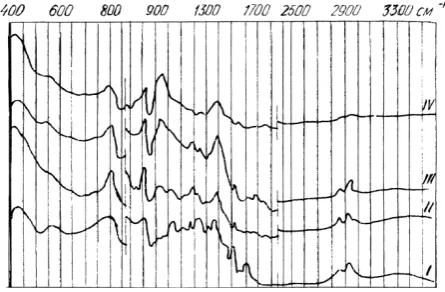
Spectral investigations showed that, with increasing the temperature, the samples with glue changed their spectroscopic characteristics (Fig. 2).
Figure 2. Infrared MDTIR spectra of glass-crystal surface with a deposited layer of glue К-400: І – solidified at the temperature 20°С for 24 hours, ІІ – heated at the temperature 80°С for 4 h, ІІІ - heated at the
temperature 150ºС for 6 h, IV - heated at the temperature 200°С for 4 h.
During the process of heating, the intensity of spectral bands at the frequencies 430 and 940 cm-1 corresponding to
vibrations of Si-O groups in the ZERODUR structure enhances. Simultaneously lowered in definite proportion is the intensity of the band 1250 cm-1 that is characteristic of
[image:2.595.76.283.573.730.2]shift to the side of lower frequencies (1210 cm-1), which is
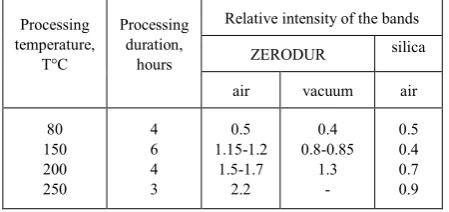
indicative of increasing strains in the bonds of this type up to breaking them. Abruption of Si-CH3 bonds promotes accumulation of Si-O groups, and this process is more intense in air than in vacuum. The obtained results are summarized in Table 2. As the internal reference intensity, we used the vibration band at the frequency 820 cm-1, the
[image:3.595.66.291.217.323.2]intensity of which does not change during the heat processing.
Table 2. Relative increase in the band intensities for zerodur and silicate surfaces with silicon-organic epoxy glue during their processing
Processing temperature, Т°С Processing duration, hours
Relative intensity of the bands
ZERODUR silica
air vacuum air
80 150 200 250 4 6 4 3 0.5 1.15-1.2 1.5-1.7 2.2 0.4 0.8-0.85 1.3 - 0.5 0.4 0.7 0.9
The observed increase in the intensity of the band 940 cm-1 can be related with the increase in the concentration
of Si-O groups as a result of creation of ionic bonds at the glass surface and silicon groups available in the epoxy composition. As a result, formed is a modified glue nano-layer chemically bounded with the ZERODUR surface. The similar spectral changes take place in the case of silica surface.
It was noted in the course of temperature and mechanical testing the glue conjunctions that destructions in the form of cracks and contraction cavities take place on combined surfaces due to development of initial micro-cracks in the damaged surface layer of parts. As far as in 1983, when producing semiconductor devices, V.P. Alyokhin ascertained that creation of fragile cracks in glue conjunctions of parts take place as a result of in-homogeneity in micro-plastic deformation observed in sub-surface layers between combined crystalline materials (on examples of silicon and germanium) and occurring gradient of dislocations. Availability of structural micro-in-homogeneities of the dislocation type (known as disclinations) in amorphous materials was considered in the works [6, 7, 8]. For the case of optical glasses and glass-ceramic materials, investigations of the influence of surface layers on micro-plastic deformation and durability are described in the work [9].
In glue conjunctions of ZERODUR with other materials that essentially differ by the value of the thermal coefficient of linear expansion, mechanical strains arise inevitably, which can result in breaking the glue conjunction. Indeed, after temperature shocks (± 60ºС) in glue conjunctions of ZERODUR with other materials, destruction in the form of fragile cracks and contraction cavities takes place on the combined surfaces due to development of initial micro-cracks in the damaged surface layer (DSL) of parts.
Occurrence of DSL related with mechanical processing results in growth of the amount of structural near-surface defects that, moving under action of mechanical loads and thermal fluctuations, create effects of micro-plasticity. Removal of this DSL with preliminary chemical etching the joined surfaces enables to obtain 1.5- to 6-fold enhanced durability (in dependence of sizes and shape) both of the very parts and their glue conjunction with parts from other materials.
Modification of glues with nano-dimensional particles is simple and extraordinary topical, as it gives the possibility to improve their properties. To modify properties of silicon-organic epoxy glue not only near the surface of combined parts but over the whole thickness of the glue joint, offered are glue compositions based on the silicon-organic thermally durable glue with preliminary introduced filling material in the form of powder from nano-dimensional (12 to 15 nm) ZrО2–3% Y2O3 particles in the amount up to 20
mass. %. Growth in the amount of nano-filler resulted in essential condensation of composition and excluded obtaining the thin glue joints. If lowering the amount of nano-filler, the positive effect of modification was lowered, too.
The offered optimal compositions and conjunctions of glass-ceramics based on them had a high durability up to 35 MPa after thermal processing (250 ºС, 2 hours). For comparison, after the same thermal processing the durability of conjunction between parts joined with conventional glue did not exceed 10 MPa.
The positive effect occurring after embedding the nano-particles of zirconium dioxide doped with 3% of Y2O3
in the offered composition on its thermal stability can be explained by a joint influence of the following factors: nano-particles fill the free volume between grains of micro-powder, which lowers the shrinkage during solidification of glue composition and mechanical strains related with it, as well as forms additional inter-atomic bonds between glue and surface of nano-filler particles.
An important aspect in using these glue compositions with micro- and nano-fillers is the possibility to use powders of materials with various thermal-and-physical properties, which allows to create glue conjunctions both with high and, if necessary, with low temperature conduction. Performed were investigations of the possibility to increase temperature conduction of silicon-organic epoxy glue due to introduction of micro-powders consisting of synthetic diamond (ACM type) with the granularity 10/7. The diamond micro-powder embedded in the amount of 20 vol. % provides high temperature conduction and durability of glue conjunctions.
cooling the glue conjunction leucosapphire-copper to cryogenic temperature (from the room one down to 80 K) by 1.5 times and obtain 6-fold increased thermal stability, as well as higher reliability and longevity in the case of thermal shocks.
(a)
[image:4.595.323.540.139.514.2](b)
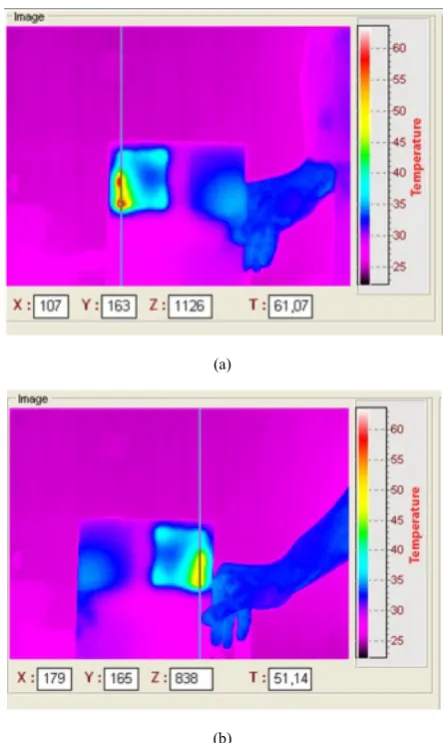
Figure 3. Thermograms of the front (a) and back (b) sides of a solar panel section that was fixed to a construction plate with the developed glue of a high temperature conduction
Offered in our works is a conception of new technology for production of solar panels, which provides a high level of heat removal from these batteries operating under intense solar radiation. Using the methods of thermal image thermography, it was shown that application of new materials and technologies allows efficient heat removal from silicon elements that are inclined to degradation at temperatures above 80 °С.
Simultaneously, the offered technical solutions lower mechanical strains in silicon convertors of solar energy. As known, diffusion processes are enhanced in mechanical strain fields, therefore heat removal and weakening the mechanical strains have a positive effect on efficiency and durability of silicon solar panels.
Using the infrared imager, we obtained thermograms both from front and back sides of two solar panel sections (Fig. 3,
4). Tested in our experiments were batteries of two different manufacturing technologies. In the first case, the tested section was fixed with its back side to a construction plate by using ordinary epoxy glue, and in the second – with specially developed glue possessing high temperature conduction.
(a)
(b)
Figure 4. Thermograms of the front (a) and back (b) sides of a solar panel section that was fixed to a construction plate with ordinary epoxy glue
The results of thermographical investigations showed that usage of high-thermal-conduction glue allows:
1. To lower the temperature of the silicon plate front face from 61.07 down to 45.17 °С, i.e., by 15.9°С, which equals 26%.
2. To lower the temperature of the silicon plate back face from 51.14°С down to 42.41°С, i.e., by 8.73°С, which equals 17%.
3. To lower the temperature drop between front and back faces (and, consequently, mechanical strains) from 9.93 °С in the case of standard technology down to 2.76°С, i.e., by 7.17°С, which equals 72%. 4. Besides, it can be seen visually that application of
[image:4.595.66.289.140.512.2]offer new constructions of solar panels, which provides both intense heat removal and lowering the mechanical strains in silicon convertors of solar energy.
We also studied the influence of surface vacuum nano-coatings made of chromium on the possibility of glue joining the parts of Teflon. As known, combination of fluoroplastic parts is a complex problem, which is related with that known glues do not possess sufficient adhesive capability to the surface of this material. It was experimentally ascertained that deposition of the chromium vacuum coating with the thickness 50 to 100 nm modifies the surface of Teflon and enables to use traditional glues for combining parts processed in this way.
4. Conclusions
The performed investigations have shown the following promising tendencies in technologies for joining materials used in precision techniques:
1. In the case of ZERODUR and silica surfaces, using the method of IR spectroscopy with the MFTIR facility, it was found chemical interaction of the silicon-organic epoxy glue with the surface of joined parts, as a result of which the modified glue nano-layer is formed.
2. Removal of the damaged surface layer by chemical etching the joined surfaces allows, in dependence on sizes and shape, 1.5- up to 6-fold enhancing both durability of the very part and glue conjunction between it and parts of other materials.
3. To modify properties of silicon-organic epoxy glue not only near the surface of combined parts but over the whole thickness of the glue joint, offered have been glue compositions based on thermostable silicon-organic glue with embedded in it filler in the form of powder consisting of nano-dimensional (15 to 20 nm) particles of zirconium oxide in the amount up to 20 mass. %.
4. The developed diamond-glue composition enables to shorten the duration of cooling the glue conjunction leucosapphire-copper to cryogenic temperature
(from the room one down to 80 K) by 1.5 times and obtain the 6-fold increased durability, as well as higher reliability and longevity under thermal shocks. This composition is also recommended to provide efficient and uniform heat removal in solar panels. 5. Deposition of the chromium vacuum coating with
the thickness 50 to 100 nm modifies the Teflon surface and allows using the traditional glues for joining the parts processed in this way.
REFERENCES
[1] E. Beyer, U. Füssel. Innovative joining technologies clustered know-how in Dresden Fraunhofer institute for material and beam technology IWS. [Online]. Available: www.iws.fraunhofer.de/en.
[2] V. Maslov. Unknown properties of aluminum nano-layer in unglue assemblage of ZERODUR parts, American Journal of Nanoscience and Nanotechnology, Vol. 1, 70 – 73.
[3] P. R. Yoder, Jr. Mounting. Optics in Optical Instruments, SPIE PRESS., Order #110, 589, 2002.
[4] Yuzhe Ding, Shaun Garland, Michael Howland, Alexander Revzin, Tingrui Pan. Universal Nanopatternable Interfacial Bonding, Advanced Materials, Vol. 23, 5551–5556, 2011. [5] V.P. Alyokhin. Physics of durability and plasticity of
materials surface layers, Nauka, Moscow, 1983.
[6] J.J.Gilman. Unified viewpoint on the flow mechanisms in materials. Physics of durability and plasticity, “Metallurgiya”, Moscow, 1972.
[7] J.J. Gilman. Micromechanics of Flow in Slids, McGraw-Hill Book Company, New York, USA, 1969.
[8] V.A. Likhachyov, V.Ye. Shudegov. Disclination model of the silica glass structure, Fizika i khimiya stekla, Vol. 15, p. 508 – 510, 1989.
[9] V. P. Maslov. New Approach to Durability of Glass-ceramics and Silicate Glass, International Journal of Materials Science,