SAM1KON
The ancient fortress of Samikon stands on the westernmost spur of Smerna, a long and irregular mountain ridge that stretches about twenty kilometers from the coast of Triphylia into the interior. This ridge, Mount Kaiapha just to the south, and the foothills on either side form a massive wall of mountains, penetrable fiom north to south only by way of the coastal plain, which here contracts to a narrow defile, barely more than a road's width, between Samikon on the one hand and impassable lagoons on the other. This plain extends as far as the River Alpheus on the north and, on the south, to the River Neda. On the west it is bounded by the Ionian Sea. Around and to the north of Samikon, its western margin is irregularly fringed with laooons, which, just south of Samikon, at Kaiapha, are swollen into a lake by the waters of the River Mavropotami (Anigros). This lake did not exist in ancient times; 1 in other respects, however, the topography of the region is essentially un- changed.2
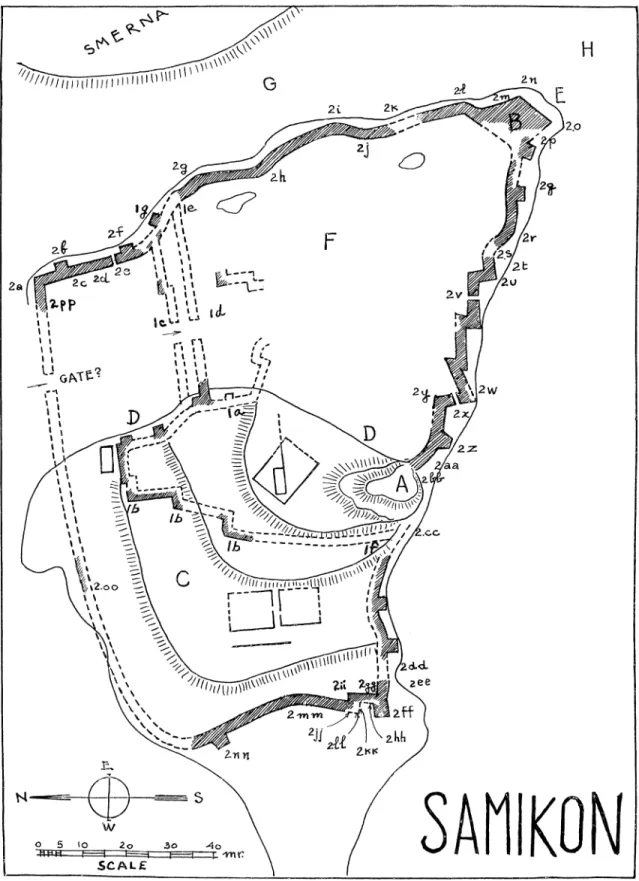
Strategic keys to this rich and verdant land are Lepreon (modern Strovitsi) and Sami- kon. Small wonder, then, that Sarnikon was fortified from time immemorial. It is, indeed, excellently adapted to serve as an acropolis. Its summit is roughly quadrilateral in shape. Its eastern side is separated from the main ridge of Smerna by a ravine (G on Plan, Fig. 1),3
rather shallow, to be sure, but sufficiently craggy to impede approach to the summit. On the south the citadel is defended by precipitous cliffs; on the west it slopes more gradually into a long arm that finally drops with abruptness into the plain close to a small hill, Kleidi. The northern ascent is least precipitous; and doubtless the mnain entrance was always here, although even this side is steep enough to preclude easy access. The surface of the spacious
1 The presence of submerged buildings in the lake pioves that at one time the banks of thie Anigros
here were diy enough to be }abitable. Strabo, viii, 3, 19 (346), inenitions only anamash benieath the caves of the Ainigriad nymplhs, although even in his day a lake had beguni to form ia-i vdCv). Pauisanias, v, 5, 7, refers to the overfloving of the Anigros as only a periodic octcurrence, caused by storms. Moreovel, in hiis age the caves, nowv accessible-only by boat, were apparently still open to pilgiiins on foot; and in front of thetn lay, not a lake, but only a river (7CoTcY6v), which the ambitious leper lhad to switn as the finial
stage of his cure (Pausanias, v, 5, 11). Partsch rightly attribtites the formation of the lake to a subsidence of the river's banjks (in Olympia, Die Ergebnisse, 1, p. 14), D&pfeld to a rise of the sea-level (Ath. Mitt., XXXVIII, 1913, P. 110).
2 The best mn.ap of Triphlylia is the one by K. Graefinghoff in Ath. iitt., XXXVIII, 1913, pl. IV. 3 All letters and iiutnbers in the following description, unless otherwise designated, refer to the Plan,
Fig. 1. For the reproduiction of the Plan and the sketches of architectural details (Figs. 12, 13, 14, 18), I am indebted to tlle kindness of Mlr. John T'lravlos, of the Agora staff.
American School of Classical Studies at Athens is collaborating with JSTOR to digitize, preserve, and extend access to
Hesperia
I
Li
N>Nzat---tt\0 -\ \\\\
X lt R jts2.o \ C .cC 2
A
<
z
zeeZeg 2lh ) l
'Z:~ ~~Zn
Lb
-
-s~~~~~~?-n-
w
o 5 0o 2 30 Ao
SCAiLE o (
SAMIKON 527
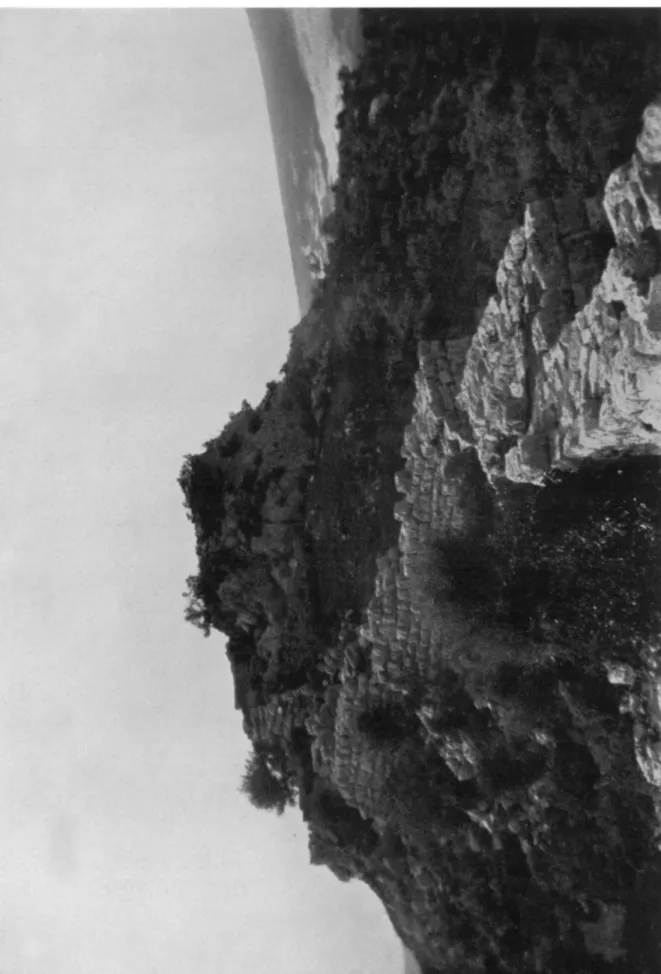
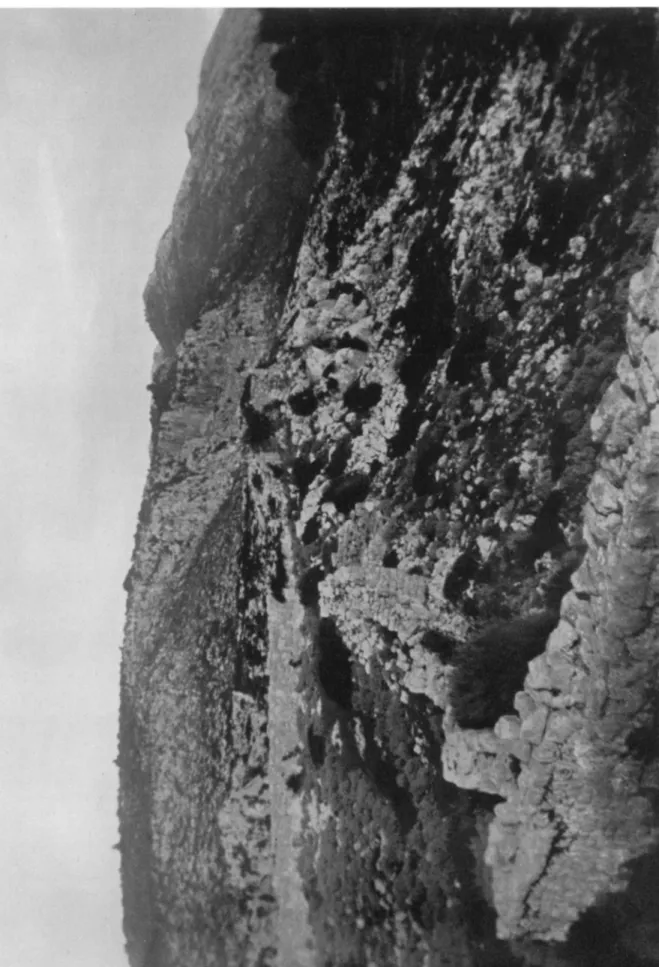
area enclosed within these bounding slopes is very irregular. Two elevations (Fig. 2 and 3), one on the southern side (A), the other at the southeastern angle (B) of the quadrilateral, are the highest points. Between them, occupying the eastern half of the citadel, lies the fold of a well-defined hollow (F), sloping downward from south to north. The remainder of the summit consists of the long and gradual northern and western slopes of the central crag (A), a steady declivity broken up into five concentric terraces (C). This terraced bluff is separated from the eastern hollow (F) by a steep slope (D) which towards the north becomes an abrupt cliff.
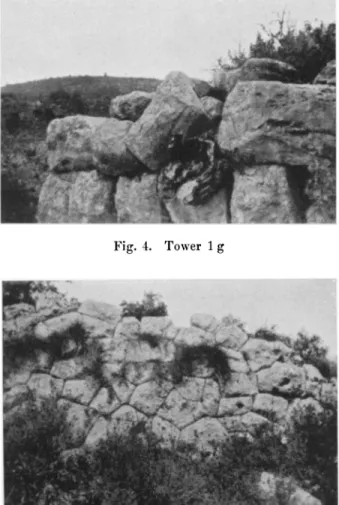
This natural acropolis bears numerous terrace walls, a few traceable foundations, and fortifications of surpassing strength and beauty. That it was once-though probably not before the eighth or seventh century B.C.1-the site of a considerable settlement is attested, not only by the literary evidence,2 but especially by the great number of sherds in which its summit abounds. Of the visible ruins, best preserved and most important are the forti- fications. The earliest of these is a line of wall (1), constructed of almost rectangular poly- gonal blocks, which is traceable in fragments along the northern and western slopes of the bluff (C) and in the hollow (F). Its blocks, though hewn of the same hard, gray limestone as those of the later and better preserved fortification 2, are smaller than the latter, are more nearly plumb in their lines of vertical jointure, and have a ruder, flatter face. On the southern and eastern sides, this earlier wall has been everywhere supplanted by the later except at Tower 1 g, which, although utilized as part of the later fortification, exhibits the technique of Wall 1 (Fig. 4). The slight projection of this tower from its adjacent wall and its undue nearness to Tower 2 f likewise show that it is alien to Wall 2. In style, Wall 1 is analogous to the main wall at Epion (modern Platiana), to the upper wall at Lepreon, and to the early wall on the summit of Mount Ithome. Its nearest parallels in Attica are a group of archaic terrace walls at Eleusis.3 It is to be dated before the sixth century B.C.
The title of Samikon to fame rests, however, not on the sporadic remnants of this early bulwark, but on the well preserved and magnificently constructed wall which superseded it. Still standing to a height of five to twelve courses on all sides save the northern, this wall (2) presents a startling example of developed polygonal masonry. It is not, however, built in the extreme or jagged-lined polygonal form, like the older wall at Oiniadai (Fig. 5)4
1 D6rpfeld, Ath. Mitt., XXXIII, 1908, p. 322: "... Auch sind bisher innerhalb der Ringmauer von uns nur spiitere griechische Vasenscherben und Dachziegel gefunden worden. Wir haben also kein Recht, an der Stelle des hoch gelegenen Samikon selbst eine vorhistorische Ansiedelung anzunehmen ..." The nearest prehistoric settlement, the Homeric Arene, was situated, not on Samikon, but upon the low hill, Kleidi, wlhich rises between Samikon and the sea (D6rpfeld, Ath. Mitt., XXXIII, 1908, pp. 320-322; XXXVIII, 1913, pp. 1 11t-114).
2 Strabo, viii, 3, 19 (346); Pausanias, v, 6, 1.
Wrede, Attische Mauern, pls. 4-8.
-
.: r
F W i . : i = i_
.... ;. 4 ^''; *.' _I _m
i ' L = | s 11 | I I l s
1- F tg. ' -'*'2awa i # # | ! I w .: ... . .:
_ l I | ...
1
.' I |_
11 | r.
: .
__E _ '
I l __'l-
ffi . b _ _
fl '-'.: . ' u;
_ ie
u S i i i i M :d
l
I B i -' S
; ' ' -' _=
-_ w
+ _v Z I
i' h^#-
X f .^+ .. /tt ' ^
__S
* at;
4z
41
A4
tW-
AW
Af
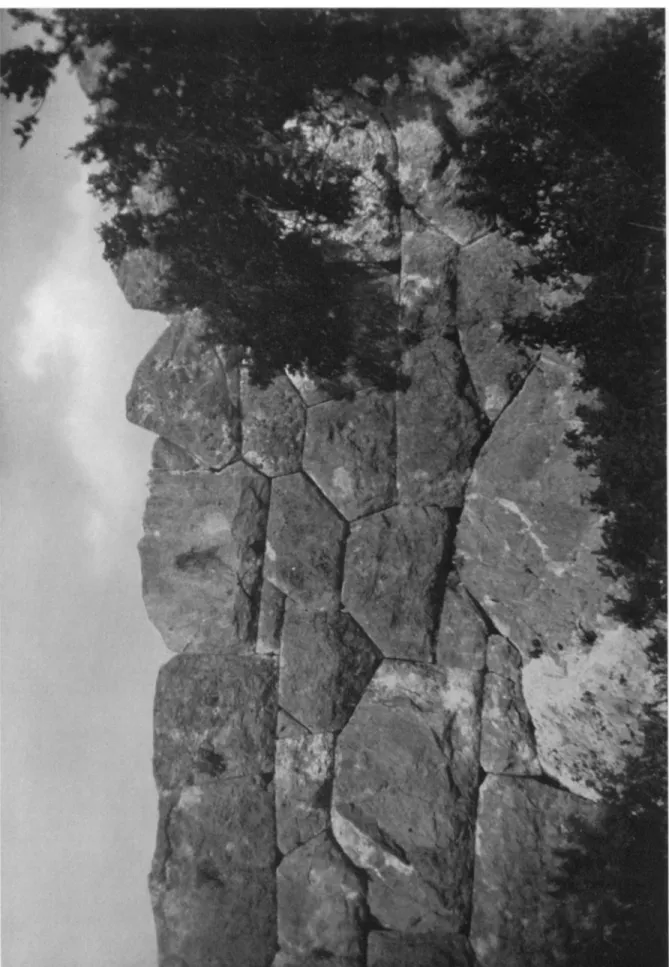
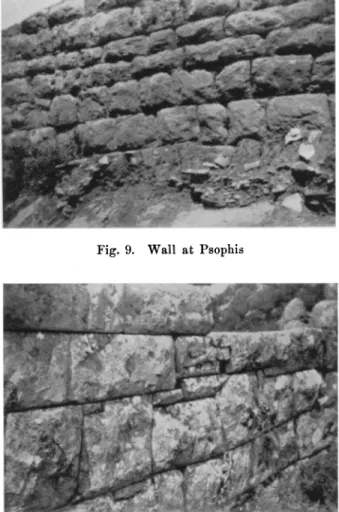
or the upper (earlier) wall at Paravola (Fig. 6),' but is an advanced expression of a related type, the nearly rectangu- lar polygonal (Fig. 7), also called the semipolygonal, pseudo-polygonal, or quasi-polygonal. This style is distin- guished from the extreme polygonal by a closer approach to rectangular shaping of its blocks. That in Western Greece it was not merely a recent de- velopment either of the extreme poly- gonal or of the true rectangular is demonstrated by its use in the walls of Epion (main wall), Lepreon (upper wall), Mount Ithome (early wall), Kal- logria,2 Kalydon, and Stratos, all of which are prior to the fifth century i]3.c. Rather, it had its own evolution as an independent type. It became more popular for military construction than the extreme polygonal because its blocks, being miore regularly shaped, were more easily joined. On the other liand, it was preferred to the true rect- angular because its blocks required less careful shaping and their poly- gonal edges locked together more strongly-and strength is, of course, the primary requisite in a fortification. It is a very flexible style: some of its examples (as the later wall at Oiniadai, Fig. 8) show rather irregular shapes; in others (as at Psophis, Fig. 9) the
/1iS
Fig. 4. Tower 1 g
Fig. 5. Earlier Wall at Oiniadai
Fig. 6. Upper (Earlier) Wall at Paravola
IThe ancient name of this Aitolian site is uinknown. Phytaios, Metapa, and Boukation have been suggested. Woodhouise prefers the last (Aetolia, p. 196).
.:M.Lj, :
5~~~$.
P"M."~~~ff
5w'.~~ffs
?NT!,~~~~~~~~~~~~~~~~~f
Sl
' _111 |~~~~~~~~~~~~~~~~~~~~~~SAn
1 E i
Mr;ei
F
- t
l
k~~~~~~~~~~~~~~~~~~~~~~~~~~~~~5
l
-~~~~~~~~~~~~1
k
lines are almost as truly vertical anid horizontal as in a wall of rectangular construction.' The rhythm at Samikon is not so polygonal as in the later wall at Oiniadai nor yet so nearly rectan- gular as, for example, at Psophis, Ithome (Epaminondean Wall), Para- vola (later wall, Fig. 10), or New Pleuron (Fig. 11).
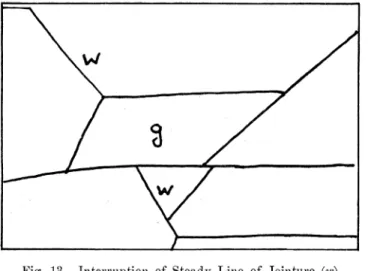
The individual blocks at Samikon are joined with a scrupulous nicety. Every edge is cut straight and true. No small, irregular stones are used here to plug the gaps between the main blocks; such gaps are filled only with triangular stones, perfectly fitted with apex downward, or, more rarely, with stones of quadrilateral shape. Sometimes a stop-gap is compounded of two separate stones (Fig. 12), or, conversely, acts like a larger block to break a steady line of jointure (Fig. 13). Seldom are triangular and quadrilateral plugs inserted in the same gap (Fig. 14). Among the main wall-blocks at Samikon the favorite shape is the pentagon; quadrilateral blocks are almost as common; hexa- gons are not infrequent; but other forms are very rare. In this respect Samikon and the later wall at Oiniadai differ from the majority of their type, in which the quadrilateral is master.2
4 V1%~~~~~~~~~~~' 1
Fig. 8. Western (Later) Wall at Oiniadai
1. V~~~~~~~~~~~~~~~~~~~.
Fig. 9. Wall at Psophis.
;4?
Fig. 10. Lower (Later) Wall at Paravola
I Compare also, for example, the varyinig regularity of line in the archaic terrace walls of this style at Eleusis (Wrede, op. cit., pls. 3-9) and the similar variation in the later, rusti-
cated semipolygonal (ibid., pls. 74-113).
2 For example, at Epion (main wall),
SAMIKON 533 These main blocks are joined together
as neatly as the stop-gaps; even the lowest course is adjusted to the bed- rock with extreme nicety (Fig. 7). This perfection of jointure (which distinguishes also the best examples of the absolute polygonal style) is at- tained only through the working of the joint-surfaces of the blocks to an exact level. These surfaces are, however, never completely smoothed, but are left slightly rough for the sake of tighter cohesion. The builders of Samikon went farther still: they often cut away
* t a 4 ' f>
Fig. 11. Wall at New Pleuilon
the back part' of the top joint-surface of a block so as better to lock in the block placed upon it. Elsewhere in Western Greece this feature is extremely rare.2 Another aid to cohesion in the foremost examples of the semi-polygonal style is the care taken that no two vertical or nearly vertical joints shall be in direct contact. The outer and inner facings of the wall, thus composed with artistic cohesion, are at Samikon, as in all well constructed fortifications, bound to the fill by a slight batter, by the use of blocks of varying thickness in the facings (the thicker blocks being locked in by the weight of the fill upon their inner ends), and by careful fitting of the fill into the nooks and crannies of the facing-blocks. Additional strength is gained at Ithome (Epaminondean Wall), Kalydon, Oiniadai (later wall), and New Pleuron by the regular use, in the facing, of unusually thick blocks which act like pegs to bind the facing tightly to the fill; rarely, as at Kalydon and at Oiniadai (later wall), these binding blocks extend
Fig. 12. Triangular Stop-gap Compounded of Two Smaller Stop gaps
through the whole thickness of the wall. The fill at Samikon, as at Ithome (EpaminondeanWall), Kaly- don, and New Pleuron, consists of small rocks; often somewhat larger rocks are employed, as at Epion (main wall), Lepreon (upper wall), Stratos, and Oiniadai (earlier wall -Fig. 15).
1 That is, the part which, wlhen the block was set in place, would lie toward the core of the wall.
2 It occurs only at Lepreon (upper
wall) and Oiniadai (later wall).
\w/
\4
Fig. 13. Interruption of Steady Line of Jointure (w) by Stop-gap (g)
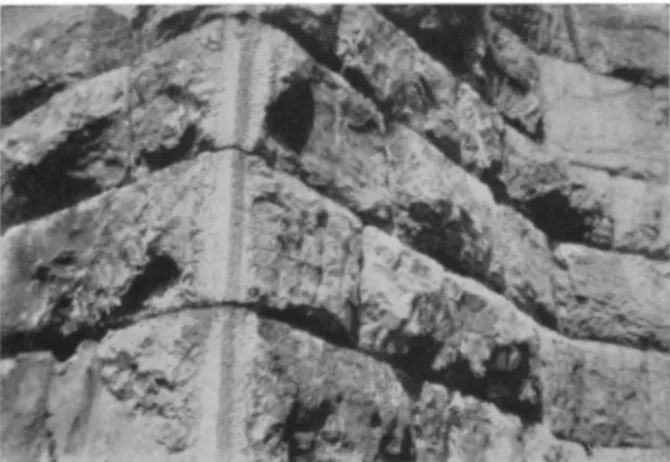
The exterior faces of the blocks at Samikon are rusticated with a beautiful, elliptical bulge, quite dif- ferent from the flatter finish of the facings at Epion (main wall), Le- preon (upper wall), Ithome (Epa- minondeanWall), Psophis, Paravola, and New Pleuron, and from the un- couth roughne.ss of Kallogria, Kaly- don, and Stratos. One must look to the later wall at Oiniadai for the closest resemblance to the undulat- ing surface of the facing at Samikon. This rustication is at Samikon more uniformly and consistently executed than at any other of the sites in Western Greece except Ithome and New Pleuron: even towers, angles, and bends display the same painstaking elaboration. Some, but not all, of the towers have corners finely drafted like the towers of Epion (added wall), Ithome (Epa- minondean Wall), Oiniadai (later wall), Paravola (later wall), and especially New Pleuron (Fig. 16). Here, as elsewhere, bends and angles are less consistently treated than the towers: sometimes they are drafted, more often not.
These are the chief technical niceties which, consistently and skillfully executed, make the wall of Samikon a model of sophistication and charm, fully the peer of the most highly developed Aitolian work. Both the fundamental elements of beauty- symmetry and variety-are evi-
dent in its structure and finish. Many are the travelers who have admired its graceful art. Leake reported it as "a beauti- ful specimen of the second (that is, well fitted polygonal) order of Hellenic masonry." 1 Curtius called it "die bedeutendsten dieser Art in ganz Elis." 2 To
Frazer's mind Samikon presented "perhaps the finest extant speci- men of ancient Greek polygonal
Fig. 14. Insertion of Triangular and Quadrilateral Plugs in Same Gap
T
Tr-avels in the Morea, I, p. 53.
SAMIKON 535.
masonry." 1 Nor is its plan less artistic than its construction: its vulnerable points are well defended by ten pre- served towers of varying projection, sixteen preserved angles, and eleven preserved bends. In its combination of tower with angle it resembles the later wall at Oiniadai, whereas at Epion (main wall), Lepreon (upper wall), Ithome (Epaminondean Wall), and New Pleuron towers alone are utilized. Two of the three rather narrow postern gates at Samikon are protected by a tower or angle set on the right (that
: A
~~M7
Fig. 13. Fill of Earlier Wall at Oiniadai
is, unshielded) side of the potential assailant. One tower in particular, 2 z, is unique in plan: it is strengthened at the base by a slanting buttress, a feature extremely rare in ancient Greek and Roman fortifications (Fig. 17). Elsewhere this device is employed only in the so-called pyramids of Kenchreai and Ligourio,2 in the walls of Chaironeia, at Selinous (Sicily), and in a Sullan fortification near Florence (Italy).3
The date of this elaborate and beautiful fortification, as of the other walls at Samikon, can be determined only from stylistic grounds; for its erection is nowhere recorded in ancient literature, and decisive archaeological evidence remains to be unearthed. Its closest par- allels in Attica are the terrace wall of a sanctuary at Eleusis, dated conjecturally by Wrede at the beginning of the fifth century B.C.,4 the south wall of the Asklepieion at Athens, dated
conjecturally at 420 B.C.,5 and the supporting walls of two cemetery lots near Vari,6 which,
because of their artistic construction, cannot be anterior to 500 B.C. or posterior to 300 B.C.
In the first and second of these walls are manifest the same hair-fine lines
Fig. 16. Drafted Corner of a Tower at Newrl Pleuron
I Pausanias's Descriptiont of Gr eece, IIl,
p. 480.
2 Compare Wiegand, Ath. Mitt., XXVI,
1901, pp. 2411 246, especially p. 245.
3 An approach to the slanting buttress is found in the later wall at Oiniadai. There, at one poinlt, the cliff is worked in a sliglht slaint up to the bottom of the first course; but the wall above is absolutely vertical, and there is Ino consciotus joining of blocks in the form of a buttress as at Samikon.
4 Wrede, op. cit., pls. 24-25 and p. 10. 5 ibid., pl. 74.
of jointure and, in the first, the same cunningly fitted triangular stop-gaps as at Samikon; but. the rustication of both is somewhat less prominent. The supporting walls at Vari, which are of fifth rather than of fourth century construction, exhibit far greater likeness to Samikon: they are similar to Samikon, not only in the sizes and shapes of their blocks and in their carefully bevelled lines of jointure, but likewise in their prominent rustication. More distant cousins of Samikon than these are the walls of the same style constructed in the fourth century B.C.1 Despite their general similarity to Samikon, they are significantly
different in their closer approximation to rectangular shaping of their blocks, and in their flatter, often ornately striated, rustication. Toward the end of the century they begin to show, in addition to these differences, a looseness of construction and an
Fig. 17. Samikon: Slanting Btittress at Tower 2z
affectedness indicative of degeneration. At Corinth, too, the fourth century fortifications of Acrocorinth,2 while representative of the same semi-polygonal style as Samikon, betray the technique of a later age in their greater fidelity to thoroughgoing horizontal courses and in their less prominent rustication. In general, they resemble the Epaminondean Wall at Ithome more closely than Samikon.
In Western Greece, the main wall at Epion, the upper wall at Lepreon, the Epaminondean Wall at Ithome, and, north of the Gulf of Patras, the walls of Kalydon, Stratos, Oiniadai (later wall), and New Pleuron closely resemble Samikon. Of these fortifi- catioits, Ithome (369 B.c.) 3 and New Pleuron (235 B.C.) 4
display a later art than Samikon: though technically expressive of the same semi-polygonal style, they ex- hibit a more nearly rectangular shaping of their blocks
and stop-gaps, they are less prominently rusticated, and their facings are bound into the fill by long, peg-like blocks extending almost, and often completely, through the horizontal thickness of the wall.5 In plan, too, Ithome and New Pleuron are more advanced than Samikon: their use of fully developed, hollow towers alone instead of a combination of solid towers, angles, and bends, and their wider posterns betoken a later origin. Finally,
I Wiede, op. cit., pls. 77-103. The walls of Phyle, also, though nlot rusticated, express in other respects the same style (Wrede, op. cit., pls. 66-67).
2 Carpenter, The Classical Fortifications of Acrocorinth, in Corinth, III, ii, pp. 1-43, especially pp. 8-16.
3 Diodoios, xv, 66.
4On the date of New Pleuron, see Droysen, Geschichte der Epigonen, II, p. 36; Woodhouse, Aetolia, pp. 124-125.
SAMIKON 537 the occurrence of the slanting buttress I at Samikon. is, in all likelihood, another sign that it antedates the year 369 B.C. Of the other examples of this device, the date of the walls'
at Chaironeia is unknown; but the so-called pyramids at Kenchreai and Ligourio are probably prior to 500 B.C.,2 the east redan-buttress of Selinous is dated at 580 B.C., and
the other slanting buttresses found there are re'buildings on earlier lines by Hermokrates in 409 B.C.3 On the other hand, Samikon is shown to be later than Epion and Lepreon
(both anterior to 600 B.C.) or Kalydon and Stratos (both anterior to 500 B.C.) by its superior finish as expressed in its finely rusticated facings, in its carefully bevelled joint- edges, and in the drafted corners of some of its towers.
Closest resemblance of all to Samikon is shown by the later of the two walls at Oiniadai. In almost every point this beautiful wall matches Samikon; the minor differences between them denote merely that Samikon is of slightly later technique. The style and plan of the wall at Oiniadai indicate that it was added to the earlier fortifi- cation of extreme polygonal ma- sonry in the fifth century B. c.,
perhaps during the First Pelopon- nesian War (465-445) as an ad- ditional safeguard against Athenian aggression. In view of this and the foregoing comparisons, it may
a~~~~1 AXh0
n
k...-
~
~
-Fig. 18. Facings of Samikon (Wall 2) and Ithome (Epaminondean Wall) compared
be concluded that the main wall at Samikon was probably constructed in the latter half of the fifth century B.C. It may well have been built by the Eleans after their conquest,
about 450 B.C., of all central and southern Triphylia except Lepreon.5 The more ancient
Wall 1 had, by that time, doubtless become so dilapidated that a thorough reconstruction
'
See above, p. 535.
4 2 Wiegand, Ath. Mitt., XXVI, 1901, pp. 241-246, would date the so-called pyramid at Kenchreali in or
after the first century n.c. The mortar, however, on which primarily he bases his conclusion, may well be a late addition, while the construction favors a far earlier date.
3 Htlot and Fougeres, Selinonte, pp. 145-150; pp. 166 -190.
4 If, as is probable, these walls were erected by the Minyani founders of Epion and Lepreon (Herodotos,
iv, 148, 4).
5 Herodotos, iv, 148, 4: wovr.?wv Jt (namely, Lepreon, Makistos, Phrixai, Pyrgos, Epion, and Noudion) w&;
and replacement were necessary. This the Eleans would be quick to undertake, for a strong position at Samikon was not only essential for the protection of their new southern frontier, but also an ideal eyrie from which to swoop in forays against recalcitrant Lepreon.'
1 It has been costumary to date the main wall of Samikon in a far earlier period. The use of projecting and reentrant angles instead of towers prompted Leake, Travels in the Moreca, I, 53, CurtiLis, Peloponnesos, IT, 78-79, and Frazer, Pausanias's Deseription of Greece, Note on Pausanias v, 6, to the belief that the fortress is the product of a remote antiquity. Leake and Frazer seek to explain the towers as late additions to the wall; but they do not explain how it happens that wall and towers are homogeneous in style and material, and are integrally knitted together. The truth is that tlhis archaic use of angles in so many places for towers was at Samikon occasioned simply by strict adherence to the plan of the earlier Wall I (overlooked by previous investigators), which, as the survival of Tower 1 f shows, had not been utterly destroyed. Curtius cites two other alleged indications of antiquity: the occasional utilization of the bed-rock as the lowest course, so to speak, of the wall, and the narrowness of the postern gates. Yet the former feature expresses, on the contrary, a rather advanced stage of art, and the latter, while a sign of antiquity, is not limited to pre-classical fortifications. Beule, ?tudes sur le P loponnese, p. 187, laboring under the illusion that only ashlar walls belong to the Classical Period, goes so far as to consider Samikon scarcely posterior to Mycenae t Dotrpfeld, Ath. Mitt., XXXIII, 1908, p. 322, rightly protests against this nonsense: "Es mnag zum Schlusse hinzugefdigt werden, daB3 die schonen Ringmauern von Samikon, die auf groBe Strecken hin noch mehrere Meter hoch erhalten sind, alle erst aus klassischer Zeit zn stammen scheinen. Kein Stuck der Mauer zeigt den kyklopischen Steinverband mnit unbearbeiteten B1ocken. Auch sind bisher innerhalb der Ringmauer von uns nur spdtere griechische Vasenscherben und Dachziegel gefunden worden. Wir haben also kein Recht, an der Stelle des hoch gelegenen Samikon selbst eine vorhistorische Ansiedelunlg anzunehmen . . ." Fougeres, Guide Bletu, Grece, p. 366 (1932 edition), swerves to the opposite extreme in regarding the walls of Sarnikon as Elean constructions of the fourth century s.c., but gives no reasons for this view.