Introducing a Distance Vector Routing Protocol
for ns-3 Simulator
Janaka Wijekoon
Hiroaki Nishi Laboratory, KeioUniversity, Japan
[email protected]
Rajitha Tennekoon
Hiroaki Nishi Laboratory, KeioUniversity, Japan
[email protected]
Erwin Harahap
Hiroaki Nishi Laboratory, KeioUniversity, Japan
[email protected]
Hiroaki Nishi
Dept. of Systems Design Engineering Keio Univ.
[email protected]
ABSTRACT
In network research, network simulators have been shown to be useful for testing and changing network protocols by means of a controlled manner. As an Internet systems simulator, ns-3 simula-tor provides an ideal simulation environment for network research. However, ns-3 is lack of table-driven IPv4 routing modules. De-spite the fact that a routing protocol is a mandatory component of a network, it is necessary to introduce a table-driven routing proto-col for the ns-3 which is able to maintain the network connectivity and consistency. To this end, we introduce a distance vector IPv4 wired routing protocol for the ns-3 simulator (DVRP). The propos-ing protocol is developed as a table-driven wired routpropos-ing protocol. In this study, we describe the proposing routing protocol, including its design, implementation, behavior on networks, and limitations.
Categories and Subject Descriptors
C.2.6 [Internetworking]: Routers; C.2.2 [Network Protocols]: Routing Protocols
General Terms
Algorithms, Design
Keywords
ns-3, routing protocol, distance vector routing, network simulation, wired routing protocols.
1.
INTRODUCTION
Network researchers must test and evaluate numerous network protocols in controlled environments to determine whether such protocols are robust and reliable. Because the Internet is the largest production-scale network, it is impractical to conduct controlled experiments directly on the Internet. Therefore, simulation
soft-.
ware is a vital tool in developing, testing, debugging, and evalu-ating network protocols. Nevertheless, simulation software should be able to simulate a particular network’s behavior and, should be able to provide analysis tools to evaluate results. In the study of [3], Carniro et al. stated that the ns-2 [8] is the most used simulator among network researchers. As the successor of the ns-2 simula-tor [8], the ns-3 simulasimula-tor [21] was introduced for more realistic simulations of network protocols.
The ns-3 simulator [21] is a discrete-event simulator, and was proposed as the eventual replacement of the ns-2 simula-tor [8]. The ns-3 simulasimula-tor usesns3::NetDevicesto connect ns-3::Nodes, because thens3::NetDevicesemulate physical network cards and thens-3::NetDevicespossess both 3 IP and Layer-2 MAC addresses. Twons3::NetDevicesare connected using an ns3::Channel, which represents a network communication medium (wired or wireless links) [20]. Furthermore, ns-3 supports most generic real-world packet structures, and the packets are serialized and de-serialized as they traverse the network stack [3]. In addi-tion, ns-3 supports both IPv4 and IPv6 addressing schemes. These features make ns-3 simulator an ideal simulator, which provides a more realistic and real-world-like simulation environment [19, 20]. Despite its advantages, ns-3 is still a new simulator and new models are currently being developed and incorporated into ns-3 distributions [5,16–18,23,25,26,28]. Because ns-3 was introduced to simulate real-network-like simulations, ns-3 must support rout-ing protocols for realistic evaluations of networks. A routrout-ing proto-col is necessary to maintain routes despite changes in network con-nections [7, 13]. In [2], Brakmo et al. theorized that most practical networks exhibit extremely complex behavior because of: 1) suit-able protocol interaction, 2) complicated network topologies, and 3) complex traffic patterns. Moreover, according to [2,6,7,9,13,26], a routing protocol is directly related to the performance of a net-work. However, thus far, ns-3 does not comply with any Ipv4 wired routing protocol modules. This limitation limits the ability to sim-ulate and analyze network topologies such as CDNs [22, 27] on the ns-3 simulator.
To this end, in this study, we present the design and implemen-tation of a table-driven IPv4 wired routing protocol for ns-3. The proposing protocol is developed as a distance vector routing pro-tocol (DVRP) based on RFC 1058 [14] and RFC 2080 [11]. The DVRP uses some vital functions of the aforementioned RFCs to route and neighbor management. The ns-3 DVRP module supports: 1) neighbor discovery and management, 2) shortest path calcula-tion based on the number of hops to a particular destinacalcula-tion, 3) route management including processing periodic and triggered
up-SIMUTOOLS 2015, August 24-26, Athens, Greece Copyright © 2015 ICST
Figure 1: DVRP Class Diagram
date messages, and 4) per-node packet buffering to support consis-tent packet delivery. We compared the DVRP module with existing ns-3 IPv4 routing protocols and herein discuss the results.
The remainder of the paper is structured as follows. Section 2 explains the existing routing protocols implemented in ns-3. Sec-tion 3 describes the design of DVRP module. SecSec-tion 4 provides the evaluation details of the proposed method. Section 5 concludes the study and suggests future studies.
2.
EXISTING
NS-3
ROUTING
PROTO-COLS
The infrastructure of ns-3 and its design are intended to support both Ipv4 and Ipv6 routing protocols. ns-3 supports open source routing implementations and also facilitates research into novel routing techniques [5, 20, 21, 25]. Furthermore, ns-3 provides Di-rect Code Execution (DCE), which is a framework for ns-3 that provides environment to execute existing implementations (e.g., network protocols, applications and user-space protocols) without source code changes.
Literature reveals that the ns-3 simulator is popular among re-searchers who are experimenting on wireless mobile ad hoc net-works (MANET) [15]. Consequently, with in recent years, several wireless routing protocols such as DSR [5], DSDV [18], AODV [18], and OLSR [1], have been introduced and tested on ns-3. Fur-thermore, the ns-3 is used by numerous researches to compare wire-less routing protocols (e.g., compare OLSR and DSDV Protocols in a VANET Scenarios) [24].
When considering LAN/WAN implementations on the ns-3, in [17], Ashok Kumar et al. proposed ns-3 to simulate various archi-tectures of data center networks, including both wired and wireless topologies. In [16], Junseok Kim argued that AODV is a proactive table-driven routing protocol, and its link usage is comparatively high. As a solution, they proposed a simple reactive on-demand
routing protocol for Wi-Fi access points. However, thus far ns-3 is lack of wired routing protocol implementations. ns-3 only consist of reacting on-demand routing protocols [5, 6] (See Section 2.1).
2.1
Existing ns-3 wired routing protocols
The ns-3 simulator [21] essentially introduces three IPv4 con-nectivity methods for wired network simulations: 1) default/static Ipv4 routing protocol [20], 2) IPv4 global routing protocol [20] and, 3) IPv4 NIX-vector routing protocol [19]. These three rout-ing protocols are reactive on-demand routrout-ing protocols [5, 6] IPv4 global and IPv4 NIX-vector routing protocols maintain per-node routing tables. However, those routing tables are built by ana-lyzing the total topology only once at the beginning of a simula-tion [19,20] and thus, both these protocols do not use a route adver-tisements to maintain up-to-date routing tables based on changes to a network topology. Besides, by using these packet forwarding methods, the ns-3 simulator can send packets between two nodes. Yet, simulate and analyze real networks such as a CDN [21] on the ns-3 simulator is impossible and thus represents a limitation for this simulator.
2.1.1
Default / Static Routing Module
The ns-3 simulator uses thens3::IPv4StaticRoutingmodule as the basic connectivity method of small networks [20]. However, static routing is not a practical solution for route management on medium and large-scale networks [7].
2.1.2
Global Routing Module
for a particular destination. Therefore, packets might reach their destinations through a long distance path. In addition, a global routing module does not employ route update messages to maintain an up-to-date routing table according to the network changes.
2.1.3
NIX-Vector Routing Module
The ns3::Ipv4NixVectorRouting performs on-demand route computation using a breadth-first search and efficient route-storage data structure known as a NIX-vector [19]. When a packet is gener-ated at the packet generation node, theIpv4NixVectorRouting mod-ule first calculates the destination route. The created route is then stored in an NIX-vector which is attached to the generated packet. Routers use the NIX-vector to determine the next forwarding hop toward the packet’s destination [19]. Similar to the global routing module, this module does not maintain routing updates to adapt network changes.
2.1.4
BRITE Routing Module
In addition to the aforementioned basic ns-3 connectivity meth-ods, Swenson and Riley proposed a method to generate large topologies on an ns-3 simulator using a novel method called a BRITE routing topology generation tool [26]. They stated that to "maintain a proper routing protocol is mandatory for large network topologies." Therefore, they proposed an enhancement to the ns-3 global routing module to generate a per-node routing table and to calculate routes using a CUDA kernel. They showed that the CUDA-based routing module is faster than the ns-3 NIX vector routing protocol. Unfortunately, the proposed routing method is also not capable of route advertisement to adapt the topological changes.
2.1.5
RIPng Routing Module for IPv6
The RIPng module is the most recently introduced routing pro-tocol to the ns-3. It was developed by T. Pecorella based on RFC 2080 [11] to the ns-3.20 [23]. This is the only fully functional rout-ing module that ns-3 presents thus far. Unfortunately, as the RIPng module only supports IPv6 routing, it is not capable of simulating IPv4 routing. Therefore, in this study, this module was not com-pared to the DVRP module.
3.
DVRP MODULE FOR NS-3
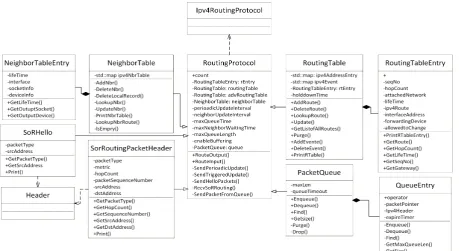
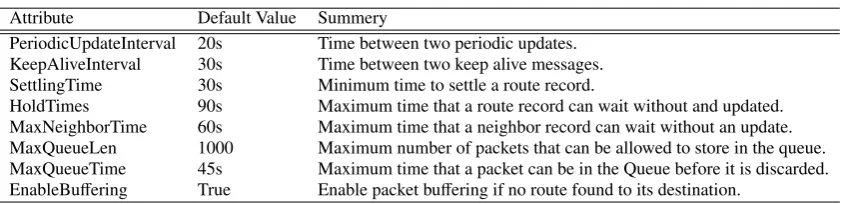
This section describes the design and implementation of the ns-3 DVRP module and focuses on: 1) neighbor discovery and main-tenance, 2) route-table creation and mainmain-tenance, 3) route- and neighbor-table update mechanism, and 4) packet-buffering mech-anism. All major attributes used in this implementation are listed in Table 1 and relationships among all classes are illustrated in Fig-ure 1.
The ns-3 DVRP module is developed using the DVR algorithm [10]. The DVRP module uses the minimum hop path as the shortest path for a certain destination and the shortest path is calculated us-ing the Bellman-Ford algorithm [4]. Routers calculate the shortest paths on update message arrival and the calculated shortest path is used to update the routing tables. Note that the current DVRP ver-sion is developed as a host-address-based routing protocol and thus maintains a host-address-based routing table instead of a network-address-based routing table.
The basic functions of the DVRP module can be explained as follows. For simplicity of explanation, we assume the following scenario: letXbe a router that receives a new destinationDfrom its neighborNat a distance ofcN. This means thatXcan reach toD
throughNwith the costc=cD+cN. Consequently, the following
rules were implemented to the DVRP for route-table maintenance
and route-table advertisement processes. Note: thesdenotes the sequence number of the existing record andsnew denotes the
se-quence number of the newly received record.
• ifDis a new destination,XaddsDin to the routing table as (D, viaN,cD+cN,snew)
• ifDis a destination that is already in the routing table with (D,M,c,s), wherec>cD+cNands>snew, then the routing
entry will update for (D, viaN,cD+cN,snew)
• ifDis a destination that is already in the routing table with (D,M,c,s), wherec>cD+cNands<=snew, then the routing
entry will not be updated.
• theXsends periodic updates to its neighbors aboutDby set-tingc=c+1 andsnew=s+2
• in the event thatDis not responsive for a defined time in-terval,Xsends periodic/(triggered) updates to its neighbors aboutDby settingc=INFINITandsnew=s+1
As the proposed protocol is implemented based on the distance vector algorithm [10], the DVRP module is implemented based on the complements and limitations of the algorithm. However, some techniques such as triggered updates hold-down timers, packet buffering and encapsulated update messages are used to address certain limitations inherited from the distance vector routing algo-rithm [10].
3.1
Class Overview
Thens3::DVRP::RoutingProtocol class is implemented to the ns-3 by extending the abstract base classns3::Ipv4L4Protocol. The ns3::DVRP::PacketHeaderandns3::DVRP::Helloclasses are ex-tended fromns3::Header. Thens3::DVRP::NeighborTableEntry class is declared to store neighbor information and the ns3::DVRP::NeighborTableclass is declared to store all neighbor records in a table. Similarly, thens3::DVRP::RoutingTableEntry class is designed to store route information, while the ns3::DVRP::RoutingTableis declared to create routing tables. In addition, thens3::DVRP::QueueEntryclass was introduced to store packets and thens3::DVRP::PacketQueueclass was introduced to manage all stored queue entries. Thens3::DVRP::RoutingProtocol class is the main class that combines all the aforementioned classes and maintains route and neighbor management functions.
The DVRP module can be configured to a simulation topol-ogy using the same method that ns-3 provided to config-ure list routing protocols [5, 18, 20, 25]. As an example, first create an object of DVRPHelper and attach it to the ns3::Ipv4ListRoutingHelper. TheListRoutingHelperthen must be attached to the ns3::InternetStackHelper to initialize the DVRP module.
3.2
Neighbor Management
The structure of the DVRP neighbor module consists of two main classes: theNeighborTableandNeighborTableEntryclasses. The NeighborTable class is a collection of NeighborTableEntry class records.
3.2.1
Neighbor Table
Table 1: DVRP Attributes and default Values
Attribute Default Value Summery
PeriodicUpdateInterval 20s Time between two periodic updates. KeepAliveInterval 30s Time between two keep alive messages. SettlingTime 30s Minimum time to settle a route record.
HoldTimes 90s Maximum time that a route record can wait without and updated. MaxNeighborTime 60s Maximum time that a neighbor record can wait without an update. MaxQueueLen 1000 Maximum number of packets that can be allowed to store in the queue. MaxQueueTime 45s Maximum time that a packet can be in the Queue before it is discarded. EnableBuffering True Enable packet buffering if no route found to its destination.
foreach KAMdo
check for existing records;
if!recordthen
add new record;
else
update the life-time of matched record;
end
foreach neighbor recorddo
iflifetime>MaxNeighborTimethen
delete the record;
delete route records refer deleted neighbor;
end
send triggered update;
end end
Algorithm 1:Neighbor Management
(a) DVRP Hello Packet Header
(b) DVRP Update Packet Header
Figure 2: Routing Packet Headers
3.2.2
Processing Neighbor Advertisement Messages
At the router initiation time, when thens3::NotifyInterfaceUp callback is triggered, all local interfaces are added to the perma-nent routing table. Consequently, the router broadcasts hello pack-ets, among its local interfaces, using the packet structure given in the Figure 2(a). After sending the first hello packet, the neighbor module is programmed to broadcast keep-alive messages in each KeepAliveIntrerval. This method has been designed to maintain consistency among routers. The same packet structure given in Fig-ure 2(a) is used to send keep-alive messages.
As soon as a router receives a hello packet, the router processes the packet using the neighbor management algorithm (Algorithm
Figure 3: Neighbor Table
Figure 4: Main Routing Table
Figure 5: Route Message Encapsulation
1). Initially, the router checks the received neighbor record for a match among existing neighbor records. If no match is found, the record is added to the neighbor table as a new neighbor. Otherwise, the router updates the last updated time of the matching record. In addition, the router checks for outdated neighbors using (1).
Li f eT ime=currentT ime−lastU pdatedT ime (1) In the event LifeTime exceeds MaxNeighbourTime:, the corre-sponding neighbor record is first removed from the neighbor ta-ble. Then, route records that refer the removed neighbor as the forwarding gateway are also removed from both advertisement and permanent routing tables. Finally, the router sends a triggered up-date message among remaining neighbors regarding the modified routing entries.
3.3
Route Management
DVRP module is a UDP-based protocol and uses UDP port num-ber 272 for route updates. The DVRP module maintains two types of routing tables: permanent and advertisement. In addition, the DVRP module uses two types of route updates messages: periodic and triggered. Routers broadcast periodic update messages in ev-eryPeriodicUpdateInterval time. The triggered updates are par-ticularly introduced to overcome the slow convergence limitation inherited by the distance vector algorithm [10].
provi-purge routing table;
ROUTES<- collect routes and merge with purged records;
if!ROUTESthen
return;
end
foreach neighbor in neighbor-tabledo
create a empty packet;
maxRum=calculate number of records based on MTU;
foreach record in ROUTESdo ifgateway=="0.0.0.0"then
set the dest. address as this node; increment the Seq. no by 2; increment the hop count by 1; set all other header fields;
update the routing table for new Seq. number; add the header to the packet;
else
set the dest. address according to the route record;
if(Seq. % 2)==0then
increment Seq. number by 2; increment the hop count by 1;
else
increment Seq. number by 1; set hop count for infinity;
end
set all other header fields; add the header to the packet;
end
ifnumber of records==maxRumthen
send the update packet to the neighbor;
end end
ifmore records to sendthen
send the update packet to the neighbor;
end end
Algorithm 2:Update Message Generation
sion. Therefore, after a triggered update is broadcasted, the router must wait 1 to 5 s before it sends the next update.
3.3.1
Routing Table
previously stated, DVRP maintains mainly two routing tables to store permanent (stable) routes and recently received routes. As shown in Figure 4, a DVRP module uses a host-address-based routing table. Therefore, every route entry stores the following attributes about the route: a destination IP address, last updated sequence number, network address of the next hop, IP address of the next hop, hop count for the destination, forwarding interface address, and the last updated time. Further, a Boolean value is used to specify whether the route entry can be changed. In addi-tion, the DVRP module uses a sequence number for every route record, while the sequence number is used for two purposes. The first purpose is to maintain route consistency. In every route update, sequence numbers of route records increment by one or two (to pro-duce an odd or even value for the sequence number). The second purpose is to indicate non-responsive records. Non-responsive and responsive records have odd and even sequence number values, re-spectively.
Newly received routes must wait at the advertisement routing table until theSettingTimeexpires to determine whether the route
is stable. The route record is then moved to the permanent routing table. A router does not send any advertisement about new route records before those records are moved to the permanent routing table. Stable routes are identified by the sequence number and hop count. That process is explained in Section 3.3.3.
3.3.2
Route Advertisements
The route update packet is designed to have multiple route records added to it. A record is added to the packet using a 13-byte route message, the format for which is given in Figure 2(b). As shown, a 32-bit wide sequence number is used in the DVRP to incorporate the DVRP in large-scale networks. The hop count is limited to one byte, because the distance between two end hosts is assumed to be not more than 255 hops.
When a particular router generates a route update packet, as shown in Figure 5, the router encapsulates all update records into a single update packet based on the maximum transfer unit (MTU) of a particular link. If a route update packet exceeds the MTU of a particular link, the route update packet is split and broadcast among neighbors.
Li f eT ime>HoldT imes∗PeriodicU pdateInterval (2)
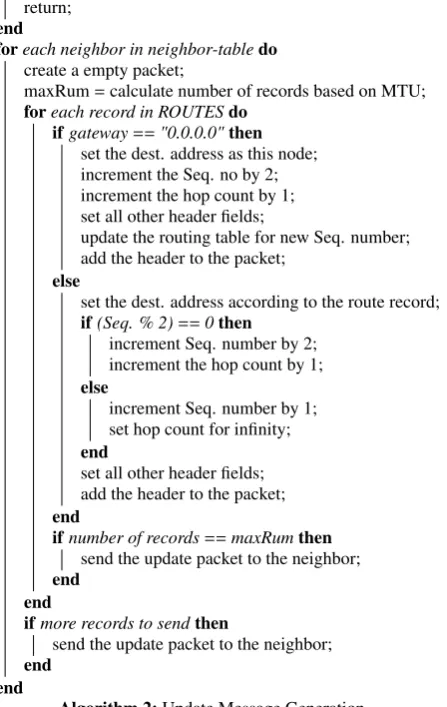
At the route update generation time, as given in Algorithm 2, the DVRP module first creates an empty route update packet. The DVRP module then purges the routing table for any outdated en-tries. All outdated route records are removed from the routing table based on (2). Consequently, the removed route records are added to the update packet by setting the sequence number to an odd value and the cost to infinity. The DVRP module specially handles the route records of the router’s local interfaces. First, all local inter-face route records are added to the update packet by incrementing the sequence number by two and the hop count by one. Thence-forth, to maintain an up-to-date sequence numbers for local inter-faces, the DVRP module updates the sequence number of the local route records in the permanent routing table.
Finally, after adding the removed and local interface route records to the update packet, the DVRP module adds remain-ing routremain-ing records to the update packet .The DVRP module then broadcasts the update packet among all neighbors.
3.3.3
Processing Update Packets
As the DVRP protocol broadcasts route updates, it is worthwhile to confirm whether the update packet is from one of the router’s own interfaces. Therefore, when the DVRP module receives a route update packet, it checks the update packet for piggybacking. If the received packet is piggybacked, the packet is discarded. Otherwise, the packet is processed as given in Algorithm 3.
ifpiggybacked packetthen
discard packet and return;
end
foreach RUM in the packetdo if(Seq. % 2) !=0then
delete routes in routing table; delete routes in advertisement table; send a triggered update;
end else
ROUTE<- find(destination); calc HopCount;
if!ROUTEthen
add a record to routing table; add a record to advertisement table;
else
ifSeq.>=ROUTE’Seq.then
ifHopCount<=ROUTE’HopCountthen ifdifferent Gatewaythen
delete routes in both tables; add route to adv. table; schedule settling event;
else
update HopCount; update the Seq.;
end
else ifHopCount>ROUTE’HopCount&& <16then
ifdifferent Gatewaythen
update HopCount; update the Seq.;
else
discard the message;
end end else
discard the message;
end end end end
Algorithm 3:Route Processing
• If no route presents in the routing table, add new routes to both routing and advertisement routing tables.
• If the received sequence number is greater than or equal to the existing sequence number, then (3) is used to calculate the shortest path and to update the routing record in the ad-vertisement table.
• If the hop count of the received record is less than or equal to the existing hop count, as given in Algorithm 3, update that particular record of the advertisement routing table based on the gateway address. If the sender address is different compared to the gateway address, delete the existing route records and add new route record to the advertisement table. An event will then be scheduled to expire afterSettingTime. At the time the scheduled event triggers, the route record will be moved from the advertisement routing table to the perma-nent routing table. In particular, the hop count, sequence
Figure 6: Average Processor Consumption
number, and last updated time of the route record will be up-dated.
• If the sender address is same as the gateway address, particu-larly hop count and the sequence number get updated accord-ing the route update message. In addition, the last updated time will also be updated.
• If the hop count is greater than the route’s hop count and is lesser than sixteen, then hop count and the hop count will be updated if the gateway is same as the sender. Otherwise, the message will be discarded
• If the received sequence number is shorter than the existing sequence number, the message will be discarded, because the node has a most updated record than does the received up-date.
CX(Y,Z)=C(X,Z)+min
w{CZ(Y, w)} (3)
CX(Y,Z) : distance betweenXtoYviaZ
C(X,Z) : distance betweenXtoZ, whereZis the neighbor ofX minw{DZ(Y, w)}: shortest hop path fromZtoY
3.4
Packet Buffering
Per-router packet buffering is introduced in the DVRP module as an additional function. If a router does not have a route through which to forward a packet, instead of the packet being dropped, it will be buffered in the local packet buffer. The packet buffering fea-ture is enabled by default to store 1000 packets in each router. Ad-ministrators can control the packet buffer option by controlling the EnableBuffering,MaxQueueLenandMaxQueueTimecontrol vari-ables given in Table 1.
ThePacketQueueclass was implemented to store packets using theQueueEntryclass. TheQueueEntryclass stores following: the packet, packet’s source IP address, packet’s destination IP address, and the maximum permitted time to remain in the packet buffer. Packets will be buffered in the packet buffer until: a router receives a route to forward the packet, or the the maximum permitted time to remain in the packet buffer has expired.
4.
EVALUATION AND DISCUSSION
Figure 7: Sample ns-3 Topology Consists of 100 Nodes
Figure 8: Route Decision Making Time (Avg.)
sample topology (of 100 routers) is given in Figure 7. The pro-posed DVRP protocol is compared with the ns-3 NIX-vector and ns-3 global routing protocols using the six topologies. Note: due to the fact that [5], [18] and [1] are wireless routing protocols, the proposed protocol is not compared with those routing protocols.
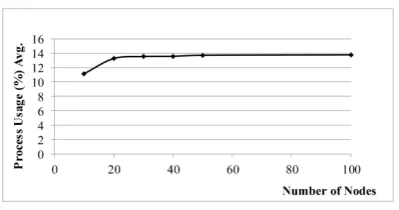
The topologies were implemented on a computer with an Intel i7 3.4 GHz processor having 8 GB of memory. The "sar" [12] Unix command was used to measure the process consumption. The ob-tained process usage result is plotted in Figure 6. According to the Figure 6, the topology consists of 100 routers consumed an average of 13.08% of the processor. Therefore, the DVRP module was able to utilize the processor usage to a reasonable degree.
4.1
Topology Development
The simulation topologies were configured using peer-to-peer links of 100 Mbps and 2 ms of delay. As shown in Figure 7, we used two links, 10 Mbps and 1 ms delay, to connect UDP echo client and UDP echo server to the network topology. We programed the client to send packets with 500 bytes payload at random intervals. The server was programmed to reply when the packet arrived. The DVRP, ns-3 NIX-vector, and ns-3 global routing protocols were configured to the aforementioned topologies. Each simulation sce-nario was simulated five times and the average results were used for the evaluation.
4.2
Results and Discussion
This section discusses the obtained results in detail. Tests were conducted to evaluate the DVRP for the route decision time (RDT), packet delivery ratio (PDR), round trip time (RTT), and routing overhead (RO).
4.2.1
Route Decision Time (RDT)
The RDT value is the average time used by a router to discover
Figure 9: Packet Delivery Ratio (Avg.)
a route from the routing table to a packet. For this experiment, we used topologies that consist of 10, 50, and 100 routers. The measured RDT values for the routing protocols are given in Figure 8. As depicted, the NIX-vector routing protocol consumes an av-erage of 0.1µs for all three topologies. This is because, as given in [19], the routing path for a particular data packet is determined during packet generation. Therefore, routers do not consume time to determine routes for incoming packets, so route decision time is extremely low compared to that in the other two routing protocols. Both DVRP and ns-3 global routing protocols display increments of the RDT value proportional to the number of routers. The rea-son is that, latency of finding a route record is depending on size of the routing table and the size of the routing table is proportional to number of nodes in a network. However, according to Figure 8, the ns-3 global routing protocol consumes a steady time to de-termine a route. As an example, 28µs are consumed for the 100 routers topology. As explained in [20], this happens because when a data packet arrives, the ns-3 global routing protocol returns the first record of the routing table that matches the destination address of the received packet. Therefore, time consumption of finding a route in the routing table is stable. But, given the fact that the ns-3 global routing protocol maintains a routing table, the RDT value is high compared to that of NIX-vector routing.
Similarly, as Figure 8 shows, the RTD value of the DVRP also increases based on the number of routers in a topology. Further, as depicted in Figure 8, the RDT values also fluctuate according to the time. This is because the DVRP protocol must allocate resources to process both route update messages and incoming data packets. As an example, the routing table must be shared between the route update and packet forwarding modules. Therefore, as Figure 8 re-veals, DVRP protocol displays an average of 10-20µs increments of the RDT value compared to the ns-3 global routing.
4.2.2
Packet Delivery Ratio (PDR)
The PDR value is calculated at the UDP echo client by divid-ing the number of received reply packets by the number of sent packets. According to the Figure 9, both NIX-vector and global routing protocols display 100% PDR. This is because these two routing protocols do not use any route update messages. Thus, the network is neither occupied nor congested. The DVRP protocol is programmed to send periodic and triggered updates as well as hello packets to maintain the topology consistency and adapt to topological changes. Route update packets occupy both the router and network to a certain percentage depending on the size of the update packet. Therefore, the proposed protocol displays 99.05% of the packet delivery ratio, which represents 0.95% packet loss compared to that of existing ns-3 routing protocols.
Figure 10: RTT measurement at the client (Avg.)
The third experiment in this study involved measuring the RTT values of reply packets at the UDP echo client. According to Fig-ure 10, all topologies configFig-ured with both NIX-vector and global routing protocols result in an average of 35 ms of RTT. Topologies configured with the DVRP protocol resulted in an average of 25ms of the RTT value. This means that the DVRP protocol is 10 s faster than the existing ns-3 routing protocols in terms of packet delivery. The NIX-Vector routing protocol has a comparatively high RTT value because the routing protocol analyzes data packets in each router to determine the next forwarding router. Therefore, a packet has considerable time in a router until the packet is forwarded to the next hop. In addition, the RTT value of the global routing protocol is high. According to [20], this is because the global routing mod-ule returns the first route of the routing table. Usually, the returned route is not the shortest path. Therefore, packets may travel in long distance paths.
According to the Figure 10, DVRP displays fluctuations of the RTT value proportional to the number of routers in the topology. One reason for this is that the DVRP module stores destination-based instead of network-destination-based route records. Therefore, the size of the routing table is proportional to the number of routers in the networks. Another reason is that the number of update messages and update packet size is proportional to the size of the routing table. The route update messages are directly affect network con-gestion. Data packets may thus travel through congested routers or links. As a result, RTT values fluctuate based on the number of nodes in the network and because of network congestion.
In the next experiment, some routers were deactivated in the mid-dle of the simulation. In addition, the behavior of the routing pro-tocols was observed. In the case of NIX-vector routing, the packets were not delivered if the broken link was in the pre calculated rout-ing path of a data packet. Similarly, for the global routrout-ing, if the deactivated router was referred by a route record, the packets were not delivered. However, DVRP module behavior was completely different compared to the NIX-Vector and global routing modules.
The DVRP module used keep-alive messages to identify the dis-abled router. After a router detects the deactivated router, it re-moves the deactivated router from its routing table and advertises among its neighbors. The entire topology then recalculates the shortest path according to the new topology. And packets are routed using the newly calculated shortest path. In addition, routers buffer the packets that cannot be delivered (because of the unresponsive router) until routers receive new routes.
4.2.4
Routing Overhead (RO)
The fourth experiment was conducted to measure the link occu-pancy ratios of routing protocols. As the NIX-vector and the ns-3 global routing protocols do not use update messages to exchange route information, the comparison was not successful. However,
Figure 11: Routing Overhead(Avg.)
the RO value of the DVRP is provided and discussed in this sec-tion.
The RO value is calculated dividing the number of bytes used for the route management by the bandwidth of the link. The re-sults are plotted in Figure 11. It shows that the DVRP protocol consumed an average of 0.003% of a 100 Mbps link in a 50-router network topology. In addition, the DVRP module displays 0.005% increments of the RO value proportional to the number of nodes in a topology. As previously stated, this is because the routing table size and number of update messages increase based on the number of nodes on a topology. However, the number of update packets did not drastically increase proportional to the number of nodes in a topology. Because the DVRP module encapsulates more than one route update message in a single update packet in order to maintain network utilization.
5.
CONCLUSION AND FUTURE STUDIES
In this study, we introduced and implemented an IPv4 table-driven wired routing protocol for an ns-3 simulator. The protocol was designed as a distance vector routing protocol (DVRP). This paper provides a detailed explanation of the design, classes, and test results. The test results showed that the DVRP could deliver a packet on an average of 10-13 ms faster compared to existing ns-3 IPv4 routing protocols. Furthermore, the DVRP module utilized only 0.003% of links in its route management. However, test results showed that the DVRP is 0.95% low in packet delivery because of the limitations inherited from the distance vector routing algorithm. The DVRP protocol was able to address successfully the limita-tions of the existing IPv4 routing protocols of the ns-3. Specifically, it used route update messages to populate the routing table and adapt to topological changes. In addition, the DVRP was enhanced to buffer undelivered packets for a pre-programmable time instead of dropping those packets. However, due to the fact that [5], [18] and [1] are wireless routing protocols, the DVRP protocol is not evaluated based on those protocols. Further the DVRP is not eval-uated based on the RIPng protocol [11] because it a IPv6 based routing protocol.
The source code of the current version of DVRP can be found in [29]. In the future , the DVRP module will be developed to support both VLSM and CIDR.
Acknowledgments
6.
REFERENCES
[1] Bikov, E.,andBoyko, P. Direct execution of olsr manet
routing daemon in ns-3. InProceedings of the 4th International ICST Conference on Simulation Tools and Techniques (SIMUTools ’11)(2011), pp. 454–461. [2] Brakmo, L. S.,andPeterson, L. L. An evaluation of the
network simulators in large-scale distributed simulations. In In Proceedings of the 1996 ACM SIGMETRICS international conference on Measurement and modeling of computer systems (SIGMETRICS ’96)(1996), pp. 80–90.
[3] Carneiro, G. J. Ns-3 network simulator 3.https://www.
nsnam.org/tutorials/NS-3-LABMEETING-1.pdf,
Accessed: 6/2015.
[4] Cheng, C., Riley, R., Kumar, S. P. R.,and
Garcia-Luna-Aceves, J. J. A loop-free extended
bellman-ford routing protocol without bouncing effect. SIGCOMM Comput. Commun. Rev. 19, 4 (Aug. 1989), 224–236.
[5] Cheng, Y., Cetinkaya, E. K.,andSterbenz, J. P. G. Dynamic
source routingdsrprotocol implementation in ns-3. InIn Proceedings of the 5th International ICST Conference on Simulation Tools and Techniques S I MUT OOLS0
12 (2012), pp. 367–374.
[6] Ciraci, S.,andAkyol, B. Experiences with network
simulation. InIn Proceedings of the first international workshop on High performance computing, networking and analytics for the power grid (HiPCNA-PG ’11)(2011), pp. 59–66.
[7] Dally, W.,andTowles, B.Principles and Practices of
Interconnection Networks. Morgan Kaufmann Publishers Inc., San Francisco, CA, USA, 2003.
[8] DARPA. The network simulator: ns-2, howpublished=. [9] Das, S., R., C., Yan, J.,andR., S. Comparative performance
evaluation of routing protocols for mobile, ad hoc networks. InIn Proceedings of the 7th International Conference on Computer Communications and Networks(1998), pp. 153–161.
[10] Dordal, P. L. An introduction to computer networks.http:
//intronetworks.cs.luc.edu/1/html/routing.html,
Accessed: 6/2015.
[11] G. Malkin, R. M. Ripng for ipv6.
http://datatracker.ietf.org/doc/rfc2080/,
Accessedd: 6/2015.
[12] Godard, S. sar(1) - linux man page.
http://linux.die.net/man/1/sar, Accessed: 6/2015.
[13] Heap, G. T.,andMaynes, L.CCNA Practical Studies. Cisco
Press, 2002.
[14] Hedrick, C. Routing information protocol.
http://tools.ietf.org/html/rfc1058, Accessedd:
6/2015.
[15] Ikeda, M., Kulla, E., Barolli, L., Takizawa, M.,andMiho,
R. Performance evaluation of wireless mobile ad-hoc network via ns-3 simulator. In2011 14th International Conference on Network-Based Information Systems (NBiS) (2011), pp. 135–141.
[16] KIM, J. Shortest path routing protocol for ns3.
http://www2.engr.arizona.edu/~junseok/
shortest_path.html, Accessed: 6/2015.
[17] Kumar, A., Rao, S.,andGoswami, D. Ns3 simulator for a
study of data center networks. In2013 IEEE 12th International Symposium on Parallel and Distributed Computing (ISPDC)(2013), pp. 224–231.
[18] Narra, H., Cheng, Y., Cetinkaya, E. K., Rohrer, J. P.,and
Sterbenz, J. P. G. Destination-sequenced distance vector
(dsdv) routing protocol implementation in ns-3. In Proceedings of the 4th International ICST Conference on Simulation Tools and Techniques (SIMUTools ’11)(2011), pp. 439–446.
[19] ns3-dev. ns-3 nix-vector routing.
http://www.nsnam.org/doxygen-release/group_
_nix-vector-routing.html, Accessed: 6/2015.
[20] ns3-dev. ns-3 routing overview.https://www.nsnam.
org/docs/release/3.10/manual/html/routing.html,
Accessed: 6/2015.
[21] ns3-dev. ns-3 simulator.http://www.nsnam.org,
Accessed: 6/2015.
[22] Nygren, E., Sitaraman, R. K.,andSun, J. The akamai
network: A platform for high-performance internet applications.SIGOPS Oper. Syst. Rev. 44, 3 (2010), 2–19. [23] Pecorella, T. Ripng.http://www.nsnam.org/
doxygen-release/group__ripng.html#details,
Accessed: 6/2015.
[24] Spaho, E., Ikeda, M., Barolli, L., Xhafa, F., Younas, M.,and
Takizawa, M. Performance of olsr and dsdv protocols in a
vanet scenario: Evaluation using cavenet and ns3. In Proceedings of the 2012 Seventh International Conference on Broadband, Wireless Computing, Communication and Applications(2012), BWCCA ’12, pp. 108–113.
[25] Suresh, P. L.,andMerz, R. ns-3-click: click modular router
integration for ns-3. InIn Proceedings of the 4th International ICST Conference on Simulation Tools and Techniques S I MUT ools0
11 (2011), pp. 423–430.
[26] Swenson, B. P.,andRiley, G. F. Simulating large topologies
in ns-3 using brite and cuda driven global routing. In Proceedings of the 6th International ICST Conference on Simulation Tools and Techniques (SimuTools ’13)(2013), pp. 159–166.
[27] Wijekoon, J., Harahap, E., Ishida, S., Tennekoon, R.,and
Nishi, H. Router-based content-aware data redirection for
future cdn systems.International Journal of Computer Network and Information Security (IJCNIS) 6, 7 (2014), 1–10.
[28] Wijekoon, J., Tennekoon, R., Harahap, E.,andNishi, H.
Service-oriented router module implementation on ns-3. In SIMUTOOLS 2014: The 7th International ICST Conference on Simulation Tools and Techniques(March, 2014). [29] Wijekoon, J., Tennekoon, R.,andNishi, H. ns3 dvrp
implementation.
https://github.com/westlab/ns3dvrp, Accessed: