International Journal of Educational Methodology
Volume 5, Issue 4, 577 - 590.ISSN: 2469-9632 http://www.ijem.com/
Analysis of the Problems Posed by Pre-Service Primary School Teachers
in Terms of Type, Cognitive Structure and Content Knowledge
Mehmet Koray Serin*
Kastamonu University, TURKEY
Received: June 21, 2019 ▪ Revised: September 22, 2019 ▪ Accepted: October 9, 2019
Abstract: In the current study, the problems posed by pre-service primary school teachers within the context of semi-structured problem formation were analyzed according to their type, cognitive structure, and content knowledge. A total of 134 pre-service primary school teachers attending a state university in Turkey participated in the current study designed in line with the case study design. The pre-service teachers were presented with a table and they were asked to establish a problem suitable for the elementary level using the data given in the table. The data were collected through the established problem statements and written explanations of the participants. The collected data were analyzed by using both content and descriptive analyses. The findings have revealed that the pre-service teachers less preferred real-life problems than routine type of problems and the problems at the level of reasoning than the problems at the levels of knowing and applying. Moreover, nearly half of the pre-service teachers erroneously expressed the grade level for which they established their problem. The results have shown that the pre-service teachers do not adequately use real-life problems and problems at the level of reasoning and that there are deficiencies in their mathematical content knowledge depending on their knowledge of the curriculum.
Keywords: Problem-posing, problem types, content knowledge, cognitive structure, pre-service primary school teachers.
To cite this article: Serin, M. K. (2019). Analysis of the problems posed by pre-service primary school teachers in terms of type, cognitive structure and content knowledge. International Journal of Educational Methodology, 5(4), 577-590. https://doi.org/10.12973/ijem.5.4.577
Introduction
As a means of rational thinking, mathematics plays an important role in raising the fluent and critical thinking individuals need in today's (and tomorrow's) dynamic world. Seen from this perspective, problem-solving has long been considered by mathematicians and math educators as the top component of the field of mathematics (Singer, Ellerton & Cai, 2015). Schoenfeld (1992) defined problem-solving as an important skill serving the school mathematics by helping to understand the value of mathematics, learn mathematical concepts, develop creative thinking skills and helping students to apply their unique skills in mathematics. While integrating mathematical problem solving into the school curriculum and investigating the affective, cognitive and metacognitive aspects of mathematics have been the main issues addressed by mathematics educators for many years, studies on posing compared to problem-solving are seen as a relatively new effort (Cai, Hwang, Jiang & Silber, 2015). Just as in problem-problem-solving, problem-posing is considered to be an important component of mathematics and is stated to be at the center of mathematics education (Crespo, 2003; Ministry of National Education [MoNE], 2018; National Council of Teachers of Mathematics [NCTM], 2000). Because of this nature of posing, in recent years many educators have preferred to focus on problem-posing (Kilic, 2017). Problem-problem-posing can be defined as simply creating a new problem statement or restructuring a given problem statement (Ticha & Hospesova, 2009). Similarly, Silver (1994) defined problem-posing as producing new questions to clarify a given situation and create new problems based on the solution of a problem. Stoyanova and Ellerton (1996), on the other hand, defined problem-posing as a process in which interpretations based on mathematical experiences and created based on concrete situations are transformed into meaningful mathematical problems. According to Christou, Mousoulides, Pittalis, Pitta-Pantazi and Sriraman (2005), problem-posing is an important component of both pure and applied mathematics and is also an integral part of modeling cycles in which mathematics is related to real life. Gonzales (1998), on the other hand, described problem-posing as the fifth stage of
*Correspondence:
Mehmet Koray Serin, Kastamonu University, Faculty of Education, Kastamonu, Turkey. [email protected]
George Polya's four-stage problem-solving process. Here, students are asked to pose a problem by investigating the problem they have solved, making changes on or additions to it.
Problem Posing Frameworks
When the literature is reviewed, it is seen that problem-posing processes are handled in different classifications by different researchers. For example, Silver (1993) classified problem-posing activities starting from the problem-posing stage of the problem-solving process. He stated that problem-posing could take place before, during, and after solving the problem. The aim of problem-posing before problem-solving is not solving the problem, but the creation of a problem from a given situation. During problem-solving, the problem statement addressed can be designed by re-considering the problem statement. For example, it can be simplified. Problem posing sometimes occurs after solving a certain problem. By changing the conditions of the problem, alternatives to the given problem can be proposed. Silver (1993) stated that this kind of problem-posing is related to the stage of looking back, one of the Polya's (1945) stages of problem-solving. Stoyanova and Ellerton (1996) remarked that problem-posing processes can be realized under three different categories. Free, semi-structured or structured. In free problem-posing activities, students create problems without any restrictions. Students are asked to create a problem free for the given general situation. In this type of problem-posing activities, students create problems based on their in and out of school experiences (Stoyanova, 1998). For example, “create a difficult problem” or “create a money problem”. Semi-structured problem-posing refers to cases in which students are given an open situation and are invited to explore the structure of this situation and to complete it using the knowledge, skills, concepts, and relationships derived from previous mathematical experiences. Visual representations where a picture, graphic or table is presented, verbal open-ended stories, symbolic representations including one or more processing steps are frequently used in semi-structured problem-posing studies (English, 1998; Isik, Isik & Kar, 2011; Silver & Cai, 2005). Finally, structured problem-posing activities refer to processes in which students create similar problems by rearranging the already solved problems or changing the conditions or questions of the given problems. In such problem-posing activities, students establish problems within the framework of strategies and situations limited by their teachers (English & Watson, 2015). Christou et al. (2005), based on the model proposed by Stoyanova and Ellerton (1996), classified problem-posing under four different processes. These processes are editing, translating, selecting and comprehending. The editing processes relate to tasks that require students to pose a problem without any restrictions based on stories or pictures presented to them (Mamona-Downs, 1993). In the translating processes, students are expected to present appropriate problems based on graphs, diagrams or tables. In the selecting processes, it is aimed that students establish the problems that are suitable for the predetermined answers. In the comprehending processes, students are engaged in problem-posing activities based on the mathematical equations or calculations given to them. Kilic (2013) proposed a problem-posing model which seems to be a combination of the classifications put forward by Stoyanova and Ellerton (1996) and Christou et al. (2005). Based on this model are there problem-posing processes built on different representation styles (symbolic, table, picture, etc.). According to Kilic (2013), problem-posing can be classified as free problem-posing (where a difficult problem is asked to be posed or a specific issue such as fraction problem is given), semi-structured problem-posing (involving editing and translating processes) and structured problem-posing (involving comprehending and selecting processes).
Problem Posing in the School Mathematics Curriculum
Problem Posing in Educational Research
When the literature is reviewed, it is seen that the place and importance of problem-posing activities in mathematics education have been demonstrated in many ways by numerous studies. For example, Silver (1994), Leung (1996), Abu-Elwan (2002), Cifarelli and Cai (2005), Perrin (2007), Cankoy and Darbaz (2010) stated that problem-posing activities have a positive effect on students' problem-solving skill. English (2003) emphasized the importance of problem-posing processes in understanding mathematical concepts and processes. Besides, it was found that students' experiences of problem-posing enhanced their perceptions of the subject and produced excitement and motivation among them (Mestre, 2002; Silver, 1994). Lowrie (2002) stated that problem-posing has an indirect positive effect on mathematics achievement and attitude towards mathematics by improving students' creativity, critical thinking, mathematical reasoning and problem-solving skills. Lavy and Shriki (2007) stated that problem-posing is an important tool to evaluate students' mathematical understanding and to have knowledge about their conceptual learning of a given situation. English (1998) and Pirie (2002) stated that problem-posing activities carried out within the context of teaching processes are an important pedagogical tool for teachers aiming to improve students' mathematics learning. On the other hand, Boaler and Brodie (2004) and Franke, Webb, Chan, Ing, Freund, and Battey (2009) emphasized that teachers see problem-posing as a useful mechanism for developing and using effective mathematical conversations. Leung and Silver (1997) noted that problem-posing should be handled at all grade levels where mathematics teaching is performed and that pre-service teachers need experiences about problem-posing during their pre-service training period. Ticha and Hospesova (2009), concluded that the studies carried out on problem-posing had a positive effect on service teachers' pedagogical content knowledge. Bragg and Nicol (2008) found that had positive effects on pre-service teachers’ beliefs about mathematics and their attitudes towards mathematics. Similarly, Gonzales (1998) emphasized that pre-service teachers who have developed problem-posing skills can guide the transition from a generation that can only solve problems to a generation that can pose problems as well. Thus, there is an increase in the amount of research conducted with pre-service teachers on problem-posing in recent years (Grundmeier, 2015; Hospesova & Ticha, 2015; Lavy, 2015).
The Current Study
Elementary education together with pre-school education is the level of education in which the foundations of mathematics education are laid. Primary school teachers working in this level of education must have a good pre-service training in the field of mathematics education as well as other fields and begin to work as a qualified and competent teacher. In this regard, the individuals who will work as a primary school teacher need to have basic process skills such as problem-solving, reasoning, relating, communication and representation skills that have been emphasized both by NCTM (2000) and math curriculums in Turkey (MoNE, 2009, 2015, 2018) and need to be competent enough to impart these skills to students. The increase seen in the amount of research focusing on problem-posing in recent years indicates that problem-posing is considered to be an important process skill. In this connection, in the current study, the problems posed by the pre-service primary school teachers in a semi-structured manner were analyzed in terms of type and cognitive structure and moreover, evaluations were made about their content knowledge based on of their explanations. The sub-problems of the study are as follows:
1. How did the pre-service teachers make use of the data in posing a semi-structured problem?
2. Which types of problems did the pre-service teachers prefer to pose in terms of content and what are the contexts they preferred?
3. What is the pre-service teachers’ content knowledge based on the problems they posed? 4. At which cognitive levels are the problems posed by the pre-service teachers?
Methodology
Research Design
The current study aiming to investigate the pre-service primary school teachers’ states of posing problems from different aspects employed the case study design, one of the qualitative research methods. The case study is a research design in which one or more cases are investigated in a detailed manner and then defined by the researcher (Christensen, Johnson & Turner, 2013). In the current study, by putting problem-posing which is an up-to-date and important skill into the center, the case study design was adopted as it aimed to investigate the problems posed by the pre-service teachers in a holistic approach in their natural environment by using data from more than one source of evidence.
Participants
sampling method was used and the criterion employed was that the participants should be enrolled in the Department of Primary School Teacher Education and that they must have taken all the courses related to mathematics in the program. Thus, the participants were selected from among the 3rd and 4th-year students who had taken the Basic Mathematics course in their first and second terms and Mathematics Teaching I and II courses in the fifth and sixth terms of their undergraduate education. As the current study was conducted at the end of the spring term, the 3rd year students were accepted to have taken the Mathematics Teaching II course. Thus, it was assumed that the participating pre-service teachers have enough information on the subject of problem-posing. No further sampling method was adopted and all the 3rd and 4th year students available participated in the study on a volunteer basis.
Data Collection
In structured problem-posing activities, problems are established based on a previously solved problem, so there is a limitation in such problem-posing activities. On the other hand, in the case of free problem-posing, activities are performed without any restrictions (Stoyanova & Ellerton, 1996; Kilic, 2013). In the current study, the semi-structured problem-posing approach is preferred as it both imposes some restriction and allows some flexibility; thus, it allows more freedom for thinking (Abu-Elwan, 1999, Bayazit & Kirnap-Donmez, 2017). In semi-structured problem-posing processes, students use new knowledge, skills, concepts, and connections from their previous mathematical experiences to present new problem statements. In this way, they can create numerous different, creative math problems (Bonotto & Dal Santo, 2015). In the current study, the table in Table 1 developed by the researcher was given to the pre-service teachers and they were asked to pose a problem by using the information in this table.
Table 1. The sample table used in semi-structured problem-posing activities.
Mehmet Ahu
1st month 80 67
2nd month 70 60
3rd month 60 53
In the current study, the pre-service teachers were asked to pose a problem at primary school level from the information given in the table and thus they posed their problems. Besides, the pre-service teachers were asked to indicate the level of primary education (1st, 2nd, 3rd or 4th grade) for which their problems are suitable and to solve the problems they posed. Opinions of an academician specialized in the field of math education were sought about the suitability of the table which was in the state of data collection tool for using in the pre-service teachers’ problem-posing activities and opinions of both this academician and a primary school teacher working in the same province where the study was conducted were sought about its suitability for primary education.
As stated in the introduction section, semi-structured problem-posing activities can be performed based on both verbal representations such as sample case, story and visual representations such as picture, table, graph. Table reading finds its place as an important objective in the mathematics curriculum starting from the 1st grade to the 4th grade. Hence, it was thought that it would be appropriate for the pre-service teachers to establish problems based on table representation. By the nature of semi-structured problem-posing activities, the participants were asked to use the numbers in the table and thus some degree of limitation was placed on the problem statement to be established. With this limitation, it was made easier for the pre-service teachers to establish problems at the primary school level, thus increasing the reliability of the analyses conducted for the suitability of the established problems for the specified grade level. At the same time, by including appropriate numerical data in the table, the likelihood of translating the problems posed by the pre-service teachers into real-life situations was increased. This was also thought to trigger the emergence of different contexts in the problems. Seen from this perspective, it can also be said that the table gives a certain degree of freedom and flexibility to the pre-service teachers.
Analyzing of Data
In the analysis of the collected data, in compliance with the nature of the qualitative research approach, both descriptive and content analysis methods were adopted. In this context, as the categories related to the use of data and their suitability for the grade level were derived from the data, the content analysis approach was adopted for these variables. On the other hand, in the analysis of the problems posed by the pre-service teachers in terms of their type and difficulty level (cognitive level), the descriptive analysis method was employed as pre-determined categories were used. In this regard, problem types were analysed on the basis of the classification proposed by Verschaffel, De Corte and Lasure (1994) while the cognitive levels of the problems were analyzed according to the classification of cognitive domains defined by Trends in International Mathematics and Science Study [TIMSS] mathematics assessment frameworks (Lindquist, Philpot, Mullis & Cotter, 2019).
precisely and (c) The use of only some of the data in the table. In samples 1, 2 and 3, participants’ examples are given for these three categories.
Example 1. The use of the table itself as a root of the problem The table above shows the weights of Mehmet and Ahu who went into a diet for 3 months. According to this information, who lost more weight?
Example 2. The use of all the data in the table as verbal statements Mehmet and Ahu agree and throw money into their moneyboxes regularly every month. In the first month, Mehmet has 80 TL and Ahu has 67 TL in their boxes. While in the 2nd month, Mehmet puts 70 TL, Ahu puts 60, in the 3rd month Mehmet puts 60 TL and Ahu puts 53 TL. Accordingly, at the end of the three months, who will save the most money in the moneybox, how much?
Example 3. The use of only some of the data in the table
Ahu reads 67 pages in the first month and 60 pages in the second month and 53 pages in the third month. Accordingly, how many pages has Ahu read in three months?
Within the context of the analysis of the data, secondly, the problems posed by the pre-service teachers were analyzed in terms of type. When the literature is reviewed, it is seen that the problems addressed in the problem-posing processes have been classified differently depending on their types. For instance, Charles and Lester (1982) classified problems according to their types as standard problems, non-standard open-ended problems, real life problems, and puzzle-type problems. Boaler (1998) classified them as open and closed, McLeod (1994) as routine and non-routine. Anderson (2009), Verschaffel, De Corte and Lasure (1994) classified problem statements as routine (ordinary and standard) and real life problems (non-routine, non-standard, extraordinary). In the problem-solving process, it is important to use different strategies and to benefit from real life experiences depending on the content of the problem rather than using rules (Bal, 2015). In the current study, the problems posed by the pre-service teachers were handled in the context of suitability for real life and grouped under two categories (a) Real life problem and (b) Routine problem. Routine problems often refer to situations involving the solution of a problem similar to a problem previously solved or the application of a learned formula to a new situation (Polya, 1945). In such problems, conducting the required arithmetic operations in the correct order is enough to reach the correct solution. Real life problems, on the other hand, are problems in which problem statements are posed based on daily life and which allow students to develop their solutions and strategies (Elia, Van den Heuvel-Panhuizen & Kolovou, 2009). Compared to routine problems, real-life problems are not problems that can be solved immediately by correct selection of one or more numbers and operations. Solutions require going beyond the use of knowledge of operations and using real-life knowledge within students. In the analysis process, problems which were not well related to real life and which could be solved easily only by conducting few operations by using the numbers given in the problem statements were evaluated under the category of “routine problem” while the problems in which the content-related context could be related to real life more easily and effectively by students were evaluated under the category of “real life problem”. In examples 4 and 5, problem statements that are considered in the categories of routine and real life problems are presented. In this stage, the contexts which were taken as the basis in the problems posed by the pre-service teachers (e.g. diet, money, page, exam grade) were also examined.
Example 4. An example problem evaluated in the category of routine problem The table above shows the number of books Mehmet and Ahu read in 3 months. At the end of 3 months, who read more and how many more?
Example 5. An example problem evaluated in the category of real life problem Mehmet and Ahu are siblings and while wandering around the downtown, they see various bikes in a shop window. The price of the bike that Mehmet likes is 220 TL and the price of the bike that Ahu likes is 170 TL. Both decide to save money to buy the bikes they like. The table above shows the money that Mehmet and Ahu have saved for three months. Thus;
a) At the end of the three months, is the money saved by Mehmet enough to buy the bike? If not, how much does he need to save more?
b) At the end of the three months, is the money saved by Ahu enough to buy the bike? If not, how much does she need to save more?
the number limitations defined for the grade levels. Therefore, it can be said that the pre-service teachers' content knowledge was evaluated based on their knowledge of the curriculum. In this regard, the problems posed were coded as (a) Suitable for the given level, (b) Not suitable for the given level and (c) No level is indicated.
It can be said that research on teacher competencies and teacher knowledge levels started with the examination of content knowledge and general pedagogical knowledge (Cakmak, Konyalioglu & Isik, 2014). These two basic types of knowledge were reconsidered by Shulman (1986) under the name of “components that teachers should have”. In his study, Shulman elaborated on the content knowledge as Content Knowledge, Pedagogical Content Knowledge and Curriculum Knowledge. Content knowledge refers to the knowledge of the subjects to be taught in the field (Mishra & Koehler, 2006). Shulman (1986) stated that the knowledge of concepts and facts in the teacher's field (e.g. mathematics) and his/her knowledge about the structure of the field can be evaluated in the content knowledge component. Pedagogical content knowledge is mainly related to teachers' content knowledge and they’re converting this knowledge into forms that students can understand. Ball, Thames and Phelps (2008) stated that content knowledge is the basis of pedagogical content knowledge. Curriculum knowledge includes information about when and how to use resources (source textbooks, concrete materials, software, technological tools, etc.) related to the curriculum in a learning area. Grossman (1990) considered the curriculum knowledge, which is considered as a separate component by Shulman (1986), within the scope of the content knowledge.
The problems considered under the category not appropriate to the specified level were coded as “below the specified level” if the problem could be solved in lower grades or classes than the grade level specified by the pre-service teacher. On the other hand, if the problem posed was suitable for grade level or levels that are above the grade level specified by the pre-service teacher, then it was coded as “above the specified level”. For example, if a problem statement which was specified to be suitable for elementary school 4th grade by the pre-service teacher could be used with 3rd graders according to the objectives stated in the curriculum, then it was coded as “below the specified level”. Similarly, if a problem statement which was specified to be suitable for elementary school 2nd grade level by the pre-service teacher could be used with the 3rd graders according to the objectives stated in the curriculum, then it was coded as “above the specified level”. As stated above, in this process, the pre-service teachers' content knowledge competencies were tried to be examined through the problems they posed. In the examples 6, 7 and 8, student opinions about the suitability of the grade levels specified for the posed problems are given.
Example 6. An example in which the grade level suitable for the problem is correctly expressed The number of bread eaten in the homes of Ahu and Mehmet in January, February and
March is as follows: In Mehmet’s home, 80, 70, and 60 breads were eaten, respectively while in Ahu’s home 67, 60 and 53 were eaten, respectively. Based on these data, draw a bar chart to compare the bread that was eaten in the homes of two friends and find out in whose house more bread was eaten and how many more breads were eaten. Suitable grade level: If it did not ask for the drawing of a bar chart, then it would be suitable for the 3rd grade but drawing a bar chart is a subject that needs to be addressed in the 4th grade level.
Student response: I think that it is suitable for the 4th grade level.
Example 7. An example in which the grade level suitable for the problem is erroneously expressed Mehmet and Ahu runs a book reading contest. This lasts for 3 months. Mehmet reads
80 pages in the first month, 70 pages in the second month and 60 pages in the third month. Ahu reads 67 pages in the first month, 60 pages in the second month and 53 pages in the third month. Who is ahead at the end of the 2nd and 3rd months?
Suitable grade level: Since students encounter 3-digit numbers in solving the problem, it is suitable for elementary school 3rd grade level according to their class number limitations.
Student response: I think that it is suitable for the 4th grade level.
As can be seen in the example 7, the pre-service teacher stated that the problem he/she posed is suitable for elementary school 4th grade. However, when the objectives and class number limitations stated in the math course curriculums (1st – 4th grades) of the Ministry of National Education are examined, it is seen that the problem is more suitable for the 3rd grade. Thus, this and similar examples were coded as “below the specified level”.
Example 8. An example in which the grade level suitable for the problem is erroneously expressed Mehmet and Ahu have solved mathematics questions for 3 months. In the first month,
Mehmet solved 70 questions while Ahu solved 60 questions. In the third month, Mehmet solved 60 questions while Ahu solved 53 questions. At the end of this three months, how many questions have Mehmet and Ahu solved?
Suitable grade level: Since students encounter 3-digit numbers in solving the problem, it is suitable for elementary school 3rd grade level according to their class number limitations.
Student response: 2nd graders can solve it.
As can be seen in the example 8, the pre-service teacher stated that the problem he/she posed is suitable for elementary school 2nd grade level. However, when the objectives and class number limitations stated in the math course curriculums (1st – 4th grades) of the Ministry of National Education are examined, it is seen that the problem is more suitable for the 3rd grade. Thus, this and similar examples were coded as “above the specified level”.
In the final stage of the data analysis, the posed problems were examined within the context of cognitive domains. In this regard, the problems were addressed under the categories (a) knowing, (b) applying and (c) reasoning presented in the mathematics assessment frameworks of TIMSS (2019). These domains deal with the problem-solving competencies of individuals within different processes. For example, arguments to support a strategy or solution are dealt with in a different domain, while mathematical representation of a problem situation (e.g. using symbols, draws, or graphs) can be dealt with in another domain. The first domain, knowing, expresses the concept and arithmetic process competencies that students should know at a basic level, while the second, applying is a slightly higher level that requires students to use conceptual understanding and operational skills together in problem-solving processes. Finally, the third field, reasoning, requires more than is necessary for the solution of routine problems, including unknown situations, complex contexts and multi-stage problems (Lindquist, Philpot, Mullis & Cotter, 2019). For instance, if the problems posed involved conducting operations at only the simple level, then they were coded as knowing; if they involved establishing simple relationships between the steps, then they were coded as applying and if they involved higher-order systematic thinking, then they were coded as reasoning. In the examples 9, 10 and 11, problem statements coded at the levels of knowing, applying and reasoning are presented.
Example 9. An example problem posed at the knowing level There is a mathematics exam every month in a school. The grades taken by Mehmet and Ahu from the mathematics exams for 3 months are given in the table above. How higher is the highest grade taken by Mehmet than the highest score taken by Ahu?
Example 10. An example problem posed at the applying level The amounts of money saved by Mehmet and Ahu for 3 months are given in the table above. Mehmet will pay 150 TL for the bike he wants to buy. With his remaining money, he will buy a book worth 20 TL. Ahu will pay 200 TL for the dress she wants to buy. Seeing that his money is not enough, Ahu wants to borrow from Mehmet. When Mehmet gives the money Ahu needs to buy the dress, then how much money will he have?
Example 11. An example problem posed at the reasoning level Mehmet and Ahu are two friends who are not eating healthily and therefore are overweight compared to their peers. The table above shows the changes in the weights of the two friends across the months after they have started eating healthily. Considering that Mehmet's weight should be 40 and Ahu's weight should be 32 kilos, in which months can they be in their target weights?
To ensure the reliability in the current study, the data were first analyzed by the researcher and codes were created and then an academician specialized in the field of math education was asked to analyze the data and thus interrater reliability was calculated. To this end, the formula proposed by Miles and Huberman (1994) [Reliability = Agreement / (Agreement + Disagreement)] was used and the rate of interrater agreement in all the analysis categories was found to be higher than 85%. The raters discussed the categories they disagreed by expressing their opinions and thus reached an agreement on all the categories.
In the current study analyzing the problems posed by the pre-service teachers in a semi-structured manner concerning context, cognitive structure, and content knowledge, first the state of using the data given in the table was examined and the related findings are presented in Table 2.
Table 2. The state of using the data presented in the sample table in the problem-posing process
3rd Year 4th Year Total
f % f % f %
Use of the table as the root of the problem 33 44,6 32 53,3 65 48,5
Use of verbal statement as the root of the problem 36 48,6 17 28,3 53 39,6
Incomplete use of the data in the table 5 6,8 11 18,3 16 11,9
As can be seen in Table 2, while 88.1% of the pre-service teachers used all the data presented in the sample table in the problems they posed, 11.9% only included some of the data in the problems they posed. The rate of the participants using incomplete data was found to be higher for the fourth-year students (18.3%) than the third-year students (6.8%). Of the participating pre-service teachers, 48.5% used the table as the root of the problem while 39.6% used the verbal problem statements in which the data in the table are presented. While the 4th year students more preferred the problem statements in which the table is used as the root of the problem (53.3%), the 3rd year students more preferred the problem statements in which the data are verbally presented through the contexts they established (48.6%).
Secondly, relatedness of the problems posed by the pre-service teachers to real life was analyzed in the current study. In this regard, first the problems posed were grouped under two categories which are real life and routine problem and the obtained results are presented in Table 3. After that, the contexts used by the pre-service teachers to form the basis of their problems were analyzed and the results are presented in Table 3.
Table 3. Data about the relatedness of the problems posed to real life
3rd year 4th year Total
f % f % f %
Real life problem 38 51,4 24 40 62 46,3
Routine problem 36 48,6 36 60 72 53,7
As can be seen in Table 3, 53.2% of the problems posed by the participants are in the category of routine problem while 46.3% are in the category of real life problem. Moreover, 51.4% of the 3rd year students included more authentic problem statements that can be encountered by students in real life while only 40% of the 4th year students did so. Besides, the contexts used by the pre-service teachers in their problems were examined and are presented in Table 4.
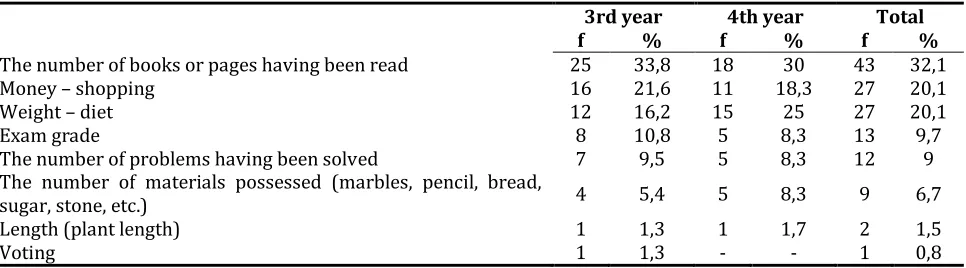
Table 4. Contexts used in the problems posed
3rd year 4th year Total
f % f % f %
The number of books or pages having been read 25 33,8 18 30 43 32,1
Money – shopping 16 21,6 11 18,3 27 20,1
Weight – diet 12 16,2 15 25 27 20,1
Exam grade 8 10,8 5 8,3 13 9,7
The number of problems having been solved 7 9,5 5 8,3 12 9
The number of materials possessed (marbles, pencil, bread,
sugar, stone, etc.) 4 5,4 5 8,3 9 6,7
Length (plant length) 1 1,3 1 1,7 2 1,5
Voting 1 1,3 - - 1 0,8
As can be seen in Table 4, the participants used the contexts related to the number of pages and books read the most with 43% to pose their problems, followed by the contexts related to money-shopping (20.1%) and weight-diet (20.1%). When a comparison was made concerning the grade level, both the 3rd year students (33.8%) and 4th year students (30%) used the number of pages and books more than the other contexts.
In the next stage of the study, the pre-service teachers were asked to indicate for which level of elementary education the problem they posed is suitable. The results of the analysis conducted in this regard are presented in Table 5.
3rd year 4th year Total
f % f % f %
Suitable 28 37,8 29 48,3 57 42,5
Not suitable Above the specified grade level Below the specified grade level 28 13 37,8 17,6 18 9 30 15 46 34,3 22 16,4
No grade level specified 5 6,8 4 6,7 9 6,7
As can be seen in Table 5, 42.5% of the problems posed by the pre-service teachers are suitable for the specified grade level while 50.7% of them are not suitable for the specified grade level. Of the pre-service teachers specifying a wrong grade level for the problem they posed, 34.3% posed a problem above the specified grade level while 16.4% posed a problem below the specified grade level. On the other hand, 6.7% of the pre-service teachers did not describe the grade level for which their problem is suitable.
Finally, the problems posed by the pre-service teachers were analyzed by classifying them into cognitive levels depending on their level of difficulty. The results of the analysis obtained in this connection are presented in Table 6.
Table 6. Analysis of the problems posed across the cognitive levels
3rd year 4th year Total
f % f % f %
Knowing 23 31,1 17 28,3 40 29,9
Applying 38 51,4 33 55 71 53
Reasoning 13 17,5 10 16,7 23 17,1
As can be seen in Table 6, the majority of the problems posed by the pre-service teachers are at the applying level (53%), 29.9% of them are in the knowing level and 17.1% are in the reasoning level. When the cognitive levels of the problems posed by the pre-service teachers were examined according to the grade level of the pre-service teachers, it was found that both the 3rd year students (51.4%) and the 4th year students (55%) preferred to pose problems that can be considered at the applying level. On the other hand, both the 3rd year and 4th year students’ least preferred the problems at the reasoning level with17.5% and 16.7%, respectively.
Discussion and Conclusion
In the current study, the contextual and cognitive structures of the problems posed by the pre-service teachers in a semi-structured manner were explored and moreover, the pre-service teachers’ content knowledge was analyzed through the problems they posed. Before starting the evaluations on the context, cognitive structure and content knowledge, how the data set presented to be used in the semi-structured problem-posing activities was used by the pre-service teachers was examined. In this regard, it was found that the pre-service teachers mostly preferred to use the table to be presented to them as the root of the problem. This might be because the pre-service teachers might have wanted to use their time more efficiently or because of their concern about presenting all of the data verbally with a suitable language in a coherent manner. In this connection, results of some studies investigating problem-posing activities in terms of language and meaning have revealed that there are some deficiencies and mistakes in many problems posed by pre-service teachers in terms of the use of mathematical language and meaning (Kar, 2016; Toluk-Ucar, 2009; Ulusoy & Kepceoglu, 2018; Unlu & Sarpkaya-Aktas, 2017). Besides, in nearly 12% of the problems posed, the data given in the table were found to be used incompletely. Isik and Kar (2012) stated that the average number of problems appropriate to the data set per pre-service teacher was low. As in the case of language and narrative deficiencies, the reason for the incomplete use of the data set can be that the relationship between the data in the table could not be established well enough and that a solvable problem could not be posed by combining the data in a meaningful way.
from real life as an indicator of their dependence on the types of questions and routines they had experienced in the past. In a study conducted on elementary school fifth grade students by Akay, Soybas and Argun (2006), it was found that the students could not use realistic mathematical values in the problems they had constructed and they mostly created routine problems without attempting to use their creativity. As stated by Bonotto (2001), verbal (routine) problems are those that cannot provide realistic contexts, far from inviting students to use their real-world experiences and intuitive knowledge. Given that the participating pre-service teachers will be teaching at the elementary level; it is thought that it is very important to prefer real-life problem situations especially in the teaching of mathematics which is an abstract course. Today, it is seen that mathematics education has been designed with an interdisciplinary approach by considering many fields together such as science, engineering and technology. In STEM (Science, Technology, Engineering, and Mathematics) education where mathematics is directly related to these disciplines and its central mathematical modeling processes, it is always emphasized that mathematics is always a part of the real world. Therefore, as an important process skill, problem-solving and posing activities should be carried out on a real life basis. At this stage, the problems posed were also investigated within the scope of the contexts taken as the basis of the problems. In this connection, it was found that the pre-service teachers mostly preferred the context of “book reading”. Those who did not prefer the context of “book reading” more preferred the contexts of “money (shopping)” and “weight (diet)”. Ulusoy and Kepceoglu (2018) stated that the service teachers preferred to act on familiar contexts. The pre-service teachers showed the easiness of transferring of data to the context they chose as the reason for this. Similarly, as it might have been found easier and more secure, the pre-service teachers in the current study might have preferred simple and uncomplicated problem situations they had encountered at the elementary level while selecting their contexts. For example, contexts such as “voting” or “length (plant height)”, which have stronger real life suitability, were allocated a very little space.
In the next stage of the current study, the pre-service teachers were asked to indicate which grade level their problems were suitable for. In this way, by taking the objectives classified across the grade levels in the elementary mathematics curriculum developed by the Ministry of National Education as the criteria, it was attempted to analyze the participants’ content knowledge. Teacher education is a unique field in that it encompasses both content and pedagogical knowledge (Peace, Fuentes & Bloom, 2018). The results showed that about half of the participants could not accurately express the level of classroom for which the problems they had established were suitable. The pre-service teachers who indicated an unsuitable grade level often indicated a grade level below the specified grade level. In other words, the problem was above the specified grade level. Based on the inadequacy of the pre-service primary school teachers' knowledge of the curriculum, it can be concluded that their content knowledge is insufficient. Similarly, Tekin Sitrava and Isik (2018); in their study investigating the free problem-posing skills, found that 20% of the pre-service primary school teachers were not able to pose problems suitable for the course objectives. In some similar studies (Even, 1993; Ma, 1999; Tirosh, 2000), it was concluded that pre-service teachers' mathematical understanding was insufficient for teaching at the elementary level. Stickles (2011) stated that the pre-service teachers who have insufficient content knowledge experience greater difficulty in problem-posing processes. Van Harpen and Presmeg (2013); in their study with high school students, concluded that students with higher content knowledge of mathematics were more successful in constructing problems Ticha and Hospesova, (2009) conducted a study on pre-service teachers and emphasized that pre-pre-service training was weak in terms of training teachers with sufficient content knowledge. According to these researchers, problem-posing activities can be considered as one of the useful activities for the development of content knowledge. What should be strongly emphasized here is that a good mathematics educator should have the experience of teaching mathematics. Baki (2018) states that this experience has three components: content knowledge, pedagogy, and practice. In the broadest terms, content knowledge is the information that the teacher should have about the subject to be taught. The math education to be delivered by the teachers with inadequate knowledge about the subjects to be taught; that is, with inadequate content knowledge can prevent students from gaining mathematical knowledge and experiences at every level of schooling including the elementary level.
(2018). For example, in the study conducted by Stein, Smith, Henningsen, and Silver (2000), it was stated that problems pre-service teachers pose are not cognitively or structurally complex. According to Isik, Isik and Kar (2011), pre-service teachers' achievement in problem-posing was generally low, and particularly their tendency to pose “relational” and “conditional” problems having higher linguistic complexity and requiring higher level thinking skills was low. Bayazit and Kirnap Donmez (2017) stated that pre-service teachers did not create higher order problems that demand creativity, force the mind, and can be solved with different strategies. Ulusoy and Kepceoglu (2018) stressed that problem-posing processes, where the use of certain processes and algorithms is at the forefront, are more preferred by pre-service teachers.
Suggestions
The current study was conducted on pre-service teachers; similar studies can be conducted on primary school teachers. In this way, primary school teachers’ activities directed to problem-posing in instructional processes can be analysed. Through interviews to be conducted with pre-service teachers, the reasons for their approaches or preferences can be explored. In this way, more in-depth knowledge can be obtained. The current study was carried out according to the semi-structured posing process; similar studies can be performed by using free and structured problem-posing activities. The amount of training received by pre-service teachers during their undergraduate education about problem-posing skills and the number of activities they are engaged in to develop these skills can be increased.
References
Abu-Elwan, R. (1999, November). The development of mathematical problem posing skills for prospective middle school teachers. In F. Mina & A. Rogerson (Eds.), Paper presented at theproceedings of the International Conference on Mathematical Education into the 21st Century: Societal Challenges, Issues and Approaches (pp. 1–8). Cairo, Egypt: Triforum.
Abu-Elwan, R. (2002). Effectiveness of problem posing strategies on prospective mathematics teachers’ problem solving performance. Journal of Science and Mathematics Education, 25(1), 56-69.
Akay, H., Soybas, D., & Argun, Z. (2006). Problem posing experiences and using open-ended questions in mathematics teaching. Kastamonu Education Journal, 14(1),129-146.
Anderson, J. (2009, October). Mathematics curriculum development and the role of problem solving. In K. School (Ed), Proceedings of the 2009 ACSA National Biennial Conference Curriculum: a national conversation (pp. 1-8). Canberra, Australia: ACT.
Artut, P., & Tarim, K. (2016). Ilkokul matematik dersi programlarinin problem cozme acisindan incelenmesi [Examination of elementary school mathematics curriculum in terms of problem solving]. In M. F. Ozmantar, A. Ozturk & E. Bay (Eds.), Reform ve degisim baglaminda ilkokul matematik ogretim programlari [Primary school mathematics curricula in the context of reform and change] (pp. 293-316). Ankara, Turkey: Pegem Academy Publishing.
Baki, A. (2018). Matematigi ogretme bilgisi [Knowledge of teaching mathematics]. Ankara, Turkey: Pegem Academy Publishing.
Bal, A. P. (2015). Examination of the mathematical problem-solving beliefs and success levels of primary school teacher candidates through the variables of mathematical success and gender. Educational Sciences: Theory and Practice, 15(5), 1373-1390.
Ball, D. L., Thames, M. H., & Phelps, G. (2008). Content knowledge for teaching: What makes it special. Journal of Teacher Education, 59(5), 389-407.
Bayazit, I., & Kirnap-Donmez, S. M. (2017). Prospective teachers’ proficiencies at problem posing in the context of proportional reasoning. Turkish Journal of Computer and Mathematics Education, 8(1), 130-160.
Boaler, J. (1998). Open and closed mathematics: Student experiences and understandings. Journal for Research on Mathematics Education, 29(1). 41-62.
Boaler, J., & Brodie, K. (2004). The importance, nature and impact of teacher questions. In D. E. McDougall & J. A. Ross (Eds.), Proceedings of the Twenty-Sixth Annual Meeting of the North American Chapter of the International Group for Psychology of Mathematics Education (Vol. 2, pp. 773–782). Toronto, Canada: PMENA.
Bonotto, C. (2001). How to connect school mathematics with students' out-of-school knowledge. ZDM, 33(3), 75-84. Bonotto, C., & Dal Santo, L. (2015). On the relationship between problem posing, problem solving, and creativity in the
primary school. In F. M. Singer, N. F. Ellerton & J. Cai (Eds.), Mathematical problem posing: From research into effective practice (pp. 103-123). New York, NY: Springer.
Meeting of the 32nd Conference of the International Group for the Psychology of Mathematics Education and 20th Conference of the North-American Chapter (Vol. 2, pp. 256–270). Morelia, Mexico: PME.
Cai, J., Hwang, S., Jiang, C., & Silber, S. (2015). Problem-posing research in mathematics education: Some answered and unanswered questions. In F. M. Singer, N. F. Ellerton, & J. Cai (Eds.), Mathematical problem posing: From research into effective practice (pp. 141-174). New York, NY: Springer.
Cakmak, Z., Konyalioglu, A. C., & Isik, A. (2014). The investigation of pre-service elementary mathematics teachers’ content knowledge on three dimensional objects. Middle Eastern and African Journal of Educational Research, 8, 28-44.
Cankoy, O., & Darbaz, S. (2010). Effect of a problem posing based problem solving instruction on understanding problem. Hacettepe University Journal of Education, 38, 11-24.
Charles, R., & Lester, F. (1982). Teaching problem solving: What, why and how. Palo Alto, CA: Dale Seymour Pub.
Christensen, L., Johnson, R., & Turner, L. (2013). Research methods, design, and analysis (12nd ed.). Upper Saddle River, NJ: Pearson Education.
Christou, C., Mousoulides, N., Pittalis, M., Pitta-Pantazi, D., & Sriraman, B. (2005). An empirical taxonomy of problem posing processes. ZDM Mathematics Education, 37(3), 149-158.
Cifarelli, V. V., & Cai, J. (2005). The evolution of mathematical explorations in open-ended problem- solving situations. The Journal of Mathematical Behavior, 24(3), 302–324.
Cifarelli, V. V., & Sevim, V. (2015). Problem posing as reformulation and sense-making within problem solving. In F. M. Singer, N. F. Ellerton & J. Cai (Eds.), Mathematical problem posing: From research into effective practice (pp. 177-194). New York, NY: Springer.
Crespo, S. (2003). Learning to pose mathematical problems: Exploring changes in preservice teachers’ practices. Educational Studies in Mathematics, 52(3), 243-270.
Elia, I., van den Heuvel-Panhuizen, M., & Kolovou, A. (2009). Exploring strategy use and strategy flexibility in non-routine problem solving by primary school high achievers in mathematics. ZDM Mathematics Education, 41(5), 605-618.
English, L. D. (1998). Children’s problem posing within formal and informal contexts. Journal for Research in Mathematics Education, 29(1), 83-106.
English, L. D. (2003). Engaging students in problem posing in an inquiry-oriented mathematics classroom. In F. K. Lester & R. I. Charles (Eds.), Teaching mathematics through problem solving, Prekindergarten-Grade 6 (pp. 187-196). Reston, VA: National Council of Teachers of Mathematics.
English, L. D., & Watson, J. M. (2015). Statistical literacy in the elementary school: Opportunities for problem posing. In F. M. Singer, N. F. Ellerton & J. Cai (Eds.), Mathematical problem posing: From research into effective practice (pp. 241-256). New York, NY: Springer.
Even, R. (1993). Subject-matter knowledge and pedagogical content knowledge: Prospective secondary teachers and the function concept. Journal for Research in Mathematics Education, 24(2), 94–116.
Franke, M. L., Webb, N. M., Chan, A. G., Ing, M., Freund, D., & Battey, D. (2009). Teacher questioning to elicit students’ mathematical thinking in elementary school classrooms. Journal ofTeacher Education, 60(4), 380–392.
Gonzales, N. A. (1998). A blueprint for problem posing. School Science and Mathematics, 94(2), 78-85.
Grossman, P. L. (1990). The making of a teacher: Teacher knowledge and teacher education. New York, NY: Teachers College Press.
Grundmeier, T. A. (2015). Developing the problem-posing abilities of prospective elementary and middle school teachers. In F. M. Singer, N. F. Ellerton & J. Cai (Eds.), Mathematical problem posing: From research into effective practice (pp. 411-431). New York, NY: Springer.
Hospesova, A., & Ticha, M. (2015). Problem posing in primary school teacher training. In F. M. Singer, N. F. Ellerton & J. Cai (Eds.), Mathematical problem posing: From research into effective practice (pp. 433-447). New York, NY: Springer.
Isik, A., Isik, C., & Kar, T. (2011). Analysis of the problems related to verbal and visual representations posed by pre-service mathematics teachers. Pamukkale University Journal of Education, 30(1), 40-49.
Kar, T. (2016). Prospective middle school mathematics teachers' knowledge of linear graphs in context of problem-posing. International Electronic Journal of Elementary Education, 8(4), 643–657.
Kilic, C. (2013). Determining the performances of pre-service primary school teachers in problem posing situations. Educational Sciences: Theory & Practice, 13(2), 1195–1211.
Kilic, C. (2017). A new problem-posing approach based on problem-solving strategy: Analyzing pre-service primary school teachers' performance. Educational Sciences: Theory and Practice, 17(3), 771-789.
Lavy, I. (2015). Problem-posing activities in a dynamic geometry environment: When and how. In F. M. Singer, N. F. Ellerton & J. Cai (Eds.), Mathematical problem posing: From research into effective practice (pp. 393-410). New York, NY: Springer.
Lavy, I., & Shriki, A. (2007). Problem posing as a means for developing mathematical knowledge of prospective teachers. In W. Jeong-Ho, P. Kyo-Sik, L. Hee-Chan & S. Dong-Yeop (Eds.), Proceedings of the 31st International Conference on the Psychology of Mathematics Education (Vol. 3, pp. 129–136). Seoul, South Korea: PME.
Leung, S. S. (1996). Problem posing as assessment: Reflections and re-constructions. The Mathematics Educators, 1(2), 159–171.
Leung, S. K., & Silver, E. A. (1997). The role of task format, mathematics knowledge, and creative thinking on the arithmetic problem posing of prospective elementary school teachers. Mathematics Education Research Journal, 9(1), 5-24.
Lindquist, M., Philpot, R., Mullis, I. V. S., & Cotter, K. E. (2019). TIMSS 2019 mathematics framework. In I. V. S. Mullis & M. O. Martin (Eds.), TIMSS 2019 assessment frameworks (pp. 11–25). Chestnut Hill, MA: TIMSS & PIRLS International Study Center, Boston College.
Lowrie, T. (2002). Young children posing problems: The influence of teacher intervention on the type of problems children pose. Mathematics Education Research Journal, 14(2), 87-98.
Ma, L. (1999). Knowing and teaching elementary mathematics: Teachers’ understanding of fundamental mathematics in China and the United States. Mahwah, NJ: Erlbaum.
Mamona-Downs, J. (1993). On analyzing problem posing. In I. Hirabayashi, N. Nohda, K. Shigematsu & F. L. Lin (Eds.), Proceedings of the 17th International Conference for the Psychology of Mathematics Education (Vol. 3, pp. 41–47). Tsukuba, Japan: International Group for the Psychology in Mathematics Education.
McLeod, D. B. (1994). Research on affect in mathematics learning in the JRME: 1970 to the present. Journal for Research in Mathematics Education, 25(6),637-647.
Mestre, P. J. (2002). Probing adults’ conceptual understanding and transfer of learning via problem posing. Applied Developmental Psychology, 23, 9–50.
Miles, M. B., & Huberman, A. M. (1994). Qualitative data analysis: An expanded sourcebook (2nd ed.). Thousand Oaks, CA, US: Sage Publications, Inc.
Mishra, P., & Koehler, M. J. (2006). Technological pedagogical content knowledge: A framework for teacher knowledge. Teachers College Record, 108(6), 1017-1054.
Ministry of National Education (MoNE). (2009). Ilkogretim matematik dersi 1-5. siniflar ogretim programi [Elementary
mathematics lesson 1-5. grades curriculum]. Retrieved from
http://talimterbiye.mebnet.net/Ogretim%20Programlari/ilkokul/2013-2014/Matematik1-5.pdf
Ministry of National Education (MoNE). (2015). Matematik dersi ogretim programi ve kilavuzu (1.2.3.4. Siniflar)
[Mathematics curriculum and guide (1.2.3.4. Grades)]. Retrieved from
http://matematikogretimi.weebly.com/uploads/2/6/5/4/26548246/matematik1-4_prg.pdf
Ministry of National Education (MoNE). (2018). Matematik dersi ogretim programi (Ilkokul ve ortaokul 1, 2, 3, 4, 5, 6, 7 ve 8. siniflar) [Mathematics curriculum (1st, 2nd, 3rd, 4th, 5th, 6th, 7th and 8th grades)]. Retrieved from http://mufredat.meb.gov.tr/ProgramDetay.aspx?PID=329
National Council of Teachers of Mathematics (NCTM). (2000). Principles and Standard for school mathematics. Reston, VA: National Council of Teachers of Mathematics.
Peace, H., Quebec Fuentes, S., & Bloom, M. (2018). Preservice teachers’ transforming perceptions of science and mathematics teacher knowledge. International Journal of Educational Methodology, 4(4), 227-241. https://doi.org/10.12973/ijem.4.4.227
Pirie, S. (2002). Problem posing: What can it tell us about students’ mathematical understanding? In D. Mewborn, P. Sztajn, E. White, H. Wiegel, R. Bryant & K. Nooney (Eds.), Psychology of Mathematics Education North America (PME-NA), Athens, GA (vol. 11, pp. 927–958). Columbus, OH: Eric Clearinghouse for Science, Mathematics, and Environmental Education.
Polya, G. (1945). How to solve it: A new aspect of mathematical method. Princeton, NJ: Princeton University Press. Schoenfeld, A. H. (1992). Learning to think mathematically: Problem solving, metacognition and sense – making in
mathematics. In D. Grouws (Ed.), Handbook for research on mathematics teaching and learning (pp. 334–370). New York, NY: Macmillan.
Schoenfeld, A. H. (1994). Reflections on doing and teaching mathematics. In A. H. Schoenfeld (Ed.), Mathematical thinking and problem solving (pp. 53-70). Hillsdale, NJ: Erlbaum.
Shulman, L.S. (1986). Those who understand; knowledge growth in teaching. Educational Researcher, 15(2), 4-31. Silver, E. A. (1993). On mathematical problem posing. In R. Hirabayasshi, N. Nohda, K. Shigematsu & F. L. Lin (Eds.),
Proceedings of the 17th Conference of the International Group for the Psychology of Mathematics Education (Vol. 1, pp. 66-85). Tsukuba, Japan: PME.
Silver, E. A. (1994). On mathematical problem posing. For the Learning of Mathematics, 14(1), 19-28.
Silver, E. A., & Cai, J. (2005). Assessing students’ mathematical problem posing. Teaching children mathematics, 12(3), 129-135.
Singer, F. M., Ellerton, N. F., & Cai, J. (Eds.). (2015). Mathematical problem posing: From research to effective practice. New York, NY: Springer.
Stein, M. K., Smith, M. S., Henningsen, M. A., & Silver, E. A. (2000). Implementing standards based mathematics instruction: A casebook for professional development. New York, NY:Teachers College Press.
Stickles, P. R. (2011). An analysis of secondary and middle school teachers’ mathematical problem posing. Investigations in Mathematics Learning, 3(2), 1–34.
Stoyanova, E. (1998). Problem posing in mathematics classrooms. In A. McIntosh, & N. Ellerton (Eds.), Research in mathematics education: A contemporary perspective (pp.164 185). Perth, Australia: MASTEC Publication.
Stoyanova, E., & Ellerton, N. F. (1996). A framework for research into students’ problem posing in school mathematics. In P. C. Clarkson (Ed.), Technology in mathematics education (pp. 518-525). Melbourne, Australia: Mathematics Education Research Group of Australasia.
Tekin Sitrava, R., & Isik, A. (2018). An investigation into prospective primary school teachers’ free problem posing skills. Gazi University Journal of Gazi Education Faculty, 38(3), 919-947.
Ticha, M., & Hospesova, A. (2009). Problem posing and development of pedagogical content knowledge in pre-service teacher training. In V. Durand-Guerrier, S. Soury-Lavergne, F. Arzarello, & F. Arzarello (Eds.), Proceedings of the Sixth Congress of the European Society for Research in Mathematics Education (pp. 1941–1950). Lyon, France: Institute National de Recherche Pedagogique.
Tirosh, D. (2000). Enhancing prospective teachers’ knowledge of children’s conceptions: The case of division of fractions. Journal for Research in Mathematics Education, 31(1), 5–25.
Toluk-Ucar, Z. (2009). Developing pre-service teachers understanding of fractions through problem posing. Teaching and Teacher Education, 25(1), 166–175.
Ulusoy, F., & Kepceoglu, I. (2018). The contextual and cognitive structure of prospective middle school mathematics teachers' problems in semi-structured problem-posing context, Journal of Kirsehir Education Faculty, 19(3), 1937-1963.
Unlu, M., & Sarpkaya-Aktas, G. (2017). Examination of pre-service elementary mathematics teachers’ problems posed about algebraic expressions and equations. Turkish Journal of Computer and Mathematics Education, 8(1), 161-187. Van Harpen, X. Y., & Presmeg, N. C. (2013). An investigation of relationships between students’ mathematical
problem-posing abilities and their mathematical content knowledge. Educational Studies in Mathematics, 83(1), 117-132. Verschaffel, L., De Corte, E., & Lasure, S. (1994). Realistic considerations in mathematical modeling of school arithmetic