Spectators’ behaviour from the view of security forces
in sport competitions
Fikret Ramazanoğlu
Physical Education and Sport School, Sakarya University, Sakarya, Turkey
Source of support:
Departmental sources
Received:
30 June 2011;
Accepted:
24 January 2012;
Published online:
11 April 2012
Abstract
Background
Due to the aggressiveness of sport spectators, during their encounter with the security forces the emotions are re-leased and as a result violence often emerges in matches. The purpose of this study is to analyse the spectators’ be-haviours from the view of the security forces and to develop effective solutions to prevent negative bebe-haviours of the spectators with the use of the data obtained.Material/Methods:
147 individuals, who are working in the Elazığ Police Department and especially those working in sport competi-tions took part in the study. The interviewees were asked face to face quescompeti-tions from a questionnaire prepared in advance. The questionnaire was composed of eighteen questions with yes, no and partially answers. The findings were provided as per cent results.Results:
The individuals believe that: spectators under the influence of alcohol should not be allowed to attend games, which would prevent fanatic behaviours (72.8%), fanatic spectators cause more problems for the security forces in the event of losing a match (61.9%), the attitude of the media increases fanaticism (67.3%), cheerleaders increase the fanaticism and negative behaviours (62.6%), referees are also a factor triggering negative behaviours of the fa-natics (49.7%).Conclusions:
Security forces reckon that the first precaution against the negative behaviours of the fanatic spectators should include forbidding fanatic spectators to enter the stadiums (27%), educating the spectators (25.1%), making the spectators aware of their behaviours (18%) and as a last resort, using force (14.5%) with arrest (15.4%).Key words: sport • spectators • fanatic behaviour • security forces
Author’s address: Fikret Ramazanoğlu, Physical Education and Sport School, Sakarya University, Esentepe Kampusu, 54187 Serdivan – Sakarya, Turkey; e-mail: [email protected]
B
ackgroundSport functions as a way to provide pleasure and a good time. Sports spectators display negative behav-iours that cause discomfort on crowds. This fact enhanc-es the chance that sport spectators will act negatively. Undesired incidents happen during the competitions leading to unintended consequences [1].
Sport has developed as a popular way to spend free time. It plays a crucial role as it moves and guides the society. It is football that is the most popular com-petitive sport affecting the entire society [2]. At the
same time, football is favoured by various socio-cul-tural groups [3].
Sports spectators are important socio-cultural commu-nity being a group of random people from various so-cio-cultural groups [4]. Having different identity and daily lives, they perform these activities anyway [5]. The groups attending to the sports come to the tribunes with their daily problems and as spectators constitute a dynamic group. The community comprises both circles of friends and individuals. Individuals usually comply with commonly accepted standards, however, they do not behave in that manner when they are in groups [6].
and Study Aim:
Authors’ Contribution: A Study Design
B Data Collection
C Statistical Analysis
D Manuscript Preparation
E Funds Collection
Aggressiveness and violence seen at sport are activat-ed by the dynamics of emotion and affect the entire population [7].
A fanatic is a person who is never alone, having on his side the group of angry people and being in possession of sharp tools [8]. The supporter is someone who is deprived of the sense of pride and as he finds the sense of ‘we’ the most important value, he cannot do anything alone. They increase their notion of moral integrity by having the strong sense of ‘we’ and supporting a strong team [9].
Anti-social personality appears at competitive sport instead of discussions. Football releases excitability and it is com-mon that winning thus increases the emotions of the crowd including aggressiveness, violence and conflicts [10,11]. The basic principle of fair game is, however, hard compe-tition needed for winning. That is why ethical hierarchy between winning and losing is sine qua non in football [12].
The improper actions of players and wrong attitudes af-fect the atmosphere during a game [13]. Sport atmo-sphere is a carrier of values which may become negative under certain conditions [14]. The idea of winning idea at all costs is the source of negative emotions at sports [15]. Many studies about the aggressiveness in sports have been conducted since sport reaches the crowds and evokes waves of emotion [10].
The aim of this study is to determine the reasons of neg-ative behaviours of spectators in sport competitions from the view of the security forces. Afterwards solutions pro-posed by the security forces will be defined more clearly.
The main purpose of the study is to create more effec-tive and efficient security service by examining every aspect of opinions about spectators expressed by the security forces serving during sports competitions. It is believed that proposed solutions based on the data obtained in the study will make a considerable step to-wards eliminating the problem.
M
aterialandM
ethodsParticipants
This study was conducted with 147 volunteer security officers employed in Elazığ Police Department (Elazığ, Turkey), who were on duty during sports matches. 144 were male and 129 were married.
Methods
At first, a comprehensive questionnaire was compiled with the use of the similar studies and by consulting
some statistics specialists. The interviewees were asked face to face questions by the researcher himself. The questionnaire was composed of eighteen questions with yes, no and partially answers. The findings were provid-ed as per cent results. The data gatherprovid-ed from the ques-tionnaire have been statistically analysed with SPSS 15 Package Program.
A set of procedures has been followed to collect the data for this study. Firstly, an official permission from Elazığ Governorship was obtained. Afterwards, the of-ficial request for interviewing the staff was made to the Police Department.
r
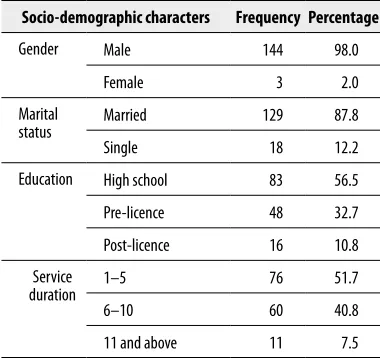
esultsAmong the officers interviewed 144 were males, 3 were females. 83 had graduated from a high school, 48 were pre-licence, 16 were post- licence. 136 have been work-ing for less than 11 years, only 11 have been workwork-ing for more than 11 years (Table 1).
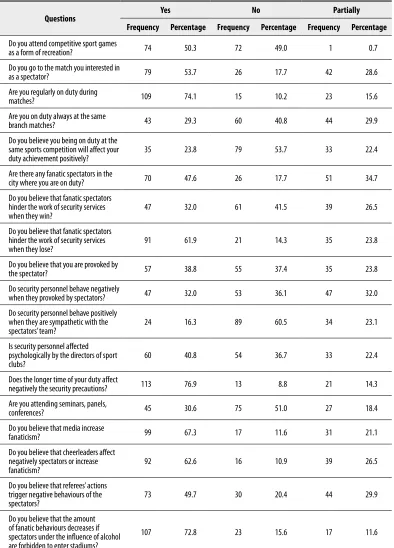
The majority of interviewees are regularly on duty (74.1%). However, only 53.7% of the participants are attending sport games as spectators and 50.3% of them have participated in sports competition. The study has demonstrated that a significant part of this group is not connected with sport culture and sporting events and they are attending matches only when they are on duty.
Some indicated that the security precautions are not always followed due to the long duration of the shift (76.9%). In addition, the study has demonstrated that a large part of the members of the security forces are not participating in training sessions such as seminars, panels and conferences. In order to improve the effec-tiveness of security measures, attention should be paid
Aggressiveness – is a mode of communication and behaviour where one expresses their feelings, needs and rights without regard or respect for the needs, rights and feelings of others.
Emotion – includes a wide range of observable behaviours, expressed feelings and changes in the state of mind.
Violence – is a physical force exerted to injure people or property. Violence may cause physical pain to the ones who experience it directly. Individuals, families, schools, workplaces, communities, society and the environment could be harmed by violence.
Socio-demographic characters Frequency Percentage
Gender Male 144 98.0 Female 3 2.0 Marital
status Married 129 87.8 Single 18 12.2 Education High school 83 56.5 Pre-licence 48 32.7 Post-licence 16 10.8 Service
duration 1–5 76 51.7 6–10 60 40.8 11 and above 11 7.5
Table 1. DPercentage and frequency distribution of socio-demographic characteristics of Security Personnel.
to training. Participants have explained that fanatic be-haviours decrease if spectators under the influence of al-cohol are forbidden to enter stadiums (72.8%).
They have pointed out that fanatic spectators hinder the work of security services when they lose (61.9%), or win (32%). In this case, it was proposed that the
security forces should develop as much flexibility as re-quired to change the position to the area occupied by the part of losing team.
It has turned out that 40.8% of the security forces are not on duty during branch matches. However, most of the respondents believe that being always on duty
Questions Yes No Partially Frequency Percentage Frequency Percentage Frequency Percentage
Do you attend competitive sport games
as a form of recreation? 74 50.3 72 49.0 1 0.7 Do you go to the match you interested in
as a spectator? 79 53.7 26 17.7 42 28.6 Are you regularly on duty during
matches? 109 74.1 15 10.2 23 15.6 Are you on duty always at the same
branch matches? 43 29.3 60 40.8 44 29.9 Do you believe you being on duty at the
same sports competition will affect your
duty achievement positively? 35 23.8 79 53.7 33 22.4 Are there any fanatic spectators in the
city where you are on duty? 70 47.6 26 17.7 51 34.7 Do you believe that fanatic spectators
hinder the work of security services
when they win? 47 32.0 61 41.5 39 26.5 Do you believe that fanatic spectators
hinder the work of security services
when they lose? 91 61.9 21 14.3 35 23.8 Do you believe that you are provoked by
the spectator? 57 38.8 55 37.4 35 23.8 Do security personnel behave negatively
when they provoked by spectators? 47 32.0 53 36.1 47 32.0 Do security personnel behave positively
when they are sympathetic with the
spectators’ team? 24 16.3 89 60.5 34 23.1 Is security personnel affected
psychologically by the directors of sport
clubs? 60 40.8 54 36.7 33 22.4
Does the longer time of your duty affect
negatively the security precautions? 113 76.9 13 8.8 21 14.3 Are you attending seminars, panels,
conferences? 45 30.6 75 51.0 27 18.4 Do you believe that media increase
fanaticism? 99 67.3 17 11.6 31 21.1 Do you believe that cheerleaders affect
negatively spectators or increase
fanaticism? 92 62.6 16 10.9 39 26.5 Do you believe that referees’ actions
trigger negative behaviours of the
spectators? 73 49.7 30 20.4 44 29.9 Do you believe that the amount
of fanatic behaviours decreases if spectators under the influence of alcohol are forbidden to enter stadiums?
107 72.8 23 15.6 17 11.6
Table 2. Answers collected from members of security services.
at the same branch matches will positively affect their duty achievements.
They have claimed that their behaviour affected nega-tively (32%) the spectators or is provoked (38.8% and 23.1% partially) by spectators. They have explained that they were under pressure created by sport clubs’ directors (40.8% and 4% partially). They pointed out that media increases the fanaticism (67.3%), cheerlead-ers negatively affect the spectators and increase fanati-cism (62.6%) and referees are also a factor triggering the negative behaviours of the fanatics (49.7%) (Table 2).
The security personnel declared that the first choice pre-caution against fanatic behaviours should be to forbid the fanatics to enter the stadiums (27%) as well as ed-ucation of spectators (25.1%). Moreover, they believe that they should get education (18%) on the behav-iour of spectators and lastly that physical force, custo-dy (14.5%) and arrest (15.4%) may adopted as possi-ble solution (Tapossi-ble 3).
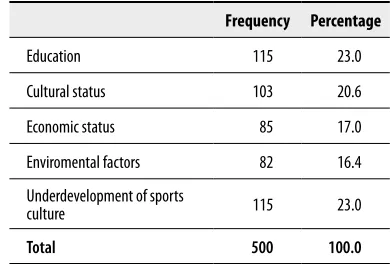
The security personnel assumed that the basic source of the negative actions of spectators may be their ed-ucational status and underdevelopment of the sports culture. On the other hand, they also believe that cul-tural and economic status of the spectators and envi-ronmental factors may constitute the reason (Table 4).
d
iscussionSocieties consist of various behaviours of the commu-nity and individuals, which can be defined with a wide range of norms [16]. Being formed by individuals, the community possesses different features than an individ-ual [4,17]. Moreover, according to Ayan (1999: 69) fa-natics have always the sense of ‘we’ [9]. Hence, it may be concluded from the study that fanatic spectators cre-ate difficulties for security forces, especially when they lose the competition (Table 2, 61.9%). Human lives are governed by the aim to achieving success. However, it should be pointed out that a spectator must think that
it is natural to be unsuccessful as well as to be successful. This concept has also been formulated by many sport scientists [12–15]. The sportsmen, directors of sport clubs and coaches should also refrain from comments that lead a group to effusive and aggressive behaviour.
According to the security officers, referees negatively af-fect the actions of the spectators (Table 2, 49.7% and 29.9% partially). In this way referees may be the agita-tors of violent actions of the spectaagita-tors. Spectaagita-tors may be easily provoked by the right decisions of the refer-ee, when they support the decision. It is important that educational programmes about football rules should be broadcasted in television [1].
Spectators under the influence of the alcohol should cer-tainly be prevented from entering the matches by con-ducting alcohol tests by security personnel [10]. In this way, the negative actions of the drunk spectators may be eliminated (Table 2, 72.8%).
The study has revealed that the security personnel be-lieves that cheerleaders affect the spectators in a nega-tive way and thus increase fanaticism (Table 2, 62.6%). The directors of the clubs should delivered marked free tickets and pay cheerleaders. It would lead a cheerlead-er to be dominant ovcheerlead-er the group that was given a free ticket. The cheerleaders must be paid regularly for be-ing good models to the spectators.
The spectators should be supervised with the cameras placed on special areas of the stadiums; the aggressive and violent spectators should be identified and pun-ished by forbidden entry to the matches, so that the freedom rights of other spectators would be preserved.
Security officers think that media organs increase the fanaticism (Table 2, 67.3%). Sports journalists’ style make the team, they are supporting, popular and foot-ball seem to be under their patronage. Sports journalists as well as club directors also remain biased and report biased in favour of their team, simultaneously increasing
Frequency Percentage
Physical effort 61 14.5 Education of spectators 106 25.1 Regular contact of police
departments 76 18.0 Custody and arrest 65 15.4
Fanatics banned from stadiums 114 27.0
Total 422 100.0
Table 3. Precautions against the actions of fanatics.
Frequency Percentage
Education 115 23.0 Cultural status 103 20.6
Economic status 85 17.0
Enviromental factors 82 16.4 Underdevelopment of sports
culture 115 23.0
Total 500 100.0
Table 4. Basic sources of negative actions of fanatics.
fanaticism. They should not forget about commenting in neutral and conciliating way.
It is believed that members of security forces should not be on duty at the same branch matches. However most respondents think that being on duty at the same branch games will positively affect their achievements and effectiveness. It should be perceived as some kind of professionalization of the security forces and should be considered in as detailed manner as possible.
Security forces do not participate in the educational ac-tivities such as seminars, panels, discussion, conferences (51% and 18.4% partially). They should value the ne-cessity and importance of education. Members of the security forces should also be taught how to cope with aggressive and fanatic spectators by planning activities and using case study analysis.
Security forces point out that fanatic spectators create more difficulties when they lose the match (61.90%) than when they win (32%). This situation should be considered in the duty planning with special attention paid to the possibility of moving the personnel to the part of the stadium occupied by losing team spectators.
c
onclusionsAggression is equated with effectiveness and craftiness [18]. Aggression and fanaticism of the spectators’ be-haviour is a multidimensional issue. The fact that the problem is a matter of education and culture should be
accepted by club executives and journalists, because this issue should not be perceived as a vicious cycle of in-creasing popularity and value. The problem of aggres-sivenesswith all its aspects should not be left on the security forces.
Violence may manifest itself in the police’s reaction to crime, self-defence against the evil or other forms of ac-tions morally justified and socially accepted [19].
A theoretical education on this issue including sociolo-gy and psycholosociolo-gy should be given to the security offi-cers. It will help security officers to control fanatic be-haviours of spectators and prevent violence [20].
The law and technology should be used maximally in the fight against spectators under the influence of alco-hol at stadiums’ entrances and fanatics inside stadiums.
The area and the interior of a stadium should be rede-signed in such way so that they will reflect the culture of sport. Moreover, the entertaining aspect of sport should be considered as a priority.
The cheerleaders should be chosen among people who have a real sense of the fan leader identity and will be trained continuously with the security forces.
Security forces involved in ensuring security should be given awards such as extra payment, extra free time as well as the successful ones should be awarded with spir-itual encouragement.
1. Ramazanoğlu F, Coban B: Aggressiveness behaviours of soccer spectators and prevention of these behav-iours. Fırat University Journal of Social Science, 2005; 15(1): 279–87
2. Ersoy A, Cebeci D: Futbolda yöneticilerin uyguladığı ödül ve cezaların disiplin açısından değerlendirilmesi. Marmara Universitesi Beden Egitimi ve Spor Bilimleri Dergisi II. Spor Bilimleri Dergisi Özel Sayısı, 2000; 178–87 [in Turkish] 3. Acet M, Serarslan Z: Futbol seyircisinin
sosyo-kül-türel yapısının şiddet eylemine etkisi, voleybol ve basketbol seyircisi ile karşılaştırılması. Marmara Universitesi Beden Egitimi ve Spor Bilimleri Dergisi II. Spor Bilimleri Dergisi Özel Sayısı, 2000; 141– 58 [in Turkish]
4. Atalay A: Spor gazeteciliği. 1998; 11–15 [in Turkish]
5. Karagözoğlu C, Mungan AS: Futbol seyircisinde saldırganlık eğilimleri. İstanbul örneği, 1997; 161– 65 [in Turkish]
6. Arslan C, Bingölbalı A, Ramazanoğlu F: Futbol seyircisini fanatik olmaya yönelten motivasyonel ve psikolojik etkenler. Spor Araştırmaları Dergisi, 2003; 7(2): 121–37 [in Turkish]
7. Baunmann S, İkizler HC ve Osman ÖA: Uygulamalı
spor psikolojisi. 1994; 7–8 [in Turkish] 8. Galeano E, Önalp E, Kutlu MN: Gölgede ve güneşte
futbol. 1998; 159–60 [in Turkish]
9. Ayan D: Aşırı taraftarlık etik bir sorunmudur? Düşünen Siyaset Dergisi, 1999; 1(2): 69 [in Turkish]
10. Ramazanoğlu F: Seyircilerde görülen saldırganlık davranışları ve önlenebilmesi. Sporda Sosyal Alanlar Seçme Konular I, 2004; 25–26 [in Turkish] 11. Afyon YA, Saygın Ö, Yıldız MY: Muğla Bölgesi
Amatör ve Genç Takımların Kategorilerine ve Mevkilerine Göre Saldırganlık Düzeylerinin Karşılaştırılması. II. Futbol ve Bilim Kongresi, 2000; 78 [in Turkish]
12. Bostancı MN: Futbolun anlattığı. Düşünen Siyaset Aylık Düşünce Dergisi, 1999; (2): 59–65 [in Turkish]
13. Collins D, Hale B, Loomis J: Differences in emo-tional responsivity and anger in athletes and non-athletes: startle reflex modulation and attributional response. J Sport Exerc Psychol, 1995; 17(2): 105
14. Johnson RN: Control of aggression. Aggression in Man and Animals, 1972; 217–19
15. Buss AH: The psychology of aggression, roots of aggression, 1981; 4–6
16. Katz D, Kahn R, Can H, Bayar Y: Örgütlerin Toplumsal Psikolojisi. Türkiye Amme İdaresi Enstitüsü Yayını, 1977; 167: 13 [in Turkish]
17. Erdoğan N: Popüler Futbol Kültürü ve Milliyetçilik. Birikim Der, 1992; 34: 27 [in Turkish]
18. Kałużny R, Płaczek A: “Declared bravery” of Polish police officers (comparative studies of 1998 and 2010). Archieves of Budo, 2011; 7(4): 247–53
19. Cynarski WJ, Litwiniuk A: The violence in boxing. Archives of Budo, 2006; 2: 1–10
20. Wann DL: Seasonal Changes in Spectators’ Identification and Involvement with and Evaluations of College Basketball and Football Teams. The Psychological Record, 1996; 46: 201–15