Page | 362
REVIEW ON LOAD SHARING & ENERGY SAVING
TECHNIQUES USED TO INCREASE THE LIFE TIME
OF WIRELESS SENSOR NETWORK
Mr.Abidali G Surati
1, Ms.Rupali R Jagtap
2 1,2Department of Electronics and Telecommunication
Annasaheb Dange College of Engineering & Technology, Ashta, Sangli, Maharashtra, India.
ABSTRACT
Wireless Sensor Networks are low power networks which have many small nodes.In wireless sensor network inherent limited
energy resource is the major drawback.To maximize the lifetime of the sensor node it is preferable to distribute the energy
dissipated throughout the wireless sensor network in order to minimize maintenance and maximize overall system
performance.In this paper we introduce various load sharing & energy saving techniques to increase the life time of all the
nodes in a way to get maximum efficiency from the network.
Keywords
:
Lifetime,
Load Sharing, Routing, Wireless Sensor NetworkI.
I
NTRODUCTIONThe popularity of Wireless Sensor Networks (WSN) has increased tremendously in recent time due to growth in
Micro-Electro-Mechanical Systems (MEMS) technology. WSN has the potentiality to connect the physical
world with the virtual world by forming a network of sensor nodes.
Figure: 1 architecture of wireless sensor node
Here, sensor nodes are usually battery-operated devices, and hence energy saving of sensor nodes is a major
design issue. To prolong the network„s lifetime, minimization of energy consumption should be implemented at
all layers of the network protocol stack starting from the physical to the application layer including cross-layer
optimization [9].
A sensor network is composed of a large number of sensor nodes, which are densely deployed
e
ither inside thephenomenon or very close to it.Since large numbers of sensor nodes are densely deployed, neighbor nodes may
be very close to each other. Hence, multihop communication in sensornetworks is expected to consume less
Page | 363
which is highly desired in covert operations.Multihop communication can also effectively overcome some of thesignal propagationeffects experienced in long-distance wireless communication.
Wireless Sensors Networks are self-governing systems composed of sensor nodes. Nodes are the building
blocks of Wireless Sensor Networks (WSN) and arevery low cost low power computers that can monitors one
ormore sensors. These nodes are usually built up of memoryelements, sensors and a small battery. These sensor
nodeshave computational and limited range receiving andtransmitting capabilities. In order to specify the path
for thedata transmission, these nodes have to make a mutualcoordination with its nearest neighbor. These nodes
behavelike a router for transceiving information. These powersupplied to an individual node completely
depends upon thesmall battery of limited energy inside it. Placements of nodesin improper places and difficulty
in changing or rechargingbatteries have made researchers to do investigations onreduction of energy
consumption [10].
II.
MAJOR
RESOURCES OF ENERGY WASTE INWSN
Energy is a very scarce resource for such sensor systems and has to be managed wisely in order to extend the
life of the sensor nodes for the duration of a particular mission. Energy consumption in a sensor node could be
due to either “useful” or “wasteful” sources. Useful energy consumption can be due to transmitting or receiving
data, processing query requests, andforwarding queries and data to neighboring nodes. Wasteful energy
consumption can be due toone or more of the following facts. One of the major sources of energy waste is idle
listening,that is, (listening to an idle channel in order to receive possible traffic) and secondly reason forenergy
waste is collision (When a node receives more than one packet at the same time, thesepackets are termed
collided), even when they coincide only partially. All packets that cause thecollision have to be discarded and
retransmissions of these packets are required which increasethe energy consumption. The next reason for energy
waste is overhearing (a node receivespackets that are destined to other nodes). The fourth one occurs as a result
of control-packetoverhead (a minimal number of control packets should be used to make a data
transmission).Finally, for energy waste is over-emitting, which is caused by the transmission of a messagewhen
the destination node is not ready. Considering the above-mentioned facts, a correctlydesigned protocol must be
considered to prevent these energy wastes [5].
In this paper we have discussed various algorithms & techniques to increase the lifetime of network to get
maximum efficiency from the network.
III.
L
OAD SHARING&
ENERGY SAVING TECHNIQUESA. Aggregation Routing Algorithm
S.Anandamurugan and C.Venkatesh suggest in [7] that WSN consists of some resource rich mobile relay nodes
and a many number of simple undynamic nodes. The mobile relays have high energy than the undynamic nodes.
The mobile relays can dynamically move around the entire network and help relieve sensors that are highly
burdened by heavy network traffic, thus improving the lifetime first analyze the performance of a large dense
network with one mobile relay and show that network lifetime improves over that of a purely undynamic
network by up to a factor of five. Also, the mobile relay needs to stay only within a two hop radius of the sink,
Page | 364
limit. The benefit of this algorithm is that it only requires a minimum number of nodes in the network to beknown of the location of the relay.It can at least improve the network lifetime in a randomly deployed WSN.
AR Algorithm with limited nodes
Parameters:
P: the current aggregation node
q: the current static relay node
r: the distance between p and the sink is r+2
ST: the straight line connecting the sink and the mobile node.
Algorithm:
Switch (k: the index of Mk where p€ Mk)
Case1, 2, 3:
Call method AR:
Case 4,...z-1:
If d(p,p0)=k-1+r
If the packet is generated in Qs-1 and it has travelled $k in Mk
Find a neighbour in Mk-1 whose distance to the sink is k-2+r and send the packet to it.
elseif the packet has reached line SK
Find a neighbour in Mk-1whose distance to the sink is k-2+r
and send the packet to it.
else
Find a neighbour who is closest to line SK and whose distance to the sink is k-1+r and send the packet to it.
elseif p is on the line SK
Find a neighbour in SK whose distance to the sink is k-1+r and send the packet to it.
else
Find a neighbour who is closest to line SK and has the same distance to the sink, send the packet to it.
Case z:
If d(p,p0)=k-1+r
Find a neighbour in SK whose distance to the sink is k-2+r and send the packet to it.
else
Find a neighbour in SK whose distance to the sink is k-1+r and send the packet to it.
Case z+1,...,R:
Find a neighbour who is closest to the sink, send the packet to it.
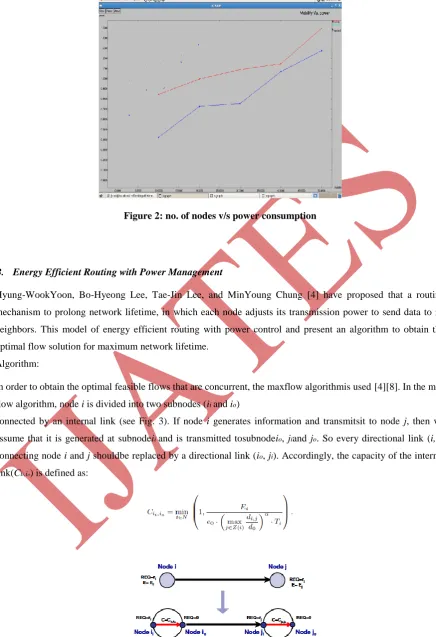
The result is presented in the figure 2 also improvement in power saving. In this, we consider 26,000 nodes; the
power taken by the existing system was 18,500. But in the present system are only 13,000. It represents 45%
Page | 365
Figure 2: no. of nodes v/s power consumptionB. Energy Efficient Routing with Power Management
Hyung-WookYoon, Bo-Hyeong Lee, Tae-Jin Lee, and MinYoung Chung [4] have proposed that a routing
mechanism to prolong network lifetime, in which each node adjusts its transmission power to send data to its
neighbors. This model of energy efficient routing with power control and present an algorithm to obtain the
optimal flow solution for maximum network lifetime.
Algorithm:
In order to obtain the optimal feasible flows that are concurrent, the maxflow algorithmis used [4][8]. In the max
flow algorithm, node i is divided into two subnodes (ii and io)
connected by an internal link (see Fig. 3). If node i generates information and transmitsit to node j, then we
assume that it is generated at subnodeii and is transmitted tosubnodeio, jiand jo. So every directional link (i, j)
connecting node i and j shouldbe replaced by a directional link (io, ji). Accordingly, the capacity of the internal
link(Cii,io) is defined as:
Page | 366
Then transform a node-capacitated network to a link-capacitated network as shown in Fig.3. All informationgenerated by a sensor node is transmitted via links under capacityconstraints. In other words, while network is
not partitioned, all information generatedin the sensor network can be transmitted to the central unit.A set of
flows satisfying thiscondition is called feasible. Proposed algorithm is to find feasible flow on each link and to
maximizenetwork lifetime. The proposed algorithm consists of two parts. First,link capacity Ciis computed then
use the maxflow algorithm to determine the flows along the links. Next, the maximum feasible time is obtained
by binary search. The algorithmterminates when the difference between the feasible and non-feasible network
lifetime is within a tolerance.
C. Neural Network Based Classification Techniques
Sudhir G. Akojwar, Rajendra M. Patrikar[6] proposed use of classification techniques using neural network to
reduce the data traffic from the node and thereby reduce energy consumption. The sensor data is classified using
ART1 Neural Network Model. Wireless sensor network populates distributed nodes. The cooperative routing
protocol is designed for communication in a distributed environment. In a distributed environment, the data
routing takes place in multiple hops and all the nodes take part in communication. This protocol has been
designed for wireless sensor networks. This ensures uniform dissipation of energy for all the nodes in the whole
network. Directed diffusion routing protocol is implemented to carry out performance comparison.
Wireless sensor network is highly data centric. Datacommunication in WSN must be efficient one and
mustconsume minimum power. Every sensor node consists ofmultiple sensors embedded in the same node.
Thus everysensor node is a source of data. These raw data streams cannotbe straight away communicated further
to the neighboringnode or the base station.
These sensor data streams need tobe classified. A group of sensor nodes forms a cluster. Eachnode transfer data
to a cluster head and then cluster headaggregates the data and sends to base station. Henceclustering and
classification techniques are important and cangive new dimension to the WSN paradigm.
Basically,classification system is either supervised or unsupervised,depending on whether they assign new
inputs to one of aninfinite number of discrete supervised classes or unsupervisedcategories respectively.
ART1 and Fuzzy ART areunsupervised neural network models which are used forclassification of sensor data.
ART1 model is used forclassification of Binary valued data. While Fuzzy ART modelcan be used for analog
data, wherein the input data is fuzzyvalued.
D. Efficient Load Sharing Routing Algorithm to Increase lifetime of Wireless Sensor Networks.
Asjad Amin, WaqarMehbob, ArslanHaiderRanjha, Hasnain Abbas, Nadeemabbas, WaqasAnjum have proposed
in [12] this algorithm an efficient load sharing routing technique to increase the life time of all the nodes in
away to get maximum efficiency from the network. The routingalgorithms such as link state which are used for
wireless sensornetworks prefer to choose a low cost path to decrease thetransmission time but they do not
consider the power of nodesfor transmission which sometimes result in reduction of alifetime of a network.
Algorithms such as link state, proposed by Dijkstra, areused for WSN to define a low cost path for transmission
of packets. A wireless sensor network is made of small low power sensors or nodes. A major issue in using
Page | 367
routing path withlowest possible cost to reduce the transmission time. Itsometimes results in unjustifieddistribution of load. Somenodes that are attached to low cost paths are distributed withheavy loads as compared
to other nodes. This results in arapid consumption of energy resource for such nodes. If a node consumes all the
available energy it is considered as dead and results in isolation of all the other nodes that areconnected to
network via this node. This severely effects thelifetime of overall network.
Algorithm:
Pv = power of node v
Pc = critical power (threshold)
D (v) = cost from source s to node v
C (v, w) = cost of link from v to w
N = Set containing all the nodes of network
M= Set containing all the nodes processed by the Algorithm for all nodes v in network N
if ( Pv< Pc)
for all neighbors w of v
C(v,w) = 40// set cost of link to a very large value
else
C (v,w) = original link cost from v to w
M = {s}
For all nodes v in network N except s
If v is adjacent to s
D (v) = C (s,v)
else
D (v) = ∞ While (M != N)
find a minimum D(W) for all w in (N – M)
M = M + {w}
For each v in (N –M) and adjacent to w, Calculate
D (v) = Min (D (v), D (w) + c (w, v))_
This modified Link state algorithm increases the life time of Wireless sensor network by defining power saving
mode. A small increase in transmission time is the only drawback of efficient load sharing routing algorithm.
IV.
CONCLUSIONS
In this paper we have presented various techniques that are used to increase the lifetime of wireless sensor
network which includes AR algorithm, neural network based techniques, energy efficient routing with power
management & efficient load sharing techniques. Their main purpose is to increase the life time of the wireless
sensor network.
V.
ACKNOWLEDGMENT
Many people have contributed to the success of this paper. Although a single sentence hardly suffices, we would
Page | 368
I express my sincere thanks to Prof. Ms.Rupali R JagtapDepartment of E&Tc, ADCET for providing theirvaluable assistance to carry out this paper.I take this opportunity to extend my gratitude to our beloved Principal
Prof. Dr.A.M.Mullafor allowing us to carry out this paper.
R
EFERENCES[1] Feng Wang, Jiangchuan Liu, “Networked Wireless Sensor Data Collection Issues, Challenges, and
Approaches” IEEE communications surveys & tutorials, vol. 13, no. 4, fourth quarter 2011.
[2] ParulKansal, DeepaliKansal, ArunBalodi, “compression of various routing protocols in wireless sensor
network” ,International Journal of Computer Applications (0975 – 8887)Volume 5– No.11, August 2010.
[3] Sourabh Jain, Praveen Kaushik, JyotiSinghai, “Energy efficient maximum lifetime routing for wireless
sensor network”, International Journal Of Advanced Smart Sensor Network Systems ( IJASSN ), Vol 2,
No.1, January 2012.
[4] Hyung-WookYoon, Bo-Hyeong Lee, Tae-Jin Lee, MinYoungChung,”Energy efficient routing with power
management to increase network lifetime in sensor networks”, ICCSA 2004, LNCS 3046, pp. 46–55,
2004._c Springer-Verlag Berlin Heidelberg ,2004 .
[5] Zahra Rezaei, ShimaMobininejad,”Energy saving in wireless sensor networks”, International Journal of
Computer Science & Engineering Survey (IJCSES) Vol.3, No.1, February 2012.
[6] Sudhir G. Akojwar, Rajendra M. Patrikar,” Improving Life Time of Wireless Sensor Networks Using
Neural Network Based Classification Techniques with Cooperative Routing”, international journal of
communications”, Issue 1, Volume 2, 2008
[7] S.Anandamurugan, C.Venkatesh,”Increasing the lifetime of wireless sensor network by using AR
algorithm”IJCA Special Issue on “Mobile Ad-hoc Networks MANETs, 2010.
[8] Y.ThomasHou,YiShi,Jianping Pan, Scott F. Midkiff, “Maximizing the lifetime of wireless sensor
network through optimal sinle session flow routing”, IEEE transactions on mobile computing, vol. 5, no. 9,
september 2006
[9] Jason Lester Hill,”System Architecture for Wireless Sensor Networks”,university of
californiaBerkeley,Spring 2003.
[10] I.F. Akyildiz, W.Su, Y. Sankarasubramaniam, E. Cayirci,” Wireless sensor networks: a survey”, Elsevier
Science B.V ,2002.
[11] Want R, Farkas K.I, NarayanaswamiC,“Energy Harvesting and conversation,”IEEE Pervasive Computing
vol 4,issue I ,January – March 2005.
[12] Asjad Amin, WaqarMehbob, ArslanHaiderRanjha, Hasnain Abbas, Nadeemabbas, WaqasAnjum,”