A Stepped Intervention Increases Well-Child Care and
Immunization Rates in a Disadvantaged Population
WHAT’S KNOWN ON THIS SUBJECT: Previous studies of reminder/recall/outreach to increase infant preventive health care in urban settings showed mixed results.
WHAT THIS STUDY ADDS: A stepped intervention of tracking and case management improved infant immunization status and receipt of preventive care in a population with low socioeconomic status, at a cost of $23.30 per infant per month.
abstract
OBJECTIVE:To test a stepped intervention of reminder/recall/case management to increase infant well-child visits and immunization rates.
METHODS:We conducted a randomized, controlled, practical, clinical trial with 811 infants born in an urban safety-net hospital and followed through 15 months of life. Step 1 (all infants) involved language-appropriate reminder postcards for every well-child visit. Step 2 (in-fants who missed an appointment or immunization) involved telephone reminders plus postcard and telephone recall. Step 3 (infants still behind on preventive care after steps 1 and 2) involved intensive case management and home visitation.
RESULTS:Infants in the intervention arm, compared with control in-fants, had significantly fewer days without immunization coverage in the first 15 months of life (109 vs 192 daysP⬍.01) and were more likely to haveⱖ5 well-child visits (65% vs 47%P⬍.01). In multivariate analyses, infants in the intervention arm were more likely than control infants to be up to date with 12-month immunizations and to have had
ⱖ5 well-child visits. The cost per child was $23.30 per month. CONCLUSION:This stepped intervention of tracking and case manage-ment improved infant immunization status and receipt of preventive care in a population of high-risk urban infants of low socioeconomic status.Pediatrics2009;124:455–464
CONTRIBUTORS:Simon J. Hambidge, MD, PhD,a,b,c,dStephanie L.
Phibbs, MPH,dVijayalaxmi Chandramouli, MS,dDiane Fairclough,
DrPH,dand John F. Steiner, MD, MPHd,e
aDenver Community Health Services, Denver Health, Denver,
Colorado; Departments ofbPediatrics,cPreventive Medicine and
Biometrics, andeGeneral Internal Medicine anddColorado
Health Outcomes Program, University of Colorado School of Medicine, Denver, Colorado
KEY WORDS
child health services, community pediatrics, immunization, randomized, controlled trial, well-child care
ABBREVIATIONS
CI— confidence interval DH—Denver Health OR— odds ratio WCV—well-child visit
ICD-9-CM—International Classification of Diseases, Ninth Revision, Clinical Modification
Results from this work were presented in part at meetings of the Pediatric Academic Societies; April 30, 2006; San Francisco, CA; and May 5, 2008; Honolulu, HI.
This trial has been registered at www.clinicaltrials.gov (identifier NCT00221507).
www.pediatrics.org/cgi/doi/10.1542/peds.2008-0446
doi:10.1542/peds.2008-0446
Accepted for publication Nov 25, 2008
Address correspondence to Simon J. Hambidge, MD, PhD, Denver Health, Mailcode 1914, 660 Bannock St, Denver, CO 80204. E-mail: [email protected]
PEDIATRICS (ISSN Numbers: Print, 0031-4005; Online, 1098-4275).
Copyright © 2009 by the American Academy of Pediatrics
Immunizations and preventive health care visits are central to high-quality infant health care. Many areas of the United States are approaching the im-munization goals outlined in Healthy People 2010.1–4 Despite these
suc-cesses, pockets of underimmunization persist in many of the same inner-city areas that were the primary sites of the measles epidemic in the 1990s.5–10
Because immunizations are associ-ated with receipt of other childhood preventive health services, many inner-city children who are underim-munized also are not receiving ade-quate well-child care.
Numerous studies identified risk fac-tors for childhood underimmunization, whereas others tested interventions to increase immunization rates.11–32 A
smaller number of studies examined risk factors for lack of receipt of well-child visits (WCVs) or tested interven-tions to improve WCV rates.11,23,31,33We
conducted a randomized, controlled, practical, clinical trial of a stepped intervention of reminder/recall/out-reach in a socioeconomically disad-vantaged, majority-Hispanic
popula-tion, to increase both immunization rates and WCVs in the first year of life.
METHODS
Setting and Subjects
Denver Health (DH) is the largest verti-cally integrated, community health center system funded by the Bureau of Primary Health Care (Section 330) in the United States.34This study used the
DH Medical Center and 3 of its affiliated community health centers. In 2005, these 3 health centers served 2174 pa-tients⬍15 months of age, with a total of 7605 visits. Ninety percent of these children were eligible for Medicaid. The racial/ethnic status of all children seen in these 3 health centers in 2005 was 19% black, 74% Hispanic, 3.5% non-Hispanic white, and 3.5% other.
Study Population and Randomization
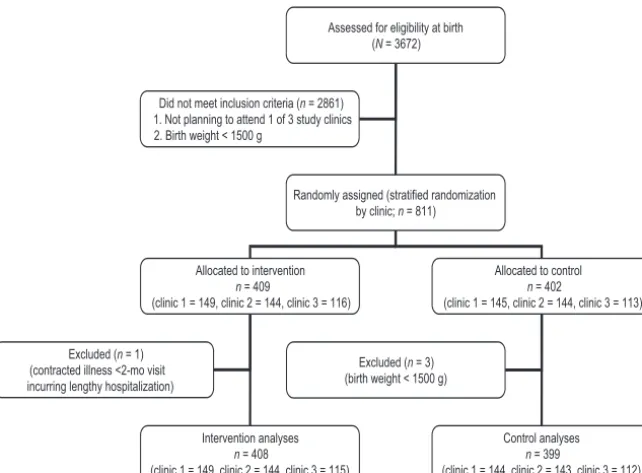
All 3672 infants who were born at DH Medical Center between February 1, 2004, and January 31, 2005, were as-sessed for eligibility (Fig 1). This clini-cal trial was approved by the
institu-tional review board of the University of Colorado School of Medicine and the research review committee of DH. Be-cause this study was determined by the institutional review board to be a minimal-risk study, consent was not required. We used the newborn nurs-ery log to identify eligible infants. This log records all births, birth weights, and primary health care center as-signments for the infants (determined on the basis of the home address). Of the total birth cohort, 811 infants met the inclusion criteria (family planning to attend 1 of 3 study health centers and infant birth weight of⬎1500 g). Infants who weigh ⬍1500 g at birth usually are hospitalized for prolonged periods and are not seen in primary care clinics until many months of age. All eligible infants underwent block-randomization, with stratification ac-cording to clinic, using random blocks of 2, 4, or 6 infants, to ensure similar numbers of control and intervention-treated infants in each clinic. Random-ization was implemented by using numbered nontranslucent envelopes; the research assistants who were re-sponsible for opening the envelopes and assigning the treatment arm were blinded to the randomization se-quence. The randomization sequence was generated by an analyst who was not otherwise involved in the study and it was maintained by the principal in-vestigator (Dr Hambidge), who was not involved in the actual random assign-ment of patients. Of the 409 infants who were allocated to the intervention arm, only 1 infant was excluded from the final analysis (because of contract-ing, before 2 months of age, a vaccine-preventable disease that resulted in a lengthy hospitalization). In the control arm, 3 infants (of a total of 402 infants) were excluded from the final analysis because they had birth weights of ⬍1500 g (these infants should not have been eligible for random assign-ment but were assigned in error). All
Assessed for eligibility at birth (N = 3672)
Did not meet inclusion criteria (n = 2861) 1. Not planning to attend 1 of 3 study clinics 2. Birth weight < 1500 g
Randomly assigned (stratified randomization by clinic; n = 811)
Allocated to intervention n = 409
(clinic 1 = 149, clinic 2 = 144, clinic 3 = 116)
Allocated to control n = 402
(clinic 1 = 145, clinic 2 = 144, clinic 3 = 113)
Excluded (n = 1) (contracted illness <2-mo visit incurring lengthy hospitalization)
Intervention analyses n = 408
(clinic 1 = 149, clinic 2 = 144, clinic 3 = 115)
Control analyses n = 399
(clinic 1 = 144, clinic 2 = 143, clinic 3 = 112) Excluded (n = 3)
(birth weight < 1500 g)
FIGURE 1
children were monitored through 15 months of life. Therefore, the first in-fant entered the study on February 1, 2004, and the last infant was moni-tored through April 31, 2006.
Study Design and Intervention
We conducted a randomized, con-trolled trial of a stepped intervention to assist families in obtaining preven-tive health care for their infants. The trial was practical in design,35to
max-imize its measure of effectiveness and external generalizability. Case manag-ers/patient navigators (described in detail below) established early contact with mothers in the intervention arm, using a scripted dialogue to assess in-dividual barriers to care. Of the par-ents representing infants enrolled in the study, 186 (46%) were met in the hospital, 182 (44%) were met by tele-phone, 8 (2%) were met at a home visit, and 32 (8%) were not met for this ini-tial scripted encounter. Mothers were interviewed to assess risk factors for underimmunization and were pro-vided with a refrigerator magnet with direct telephone contact information for case managers, an immunization schedule, and a bag containing educa-tional materials from the Colorado Bright Beginnings Warm Welcome pro-gram (information available at www. brightbeginningsco.org).
The intervention consisted of 3 steps, with each more-intensive step tar-geted to the progressively smaller number of children who had not re-sponded to less-intensive interventions. In step 1, all infants in the intervention arm received language-appropriate reminder postcards before every WCV. In step 2, all high-risk infants received a telephone reminder before all WCVs, with postcard and telephone recall for all missed WCVs or immunizations. An infant was classified as being at high risk on the basis of either missing a WCV or immunization or having
char-acteristics known from previous work with an earlier birth cohort of infants in this same safety-net health care sys-tem to be associated with lower immu-nization rates.23,24 These
characteris-tics included having a mother who was non-Hispanic (for the population served by DH, we showed that non-Hispanic white and black infants had worse immunization rates than did Hispanic infants23), who intended to
bottle feed (not breastfeed), who was uninsured, or who had a history of poor prenatal care or smoking.24In
ad-dition, infants were included in the high risk group if the mother had a history of street drug use or domestic violence. In step 3, only the infants who were still missing WCVs or behind on immunizations after step 2 received in-tensive outreach and home visitation. The timing of the intervention was as follows: 10 days before the age due for a WCV, reminder postcard (step 1) and telephone call (step 2); 10 and 21 days overdue for a WCV or immunization, re-call postcard and telephone re-call (step 2); 30 days overdue, home visit (step 3). The intervention continued through 16 months of age (May 31, 2006, for the youngest child in the cohort). Once children were classified as being at high risk and received more-intensive intervention, they continued to receive the more-intensive intervention for the duration of the study. We did not inter-vene or track patients once they left the DH system.
All telephone contacts and home visits were conducted by 1 of 3 patient navi-gators or promotoras (“health pro-moters”), all of whom had master’s de-grees and lived within the defined service area of a DH community health center. Two of the navigators were flu-ent in Spanish (1 spoke Spanish as her first language); the non–Spanish-speaking navigator worked only with English-speaking families. The naviga-tors conducted reminder/recall
activi-ties on weekends and evenings, as well as weekdays. In addition to reminders/ recalls, the navigators provided assis-tance with a broad array of nonbiomedi-cal issues, including transportation, insurance problems (especially Medic-aid reenrollment), billing issues, child care referrals, Social Security problems, and in some cases obtaining food on an emergency basis.
Data Sources
Immunization Registry
The DH electronic immunization regis-try is the system-wide legal repository for pediatric immunizations. This reg-istry captures ⬎97% of immuniza-tions given in the DH system,36and it
recorded ⬃1 700 000 vaccines for 140 000 children by February 1, 2004 (Michele Berg, MBA, written personal communication, 2007). These data were used to assess all immunization outcomes for this study.
Medical Record Review
Medical chart review was conducted to obtain measures of maternal prena-tal care, risk behaviors, race/ethnicity, language, birth country, and breast-feeding intent. Three trained research assistants abstracted these data from maternal prenatal and peripartum records. They also abstracted informa-tion from the newborn nursery log, in-cluding infant medical record number, date of birth, birth weight, and in-tended site for primary care.
Administrative Data
electronic registry) and WCV data (from billing records) were down-loaded weekly into a research data-base, to allow reminder/recall activi-ties to be performed in real time.
Measures
Primary Outcome Measures
The primary outcomes for this study were immunization and well-child care receipt, measured as both dichoto-mous and continuous variables. Immu-nization receipt was determined by us-ing the immunization registry, with duplicate immunizations or invalid doses being removed according to the minimal ages and intervals set by the Centers for Disease Control and Pre-vention for the time at the inception of our cohort.37 The primary
immuniza-tion measure was the continuous out-come of days underimmunized in the first 15 months of life. We used the method described by Luman et al38
to determine days underimmunized. Days underimmunized is a more-sensitive measure of infant underim-munization than up-to-date rates, be-cause it reflects the time at risk for vaccine-preventable disease in the first year of life. For the dichotomous outcome, up-to-date status was de-fined as receipt of the following immunizations: 4 diphtheria-tetanus-pertussis, 3 poliovirus, 1 measles-mumps-rubella, 3Haemophilus influ-enzae type B, 3 hepatitis B, 1 varicella, and 2 conjugated 7-valent pneumococcal vaccine doses by 15 months of age. These were all of the vaccines recommended for this age group at that time; only 2 pneumo-coccal vaccine doses were included because a transient national short-age affected our cohort and resulted in DH administering only 2 infant con-jugated 7-valent pneumococcal vac-cine doses until the shortage was re-solved.
WCVs were defined as age-appropriate
encounters associated with ICD-9-CM diagnosis code V20.2. A previous study conducted in the same health care sys-tem23 supported the validity of this
measure, with 10 782 WCVs being iden-tified through chart review and 10 494 being identified on the basis of ICD-9-CM codes alone (excellent agree-ment,⫽0.941). The dichotomous up-to-date well-child care outcome was defined as receipt of⬎5 WCVs by 15 months of age, of a possible 6 visits (at 2 weeks, 2 months, 4 months, 6 months, 9 months, and 12 months). This number of WCVs in the first 15 months of life is now a benchmark quality measure for managed-care plans.39
Secondary Outcome Measures
Secondary outcome measures in-cluded (1) receipt of influenza vaccine (which was not part of the standard immunization series but was increas-ingly recommended over the course of the study), (2) number of children with no health insurance, and (3) health care visits and charges attributable to hospitalization or emergency depart-ment or urgent care visits in the first 15 months of life.
Covariates
Maternal prenatal records provided the following covariates: language, parity, gravidity, total number of pre-natal visits, date of first prepre-natal visit, intent to breastfeed, history of domes-tic violence, and any use of tobacco, alcohol, or illicit drugs. Maternal post-natal visits or infant WCVs provided breastfeeding information when pre-natal information was not available. Data extracted from the newborn log were supplemented with data from the infant’s medical record when needed, so that complete informa-tion was obtained regarding infant date of birth, birth weight, and clinic where the infant’s care would be ob-tained. Administrative data
supple-mented the data from the medical chart and newborn nursery log to provide maternal race and ethnicity, insurance status, date of birth, and marital status. Insurance status was analyzed as the dominant insurance for each child over the course of the study. Poor prenatal care was de-fined as initiation of prenatal care after the first trimester or a total prenatal visit count of⬍7 visits. Be-cause the number of people report-ing any personal risk behavior was small, we created a maternal risk co-variate that was positive if there was a history of any alcohol or drug abuse or domestic violence.
Analyses
We used intent-to-treat analyses throughout this study, enrolling all infants who were intending to re-ceive care at any of 3 preselected pri-mary care clinics within DH and ran-domly assigning all infants at birth. Comparisons of the intervention and control groups were assessed by us-ing bivariate techniques, includus-ing
2 analyses for all categorical
vari-ables,ttests for normally distributed, continuous variables, and Wilcoxon tests for non–normally distributed variables. In a secondary analysis, we examined outcomes for infants who were active users of the health care system, ex-cluding those defined by clinic staff members (who used standard meth-ods40 to identify infants who had
moved or gone elsewhere) or research case managers as having left the health care system.
clinic level. The multivariate model chosen for analysis was determined on the basis of the distribution of the outcome variable; logistic regres-sion was used for bivariate out-comes (immunization up-to-date sta-tus and WCV up-to-date stasta-tus), and ordinary least-squares regression was used to model days underimmu-nized. Time (in days) to the fifth WCV was modeled with Cox regression techniques for multivariate analyses and with Kaplan-Meier analyses for graphing of unadjusted outcomes. We used standard statistical soft-ware to conduct all analyses (SAS 9.01; SAS Institute, Cary, NC).
RESULTS
Study Flow
Of the 3672 infants born at DH Medical Center during the study enrollment year (Fig 1), 811 were eligible for ran-dom assignment because they would receive health care at 1 of the 3 inter-vention clinics; after 4 exclusions (3 in-fants with birth weights of ⬍1500 g who were randomly assigned in error and 1 infant who underwent a lengthy hospitalization attributable to a vaccine-preventable disease that oc-curred before receipt of the 2-month immunizations), there were 408 in-fants in the intervention arm and 399 in the control arm. The randomization scheme resulted in similar numbers of infants in each study arm in each of the 3 clinics.
Study Population Characteristics
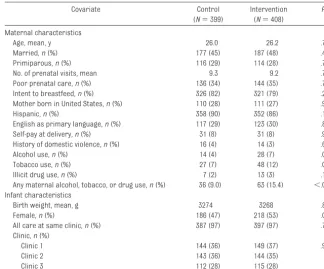
Maternal and infant characteristics are shown in Table 1. In general, these infants were from poor (⬎99% with public insurance or uninsured), pri-marily Hispanic, Spanish-speaking, ur-ban families. Despite randomization, 2 risk factors, namely, maternal alcohol use and tobacco use, differed signifi-cantly in prevalence in the 2 study arms. In both cases, there were more
women with the risk factor in the inter-vention arm. In addition, there were trends toward more girls, more illicit drug use, and fewer Hispanic mothers in the intervention arm than in the con-trol arm. In our population, non-Hispanic ethnicity is a risk factor for underimmunization.24 The risk
vari-able that combined all risk factors (smoking, domestic violence, and drug use) was more prevalent in the inter-vention arm.
Intervention Exposure
Overall, we sent 4812 language-appropriate reminder or recall post-cards (mean: 12 per infant), made 2675 telephone calls (mean: 6.6 per in-fant), and conducted 275 home visits (mean: 0.7 per infant). The telephone calls resulted in 1286 personal con-tacts, 624 messages left, and 765 non-contacts. Although 30 infants required no telephone calls, 8 infants required
⬎21 calls; the majority (296 infants) required 1 to 10 calls. Step 1 of the intervention involved the 30 infants (7% of the 408 infants in the interven-tion arm) who required no telephone calls, step 2 of the intervention in-volved 228 infants (56%), and step 3 involved 150 infants (37%) who re-quired ⱖ1 home visit. Of the 150 in-fants in step 3, 80 (53%) received 1 home visit, 59 (39%) received 2 or 3 home visits, and the rest received 4 to 7 home visits. There was no difference in intervention intensity among the 3 study clinics (data not shown). One hundred thirty infants (32%) were classified as being at high risk at birth and were placed directly into step 2 of the intervention. However, 54 infants (42%) in that group required a home visit, compared with 97 (35%) of 278 in the low-risk group (nonsignificant dif-ference,P⫽.19).
TABLE 1 Maternal and Infant Characteristics
Covariate Control
(N⫽399)
Intervention (N⫽408)
P
Maternal characteristics
Age, mean, y 26.0 26.2 .74
Married,n(%) 177 (45) 187 (48) .43
Primiparous,n(%) 116 (29) 114 (28) .72
No. of prenatal visits, mean 9.3 9.2 .76
Poor prenatal care,n(%) 136 (34) 144 (35) .72
Intent to breastfeed,n(%) 326 (82) 321 (79) .28
Mother born in United States,n(%) 110 (28) 111 (27) .91
Hispanic,n(%) 358 (90) 352 (86) .13a
English as primary language,n(%) 117 (29) 123 (30) .80
Self-pay at delivery,n(%) 31 (8) 31 (8) .93
History of domestic violence,n(%) 16 (4) 14 (3) .67
Alcohol use,n(%) 14 (4) 28 (7) .03b
Tobacco use,n(%) 27 (7) 48 (12) .01b
Illicit drug use,n(%) 7 (2) 13 (3) .19a
Any maternal alcohol, tobacco, or drug use,n(%) 36 (9.0) 63 (15.4) ⬍.01b
Infant characteristics
Birth weight, mean, g 3274 3268 .87
Female,n(%) 186 (47) 218 (53) .05a
All care at same clinic,n(%) 387 (97) 397 (97) .79
Clinic,n(%)
Clinic 1 144 (36) 149 (37) .99
Clinic 2 143 (36) 144 (35)
Clinic 3 112 (28) 115 (28)
Percentages apply to the number of children after exclusion of infants with unknown or blank values for that covariate. All covariates had⬍3% unknown or blank data. For dichotomous variables, only 1 descriptor is shown. Percentages may not add to 100% because of rounding.
Unadjusted Outcomes
In our primary intent-to-treat analysis, the intervention reduced the number of days of underimmunization in the first 15 months of life from 192 days to 109 days (P⬍.01) (Table 2). This rep-resents almost 3 months of better pro-tection against vaccine-preventable disease. The proportion of children withⱖ5 WCVs by 15 months of age in-creased from 47% in the control arm to 65% in the intervention arm (P⬍ .01). Among active patients (n⫽313 in the control arm andn ⫽ 281 in the intervention arm), the proportion of in-fants with ⱖ5 WCVs increased from 55% to 85% (P⬍.01).
Adjusted Outcomes
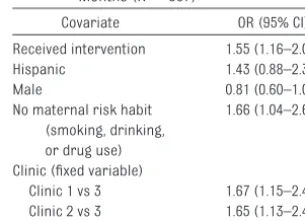
After adjustment for all significant co-variates in a multivariate linear re-gression model, only the intervention and Hispanic ethnicity were signifi-cantly associated with the number of days underimmunized per infant by 15 months of age (Table 3). In logistic re-gression modeling of the proportion of infants who were up to date with the 12-month immunizations by 15 months of age, being in the intervention arm (odds ratio [OR]: 1.6 [95% confidence
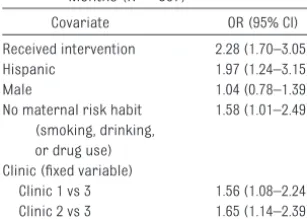
interval [CI]: 1.2–2.1]) and having a mother without documented risk be-haviors (OR: 1.7 [95% CI: 1.0 –2.7]) were independently associated with better rates (Table 4). Similarly, being in the intervention arm (OR: 2.3 [95% CI: 1.7– 3.0]), having no documented risk be-haviors (OR: 1.6 [95% CI: 1.0 –2.5]), and being of Hispanic ethnicity (OR: 2.0 [95% CI: 1.2–3.2]) were associated with better WCV rates (Table 5). One clinic also had consistently lower immuniza-tion and WCV rates, which reflects the variability that exists even within an integrated health care system and indicates the need for appropri-ate randomization within clinics and adjustment for clinic-level effects in randomized, controlled trials.
Analysis of Time to Fifth WCV
The time to the fifth WCV was notice-ably shorter in the intervention arm than in the control arm (Kaplan-Meier log-rank test,P⬍.01). In a multivari-ate Cox regression analysis of these data, the intervention (P⬍.0001), His-panic ethnicity (P⫽.003), absence of any maternal risk factor (P⫽.03), and clinic site (P⬍ .001) were positively associated with increased WCVs.
Secondary Outcomes
In addition to the primary immunization and WCV outcomes, the intervention had other benefits. For example, although in-fluenza vaccination was not part of the intervention, the proportion of infants who receivedⱖ1 vaccination to protect against influenza increased from 68% to 77% and that for 2 vaccinations in-creased from 31% to 43% (for both,P⬍ .01). Many infants in this study, despite being eligible for Medicaid, faced barri-ers in enrollment, which in turn limited health care access. The proportion of in-fants who were never enrolled in Medic-aid during the 15 months of the study decreased from 20% (81 of 399 infants) in the control arm to 14% (59 of 408 in-fants) in the intervention arm (P⫽.03). Overall health care charges and visits to the pediatric hospital ward or ICU, the emergency department, and the urgent care clinic did not differ significantly be-tween study arms (data not shown).
Cost Outcomes
The total cost of the intervention, in-cluding all personnel, mailings, tele-phone calls, home visits, and creation of the reminder/recall database, was $142 596. Therefore, the cost for each child in the intervention arm was $349.50, or $23.30 per child per month over 15 months. The cost per addi-tional WCV was $530, and the cost per additional child brought up to date was $3316. The cost per additional immuni-zation administered was $266. TABLE 2 Unadjusted Analyses of Preventive Health Services Measures (N⫽807)
Outcome Control
(N⫽399)
Intervention (N⫽408)
P
Immunization
Proportion up to date at 15 mo, % 33 44 ⬍.01
Time not up to date at 15 mo, mean⫾SD, d 192⫾442 109⫾273 ⬍.01
Proportion with 5 WCVs by 15 mo, % 47 65 ⬍.01
TABLE 3 Multivariate Linear Regression Analysis of Days Underimmunized at 15 Months (N⫽807)
Covariate Estimate SE P Standardized
Estimate
Intercept 423.6 59.8 ⬍.0001 ⬍0.01
Received intervention ⫺107.5 32.3 ⬍.01 ⫺0.12
Hispanic ⫺220.6 51.9 ⬍.01 ⫺0.16
Female ⫺2.2 32.3 .95 ⫺0.00
Maternal smoking, drinking, and/or drug use 11.3 50.6 .82 0.01 Clinic (fixed variable)
Clinic 1 39.5 40.9 .33 0.04
Clinic 2 36.3 41.3 .38 0.04
TABLE 4 Multivariate Logistic Regression Analysis of Up-To-Date Status for 12-Month Immunizations at 15 Months (N⫽807)
Covariate OR (95% CI)
Received intervention 1.55 (1.16–2.07)
Hispanic 1.43 (0.88–2.32)
Male 0.81 (0.60–1.08)
No maternal risk habit (smoking, drinking, or drug use)
1.66 (1.04–2.65)
Clinic (fixed variable)
DISCUSSION
We conducted a randomized, controlled trial to evaluate a stepped intervention of reminder, recall, case management, and home visitation to increase immuniza-tion and WCV rates in a poor urban pop-ulation. The intervention resulted in im-proved preventive health care delivery for both primary outcome measures; days underimmunized in the first 15 months of life were decreased by 43%, which resulted in almost 3 months less of underimmunization per child, on aver-age. The proportion of children withⱖ5 WCVs by 15 months of age increased by 18%, to 65% of infants in the intervention arm (85% for children who were active users of the health care system).
This study adds information to several previously published interventions to in-crease immunization rates for inner-city infants. There is ample evidence of the success of reminder/recall strategies in general to increase pediatric immuniza-tion rates.15,16,19,21,29However, there have
been several negative or only marginally successful trials of reminder/recall strategies in specific inner-city locales. For example, a large-scale, registry-based, reminder/recall intervention in Atlanta, Georgia, resulted in only small improvements in immunization status.25
A number of previous interventions in Denver have been unsuccessful or only slightly successful,23,41,42including an
in-tervention that used both reminder/re-call and additional clinic-based strate-gies.23 Taken together, these results
suggest that reminder/recall activities work to improve pediatric immunization rates but, in some economically disad-vantaged areas, additional strategies (such as intensive case management) may be necessary to reach optimal vac-cination coverage, to provide herd im-munity for entire populations, and to meet the goals of Healthy People 2010.1
In our study, children who were not brought in for well-child care and immu-nizations after reminder/recall were tar-geted with more-intensive outreach, in-cluding home visitation. Slightly more than one third of our population re-quiredⱖ1 home visit. Such reminder/ recall/outreach has been shown to work in other settings. For example, Rodewald et al31 demonstrated that this strategy
could improve immunization rates and preventive health care visits in the Roch-ester, New York, area, although they used an on-treatment rather than intent-to-treat analysis. That intervention was the model for the Rochester Primary Care Outreach Program32 and was
shown to reduce disparities in childhood immunization rates.16The successful
in-terventions in that study and in the cur-rent study, in 2 very diffecur-rent settings and populations, suggest that the re-minder/recall/outreach method works to improve preventive health services in disadvantaged populations. A key to the success of both projects was the work of energized, committed, culturally profi-cient case managers who functioned as patient navigators to help access pre-ventive services for families. In our study, given the majority-Hispanic popu-lation, they functioned aspromotoras, community workers who promoted the health of infants while addressing both biomedical and social needs.
Of note, the identification of infants as being at low risk or high risk at birth did not differentiate successfully the infants who would eventually need a home visit. This finding adds to previous evidence24
that it is not possible to predict
accu-rately at birth which infants will fall be-hind in their preventive health care, and it emphasizes the need to target all in-fants in vulnerable populations.
Clearly, any prospect of translating this research into practice depends on the relative cost of the intervention per child. The Rochester group estimated their costs for tracking and outreach at $5.27 per child per month ($6.72 in 2004 dol-lars); our costs were 3.5 times greater, accounting for inflation.43This difference
in cost was attributable to several fac-tors. First, our protocol involved meeting families in the hospital when possible; this added case management time and therefore cost to the intervention. Sec-ond, more than one third of our cost was attributable to the one-time creation of a sophisticated computer database that could automatically process electronic immunization and WCV data and gener-ate reminder/recall cards and lists. Third, and most importantly, 37% of in-fants in our study required a home visit, compared with 12% in the Rochester study. This threefold increase accounted for much of the increased cost and sug-gests that the population in Denver is less responsive to reminder/recall cards and calls than is that in Rochester.
A study using home visitation and case management to increase WCV and im-munization rates for black infants in South Central Los Angeles, California, was fairly successful but at significant cost, that is, $12 022 per additional child immunized and $1587 per child in the intervention arm.30However, that
study used home visitation for all chil-dren in the intervention group, which increased costs, and did not use a postcard and telephone reminder/re-call system, which might have in-creased effectiveness.
From a societal perspective, vaccines are the most cost-effective pediatric health intervention, saving an average of $5 in direct costs and $11 in addi-tional costs to society for every $1 TABLE 5 Multivariate Logistic Regression
Analysis of Receipt of⬎5 WCVs by 15 Months (N⫽807)
Covariate OR (95% CI)
Received intervention 2.28 (1.70–3.05)
Hispanic 1.97 (1.24–3.15)
Male 1.04 (0.78–1.39)
No maternal risk habit (smoking, drinking, or drug use)
1.58 (1.01–2.49)
Clinic (fixed variable)
spent.44In the United States, however,
with its current fragmented system of health care, every health care delivery system must decide what is an accept-able cost/effect ratio for interventions that improve infant preventive visits and immunization rates.
In the most in-depth studies of home visitation of poor mothers and ma-ternal and child outcomes to date, Olds and colleagues45–49 demonstrated
many favorable outcomes in different settings, including Denver, Colorado. Of note, those studies did not demon-strate an increase in infant immuniza-tion rates,45 although childhood
vac-cines were not a target of the home visitors but only a secondary outcome. Those studies also found that nurse home visitors produced better out-comes than did paraprofessional home visitors.47,48Our study used case
managers/home visitors who had master’s degrees and were commu-nity based, which suggests that it is possible to have successful outcomes with home visitors who are not nurses. Other programs used community-based paraprofessionals successfully to demonstrate positive maternal-child outcomes,50although
immuniza-tion rates and WCVs were not targeted specifically.
Perhaps the major limitation of our work is external generalizability, given the fact that we intervened in a large, vertically integrated, urban health care system with a population of majority-Hispanic children. It is there-fore encouraging that similar strate-gies worked both in inner-city Denver and in Rochester, New York,31 which
had a population that was⬍10% His-panic at the time of the study and more than one third black. Taken together, these 2 studies suggest that the reminder/recall/case management/ home visitation strategy would work in very different settings. A second limita-tion is that, because certain maternal risk factors resulted in more-intensive intervention, any association of those risk factors with health care outcomes at the end of the study would be biased toward the null hypothesis. A third lim-itation is that few infants (7%) did not require at least some telephone re-minder/recall, which suggests that fu-ture interventions in similar popula-tions may need to begin by at least calling all infants. Finally, any assess-ment of the effectiveness of a lon-gitudinal intervention requires data on sustainability. We are collecting follow-up data on our entire cohort through 2 years of age, well after the
end of the intervention, and will assess receipt of preventive health care (WCVs, immunizations, and other sec-ondary outcomes, such as screening for lead toxicity and anemia and inter-partum spacing) at that time.
CONCLUSION
A stepped intervention of reminder/ recall/case management/home visita-tion was successful in improving re-ceipt of preventive health services in a disadvantaged population of urban in-fants. Implementation of this strategy on a broader scale will require addi-tional data on cost-effectiveness and sustainability of the positive impact of the intervention.
ACKNOWLEDGMENTS
This study was funded by a Generalist Physician Faculty Scholars Award to Dr Hambidge from the Robert Wood John-son Foundation.
We thank William Henderson, PhD, for his advice on randomization. We also greatly appreciate Silvia Gutie´r-rez Raghunath and Maria Elena Rivera for their dedicated contribu-tions to these families and this study; without them, our work would not have been possible.
REFERENCES
1. US Department of Health and Human Services.Healthy People 2010, Volume I: Understanding and Improving Health and Objectives for Improving Health. 2nd ed. Washington, DC: US Department of Health and Human Services; 2000. Available at: www.health.gov/
healthypeople. Accessed June 24, 2009
2. Centers for Disease Control and Prevention. National, state, and urban area vaccination coverage levels among children aged 19 –35 months: United States, 2006.MMWR Morb Mortal Wkly Rep.
2007;56(34):880 – 885
3. Abramson J, Pickering L. US immunization policy.JAMA.2002;287(4):505–509
4. National Vaccine Advisory Committee. Strategies to sustain success in childhood immunizations.
JAMA.1999;282(4):363–370
5. Gindler J, Atkinson W, Markowitz L, Hutchins S. Epidemiology of measles in the United States in 1989 and 1990.Pediatr Infect Dis J.1992;11(10):841– 846
6. Kenyon TA, Matuck MA, Stroh G. Persistent low immunization coverage among inner-city pre-school children despite access to free vaccine.Pediatrics.1998;101(4):612– 616
7. Klevens R, Luman ET. US children living in and near poverty: risk of vaccine-preventable diseases.
8. Daniels D, Jiles R, Klevens R, Herrera G. Undervaccinated African-American preschoolers: a case of missed opportunities.Am J Prev Med.2001;20(4 suppl):61– 68
9. Santoli J, Setia S, Rodewald L, et al. Immunization pockets of need: science and practice.Am J Prev Med.2000;19(3 suppl):89 –98
10. Wooten KG, Luman ET, Barker LE. Socioeconomic factors and persistent racial disparities in childhood vaccination.Am J Health Behav.2007;31(4):434 – 445
11. Freed G, Clark S, Pathman D, Schectman R. Influences on the receipt of well-child visits in the first two years of life.Pediatrics.1999;103(4):864 – 869
12. Brenner R, Simons-Morton B, Bhaskar B, et al. Prevalence and predictors of immunization among inner-city infants: a birth cohort study.Pediatrics.2001;108(3):661– 670
13. Bates AS, Wolinsky FD. Personal, financial and structural barriers to immunization in socioeco-nomically disadvantaged urban children.Pediatrics.1998;101(4):591–596
14. Wood D, Donald-Sherbourne C, Halfon N, et al. Factors related to immunization status among inner-city Latino and African-American preschoolers.Pediatrics.1995;96(2):295–301
15. Szilagyi PG, Bordley C, Vann J, et al. Effect of patient reminder/recall interventions on immuniza-tion rates: a review.JAMA.2000;284(14):1820 –1827
16. Szilagyi PG, Schaffer S, Shone L, et al. Reducing geographic, racial, and ethnic disparities in childhood immunization rates by using reminder/recall interventions in urban primary care practices.Pediatrics.2002;110(5). Available at: www.pediatrics.org/cgi/content/full/110/5/e58 17. LeBaron CW, Chaney M, Baughman AL, et al. Impact of measurement and feedback on vaccination
coverage in public clinics, 1988 –1994.JAMA.1997;277(8):631– 635
18. LeBaron CW, Mercer T, Massoudi MS, et al. Changes in clinic vaccination coverage after institution of measurement and feedback in 4 states and 2 cities.Arch Pediatr Adolesc Med.1999;153(8): 879 – 886
19. Centers for Disease Control and Prevention. Vaccine-preventable diseases: improving vaccination coverage in children, adolescents, and adults: a report on recommendations from the Task Force on Community Preventive Services.MMWR Recomm Rep.1999;48(RR-8):1–15
20. Bordley WC, Chelminski A, Margolis PA, Kraus R, Szilagyi PG, Vann JJ. The effect of audit and feedback on immunization delivery: a systematic review.Am J Prev Med.2000;18(4):343–350 21. Briss PA, Rodewald LE, Hinman AR, et al. Reviews of evidence regarding interventions to improve
vaccination coverage in children, adolescents, and adults.Am J Prev Med.2000;18(1 suppl): 97–140
22. Dini EF, Linkins RW, Sigafoos J. The impact of computer-generated messages on childhood immu-nization coverage.Am J Prev Med.2000;18(2):132–139
23. Hambidge SJ, Davidson AJ, Phibbs SL, et al. Strategies to improve immunization rates and well-child care in a disadvantaged population: a cluster randomized controlled trial.Arch Pediatr Adolesc Med.2004;158(2):162–169
24. Hambidge SJ, Phibbs SL, Davidson AJ, et al. Individually significant risk factors do not provide an accurate clinical prediction rule for infant underimmunization in one disadvantaged urban area.
Ambul Pediatr.2006;6(3):165–172
25. LeBaron CW, Starnes DM, Rask KJ. The impact of reminder-recall interventions on low vaccination coverage in an inner-city population.Arch Pediatr Adolesc Med.2004;158(3):255–261
26. Rodewald LE. Closing the gap: strategies for increasing immunization levels among at-risk popu-lations.Ethn Dis.2002;12(1):S2–S3
27. Santoli JM, Huet NJ, Smith PJ, et al. Insurance status and vaccination coverage among US pre-school children.Pediatrics.2004;113(6 suppl):1959 –1964
28. Shefer A, Briss P, Rodewarld L, et al. Improving immunization coverage rates: an evidence-based review of the literature.Epidemiol Rev.1999;21(1):96 –142
29. Szilagyi P, Vann J, Bordley C, et al. Interventions aimed at improving immunization rates.Cochrane Database Syst Rev.2002;(4):CD003941
30. Wood D, Halfon N, Donald-Sherbourne C, et al. Increasing immunization rates among inner-city, African American children: a randomized trial of case management. JAMA. 1998;279(1):29 –34 31. Rodewald LE, Szilagyi PG, Humiston SG, Barth R, Kraus R, Raubertas RF. A randomized study of
tracking with outreach and provider prompting to improve immunization coverage and primary care.Pediatrics.1999;103(1):31–38
32. Shefer A, Santoli J, Wortley P, et al. Status of quality improvement activities to improve immuni-zation practices and delivery: findings from the immuniimmuni-zation quality improvement symposium, October 2003.J Public Health Manag Pract.2006;12(1):77– 89
34. Gabow P, Eisert S, Wright R. Denver Health: a model for the integration of a public hospital and community health centers.Ann Intern Med.2003;138(2):143–149
35. Tunis SR, Stryer DB, Clancy CM. Practical clinical trials: increasing the value of clinical research for decision making in clinical and health policy.JAMA.2003;290(12):1624 –1632
36. Davidson AJ, Melinkovich P, Beaty BL, et al. Immunization registry accuracy: improvement with progressive clinical application.Am J Prev Med.2003;24(3):276 –280
37. Centers for Disease Control and Prevention. Recommended childhood and adolescent immuniza-tion schedule: United States, January-June 2004.MMWR Morb Mortal Wkly Rep.2004;53(1):Q1–Q4 38. Luman ET, Barker LE, Shaw KM, McCauley MM, Buehler JW, Pickering LK. Timeliness of childhood vaccinations in the United States: days undervaccinated and number of vaccines delayed.JAMA.
2005;293(10):1204 –1211
39. Pawlson LG, Scholle SH, Powers A. Comparison of administrative-only versus administrative plus chart review data for reporting HEDIS hybrid measures.Am J Manag Care.2007;13(10):553–558 40. Phibbs SL, Hambidge SJ, Steiner JF, Davidson AJ. The impact of inactive infants on clinic-based
immunization rates.Ambul Pediatr.2006;6(3):173–177
41. Daley MF, Steiner JF, Brayden RM, Xu S, Morrison S, Kempe A. Immunization registry-based recall for a new vaccine.Ambul. Pediatr.2002;2(6):438 – 443
42. Daley MF, Steiner JF, Kempe A, et al. Quality improvement in immunization delivery following an unsuccessful immunization recall.Ambul Pediatr.2004;4(3):217–223
43. Bureau of Labor Statistics. Consumer Price Index tables. Available at: ftp://ftp.bls.gov/pub/ special.requests/cpi/cpiai.txt. Accessed October 12, 2008
44. Zhou F, Santoli J, Messonnier ML, et al. Economic evaluation of the 7-vaccine routine childhood immunization schedule in the United States, 2001.Arch Pediatr Adolesc Med.2005;159(12): 1136 –1144
45. Kitzman H, Olds DL, Henderson CR Jr, et al. Effect of prenatal and infancy home visitation by nurses on pregnancy outcomes, childhood injuries, and repeated childbearing: a randomized controlled trial.JAMA.1997;278(8):644 – 652
46. Kitzman H, Olds DL, Sidora K, et al. Enduring effects of nurse home visitation on maternal life course: a 3-year follow-up of a randomized trial.JAMA.2000;283(15):1983–1989
47. Olds DL, Robinson J, O’Brien R, et al. Home visiting by paraprofessionals and by nurses: a random-ized, controlled trial.Pediatrics.2002;110(3):486 – 496
48. Olds DL, Robinson J, Pettitt LM, et al. Effects of home visits by paraprofessionals and by nurses: age 4 follow-up results of a randomized trial.Pediatrics.2004;114(6):1560 –1568
49. Olds DL, Kitzman H, Hanks C, et al. Effects of nurse home visiting on maternal and child functioning: age-9 follow-up of a randomized trial.Pediatrics.2007;120(4). Available at: www.pediatrics.org/ cgi/content/full/120/4/e832
DOI: 10.1542/peds.2008-0446 originally published online July 27, 2009;
2009;124;455
Pediatrics
Fairclough and John F. Steiner
Simon J. Hambidge, Stephanie L. Phibbs, Vijayalaxmi Chandramouli, Diane
Services
Updated Information &
http://pediatrics.aappublications.org/content/124/2/455
including high resolution figures, can be found at:
References
http://pediatrics.aappublications.org/content/124/2/455#BIBL
This article cites 43 articles, 8 of which you can access for free at:
Subspecialty Collections
b
http://www.aappublications.org/cgi/collection/infectious_diseases_su
Infectious Disease following collection(s):
This article, along with others on similar topics, appears in the
Permissions & Licensing
http://www.aappublications.org/site/misc/Permissions.xhtml
in its entirety can be found online at:
Information about reproducing this article in parts (figures, tables) or
Reprints
http://www.aappublications.org/site/misc/reprints.xhtml
DOI: 10.1542/peds.2008-0446 originally published online July 27, 2009;
2009;124;455
Pediatrics
Fairclough and John F. Steiner
Simon J. Hambidge, Stephanie L. Phibbs, Vijayalaxmi Chandramouli, Diane
Disadvantaged Population
A Stepped Intervention Increases Well-Child Care and Immunization Rates in a
http://pediatrics.aappublications.org/content/124/2/455
located on the World Wide Web at:
The online version of this article, along with updated information and services, is
by the American Academy of Pediatrics. All rights reserved. Print ISSN: 1073-0397.