A Brief Screening Questionnaire for Infant Sleep Problems:
Validation and Findings for an Internet Sample
Avi Sadeh, DSc
ABSTRACT. Objective. To develop and validate (us-ing subjective and objective methods) a brief infant sleep questionnaire (BISQ) that would be appropriate for screening in pediatric settings.
Design. Two studies were performed to assess the properties of the BISQ. Study I compared BISQ measures with sleep diary measures and objective actigraphic sleep measures for clinical (Nⴝ43) and control (Nⴝ57) groups of infants (5–29 months of age). The second study was based on an Internet survey of 1028 respondents who completed the BISQ posted on an infant sleep web site.
Results. In study I, BISQ measures were found to be correlated significantly with sleep measures derived from actigraphy and sleep diaries. BISQ measures (num-ber of night wakings and nocturnal sleep duration) were the best predictors for distinguishing between clinical and control samples. High test-retest correlations (r>.82) were demonstrated for BISQ measures for a subsample of 26 infants. Study II provided a developmental perspec-tive on BISQ measures. The study demonstrated that BISQ measures derived from a large Internet survey pro-vided developmental and sleep ecology-related findings that corresponded to the existing literature findings on sleep patterns in early childhood.
Conclusions. The findings provide psychometric, clinical, and ecologic support for the use of the BISQ as a brief infant sleep screening tool for clinical and re-search purposes. Potential clinical cutoff scores are provided. Pediatrics 2004;113:e570 –e577. URL: http: //www.pediatrics.org/cgi/content/full/113/6/e570; sleep, infant, child, actigraphy, night waking, assessment, screening.
ABBREVIATION. BISQ, brief infant sleep questionnaire.
I
nfant sleep problems are among the most preva-lent problems presented to pediatricians and other child-care professionals.1–3 The consolida-tion of sleep during the night, which is referred to as “sleeping through the night,” is a rapid maturational process during the first year of life.4,5However, sur-veys show that as many as 20% to 30% of all infants and toddlers do not succeed in achieving this goal and their sleep continues to be fragmented, as man-ifested by multiple and/or prolonged night wakings, which are considered to be the most prevalent sleepproblems during early childhood.6–9 If not treated, these night-waking problems are persistent and can last well into adulthood.10–12
Night waking and related sleep problems have been associated with difficult temperaments and be-havior problems among children12–17 and with poorer neurobehavioral functioning among older children.17Parental stress and psychopathologic con-ditions have also been linked to sleep problems in early childhood.18–22
Numerous studies have shown that infant sleep problems are treatable, with high success rates.2,23–26 Early intervention and prevention programs have also demonstrated impressive efficacy.27,28 The high prevalence of sleep problems, their negative implica-tions for infants and their parents, and the high success rates of clinical and educational interven-tions emphasize the need for early screening tools that could be used by parents and/or professionals to assess sleep problems in the first 3 years of life.
A recent survey reported that a high proportion of pediatricians do not regularly screen infants and tod-dlers for sleep problems.3 In addition, only 46% of the pediatricians surveyed felt confident of their abil-ity to screen for sleep problems. An earlier study also emphasized insufficient teaching regarding pediatric sleep issues in medical schools.1The authors of both studies concluded that more education in pediatric sleep medicine is needed. Furthermore, a recent study demonstrated that sleep problems are rarely addressed in general pediatric clinics before their identification by parental responses on a validated sleep questionnaire.29 Therefore, it is conceivable that the availability of brief validated screening in-struments would facilitate regular screening by pro-fessionals. A screening instrument that would also be available to parents who have concerns about their child’s sleep could promote early detection of and intervention for sleep problems.
It is surprising that the use of a standardized, brief, valid infant sleep questionnaire has never been es-tablished. Many studies have used various infant sleep questionnaires for different purposes.6,8,9,12,30–36 However, none of those instruments has become a standardized clinical or research tool. The aims of the present study were 1) to develop a brief standard-ized questionnaire for screening for infant and tod-dler sleep problems, 2) to validate the questionnaire by comparing clinical and nonclinical samples, 3) to validate the derived sleep measures by correlating them with daily sleep logs and objective actigraphic From the Department of Psychology, Tel Aviv University, Tel Aviv, Israel.
Received for publication Jul 7, 2003; accepted Jan 5, 2004.
Address correspondence to Avi Sadeh, DSc, Department of Psychology, Tel Aviv University, Ramat Aviv, Tel Aviv 69978, Israel. E-mail: sadeh@post. tau.ac.il
sleep measures, and 4) to examine the possibility of using the questionnaire as an Internet resource for parents.
Two studies were conducted with the brief infant sleep questionnaire (BISQ). The first study was based on clinical and nonclinical control samples. The sec-ond study was based on a sample of parents who completed the BISQ via the Internet.
METHODS Study I
Aims
The aims of this specific study were 1) to examine the test-retest reliability of the BISQ measures, 2) to compare the BISQ measures with other subjective and objective measures of sleep, and 3) to evaluate the use of the BISQ for diagnostic purposes (its accuracy in discriminating between clinical and control samples).
Participants
One hundred infants and their parents participated in this study. The clinical sample consisted of 43 infants and toddlers (26 boys and 17 girls) whose parents sought professional help (self-referrals and professional (self-referrals) for sleep problems at a chil-dren’s sleep laboratory. The chilchil-dren’s ages ranged from 6 to 29 months (mean age: 12.30 months, SD: 5.51 months). The control sample consisted of 57 children (30 boys and 27 girls) with no reported sleep problems, whose parents volunteered to participate in the study. The parents of the control group were recruited by direct contacts with parents working in large, high-technology companies to match for the relatively high socioeconomic status of the clinical group. The ages of the children in the control group ranged from 5 to 26 months (mean age: 14.44 months, SD: 6.26 months). Although age differences between the groups were not significant, age was used as a covariate or adjusted for in all statistical analyses. For the entire sample, the median age was 12.61 months, the first quartile was 9.88 months, and the third quartile was 19.66 months.
The parents of each child in both samples completed the BISQ and an additional questionnaire covering family background in-formation. The BISQ was completed by 1 of the parents during the initial contact (intake or the first meeting with control parents). In addition, the parents were given actigraphs and daily sleep logs and were instructed to attach the actigraph to the child’s left leg for 5 to 7 consecutive nights. For a test-retest reliability evaluation, 26 parents completed the BISQ twice, with a 3-week interval between administrations.
Measures The BISQ
The BISQ was developed on the basis of a review of the infant sleep literature in search of meaningful variables, particularly clinical studies based on the use of subjective and objective infant sleep measures.25,37,38The questionnaire variables (see
“Appen-dix”) included 1) nocturnal sleep duration (between the hours of 7pmand 7am); 2) daytime sleep duration (between the hours of 7 am and 7 pm); 3) number of night wakings; 4) duration of wakefulness during the night hours (10pmto 6am); 5) nocturnal sleep-onset time (the clock time at which the child falls asleep for the night); 6) settling time (latency to falling asleep for the night); 7) method of falling asleep; 8) location of sleep; 9) preferred body position; 10) age of child; 11) gender of child; 12) birth order; and 13) role of responder (who completed the BISQ). Completion of the BISQ requires 5 to 10 minutes. The parents were instructed to refer to their child’s sleep during the past week. Full completion of the BISQ was a criterion for inclusion in the study.
Actigraphy
The actigraph (AMA-32; Ambulatory Monitoring, Ardsley, NY) is a miniature, wristwatch-like device that monitors activity levels for extended continuous periods. Previous work has demon-strated the validity of actigraphy in monitoring sleep-wake pat-terns among infants, children, and adults.25,38–42The clinical use of
actigraphy to assess infant sleep disruptions and to document the efficacy of clinical interventions has also been demonstrated.25,37,38
Furthermore, normative developmental data have been collected, and developmental changes in sleep patterns have been estab-lished.38,43–46
Actigraphic measures were averaged across the 5 to 7 days of monitoring. Actigraphic sleep measures included 1) sleep-onset time, 2) sleep period (from sleep-onset time to morning awakening time), 3) true sleep time (sleep time excluding all periods of wakefulness), 4) sleep percentage (percentage of true sleep time in the total sleep period), and 5) number of night wakings that lasted ⱖ5 minutes. Actigraphic information for 2 infants in the control group was not available because the parents were concerned that attaching the actigraph to the infant during the night might dis-rupt their infant’s sleep.
Daily Sleep Logs
Daily sleep logs have been developed and used in clinical research on pediatric sleep problems.25,37 The parents were
re-quested to complete the daily logs each day and night, and the measures were averaged across the monitoring period. The de-rived measures included 1) reported sleep onset, 2) reported sleep duration, and 3) reported number of night wakings. The parents of 1 infant in each group failed to complete the daily log information.
Study II Aims
The aims of this specific study were 1) to test the feasibility of using the BISQ on the Internet as a method of obtaining data from parents and providing them with feedback, 2) to compare re-ported sleep measures for infants whose parents consider their sleep to be a serious problem with sleep measures for infants considered nonproblem sleepers, and 3) to compare the sleep measures and the roles of related factors (sleeping location and soothing techniques) obtained from an Internet study with the well-established findings in the literature.
Participants and Procedures
An electronic version of the BISQ was posted on a web site dedicated to sleep among infants and young children (0 –3 years of age). Parents could complete the BISQ and receive automatic feedback at the e-mail address they provided. The parents were informed that the data they provided would not serve any pur-pose other than scientific research. The e-mail addresses for the completed questionnaires were analyzed to detect duplicates (ie, parents who completed the questionnaire twice because of tech-nical errors or because they were testing the feedback system). All duplicate files were eliminated from the database. The resulting Internet sample consisted of 1028 parents who completed the BISQ for their infants and toddlers within the age range of 0 to 30 months (613 boys and 415 girls). For additional analyses, the children were divided into 3 age groups, ie, 0 to 6 months (N⫽
281), 7 to 12 months (N⫽438), and 13 to 30 months (N⫽309). The parents of 34.28% of the infants considered their sleep to be a very serious problem, the parents of 59.63% of the infants considered their sleep to be a “small problem,” and the sleep of only 7.07% of the infants was considered not to be a problem at all. These results suggest that the Internet sample is skewed toward a higher prev-alence of sleep problems or that parents who consider their in-fant’s sleep to be a problem are more likely to search for and visit web sites addressing infant sleep.
RESULTS Study I
Types of Analyses
Test-Retest Reliability
Pearson correlations were calculated for the sleep measures obtained from repeated administrations of the BISQ. Strong correlations were found between the repeated sleep measures for nocturnal sleep du-ration (r ⫽ .82), daytime sleep duration (r ⫽ .89), number of night wakings (r⫽.88), duration of noc-turnal wakefulness (r ⫽ .95), nocturnal sleep-onset time (r⫽ .95), and settling time (r⫽ .94). All corre-lations were significant atP⬍.0001.
Correspondences Among BISQ, Actigraphic, and Daily Log Sleep Measures
Correlations between corresponding or related sleep measures derived from the BISQ, the acti-graphic data, and the daily sleep logs were calcu-lated and are presented in Table 2. Significant corre-lations were obtained between the BISQ and actigraphic sleep measures related to sleep-onset time and the number of night wakings. Significant correlations were obtained between the BISQ and daily log sleep measures, demonstrating a high de-gree of correspondence between measures derived from the economical BISQ and those derived from the more demanding daily logs. Stronger correla-tions were found between daily log and actigraphic measures with respect to sleep-onset time, nocturnal sleep duration, and number of night wakings.
To test whether there were systematic differences between the means of the derived measures, the means of corresponding measures were compared by using 1-way analysis of variance for a within-subject repeated-measure design (Table 3). The re-sults of the analysis of variance reflected systematic differences between the measures derived from the BISQ, the daily logs, and actigraphy. Sleep-onset times derived from the BISQ were significantly ear-lier than those derived with the other methods. The nocturnal sleep duration derived from the BISQ was similar to the actigraphic measure, and both were significantly shorter than the estimate derived from the daily logs. Parents reported significantly more
night wakings on the BISQ than on the daily logs. However, the actigraph detected more night wak-ings than reported with either instrument.
Correlations Between BISQ Measures and Age
To assess the age-related changes in BISQ mea-sures, separate Pearson correlations were calculated for the clinical and control groups. In the clinical group, age was correlated significantly only with a decrease in daytime sleep (r ⫽ .37;P ⬍ .05). In the control group, age was associated significantly only with a reduction in the number of night wakings (r⫽
.38;P⬍ .05).
Comparison of BISQ Measures Between the Clinical and Control Samples
BISQ measures for the clinical and control samples were compared by using 2-way analysis of variance with group (clinical/control) as the main indepen-dent variable (Table 4). Gender was included as a second independent variable in the analysis to con-trol for related effects, and age was included as a covariate to control for age-related effects.
The results demonstrated group differences in 3 sleep measures. Reportedly, in comparison with con-trol children, sleep-disturbed infants slept less dur-ing the night (8.91 vs 9.67 hours), woke up more often (4.98 vs 1.83 times), and spent more time in wakefulness during the night (1.05 vs 0.34 hours).
To assess the measures that discriminated between the clinical and control infants with a multivariate approach, we used discriminant analysis with group as the classifying variable and the BISQ measures as predictors. The results indicated that 2 BISQ mea-sures had significant independent contributions in differentiating between the clinical and control in-fants. These measures were the number of night wakings (F ⫽ 50.33;P ⬍ .0001) and nocturnal sleep duration (F ⫽ 10.16;P ⬍ .005). These measures ac-counted for 45.27% of the variance between the groups. The rate of correct assignment to the clinical
TABLE 1. BISQ Measures
Measure Mean⫾SD Minimum Maximum
Sleep-onset time, h 20.61⫾1.09 18.75 24.00
Nocturnal sleep duration, h 9.35⫾1.40 4 12
Daytime sleep duration, h 2.25⫾0.79 0.33 4
Total sleep duration, h 11.61⫾1.57 7 15.5
Night wakings, no. 3.21⫾2.47 0 12
Nocturnal wakefulness, h 0.65⫾0.64 0 3.5
TABLE 2. Pearson Between-Methods Correlations for Corresponding Sleep Measures
Sleep Measure Correlation
BISQ-Actigraph BISQ-Daily Logs Actigraphy-Daily Logs
Sleep-onset time .54† 0.61* 0.96*
Nocturnal sleep latency NA 0.36† NA
Nocturnal sleep duration .23‡ 0.27‡ 0.87*
Night wakings .42* 0.83* 0.49*
NA indicates not applicable. *P⬍.0001.
versus nonclinical group, on the basis of these mea-sures, was 85%.
For comparison, similar discriminant analyses were conducted for the actigraphic and daily log measures. Only 1 actigraphic measure had a unique contribution in discriminating between the clinical and nonclinical groups. This measure was the num-ber of night wakings (F⫽6.29;P⬍.05). This variable explained 6.15% of the variance, and the correct clas-sification rate was only 65%. When the analysis was performed with the daily log sleep measures, only the average number of reported night wakings had a unique discriminative contribution (F ⫽ 52.65;P ⬍
.0001). This variable explained 37.70% of the vari-ance, and the correct classification rate was 81%.
For practical purposes, a simple cutoff-score ap-proach was tested. The criteria used to define poor sleepers on the basis of the BISQ measures were as follows: 1) the child wakes ⬎3 times per night; 2) nocturnal wakefulness is ⬎1 hour; or 3) the total sleep time is⬍9 hours. These criteria were chosen on the basis of the discriminant analysis, the group means, and SD to maximize the differences. By using these criteria, 80% of the children were correctly classified in the clinical or control samples.
Study II Types of Analyses
Data analysis for study II included the following components: 1) assessment of age- and gender-re-lated differences, 2) comparison of BISQ measures according to ratings of the severity of the infant sleep problem, and 3) examination of the role of sleep-related ecology. It is important to emphasize that, with such a large sample, statistically significant re-sults do not equate with clinical significance.
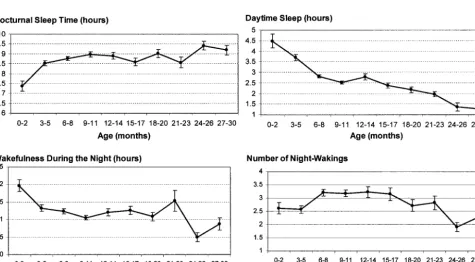
Age- and Gender-Related Differences in BISQ Sleep Measures The age-related differences in sleep measures are summarized in Table 5. The distributions of 4 sleep measures across age groups are illustrated in Fig 1.
Nocturnal sleep duration increased significantly from the first to the second 6 months of life and remained quite constant during the next 18 months of life (r ⫽ .11; P ⬍ .0005). Daytime sleep duration and total sleep duration decreased significantly with age (r⫽ ⫺.39 andP⬍ .0001 andr⫽ ⫺.18 andP⬍
.0001, respectively). Interestingly, for some of the measures (ie, sleep-onset time, settling time, number of night wakings, and nocturnal wakefulness), the age-related trends were nonlinear and the trend from the second half of the first year to the subsequent 18 months was reversed from the trend from the first half to the second half of the first year.
Reported Infant Sleep Measures According to the Rated Severity of the Sleep Problem
Significant differences in most sleep measures were found between the groups according to the parental ratings of problem severity (Table 6). In comparison with infants with no sleep problem (N⫽
72) and infants with a small problem (N ⫽ 607), infants with severe sleep problems (N⫽ 349) were reported as having 1) shorter sleep duration during the night and during the daytime hours, 2) later sleep-onset time at night, 3) longer settling time, 4) greater number of night wakings, and 5) more time spent in wakefulness during the night.
A multivariate approach was adopted to elucidate the unique contribution of each sleep variable to the parental characterization of a severe sleep problem. A stepwise discriminant analysis was used, with sleep problem status (severe problem versus nonse-vere problem/no problem) as the classifying variable and the reported sleep measures as the discriminant measures. The first discriminant measure included was total sleep duration, which explained 9.64% of the variance (F ⫽ 96.42; P ⬍ .0001). The second variable with a unique discriminant contribution was the number of night wakings, which explained 5.55% of the variance (F ⫽ 53.09; P ⬍ .0001). The third variable was nocturnal wakefulness, which
ex-TABLE 3. Corresponding Sleep Measures Derived From the BISQ, Daily Logs, and Actigraphy*
Sleep Measure BISQ Daily Logs Actigraphy F
Sleep onset time, h 20.62⫾1.08 21.05⫾0.77 21.13⫾0.75 4.71*
Nocturnal sleep duration, h 9.35⫾1.40 9.84⫾0.91 9.48⫾0.82 7.14†
Night wakings, no. 3.21⫾2.47 2.62⫾2.00 4.48⫾1.45 52.43‡
All posthoc pairwise comparisons between combinations of two measures were significant atP⬍.05 except for the comparison between actigraphic and BISQ measures of nocturnal sleep duration. Values are mean⫾SD.
*P⬍.05. †P⬍.01. ‡P⬍.0001.
TABLE 4. BISQ Sleep Measures for the Clinical and Control Samples
BISQ Measure Clinical Sample Control Sample F(1,94)
Nocturnal sleep duration, h 8.91⫾1.65 9.67⫾1.08 7.24* Daytime sleep duration, h 2.16⫾0.78 2.32⫾0.79 1.10
Settling time, h 0.48⫾0.31 0.38⫾0.33 1.85
Night-wakings, no. 4.98⫾2.38 1.83⫾1.45 67.13†
Nocturnal wakefulness, h 1.05⫾0.73 0.34⫾0.34 38.39† Values are mean⫾SD.
plained 1.32% of the variance (F⫽ 12.02;P⬍ .001). The last variable with a unique contribution was sleep latency, which explained 0.75% of the variance (F⫽6.82;P⬍.01). When discriminant analysis was performed with these 4 measures as the discriminant variables, the correct assignment rate (severe sleep problem versus others) was 70% (34.7% of the infants with severe sleep problems and 28.4% of the infants from the other groups were misclassified).
Effects of Sleep Ecology
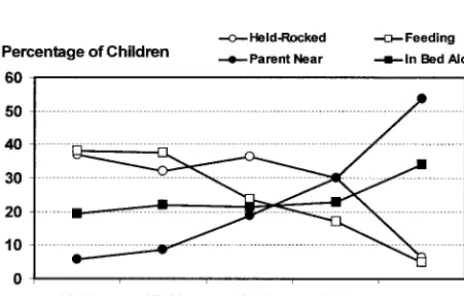
Most of the infants (57.67%) were reportedly sleep-ing in a separate crib in a separate room, whereas 16.73% were reported to be sleeping in their parents’ bed. An additional 18.11% of the infants slept in a crib in the parents’ room. Almost one-third of the children (32.28%) were soothed to sleep while being fed. The second most common method of falling asleep was alone in the crib (21.85% of the infants), followed by falling asleep while being held (18.70%)
and being rocked (14.27%). Falling asleep in the crib with parental presence was reported for 12.89% of the infants. Figure 2 presents the prevalence of spe-cific soothing methods at different ages.
To evaluate the relationships between sleep ecol-ogy and reported infant sleep patterns, we used gen-eral linear model analysis47 to assess the roles of sleep location and soothing method, in addition to gender, birth order, and child’s age, as predictors of the BISQ sleep measures. The method of falling asleep was a significant predictor of sleep duration (for nocturnal sleep:F⫽8.50,P⬍.0001; for daytime sleep:F ⫽ 6.51,P ⬍ .0001; for total sleep time:F ⫽
4.14,P⬍.005). Children who fell asleep in their cribs alone slept more during the night and had longer total sleep times, whereas children who fell asleep while they were being held spent more time in day-time sleep, in comparison with infants who fell asleep in their cribs alone. In addition, parents of infants who fell asleep in their cribs alone reported
Fig 1. Distribution of BISQ sleep measures across age groups (means⫾SE). TABLE 5. BISQ Sleep Measures, According to 3 Age Groups, for the Internet Sample (N⫽1018)
Sleep Measure Age Groups, mo
0–6 (A) 7–12 (B) 13–18 (C) 19–24 (D) 24–30 (E) F
1. Nocturnal sleep duration, h 8.40⫾1.73 8.89⫾1.75 8.76⫾1.84 8.80⫾1.59 9.30⫾1.13 4.59* 2. Daytime sleep duration, h 3.61⫾1.80 2.60⫾1.09 2.65⫾1.48 1.92⫾.63 1.30⫾.86 47.81† 3. Total sleep duration, h 12.02⫾2.37 11.49⫾1.99 11.42⫾2.27 10.72⫾1.63 10.60⫾1.29 8.50† 4. Sleep-onset time, h 21.26⫾1.57 20.64⫾1.29 20.91⫾1.40 20.97⫾1.11 20.90⫾1.11 8.74† 5. Settling time, rating 3.20⫾1.16 2.93⫾1.06 3.13⫾1.16 3.19⫾1.15 3.37⫾1.09 3.68‡ 6. Night wakings, no. 2.69⫾1.75 3.25⫾1.93 3.10⫾2.17 2.67⫾1.50 2.10⫾1.32 6.86† 7. Nocturnal wakefulness, h 1.37⫾1.12 1.18⫾1.10 1.14⫾1.04 1.37⫾1.40 .71⫾.78 4.08*
Severe sleep problem rating, % 28.83 36.07 33.33 42.86 34.15 NS (2)
Scheffe’s posthoc analyses for each BISQ measure: 1, A⬍E; 2, A⬎B⫽C⬎D⫽E; 3, A⬎B⬎D⫽E; 4, A⬍B; 5, A⬎B; 6, A⬍B⫽
C⬎E; 7, A⬎E. NS, not significant. *P⬍.005.
fewer night wakings (F ⫽ 4.46; P ⬍ .005), shorter periods of wakefulness during the night (F⫽6.91;P
⬍ .0001), and shorter settling times (F ⫽ 28.98;P⬍
.0001).
Sleep location also played a significant role in pre-dicting sleep patterns. Parents of children who slept in a crib in a separate room reported fewer night wakings (F ⫽ 8.14; P ⬍ .0001) and shorter settling times (F⫽ 8.37;P⬍.0001).
DISCUSSION
The results of these 2 studies demonstrated the reliability, clinical validity, and applicability of the BISQ for screening sleep problems among infants and young children. Study I demonstrated the test-retest reliability of the BISQ measures and the valid-ity of the BISQ in comparison with other objective and subjective sleep measures. Study II demon-strated the feasibility of having parents complete the questionnaire via the Internet and provided valuable sleep data for a large sample of children.
In study I, the correlations between the corre-sponding BISQ and actigraphic sleep measures were relatively low. This finding is not surprising, because it has often been demonstrated that parental knowl-edge is considerably different from objective mea-sures of infant sleep.5,25,37,38 It is also expected that daily sleep logs would exhibit better correspondence with actigraphic measures, because both types of measures are based on specific daily comparisons,
whereas the BISQ addresses more global perceptions of the parents. However, examination of the group means suggests that 2 of 3 BISQ sleep measures (nocturnal sleep duration and number of night wak-ings) were closer to the actigraphic sleep measures than were the daily logs. Furthermore, in assessing the differences between the clinical and control groups, the BISQ takes precedence and its measures are superior in discriminating between the groups (85% correct classifications vs 81% using daily log measures and only 65% using actigraphic measures). These results lead to the conclusion that the number of night wakings monitored by the parents (when the infant signals) is a better discriminating measure for referral than is the objective number of night wak-ings. A derivative of this conclusion is the idea that perhaps the major difference between infants in the clinical and control groups lies in the inability of the former to self-soothe and fall back to sleep without parental help.5,25,38,48,49
The results of study I also suggest clinical guide-lines for considering referrals. It seems that if a child reportedly wakes up⬎3 times per night, spends⬎1 hour in wakefulness during the night, or spends⬍9 hours in sleep (day and night), then a clinical referral should be considered. These criteria seem to be stable between 6 and 30 months of age.
Before the findings of study II are addressed in more detail, the limitations of this Internet study should be highlighted. The lack of demographic and additional background data for the Internet sample limits our capacity to interpret the findings and to assess the extent to which they represent normative data. This sample might have been skewed toward a higher prevalence of sleep problems, in comparison with the typical rates of 20% to 30% reported in published surveys.6,7,12,50 However, the develop-mental trends demonstrated in study II are consis-tent with well-established maturational process-es.6,34,49,51–53During the first 30 months of life, sleep duration decreases mostly during the daytime hours. Nocturnal sleep-onset time approaches earlier hours during the first year of life. Sleep latency is shorter during the second half of the first year. There is an increase in the number of night wakings toward the end of the first year.54 The nocturnal time spent in wakefulness decreases during the first year of life. The results obtained using the BISQ with the Internet sample are very similar to those obtained in very
Fig 2.Percentages of children who fall asleep with specific sooth-ing techniques in different age groups. Held-Rocked, child falls asleep while being held or rocked; Parent Near, child falls asleep in his or her crib with a parent nearby; In Bed Alone, child falls asleep in his or her crib with no parental presence; Feeding, child falls asleep while feeding.
TABLE 6. BISQ Sleep Measures According to Sleep Problem Severity Ratings*
Sleep Measure No
Problem
Small Problem
Severe Problem
F
Nocturnal sleep duration, h 9.60⫾1.48 8.99⫾1.60 8.13⫾1.84 42.37*
Daytime sleep duration, h 3.64⫾2.02 2.88⫾1.46 2.46⫾1.29 22.60*
Total sleep duration, h 13.24⫾2.10 11.87⫾1.88 10.54⫾2.17 73.02*
Sleep-onset time, h 20.86⫾1.42 20.84⫾1.35 21.00⫾1.47 2.28
Settling time, rating 2.56⫾1.03 3.00⫾1.08 3.34⫾1.15 19.66*
Night wakings, no. 1.61⫾1.73 2.71⫾1.64 3.74⫾2.09 46.01*
Nocturnal wakefulness, h 0.74⫾1.15 1.06⫾0.99 1.59⫾1.21 35.42*
recent studies using objective measures49and subjec-tive reports.53
The comparison of sleep measures for the groups according to the rated severity of the sleep problem indicated that more severe sleep problems were as-sociated with shorter sleep, more night wakings, longer nocturnal wakefulness, and longer settling times. These findings are consistent with those ob-tained in the comparison between the clinical and control samples in study I.
The findings associating sleep ecology with re-ported sleep patterns correspond to the existing lit-erature findings. Soothing techniques and the loca-tion of sleep seem to play important roles in infant sleep. Infants who fall asleep alone in the crib and sleep in a crib in a separate room are more likely to sleep through the night, with fewer night wak-ings.9,55,56 It is also possible that parents of such infants are less likely to notice when their infant
wakes up, because of the distance and visual sepa-ration.
Overall, the results of these studies provide exten-sive information on the reliability and validity of the BISQ, establishing it as a reliable valid tool for as-sessing and screening for infant sleep problems. The BISQ seems to be the first brief infant sleep question-naire that has been supported by all of the following factors: 1) objective and subjective data, 2) assess-ment of test-retest reliability, 3) comparison between clinical and control samples, and 4) a large commu-nity sample with findings that correspond to the existing literature results. Additional surveys of clin-ical and normal samples in different cultures would provide culturally sensitive normative data.
ACKNOWLEDGMENTS
I thank Helene and Woolf Marmot for support and Ornit Arbel and Jeri Hahn-Markowitz for help in preparing this manuscript.
APPENDIX: THE BISQ
Please mark only one (most appropriate) choice, when you respond to items with a few options.
Name of Responder: ________________________ Date: ___________
Role of Responder:䊐 Father 䊐 Mother 䊐Grandparent 䊐 Other, Specify: __________ Name of the child: ______________ Date of Birth: Month ______ Day: ______ Year: ______ Sex:䊐 Male䊐Female Birth order of the child: 䊐Oldest 䊐Middle 䊐Youngest Sleeping arrangement:
䊐Infant crib in a separate room 䊐 Infant crib in parents’ room
䊐In parents’ bed 䊐 Infant crib in room with sibling
䊐Other, Specify: ______________
In what position does your child sleep most of the time?
䊐On his/her belly 䊐On his/her side 䊐 On his/her back
How much time does your child spend in sleep during the NIGHT (between 7 in the evening and 7 in the
morning)? Hours: ______ Minutes: ______
How much time does your child spend in sleep during the DAY (between 7 in the morning and 7 in the
evening)? Hours: ______ Minutes: _______
Average number of night wakings per night: ____________
How much time during the night does your child spend in wakefulness (from 10 in the evening to 6 in the
morning)? Hours: ______ Minutes: ______
How long does it take to put your baby to sleep in the evening?
Hours: ______ Minutes: ______
How does your baby fall asleep?
䊐While feeding 䊐Being rocked 䊐Being held
䊐In bed alone 䊐 In bed near parent
When does your baby usually fall asleep for the night:
Hours: ______ Minutes: ______
Do you consider your child’s sleep as a problem?
䊐A very serious problem 䊐 A small problem 䊐Not a problem at all
REFERENCES
1. Mindell JA, Moline ML, Zendell SM, Brown LW, Fry JM. Pediatricians and sleep disorders: training and practice.Pediatrics.1994;94:194 –200 2. Mindell JA. Empirically supported treatments in pediatric psychology:
bedtime refusal and night wakings in young children.J Pediatr Psychol. 1999;24:465– 481
3. Owens JA. The practice of pediatric sleep medicine: results of a com-munity survey.Pediatrics.2001; 108(3). Available at: www.pediatrics. org/cgi/content/full/108/3/e51
4. Bernal JF. Night waking in infants during the first 14 months.Dev Med Child Neurol.1973;15:760 –769
5. Anders TF, Halpern LF, Hua J. Sleeping through the night: a develop-mental perspective.Pediatrics.1992;90:554 –560
6. Armstrong KL, Quinn RA, Dadds MR. The sleep patterns of normal children.Med J Aust.1994;161:202–206
7. Johnson CM. Infant and toddler sleep: a telephone survey of parents in one community.J Dev Behav Pediatr.1991;12:108 –114
8. Richman N. A community survey of characteristics of one- to two-year-olds with sleep disruptions.J Am Acad Child Psychiatry.1981;20:281–291 9. Adair R, Bauchner H, Philipp B, Levenson S, Zuckerman B. Night waking during infancy: role of parental presence at bedtime.Pediatrics. 1991;87:500 –504
10. Hauri P, Olmstead E. Childhood-onset insomnia.Sleep.1980;3:59 – 65 11. Kataria S, Swanson MS, Trevathan GE. Persistence of sleep disturbances
in preschool children.J Pediatr.1987;110:642– 646
13. Carey WB. Night waking and temperament in infancy.J Pediatr.1974; 84:756 –758
14. Schaefer CE. Night waking and temperament in early childhood. Psy-chol Rep.1990;67:192–194
15. Sadeh A, Lavie P, Scher A. Maternal perceptions of temperament of sleep-disturbed toddlers.Early Educ Dev.1994;5:311–322
16. Owens-Stively J, Frank N, Smith A, et al. Child temperament, parenting discipline style, and daytime behavior in childhood sleep disorders.J Dev Behav Pediatr.1997;18:314 –321
17. Sadeh A, Gruber R, Raviv A. Sleep, neurobehavioral functioning and behavior problems in school-age children.Child Dev.2002;73:405– 417 18. Thome M, Alder B. A telephone intervention to reduce fatigue and
symptom distress in mothers with difficult infants in the community.J Adv Nurs.1999;29:128 –137
19. Van Tassel EB. The relative influence of child and environmental char-acteristics on sleep disturbances in the first and second years of life.J Dev Behav Pediatr.1985;6:81– 85
20. Gelman VS, King NJ. Wellbeing of mothers with children exhibiting sleep disturbance.Aust J Psychol.2001;53:18 –22
21. Seifer R, Sameroff AJ, Dickstein S, Hayden LC. Parental psychopathol-ogy and sleep variation in children.Child Adolesc Psychiatr Clin N Am. 1996;5:715–727
22. Sadeh A.Sleeping Like a Baby: A Sensitive and Sensible Approach to Solving Your Child’s Sleep Problems. New York, NY: Yale University Press; 2001 23. Kuhn BR, Weidinger D. Interventions for infant and toddler sleep
disturbance: a review.Child Fam Behav Ther.2000;22:33–50
24. Stores G. Practitioner review: assessment and treatment of sleep disor-ders in children and adolescents. J Child Psychol Psychiatry.1996;37: 907–925
25. Sadeh A. Assessment of intervention for infant night waking: parental reports and activity-based home monitoring. J Consult Clin Psychol. 1994;62:63– 68
26. Owens JL, France KG, Wiggs L. Behavioural and cognitive-behavioural interventions for sleep disorders in infants and children: a review.Sleep Med Rev.1999;3:281–302
27. Kerr SM, Jowett SA, Smith LN. Preventing sleep problems in infants: a randomized controlled trial.J Adv Nurs.1996;24:938 –942
28. Wolfson A, Lacks P, Futterman A. Effects of parent training on infant sleeping patterns, parents’ stress, and perceived parental competence.J Consult Clin Psychol.1992;60:41– 48
29. Chervin RD, Archbold KH, Panahi P, Pituch KJ. Sleep problems seldom addressed at two general pediatric clinics.Pediatrics.2001;107:1375–1380 30. Hiscock H, Wake M. Infant sleep problems and postnatal depression: a
community-based study.Pediatrics.2001;107:1317–1322
31. Weissbluth M, Liu K. Sleep patterns, attention span, and infant temper-ament.J Dev Behav Pediatr.1983;4:34 –36
32. Thunstrom M. Severe sleep problems among infants in a normal pop-ulation in Sweden: prevalence, severity and correlates.Acta Paediatr. 1999;88:1356 –1363
33. Ottaviano S, Giannotti F, Cortesi F, Bruni O, Ottaviano C. Sleep char-acteristics in healthy children from birth to 6 years of age in the urban area of Rome.Sleep.1996;19:1–3
34. Scher A, Tirosh E, Jaffe M, Rubin L, Sadeh A, Lavie P. Sleep patterns of infants and young children in Israel.Int J Behav Dev.1995;18:701–711 35. Chervin RD, Hedger K, Dillon JE, Pituch KJ. Pediatric sleep
question-naire (PSQ): validity and reliability of scales for sleep-disordered breathing, snoring, sleepiness, and behavioral problems. Sleep Med. 2000;1:21–32
36. Matthey S. The sleep and settle questionnaire for parents of infants: psychometric properties.J Paediatr Child Health.2001;37:470 – 475 37. Sadeh A. Evaluating night wakings in sleep-disturbed infants: a
meth-odological study of parental reports and actigraphy. Sleep.1996;19: 757–762
38. Sadeh A, Lavie P, Scher A, Tirosh E, Epstein R. Actigraphic home-monitoring sleep-disturbed and control infants and young children: a new method for pediatric assessment of sleep-wake patterns.Pediatrics. 1991;87:494 – 499
39. Sadeh A, Acebo C. The role of actigraphy in sleep medicine.Sleep Med Rev.2002;6:113–124
40. Sadeh A, Acebo C, Seifer R, Aytur S, Carskadon MA. Activity-based assessment of sleep-wake patterns during the 1st year of life.Infant Behav Dev.1995;18:329 –337
41. Sadeh A, Hauri PJ, Kripke DF, Lavie P. The role of actigraphy in the evaluation of sleep disorders.Sleep.1995;18:288 –302
42. Sadeh A, Sharkey KM, Carskadon MA. Activity-based sleep-wake identification: an empirical test of methodological issues.Sleep.1994;17: 201–207
43. Acebo C, Sadeh A, Seifer R, Tzischinsky O, Carskadon MA. Sleep/wake patterns in one to five year old children from activity monitoring and maternal reports.Sleep.2000;23:A30 –A31
44. Sadeh A, Dark I, Vohr BR. Newborns’ sleep-wake patterns: the role of maternal, delivery and infant factors.Early Hum Dev.1996;44:113–126 45. Sadeh A, Raviv A, Gruber R. Sleep patterns and sleep disruptions in
school-age children.Dev Psychol.2000;36:291–301
46. Tikotzky L, Sadeh A. Sleep patterns and sleep disruptions in kinder-garten children.J Clin Child Psychol.2001;30:579 –589
47. SAS Institute Inc. The GLM procedure. In: SAS/STAT User’s Guide, Version 6. 4th ed. Cary, NC: SAS Institute Inc; 1990:891–996
48. Goodlin-Jones BL, Burnham MM, Gaylor EE, Anders TF. Night waking, sleep-wake organization, and self-soothing in the first year of life.J Dev Behav Pediatr.2001;22:226 –233
49. Burnham MM, Goodlin-Jones BL, Gaylor EE, Anders TF. Nighttime sleep-wake patterns and self-soothing from birth to one year of age: a longitudinal intervention study. J Child Psychol Psychiatry. 2002;43: 713–725
50. Adair R, Zuckerman B, Bauchner H, Philipp B, Levenson S. Reducing night waking in infancy: a primary care intervention.Pediatrics.1992; 89:585–588
51. Anders TF. Night-waking in infants during the first year of life.Ann Prog Child Psychiatry Child Dev.1980;122–130
52. Moore T, Ucko LE. Night waking in early infancy.Arch Dis Child. 1957;32:333–342
53. Iglowstein I, Jenni OG, Molinari L, Largo RH. Sleep duration from infancy to adolescence: reference values and generational trends. Pedi-atrics.2003;111:302–307
54. Scher A. A longitudinal study of night waking in the first year.Child Care Health Dev.1991;17:295–302
55. Wolf AW, Lozoff B. Object attachment, thumbsucking, and the passage to sleep.J Am Acad Child Adolesc Psychiatry.1989;28:287–292 56. Morrell J, Cortina-Borja M. The developmental change in strategies
DOI: 10.1542/peds.113.6.e570
2004;113;e570
Pediatrics
Avi Sadeh
Findings for an Internet Sample
A Brief Screening Questionnaire for Infant Sleep Problems: Validation and
Services
Updated Information &
http://pediatrics.aappublications.org/content/113/6/e570 including high resolution figures, can be found at:
References
http://pediatrics.aappublications.org/content/113/6/e570#BIBL This article cites 52 articles, 10 of which you can access for free at:
Subspecialty Collections
atistics_sub
http://www.aappublications.org/cgi/collection/research_methods_-_st Research Methods & Statistics
b
http://www.aappublications.org/cgi/collection/medical_education_su Medical Education
following collection(s):
This article, along with others on similar topics, appears in the
Permissions & Licensing
http://www.aappublications.org/site/misc/Permissions.xhtml in its entirety can be found online at:
Information about reproducing this article in parts (figures, tables) or
Reprints
DOI: 10.1542/peds.113.6.e570
2004;113;e570
Pediatrics
Avi Sadeh
Findings for an Internet Sample
A Brief Screening Questionnaire for Infant Sleep Problems: Validation and
http://pediatrics.aappublications.org/content/113/6/e570
located on the World Wide Web at:
The online version of this article, along with updated information and services, is
by the American Academy of Pediatrics. All rights reserved. Print ISSN: 1073-0397.