University of Pennsylvania
ScholarlyCommons
Publicly Accessible Penn Dissertations
2017
Why Does Plato's Laws Exist?
Harold Parker
University of Pennsylvania, [email protected]
Follow this and additional works at:https://repository.upenn.edu/edissertations Part of thePhilosophy Commons
This paper is posted at ScholarlyCommons.https://repository.upenn.edu/edissertations/2515
For more information, please [email protected].
Recommended Citation
Why Does Plato's Laws Exist?
Abstract
If the ideal city described at length in Plato’s Republic is a perfect and philosophically attractive encapsulation of Plato’s political philosophy, why does Plato go on to write the Laws – which also describes an ideal city, albeit one very different from the Republic? The fundamental challenge of scholarship concerning the Laws is to supply a comprehensive account of the dialogue that explains all aspects of it while also distinguishing the Laws from the Republic in a way that does not devalue the Laws as a mere afterthought to the Republic. Past attempts at meeting this challenge, I argue, can be classified under the headings of the democratic, legal, and demiurgic approaches. Although each is prima facie plausible, each also faces its own set of problems.
Furthermore, none are truly capable of explaining the Laws in its full specificity; the intricate array of customs, regulations, and practices making up the life of the city described form a complex totality not reducible to the concept of democracy, the rule of law, or demiurgy. Instead, I propose a fundamentally new approach to interpreting the Laws, the systematic approach, which I claim is responsive to the deepest and most innovative tendencies within the dialogue. Specifically, the proper way of conceiving the shift from the Republic to the Laws, I argue, lies in Plato replacing the concept of “cadre” in the former with the concept of a self-governing “system” in the latter. As I deploy these notions, a cadre is a small group of specially qualified individuals, while a system is a large population whose members or constituents affect, and interact with, one another in orderly ways. Each of these concepts gives rise to a corresponding model of government. Under the cadre model, all power is assigned to a small minority of specially qualified individuals, and under the system model, power is periodically rotated between members of a group in accordance with both laws and the extra-legal patterns of social and cultural norms. I use this framework to mount a series of linked investigations into various aspects of the society described in the Laws.
Degree Type
Dissertation
Degree Name
Doctor of Philosophy (PhD)
Graduate Group
Philosophy
First Advisor
Susan Meyer
Keywords
Laws, Plato
Subject Categories
WHY DOES PLATO’S LAWS EXIST?
Harold Graham Parker, III
A DISSERTATION
in
Philosophy
Presented to the Faculties of the University of Pennsylvania
in
Partial Fulfillment of the Requirements for the
Degree of Doctor of Philosophy
2017
Supervisor of Dissertation
________________
Susan Sauvé Meyer Professor of Philosophy
Graduate Group Chairperson
Samuel Freeman, Avalon Professor of the Humanities
Dissertation Committee
Charles Kahn, Professor Emeritus of Philosophy
WHY DOES PLATO’S LAWS EXIST?
COPYRIGHT
2017
iii
ACKNOWLEDGMENT
The rhythm of my life is punctuated by the unceasing series of claims I have
made on the physical, emotional, and cognitive labor of other people. Since most of these
claims will go uncompensated, it is only fitting I use this brief space to state a few
acknowledgements.
First of all, I would like to thank my adviser, Susan Sauvé Meyer, for her
sustained and valuable input and guidance. She has read countless drafts, made countless
suggestions, and taken countless meetings with me, and my dissertation – as well as my
own formation as a scholar and philosopher – has benefitted tremendously from her
sterling example of professionalism and intellectualism. The other members of my
committee, Charles Kahn and Alexander Guerrero, are also not without a richly-deserved
place in the firmament of my regard: they have contributed mightily and generously in
the form of their time and intellectual judgment, and I am deeply grateful to them.
The classical-philosophical community of graduate students at Penn merits my
thanks as well. My experience at Penn would simply be unimaginable without the almost
constant companionship of colleagues like Max Robitzsch, Aditi Chaturvedi, Brian
Reese, and Michael Vasquez. Likewise, my experience in the world in general would be
simply unimaginable without my wonderful partner, Alisa Gross.
Lastly, I would like to thank the members of my family (including Wuvvy),
especially my mother. In fact, in addition to every other debt I owe her, it is quite
possible that my mother’s somewhat impatient literary-critical refrain, “what’s the moral
iv
ABSTRACT
WHY DOES PLATO’S LAWS EXIST?
Harold Graham Parker, III
Susan Sauvé Meyer
If the ideal city described at length in Plato’s Republic is a perfect and
philosophically attractive encapsulation of Plato’s political philosophy, why does Plato
go on to write the Laws – which also describes an ideal city, albeit one very different
from the Republic? The fundamental challenge of scholarship concerning the Laws is to
supply a comprehensive account of the dialogue that explains all aspects of it while also
distinguishing the Laws from the Republic in a way that does not devalue the Laws as a
mere afterthought to the Republic. Past attempts at meeting this challenge, I argue, can be
classified under the headings of the democratic, legal, and demiurgic approaches.
Although each is prima facie plausible, each also faces its own set of problems.
Furthermore, none are truly capable of explaining the Laws in its full specificity; the
intricate array of customs, regulations, and practices making up the life of the city
described form a complex totality not reducible to the concept of democracy, the rule of
law, or demiurgy.
Instead, I propose a fundamentally new approach to interpreting the Laws, the
systematic approach, which I claim is responsive to the deepest and most innovative
tendencies within the dialogue. Specifically, the proper way of conceiving the shift from
the Republic to the Laws, I argue, lies in Plato replacing the concept of “cadre” in the
v
notions, a cadre is a small group of specially qualified individuals, while a system is a
large population whose members or constituents affect, and interact with, one another in
orderly ways. Each of these concepts gives rise to a corresponding model of government.
Under the cadre model, all power is assigned to a small minority of specially qualified
individuals, and under the system model, power is periodically rotated between members
of a group in accordance with both laws and the extra-legal patterns of social and cultural
norms. I use this framework to mount a series of linked investigations into various
vi
TABLE OF CONTENTS
1. INTRODUCTION 1
1.1. The problem under consideration 1
1.2. A survey of the secondary literature 5
1.2.1. The democratic approach 5
1.2.2. The legal approach 7
1.2.3. The demiurgic approach 10
1.2.4. Individual authors in the secondary literature 12
1.3. The systematic approach 16
1.3.1. Elucidatory examples of the systematic approach 18
1.3.2. The systematic approach vs. the democratic approach 28
1.3.3. The systematic approach vs. the legal approach 31
1.3.4. The systematic approach vs. the demiurgic approach 33
1.4. The systematic approach in the secondary literature 38
1.5. The plan of the subsequent work 41
Electoral Policy in the Laws 2. ELECTING THE NOMOPHYLAKES 46
2.1. Introduction 46
2.2. The analytic of government 55
2.3. Election of the nomophylakes 64
2.3.1. Military membership for electors 67
2.3.2. The function of religiosity 74
2.3.3. The expanded ballot 79
2.3.4. Intelligent process 86
2.3.5. Scene of instruction 94
2.3.6. The use of age restrictions 100
3. ELECTING THE COUNCIL 106
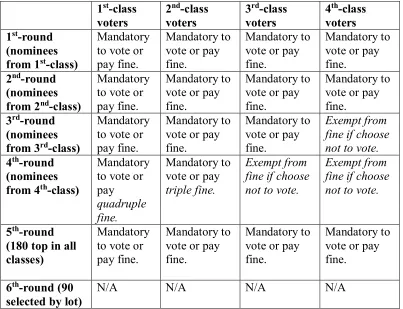
3.1. Schedule of incentives 107
vii
Cultural Policy in the Laws
4. CULTURE AS PROBLEM 128
4.1. Introduction 128
4.1.1. Culture in the broad sense 129
4.1.2. Relevance to the systematic approach 130 4.1.3. Selected aspects of relevance to the secondary literature 132
4.2. Culture as a problem in the Laws 135
4.2.1. The equivalence of culture in the narrow and broad sense 135 4.2.2. The cultural logic of habituation 137 4.2.3. The significance of susceptibility 138 4.2.4. The intrinsic danger of the social field 140 4.2.5. The relevance of the concept of positive feedback 141
4.2.6. Egyptian aesthetics 142
4.2.7. Case study (I): 658e-659c 143
4.2.7.1. Ideal theatrical culture (I): 658e-659b 144 4.2.7.2 . Pathological theatrical culture (I): 700a-701c 147
4.2.8. Case study (II): 700a-701c 149
4.2.8.1. Ideal theatrical culture (II): 700a-700d 150 4.2.8.2 . Pathological theatrical culture (II): 700d-701c 152
5. CULTURE AS SOLUTION 158
5.1. Orientation 158
5.2. General strategies of cultural management 161
5.2.1. Thematization of the infra-legal 161 5.2.2. Preferred patterns of interaction 163
5.2.2.1. Contest culture 164
5.2.2.2 . Memorial culture 166
5.3. Specifically social strategies 170
5.3.1. Social persuasion 170
5.3.2. Social enforcement 171
viii
5.4. Region-targeted strategies 175
5.4.1. Fan culture 177
5.4.2. Communal meals 178
5.4.3. Religious culture 179
Intellectual Policy in the Laws
6. A DESCRIPTION OF THE NOCTURNAL COUNCIL 180
6.1. The place in the text 186
6.2. Three beginnings 186
6.2.1. The scrutineers 187
6.2.2. The observers 189
6.2.3. The logic of finality 191
6.3. Membership of the council 193
6.4. Mentorship of the junior guardians 194
6.5. Meeting time of the nocturnal council 196
6.6. Rationale of the nocturnal council 197
6.6.1. Anchor of the state 197
6.6.2. Mode of competence 200
6.6.3. The corporate metaphor 202
6.7. Activities of the nocturnal council 204
6.7.1. Discussions, education, and research 205
6.7.2. Reform of atheists 209
6.7.3. Repatriation of observers 211
6.8. The operation of the nocturnal council 214
6.9. Attributed powers 218
6.10. Vague powers 219
7. THE NOCTURNAL COUNCIL AND THE SYSTEMATIC APPROACH 222
7.1. The question of continuity 223
7.2. The nocturnal council as indirectly elected 226
7.3. Mentorship of the junior guardians 229
ix
7.8. Vague powers 244
7.8.1. The authority of the nocturnal council 245
7.8.2. The title claim 251
7.8.3. Legal protectorate 274
7.8.4. The grant 270
8. CONCLUSION 277
1
1. INTRODUCTION
1.1. The problem under consideration
Why does Plato’s last dialogue, the Laws, exist?1 Or worse yet, does it exist? The
underlying subject of the dialogue – describing at length an ideal society – is certainly a
subject worthy of human intellectual interest. Indeed, Plato’s more famous dialogue, the
Republic, shares this topic. Yet at the same time, the existence of this dialogue –
triumphant, complete in itself, and philosophically attractive – hardly calls for
justification. It is, in a word, καλή. But if the Republic is perfect, complete, and “classic”
in every way, then its self-assured triumph is so much the worse for the Laws. If the
Republic already exists, why, then, does the Laws exist? And if the Republic exists, does
the Laws even really exist?
One could grant that the Laws exists perhaps as a mere adjunct to the Republic, or
as a workmanlike exercise in practicality from the Republic’s template, or even as an
expression of Plato’s senility and waning powers, but each of these options is just a way
of denying that the Laws really exists in the first place.2 They are to consign the Laws to
the embarrassment and decadence and imperfection of the post-classical – proof of
1 The best bibliographical guide to scholarship on the Laws is Saunders and Brisson, Bibliography on Plato’s Laws. Unless otherwise specified, I will use the English translation of the Laws by Saunders contained in Plato, Complete Works. Additionally, there exists a useful English translation of the Laws by Tom Griffith, edited by Malcolm Schofield: Plato: Laws, Griffith and Schofield. The most authoritative Greek text is that Des Place, found together with a French translation in Des Places, Platon: Oeuvres Complètes. The Greek of the Oxford Classical Text is useful as well. Plato and Burnet, Platonis Opera. T. 5.A useful commentary (as well as a German translation) can be found in Schöpsdau, Nomoi. Finally, another useful commentary and English translation, unfortunately only of the first two books of the Laws, can be found in Meyer, Plato.
2 Other ways of denying that the Laws – as a complete, unified, and organized work – even exists would be
2
Plato’s dual existence as both philosopher and individual, i.e., the merely biological
continuation of the eternal thinker and author of the Republic, itself an eternal work of
which the Laws would be merely a contingent emanation. The Republic and Laws would
then correspond to Plato philosophus and Plato comicus.3 Even if Plato comicus, in a
sense, authored Plato philosophus, it is most certainly Plato philosophus, and not Plato
comicus, who authored the Republic. There is no reason to believe any subsequent work
has the same author in the sense I mean, short of establishing this fact by reference to the
work.
So why, indeed, does Plato’s Laws exist? Such a question can be answered in two
different ways. On the one hand, we can answer this question with regard to Plato the
historical individual (“Plato comicus”). In other words, we can inquire about events in the
personal biography of Plato with a view toward explaining his decision to author the
Laws.4 Yet such a line of inquiry is alien to academic philosophy except to the extent it
serves as an indirect way of answering other questions falling within its proper domain.
After all, the Laws would remain interesting and would remain a “problem” even if it
were authored by someone besides Plato. On the other hand, we can answer this question
in a resolutely work-focused way. What is the raison d’être, we might ask, of the work
itself? (Forget the raisons of the author.) Or, to put it in Aristotelian terms, what is the
τέλος of the Laws – i.e., what immanent governing principle informs and makes it the
way it is, as distinct from a set of external reasons? In the Laws, when the Athenian asks
3 In addition to the philosopher by name of Plato, there was also a contemporaneous comic poet by the
same name. These two figures are often distinguished as Plato philosophus and Plato comicus. Here, however, I am using the latter phrase to refer to Plato the historical individual, as opposed to “Plato” the thinker/author constructible from texts.
4 Cf. Morrow: “No one can study the Laws critically without asking what Plato was trying to do when he
3
Kleinias and Megillus about the purported divine authorship of the law-codes at Sparta
and Crete, what he is asking them to exhibit is the underlying spirit or overall rationale at
work in these law-codes – their τάξις. All questions of scholarship concerning the Laws
are ultimately subordinated to this question, the fundamental question. The present
dissertation is an attempt to answer it.
Before giving that answer, I will first canvass the general outlines of the societies
of the Republic and Laws, focusing on the elements most useful to my framework. Next, I
will describe other popular approaches in the secondary literature before proceeding to
describe my own, using examples from the subsequent chapters in this dissertation.
Afterwards, I will compare my approach with others in the secondary literature. Finally, I
will set out the plan for the rest of my dissertation carrying out this approach in the form
of three studies.
In the Republic, a small group of elite “philosopher-kings” preside as absolute
rulers of the “kallipolis.” They reign in virtue of the unerring knowledge of the good they
are intended to possess. This knowledge both imparts to them the capacity to rule and
endows them with the title to rule the rest of the city (540a-b). They rule without the
intermediation of laws or checks.5 Only this group rules; indeed, the exclusivity of their
rule follows from the very conception of justice in the Republic as “doing one’s own
work” (433a). They are selected for this role after considerable scrutiny and preparation,
which takes the form of biological eugenics, character diagnostics, and considerable
5 True, Plato does sometimes use expressions in the Republic like “the laws and the ways of life of the city”
4
periods of careful education (502c ff.). In summary, the strategy of governance
appropriate to the Republic is the exclusive empowering of a small group as rulers who
are in turn made as excellent rulers as possible. Meanwhile, the vast majority of the
population plays no effective role in the governance of the polis. The “guardians,” as they
are called, appear to possess absolute power within the basic structure of the state.
In the Laws, power is more widely distributed: there exists a variety of different
political offices. The chief power-exercising bodies are the nomophylakes (752d-755b),
the council (756b-758d), and the assembly (763e-764b). Other magistrates include priests
(759b-d), local wardens for the market, city, and country (760b-763e), and various
educational officials (765a-766c). These magistracies are mostly filled by elections to
which nearly everyone has some form of input or access.6 A system of popular courts
completes the set of political institutions of Magnesia (766d-768e). In sum, instead of
being ruled by omnicompetent philosopher-kings, the citizens themselves take turns
governing and being governed, and they do, at least in part, in the style of the traditional
Greek polis. In addition to the political institutions, an intricate body of religious rites,
social customs, and sundry usages and practices (e.g., organized dances in 771a-772a,
communal meals in 779d-783b, etc.) — again, partly in the style of the traditional polis,
even if significantly redesigned by Plato — adorns the life of the city.7 Most importantly,
there exists no small class analogous to the philosopher-kings of the Republic: i.e., there
exists no small class which is cognitively enriched to the maximum extent and then
empowered to the maximum extent. Nevertheless, there is still a pronounced interest in
6 I discuss these elections at length in Chapter 2 and Chapter 3.
5
moral character and cognitive enrichment and distributing power according to attainment
in these respects. Finally, there exists a kind of remnant-version of the philosopher-kings
of the Republic called the nocturnal council. This council is made up of the most
philosophically capable elders of the city and is given important, if vague, responsibilities
(951a-952d, 960b-969c).8
1.2. A survey of the secondary literature
The question I want to answer is why the Laws exists. In other words, how can
we (a) best describe and organize the ways in which it differs from the Republic and
constitutes its own unity, and (b) explain the evident appearl associated with this set of
changes? Before enumerating and discussing a variety of attempts by individual scholars
to answer these questions, I will describe three general ways the shift could be
characterized – namely, the (i) democratic approach, (ii) the legal approach, or (iii) the
demiurgic approach. Needless to say, individual scholars may belong to the same general
approach but still differ with one another; likewise, the approaches can be combined in
various ways. While I think each approach is valid pro tanto, none of them, I argue, can
fully answer (a) and (b). Here I will describe each and identify some problems with it.
Subsequently, I will describe my own approach, the systematic, and explain how I think
it solves the problems with each of the other three.
1.2.1. The democratic approach
6
In the Laws Plato appears to espouse a markedly more democratic way of
proceeding than he does in the Republic. After all, in the Republic there are no
democratic ways of assigning power whatsoever, and in addition, the form of government
of democracy comes under specific criticism in Book VIII and other places.9 In the Laws,
by contrast the electoral devices of election and lot figure many times – for instance, the
members of the council and nomophylakes are partially elected, and the members of the
council are also partially selected by lot.10 In addition, daily life in the Laws partakes of a
more “activist” character in general according to which citizens are called upon to
exercise their own powers and make decisions for the good of the community.11 Thus, to
the extent we are interested in an account of the Laws which comprehensively explains it
and distinguishes it from the Republic, the concept of democracy seems promising.
However, there are two reasons to reject the democratic approach, even while
assenting to it pro tanto, from the perspective of (a) and (b) above. First, it does not
capture the rich specificity of the Laws, especially the intricate array of customs,
regulations, and practices making up Magnesian life – all in all, a complex totality in no
way reducible to the concept of democracy as the distinguishing element from the
Republic. Many of these things are orthogonal to the question of democracy, and some of
them are even anti-democratic. For instance, the complex system of incentives in place
for electing the council is anti-democratic, and the memorial culture of Magnesia is
9 Many portions of the Republic (as well as Plato’s corpus as a whole) admit of an anti-democratic reading.
The most explicit is in 555b-562a.
10 The election of the nomophylakes is discussed in Chapter 2, and that of the council is discussed in Chapter 3.
7
neither pro-democratic nor anti-democratic.12 Some aspects, like the “social
enforcement” I describe in Chapter 5, are appropriate to the historical reality of
contemporaneous Greek democracy, but not captured by the bare concept of
democracy.13 Thus, we must look for supplementary resources if we want to best
characterize why the Laws exists.
Second, the term democracy is a problematic term of analysis for tackling the
shift from the Republic to the Laws. It highlights contingent sociology instead of marking
out what is of fundamental political concern from Plato’s perspective. Namely, the term
implies that the δῆμος or “people” is the group possessed of κράτος or “power” in
government, but this is not the most important characteristic of government from Plato’s
perspective.14 For Plato, it is irrelevant whether the ruling-element of society is an
individual monarch, a small clique of families, or the popular δῆμος. Rather, as he claims
in the Statesman, the most important characteristic of government is – regardless of its
formal character – whether or not it empowers those with the knowledge and art of
ruling. Only a government satisfying this criterion is correctly called a “government”
(πολιτεία) at all; other attempts to rule are merely “imitations” of government.15 So to
12 This is analyzed at length in Chapter 5. I also explain it to some extent subsequently in this chapter. 13 Monoson advocates precisely the former sense of democracy and thus brings to light various
“democratic” aspects of Plato’s Republic (the Laws is incidental to her main project). However, as correct as Monoson undoubtedly is in this regard, it also seems true that Plato himself did not necessarily think of democracy in this way. I discuss Monoson further below. Monoson, Plato’s Democratic Entanglements.
14 It is also an inadequate basis for the understanding of contemporaneous Attic democracy. For
representatives of a different view of actually-existing Athenian democracy, see Balot, Greek Political Thought; Ober, The Athenian Revolution.
1515 See Stm., 259a-b, for the related fundamental claim (familiar enough in the Socratic-Platonic context)
8
call the Laws “more democratic” than the Republic is to plot the two, albeit appropriately,
along a rather inappropriate axis.
1.2.2. The legal approach
What would be a more appropriate axis? The Statesman itself gives us a possible
clue: some imitations are deemed “for the better” and others “for the worse.”
Specifically, it is the presence of law that distinguishes imitations “for the better” from
those “for the worse.”16 The best form of government – the one by those with the
knowledge and art of ruling – cannot be bound by law at all.17 Since the society of the
Laws certainly features a number of, well, laws, goes to great lengths to inculcate a kind
of spirit of law-abiding in general, and is described in Book V as only the “second-best”
form of government,18 it would be tempting to take “law” as the successor-concept to
“democracy” in our attempt to formulate an account that satisfactorily explains the Laws
contrast to the Republic.19
have knowledge, but these does not exist some pre-government group x which has knowledge such that the government of Magnesia can be labeled “government by x” in the style of an oligarchy or democracy.s
16 See Stm., 293e.
17 See Stm., 294a. This fact has to do with the limitations of the law-form, described below. 18 I will discuss this passage under the heading of the “demiurgic approach” below.
19 Such is the totemic allure of the law-form that Barker even goes so far as to call Magnesia the
“law-state.” Guthrie, A History of Greek Philosophy, 374. Cf. Sabine: “As the name of the dialogue indicates, the
9
Unfortunately, there are three problems with this approach – call it the “legal
approach.” The first two arise directly from Plato’s repeated and emphatic critique of the
law-form considered in isolation. Plato claims in the Statesman that the law, due to (i)
“dissimilarities between human beings and their actions” and (ii) “the fact that practically
nothing in human affairs ever remains stable,” cannot hope to successfully “embrace
what is best and most just for all at the same time.” The “simple decisions” codified in
law will prove problematic inasmuch as “it is impossible for what is perpetually simple to
be useful in relation to what is never simple.”20
Second, Plato claims in Book VI of the Laws that, regardless of the intrinsic
excellence of a set of laws, electing incompetent or unsuitable officials into power will
bring disaster. At best, these officials will waste the “good laws” with risible results. At
worst, they will pervert them to an end positively destructive to the state, and “the state
will find that its laws are doing it damage and injury on a gigantic scale” (751b-c). The
disturbing ease with which even “good laws” can be nullified or transformed into their
opposite demonstrates both the fragility of laws tout court and the necessity they be
supplemented with a reliable method of producing and selecting capable individuals to
place at their helm.
Third, as we saw with the deficiency of the democratic approach above, there are
many distinctive aspects of life in Magnesia which go uncaptured by this description –
for example, the preambles to the laws, social enforcement, the provision of communal
messes for women as well as men, and so on. However, even as the legal approach fails
to adequately describe the specificity of the Laws in its entirety, it is nonetheless
10
substantially correct. Indeed, I view the approach put forward in this dissertation – the
systematic approach – as a supplement and transformed version of the legal approach. I
aim to describe what Plato is doing in the Laws as in part a response to his own critique
of the law-form as well a combination of the law-form with certain extra-legal
improvements nonetheless germane to the legal approach: an attempt to make the
law-form work given the advantages and disadvantages of groups of actually-existing agents
who are cognitive, affective, and practical. However, before discussing this in more
detail, let us turn to the last general approach to theorizing the relationship between the
Republic and the Laws.
1.2.3. The demiurgic approach
It is popular to regard the Laws as a less ideal – or indeed as a “second best” –
version of the Republic. In particular, a famous passage in Book V (739c-e) seems to
make precisely that claim. After proposing the establishment of a certain city which the
Athenian calls “best,” he announces instead the development in what is to follow of a city
he calls "second best” (739c-e). Many interpret this as a coded – or straightforward –
reference to the Republic along with a manifesto of the Laws: it is to be the “second best”
city after the Republic.21 Let us therefore call the approach which emphasizes Plato’s
demiurgy as the key concept in an account explaining the Laws in its entirety and
21 E.g., Guthrie, A History of Greek Philosophy, 335; Kahn, Plato and the Post-Socratic Dialogue, 229. On
11
valuably distinguishing it from the Republic. The concept of demiurgy is borrowed from
the primarily cosmological dialogue of about the same time as the Laws, the Timaeus.22
There are three responses that could be made to this way of analyzing the Laws.
First, it should be noted that the demiurgic approach comes perilously close to a
statement of support for the inexistence of the Laws. After all, the Laws would only exist
as a pale imitation of the Republic, and we know how Plato feels about imitations. Of
course, advocates of the demiurgic approach may not begrudge that outcome if they think
that their approach is indeed the most textually and conceptually sound one.
Nevertheless, to the extent that we have a regulative interest in approaches to the Laws
which claim that it does exist, we have reason to disfavor in our investigations the
demiurgic approach as presently constituted.
Second, the demiurgic approach relies upon a mistaken interpretation of the
passage in Book V. In particular, it glosses over the communist criterion adduced to
separate the best from the second best city (739c-e). This criterion simply does not do the
work many interpreters of the dialogue suppose it to do. In the Republic, only the
guardians partake of communism, not the rest of the citizens; thus, given this crucial
limitation in the scope of the Republic’s communism, it is incorrect to peremptorily
identify the Republic with the “best” society conjectured in Book V of the Laws.23
Furthermore, a great number of other facts about the society in the Republic testify to its
not being the best society possible: e.g., its inevitable decline (546a ff.), infanticide
22 According to this dialogue, a divine “craftsman” (dêmiourgos) fashions the world in the likeness of some
divine model using the imperfect material at his disposal. Thus, I use the word “demiurgic” to characterize the approach oriented to the ways in which the society of the Laws “falls short” of some more perfect model on which it is nonetheless based. See Timaeus, passim.
12
(459d, 460b-c, etc.), the need to lie to its citizens (382c-d, 389b ff., 459c., etc.), and the
clumsy mechanisms necessary to avoid incest (461e). Of course, this is not, at the same
time, to deny that the Republic, at least according to certain metrics, is “better” than the
Laws. Rather, it is to deny that the two governments are such as to be tidily ranked “best”
and “second best.” Additionally, as Aristotle might remind us, to the extent we are
practically concerned beings we will be primarily interested in the conception of the good
that is πρακτός.24 Thus, any account of the Laws which makes it more “practical” but less
“fine” in comparison with the Republic should not be viewed as a wholly derogatory
determination.25
Finally, to assert the Laws is the “second best” of the Republic is not to make a
contentful assertion regarding the specificity of the Laws. To assert “The Laws is like the
Republic, but less so” is simply to say nothing at all about the dialogue as such.26 To
reduce the statement of the nature of the Laws to the second best of the Republic is to fail
to describe the Laws in itself and, at best, to substitute what is only a proprium for an
account.
1.2.4. Individual authors in the secondary literature
24 See E.E., 1218a-b or E.N., 1096b. For English and Greek versions of these texts, see Aristotle and
Woods, Eudemian Ethics. Books I, II, and VIII; Aristotle, Walzer, and Mingay, Aristotelis Ethica Eudemia; Crisp, Nicomachean Ethics; Bywater, Aristoteles Ethica Nicomachea.
25 Thus, Schofield characterizes one of the two projects at work in the Laws as an “idealizing” one and the
other as “trying to cope with human beings as they actually are.” Schofield, “The Laws’ two projects.”
26 Above, I emphasized that the demiurgic approach risks denying that the Laws even exists. Here I make
13
The “systematic approach” which it is the task of this dissertation to expound by
means of three linked studies27 builds on – while also supplementing, extending, and
revising – some of the most significant works on the Laws in recent scholarship:
specifically, those of Morrow, Bobonich, and Laks.
In his magisterial Plato’s Cretan City (1960), Morrow offers a comprehensive
interpretation of every detail of the new society in the Laws from the analytic perspective
that such a society is the synthesis of contemporaneous Greek historical materials with
Platonic philosophical principles.28 Morrow analyzes the Laws as a “deliberate and
sustained effort on Plato's part to illustrate how a philosopher-legislator would proceed,
using the materials at his disposal in Greek life.”29 Morrow’s general approach (the
demiurgic par excellence) – which I would hardly dare to refute so much as revise or
supplement – also shows the pitfalls of regarding the Laws as the second best of the
Republic. While Morrow successfully makes the case for the fact of demiurgy, as well as
the “logic” of such a thing, so to speak, his account is incomplete, I contend, without
attending to the very rationale according to which what is demiurgically utilized is
potentially useful.30
Ryan Balot in his comprehensive study of contemporaneous classical Greece,
Greek Political Thought (2006), provides me with important evidence in assessing the
27 The first “study” is carried out in Chapter 2 and Chapter 3, the second in Chapter 4 and Chapter 5,
and the third in Chapter 6 and Chapter 7.
28 An excellent article by Morrow, The Demiurge in Politics, provides an incisive philosophical précis of
this idea.
29 Morrow, “The Demiurge in Politics,” 20.
30 Attending to such a rationale – under the aegis of the systematic approach – necessitates a modification
of demiurgy as traditionally understood. To that end, I will distinguish between what I call concessionary demiurgy and creative demiurgy, and I will claim that the latter in particular characterizes Plato’s enterprise in the Laws. Creative demiurgy is the mode of demiurgy attuned to the advantages, in addition to the
14
specificity of Plato’s demiurgic utilization of historical circumstances. In particular, Balot
emphasizes the “culture of participation” along with the widespread “respect for the
capacities of individuals” and recognition of the “human importance of free political
associating” in the contest of the Athenian polis.31 These elements also – along with
Balot’s additional emphasis in the same context on the supra-legal concept of the good
life and infra-legal focus on the character of citizens – go part of the way to illuminating
why the Laws cannot be neatly assimilated to the legal approach as what distinguishes it
from the Republic by providing contemporaneous evidence for aspects of society that
also characterize the Laws. Likewise, the analytic emphasis of Ober on actually-existing
Athenian democracy as a “sociopolitical” rather than a “constitutional” phenomenon is an
aid to understanding the roundabout and trans-institutional character of the politeia of the
Laws.32
In Plato’s Utopia Recast: His Later Ethics and Politics (2002), Bobonich takes
Plato’s view of the capacities of ordinary citizens (i.e., non-philosophers) as the central
pivot on the basis of which to understand to Laws.33 The putative existence of “increased
optimism” on Plato’s part would certainly be relevant to his political-philosophy,
detracting from the strength of the “philosopher-king” thesis and perhaps motivating a
more “Protagorean” picture, one version of which could even be the set of political
institutions we find in the Laws.34 I will say more on the relational possibilities of the
31 Balot, Greek Political Thought, 15, 49. 32 Ober, The Athenian Revolution, 114, passim.
15
systematic approach and Bobonich’s thesis both below in this Introduction and in the
rest of the dissertation.
In Médiation et coercition: pour une lecture des lois de Platon (2005), Laks
describes the Laws as “une oeuvre relationnelle” (in regard to the Republic) and proposes
three different ways of conceptualizing that relation: completion, revision, and
realization.35 He argues that realization is the most appropriate way of conceptualizing
the relation although in certain respects revision might be more appropriate. Laks
suggests that the Laws presents a set of laws and institutions which are “humainement
parlant, les meilleures possibles.”36 Those of the Republic, by contrast, are simply not
possible for human beings.37 Thus, the Laws seen in this way is a kind of realization,
rather than a real revision of the Republic. Yet Laks also argues that so great is the gulf
between the gods and humans that the category of realization may even be inadequate to
describe the relation between the two dialogues. Rather, the Laws “se presentment moins
comme la réalisation d’un modèle que comme un modèle d’un autre type.”38 In this
sense, there is something immitigably revisionary about the Laws. In sum, Laks claims
that we should see the Laws as neither an instance of revision nor realization per se, but
rather as a “changement d’un niveau (divin) à l’autre (humain).”39
35 Laks, Médiation et Coercition, 33. Completion and revision are self-explanatory. By realization, Laks
means “l’inscription d’un modèle donné dans un matériau qui ne lui est pas nécessairement adapté, et lui impose ses conditions.” Clearly, realization, then, is a form of demiurgy. Note that a relational work of realization may only partially perform the actual work of realization; rather, to qualify what it must do is “du moins la première étape (de nature encore théorique) sur la voie d’une telle realization.” Ibid., 41.
36 Laks, Médiation et Coercition, 45.
37 Thus, Laks must argue that passages in the Republic apparently asserting the possibility of the kallipolis
assert something like “possibility tout court” and not “possibility for us.” Ibid., 79–85. Cf. Davis, “On the Imputed Possibilities of Callipolis and Magnesia.”
16
Furthermore, the key concept Laks find operative in the Laws between
“optimisme de principe” and “pessimissime de fait” is that of mediation.40 It is the job of
the legislator to “mediate” between the perfect model strictly unrealizable by human
beings and the human beings themselves. An important part of this mediation consists in
the problematization of the law, especially as they are outfitted with preambles.41 Yet
everywhere in the Laws there exists, according to Laks, “un certain retrait,” given the
all-too-human nature of the Magnesians.42
Monoson seeks to complicate Plato’s ostensibly simple – and negative – view of
democracy, substituting for the received wisdom a verdict of distinct ambivalence on
Plato’s part.43 To do this, she relies upon a fuller vision of democracy than the mere
concept, one supplemented by the contemporaneous rituals, performances, and practices
of actually-existing Athenian democracy.44 This approach is certainly compatible with
the systematic, and I will reserve some critical comments for below. Schofield, too, casts
a salutary light on the way religious festivals, etc., perform an ideological role in
Magnesia as well as the ways in which the Laws embodies an “Athenian” rather than a
“Socratic” paternalism in which pride in the openness of society and the autonomy of
citizens to make up their own mind plays an important role.45
Finally, Samaras also attempts to analyze the shift from the Republic to the Laws
with reference to the concept of democracy. He does not see the passage as one of a
40 Ibid., 169.
41 Laks extensively discusses the role of preambles. Ibid., 21, 93–165. 42 Ibid., 36.
43 Monoson, Plato’s Democratic Entanglements.
44 Likewise, Prauscello analyzes the specifically choral performances in the Laws as rituals with desired
political effects. Prauscello, Performing Citizenship in Plato’s Laws.
17
simple evaluative reordering: rather, democracy goes from a “politically inefficient and
morally destructive form of government” to something which could “contribute, at least
to some degree, towards the best humanly achievable Greek city.”46 Thus, Samaras is
interested in Plato’s use of democracy as a tool in Plato’s hands (cf. Morrow); he includes
in his analysis of power both the “formal” distribution of power and the “informal”
distribution of power.47
1.3. The systematic approach
From law to system
It is precisely here, therefore, that I would like to introduce my own concept –
“system” – as the successor-concept to “law” as what best characterizes Magnesia in
comparison with the kallipolis. The “system” concept is at the heart of what I call the
“systematic” approach, which I argue is preferable to the legal approach inasmuch as it
(i) overcomes the bad generality and (ii) fragility of the law-form which mar the legal
approach. Additionally, it (iii) accounts for those elements of the specificity of the Laws
not captured by the legal approach. The systematic approach also solves problems
associated with the democratic and demiurgic approaches.
Cadre vs. system
The relevant contrastive concept to that of system is the “cadre.” I claim that the
nature of the shift between the Republic and Laws is best captured by the distinction
18
between “cadre” and “system.” As I deploy these notions, a cadre is a small group of
specially qualified individuals, while a system is a large population whose members or
constituents affect, and interact with, another in orderly ways. Each of these concepts
gives rise to a corresponding model of government. Under the cadre model of
government, power emanates from a small cadre of perfect or nearly perfect individuals
whose existence it is essential to reproduce from generation to generation. By contrast,
under the system model of government power resides in the complex patterns of
interaction instituted among and embodied by individuals. These patterns include fixed
and orderly electoral procedures, the rule of law, and extra-legal social and cultural
norms. It is vital to maintain these patterns for the sake of preserving the dynamic
equilibrium constitutive of political order within the system. If power flows from a cadre,
it circulates among a system.
The systematic approach is an answer to the fundamental question of why the
Laws exists – namely, to demonstrate the system model vis-à-vis the government of
Magnesia. In the three studies that follow this Introduction, I want to identify and
analyze the ways in which the society of the Laws “governs itself” without having
recourse to the totalizing surveillance, intelligence, and authority of a cadre. In so doing, I
aim (a) to bring to light the character of the Laws in its specificity, (b) to put forward a
general argument about the trajectory of Plato’s political philosophy, and (c) to examine
how Plato brings our social destiny to the center of his normative political philosophizing
as part of what I will call his creative demiurgy.
19
In the Laws, the starring role in the polis no longer played by the bodies and souls
of a small group of philosopher-kings. Rather, the population at large “governs itself” –
not only in the sense of exercising direct political control over themselves in accordance
with rules, but in addition in the sense of displaying dispositions as a population that aid
their continued existence as an organized population. This is the principal shift from the
Republic – the replacement of a small group with total control by the complex and
continuous activity of a population.
(1) Elections
To see what I mean by means of an elucidatory example, consider the prominence
and special design of elections in the Laws. By an election I refer to an orderly process
which elevates to office an individual or group from some candidate-class on the basis of
a fixed procedure, typically involving voting or other electoral mechanisms. Take that of
the nomophylakes.48 First, all citizens eligible to vote proceed to an especially significant
temple, and there anyone who wishes may submit a nominating vote directly on the altar
of the temple, including key information both of the candidate and himself on the tablet
(753b-753c). Next, for an extended period of time anyone who wishes may remove any
tablet to which he objects and place it for display in the market-place instead (753c).
Subsequently, the officials in charge of this procedure make a list of the three hundred
candidates with the most nominations, and everyone who wishes votes again, but this
time from the restricted list of candidates (753c-d). The process repeats itself twice more
until the list of candidates has been winnowed to just thirty-seven (753d). To cast a vote
20
in the final round of voting, electors must “walk between the victims of a sacrifice”
before recording their vote (753d).
At first glance, we might take the ubiquity of elections in the Laws as evidence for
the democratic approach. However, a closer inspection raises questions and leads to
criticisms. Take, for instance, the various “religious” aspects of the electoral process, the
“rejection round” wherein electors may reject each other’s nominations by removing
them from the temple to the marketplace, or the iterative component of the above election
– none of them are adequately explained merely as ways of empowering the δῆμος. Thus,
(i) the title of democratic does not explain the specificity of the election of the
nomophylakes. Moreover, (ii) it is the lot, not the voting-contest as above, which was
regarded by the Greeks as quintessentially democratic, and therefore, again, it is
problematic to assimilate this election to the democratic approach. Additionally, (iii)
there are components of various elections (though not necessarily that of the
nomophylakes) which could justly be described as anti-democratic – i.e., they appear to
mitigate or restrain the excesses of democratic recklessness.49
Let us therefore consider the election of the nomophylakes in relation to the
systematic approach. Recall that a system is a population whose members affect and
interact with each other in orderly ways and that the system model of government looks
to the complex patterns of interaction instituted among and embodied by individuals as
the basis of power. Thus, if an election is a process for elevating a candidate to an office
on the basis of a fixed procedure, for the systematic approach, unlike the democratic
21
approach, the key term and relevant concept will be that of procedure. Candidates who
are elected are chosen on the basis of a rule-following procedure, as opposed to being
chosen on the basis of an exercise of pure discretion. Procedure and discretion within the
genus of choice correspond to election and appointment within the genus of specifically
political selection. Within this concept-grid, accordingly, we can analyze the Republic as
featuring the direct appointment of those in power by those in power on the basis of the
latter’s (philosophically fortified) discretion and the Laws as featuring elections taking
place on the basis of open, orderly procedures codified in law.
The systematic approach has no trouble accounting for the specificity of the
election of nomophylakes, including the use of voting-contests and anti-democratic
elements. The key is to see that the point of arranging things in such a manner is not
simply to give the δῆμος as such power, but rather to harness the self-governing
capacities of a population within the confines of set of rules and procedures.50 Moreover,
resorting to the population itself is in no way a mere concession (such as the demiurgic
approach would have it), but rather by doing so the election of the nomophylakes makes
creatively demiurgic use of the active and social powers of the population participating in
it. Indeed, it is the very use of these powers which separates the election from an instance
of mere law or mere procedure (such as the legal approach would have it); rather, it
depends upon the solicited operation of the expertise, powers, and discretion of the
electors.
50 For the details, I will refer to Chapter 2. In particular, see “The function of religiosity” for information
22
There is ample textual evidence that electoral processes such as that for the
nomophylakes are not mere procedures (or sets of rules or laws), but rather depend for
their success on specific properties of the populations that enact them. The Athenian
declares that those who are elected must have undergone testing (βάσανος) “right from
their childhood until the moment of their election” (751c5-8). I call that sort of testing
“candidate strategies:” it aims to improve and insure the quality of the candidate-class or
various candidate candidate-classes from which officers are chosen. In part, such
strategies are specifically electoral; but also in part they pertain to all aspects of living in
Magnesia. In other words, candidate strategies are part of continuous and society-wide
process of βάσανος.
In addition, Plato also relies upon strategies for producing excellence in
government through the special training and education of the electors for these offices. I
call these “elector strategies.” For instance, Plato decrees that they must “have been
brought up [πεπαιδευμένους]] in law-abiding habits” (751c8-9). Plato’s elections simply
will not function correctly unless the electors possess the right kind of παιδεία. Actually,
correctnesss as such is not even the relevant desideratum – rather, robust correctness is
what is required when the Athenian declares that the electors must be “able to approve or
disapprove of the candidates for the right reasons and elect or reject them according to
their deserts” (751d1-2). Like candidate strategies, elector strategies can also be called
“continuous;” elections are not self-contained exercises of self-governance, but rather
snapshots in time of the systematic functioning of a population governing itself using an
23
Finally, this election – like other elections in Magnesia – is dependent on more
than the personal properties of candidates and electors, but requires also that both groups
be integrated within a stable population of citizens who know each other well-enough to
form reliable inter-personal discriminations in elections and to make other decisions in
light of the regard of others (751d3-5).51 In sum, what is functional and distinctive about
this electoral process is best explained, not through recourse to the concepts of
democracy or legality, but through recourse to the concept of a self-affecting population
(system) whose forms of “knowledge” about itself are methodically solicited and utilized
in non-obvious ways unavailable to the individuals themselves. The system model is,
therefore, an intricate kind of demiurgy which is poorly described as a mere concession
to the deficient material of human beings.
(2) Cultures
Less directly political-institutional instances of the systematic approach to the
Laws are provided by what I call the “contest culture” and “memorial culture” of
Magnesia. Both represent ways of tending to self-affecting, self-interacting populations;
both require a central framework of law-like policies, rules, or patterns as wellas a
suitably talented population to abide by, and enact, them; and finally, both throw the
differences between the cadre and system model into full relief.
By “contest culture” I refer to Plato’s attempts to manipulate the normative
distribution of public honors for the purpose of encouraging socially beneficial, and
discouraging socially detrimental, patterns of behavior. For instance, in comparison with
24
the individual who merely refrains from crime, the individual who also prevents others
from committing crimes is to be honored more than twice as much by the public
(730d2-5). He or she is to be declared “the winner of the prize for virtue” (730d5-7). Plato
repeatedly signals his desire to institute a kind of friendly, non-jealous competition for
virtue among the citizens; within this contest culture they are most successful who help
others succeed. Such stipulations dovetail with a host of similar practical
recommendations in Magnesia founded on similar analyses of the communicability of
virtue by means of inter-personal education, assistance, and correction.52
In sum, through the judicious bestowal of honors the state attempts to use for its
own purposes the ability of a population to rate each other and seek each other’s
approval; the utility of special modes of influence is recognized and commended to
others. In so doing, Plato makes use of the self-affecting dynamic of a population within
a system; he relies upon a set of generic policies which must be supplemented by actually
sufficiently virtuous people; and he relies upon a population to in part manage itself
rather than rerouting all decisions and control through an empowered cadre.
The “memorial culture” of Magnesia functions similarly. By “memorial culture” I
refer to the set of guidelines according to which citizens are to continually remind
themselves and one another of various maxims and advice. These maxims and advice
tend to be “more detailed” (732b5) than the ideological pronouncements featured
elsewhere, yet they are no less important inasmuch as they help stitch up the ethical
lacunae of everyday life.
25
If forgetting is an “outflow” of valuable thought,53 then Magnesian memorial
culture aims – via the social functionality of individuals in a population reminding one
another– at supplying a perpetual inflow of intelligence, thereby helping to maintain an
economy of useful knowledge in circulation and use (732b-c). It helps correct for
essential shortcomings of individuals (all individuals) and operates along an infra- and
para-legal dimension.54 Like the contest culture described above, Magnesian memorial
culture represents a way of tending to a population of individuals systematically
interacting with each other; it combines the enthusiasm and virtue of live individuals with
the operation of general directives; and finally, it throws the difference between the cadre
and system models into relief. There is no cadre pulling the strings of Magnesian
memorial culture (cf. Republic), but it would be likewise inaccurate to describe it as
displaying a trust in the δῆμος itself (cf. democratic approach). Rather, it represents a
demiurgically innovative way of using the social powers of human beings in groups to a
positive end in the absence of a supreme cadre.
(3) Nocturnal council
The ultimate tool with which to further the self-government of a population in
regard to the intellectual economy of ideas is the so-called nocturnal council. The
nocturnal council is intended to include the wisest old men and the most promising young
men; they conduct various sort of intellectual researches and discussion akin to those
53 This is part of what could be called the “hydraulic” theory of memory given by Plato in 732b-c. 54 That is to say, it concerns a domain beneath the practical scope of law (infra-legal) and operates
26
practiced by the philosopher-kings of the Republic.55 Among other shadowy ascriptions
of power, Plato insists that the state “must be entrusted to it” (969b). Indeed, many have
found the nocturnal council to be seriously at odds in spirit with the rest of the Laws, and
some have even hypothesized a non-integral text at work. However, as I argue in
Chapter 6 and Chapter 7 of this work, there is no contradiction between the nocturnal
council and the rest of the government of Magnesia, either in spirit or in fact. Instead,
rather than constituting a kind of ersatz or clandestine cadre, the nocturnal council acts as
an organ of propagation and dissemination over the population in a fashion totally
appropriate to the system model. To see that the nocturnal council is best described as
supporting, rather than undermining, the systematic approach, it is simply necessary to
review the (i) “team functionality” that characterizes the mode of operation of the
council, (ii) the status of its members as indirectly elected, and (iii) the role of the council
as a “legal protectorate.”
By “team functionality,” I refer to the special mode of collaboration obtains
between junior and senior guardians. Whereas the senior guardians participate in the
council mostly in virtue of some other office to which they were elected, the junior
guardians participate in virtue of having been selected as promising by the senior
guardians. Although the junior guardians do not appear to exercise any special power
(even within the circumscribed real powers of the nocturnal council), the Athenian does
provide information about how they are to work together (964d-965a). Specifically, the
junior guardians are (a) to survey the whole state and “store up in their memory all the
sensations they receive while on guard,” (964e1-5) whereas the senior guardians are (b)
27
to deliberate in light of the reports of, and with the assistance of, these observers. The
atmosphere throughout is characterized as one of open deliberation, discussion, and
research. Although the division of labor between the two types of guardians should not be
reduced to mere theorists and mere data-gatherers (both seem to require some
understanding of either task), nevertheless it is true that the two tiers of council-members
together form a complex, cooperative unity whose group-functionality exceeds their
individual powers. To this extent, the nocturnal council should not be described as
consisting of cadre-like individuals with absolute knowledge and surveillance; rather, the
council as such only functions in a corporate sense best described within the systematic
approach.
Most members of the nocturnal council occupy it ex officio – i.e., they are
indirectly elected to the council via election to another office. Therefore, they are already
considerably involved in the daily governance of the state. However, given the
predominantly academic and argument-focused character of the council along with their
superior understanding of good laws from a standpoint of ends, they are perfectly poised
– via circulating ,socializing, and co-deliberating with other officials – to amplify the
influence of philosophy itself, to exercise a kind of soft, benevolent, and non-coercive
control over Magnesian society, and to correct for the deficiencies of the legal form by
enriching it with a supplemental intelligence everywhere along the line.
Indeed, the role of the nocturnal council as “legal protectorate” also has to do with
the utility of such a supplemental intelligence. The Athenian proposes a law declaring
that “the Nocturnal Council of the Authorities shall be constituted the legal protector of
28
however, when properly interpreted, I argue,56 it is both innocuous and supportive of the
system model. In particular, that the council is a “protectorate” (φυλακή) – based on how
Plato uses similar words in the Laws – has to do with the superior ability of the
councilmembers to teach and explain various aspects of virtue and similar topics, i.e., it
has to do with the possession by the council of a set of intellectual-discursive skills along
with the utility of those skills for the state. The nocturnal council, then, provides a way of
embodying the extra-legal yet legally necessary discursive and persuasive capacities of
philosophers in such a way as to ensure the permanence and security of the laws
themselves. Such an attempt is fully in accord with the system model I claim best
characterizes the city of Magnesia.
1.3.2. The systematic approach vs. the democratic approach
The systematic approach to the Laws better captures the work in its specificity
than the democratic, legal, or demiurgic approaches. Let us consider each of these terms
in turn in comparison with the systematic, beginning with the democratic. Of course, the
democratic approach (like the other two) has a great deal to speak for it. Even if it does
not completely describe the Laws in its specificity, it certainly captures an important truth
about the dialogue to assert that it is more democratic than the Republic: the latter is the
enemy to everything democratic, whereas the former does feature many features which
could be described as more or less democratic.
However, a closer look at contemporaneous notions of democratic institutions
(which feature the lot) reveals the extent to which the character of the Laws is not