R E S E A R C H
Open Access
Fairness, power allocation, and CSI
quantization in block fading multiuser systems
Behrooz Makki
*and Thomas Eriksson
Abstract
This paper studies the fairness, power allocation, and channel state information (CSI) quantization in multiuser systems utilizing multiple feedback bits per user. For a given set of schedulers, we obtain the system throughput with different power allocation strategies and any combination of different fading distributions. Moreover, the system performance under user different outage probability constraints is investigated. Assuming homogenous users, as a special case, the throughput is determined for fixed andrandom request networks. Considering nonidentical fading channels between the transmitter and receivers, the throughput is found under theK-significant averagefeedback bit allocation technique, and two suboptimal fairness schemes are investigated which satisfy different quality-of-service requirements. The results show that using optimal power allocation, the first quantization region (QR) of each user is the only QR for which no power may be allocated. The system outage probability vanishes as the number of users goes to infinity. Users hard outage probability constraints can be satisfied at the cost of one more QR in the channel quantizer. Finally, the proposed fairness schemes are more flexible than the standard proportional fair (PF) scheduling in dealing with the throughput-fairness tradeoff. However, their superiority over PF scheduling depends on the fairness constraint.
1 Introduction 1.1 Motivation
It has been demonstrated both practically [1-8] and the-oretically [9-19] that employment of adaptive modulation and scheduling leads to substantial performance improve-ment in multiuser systems, normally called multiuser diversity. Traditionally, the fading is considered as an unreliability source which should be mitigated. In the multiuser diversity context, however, the channel fading has a positive impact and is helpful for improving the system performance [1-19]. This is because in a system with a number of users experiencing independent fad-ing conditions, it is more likely that at each time instant, one of the users experiencesgoodchannel quality. Hence, the data transmission efficiency is improved by always communicating thebestusers.
In order to prioritize among the users and select the proper modulation for the best user, the scheduler must, in theory, know the channels perfectly which, due to feed-back signaling overhead, is not practically feasible. Hence,
*Correspondence: [email protected]
Department of Signals and Systems, Chalmers University of Technology, Hörsalsvägen 11, 41269 Gothenburg, Sweden
a quantized representation of the channel state informa-tion (CSI), expressed via a limited number of feedback bits, is normally provided at the transmitters. This is a simple and practical approach motivating the current limited-feedback schemes such as [1-8] and this paper.
In a limited-feedback multiuser system, different aspects should be taken into account, among which fair-ness [9,15-17] is one of the most important ones. As discussed in [20], the users in different locations of a cellular coverage area are subject to distance-dependent path loss that may have more than 30-dB dynamic range. That is, in realistic propagation conditions, the chan-nels from a transmitter to the users are not identically distributed. Hence, the rate and power optimization in terms of throughput, as the sole constraint, leads to giv-ing all resources to the users close to the transmitter, while leaving users at the cell edges to starve. To avoid this problem, fairness is an additive constraint widely stud-ied in the literature. However, considering the fairness as a constraint results in sacrificing part of the through-put, to provide equality between the users. Therefore, it is important to study the throughput-fairness tradeoff in multiuser systems.
1.2 Literature review
Assuming different levels of CSI, many scientific reports can be found that have tackled the multiuser diversity problem in different theoretical and practical aspects. For instance, [9-11] studied the performance of multiuser networks under perfect CSI assumption. Considering lim-ited feedback, [2,3] have presented reviews of the related papers published until 2008. In the following, a descrip-tion of the recently published papers, most relevant to our work, is presenteda.
Most of the proposed limited-feedback multiuser mod-els are based on one-bit feedback and threshold-based schemes, where the CSI is fed back when it exceeds a threshold. In these methods, the system performance has been mostly investigated with fixed transmission power and for homogeneous networks, i.e., networks with inde-pendent and identically distributed (i.i.d) channels, which require no fairness discussion. For example, a threshold-based scheme was proposed by [21], where the users inform the transmitter about their channels’ quality only if it passes a threshold. Almost the same results were obtained in [22], where multiuser diversity was exploited in slowly fading random access channels. Also, [8] and [12] studied the effect of one-bit feedback and a per-user threshold scheme on the performance of multiuser net-works, respectively. With one-bit feedback, [23] found the throughput of multiple-input multiple-output (MIMO) broadcast systems. Moreover, in [24], the users report their CSI via dedicated feedback channels if their schedul-ing metric is greater than a threshold. Finally, consid-ering erroneous delayed quantized CSI feedback, [25] found the average throughput of i.i.d multiuser orthog-onal frequency division with multiple access (OFDMA) systems utilizing M-level quadrature amplitude modula-tion (M-QAM) or M-level phase shift keying (M-PSK) modulations.
Multiple feedback bits per user has been addressed in a number of recent works, where the quantized CSI is obtained via random vector quantization or predefined tables. For instance, utilizing M-QAM or binary PSK tech-niques, [14,19,26-28] studied the spectral efficiency of i.i.d multiuser systems in the presence of multiple-bit quan-tized CSI. Here, the quantizers are determined based on given tables determined by the desired bit error rates. Then, [29] investigated different feedback quantization schemes in multiuser networks where the quantizers are designed such that the probability of not selecting the user with the best channel quality is minimized. Also, [30] ana-lyzed the throughput scaling of a per-user unitary and rate control scheme for an asymptotically large number of users. Here, thegain shapeis quantized by randomly generated feedback codebooks, while the signal-to-noise-and-interference ratio (SINR) of each user is assumed to be perfectly known at the transmitter. Moreover,
using random vector quantization, [31] found the ergodic achievable rates of a multimode multiuser MIMO chan-nel in the presence of delayed quantized CSI feedback. Khoshnevis and Yu [32] studied different feedback bit allo-cation approaches in multiuser systems using a shared feedback channel. The feedback bits are distributed such that the average transmission power is minimized, subject to individual users’ outage probability. In all mentioned papers, the results are obtained with fixed transmission power in i.i.d channels. Finally, considering the quantized CSI in orthogonal multiple access channels, [33] studied the weighted average power minimization subject to indi-vidual users’ minimum average rate constraint. Here, the optimal transmission parameters are obtained for given quantization boundaries.
In contrast to the mentioned papers, there are a number of schemes developed for fairness in limited-feedback multiuser systems. For instance, [34] proposed a threshold-based scheduling approach to tackle the capac-ity and fairness tradeoff in multiuser systems. Here, the users are divided into two groups. In the first group, the users whose normalized signal-to-noise ratio (SNR) exceeds a threshold send feedback. In the second group, a number of the best remaining users whose absolute SNR passes the threshold send one-bit feedback. The results of [34] were extended in [17], where cases in which none of the users’ channel quality exceeds the threshold were specially considered. Furthermore, [35,36] studied the capacity and fairness in multiuser diversity systems under a specific feedback scheme. Here, the users share a common feedback channel period which is divided into some subperiods. In each subperiod, if a user chan-nel quality passes threshold(s), it sends some feedback and, if it is the only user sending feedback, the feedback process ends. If two or more users send feedback simul-taneously, the feedback signal is irrecoverable and lost. Finally, considering uniform power allocation, [37] used quantized CSI to maximize the outage capacity under a long-term fairness constraint. The fairness is obtained by (1) clustering the users and (2) determining the quanti-zation regions (QRs) in each cluster, such that the prob-ability that equal number of users fall into a region is the same.
1.3 Contributions
Particularly, the paper demonstrates (1) the effect of adap-tive power allocation and user activation probability on the throughput of the multiuser systems utilizing quan-tized CSI feedback, (2) what optimality conditions the quantization parameters should satisfy and how they are affected by increasing the power and number of users, (3) how different long-term or semi-instantaneous fairness constraints can be satisfied by combination of different suboptimal scheduling policies, (4) how a user outage probability affects the system throughput, and (5) what is the throughput of a system utilizing theK-significant average scheme for feedback bit allocation.
In comparison to the previous literature, the new points considered in the paper are as follows: (1) The number of feedback bits is not limited to one, and the users can have different number of feedback bits. (2) As opposed to all reviewed papers, except [33] where the goal is to minimize the average power in orthogonal multiple access channels, the throughput is obtained under both optimal and uniform power allocation strategies. (3) In contrast to some other works, e.g., [23,33], the data outage probabil-ity, due to imperfect CSI at the transmitter, is considered in the throughput calculation. Also, the system perfor-mance under users’ hard outage probability constraints is studied. (4) Both long-term and semi-instantaneous fairness constraints are addressed with practical schedul-ing schemes. The fairness schemes are different from the ones considered in [17,34-37]. Finally, (5) the results are not restricted to specific schedulers, and the effect of user activation probability andK-significant average feed-back bit allocation on the throughput is discussed. Thus, the paper is a generalization of what have been done in, e.g., [8,12,21,22], and new discussions on the quantizer optimality conditions, random request networks, optimal power allocation, user outage probability, and fairness are presented which, to the best of authors knowledge, have not been investigated before.
The main conclusions of the paper are as follows: (1) optimal channel quantization affects the system through-put substantially, specifically when the number of users increases or the transmission power decreases. (2) With uniform power allocation, the throughput of a user with extremely hard outage probability constraint andM chan-nel QRs is the same as the throughput with no outage probability constraint and M −1 QRs. (3) The system outage probability vanishes as the number of users goes to infinity. (4) Using optimal power allocation, the first QR of each user is the only region for which no power may be allocated. (5) For a large range of scheduling poli-cies, the maximum (un)fair throughput is achieved when the channel is assumed to be its worst value within each QR, except the first one. (6) The optimal QRs expand as the number of users increases. Also, the QRs get closer to origin when the power increases. Finally, (7)
the proposed fairness schemes are more flexible than the standard proportional fair (PF) scheduling model in deal-ing with the throughput-fairness tradeoff. However, their superiority over PF scheduling depends on the fairness constraint.
1.4 An overview of the paper
The system model and the notations are presented in Section 2. Power-limited throughput optimization prob-lem in the case when there is no fairness constraint is first studied in Section 3. Although this is a special case of the general problem, it provides a basis that can be used when the fairness constraints are added. Demon-strating the general problem, the throughput is obtained under uniform and optimal power allocation strategies, which is then followed by discussions about the optimal-ity conditions of the quantization parameters. Finally, we study two special cases, where fixed or random number of users experience the same fading pdfs, and when the
k-significant average technique [4-7] is implemented for feedback bit allocation.
The throughput-fairness tradeoff is addressed in Section 4. First, the system throughput is investigated in the case, where each individual user is constrained to have a given minimum throughput over long time. We call this condition as long-term fairness constraint. Here, due to the nonconvexity of the optimization problem, a numeri-cal algorithm is developed which can be implemented in different optimization problems.
Although long-term fairness constraint guarantees the user average performance, there may be cases where they remain off in many successive time slots. However, depending on the application, this may not be desirable for the users. Hence, we consider asemi-instantaneous fair-nessconstraint which is defined as the condition that the users are served by the transmitter not always but within limited time slots. Here, using the round robin approach, we study a suboptimal but simple technique which makes it possible for each user to receive information within lim-ited transmission periods. This scheme is later generalized to the combination of two time division multiple access (TDMA) [38,39] and opportunistic [40,41] scheduling approaches providing transmission policies for a wide range of quality-of-service requirements. Moreover, the results are compared with the ones in the standard PF scheduling scheme, which demonstrate the flexibility of the proposed methods in tackling the throughput-fairness tradeoff.
2 System model 2.1 Notations
In the sequel, fGn(gn) and FGn(gn) are the probability density function (pdf ) and the cumulative distribution function (cdf ) of the channel gain random variable Gn, respectively. Also,gnrepresents the instantaneous realiza-tion of the variableGn. A quantization encoder
ξn(gn)=mifgn∈Sn,m=[g˜n,m−1,g˜n,m),m=1,. . .,Mn (1)
is implemented at thenth receiver whereMnis the num-ber of QRs,Sn,m denotes themth QR andg˜n,m’s (g˜n,0 = 0,g˜n,Mn = ∞) represent the quantization boundaries. Then,pn,m = Pr{gn ∈ Sn,m} =
g˜n,m ˜
gn,m−1fGn(gn)dgn is the probability that the instantaneous realization of the gain
Gnfalls into itsmth QR.
If thenth receiver with gaingn ∈Sn,mis scheduled, the data is sent with rateRn,m=log(1+ ˆgn,mTn,m), whereTn,m denotes the transmission power, andgˆn,m∈Sn,mis a fixed value considered by the base station (BS). The throughput of thenth user is represented byR¯(n), andR¯(1,. . .,N) =
N
n=1R¯(n)is the throughput of a system havingNusers. We define the notationu[c]vto indicate the event that the receiveruwins in the competition withvbased on the selection criterionc. Moreover,
Iuc,v(m)=j|j∈ {1,. . .,Mv}, Gu∈Su,m,Gv∈Sv,j,u[c]v
(2)
is defined as the subset ofGvQR indices that based on the selection metricc, the receivervloses in the competition with useruifGu ∈ Su,m. Also,ϕu,m = Pr{Gv ∈ Sv,j,j ∈
Iuc,v(m),∀v=u}denotes the probability that useruwins in the competition with the others ifGu ∈ Su,m. Finally, as stated in the following, appropriate modifications are applied to the notations when semi-instantaneous fairness constraint is considered for data transmission.
2.2 Channel model
Consider the downlink of a block fading cellular system with a single BS andNreceivers. While we briefly discuss random request networks, we mainly focus on fixed mul-tiuser setups, where all users are always active, that is,Nis a fixed finite number. In each time slot, a scheduler selects one of the receivers, e.g., thenth receiver. Then, the length
Lc codeword{X[i]|i = 1,. . .,Lc}multiplied by the fad-ing coefficientHnis summed with i.i.d complex Gaussian noise samplesb {Z
n[i]|i = 1,. . .,Lc,Zn[i]∼ CN(0,σn2)} resulting in
Yn[i]=HnX[i]+Zn[i] ,i=1,. . .,Lc. (3)
The channel gains, defined as Gn= |. Hn|2,n=1,. . .,
N, are assumed to remain constant for a duration, gen-erally determined by the channel coherence time, and then change independently according to their corre-sponding fading pdfs fGn(gn), n=1,. . .,N. The results are general in the sense that the channel gain dis-tributions can be a combination of different pdfs taking positive values over the entire range (0,∞). With no loss of generality, we set the noise vari-ances σn2=1,n=1,. . .,N. Finally, all results are pre-sented in natural logarithm basis, and in all simulations, the throughput is presented in nats per channel use (npcu).
Motivated by the transmission of training sequences, it is assumed that each receiver has perfect instantaneous knowledge about its own channel gain, which is an accept-able assumption for block fading networks [42-47]. On the other hand, the BS is provided with quantized CSI from all receivers. Then, as the data rate for the quantized CSI feedback is very low, it is supposed to be received noise-free and with negligible delay. This is an appropri-ate model for networks with stationary or slow-moving users such as wireless local area networks (WLANs). Par-ticularly, since long block length capacity-approaching codes can be implemented in such systems, the results can provide realistic insight about the performance bounds of the considered CSI feedback approaches, e.g., [42].
2.3 Figure of merit
In delay-insensitive conditions, the ergodic capacity is a valid performance measure of fading channels [48]. Many wireless applications, however, are delay-constrained, where the codewords span a finite number of fad-ing blocks. In this case, other performance yardsticks should be considered, among which the system through-put is the most common [43-47]. Let R(g1,. . .,gN) be the achievable rate, i.e., the data rate (in npcu) which can be successfully decoded by the receivers, for the gains realizations gn,n = 1,. . .,N.c In this way, the throughput, defined as the ratio of the expected value of decoded information nats (E{Q}) and the expected number of channel uses per block (E{τ}) [47], is found as
η=. E{Q}
E{τ} =
E{LcR(g1,. . .,gN)}
Lc
=E{R(g1,. . .,gN)}= ¯. R(1,. . .,N),
(4)
degen-erates to the average rate defined as expectation on achievable rates for different gain realizations.
3 Performance analysis: unfair scenario
This section focuses on power-limited throughput opti-mization problem with no fairness constraint. Consider-ingN receivers, each of which havingMn,n = 1,. . .,N, CSI QRs, the quantization encoder (1) is implemented at the receivers, and the quantization indices are sent back to the BS. At the beginning of each block, the lim-ited feedback bits are transmitted to the BS in different time/frequency subslots, such that no collision occurs in the feedback channel (a review of the different feedback transmission schemes can be found in [2]). A scheduler is employed by the BS which, based on the criterionc, selects one of the receivers to be served at any time slotd. Given that the user n being in region Sn,m is selected, the data is transmitted at rateRn,m = log(1+ ˆgn,mTn,m), wheregˆn,m is the fixed value considered for the QRSn,m, and Tn,m is the considered power. If the instantaneous gain realization supports the rate, i.e., gn ≥ ˆgn,m, the transmitted data is successfully decoded; otherwise out-age occurs. Here, outout-age is defined as the event that the transmitted data is not correctly decoded by the receiver which, as the length of the codewords are asymptotically long, happens if and only ifgn < gˆn,m. Hence, for every realization is in the regionSn,m, the optimal considered gaingˆn,m must be within this region as well, i.e.,gˆn,m ∈
Sn,m.
Remark 1.In practical schemes, different modulation and coding schemes are determined via the received feed-back and a table of thresholds [1,2,14,19,26-28]. Here, the reconstruction pointsgˆn,m work the same as the thresh-olds, because for a given set of powers, the transmission rate is set to log(1+ ˆgn,mTn,m)if the quantization indexm is received for thenth user.
The usernand the rateRn,mare selected by the BS if all the other gains fall into regions that lose in competition
with regionSn,m. Therefore, the winning probabilityϕn,m is obtained by
which is the sum probability of all possible losing cases that may happen to the other users ifgn ∈ Sn,m. In this way, the throughput of thenth user is
¯ throughput is obtained by
¯
Correspondingly, the average power considered for the
nth user is ¯
T(n)=Mn
m=1pn,mϕn,mTn,m, (9)
and the system average transmission power is found as
¯
T(1,. . .,N)=N n=1
Mn
m=1pn,mϕn,mTn,m. (10) In this perspective, for a power constraintT, the power-limited throughput optimization problem can be stated as
the following, we present some optimality conditions for the transmission powers and the quantization parameters. Moreover, Algorithm 1, which is illustrated in Section 4, provides an iterative method for optimizing the parame-ters in (11).
Theorem 1.With quantized CSI and for any scheduling policy, the system throughput is bounded by
¯
Proof. Please see Appendix 1.
In the following, the general problem (11) is first studied for the special case when all users have iden-tical fading pdfs. Then, the throughput is obtained for theK-significant average feedback bit allocation scheme, and some discussions on optimal parameters in (11) are presented.
3.1 Users with the same fading pdfs and equal number of quantization regions
3.1.1 Fixed number of users
Provided that the users are homogeneous, i.e., experience the same fading pdffG(g), and have equal number of QRs, they will use the same quantization functions
ξ(g)=m,g∈Sm=[g˜m−1,g˜m),m=1,. . .,M. (13)
Again,Mis the number of QRs, andpm=
g˜m ˜
gm−1fG(g)dg is the probability of being in the mth regionSm. In this case, the regionSmof a user may be selected by the BS if none of the other channels fall into higher QRs. That is, for every QRSm, we have
Inc,v(m)= {j|j≤m,∀v=1,. . .,N,v=n}. (14)
Therefore, considering thenth user, the winning proba-bility of themth region is found as
ϕm= . . . users except usernthat are in thekth QR. Note that in deriving (15), we have used the fact that if along with the nth receiver, jm of the other users fall into themth region (and the rest are in lower QRs), one of these users is selected randomly with probability j 1
m+1. In other words, (15) gives the probability that a specific user withg ∈ Sm is selected which occurs if none of the other user chan-nel gains fall into the higher QRs, and the considered user is selected among the (jm +1) users experiencing
g ∈ Sm. Thus, the summation in (15) is over all possi-ble cases, where thenth user channel gain falls in themth QR, and the channel gains of the other users are not in the higher QRs. In this way, the throughput and the average transmission power, i.e., (8) and (10), are simplified to
¯ sion power and the fixed considered gain of each user if its gain falls into themth QR. Replacing (16) and (17) in (11), the optimal throughput can be found based on the transmission power constraint.
this way, the optimal powers, maximizing the through-put, are found by (16), (17), and a Lagrange multiplier approachϒ = ¯R(1,. . .,N)+λT¯(1,. . .,N)leading to the long-term power allocation, the power is not wasted on weak channel realizations, and the saved power is spent on strong gain realizations. However, as seen in the follow-ing, the rate increment due to long-term power allocation, compared to short-term power allocation, reduces at high SNRs.
Remark 2.Equation (18) is based on the fact that replac-ing (16) and (17) in (11), the throughput optimization is a convex problem on power termsTm. Therefore, (18) gives the unique optimal solution for the powers.
3.1.2 Random request network
Equation (16) demonstrates the system throughput for fixed number of receivers always requesting new informa-tion. However, there may be cases where in each time slot, only a subset of the users require information bits. We refer to this scenario asrandom request network. In this case, the inactive users send no CSI, and the scheduler selects the best candidate among the active users. Review-ing the literature, one can find different approaches mod-eling the users’ activeness probability [22,49]. Here, we consider the model where each user becomes active with probabilityφ, independently of the others. Then, consid-ering (16) and (17), it is easy to show that the system throughput and transmission power are found, respec-tively, as
thatnout ofN users are active, and the summations are
on all activation conditions of theNusers. Then, the rate optimization problem (11) changes to
¯
which can be solved numerically.
Remark 3.Equations (19) to (21) are obtained for iden-tically distributed users. Considering nonidentical fading channels, e.g., (19) is rephrased as
¯
whereφjdenotes thejth user activation probability,Jc = {1,. . .,N} −Jis the complement of the setJ, andR¯(∀j∈J) is the average rate in the presence of thejth,j ∈ J, users which is obtained with the same procedure as in (8).
Finally, while some simulation results are presented in Section 5, we do not consider the case of users with identical pdfs in the rest of the paper.
3.2 K-significant average approach under short-term power constraint
Clearly, the CSI feedback overhead increases as the num-ber of users increases. This is the point that creates challenging problems in practical systems containing large number of receivers. In order to tackle this problem, a number of suboptimal bit allocation methods have been proposed, among which we can mention the threshold-based scheduling [19,21] andK-significantschemes [4-7]. In the threshold-based scheduling, the users notify the transmitter only if their channel quality, e.g., SNR, exceeds some predefined threshold. However, this is a special case of the general quantized CSI feedback scheme with proper selection of the QRs.
characteristics wins in competition with the other non-significant users, has the chance of data reception if no fairness is considered in user selection. With no loss of generality, we suppose this user to be the Nth one and let the significant users be theKfirst ones. The following theorem demonstrates that the throughput achieved byN
users utilizing the K-significant average approach is the same as the throughput of theKsignificant users unless if the expected rate of the best nonsignificant user exceeds the rate obtained by the significant users all falling into their first QR.
Theorem 2.Utilizing theK-significant average approach, the optimal system throughput is obtained by
¯
Rsig(1,. . .,N)=max
⎧ ⎪ ⎨ ⎪
⎩R¯max(1,. . .,K),
max{ ¯R(1,. . .,K)+p1,1×. . .×pK,1(ϑ−ψ ) (b)
}
⎫ ⎪ ⎬ ⎪ ⎭,
ϑ=1−FGN(gˆN)
log(1+ ˆgNT)
ψ= 1
ps,1
FGs(g˜s,1)−FGs(gˆs,1)
log(1+ ˆgs,1T), (22)
where considering uniform power allocation,R¯max(1,. . .,K) is found by (11). Then,R¯(1,. . .,K)is given by (8), and in each maximization, the optimization is done on all param-eters{˜gn,m,gˆn,m,n=1,. . .,K,m= 1,. . .,Mn,gˆN}. Also,s is the best user selected among significant users if all fall in their first QR, and ϑ is the expected rate of theNth user with no CSI feedback. Then, the term(b)is the rate increase/decrease obtained by communicating the non-significantNth user if it is selected by the scheduler when the significant users fall into their first QRs.
Proof. Comparing theNth and any of theKsignificant users, it is obvious that this is not optimal to consider more than one QR for the significant users that lose in competition with theNth user, as the losing QRs can be merged together. That is, theNth receiver can be served by the BS only when all significant users fall into their first QR and theNth user wins in competition with them. In this way, the optimal system throughput is obtained by (22). Here, (22) checks whether scheduling the nonsignifi-cant user increases the throughput or the signifinonsignifi-cant users should always be scheduled even if all of them fall into their first QRs.
With the same argument, the results can be extended to the case when optimal power allocation is implemented by the BS. Also, although suboptimal,K-significant aver-age feedback bit allocation approach is a simple pro-cedure with no additional bit mapping requirement, which makes it interesting in practical CSI feedback schemes dealing with nonidentical gain pdfs [4-8]. Note that along with the K-significant average, there is a
K-significantinstantaneousscheme where, in each block, the feedback bits are dynamically allocated to the users experiencing the highest channel quality. However, the
K-significant instantaneous method, which is normally used in OFDMA systems, is not implementable in our communication setup as the users are not con-nected and do not have access to the instantaneous CSI of each other. Finally, the simulation results of
the K-significant average approach can be found in
Section 5.
3.3 Some discussions on the optimality conditions of the power-limited throughput maximization problem This part presents some discussions on the optimality conditions of the quantization parameters involved in (11).
Theorem 3.Under short-term power constraintTn,m =
T,∀n,m, the optimal quantization parameters satisfy the condition g˜n,m = ˆgn,m+1,∀n,m, independent of the scheduling policy, channels distributions, and the number of quantization regions or the users.
Proof. Please see Appendix 2.
Theorem 3 studied the optimal quantization parameters under the short-term power constraint. In order to re-prove the same optimality conditions under the premise of optimal power allocation, we should first show that to maximize the system throughput, the higher quanti-zation regions should receive more power, i.e., Tn,m ≤
Tn,m+1,∀n,m, ifϕn,m≤ϕn,m+1. For this reason, two adja-cent QRs of a user are considered, and it is shown that the higher region has more contribution on the system throughput and so should receive more power. Based on (5), the contributions of themth and the(m+1)th QRs of the nth user on the system throughput are R¯n,m = ϕn,mPr{gn ≥ ˆgn,m|gn ∈ Sn,m}log(1 + ˆgn,mTn,m) and
¯
Rn,m+1 = ϕn,m+1Pr{gn ≥ ˆgn,m+1|gn ∈ Sn,m+1}log(1 + ˆ
gn,m+1Tn,m+1), respectively. Also, the average power con-sumed in these two regions is
χ=ϕn,mpn,mTn,m+ϕn,m+1pn,m+1Tn,m+1.
which leads toR¯nonoptimaln,m+1 =ϕn,m+1log(1+ ˆgn,mTn,m+1)≤ ¯
Rn,m+1. Then, comparingR¯nonoptimaln,m+1 andR¯n,m, it is obvious that in the optimal case, in terms of (11), we have
Tn,m≤Tn,m+1,∀n,m.
This is particularly due to the fact that by changing the set of powers(Tn,m,Tn,m+1), whereTn,m = Tn,m+1, to (Tn,m − ε,Tn,m+1 + ϕn,mϕn,m+1ppn,mn,m+1ε),ε ≥ 0, the sum
¯
Rnnonoptimal,m+1 + ¯Rn,m (and consequently R¯n,m+1 + ¯Rn,m) is increased while the average power consumptionχis kept the same as before. Therefore, in order to have maximum throughput, the power should be preferably given to the last QRs.
Note that the propertyϕn,m ≤ ϕn,m+1, i.e.,Inc,u(m) ⊂
Inc,u(m+1), simply means that the scheduler should be designed such that the better the channel quality of a user is, the higher winning chance it has. To the best of the authors’ knowledge, this is one of the properties of all the present scheduling schemes.
In this way, the same argument as for the short-term power constraint is used to show the validity of Theorem 3 under long-term power constraint; assume that the quan-tization parameters and the powers have been optimized such that (8) is maximized butg˜n,m = ˆgn,m+1. If the cur-rent gain realization of the winner user n is within the regiong˜n,m ≤ gn < gˆn,m+1, the data transmitted at rate log(1 + ˆgn,m+1Tn,m+1) is lost, and the power Tn,m+1 is wasted. On the other hand, by reducing the rate to log(1+ ˆ
gn,mTn,m)not only the system throughput is increased by ϕn,m(FGn(gˆn,m+1)−FGn(g˜n,m))log(1+ ˆgn,mTn,m)but also the average transmission power is reduced, as Tn,m ≤
Tn,m+1. The rate increment and power reduction conflict the optimality assumption, and so in the optimal case, we haveg˜n,m= ˆgn,m+1,∀n,m.
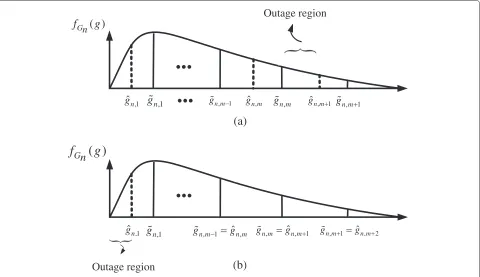
Figure 1 demonstrates the quantizers’ optimality con-dition more clearly. This is an intuitive result, meaning that to maximize the throughput in power-limited com-munication setups utilizing scheduling and quantized CSI feedback, the channel gain should be assumed to be con-stant, equal to its worst case within each QR except the first one. Finally, note that the arguments are valid for both fixed and random request networks.
According to the above discussions, optimizing the power-limited system throughput, the outagemayhappen iff a user in the first QR is selected; in the optimal case, the codeword transmitted to the scheduled user withinm>1 QR is always decoded, as the data is sent with the lowest possible rate. Therefore, the outage only happens if (1) a user in the first QR is scheduled and (2)gn < gˆn,1where
nis the index of the scheduled user (the outage region in Figure 1b).
Interestingly, the system outage probability vanishes as the number of users goes to infinity. This is because with infinitely, many users, i.e., N → ∞, the probabil-ity Pr{User nis scheduled &gn < gˆn,1} goes to zero, as there are always users with high channel quality. That is, for every given threshold ζ, we have lim
N→∞Pr{∀ζ,∃k ∈ {1,. . .,N},gk ≥ ζ} →1. Hence, no outage occurs as the users with high quantization indices are always scheduled.
Corollary 1.For every given long-term power con-straint, we haveTn,m>0,m>1 as long asϕn,m≤ϕn,m+1. That is, the only region thatmayreceive no transmission power is the first one.
Proof.The propertyTn,m≤Tn,m+1,∀n,m, simply means that for each user under long-term power allocation strat-egy, no power is assigned to a QR until the higher regions have received their required power. That is, for each power constraintT, there is an indexmof the QRs, where
Tn,m>0 form≥
mandTn,m=0 form<
m. However, in the optimal case, the QRs 1≤m< mthat have received no power are merged together to make a single (first) QR. Hence,Tn,m > 0 ifm > 1. This is a useful conclusion simplifying the optimal power allocation algorithm.
Finally, we close the section with the following dis-cussion about the transmission parameters setting. In practice, the suitable transmission parameters can be determined in two ways. In the first method, the system performance is evaluated off-line for different rates/powers, and the appropriate parameters are col-lected in a table which is used during data transmission. In this case, which is the same as in adaptive modula-tion and coding protocols [1], there is no need to know the channel cdf (in general, the only parameters that we need to know are the QRs and the transmission pow-ers, and not the channel cdf ). In the second method, however, the gain cdfs and an optimization algorithm are utilized by the BS for parameter setting. This is a suitable method for the scenario where the channel fol-lows a specific cdf pattern, and only the average statis-tics (e.g., the gains mean and variance) change slowly. Since the average statistics of the channel vary slowly (in most cases with a time constant of several 100 ms), the amount of feedback needed for long-run adaptation will be negligible compared to the channel quantization feedback.
4 Performance analysis: fairness scenario
( )
Gnf
g
,
n m
g
, 1n m
g gˆn m, gˆn m, 1
g
n m, 1(a)
, ˆ , 1
n m n m
g g
, 1
ˆ
,n m n m
g
g
gn m, 1 gˆn m, 2(b)
Outage region
,1
n
g
,1
ˆ
ng
...
...
( )
Gn
f
g
...
,1
ˆ
ng
g
n,1Outage region
Figure 1Quantization boundaries of a channel fading pdf.(a)Nonoptimal,(b)Optimal.
throughput but also the long-term data transmission effi-ciency of individual users. However, in a typical wireless network, the channel distributions are not necessarily identical. In this case, the strategy of communicating with the user having the best channel leads to giving almost all the resources to the statistically stronger user(s), thereby resulting in an unfair scheduling. A scheduling algorithm with fairness should sacrifice part of the sys-tem throughput and multiuser diversity to equalize the probability that a user is scheduled. There are many schemes tackling the fairness problem [15-17,34-37]. Here, we focus on two different fairness techniques as follows.
4.1 Long-term fairness constraint
There may be applications where while optimizing the system power-limited data transmission efficiency, every individual user should be guaranteed to have a given min-imum throughput in long term. We call this limitation as long-term fairness constraint where, using (7), the rate optimization problem (11) is replaced by
Here, γn is the nth user throughput constraint. Also, (23.II) constrains each user to have a given minimum average rate. That is, the power-limited throughput is maximized under the condition that the user individual throughput constraintsR¯(n) ≥γn,∀n, are satisfied. Note that (23) is changed to (11) if (23.II) is relaxed. Finally, with the same procedure as before, we havegˆn,m+1= ˜gn,m,m≥1, in the optimal case.
Depending on the user selection criterion and the power allocation strategy, there may be no closed-form solution for (23). This is particularly because the best user, in the sense of unfair throughput, i.e., (11), should not neces-sarily be selected, to satisfy (23.II) for all users. In simple words, in order to get some constrained system through-put, we may need to devote some rates for nonoptimal, in terms of throughput, receivers such that (23.II) is satis-fiede. Therefore, (23) leads to a complex nonconvex opti-mization problem even in its simplest cases. To tackle this problem under short-term power constraint, we propose a numerical method stated in Algorithm 1 which solves the problem using optimal scheduling, in the sense of (23).
¯
RLTmax(1,. . .,N)= max ∀˜gn,m,gˆn,m,Tn,m
N n=1
Mn
m=1ϕn,mβn,mlog(1+ ˆgn,mTn,m)
s.t.
# N n=1
Mn
m=1pn,mϕn,mTn,m≤T, (I)
Mn
m=1ϕn,mβn,mlog(1+ ˆgn,mTn,m)≥ γn,∀n (II)
Algorithm 1Throughput optimization
I. For a given short-term power allocation constraint
Tn,m=T,∀n,m,and the user individual
throughput constraintsγn,n=1. . .N, considerJ,
e.g.,J=20, randomly generated vectors
(j)=[g˜(j) 1,1,. . .g˜
(j) N,MN,gˆ
(j) 1,1,. . .,gˆ
(j)
N,1], where 0<gˆn(j,1) ≤ ˜gn(j,1) ≤ ˜gn(j,2) < . . . <g˜n(j,)Mn,∀n. II. For each vector(j), do the following
subprocedures:
1. For all possible user selection policies, i.e., all possible QR selection configurations, find the throughput based on (8).
2. For each user selection configuration, set the throughput equal to zero, if (23.II) is not satisfied. 3. SetR¯(j)(1,. . .,N), i.e., the throughput of thejth
vector, equal to the maximum of the throughput obtained under different user selection
configurations.
III. Determine the vector which results in highest throughput, i.e.,(k), where
¯
R(j)(1,. . .,N)≤ ¯R(k)(1,. . .,N),∀j=1,. . .,J.
IV. (1)←(k).
V. GenerateqJ, e.g.,q=5, vectors
(i),new,i=1,. . .,qaround(1). These vectors are
generated by adding small random numbers to the coefficients of(1)such that they satisfy the constraints introduced in I.
VI. (i+1)←(i),new,i=1,. . .,q.
VII. The same as in step I, regenerate the remaining vectors(j),j=q+2,. . .,Jrandomly. VIII. Go to II and continue until convergence.
Algorithm 1 roots from the genetic algorithm concepts which, the same as other machine learning-based algo-rithms such as particle swarm optimization, is based on (1) searching around the current solution, i.e., testing solu-tions with small random changes in the parameters of the current solution as well as (2) reducing the effect of local minima by mutation. In each iteration of the algorithm, we search around the best solution which has been obtained up to now and check a number of randomly generated answers which help prevent it from getting trapped into the local minima.
Similar to other techniques for solving nonconvex opti-mization problems, it can not be guaranteed that the algo-rithm leads to the globally optimal solution for all channel conditions. However, the algorithm can be run for many different initial parameter settings to reduce the effect of local minima. Furthermore, our experiments show that the algorithm is much more efficient than using a greedy
search scheme which requires a large number of initial random seeds due to the nonconvexity of (23). Finally, although it may be time consuming when the num-ber of optimization parameters increases, the proposed algorithm has been shown to be efficient in many com-plex optimization problems dealing with local minima issues [50].
4.2 Semi-instantaneous fairness constraint
The optimization problem (11) determines the maxi-mum long-term system performance in power-limited conditions. In this case, depending on the gains real-izations, it may happen that a user remains off for a long time. On the other hand, in delay-sensitive applica-tions, the users may require to be served not always but repeatedly within limited transmission periods. In other words, the scheduling approach should guarantee that each user gets some minimum amount of information in limited periods, to keep the connection alive. In order to provide such a property, we consider a simple scheme where, deviating from the optimal scheduling approach, the receivers are served by the standard round robin (RR) approach for a certain amount of time. In this way, while optimal scheduling, in the sense of (11), is utilized in most of fading blocks, in some time slots, the sched-uler is switched off and the users are communicated one by one.
Setting ϕn,m = 1,∀m, the throughput and the aver-age transmission power of the single-input single-output
(SISO) system between the transmitter and the nth
receiver, with no competition with others, are obtained by
¯ θ (n)=
Mr n
m=1
FGn(g˜
r
n,m)−FGn(gˆ r n,m)
log(1+ ˆgnr,mTnr,m)
(24)
and
¯
Tnr =
Mr n
m=1
prn,mTnr,m, (25)
respectively. Here, Mr
n is the number of QRs, prn,m =
˜gn,mr ˜
gn,mr −1fGn(gn)dgn, andg˜nr,mrepresents the mth quantiza-tion boundary of the encoder funcquantiza-tion
ξnr(gn)=mifgn∈Srn,m=[g˜nr,m−1,g˜nr,m),m=1,. . .,Mnr
Srn,m. In this way, considering the RR period to beα, the constrained throughput is found as
¯
and the average transmission power of the system is
¯ and (10), respectively. The first term in (26) represents the throughput achieved during the scheduler activa-tion period, and the second term gives the throughput achieved during the RR period. Consequently, the power-limited rate optimization problem, i.e., (11), is rephrased as implementing appropriate modifications in Algorithm 1, the optimal parameters gˆn,1,g˜n,m,Tn,m,gˆrn,1,g˜nr,m,Tnr,m, ∀n,m can be determined numerically. For this case, we set γn = 0,∀n, in the algorithm and replace (j) found according to (26).
Although the proposed scheme gives the users the chance of data reception in limited time slots, there is still a positive probability that they receive no informa-tion even within the round robin periods; using the worst case condition, i.e., gˆnr,m+1 = ˜gnr,m, the transmitted data of thenth user is lost if its instantaneous gain realization
gn falls in the regiongn ∈[0,gˆnr,1) (Corollary 1). Hence, with limited number of QRs, there is always a positive out-age probability πnr = Pr{0 ≤ gn < gˆnr,1} = FGn(gˆrn,1)
for each user during the round robin time slots. However, by adding thegˆnr,1 ≤FG−n1(ξn)constraint to the optimiza-tion problem, i.e., (28), this outage probability of the users can be reduced to a given threshold ξn. In this way, we guarantee that with probability of (1 − ξn), the user n receives some information within a limited number of transmission blocks determined byα.
4.2.1 Generalization of the fairness scheme
Equation (28) is derived based on the assumption that the nonoptimally scheduled, in the sense of (11), part of the transmission periods is uniformly allocated to the users (round robin scheme). However, in order to pro-vide a better fairness scheme, these time slots can be divided between the receivers in a wiser manner such that the users’ quality-of-service requirements are satisfied. In this perspective, the constrained throughput optimization problem (28) is generalized to
¯
where αn is the fraction of the time slots in which the usernis selected regardless of the other channels’ qual-ity. Here, the constraintgˆnr,1≤FG−1
n(ξn)limits thenth user outage probability during the fairness-based data trans-mission period to a given threshold ξn. Again, we have ˜
gn,m = ˆgn,m+1,g˜rn,m = ˆgnr,m+1,∀n,m ≥ 1 in the optimal case.
Remark 4.Equation (29) is a generalization of the two TDMA-based(α=1)[13,38,39] and opportunistic(α=0) [40,41] scheduling schemes which can determine the opti-mal data transmission strategy in a wide range of commu-nication scenarios.
Theorem 4.LetR¯semi
max(1,. . .,N|Mnr,ξn)be the maximum throughput obtained by (29) when thenth user has an out-age probability constraintξnandMrnQRs in the RR-based time slots. Then, under a short-term power constraint,
lim ξn→0
¯
with relaxed outage probability constraint and one less region in the quantizer of that user.
Proof.Please see Appendix 3.
In other words, the theorem simply means that in order to have an outage-free data transmission within the RR-based time slots, the data should be transmitted with an extremely low rate when the channel falls in the first QR. Therefore, the first QR has (almost) no contribution on the system throughput which will be determined by averaging on the achievable rates of them≥2 QRs.
Remark 5.Using Theorem 3 and Figure 1b, the same assertion can be proved for the case when an outage probability constraint is considered in the opportunistic scheduling period. Note that in both fairness schemes considered in this paper, the parameters are determined off-line, and consequently, fairness does not increase the implementation complexity or the feedback load. More-over, in both methods, the users’ contributions on the throughput are not necessarily the same, and they can be weighted. This gives flexibility, for instance com-pared to the standard PF scheduling, in dealing with the throughput-fairness tradeoff.
5 Simulation results and discussions
Simulation results are achieved for Rayleigh fading chan-nelsfGn(gn)= μ1ne
−gn
μn,gn> 0, whereμndenotes thenth user fading parameter. Also, the noise variances are set to σn2=1,n=1,. . .,N. Figures 2, 3, 4, 5, and 6 concentrate on the case where the users experience identical fading distributions withμn = 1,∀n. Here, the optimal quan-tizers have been obtained with proper modifications in Algorithm 1. Also, the results have been double-checked by the modified version of the gradient-based quantiza-tion algorithm of [43] which studies the SISO channels. The results are presented as follows.
5.1 System throughput with different power constraints and user activation probabilities
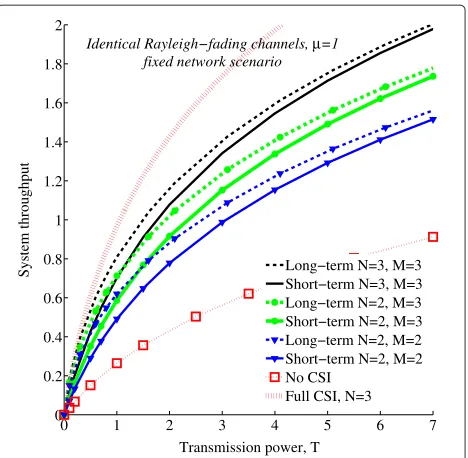
Figure 2 demonstrates the system throughput for the fixed network scenario and under different transmission power constraints. Then, the system performance in random request networks is studied in Figures 3 and 4, where the throughput is obtained under different transmission power constraints and user activation probabilities. Here, the results show that
• Substantial throughput increment is achieved via
very limited number of QRs, i.e., feedback bits, (Figures 2, 3, and 4). Particularly, the increment is considerable when the user activation probability
0 1 2 3 4 5 6 7
0 0.2 0.4 0.6 0.8 1 1.2 1.4 1.6 1.8 2
Transmission power, T
System throughput Long−term N=3, M=3 Short−term N=3, M=3 Long−term N=2, M=3 Short−term N=2, M=3 Long−term N=2, M=2 Short−term N=2, M=2 No CSI
Full CSI, N=3
Identical Rayleigh−fading channels, μ=1 fixed network scenario
Figure 2Throughput versus transmission power,T.Identical fading pdfs,μ=1, fixed network scenario.Nis the number of users, andMrepresents the number of QRs considered for each user.
increases (Figure 3). Also, in harmony with the literature, the partial CSI is more effective when the number of users increases. The intuition behind this is that with more CSI, the multiuser diversity which is an increasing function of the number of users is more efficiently exploited.
1 2 3 4 5 6 7
0.6 0.7 0.8 0.9 1 1.1 1.2 1.3 1.4 1.5 1.6
Average transmission power, T
System throughput
N=2, M=3, φ=1 N=2, M=2, φ=1 N=2, M=3, φ=0.7 N=2, M=2, φ=0.7 No CSI, φ=1
Random request (φ=0.7) and fixed (φ=1) networks, Long−term power constraint,
Rayleigh−fading channel, Identical fading channels, µ=1
Figure 3Throughput versus transmission power constraintT
0 0.2 0.4 0.6 0.8 1 0
0.1 0.2 0.3 0.4 0.5 0.6 0.7 0.8
Users activation probailiy,
Sys
te
m
th
ro
ug
hput
N=4, M=3 N=3, M=3 N=4, M=2 N=3, M=2 N=2, M=3 N=2, M=2 Throughput in random request
network,
Short−term power constraint T=1,
Figure 4Throughput versus user activation probabilityφ. Short-term power constraintT=1, identical fading pdfs,μ=1.
• The relative effect of optimal power allocation,
compared to short-term power allocation, is slightly higher when the number of users decreases (Figure 2).
5.2 The optimal quantization parameters
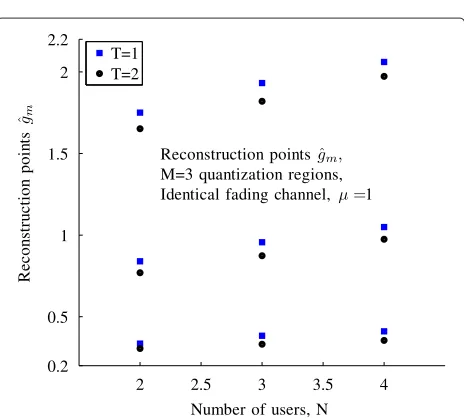
Considering M = 3 QRs for each user, Figure 5 shows
the optimal reconstruction pointsgˆmobtained for differ-ent transmission powers and number of users. Here, the following points are interesting to be noted:
• According to Theorem 3 and its following
discussions, the last two points in each triple of
2 2.5 3 3.5 4
0.2 0.5 1 1.5 2 2.2
Number of users, N
Recon
stru
c
tion
poin
ts
T=1 T=2
Reconstruction points M=3 quantization regions, Identical fading channel, 1
Figure 5Optimal reconstruction points for different number of users and transmission powers.Identical fading pdfs,μ=1,M=3 quantization regions.
0 2 4 6 8
0.65 0.7 0.75 0.8 0.85 0.9 0.95 1
Transmission power, T
Throughput gain,
Δ
N=2, M=3 N=2, M=2 N=4, M=2
Rayleigh−fading channels, μ=1, short−term power constraint
Figure 6Throughput gain versus the transmission powerT, identical fading pdfs,μ=1, short-term power constraint.
points(gˆ1,gˆ2,gˆ3)coincide with the quantization boundaries, while the first point is the fixed valuegˆ1 considered in the first region. Also, the same points
are obtained byM=4QRs and extremely hard
outage probability constraint for each user, where the first QR converges to zero (Remark 5).
• The optimal QRs get closer to zero when the
transmission power increases.
• The QRs expand as the number of users increases.
The intuition behind this point is that with high number of users, the probability that a user with low channel quality is scheduled reduces. Therefore, the quantization boundaries expand such that high SNRs are quantized with higher resolution.
5.3 The system throughput in the presence of different quantizers
The effect of optimal channel quantization on the sys-tem throughput is investigated in Figure 6. Here, the throughput gain = ¯R¯Eq
ROpt is plotted as a function of the transmission power, whereR¯OptandR¯Eqare the sys-tem throughput obtained by optimal channel quantization and probability quantizer, respectively (with equal-probability quantization, the channel pdf is divided into
Mregions having the probabilities M1). According to the figure, the following points are concluded:
• The channel quantization has a large impact on the
system performance, particularly at low SNRs. For
instance, withN=4users and one bit feedback per
if the optimal quantizers are replaced with equal-probability quantization at low SNRs.
• As expected, optimal quantization becomes more
important when the number of users increases.
• On the other hand, the performance loss due to
nonoptimal quantizers decreases when the number of QRs or the transmission power increases.
Figures 7, 8, 9, and 10 focus on the system throughput and fairness approaches in the presence of nonidentical fading pdfs.
5.4 Throughput in the presence ofK-significant average feedback bit allocation approach
AssumingK = 2- andK = 3-significant approach and
T =1, Figure 7 presents the system throughput as a func-tion of a nonsignificant user fading parameter. Here, the
K significant users are supposed to have identical fading coefficientsμ = 1, while the nonsignificant user fading coefficient is less than one. Note that the number of users
can be any number N ≥ K +1, as only the best
non-significant user participates in the scheduling. The figure emphasizes the following points:
• UsingK -significant average approach, the
nonsignificant users affect the system throughput only when their average characteristics are
comparable with ones in the significant users; when the nonsignificant users experience very poor channel condition, they have no contribution to the system
0.4 0.5 0.6 0.7 0.8 0.9 1
0.5 0.55 0.6 0.65 0.7
The best nonsignificant user fading coefficient,
Sys
te
m
th
ro
ug
hput
K=3 K=2
M=2 M=3
System throughput in K−significant scheme, Fading coefficient of significant channels μ=1,
Short−term power constraint, T=1
μ Figure 7Throughput versus the nonsignificant user fading parameter.K-significant average approach, short-term power constraintT=1, fading coefficient of significant usersμ=1. The total number of users can beN≥K+1 as long as the fading coefficient of the other nonsignificant users is less thanμ.
0.75 1 1.25 1.5
0 0.1 0.2 0.3 0.4 0.5 0.6 0.7 0.8 0.9 1
Transmission power, T
System throughput Unfair, M1=1, M2=4
Unfair, M
1=2, M2=2
Long−term fair, M
1=1, M2=4
Long−term fair, M
1=2, M2=2
PF scheduling, M
1=2, M2=2
N=2 users with Rayleigh fading channels, μ1=1,μ2=2, Short−term power constraint
Long−term fairness constraint,γ
1=γ2=0.3
Figure 8The throughput versus the transmission powerTunder long-term fairness constraint,γ1=γ2=0.3.Short-term power constraint,N=2 users with fading coefficientsμ1=1,μ2=2. With
a long-term fairness constraint, no transmission is allowed at low SNRs, as the users’ individual throughput constraints (23.II) are not satisfied. Increasing the power, there is a threshold above which data transmission is possible since the users’ individual throughput constraints are satisfied.
throughput, since the significant users are always scheduled (flat lines in Figure 7). However, when the nonsignificant users’ channel quality improves, they can win in competition with the significant users falling into their first QRs (the increasing parts of the curves in Figure 7; also, please see Theorem 2).
• The nonsignificant users have less chance of data
transmission, i.e., the increasing parts start at higher
values ofμ, when the number of users increases. This
is intuitively due to the fact that with higher number of significant users, the probability that all users experience bad channel condition, i.e., all fall into first QR, reduces.
• On the other hand, the nonsignificant users are more
involved in the scheduling process when the number of QRs considered for the significant users increases. This is because with more QRs, the first region and its contribution to the throughput become smaller.
5.5 The long-term fairness constraint and feedback bit allocation strategies
a
b
Figure 9Optimal time-sharing coefficients versus (a)
transmission powerTand (b) the second user fading coefficient
μ2.N=2 users, short-term power constraint, equal-probability fading quantization. The time-sharing parameters are determined such that the two users have the same throughput.Mis the number of QRs considered for each user.
• Considering a long-term fairness constraint, no data
transmission is allowed at low transmission powers, as the worse user (user 1) individual throughput constraints, i.e., (23.II), can not be satisfied.
• Further, even if the weak users’ long-term fairness
constraints are satisfied, the sum throughput is less than the one with no fairness constraint (please compare the sum throughput of the unfair scheduling curves and the ones with long-term fairness constraint). This is due to the fact that part of the throughput is sacrificed to satisfy the users’ fairness requirements.
• Assuming a long-term fairness constraint, the
optimal scheduling protocol is completely different from the one expected in the common schedulers. For instance, with the parameter setting of Figure 8, the worse user (user 1) individual throughput constraint is satisfied with less transmission power in
theM1=1,M2=4case, when compared with the
M1=M2=2case. This is because, although less
0.5 0.75 1 1.25 1.5
0.4 0.5 0.6 0.7 0.8 0.9 1
Transmission power, T
System throughput
Unfair (opportunistic), α 1=α2=0 Semi−instantaneous fair, α
1=0.2,α2=0.2 PF scheduling, M
1=2, M2=2 Round robin, α
1=0.5,α2=0.5
N=2 users with Rayleigh fading channels,μ1=1,μ2=2, Short−term power constraint, Number of quantization regions in (29):
M
1=1, M2=4, M1 r=4, M
2 r=4
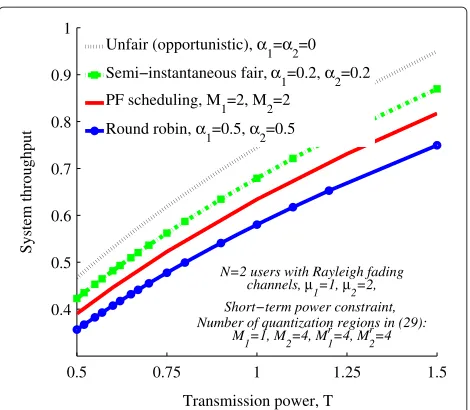
Figure 10System throughput under different
semi-instantaneous fairness constraints.The throughput is found according to (29) forN=2 users with Rayleigh fading channels,
μ1=1,μ2=2,M1=1,M2=4,Mr1=4, andMr2=4. Short-term
power constraint. The results are the same as the ones obtained by
Mr1=5,Mr2=5 under extremely hard outage probability constraint (Theorem 4).
partial CSI is allocated to user 1 in the first case, it is more often scheduled, i.e., its scheduling probability in (23.II) increases.
• To increase the sum throughput, more feedback
resources should be allocated to users experiencing better channels, even if there is a fairness constraint
(please compare the casesM1=1,M2=4, and
M1=M2=2).
• Finally, the system performance is highly affected by
the bit allocation procedure. This is a motivation for investigating optimal bit allocation in the
throughput-fairness problem in the future.
5.6 The system throughput with time-sharing and a semi-instantaneous fairness constraint
The system performance under semi-instantaneous fair-ness constraint is investigated in Figures 9 and 10. Consid-ering two users with different fading coefficients, Figure 9 shows the optimal time-sharing parameters such that the two users have the same throughput. That is, the time-sharing coefficients are determined such that α1R¯(1) = α2R¯(2). Here, it is focused on short-term power constraint and equal-probability quantizers. Further, Figure 10 stud-ies the effect of the different semi-instantaneous fairness constraints on the system throughput. Here, the results are obtained according to (29) forN = 2 users with fad-ing coefficients μ1 = 1,μ2 = 2, M1 = 1,M2 = 4,