R E S E A R C H
Open Access
Determinant-based MIMO scheduling with
reduced pilot overhead
Kyeongjun Ko and Jungwoo Lee
*Abstract
In a multiuser multiple-input multiple-output (MU-MIMO) cellular system where there are many candidate users, it is critical to select a user group which maximizes the overall throughput of the system. However, the optimal scheduling strategy (exhaustive user selection) is computationally prohibitive when the total number of users is large. In this article, we propose a determinant-based user selection algorithm which reduces the search complexity without much performance degradation. A key contribution of this article is to use a matrix
determinant as a measure of orthogonality as well as channel quality in user selection. Linear precoding schemes (zero-forcing beamforming or block diagonalization) widely used in MU-MIMO systems require two sets of pilots to estimate both raw and effective channels, which results in increased pilot overhead. In order to reduce the overhead, we also propose a new pilot scheme with only one set of pilot, which is another key contribution of this article. The new pilot scheme is combined with the proposed scheduling algorithm. Simulation results show that the proposed scheduling algorithm with a new pilot scheme reduces computational complexity and pilot overhead with negligible performance degradation compared to the exhaustive scheduling with a conventional pilot scheme.
1 Introduction
Multiuser multiple-input multiple-output (MU-MIMO) systems have drawn much attention recently because of higher capacity compared to single-user MIMO (SU-MIMO) systems [1]. In multiuser input single-output (MU-SISO) systems, it was shown that allocating entire power to the user who has the best channel is the optimal strategy [2]. On the other hand, in MU-MIMO systems, it has been known that allocating power to multiple users simultaneously is better, which is differ-ent from MU-SISO systems. However, MU-MIMO sys-tems have some practical issues. A MU-MIMO system needs complicated user selection process compared to a SU-MIMO system. It needs to find a user group which maximizes the throughput while a SU-MIMO system finds only the best user. By the way, it is not simple to find the best group of users because a linear precoding matrix to remove inter-user interference needs to be computed for each candidate group of users. Especially, the optimal (exhaustive) user selection scheme is com-putationally prohibitive when the total number of users
is large in a given system (cell). Many suboptimal user scheduling algorithms have been proposed to reduce the computational complexity of the optimal user selection scheme.
A suboptimal scheduling algorithm by using Gram-Schmidt Orthogonalization (GSO) in MU-MISO system was proposed [3]. However, it cannot be used in MU-MIMO systems since GSO is used only for vector chan-nels. In conventional MU-MIMO systems, user channels are represented with matrices. Two low complexity user scheduling algorithms, the capacity based algorithm and the Frobenius norm-based algorithm, that can be applied to MU-MIMO systems were proposed in [4]. These schemes achieve performance close to the opti-mal scheduling algorithm but still with high complexity. The capacity-based algorithm needs frequent computa-tion of singular value decomposicomputa-tion (SVD) and the Fro-benius norm-based algorithm also needs heavy GSO computation. Therefore, our motivation is to further reduce the complexity of the user selection algorithm in MU-MIMO systems.
Inter-user interference occurs when the resources are allocated to multiple users in MU-MIMO systems. The inter-user interference must be eliminated since it limits
* Correspondence: [email protected]
Department of Electrical Engineering and Computer Science, Seoul National University, Seoul, Korea
the sum-capacity of the system. Dirty paper coding (DPC) is the optimal non-linear precoding technique to avoid the inter-user interference, but its complexity is prohibitive [5]. Zero-forcing beamforming (ZFBF) and block diagonalization (BD) were proposed to reduce the complexity as linear precoding techniques [6-8]. The ZF scheme eliminates the inter-user interference by using the pseudo-inverse of the selected users’channel matrix in multiuser MISO systems. The BD scheme removes the interference by finding the null space of the selected users’concatenated channel matrices which excludes the intended user’s channel matrix. It can be considered as an extended scheme of the ZF scheme.
The linear precoding techniques require the channel state information (CSI) at the transmitter. The channel estimation has to be done at each receiver by embed-ding pilots in the signal, and the estimated channel has to be fed back to the transmitter. However, ZF and BD need two sets of pilots. One is common pilot, which is used to estimate the raw channel. The other is dedicated pilot, which is used to estimate the effective channel which is a combined channel of the raw channel and the precoding matrix. A SU-MIMO system and a ran-dom beamforming (RBF) system (a MU-MIMO system) do not need dedicated pilots since the beamforming matrix is available at the receiver. But, in the ZF scheme and the BD scheme, the receiver does not know the beamforming (precoding) matrix since the beamforming matrices depend on the selected users, and each receiver does not know the users selected in transmitter. There-fore, ZF and BD need dedicated pilots to estimate the effective channel. Obviously, the data rate will suffer with large pilot overhead due to the two sets of pilots, which may make MU-MIMO less attractive.
There exist many low complexity MU-MIMO sche-duling algorithms since the optimal schesche-duling scheme is too computationally complex to be used in the practi-cal systems [3,4,9-12]. In [12], an MU-MIMO schedul-ing algorithm by chordal distance was proposed. The chordal distance estimates distance between spaces [13], and thus can be used for MU-MIMO systems. In select-ing users, the degree of orthogonality measured by the chordal distance is not enough, and the channel power for each user also matters. Therefore both chordal dis-tance and channel power should be considered simulta-neously to select users. A weighting factor between the chordal distance and the channel power,a, was used.
In this article, we propose two new methods. One is the low complexity MU-MIMO scheduling, and the other is a new pilot scheme which uses only one set of (dedicated) pilots. The new user selection (scheduling) scheme proposed in this article is based on a determi-nant property and an iterative matrix computation, which is different from [3,4,9-12]. Simulation results
show performance comparison between the combination of two methods and the existing scheduling and pilot schemes. The rest of the article is organized as follows. The system model section introduces the system model. A new low complexity MU-MIMO user selection scheme with BD is proposed in the section of determi-nant-based multiuser MIMO scheduling algorithm. The complexity of the proposed algorithm is analyzed in the section of computational complexity analysis. The sec-tion of low overhead pilot design for BD presents a new pilot scheme that uses a single set of pilots with BD. Numerical results are shown in the section of simulation results. Finally, conclusions are given in the last section.
2 System model
We consider an MU-MIMO downlink channel with a single base station (BS) which hasM transmit antennas,
andKTusers with Nreceive antennas. We assume that
the receivers estimate their channels perfectly and the BS knows the exact CSI of all the users. The broadcast channel of MU-MIMO system is given by
yi=Hix+ni, i= 1,. . .,K (1)
whereKis the number of the simultaneously selected
users, Hi is theN ×M channel matrix of the ith user
(selected by a scheduler from KT ≥ Kusers),ni is the
complex white Gaussian noise vector for theith selected user (each element of ni is i.i.d. complex Gaussian with
zero mean and unit variance), andyiis the received
sig-nal vector at the ith selected user. Note that the channel entries ofHiare independent identically distributed (i.i.
d.) complex Gaussian with zero mean and unit variance. The transmitted signal,x, is expressed as
x=
wheresl is the symbol vector of thelth selected user
with E[∥sl∥2] = 1,Pl is the power allocated for thelth
selected user, andVlis the precoding matrix for thelth
selected user.
3 Determinant-based multiuser MIMO scheduling algorithm
3.1 Block diagonalization
The received signal (1) can be divided into the desired signal, the interference signal, and the noise as follows.
yi=PiHiVisi+Hi
are not orthogonal to each other in MU-MIMO. There are two kinds of interference mitigation/cancellation techniques. The first kind is the orthogonal RBF scheme [9]. It selects the users who have maximum signal to interference plus noise ratio (SINR) for each beam of a fixed random unitary matrix. We get better performance as the number of users increases since the users who have larger SINR tend to be selected in the case. The per user unitary rate control (PU2RC) system [10] was proposed as an extended version of RBF.
The second kind is the ZFBF scheme. The BD scheme is an extended scheme of ZFBF which is an MU-MISO system. The ZFBF and the BD schemes eliminate inter-ference signal by using a precoding matrix. In the BD
scheme, the precoding matrixVi is selected such that
HiVj = 0,∀i≠ j. In order to maintain the power
con-straint, it is assumed that ViVH
i =IN. This is an ortho-normal basis for the null space of the matrix formed by stacking allHj, j≠imatrices together. This removes the
interference term in (3). However, at mostK=⌈M/N⌉
users can be selected simultaneously because of the con-straint of null space where⌈a⌉is the minimum integer
number not smaller than a. In the BD scheme, we can
express (3) as
yi=PiHiVisi+ni. (4)
3.2 Power allocation
An MU-MIMO system can be divided intoK
indepen-dent parallel SU-MIMO in the BD scheme as in (4). Water-filling-based power allocation can be used since the BS knows perfect channel information of all the
receivers. When we assume each receiver receives N
streams, there are total N·Kstreams on which we use
water-filling. The capacity with water-filling [11,12] is written as
whereP is the total transmit power,n is the number
of total streams, S is the set of the selected users,
H(S) is the set of channels in S, li (i= 1,..., n) is the the MU-MIMO system with BD and water-filling among the selected users can then be given by
R(S) =
S
C(H(S)V(S),P) (6)
where V(S) is set of precoding matrix in S.
3.3 Low complexity MU-MIMO scheduling algorithm
The optimal MU-MIMO scheduling with BD is per-formed by
Ropt(S) = max
S⊂{1,...,KT},1≤|S|≤K
R(S) (7)
Therefore, the optimal scheduling is computationally prohibitive if KT≫ Ksince the number of all possible
pairs of the selected users is Ki=1KT
i
. The most
important consideration in selecting users in MU-MIMO systems with ZFBF or BD is the orthogonality among the channels of the selected users. If the ortho-gonality among the selected users is not large, the beamforming direction of a user is going to be misa-ligned from its own channel since the precoding matrix becomes the null space of channels of the other selected users. That is, the precoding matrix by ZFBF or BD eliminates not only the undesired interference signal, but also the intended signal, and the reduction of the desired signal is roughly proportional to the distance between its own channel and the precoding matrix. For example, if the channels among the selected users are orthogonal to each other, the desired signal does not suffer degradation because the precoding matrix is aligned with the channel of the desired signal perfectly. In the other extreme case, if the channels among the selected users is in the same direction or plane, the desired signal is lost completely since the precoding matrix is orthogonal to the channel of the desired signal. The orthogonality among the selected users was esti-mated by GSO in [3]. The scheduling algorithm in [3] has good performance with low complexity, but it can be used only in MU-MISO systems since GSO can be applied to vectors only. On the other hand, the capa-city-based algorithm and the Frobenius norm-based algorithm were proposed in [4] for MU-MIMO systems. The capacity-based algorithm selects a user that achieves maximum capacity first, and successively finds another user which has maximum sum capacity based on greedy algorithm. However, it requires SVD compu-tation at each step, and still has high complexity. The Frobenius norm-based algorithm has lower complexity than the capacity-based algorithm. It finds a receiver set with the sum of Frobenius norm of orthogonal elements computed by a projection matrix among the candidate
users’channels instead of computing the sum capacity
by those vectors, which can be thought of as a measure of the channel quality and the distance between user channels. For example, Figure 1 shows the relationship between orthogonality and determinant, and computes the volume of an geometric object spanned by vectors. Note that the volume of Figure 1a is larger than that of Figure 1b even when the edges of (b) have the same length as those of (a). If the vector channels of a given set of receivers are considered as the spanning vectors of the parallelepiped of Figure 1, the volume of the par-allelepiped increases when the vector channels are close to orthogonal to each other assuming that each vector has fixed magnitude. We can also extend the argument from a vector to a matrix, and the volume of the geo-metric object gets larger as the orthogonality among the users increases even when matrix channels are used. Therefore, the determinant-based scheme can be regarded as an extension of the GSO scheme in [3]. It should also be noted that a determinant is also related to the channel quality as well as the distance between the selected user channels. If the size of the spanning vectors in Figure 1 is large, the volume also increases. Hence, a determinant is useful for user selection because it measures both distance and channel quality.
In summary, it is critical to have orthogonality between different user channels for the MU-MIMO sys-tem with BD to be effective. The chordal distance and the channel quality are independent with each other. Even if the selected users have large channel power, the volume may be small when the chordal distance among the selected users is small. Thus, the volume of the par-allelepiped spanned by vector or matrix channels is related to both the chordal distance and the channel power.
The first step of the proposed algorithm is to find the
user which maximizes capacity among candidates in T.
A next user that maximizes determinant with the
selected user set S is chosen in a successive fashion
without computing a precoding matrix by SVD. The
volumeSof a figure composed by a generalm×n
com-plex matrix,B, is given by [14]
S= det(BHB). (8)
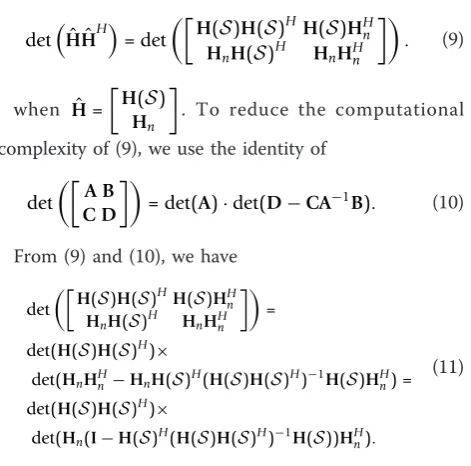
The determinant of the combined matrix of the chan-nel H(S) of the selected set and the channel of thenth candidate userHnis given by
detHˆHˆH= det
H(S)H(S)HH(S)HHn HnH(S)H HnHHn
. (9)
when Hˆ =
H(S) Hn
. To reduce the computational
complexity of (9), we use the identity of
det
A B C D
= det(A)·det(D−CA−1B). (10) From (9) and (10), we have
det
H(S)H(S)HH(S)HHn
HnH(S)H HnHHn
=
det(H(S)H(S)H)×
det(HnHHn −HnH(S)H(H(S)H(S)H)−1H(S)HHn) =
det(H(S)H(S)H)×
det(Hn(I−H(S)H(H(S)H(S)H)−1H(S))HHn).
(11)
Note that the first term det(H(S)H(S)H) in (11) has nothing to do withHnwhich is the channel of a
candi-date user in T, and it can be skipped in the user
sche-duling process. Denoting
I−H(S)H(H(S)H(S)H)−1H(S) by X, the scheduler selects the user that has the maximum value of
(a) (b)
A
B
OhPGeGOiP
in each iteration. In the scheduling algorithm, an extra user that maximizes the volume in (11) with the pre-vious selected user set S. The usersi that is selected at
theith iteration is dropped from T, and it is added to S. The sum-rate is also computed at each iteration for
updated S by (5) and (6). If the sum-rate of the ith
iteration is smaller than that of the (i- 1)th iteration,
the algorithm stops with the result of the (i - 1)th
iteration.
The detailed user scheduling process is described in Algorithm 1. It should be noted that fewer than Kusers can be selected in the user scheduling process. This may occur when a new user which is close to the subspace of existing users reduces the null subspace in the BD
scheme. In the DPC scheme, all K users are always
used, but the number of selected users in BD can be smaller thanK.
Algorithm 1 Determinant-based multiuser MIMO scheduling algorithm
4 Computational complexity analysis
The key contribution of the proposed scheduling algo-rithm is to achieve low complexity without sacrificing performance. In this section, we compare the proposed scheduling algorithm with the existing scheduling algo-rithms which include the optimal scheduling algorithm and other low complexity scheduling algorithms in terms of complexity. The complexity is counted as the
number of flops, denoted as ψ. A flop is defined as a
real floating point operation [15]. Each of a real addi-tion, a multiplicaaddi-tion, and a division is counted as one flop [4]. A complex addition and multiplication have two flops and six flops, respectively. Although flop counting cannot show complexity precisely in practical
systems, it can indicate a rough order of the computa-tional complexity.
4.1 Complexity of typical matrix operation
We assumeKT≫ K, N≤ M, and K=
M
N
in this
sec-tion. For anN×Mcomplex valued matrixH, the
num-ber of typical matrix operation is given by Shen et al. [4].
4.2 Optimal scheduling algorithm
A BS performs exhaustive search over all Ki=1
KT
i
possible user sets in the optimal scheduling algorithm. Thus the order of the optimal scheduling algorithm is given by
4.3 Suboptimal scheduling algorithm
We analyze computational complexity of the capacity-based algorithm, the Frobenius norm-capacity-based algorithm [4], and the chordal distance-based algorithm [12]. The complexity of the capacity-based algorithm is expressed by
ψF≈
The complexity of the chordal distance-based schedul-ing algorithm is
4.4 Determinant-based scheduling algorithm
As for the determinant-based scheduling algorithm, the complexity is given by
ψDE<
The number of flops needed for computing
I+ P
MHH
H which is a positive definite matrix is 8MN2
+ N2 + N flops. We need 8M2N + 8MN2 flops for
HnXnHHn which is also a positive definite matrix. To reduce computation, we can use Cholesky decomposi-tion which decomposes a positive definite matrix into a product of an lower triangular matrix and its hermitian. With Cholesky decomposition, the determinant of a positive definite matrix can be computed by
det(HnXHHn) = det(LLH). (17)
The Cholesky decomposition of ann×nmatrix needs
n(n - 1) real additions, n(n - 1) real multiplications,
and n real square root calculations. To compute the
determinant, additionalnreal multiplications are needed [11]. Therefore. the number of flops to compute
det(HnXHHn) is 4
flops for water-filling and the update of X is omitted
since it is dependent not on KT, but on K which is
much smaller thanKT. From the section of complexity
of typical matrix operation, the complexity order of sin-gular decomposition plus water filling isO(M3). Since the complexity order of the inverse part of computingX and the water filling (with singular decomposition) isO
(M3), the overall complexity of the X update and the water filling isO(KM3), so it does not change the overall complexity order of (16) becauseK≪KT.
As shown in the above computational complexity ana-lysis, we observe that all the low complexity scheduling algorithms have complexity proportional toKTwhile the
optimal scheduling algorithm is not. The determinant-based scheduling algorithm has the lowest computa-tional complexity among the scheduling algorithms that are considered. It is interesting to note that its
complex-ity is dependent not on K, but on M and KT only.
Therefore, the determinant-based scheduling algorithm has an advantage in the systems with largeK.
5 Low overhead pilot design for BD
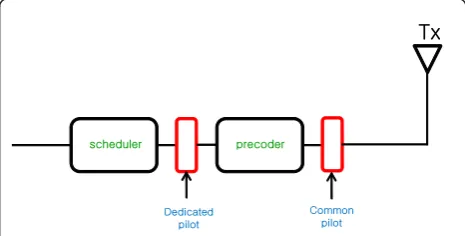
Pilot signals are used for a receiver to estimate its CSI, and the pilot overhead may decrease the data through-put. There are two types of pilots in practical implemen-tation of MU-MIMO systems. One is common pilots and the other is dedicated pilots. The common pilots are used to estimate the raw channel without the pre-coding matrix, and the dedicated pilots are used to esti-mate the effective channel which is a combination of the raw channel and the precoding matrix. Figure 2 shows a conventional MU-MIMO transmitter block dia-gram describing where the common pilot and the dedi-cated pilot signals are inserted.
In an open loop MIMO or a closed loop SU-MIMO with beamforming matrix, the channel is esti-mated with the common pilots. Note that a receiver computes or knows the beamforming matrix in a closed loop SU-MIMO. It is enough to use only the common
pilot for both RBF and PU2RC which are MU-MIMO
systems. The two schemes use a fixed unitary beam-forming matrix which is known to both the BS and the
receivers. Therefore, the effective channel can be easily computed at the receiver by using the known beam-forming matrix.
In the ZFBF and BD schemes, the effective channel cannot be estimated with common pilots only which are used to estimate raw channel since receivers do not know the beam-forming matrix for the selected users determined by the BS. Thus, the dedicated pilots are needed to estimate the effective channel which is the combined channel of the raw channel and the beam-forming matrix. The additional dedicated pilots are overhead which reduces the overall data throughput. The requirement of the additional pilot overhead is a disadvantage of ZFBF and BD although they have per-formance gain compared to SU-MIMO or other MU-MIMO systems.
We propose a reduced pilot scheme by matrix inver-sion for ZF and BD in this section. In the proposed scheme, only the dedicated pilot is used. We assume block fading channel and zero feedback delay for
simpli-city. First, we define M × M unitary pilot matrix, F,
which is given by
=φ1Tφ2T. . . φKTT (18)
wherejiis N×M pilot matrix and K= M
N for
simpli-city. The matricesji’s (i = 1,...,K) are orthonormal to
each other. Note that each row ofji is a time-domain
sequence of length M which is orthogonal to each
other. The received pilot signal at thekth user at time slottis described by
H(kt)V(t)=H(kt)[V(1t)φ1+V(1t)φ1+· · ·+V(Kt)φK]. (19) where H(kt) is the channel matrix of the kth user at time slott. Note thatV(t)at time slottis given by
V(t)=V(t) 1 . . .V
(t)
K
(for the selected users at time slott−1) =IM (otherwise)
(20)
whereIMis anM×Midentity matrix. The channel of
thekth user at time slottis estimated by
Hk(t)(V(1t)φ1+V2(t)φ2+· · ·+V(Kt)φK)H
=H(kt)V(1t)H(kt)V2(t). . .H(kt)V(Kt). (21)
Each receiver estimate H(kt)V(t) instead of H(kt) by dedicated pilotF, which means that the raw channel is not estimated. In fact, each receiver does not have to know its own raw channel since effective channel is
enough to decode the data. Note that the BS need to estimate the raw channel of each receiver to construct the precoding matrices.
The BS estimates the raw channel of each receiver by multiplying the inverse of the precoding matrix to (21).
Hk(t)V(1t)H(kt)V2(t). . .H(kt)V(Kt)·V−1 =Hk·V·V−1
=Hk
(22)
A technical issue in (22) is whether V-1exists or not. If V-1does not exist, the raw channel in (22) may not be obtained precisely. In order forV-1to exist, Vshould
be an M × M square matrix, and it has to have full
rank. We use two methods to deal with the inverse issue. At first, the user scheduling algorithm selects a set ofKusers for which the inverse of V-1 exists. When the user selection algorithm fails to find such set of users, we use a generalized (Moore-Penrose) inverse [15] instead of an ordinary inverse, which may degrade the system performance when this occurs. It was observed that the event that the ordinary inverse does not exist occurs rarely in the simulations, so the impact on the performance is negligible.
Our proposed scheduling algorithm selects the users who are near-orthogonal to each other, and thus the precoding matrices also tend to near-orthogonal to each other. By well known properties of an i.i.d. Rayleigh fad-ing matrix channel, the channel matrix is of full rank with probability one [16,17]. In our simulations, it was empirically observed that the inverse ofValmost always exist, which may be due to the fact that the proposed algorithm selects near-orthogonal users. In case the inverse does not exist, we can simply keep re-selecting users until the corresponding V-1 exist. This way, the existence of the inverse can be achieved with high prob-ability. In the proposed reduced pilot scheme, only one pilot (dedicated pilot) is used so that the overall throughput is improved.
6 Simulation results
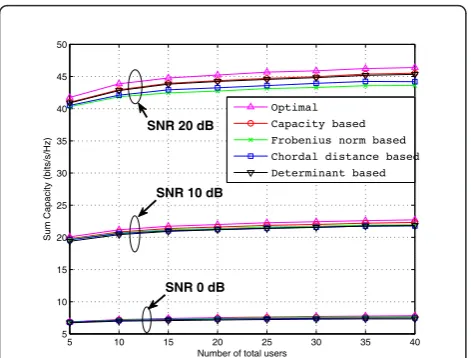
In this section, we compare the performance of the pro-posed scheduling algorithm with the optimal scheduling algorithm and the low complexity scheduling algorithms which include the capacity-based algorithm, the Frobe-nius norm-based algorithm, and the chordal distance-based algorithm. Figure 3 shows the sum-capacity com-parison of various scheduling algorithms with respect to
KTand SNR whenM = 8,N= 4. We can see the
low complexity scheduling algorithms at high SNR with the lowest complexity.
Figure 4 compares sum-capacity of various scheduling
algorithms with respect to KTand SNR when M = 8,
N= 2. Compared to Figure 3, Kis twice larger in this
case. Figure 4 also shows an advantage of the determi-nant-based scheduling algorithm. It achieves almost the same performance as the capacity-based algorithm and the Frobenius norm-based algorithm, and it is close to the optimal scheduling algorithm, and has better perfor-mance than the chordal distance-based algorithm for all SNR range. Interestingly, our proposed algorithm can be considered as a capacity upperbound in high SNR since the determinant of a matrix is an approximation of the channel capacity in high SNR.
Figures 5 and 6 show the effect of the reduced pilot scheme on the optimal scheduling algorithm and the determinant-based scheduling algorithm in terms of sum-capacity. It is observed that the degradation due to the reduced pilot scheme is almost negligible in terms of sum capacity. There is a slight gap in low SNR between the two pilot scheme and the one pilot scheme, but the two schemes have almost the same performance in high SNR. The small degradation in the low SNR regime is due to the fact that the number of the selected users is fewer thanKat low SNR in the scheduling algo-rithm with two pilots, and it may be better to choose
fewer than K users at low SNR. In the reduced pilot
scheme, K users always have to be selected, which
5 10 15 20 25 30 35 40
Number of total users
Sum Capacity (bits/s/Hz)
Figure 3 Sum-capacity comparison of various scheduling algorithms whenM= 8,N= 4.
Number of total users
Sum Capacity (bits/s/Hz)
Figure 4 Sum-capacity comparison of various scheduling algorithms whenM= 8,N= 2.
Optimal w/ reduced pilot Determinant
Determinant w/ reduced pilot
Figure 5 Effect of reduced pilot scheme in the optimal scheduling algorithm and the determinant-based scheduling algorithm whenM= 8,N= 4,KT= 20.
causes a minor degradation. On the other hand,Kusers tend to be selected at high SNR even in the scheduling algorithm with two pilots. In practical systems, the throughput increases when the proposed pilot scheme is used since more data can be transmitted instead of common pilot signals although the proposed pilot scheme has slight capacity degradation compared to the conventional pilot scheme of Figure 2. Let us discuss
why fewer thanKusers may perform better at low SNR.
It was shown in [1] that TDMA performs as well as DPC (the optimal MU-MIMO scheme) below about 5dB of SNR. It was also shown in [18] that linear pre-coding such as BD performs worse than DPC, so linear precoding is expected to be worse than TDMA at low
SNR (below 5dB). Hence, a system with fewer than K
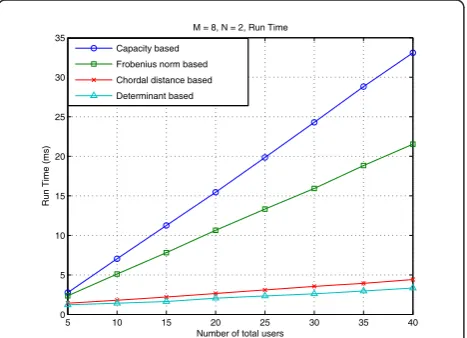
users may perform better than the system withKusers. Figure 7 compares run time of various low complexity
algorithms whenM = 8, N= 2. It is observed that the
determinant-based scheduling algorithm has the shortest run time among the low complexity scheduling algo-rithms. It has significant gain over the capacity-based algorithm and the Frobenius norm-based algorithm in terms of run time, and it is slightly better than the chor-dal distance-based algorithm. However, it achieves better sum capacity than the chordal distance-based algorithm as can be seen in Figures 3 through 7.
7 Conclusions
In this article, we propose a low complexity MU-MIMO scheduling algorithm with BD and a reduced pilot scheme. A key contribution of this paper is that the user selection algorithm uses the determinant of a matrix composed of users’channel matrices so that the ortho-gonality as well as the channel quality of the selected users are measured. Its performance is close to the
optimal scheduling algorithm, and has advantage over the other low complexity scheduling algorithms in terms of both sum-capacity and computational complexity. Another key contribution of the paper is a new pilot scheme which reduces pilot overhead by using only one set of pilots called dedicated pilots. The simulations show that the performance of the new single pilot scheme is comparable to the conventional two pilot scheme. It appears that the proposed methods of new scheduling and pilot reduction are promising for practical imple-mentation of next generation wireless systems such as 3GPP LTE Advanced.
Acknowledgements
This research was supported in part by the Basic Science Research Programs (KRF-2008-314-D00287, 2010-0013397), Mid-career Researcher Program (2010-0027155) through the NRF funded by the MEST, Seoul R&BD Program (JP091007, 0423-20090051), the KETEP grant (2011T100100151), the INMAC, and the BK21.
Competing interests
The authors declare that they have no competing interests.
Received: 9 October 2011 Accepted: 29 February 2012 Published: 29 February 2012
References
1. N Jindal, A Goldsmith, Dirty-paper coding versus TDMA for MIMO broadcast channels. IEEE Trans Inf Theory.51(5), 1783–1794 (2005). doi:10.1109/ TIT.2005.846425
2. R Knopp, P Humblet, Information capacity and power control in single cell multiuser communications, inProc of IEEE ICC, (Seattle, 1995), pp. 331–335 3. T Yoo, AJ Goldsmith, Optimality of zero-forcing beamforming with
multiuser diversity, inProc IEEE Int Cont Communications, vol. 1. (Seoul, South Korea, 2005), pp. 542–546
4. Z Shen, R Chen, JG Andrews, JRW Heath, BL Evans, Low complexity user selection algorithms for multiuser MIMO systems with block diagonalization. IEEE Trans Signal Process.54(9), 3658–3663 (2006)
5. M Costa, Writing on dirty paper. IEEE Trans Inf Theory.29, 439–441 (1983). doi:10.1109/TIT.1983.1056659
6. CB Peel, BM Hochwald, AL Seindlehurst, A vector-perturbation technique for near-capacity multiantenna multiuser communication–part I: channel inversion and regularization. IEEE Trans Inf Theory.49(7), 1691–1706 (2003). doi:10.1109/TIT.2003.813523
7. LU Choi, RD Murch, A transmit preprocessing technique for multiuser MIMO systems using a decomposition approach. IEEE Trans Wirel Commun. 3(1), 20–24 (2004). doi:10.1109/TWC.2003.821148
8. QH Spencer, AL Swindlehurst, M Haardt, Zero-forcing methods for downlink spatial multiplexing in multiuser MIMO channels. IEEE Trans Signal Process. 52(2), 461–471 (2004). doi:10.1109/TSP.2003.821107
9. M Sharif, B Hassibi, On the capacity of MIMO broadcast channels with partial side information. IEEE Trans Inf Theory.51, 506–522 (2005). doi:10.1109/TIT.2004.840897
10. JS Kim, H Kim, KB Lee, Limited feedback signaling for MIMO broadcast channels, inProc IEEE Int workshop on Signal Proc Adv Wireless Commun, (New York City, NY, 2005), pp. 855–859
11. X Zhang, J Lee, Low complexity multiuser MIMO scheduling with channel decomposition using capacity upperbound. IEEE Trans Commun.56(6), 871–876 (2008)
12. K Ko, J Lee, Low complexity multiuser MIMO scheduling with chordal distance, Proc CISS, (Princeton, NJ, 2008), pp. 80–84
13. JH Conway, RH Hardin, NJA Sloane, Packing lines, plane, etc.: packings in Grassmannian spaces. Exp Math.5(2), 139–159 (1996)
14. SH Friedberg, AJ Insel, LE Spence,Linear Algebra, (Prentice Hall, NJ, 2003) 15. A Ben-Israel, TNE Greville,Generalized Inverses: Theory and Applications,
(Wiley, New York, 1977)
5 10 15 20 25 30 35 40
Number of total users
Run Time (ms)
Capacity based Frobenius norm based Chordal distance based Determinant based
16. N Jindal, Antenna combining for the MIMO downlink channel. IEEE Trans Wirel Commun.7(10), 3834–3844 (2008)
17. A Tulino, S Verdu, Random matrix theory and wireless communications. Foundations and Trends in Commun Inf Theory.1(1), 1–182 (2004). doi:10.1561/0100000001
18. T Yoo, A Goldsmith, On the optimality of multiantenna broadcast scheduling using zero-forcing beamforming. IEEE J Sel Areas Commun. 24(3), 528–541 (2006)
doi:10.1186/1687-1499-2012-71
Cite this article as:Ko and Lee:Determinant-based MIMO scheduling with reduced pilot overhead.EURASIP Journal on Wireless Communications and Networking20122012:71.
Submit your manuscript to a
journal and benefi t from:
7Convenient online submission
7Rigorous peer review
7Immediate publication on acceptance
7Open access: articles freely available online
7High visibility within the fi eld
7Retaining the copyright to your article