R E S E A R C H
Open Access
A novel resource scheduling method of
netted radars based on Markov decision
process during target tracking in clutter
Zhenkai Zhang
1,2*and Yubo Tian
1Abstract
In order to improve the radio frequency stealth ability of phased array radars, a novel resource scheduling method of the radar network for target tracking in clutter is presented. Firstly, the relationship model between radar resource and tracking accuracy is built, and the sampling interval, power, and waveform will influence predicted error covariance matrix through transition matrix and measurement noise. Then, radar resource scheduling algorithm based on Markov decision process which is converted to be a binary optimization problem is proposed, and an improved binary wind-driven optimization method is presented to solve that problem. The radar and its radiation parameters will be selected for better radio frequency stealth performance and tracking accuracy. Simulation results show that the proposed algorithm not only has excellent tracking accuracy in clutter but also has better radio frequency stealth ability comparing with other methods.
Keywords:Power control, Radio frequency stealth, Target tracking, Sampling interval, Waveform selection
1 Introduction
Low probability intercept (LPI) is one of the important features of modern radars. In order to improve the LPI performance, we need to reduce not only the radar cross section (RCS) but also the radiation of the radars which is also called radio frequency stealth (RFS) [1]. In order to achieve the important tactical requirement of RFS, it is necessary to dynamically manage the radar resource, such as sampling interval, power, and waveform. As we know, larger sampling interval will lead to less radiation times, and lower power and waveform agility will bring better performance of RFS. The research of [2] considers an advanced pulse compression noise radar waveform possessing salient features and noise waveforms and demonstrates the RFS characteristic of the waveform with different κ values. The work in [3] evaluated the mutual interference and low probability of interception capabilities of noise waveforms. The research in [2, 3] fo-cuses on the waveform feature without the consideration of radar efficiency. A novel adaptive sampling interval
algorithm is presented in [4], which optimizes the sam-pling interval based on particle swarm optimization in order to obtain excellent performance for phased array radar. For better tracking performance instead of RFS ability in [4], an adaptive maneuvering target tracking al-gorithm for Doppler radar is proposed in [5], where both the sampling interval and transmitting waveform can be adjusted according to the predicted error covariance output adaptively. Both the works in [4, 5] design the ra-diation parameters only for the single radar. For multiple networked radars, the efficient dynamic power control and management algorithms are presented in [6], and optimal sensor management algorithms are developed for controlling the active sensor emission to minimize the threat posed to all the platforms. Another LPI optimization strategy is proposed for target tracking in radar network architectures in [7, 8], where Schleher intercept factor is minimized by optimizing transmission power allocation among netted phased array radars in the network. However, almost all of those works do not consider the scheduling and control method of com-bined parameters, such as radar power, sampling inter-val, and waveform parameters. Moreover, it is impossible * Correspondence:[email protected]
1College of Electronic Information, Jiangsu University of Science and
Technology, Zhenjiang, People’s Republic of China 2
Centre for Communication Systems, Durham University, Durham, UK
for phased array radars to schedule such parameters in an infinite scope.
For the resource allocation of phased array radars in the network, this paper will present a novel sched-uling method of sampling interval, power, and wave-form parameters in a limited library during tracking in clutter. The remainder of this paper is organized as follows. Section 2 introduces the interacting mul-tiple model probability data association algorithm. Section 3 presents the relationship model between radar resource and tracking accuracy. The proposed radar resource scheduling algorithm based on Markov decision process is explained in Section 4. Simulations of the proposed algorithms and comparison results with other methods are provided in Section 5. The conclusions are presented in Section 6.
2 Interacting multiple model probability data association
The proposed resource scheduling method will be used during the tracking process in clutter. As we know, the interacting multiple model (IMM) algorithm has demon-strated its ability to catch up the unknown maneuver, while the probability data association (PDA) approach has shown its relative easy-implementation and good performance properties in the target tracking commu-nity [9, 10]. The paper prefers to combine them together and use IMMPDA for the target tracking in clutter.
Letxkand zkrepresent the state vector and the obser-vation vector, respectively; the state equation and trans-fer equation at timekare:
xkþ1¼ Fxkþwk ð1Þ
zkþ1¼Hxkþvk ð2Þ
The process noise wk and the measurement noise
vk are mutually uncorrelated zero-mean white Gauss-ian processes with covarGauss-iance matrices Q and Bk, F is the transition matrix, and H is the observation matrix. The IMMPDA algorithm includes the follow-ing steps.
(1) Input interaction
The initial state for prediction of each model is a mix-ture of the states from the last cycle of all models with the mixing probabilities:
k−1is the model probability of the modelsin the
last cycle, θs|t is the probability for the transition from
model s to model t, and X N
s¼1
θsjt¼1 ,
N is the model
numbers. The initial state ^x0t
k−1jk−1 and covariance
of the modelsof the last cycle, respectively.
(2) Measurement validation
The validated measurement zkat time should meet the condition as:
ciated covariance matrix, and γ is the validation gate which represents a threshold that is associated with the acceptability of the measurements.
(3) Model filtering
At the prediction step, the state and covariance are predicted using the estimate of the previous step. The predicted state and covariance of model tat time k can be represented as:
The updated state and covariance with the ith meas-urement can be represented as:
^
xti;kjk ¼^xtkjk−1þGtkrti;k ð9Þ Pti;kjk¼Pti;kjk−1þGtkHPti;kjk−1 ð10Þ
The innovation covariance St
k and Kalman gain Gtk of
modeltat timekis represented as:
St
Gtk ¼Ptkjk−1HT Stk
−1
ð12Þ
wherert
i;k¼zi;k−^ztkjk−1 andzi,kis theith measurement. (4) Measurement probability computing
βt
i;k is the probability of event during which zi,kis the correct measurement from the target. βt0;k is the prob-ability of event during which none of the validated mea-surements is corrected. The association probabilities of βt
where Wk is the number of validated measurements at
time k, bk=Wk(1−PD,k|k−1)(PD,k|k−1Vk)−1, PD,k|k−1 is
the detection probability, and Vk represents the
valid-ation region.
(5) Update of the model probability
The likelihood functionΛtk corresponding to the model tis
The updated model probability is
μt
k is the normalizing constant.
(6) PDA filtering of every model
The state and covariance estimate of model t can be written as:
(7) Estimate and covariance combination
The final estimatex^kjk of the state and covariance Pk|k can be represented as:
^
The radar and its radiation parameters will be selected during target tracking. So IMMPDA in this section is used to tracking the target in clutter. And the proposed radar resource scheduling method is proposed based on IMMPDA.
3 Relationship model between radar resource and tracking accuracy
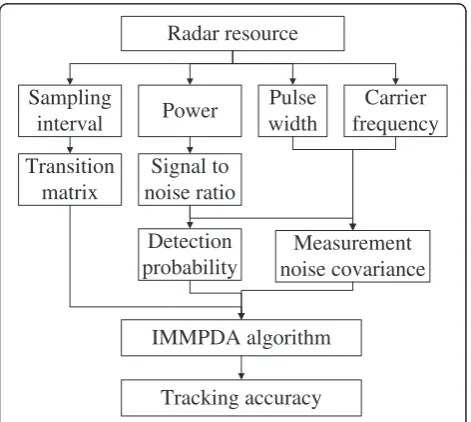
In this paper, the radar resource includes the sampling interval, radiated power, the pulse width, and carrier fre-quency of the transmitted waveform. All of these param-eters have an impact on the tracking accuracy, which can be seen in Fig. 1. The sampling interval has an effect on the computing of the transition matrix. The detection
Radar resource
probability and measurement noise are under the influ-ence of power, pulse width, and carrier frequency of the transmitted signal. In addition, the transition matrix and measurement noise covariance will decide the tracking accuracy of IMMPDA algorithm in section 2.
3.1 Transition matrix
In the IMMPDA algorithm, the motion model includes constant velocity model and coordinated turn rate model, and transmission matrix can be represented as Eqs. (21) and (22), respectively.
FCV¼
whereTis the sampling interval andωis the turn factor.
3.2 Signal to noise ratio
The overall netted radar sensitivity can be calculated by summing up the partial signal to noise ratio (SNR) [11] of each transmitter-receiver pair (assuming all signals can be separately distinguished at each receiver), which is given by
where the thermal noise at each receiver is assumed to be statistically independent, Pti is the ith peak
transmit-ted power, Gti and Grj are the ith transmitter gain and
jth receiver gain,σijof the target means theith
transmit-ter and jth receiver which is assumed to be known in our library, λi is the ith transmitted wave-length, Tdw
and kBare target integration time and Boltzmann’s
con-stant, respectively, Tsij is the receiving system noise
temperature (at a particular receiver),NFj represents the
noise figure at each receiver,Lijis the system loss forith
transmitter and jth receiver, andRtiand Rrj are the
dis-tance from ith transmitter to the target and distance from target tojth receiver.
Then, the detection probability can be represented as:
Pd¼ exp
lnPfa
1þSNRnetted
ð24Þ
wherePfais false-alarm probability. The detection
prob-abilityPdhas an important impact on the tracking
per-formance in the clutter, which is the function of radiated power and target RCS and range.
3.3 Covariance of measurement noise
The covariance matrixBkof measurement noise is con-trolled by the radiated power and waveform parameters of the radar during tracking. We assume all the radars in the network transmit the same type of waveform. Range and range-rate measurements are obtained using the type of linear frequency modulated (LFM) Gaussian pulses. The measurement noise covariance is given by:
Bk¼
carrier frequency (kHz),pudenotes the pulse width (ms), and b denotes the sweep rate (Hz/s). b can be positive (LFM upsweep), negative (LFM downsweep), or zero. In this paper, all the waveform parameters are assumed to be constant except the signal to noise ratio, carrier fre-quency, and pulse length at timek.
From Eqs. (23) and (25), we can see that different signal to noise ratioSNRnettedin the radar network can lead to
dif-ferent measurement noise covariance. However, during the tracking process,RtiandRrjare unknown before radar detection in Eq. (23). SoRtiandRrjat timekare predicted according to target’s velocity, the distance fromith trans-mitter to the target and distance from target tojth receiver at the last sampling timek–1. SoRtiandRrjare replaced byRpreti andRprerj which are, respectively, presented as
Rpreti ð Þ ¼k Rtiðk−1Þ þTveiðk−1Þ ð26Þ
Rprerj ð Þ ¼k Rrjðk−1Þ þTvejðk−1Þ ð27Þ
where T is the tracking interval, vei(k−1) and vej(k−1)
are estimated by theith and jth radar using the tracking algorithm at timek–1.
3.4 Predicted error covariance
Using the state vectorxkand transfer Eq. (2), the observa-tion vector zprek +1 at time k+ 1will be predicted. Then, the
predicted error covariance matrixPprek +1will be obtained by
Eq. (20) under the clutter environment of the timek. The smaller the trace ofPprek +1is, the better the tracking accuracy
(MDP) which is employed to manage the radar resource in the next section.
4 Radar resource scheduling model based on Markov decision process
4.1 Markov decision process theory
As its name suggests, MDP processed the Markov prop-erty in the sense that system evolution beyond a decision point depends only on the system state and action chosen at that point [12]. The theory of MDP indicates that it is sufficient to locate a stationary policy to achieve optimality, meaning that there is no need to consider the past history when making a decision about which ac-tion to perform in a given state.
Under the Markovian and stationary assumptions, a discrete-time MDP [13, 14] is defined by a tuple {S, A,
Tm,r}.
(1) A finite state spaceS= {si},i= 1,…,n
(2) A finite and non-empty set of available control ac-tionsA(si) = {ak}k= 1,…,|A(si)| associated to each statesi∈S
(3) A real-valued one-step reward functionr:S×A→
ℝ, wherer=r(si,ak) is the reward gained by taking actionakin statesi.
(4)p(si,sj,ak) means the probability that the system will be statesj∈Swhen actionak∈A(si) in satesi∈S is chosen. The set of these transition probabilities constitute the transition matrixTm.
In the following, we will denote withs(t),a(t), andr(t) the state, the action, and the reward of the system at time t, respectively. A stationary policy is a function π: S→A, which maps every statesi∈Sto a unique control actionak∈A(si). When the system operates under policy π, the MDP reduces to a discrete-time Markov chain.
4.2 Radar resource scheduling model based on MDP
In this paper, the state space is composed of n trace value of tracking error covariance matrix, which repre-sents the tracking accuracy of IMMPDA in Section 2. si denotes theith tracking accuracy. As it is shown in Sec-tion 3, the acSec-tion ak should denote the kth radiation of radar j with its power pk, carrier frequency w0k, pulse widthpuk, and sampling interval sak, which have an im-pact on the tracking performance.
ak ¼ pikj;w0ikj;piukj;siakj
n o
ð28Þ
The reward function in our algorithm is designed as:
r sð i;akÞ ¼Nor trace Pkjkþ1ð Þak
þNor resourceð ð Þak Þ ð29Þ where Nor() is the normalization function, Pk|k+ 1(ak) is
the predicted tracking error covariance after the action akis taken, and trace() is the function of trace operation.
resource(ak) means the power and time cost of the
ac-tion ak, resourceð Þ ¼ak pik=siak, as we know, larger sam-pling interval means less radiation times during the tracking.
As the predicted tracking error covariance can be pre-dicted through the relationship between radar resource and tracking performance, the transition probability is supposed to be 1. The expected award in the algorithm can be represented as:
V ið Þ ¼ min
a fr sði;akÞg ð30Þ
The MDP problem is the determination of the optimal policy ak minimizing costV. In this paper, it is difficult
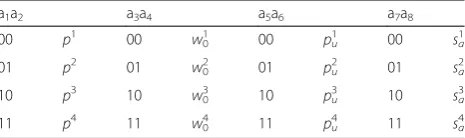
for the radar to control the power, carrier frequency, pulse width, and sampling interval freely, so the award design is converted to an optimization problem. Four kinds of radar radiation parameters are designed in this paper, as it is shown in Table 1. During the scheduling, the action akis represented as an eight binary sequence {a1a2a3a4a5a6a7a8}, which implies the radiation
parame-ters of radar resource. The optimization variable in this study is a binary variable that corresponds to the status of the radar resource.
4.3 Improved WDO method for solution of MDP
As it is shown in Section 4.2, finding an optimal solu-tion of an MDP means finding a policy that minimizes V. In order to solve the MDP problem, a binary wind-driven optimization (WDO) method is proposed in this section, which can select the binary sequence for the excellent tracking accuracy and low probability of inter-cept. This optimization problem is mathematically for-mulated as (30).
The WDO presented in [15] is not for the
optimization of binary solution. In order to solve the binary optimization problem of MDP, the original WDO method is modified with the binary character. The major difference between binary WDO with continuous ver-sion is that the amount of position displacement per it-eration is rather defined in terms of probabilities that a bit will change to one. In continuous WDO, the coordi-nates of the air parcel as the parcel positions are repre-sented in continuous values; meanwhile, in binary
Table 1Binary sequence of the radar resource
a1a2 a3a4 a5a6 a7a8
00 p1 00 w0
1
00 pu1 00 sa1
01 p2 01 w0
2
01 pu2 01 sa2
10 p3 10 w0
3
10 pu3 10 sa3
11 p4 11 w0
4
WDO, the parcel’s coordinates are shown in discrete values. Velocity updating in binary WDO is similar to WDO, but it has velocity clamping to balance the ex-ploration and exploitation in the search space. Plus, in binary WDO, the position updating is based on a moid function as shown in Eqs. (30) and (31). The sig-moid function is used to force the real values between 0 and 1.
S uð newÞ ¼1=ð1þ expð−unewÞÞ ð31Þ
xnew ¼ 0ifS uð newÞ≤rand
1ifS uð newÞ>rand ð32Þ
whereS() is a sigmoid function which can scale the posi-tions between 0 and 1, rand is a quasi random number uniformly distributed within the range of (0, 1), and unew
and xnew are the velocity and position in the next
iter-ation, respectively.
5 Simulations
In this section, Monte Carlo simulations are performed to analyze the performance of the proposed resource scheduling method.
5.1 Design of target trajectory and radar resource
We assume that there are two radars for tracking one target in clutter. In the transition matrix Eqs. (21) and (22),T= 1 s andω= 0.1. Figure 2 shows the target trajec-tory with its measurement results in 100 s. The clutter for the target is produced randomly during the trajec-tory. Both the positions of the radars are (0 km, 0 km) and (20 km, 100 km), respectively.
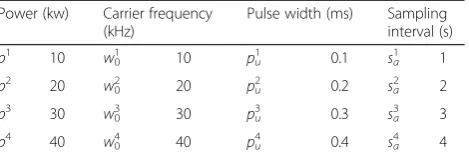
The simple library of the radar resource is designed as Table 2. The sampling interval, power, pulse width, and carrier frequency have four types of value.
5.2 Comparison of tracking performance
The proposed adaptive resource scheduling method and the resource scheduling with constant parameters for the tacking fusion in the radar network, which are la-beled as “Adaptive fusion” and “Constant fusion,” re-spectively, are realized in the simulation. The simulation also compares the performance with the single working radars which are, respectively, labeled as “Radar1” and “Radar2,” both of which use the proposed resource scheduling method-based MDP. The methods of “ Con-stant fusion” is assumed to track the target with max-imum power, minmax-imum sampling interval, and constant waveform parameters in order to get the highest detec-tion probability which is nearly equal to 1. In addidetec-tion, the radar receives the signals reflected from the target when the other radar works. The fusion center tracks the target according to the data received from all the ra-dars in the network.
The root-mean-square error (RMSE) of time kcan be formulated as Eq. (32):
RMSEð Þ ¼k
ffiffiffiffiffiffiffiffiffiffiffiffiffiffiffiffiffiffiffiffiffiffiffiffiffiffiffiffiffiffiffiffiffiffi 1
Mc XMc
m¼1
xk−^xmk
2
v u u
t ð33Þ
whereMc is the number of the Monte Carlo simulation,
xkis the true state of the system, and^xmk is the estimated vector at themth simulation,Mc= 200.
200 205 210 215 220 225
300 302 304 306 308 310 312
X direction(km)
Y direction(km)
Radar1 Radar2 Adaptive method Constant Fusion True trajectory Clutter
Fig. 2Target trajectory
Table 2Binary sequence of the radar resource
Power (kw) Carrier frequency (kHz)
Pulse width (ms) Sampling interval (s)
p1 10 w 0
1 10 pu1 0.1 sa1 1
p2 20 w 0
2 20 pu2 0.2 sa2 2
p3 30 w 0
3 30 pu3 0.3 sa3 3
p4 40 w 0
4 40 pu4 0.4 sa4 4
0 10 20 30 40 50 60 70 80 90 100
-0.005 0 0.005 0.01 0.015 0.02 0.025
Time(s)
RMSE(km)
Radar1 Radar2 Adaptive Fusion Constant Fusion
Figure 3 shows the range RMSE using the four methods. We can see that the proposed method“ Adap-tive fusion” presents almost the same excellent tracking accuracy with other methods. As the fusion method takes the advantage of the superior decision ability of MDP and optimization performance of binary WDO, it can obtain excellent tracking performance using the more effective tracking data selected from Radar1 and Radar2 in turn.
5.3 Comparison of RFS performance
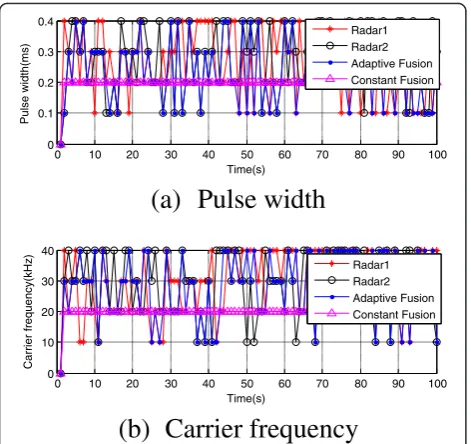
The transmitted signal feature is shown in Fig. 4, and the pulse width and carrier frequency are shown in Fig. 4a, b, respectively. The results show the waveform agility during the tracking, which will bring low prob-ability of intercept prob-ability of the radars. The radiation
label of the two radars is shown in Fig. 5. We can see that the radars work in turn.
The radiated power and sampling interval are illus-trated in Fig. 6 and Fig. 7, respectively. Compared with the other three methods, we can see that the proposed method presents excellent tracking accuracy, but also ra-diates least power with largest sampling interval. The ex-perimental results indicate that binary wind-driven optimization method has a better global optimization capability, as the method could select a proper set of radar resource according to the decision superiority of MDP and accurate predicted tracking error covariance in IMMPDA, after building the relationship model be-tween the radar resources and tracking performance.
A detailed account of the complexity requirements of the proposed algorithm of “Adaptive fusion,” “‘Constant fusion,” “Radar1,” and “Radar2” is performed and
0 10 20 30 40 50 60 70 80 90 100
0 0.1 0.2 0.3 0.4
Time(s)
Pulse width(ms)
Radar1 Radar2 Adaptive Fusion Constant Fusion
(a) Pulse width
0 10 20 30 40 50 60 70 80 90 100
0 10 20 30 40
Time(s)
Carrier frequency(kHz)
Radar1 Radar2 Adaptive Fusion Constant Fusion
(b) Carrier frequency
Fig. 4Transmitted waveform feature0 10 20 30 40 50 60 70 80 90 100
Radar1 Radar2
Time(s)
Radar label
Fig. 5Radiation label the radars
0 10 20 30 40 50 60 70 80 90 100
0 5 10 15 20 25 30 35 40
Time(s)
Power(kw)
Radar1 Radar2 Adaptive Fusion Constant Fusion
Fig. 6Radiated power
0 10 20 30 40 50 60 70 80 90 100
0 0.5 1 1.5 2 2.5 3 3.5 4
Time(s)
Sampling interval(s) Radar1
Radar2 Adaptive Fusion Constant Fusion
illustrated in Table 3.NpmaxandNimaxare the maximum
numbers of air parcels and iterations in WDO process. Wk and N are the numbers of validated measurements and the motion models, respectively, in the IMMPDA algorithm.Nra represents the radar numbers in the
net-work, andNrais supposed to be 2 in our simulation.
It is seen that the proposed“Adaptive fusion” method has a comparable computation complexity. As the num-ber of radars increases, the computation time is in-creased as well. The proposed binary WOD is a suitable search technique for radar resource scheduling in this paper, it has to spend more time on the optimization process than the other methods. It also has been seen that the “constant fusion” method present least com-plexity with largest waste of radar resource.
As we know, the theory [12] of MDP indicates that it is sufficient to locate a stationary policy to achieve optimality. The proposed method uses MDP to find optimal policy in radar resource scheduling, which can achieve an optimal trade-off between the radar RFS ability and tracking accuracy. In addition, the proposed binary WDO used for solving MDP problem can pro-vide advantages over other optimization methods [15], as it can prevent air parcels from remaining trapped at the boundary for long periods of time and pull them back into the search space. And the Coriolis force in WDO introduces a stochastic effect from other dimen-sions, providing robustness to the motion of the par-cel. In addition, the WDO method proves higher efficiency than the other optimization methods [15], such as particle swarm optimization (PSO) and genetic algorithm (GA).
As a result, the proposed method based MDP and bin-ary WDO can present excellent performance for radar resource scheduling.
6 Conclusions
In this paper, we have presented a new resource schedul-ing method for the radar network based on MDP. Dur-ing the target trackDur-ing in the clutter, the relation model is built between the radar resource and tracking per-formance. Then, the selection of radar and its resource can be optimized by an improved WDO method, in order to obtain the maximum reward in the MDP. The simulation results show that the proposed algorithm re-duces much more radar resource with excellent tracking performance in clutter. Future research will focus on the
reduction of computational complexity for resource scheduling in the radar network.
Competing interests
We note that there are no data sharing issues since all of the numerical information is produced by solving the equations of the proposed algorithm, which are realized by MATLAB software in the paper. The authors have declared that no competing interests exist.
Authors’information
Zhenkai Zhang was born in Jiangsu, China. He received his doctor degree from Nanjing University of Aeronautics and Astronautics in 2013. His research interests include radar signal processing and optimization methods. Now, he is an academic visitor in Durham University in UK.
Yubo Tian was born in 1971. He is a Ph.D. and a professor in the Department of Electronic Engineering, Jiangsu University of Science and Technology. His research interests include radar signal processing and electromagnetic computing.
Acknowledgements
This work was supported by the National Natural Science Fund (61401179) in China, Colleges of Jiangsu Province Natural Science Fund (14KJB510009), the Science and Technology on Electronic Information Control Laboratory Project, Scientific Research Start-up Funding from Jiangsu University of Science and Technology, and Fundamental Research Funds for the Central Universities (NJ20140010).
Received: 11 May 2015 Accepted: 12 January 2016
References
1. David A. Lynch. Introduction to RF stealth. Raleigh, North Carolina: SciTech Publishing press; 2013.
2. MA Govoni, L Hongbin, JA Kosinski, Low probability of interception of an advanced noise radar waveform with linear-FM. IEEE Trans Aerosp Electron Syst49(2), 1351–1356 (2013)
3. T Thayaparan, M Daković, L Stanković, Mutual interference and low probability of interception capabilities of noise radar. IET Radar, Sonar & Navigation2(4), 294–305 (2008)
4. Z Zhang, J Zhou, F Wang, W Liu, Multiple-target tracking with adaptive sampling intervals for phased-array radar. J Syst Eng Electron 22(5), 760–766 (2011)
5. T Cheng, DQ Zou, ZS He,Adaptive waveform and sampling interval tracking based on estimation accuracy for Doppler radar(Proceedings of IET International Radar Conference, Xi’an, 2013), pp. 1–4
6. V Krishnamurthy, Emission management for low probability intercept sensors in network centric warfare. IEEE Trans Aerosp Electron Syst 41(1), 133–151 (2005)
7. S Chenguang, Z Jianjiang, W Fei,Low probability of intercept optimization for radar network based on mutual information(2014 IEEE China Summit & International Conference on Signal and Information Processing (ChinaSIP), Xi’an, 2014), pp. 683–687
8. S Chenguang, Z Jianjiang, W Fei, Y Yuxiao,Minimum mean square error based low probability of intercept optimization for radar network(IEEE International Conference on Signal Processing, Communications and Computing (ICSPCC), Guilin, 2014), pp. 10–13
9. K Jo, J Kim, M Sunwoo, Real-time road-slope estimation based on the intergration of on bradard sensors with GPS using an IMMPDA filter. IEEE Trans Intell Transp Syst14(4), 1718–1732 (2013)
10. B Vondra,Overview of the multisensor IMMPDA filter with an amplitude feature for tracking maneuvering target in cluttered environment(Proceedings of 21st international conference on applied electromagnetic and communications, Dubrovnik, 2013), pp. 1–6
Table 3Requirements of radar resource scheduling methods
Adaptive fusion Radar1 Radar2 Constant fusion
11. Y Teng, HD Griffiths, CJ Baker, K Woodbridge, Netted radar sensitivity and ambiguity. IET Radar, Sonar & Navigation11(6), 479–486 (2007) 12. X Ruofan, M Fumio, T Kishor,A Markov decision process approach
for optimal data backup scheduling(44th Annual IEEE international conference on dependable systems and networks, Atlanta, 2014), pp. 660–665
13. P-Y Kong, Optimal probabilistic policy for dynamic resource activation using Markov decision process in green wireless networks. IEEE Trans Mob Comput13(10), 2357–2368 (2014)
14. G Oddi, M Panfili, A Pietrabissa et al.,A resource allocation algorithm of multi-cloud resource based on Markov decision process, 1st edn. (Proceedings of IEEE 5th International Conference on Cloud Computing Technology and Science, Bristol, 2013), pp. 130–135
15. Z Bayraktar, M Komurcu, JA Bossard, DH Werner, The wind driven optimization technique and its application in electromagnetics. IEEE Trans Antennas Propag61(5), 2745–2757 (2013)
Submit your manuscript to a
journal and benefi t from:
7Convenient online submission
7Rigorous peer review
7Immediate publication on acceptance
7Open access: articles freely available online
7High visibility within the fi eld
7Retaining the copyright to your article