Integrity
Charanjit S. Jutla
IBM T. J. Watson Research Center, Yorktown Heights, NY 10598-704
Abstract. We define a new mode of operation for block ciphers which in addition to providing confidentiality also ensures message integrity. In contrast, previously for message integrity a separate pass was required to compute a cryptographic message authentication code (MAC). The new mode of operation, called Integrity Aware Parallelizable Mode (IAPM), requires a total ofm+1 block cipher evaluations on a plain-text of length mblocks. For comparison, the well known CBC (cipher block chaining) encryption mode requires m block cipher evaluations, and the second pass of computing the CBC-MAC essentially requires additionalm+ 1 block cipher evaluations. As the name suggests, the new mode is also highly parallelizable.
Keywords:Block Ciphers, Encryption, Authentication, Pairwise Independent, Parallelizable
1
Introduction
Symmetric key encryption has become an integral part of today’s world of com-munication. It refers to schemes and algorithms used to secretly communicate data over an insecure channel between parties sharing a secret key. It is also used in other scenarios such as data storage.
There are two primary aspects of any security system: confidentiality and
authentication. In its most prevalent form, confidentiality is attained by encryp-tion of bulk digital data using block ciphers. The block ciphers (e.g. DES [26], AES[1]), which are designed to encrypt fixed length data, are used in various chaining modes to encrypt bulk data. One such mode of operation is cipher block chaining (CBC) ([2, 27]). The security of CBC has been well studied [3].
Cipher block chaining of block ciphers is also used for authentication be-tween parties sharing a secret key. The CBC-MAC (CBC Message Authenti-cation Code) is an international standard [14]. The security of CBC-MAC was demonstrated in [6]. Authentication in this symmetric key setting is also called
Message Integrity.
Nevertheless, it is enticing to combine the two passes into one so that in a single cipher block chaining pass, both confidentiality and message integrity are ensured. Many such attempts have been made, which essentially use a simple checksum or manipulation detection code (MDC) in the chaining mode ([28, 23, 9]). Unfortunately, all such previous schemes are susceptible to attacks (see e.g. [32]).
We mention here that there are two alternative approaches toauthenticated encryption[7], i.e. encryption with message integrity. The first is to generate a MAC using universal hash functions [8] as in UMAC ([5]). UMACs on certain architectures can be generated rather fast. However, UMAC suffers from requir-ing too much key material or a pseudorandom number generator to expand the key. (For comparison sake, on a message of size n, UMAC requires a key of size n for similar efficiency and security.) In another scheme, block numbers are em-bedded into individual blocks to thwart attacks against message integrity ([18]). However, this makes the cipher-text longer.
In this paper, we present a new mode of operation for block ciphers, which in a single pass achieves both confidentiality and message integrity. In one variant, to encrypt a message of length m blocks, the new mode requires a total of m+ 1 block cipher evaluations. All other operations are simple operations, like exclusive-or. To contrast this with the usual CBC mode, the encryption pass requires m block cipher evaluations, and the CBC-MAC computation on the ciphertext requires anotherm+ 1 block cipher evaluations.
Our new mode of operation is also simple. To illustrate, a simpler (though not as efficient) version of the mode starts by performing a usual CBC encryption of the plain-text appended with checksum (MDC). As required in CBC mode, it uses a random initial vectorr. As already mentioned, such a scheme is susceptible to message integrity attacks. However, if one “whitens” the complete output with a random sequence, the scheme becomes secure against message integrity attacks. Whitening just refers to xor-ing the output with a random sequence. The random sequence could be generated by running the block cipher onr,r+1, r+ 2,...,r+m(but with a different shared key). This requiresm+ 1 additional cryptographic operations, and hence is no more efficient than generating a MAC. The efficiency of the new mode comes from proving that the output whitening random sequence need only be pair-wise independent. In other words, if the output whitening sequence is s0, s1, s2,...,sm, then each si is required to be
random, but only pairwise-independent of the other elements. Such a sequence is easily generated by performing only logmcryptographic operations like block cipher evaluations. A simple algebraic scheme can also generate such a sequence by performing only two cryptographic operations.
In fact, an even weaker condition than pair-wise independence suffices. A sequence of uniformly distributed n-bit random numbers s0,s1,...,sm, is called XOR-universal [19] if for every n-bit constant c, and every pair i, j, i 6= j, probability that si ⊕sj equals c is 2−n. We show that the output whitening sequence need only be XOR-universal. A simple algebraic scheme can generate such a sequence by performing only one cryptographic operation.
which is highly parallelizable, and we call this mode IAPM (for Integrity Aware Parallelizable Mode).
It is known (see [7], [18]) that for symmetric key encryption, confidentiality under chosen plaintext attacks (CPA), along with integrity of ciphertexts, implies confidentiality under chosen ciphertext attacks (CCA). In this paper we prove the schemes secure for confidentiality under CPA, and secure for integrity of ciphertexts.
Concurrently to our work, Gligor and Donescu ([10]) have also described a mode of operation similar to CBC (but not the parallelizable mode) which has built-in message integrity, although with a slightly weaker security bound than our construction. Subsequently, and based on these results, a new authenticated encryption mode OCB was described in [31]. The mode OCB was designed to also handle plaintexts of irregular lengths, i.e. bit lengths which are not multiple of the block length.
It has also been shown ([17]) that any scheme to encryptmblocks of sizen bits each, that assures message integrity, is linear in (GF2)n, and usesm+k invo-cations of random functions (fromnbits tonbits) andv blocks of randomness, must havek+v at leastΩ(logm).
Pairwise independent random number generators (also called universal hash functions [8]) have been used extensively in cryptography. In particular, Gol-dreich, Krawczyk and Luby [11] used them to build pseudorandom generators from regular one-way functions, and Naor and Yung [25] used them in the con-struction of universal one-way hash functions. In the context of symmetric key encryption, pairwise independent random permutations were used to construct pseudo-random permutations from pseudo-random functions [24]. In the context of de-randomization, Luby had demonstrated how the random choices needed in a randomized parallel algorithm for maximal independent set problem need only be pairwise independent [21].
The rest of the paper is organized as follows. Section 2 formalizes the notions of security, for both confidentiality and message integrity. Section 3 describes the new mode of operation IAPM. We also formalize the mode in the random permutation model. In section 4 we prove that the new scheme is secure for message integrity. In section 5 we prove the secrecy theorem for IAPM.
2
Authenticated Encryption Schemes
We give definitions of schemes which explicitly define the notion of secrecy of the input message. In addition, we also define the notion of message integrity. Moreover, we allow arbitrary finite length input messages as long as they are multiple of the block size of the underlying block cipher.
Let Coins be the set of infinite binary strings. Let K⊆ {0,1}∗ be the key
space, andDbe a distribution on the key space.
DefinitionA (probabilistic, symmetric, stateless)authenticated encryptionscheme, with block sizen, key spaceK, and distributionD, consists of the following:
– message sending with integrity:
LetE:K ×Coins× {{0,1}n}∗→ {{0,1}n}∗
D:K × {{0,1}n}∗→ {{0,1}n}∗∪ {⊥}
be polynomial time computable function ensembles. The functionsEandD must have the property that for allx∈ K, for allP∈ {{0,1}n}∗,c∈Coins
Dx(Ex(c, P)) =P
We will usually drop the random argument toE as well, and just think of E as a probabilistic function ensemble. The security of such a scheme is given by the following two definitions, the first defining confidentiality under chosen plaintext attacks, and the second defining message integrity.
Definition(Security under Find-then-Guess [22], [3])
Consider an adaptive probabilistic adversary A which runs in two stages:
find andguess. The two stages will be called A1 and A2. It is given access to the encryption oracle Ex. In the find stage it tries to come up with two equal length messagesP0andP1. It also retains a stateC1 for the next stage. In the
guess stage it is given the encryption C2 of Pb, whereb is chosen randomly to be 0 or 1. The valueC2 can really be seen as result of another oracle queryPb, except thatbis hidden from the adversary. This “oracle call” will also be called the “choice” stage. The adversary’s success is reflected in how well it guessesb. Formally,
AdvA=|Pr[x←D K; (P0, P1, C1)←A1Ex(·); b←
R{0,1}; C2←Ex(Pb) : A2Ex(·)(C1, C2) =b]−1/2|
An authenticated encryption scheme is said to be (t, q, µ, ǫ)-secure against chosen plaintext attack if for any adversary A as above which runs in time at mostt and asks at mostqqueries ofEx, these totalling at mostµblocks, its advantage AdvA is at mostǫ.
The following notion of security is also calledintegrity of ciphertext([7]).
Definition(Message Integrity):Consider an adaptive probabilistic adversaryA running in two stages. In the first stage (find) A asks r queries of the oracle Ex. Let the oracle replies be C1, ..., Cr. Subsequently in the second stage, A produces a cipher-text C′, different from each Ci, i ∈ [1..r]. The adversary’s success probability is given by
Succdef= Pr[Dx(C′)6=⊥]
where the probability is over the choice of x from K according to D, other randomness used byE, and the probabilistic choices ofA.
An authenticated encryption scheme is (t, q, µ, ǫ)-secure for message integrity if for any adversary A running in time at mostt and making at mostq queries totallingµblocks, its success probability is at mostǫ.
3
The New Modes of Operation
3.1 XOR-Universal Distributions
DefinitionWe denote by F(m→n) the set of all functions frommbits to n bits. We denote byP(n→n) the set of all permutations fromnbits tonbits.
Definition(Hash Function Family): An (m, n)-family of hash functionsH is a collection of functions that map the set of binary strings of length m bits into the set of binary strings of lengthn, i.e. a subset ofF(m→n).
Definition (XOR-Universal Hash Function Family) [19] An (m, n)-family of hash functions H is called an XOR-Universal hash function family, if for every m-bit value M, and every n-bit value c, Prh[h(M) = c] is 2−n, and further if for every pair of distinct m-bit values M1 and M2, and every n-bit value c, Prh[h(M1)⊕h(M2) = c] is 2−n, where the probabilities are over choosing h uniformly from H.
An (m, n) hash function familyHcan be given by a single functionH, which takes a⌈log|H|⌉-bit value, calledseed, as another argument.
Definition(XOR-universal sequence): A probability distribution over sequences of n-bit numberss0, s1,...,sm−1, is called XOR-universal if eachsi is uniformly
distributed and for everyn-bit constant c, and every pairi,j,i6=j, the proba-bility that si⊕sj iscis 2−n.
An XOR-universal sequence of length 2m can be generated using an XOR-Universal (m, n)-hash function familyHand seedkby,si=H(k, i).
3.2 The New Mode - IAPM
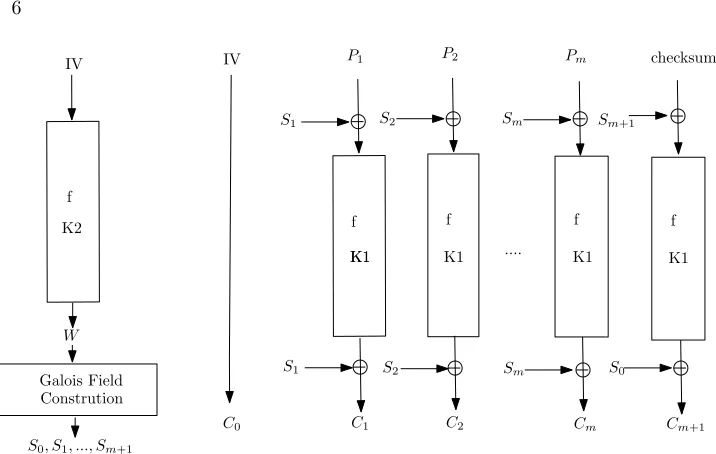
We now describe the new mode of operation for block ciphers, which along with confidentiality also guarantees message integrity. The new mode is also highly parallelizable, as will be clear from the description. It is called IAPM
for integrity aware parallelizable mode. There are many variants of this mode, depending on how the XOR-universal sequence is generated, and even on how the initial vectors are chosen. One variant is described in Fig 1. We now give more details for IAPM and its many variants.
Letnbe the block size of the underlying block cipher (or pseudo-random per-mutation). For now, we assume that if the block cipher requires keys of lengthk, then this mode of operation requires two keys of lengthk, chosen independently. Let these keys be calledK1 andK2. From now on, we will usefxto denote the block cipher encryption function under keyx.
The message to be encrypted,P, is divided into blocks of lengthneach. Let these blocks be P1, P2,...,Pm. A random initial block, also called initial vector
(IV), of lengthn(bits) is chosen. As we discuss later, the IV need not be random, as long as it is unique (that is never reused). The IV is expanded using the key K2, used as a secret seed, to produce an XOR-Universal sequence S0, ..., Sm+1.
There are various methods to achieve this, which we will discuss shortly. The cipher-text messageC=< C0, C1, ..., Cm+1 >is then generated as follows (see
Figure 1). The encryption pseudo-code follows: C0 = IV
C0 S0, S1, ..., Sm+1
f f f f
K1
K1 K1 K1 K1
S1 S2 Sm Sm+1
S1 S2 Sm S0
P1 P2 Pm checksum
C1 C2 Cm Cm+1
.... f
K2
W
Galois Field Constrution
IV IV
Fig. 1.Parallelizable Encryption with Message Integrity (IAPM)
Cj =Nj ⊕ Sj end for
checksum =Lm j=1Pj
Mm+1 = checksum⊕Sm+1
Nm+1 =fK1(Mm+1)
Cm+1 =Nm+1 ⊕ S0
Note thatS0is used in the last step. The xor-ing ofSj withPj before applying
the function f is commonly calledpre-whitening. Similarly, xor-ing ofSj to Nj to obtainCj is calledpost-whitening.
It is easy to see that the above scheme is invertible. The inversion process yields blocks P1, P2, ..., Pm+1. The decrypted plain-text is < P1, P2, ..., Pm >.
Message integrity is verified by checkingPm+1=P1⊕P2⊕...⊕Pm.
Generation of XOR-Universal Sequences. We now focus on how the XOR-universal sequence used above is generated. We first describe methods which employs the block cipher itself. The block IV is first expanded intot=O(logm) new random blocksW1, ..., Wtusing the block cipher and keyK2 as follows:
W1=fK2(IV)
fori= 2 tot do
Wi =fK2(W1+i−2)
end for
Thetblocks are then used to producem+ 2 new XOR-universal random blocks S0, S1, ..., Sm+1. In other words, the t blocks W1, ..., Wt combined serve as the
fori= 1 to 2tdo
Let< a1, a2, ...at>be the binary representation ofi
Si−1=Ltj=1(aj·Wj)
end for
Galois Field Constructions of XOR-Universal Sequences. There are several algebraic XOR-Universal Hash families. Firstly, one could consider a pairwise independent hash function family H using an algebraic construction in GF(p) as follows: generate two random blocks W1, and W2, and then let
Sj =H(hW1, W2i, j) = (W1+W2∗j) modp, wherepis a prime of appropriate
size. For example, if the block cipher has block size 128 bits,pcould be chosen to be 2128−159. This leads to a faster implementation than the subset construction.
A sequence of 2n−1 uniformly distributedn-bit random numbers, which are XOR-universal, can also be generated by viewing then-bit numbers as elements of GF(2n). Consider,H(W, j) =j·W, where multiplication is in GF(2n). It is easy to see that His an (n, n)-XOR-universal hash family (except for the value j = 0). Now, let Sj =H(W, e(j)), where e(j) is any one to one function from
Z2n−1 to non-zero elements of GF(2n). Then, it is easy to see thatS0, ..., S2n−2 is an XOR-universal sequence. Note that this requires generation of only a single W, i.e.t= 1 (see fig 1).
It is worth noting that in a serial implementation of IAPM, and particularly in a resource constrained system, generation of Sj from W or from Sj−1 may
influence the efficiency of the mode. In particular, if e(j) = gj, where g is a generator of the field GF(2n), it takes at least one multiplication to getSjfrom Sj−1. Ife(j) is the binary representation ofj+ 1, then a basis of the field GF(2n)
overGF2 (timesW) maybe initialized innvectors, and thenSjcan be computed by exclusive-or operations of these vectors. In fact, e(j) can be the (j+ 1)-th gray code vector, in which case, only onen-bit exclusive-or operation is required to getSj fromSj−1 (see e.g. [15, 31]), as long as thenprecomputed vectors are
maintained.
In some situations, even maintainingnvectors in active memory maybe too taxing on the system. In such a situation, a GF(p) based solution as described in the next section may be advantageous.
Safe Initial Vectors. Till now we have focused on construction of XOR-universal sequences using fresh seeds for each message, e.g. usingW =fK2(IV)
as seed into an XOR-universal hash family. Halevi [12] has observed that the XOR-universal sequences can be generated using non-cryptographic operations, i.e. by avoiding fK2(IV). A careful setup and analysis shows that one can use
the same seed for all messages, and hence this “global” seed can just be the independently chosenn-bit keyK2. To this end, we define a set of initial vectors to besafeas follows.
Definition. For a sequence of messagesPi,i= 1 toz, each of lengthmi n-bit blocks, a sequence ofn-bit initial vectors IVi (i= 1 toz) is calledsafeif (a) for alli∈[1..z], IVi+mi+ 1<2n−1, where the addition is integer addition, and (b) for all i, i1 ∈[1..z], i6=i1, for all j ∈ [0..mi+ 1], for all j1 ∈[0..mi1+ 1],
Thej-th whitening value for the i-th message, Si
j (j ∈[0..mi+ 1]), is then generated asSi
j =H(K2,IV
i+j), whereHis any XOR-Universal hash family. We will show the surprising result that if the initial vectors are safe, then re-gardless of how the adversary choses the n-bit initial vector for its adversarial message, its (success) probability for attaining message integrity is negligible.
There are many ways to implement safe initial vectors, including a random choice for the initial vector. Alternatively, one could require the initial vector to be a multiple of 2n/2, and assuming the length of each message is less than
2n/2 −1, this leads to a sequence of safe initial vectors. However, with this
scheme, some of the optimizations mentioned above for computingSj fromSj−1
do not work when switching to a new message. For the same optimizations to work even across messages, one can set IVi = IVi−1+mi−1+ 2 (see fig 2), and
it is easy to see that this leads to safe initial vectors.
IV = IVprev + lenprev + 2
C0
Sprevm+1
Incremental GF
S0, S1, ..., Sm+1
f f f f
K1
K1 K1 K1 K1
S1 S2 Sm Sm+1
S1 S2 Sm S0
P1 P2 Pm checksum
C1 C2 Cm Cm+1
Construction ....
(keyless orK2
Fig. 2.IAPM with Safe Initial Vectors
The intuition behind why safe initial vectors are secure is that while en-crypting genuine messages, the value IVi+mi+ 1 is never used for calculating a post-whitening value. Now, suppose an adversary, attacking the message in-tegrity of the scheme, tries to use an initial vector different from IVi, but one which is close enough, say IVi+s, wheres≤mi. Then, the above fact and the asymmetry in the last block whitening values forces the adversary to end up using “wrong” whitening value (either post-whitening or pre-whitening value) for at least one block. We defer complete details of the proof to section 4.
3.3 Integrity Aware Parallelizable Mode (IAPM) using a prime number
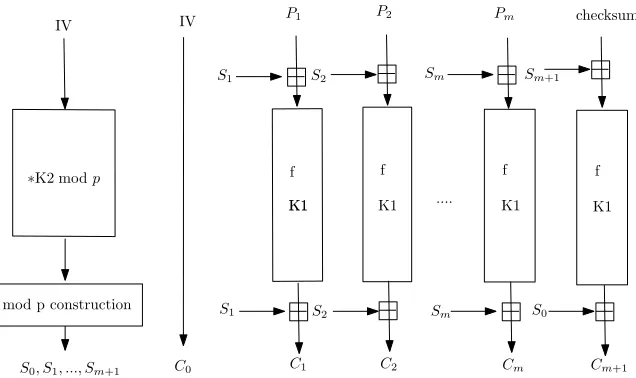
XOR-universal in GF(p). Such a sequence can be used securely in a slight variant of the mode described above where “whitening” now refers to addition modulo 2n. We now give more details of this variant.
Letpbe a prime close to 2n. For example, for 128 bit block cipherspcould be 2128−159, which is known to be a prime. This prime will be fixed for all
invocations of this mode using block ciphers of block size 128 bit. For 64-bit ciphersp= 264−257 is a close prime.
LetK2 be an additional independently chosen key (in addition to key K1 for the block cipher). Now, the sequence S0, S1, ..., Sm+1 is generated by the
following procedure:
procedurexor universal gfp sequence(inputIV,m, K2;outputS)
{
S0= IV∗K2 modp forj= 1 to m+ 1 do
S∗
j = (Sj−1+K2) mod 2n if(K2> S∗
j) Sj=Sj∗+ (2n−p) elseSj=Sj∗.
end for
}
We assume that the initial vectors IV are chosen to be safe, e.g. by requiring them to be multiple of 2⌈n/2⌉, or by incrementing them appropriately as in the
previous section.
In the above code, the condition (K2 > S∗
j) is equivalent to n-bit integer addition overflow in the previous step. Essentially, we are computing Sj to be (j+ 1)∗K2 modp, except that we use a lazy representation. In other words, we do not reduce modulopif (Sj−1+K2)<2n, but we do compensate by 2n−p
if (Sj−1+K2) ≥ 2n, as in the latter case, (Sj−1+K2) = Sj−1+K2−p =
(Sj−1+K2−2n) + (2n−p) (mod p). We prove in lemma 9 that there is no
overflow when compensating by (2n−p).
C0 S0, S1, ..., Sm+1
f f f f
K1
K1 K1 K1 K1
S1 S2 Sm Sm+1
S1 S2 Sm S0
P1 P2 Pm checksum
C1 C2 Cm Cm+1
.... IV
IV
∗K2 modp
mod p construction
In this mode, the pre- and post-whitening is done byn-bit integer addition. The ciphertext messageC=< C0, C1, ..., Cm+1>is generated as follows (see fig
3):
C0 = IV
forj= 1 to mdo
Mj = (Pj + Sj) mod 2n Nj =fK1(Mj)
Cj = (Nj + Sj) mod 2n
end for
checksum =P1⊕P2⊕...⊕Pm
Mm+1 = (checksum +Sm+1) mod 2n
Nm+1 =fK1(Mm+1)
Cm+1 = (Nm+1 + S0) mod 2n
Note that for computing the checksum we use exclusive-or instead of addition modulo 2n. Note thatS
0is used in the last step. The above scheme is invertible.
3.4 IAPM in Random Permutation Model
Since the description of IAPM in section 3.2 was for block ciphers, we formally define the authenticated encryption scheme IAPM in the random permutation model here. In the following, the operator “+” will stand for integer addition, and “⊕” for n-bit exclusive-or.
Definition.Given a permutationf fromnbits tonbits, and a functiongfrom nbits tonbits, the (deterministic) function E-IAPMf,g:{0,1}n× {{0,1}n}∗→
{{0,1}n}+ is defined as follows:
- Let the input to E-IAPMf,g be an n bit IV (denoting initial vector), and anmn-bit string P (2n > m≥0), such that IV+m+ 1<2n−1, which is divided intom n-bit stringsP1, P2, ..., Pm.
- DefineC0=IV, and checksum = 0⊕Lmj=1Pj.
- For notational convenience, we will also refer to checksum asPm+1.
- Define forj= 1 tom:Cj =g(IV +j)⊕f(Pj⊕g(IV +j)). - DefineCm+1=g(IV)⊕f(Pm+1⊕g(IV +m+ 1)).
- The output of the function E-IAPMf,gis the (m+2)n-bit stringC0, C1, ..., Cm, Cm+1.
Definition. Given a permutation f from n bits to n bits, and a function g from n bits to n bits, the (deterministic) function D-IAPMf,g: {{0,1}n}+ →
{{0,1}n}∗∪ {⊥}is defined as follows:
- Let the input to D-IAPMf,g be an (m+ 2)n-bit string C (2n ≥ m ≥ 0), which is divided into (m+ 2)n-bit stringsC0, C1, ..., Cm, Cm+1.
- DefineIV =C0.
- If IV+m+ 1≥2n−1, the output of the function is⊥. - Define forj= 1 tom:Pj =g(IV +j)⊕f−1(Cj⊕g(IV +j)).
- DefinePm+1=g(IV +m+ 1)⊕f−1(Cm+1⊕g(IV)).
- if 0⊕Lm
j=1Pj is not same as Pm+1, return⊥, otherwise the output of the
Definition. (IAPM in random permutation model) Let G be a (n, n)-family of XOR-universal hash functions. The authenticated encryption scheme IAPM(G) with block size n is given by the following key space, distribution, encryption function and decryption function:
- The set K of keys is the set of pairsf andg, wheref is inP(n→n) (i.e. a permutation), andgis inG.
- the distributionDonKis given by choosingf uniformly fromP(n→n), and choosinggindependently and uniformly fromG.
- The encryption function under key (f,g) is given by E-IAPMf,g. - The decryption function under key (f,g) is given by D-IAPMf,g.
It is easy to see that D-IAPMf,g(E-IAPMf,g(IV, hP1, ..., Pmi)) =hP1, ..., Pmi.
4
Message Integrity of IAPM
In this section we will prove the message integrity of IAPM in the random permutation model. The proof can be extended to strong (super) pseudo-random permutations ([22]) by standard techniques1.
For simplicity, we will assume that the initial vectors (IVs) are chosen determin-istically as a function of the previous ciphertexts (which includes the previous initial vectors and the lengths of the previous ciphertexts). As shown in section 3.2, there are several deterministic schemes to achieve safe initial vectors, and the following theorem assumes any such scheme. If, on the other hand, the initial vectors are chosen randomly (and completely independent off and g), a slight modification of the proof below shows that the adversary’s success probability is marginally higher, i.e. by (z+u)(z+1)∗2−n(wherezanduare as in the theorem below). In the proof, we will mention the changes required for this random IV case.
Theorem 1. LetA be an adaptive adversary attacking the message integrity of IAPM(G) (in the random permutation model). LetA make at mostz queries in the first stage, totalling at mostµblocks. Letu=µ+z. Moreover, assume that the initial vectors for the queries in the first stage are chosen using a deterministic scheme such that they are safe. Let v be the maximum number of blocks in the second stage. If 4u2<2n, and4v2<2n, then for adversary A,
Succ <(u2+ 2u+ 3v+ 4z+ 1)∗2−n
Proof:
We first note that we allow arbitrary functions as adversaries and not just computable functions. Then without loss of generality, we can assume that the adversary is deterministic, as every probabilistic adversary is just a probability distribution over all deterministic adversaries [20].
1 Even if the functiongwas chosen as an application of another random permutation
Note that, in the message integrity attack, the adversary’s success probability is measured under the key chosen fromK according to distributionD. Thus by definition of IAPM(G), the space for the probability distribution is the set of pairs f and g. Any variable which is a function of f and g, will be called a random variable, and for clarity will be in bold-face. We will refer to f as the permutation, andgasthe whitening function.
Fix an adaptive adversary. Since the adversary is deterministic, the first query’s plaintext (say P1 = hP1
1, ..., Pm1i) is fixed for that adversary. Thus, the first query’s output, sayC1, is only a function of f andg. Note that the IV for
the first message (which is the first block ofC1) is also chosen deterministically,
and is in fact fixed. The adversary being adaptive, its second query is a function ofC1. But, sinceC1 is only a function of f andg, the second query’s plaintext
and IV can also be considered just as a function of f andg. Thus,C2is only a
function off andg, and so forth.
For all variables corresponding to a message (query), we will use superscripts to denote the message number, and subscripts to denote blocks in a particular message. We will useCto denote the wholetranscriptof sequence of ciphertext outputs C1, ...,Cz. Thus, Ci
j is a variable denoting the jth block in the ith ciphertext message. More precisely, this variable C should be written C(f,g), as it is a function off andg, as argued in the previous paragraph.
We will use ci to denote prospective values for Ci. We will use c to de-note the prospective ciphertext transcript c1, ..., cz. The function | · | is used to represent length of a message in n-bit blocks. Let l() be the length of the first ciphertext (determined by the adversaryA). Given a sequence of ciphertext messagesc1, ..., ci,i < z, letl(c1, ..., ci) be the length of the (i+ 1)th ciphertext (which is determined by the adversary, and therefore is a deterministic function of c1, ..., ci). We will use the shorthand li for |ci|. If the adversary makes less than z queries in the first stage, sayz′ ≤z, we assume, for convenience, that
l(c1, ..., ci) = 1 for alli≥z′, as the ciphertext transcript includes the initial
vec-torsci
0. Note that if a query is a null message, then IAPM generates two blocks
of ciphertext, the initial vector and the block produced from the checksum. Thus for all i ≤z′, li ≥2, whereas, for all i > z′, li = 1. We will use the function Z(c) to determine the largesti(≤z) such thatli(c)≥2. Similarly, the random variableZ will denoteZ(C(f,g)). Note,Z≤z.
We will also refer toci
0as IVi(c), or just IVi when clear from context.
Let the adversary’s query in the second stage, the attempted forgery, be cipher-text C′, different from all ciphertexts in the first stage. We will refer
to C′ as the forged ciphertext. Since,C′ is a deterministic function ofC, given
c1, ..., czlet the ciphertext in the second stage bec′ with lengthl′, i.e.c′=C′(c).
We will also refer toc′
0 as IV′(c), or just IV′ when clear from context.
LetLi =l(C1, ...,Ci−1) be the random variable representing the length of
ciphertextCi(i.e. the checksum block has indexLi−1). Similarly,L′ will denote
the length ofC′.
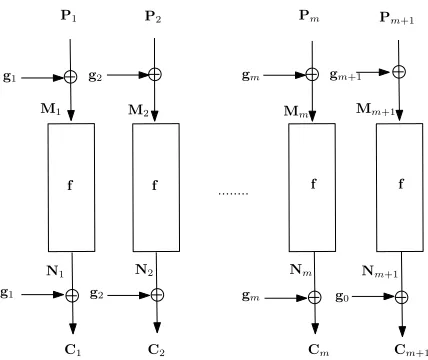
As per the definition of IAPM in random permutation model (also see fig. 4), the whitening functiongis applied before and after the application of the per-mutation f. For each block j in message i, the pre-whitening is done with g
f
g1 g2 gm gm+1
P1 P2 Pm Pm+1
C1
...
g1 g2 gm g0
f f f
C2 Cm Cm+1
M1 M2 Mm Mm+1
N1 N2 Nm Nm+1
Fig. 4.IAPM in Random Permutation Model
offset with zero. Motivated by this, for each i in [1..z], define σi
j(c) to be the
post-whitening offset in the jth block of the ith message, namely σi
j(c) = j if j < li−1, and σi
j(c) = 0 if j =li−1. Similarly, define σj′(c) =j ifj < l′−1 andσ′
j(c) = 0 ifj=l′−1.
For a fixed ciphertext transcriptc, the plaintext blockPi
j (being chosen adap-tively) can beviewed as only a function ofc, and we will write it asPi
j(c). Thus, instead of writingPi
j as a function of the permutationf and the whitening func-tiong, we will be considering it as a function of prospective ciphertext transcript c. The random variablePi
j can still be expressed as Pji(C) =Pji(C(f,g)). For any prospective ciphertext transcript c, and whitening function g ∈ G, for i ∈ [1..z], j ∈ [1..li −1], define Mi
j(c, g) = Pji(c)⊕g(ci0+j). Similarly,
define Nji(c, g) = cij ⊕g(ci0 +σji(c)). We will use Mij to denote the random variableMi
j(C,g), and useNij to denote the random variableNji(C,g). In other words,Mi
jis the actual input to the permutationf (forith message’sjth block) and Ni
j is the output off on that input. We will refer toMijs asthe whitened
plaintext blocks, and Ni
js as the raw ciphertext blocks. Just as for C, we will useP(c),M(c, g) andN(c, g) to denote the whole sequence. Note that although
Ni
j = f(Mij), there is no such relationship between Nji(c, g) and Mji(c, g). In particular,Ni
j(c, g) =f(Mji(c, g)) only if the transcriptcand whitening function g are such thatci
j =f(Mji(c, g))⊕g(ci0+σji(c)).
Moving on to the forged ciphertext, again for a fixed c, as c′ is fixed, for
j ∈[1..l′−1], defineN′
j(c, g) =c′j⊕g(c0′ +σj′(c)). Note that asc′ is picked by the adversary,p′ is not just a function ofc, and henceM′ (as opposed to Mi
j)
cannot be defined as a function of just c and g. Thus, for j ∈ [1..l′−1], and
any permutationf, andg∈ G, defineM′
j(c, g, f) =f−1(Nj′(c, g)). As beforeN′j will stand for the random variableN′
j(C,g), and M′j for Mj′(C,g,f). We will refer to N′
js asthe whitened forged ciphertext blocks, andM′j as the raw forged
Also, forj∈[1..l′−1], defineP′
j(c, g, f) =M′(c, g, f)⊕g(c′0+j). By definition
of IAPM(G) (see D-IAPM), the random variable P′
j(= Pj′(C,g,f)) is M′j ⊕
g(C′0+j) .
For future reference, we list all these definitions and equalities here.
Pij=Pji(C), forj∈[1..Li−2] (1)
Cij=g(C0i +j)⊕f(Pij⊕g(Ci0+j)), forj∈[1..Li−2] (2)
PiLi−1= 0⊕
Li−2
M j=1
Pij (3)
CiLi−1=g(C i
0)⊕f(PiLi−1⊕g(C i
0+Li−1)) (4)
Mji(c, g) =Pji(c)⊕g(ci0+j) (5)
Ni
j(c, g) =cij⊕g(ci0+σji(c)) (6)
Mi
j=Mji(C,g) (7)
Nij=Nji(C,g) =f(Mij) (8)
N′
j(c, g) =c′j⊕g(c′0+σj′(c)) (9)
N′j=Nj′(C,g) (10)
M′
j(c, g, f) =f−1(Nj′(c, g)) (11)
M′j=Mj′(C,g,f) (12)
P′
j(c, g, f) =M′(c, g, f)⊕g(c′0+j) (13)
P′j=M′j⊕g(C′0+j) (14)
Below we define eventsE0, E1and E2which are random variables (being functions of the permutation f and the whitening function g). We prove that either the adversary forces the eventsE0orE1, or the eventE2happens with high probability. In either case we show that the checksum validates with low probability. The eventsE0andE1describe attacks in which the forged cipher-text is copied from one of the previous legitimate ciphercipher-texts, possibly with re-arrangement and deletion of blocks. The eventE0is called deletion attempt, as the adversary in this case just truncates an original ciphertext, but retains the last block. The eventE1can be seen as a rotation attempt by the adversary.
Event E0 (deletion attempt): There is ani∈[1..Z], such that 2≤L′ <Li, and
(i) ∀j∈[0..L′−2] : C′j =Cji and (ii) C′L′−1=CiLi−1
Event E1 (rotation attempt)2: There is ani∈[1..Z], and at, 1≤t≤Li−L′,
such that
(i) C′
0=Ci0+t, (ii) ∀j∈[1..L′−1] : C′j=Ciσ′
j(C)+t
2 If we only consider initial vectors chosen with a nice structure, e.g. with enough
In other words, C′
1 = Cit+1, C′2 = Cit+2,...,C′L′ = Cit. Also, (i) is same as requiring the initial vector of the forged ciphertext to be same as the initial vector of thei-th ciphertext offset byt.
Event E2 says that there is a block x in the forged ciphertext C′, such that
its (whitened forged ciphertext block)N′
xvariable is different from all previous (raw ciphertext variables)Ns, and also different from all otherN′s.
Event E2: There is anx∈[1..L′−1] such that
(i) ∀t∈[1..z]∀j∈[1..Lt−1] :N′x6=Ntj
and (ii) ∀j∈[1..L′−1], j=6 x :N′x6=N′j
The adversary’s success probability is upper bounded by (a) the probability of eventE0orE1orE2not happening, plus (b) the probability of the checksum validating along with eventsE0 or E1or E2 happening. Intuitively, whenE0
orE1holds, a pre-whitening value will have a discrepancy, whereas ifE2holds, a post-whitening value will have a discrepancy. These discrepancies lead to a bound on the latter probability (b), though proving the bound requires a few lemmas.
As for bounding the probability (a), the eventE2not happening translates into a disjunction of events of the typegi
j⊕gij11 =Cij⊕Cij11, wheregij stands for g(IVi +j). Naively, since G is XOR-universal, one would think that the probability of each of these events is 2−n. However, it is not guaranteed that the whitening function gis independent of the ciphertext C, as the ciphertext satisfiesCi
j =Nij⊕gij. Intuitively, if all the whitened plaintextsMijwere distinct andCi
j=Nij⊕gijwere the only relations betweenCandg, then indeedgwould be independent of C (as gand f are independently chosen). But, requiring all
Mij to be distinct implies another relation betweenCandg.
However, it can be shown that, on every fixed outcome of the ciphertextC
(i.e. C = c for some constant transcript c), requiring the M variables to be distinct (and theNvariables to be distinct), rules out only a negligible fraction of functions inG as a potential value forg, and moreover leaves the remaining functions inG equi-probable.
So, consider the following predicate PD (pairwise different). For any constant c and functiong∈ G, define PD(c, g) to be
∀i, i1∈[1..z],∀j∈[1..li−1],∀j1∈[1..li1−1],(i, j)6= (i1, j1) : (Mji(c, g)6=Mji11(c, g)) ∧ (Nji(c, g)6=Nji11(c, g))
Again, we will use PD to denote the random variable PD(C(f,g),g). If a random schedule is used to pick the initial vectors, then we must include in this predicate the condition that {ci
0}i are safe.
The rest of the proof of the theorem is organized as follows. To start with, we will formalize in lemma 1 the equi-probability of the allowedg, given a constant transcript C = c and conditioned on the event PD(c,g). We use this lemma to prove in lemma 6 that the probability of the eventPD and the negation of (E0or E1orE2) is low. We also use lemma 1 to prove in lemma 3 that event
(lemmas 7 and 8), which would lead to the proof of the theorem. We first state all the lemmas, and use them to prove the theorem. The proofs of the lemmas follow later.
We need to characterize the set of prospective ciphertexts with safe IVs for this particular adversary A. Before that, recall the (adversarial) ciphertext length function l from above. Also, recall that the predicate “safe” applies to a set of initial vectors. Now, for 0≤i < z, define
L(c1, ..., ci) ={ci+1 : |ci+1|=l(c1, ..., ci) and{cj0}j∈[1..i+1] safe}
Let,
C = {c : ∀i∈[1..z]ci∈ L(c1, ..., ci−1)}
Thus, C can be seen as the space of prospective ciphertext transcripts for this particular adversary A. Note that when we sum overcranging fromC, it really means the following telescopic sum
X c∈C
= X
c1∈L()
... X
ci∈L(c1,...,ci−1)
... X
cz∈L(c1,...,cz−1)
Remark: If a random schedule is used to choose the IVs, then we exclude the safety condition from C, and include it in the predicate PD. Moreover, in all the lemmas and the proof of the theorem below, the probability will be over choosing (f,g) according toD, as well as choosing the initial vectors randomly and independently. The only change will be in the analysis of lemma 2, as the safety condition will incur an additional cost of (z+u)(z+ 1)∗2−n.
In the following lemmas, the adversary A is fixed to be as in Theorem 1 statement. The quantities n, z, µ, u, and v are as stipulated in Theorem 1 statement.
Lemma 1. For every prospective ciphertext transcriptc∈ C, and for any func-tion g∈ G such that PD(c, g),
Pr(f,g)∈
DK[g=g|C=c ∧ PD(c,g)] =
Pr(f,g)∈
DK[g=g] Pr(f,g)∈
DK[PD(c,g)]
Lemma 2. For every prospective ciphertext transcriptc∈ C,
Pr(f,g)∈
DK[¬PD(c,g)]< u 2∗2−n
Lemma 3.
Pr(f,g)∈
DK[¬PD]< u 2∗2−n
The following lemma follows from lemmas 1 and 2, and is used to prove lemmas 6 and 8.
Lemma 4. For every triple ofn-bit constantsa,b, and d, such thata6=b, and every prospective ciphertext transcript c∈ C
Pr(f,g)∈
DK[g(a)⊕g(b) =d ∧C=c∧ PD(c,g)]≤2
−n+1∗Pr
The following lemma is also used to prove lemma 6.
Lemma 5. For every prospective ciphertext transcriptc∈ C, and its correspond-ing forged transcriptc′, either E0orE1holds forc, or
∃x∈[1..l′−1]∀t∈[1..z]∀j∈[1..lt−1] : (IV′(c)+σx′(c) =IV t
(c)+σjt(c))⇒(c′x6=ctj)
Lemma 6. Let eventsE0,E1,E2be as in Theorem 1. Then,
Pr(f,g)∈
DK[¬(E0∨ E1∨E2) ∧ PD]<(2u+ 2v)∗2 −n
Lemma 7. Pr(f,g)∈ DK[
LL′−1
j=1 P′j = 0|E2]≤ 2n−(vu+v)
Lemma 8. Pr(f,g)∈ DK[
LL′−1
j=1 P′j = 0 ∧ (E0∨ E1)∧PD]≤z∗2−n+2
Proof of Theorem 1 (cont’d):
Pr(f,g)∈
DK[ L′−1
M j=1
P′j = 0]
≤Pr[
L′−1 M j=1
P′j= 0 ∧PD] + Pr[¬PD]
≤Pr[
L′−1 M j=1
P′j= 0 ∧(E0∨E1∨E2) ∧ PD]
+Pr[
L′−1 M j=1
P′j= 0 ∧ ¬(E0∨E1∨E2) ∧ PD] + Pr[¬PD]
≤Pr[
L′−1 M j=1
P′
j= 0 ∧(E0∨E1) ∧ PD] + Pr[
L′−1 M j=1
P′
j = 0 ∧E2]
+Pr[¬(E0∨E1∨E2) ∧ PD] + Pr[¬PD]
≤z∗2−n+2+ v
2n−(u+v)+ (u+v)∗2
−n+1+u2∗2−n (by lemma 8, 7, 6, and 3 resp.)
≤(u2+ 2u+ 3v+ 4z)∗2−n+O(u+v)∗v∗2−2n
4.1 Proofs of the lemmas
Lemma 1.For every prospective ciphertext transcriptc∈ C, and for any func-tiong∈ G such that PD(c, g),
Pr(f,g)∈
DK[g=g|C=c ∧ PD(c,g)] =
Pr(f,g)∈
DK[g=g]
Pr(f,g)∈
DK[PD(c,g)]
Proof:Now,
Pr(f,g)∈
DK[g=g|C=c ∧ PD(c,g)]
We first consider the numerator:
Pr[g=g ∧ C=c ∧ PD(c,g)]
=X
f′
Pr[g=g ∧ f =f′ ∧ C=c ∧ PD(c,g)]
= Pr[g=g ∧ f ∈Fc,g ∧ C=c ∧ PD(c,g)] = Pr[g=g ∧ f ∈Fc,g]
whereFc,g is the set of permutation defined as follows: since PD(c, g) holds, all the raw ciphertext block variables N(c, g) are distinct. Similarly, all whitened plaintext block variablesM(c, g) are distinct. TheseM(c, g) andN(c, g) values determine a unique permutationfc,g projected on a number of blocks given byc (i.e.|c| −z). Thus, forc, gs.t. PD(c, g), defineFc,gto be the set of permutations with the projection on these blocks equal tofc,g, and with no other restrictions on other blocks. Ifc, gare such that¬PD(c, g), then we letFc,gto be the empty set.
The last equality above follows as the two events are identical. To see that
g=g andf ∈Fc,g impliesC=c, first note that since f is inFc,g, the set Fc,g is non-empty, and hence PD(c, g) holds, which implies PD(c,g). Now note that the first plaintext messagep1 is fixed, and moreover the first initial vectorc1
0 is
fixed, which fixesM1 to M1(c, g) by equations (7) and (5). SinceN1 =f(M1)
(by (8)), this fixesN1tof(M1(c, g)) which isfc,g(M1(c, g)) by definition ofFc,g
andfc,g. But,fc,g(M1(c, g)) is same asN1(c, g) by definition offc,g. Thus, C1
is fixed toc1 by (2) and (6). This in turn, fixesP2=P2(c) by (1), and fixesC20
toc20as the initial vectors are chosen as a deterministic function of the previous
ciphertexts, and so forth inductively. We now consider the denominator:
Pr[C=c ∧ PD(c,g)]
= X
g′∈G
X f′
Pr[g=g′ ∧ f =f′ ∧ C=c ∧ PD(c,g)]
= X
g′∈G:P D(c,g′)
Pr[g=g′ ∧ f ∈Fc,g′ ∧ C=c ∧ PD(c,g)]
= X
g′∈G:P D(c,g′)
Pr[g=g′ ∧ f ∈Fc,g′]
The above follows because as before, when PD(c, g′) holds, there is a fixed set of
permutationsFc,g′ with a unique projection (on|c| −z blocks) compatible with g=g′ andC=c.
Sincegand f are independent, we have from the above analysis:
Pr[g=g|C=c ∧ PD(c,g)]
=P Pr[g=g ∧ f ∈Fc,g]
g′∈G:P D(c,g′) Pr[g=g′ ∧ f ∈Fc,g′]
=P Pr[g=g]∗Pr[f ∈Fc,g]
= Pr[g=g] Pr[P D(c,g)]
The last equality follows because in distributionD, f is chosen uniformly, and Fc,gis non-empty by hypothesis of the lemma, andFc,g′is non-empty as PD(c, g′)
holds, and further|Fc,g|=|Fc,g′|.
Lemma 2. For every prospective ciphertext transcriptc∈ C,
Pr(f,g)∈
DK[¬PD(c,g)]<(u 2)∗2−n
Proof:Recall that event PD(c,g) is
∀i, i1∈[1..z],∀j∈[1..li−1],∀j1∈[1..li1−1],(i, j)6= (i1, j1) : (Mji(c,g)6=Mji11(c,g)) ∧ (Nji(c,g)6=Nji11(c,g))
Then¬PD(c,g) can be written as
∃i, i1∈[1..z],∃j∈[1..li−1],∃j1∈[1..li1−1] : (i, j)6= (i1, j1) ∧
[(Mji(c,g) =Mji11(c,g)) ∨ (Nji(c,g) =Nji11(c,g))]
Since we have a constant ciphertext transcriptc, and hence a constant plain-text P(c) as well, the probability of any event Mi
j(c,g) = Mji11(c,g) is just
2−n, as each Mi
j(c,g) is just a function of g, the latter being chosen from an XOR-universal set G, and given that the initial vectors are safe. Similarly for Ni
j(c,g) =Nji11(c,g). The lemma follows by union bound. Lemma 3.
Pr(f,g)∈
DK[¬PD]<(u 2)∗2−n
Proof:Forc=c1, c2, ..., ci,i≤z, define #(c) to be (2n)!/(2n−Pi
j=1(|cj| −1))!.
In other words, #(c) is the ratio of number of permutations on 2n blocks and
|Fc,g| (as defined in lemma 1, and which is same irrespective of g, as long as PD(c, g) holds).
Recall from the proof of lemma 1, forc∈ C,
Pr[C=c ∧ PD(c,g)]
= X
g′∈G:P D(c,g′)
Pr[g=g′ ∧ f ∈Fc,g′]
We use this to get,
Pr[PD(C,g)]
=X
c∈C
Pr[C=c ∧ PD(c,g)]
=X
c∈C
X g′∈G:PD(c,g′)
Pr[g=g′ ∧ f ∈Fc,g′]
=X
c∈C
X g′∈G:PD(c,g′)
=X c∈C
X g′∈G:PD(c,g′)
Pr[g=g′]∗ 1
#(c)
=X
c∈C
1
#(c)∗ Pr[PD(c,g]
≥minc∈C {Pr[PD(c,g)]} ∗ X
c∈C
1 #(c)
≥(1−u2∗2−n) ∗ X
c∈C
1
#(c) (by lemma 2)
≥(1−u2∗2−n)
The last inequality follows by
X c∈C
1 #(c)
= X
c1∈L()
... X
ci∈L(c1,...,ci−1)
... X
cz∈L(c1,...,cz−1)
1 #(c1;...;cz)
≥ X
c1∈L()
... X
ci∈L(c1,...,ci−1)
... X
cz−1∈L(c1,...,cz−2)
1 #(c1;...;cz−1)
≥ ...
≥ X
c1∈L()
1 #(c1)
≥1
where we used the fact that the number ofcz inL(c1, ..., cz−1) is 2n(|cz|−1), and so on.
We will need the following lemma to prove lemma 6 and lemma 8.
Lemma 4.For every triple of n-bit constants a,b, andd, such thata6=b, and every prospective ciphertext transcript c∈ C
Pr(f,g)∈
DK[g(a)⊕g(b) =d ∧C=c∧ PD(c,g)]≤2
−n+1∗Pr
(f,g)∈DK[C=c]
Proof:
Pr[g(a)⊕g(b) =d ∧C=c∧ PD(c,g)] = Pr[g(a)⊕g(b) =d|C=c∧ PD(c,g)]
∗Pr[C=c∧ PD(c,g)]
≤Pr[g(a)⊕g(b) =d|C=c∧ PD(c,g)]
∗Pr[C=c]
The first factor is upper bounded by 2−n/Pr[PD(c,g)] by using lemma 1. To see this,
Pr(f,g)∈
=X g∈G
Pr[g=g ∧ g(a)⊕g(b) =d|C=c∧ PD(c,g)]
=X
g∈G
Pr[g=g|C=c∧ PD(c,g)] ∗ Pr[g(a)⊕g(b) =d|g=g ∧ C=c∧ PD(c,g)]
= X
g∈G:g(a)⊕g(b)=d
Pr[g=g |C=c∧PD(c,g)]
≤ X
g∈G:g(a)⊕g(b)=d
Pr(f,g)∈
DK[g=g]
Pr[ PD(c,g)] (by lemma 1)
= 1
Pr[PD(c,g)] ∗
X g∈G:g(a)⊕g(b)=d
1
|G|
= 1
Pr[PD(c,g)] ∗ Prg∈G[g(a)⊕g(b) =d]
= 2
−n
Pr[PD(c,g)]
Now by lemma 2, and the hypothesis of Theorem 1 that 4u2 < 2n, we have Pr[PD(c,g)]>1/2, and hence the lemma follows.
Lemma 5.For every prospective ciphertext transcriptc∈ C, and its correspond-ing forged transcriptc′, either E0orE1holds forc, or
∃x∈[1..l′−1]∀t∈[1..z]∀j∈[1..lt−1] : (IV′(c)+σx′(c) = IVt(c)+σtj(c))⇒(c′x6=ctj)
Proof:Since the initial vectors are safe, by definition, for allt∈[1..z], IVt+lt− 1<2n−1. Also, IV′+l′−1<2n−1 (see step 3 of D-IAPM).
Recall thatσt
j(c) is the post-whitening offset for blockj in message t. As it is clear from context, we will drop the argumentc fromσandσ′.
If for all message indicest∈[1..z], the forged initial vector IV′ is not equal to IVt(along with their offsets), i.e. for allt: IV′ 6∈IVt+ [0..lt−2], then we can takex=l′−1, in which caseσ′
x= 0, and hence IV′+σ′x= IV′. Now, note that σt
j ranges from 0 tolt−2, and hence thisxsatisfies the lemma vacuously. Next, consider the case where there exists at ∈[1..z] such that IV′ equals IVtwith some offset, i.e. IV′ ∈IVt+ [0..lt−2]. As the initial vectors are safe, there can be at most one sucht. Also, note thatt≤Z(c), as fori > Z(c),li= 1. There are two main sub-cases.
(a) For everyx∈[1..l′−1], IV′+σ′
x∈IVt+ [0..lt−2] (i.e. the set IV′along with its offsets is contained in set IVtalong with its offsets). Again, as the initial vectors are safe, IV′+σ′
xcannot equal IVt
′
+σt′
j′, for some othert′6=t. Also,
sinceσ′
xranges over values from 0 tol′−2, we have IV′+l′−2≤IVt+lt−2. There are two further sub-cases.
(a1) (IV′ = IVt : truncation attempt). Here, l′ ≤lt. If c′ is a (strict) prefix
of ct, then we pick the last block of c′, i.e. we let x= l′−1. Since it
is the last block, the post-whitening offset is zero, i.e. σ′
x = 0. Since, IV′ = IVt, the value IV′+σ′
x will be same as IVt+σjt(for somej) only ifσt
of ct, if c′
x =ctlt−1 then it forces event E0 (the deletion attempt) forc (notet≤Z(c)).
Otherwise, ifc′ is not a prefix ofct, letxbe the least index in whichc′
andctdiffer. If for somej, σt
j =σ′x, then either σjt=σ′x= 0, orj =x. In the latter case,c′
x⊕ctj=c′x⊕ctx, which is non-zero asxis the index in whichc′ andctdiffer. In the former case, j =lt−1, andx=l′−1.
In this case,c′
x⊕ctj =c′l′−1⊕ctlt−1. If this quantity is zero, then since x(= l′ −1) was the least index in which ct and c′ differed, event E0
would hold forc.
(a2) (IV′ 6= IVt:rotation attempt) Note that, if instead of general safe intitial vectors we had required the initial vectors to have enough least significant bits to be zero, so that the offsets could be embeded un-ambiguously, then this case would not arise. In other words, with this restriction, IV′+σ′x ∈ IVt+ [0..lt−2] could only happen if IV′ = IVt. However, in the case of general safe initial vectors, this case could certainly arise. We will show that for eachx, there is a uniquejx∈[1..lt−1], such that IV′+σ′
x= IVt+σtjx. Recall thatσ
′
x=xexcept forx=l′−1, in which case it drops to zero, i.e.x−(l′−1). Hence for the abovejxto exist,jl
′−1
must drop by (l′−1) as well (we formalize this in the next paragraph).
Next, we will show that either for somex, c′
x 6=ctjx or eventE1 holds (i.e.c′ is a rotation of a portion of ct).
To be more precise, we first note that IV′≥IVt+ 1, as IV′ is in IVt+ [0..lt−2]. Thus from IV′≤IVt+lt−l′ it follows that IV′ = IVt+s, for somessuch that 1≤s≤lt−l′ (thus satisfying E1(i)). Thus, for every
x∈[1..l′−1], IV′
+σ′
x= IV t
+σ′
x+s. Note that 1≤σx′ +s≤lt−2, as 0≤σ′
x ≤l′−2, and 1≤s≤lt−l′. Hence, for each x∈[1..l′−1], σt
σ′
x+s=σ
′
x+s, and hence IV
′
+σ′
x= IV t
+σ′
x+s= IV t
+σt σ′
x+s. Thus, for eachx, there is a uniquejx, namelyσ′
x+s, such that IV′+σ′x= IVt+σtjx. Now, suppose for all x∈ [1..l′−1], c′
x⊕ctjx = 0, i.e. c
′
x = ctσ′
x+s. But this implies that E1 holds for c. Otherwise, we have an x such that c′
x⊕ctjx 6= 0, and the lemma follows as tand jx are the only values for which IV′+σ′
x= IVt+σjtx.
(b) (extension attempt) There exists an x ∈ [1..l′ −1] such that IV′
+σ′
x 6∈ IVt+ [0..lt−2]. Since, IV′
∈IVt+ [0..lt−2], it follows that there exists an x∈[1..l′−2] such that IV′
+σ′
x6∈IV t
+ [0..lt−2]. For the least suchx(and noteσ′
x =x), we have IV
′+x= IVt+lt−1. Since the initial vectors are
safe, there is no othert′, j′ such that IV′+σ′
x= IVt
′
+σt′
j′,j′ in [1..lt ′
−1]. Thus thisxsatisfies the lemma vacuously. The key observation here is that for everyt∈[1..Z(c)], the value IVt+lt−1 is never used as a post-whitening index in the first stage of the attack.
Lemma 6. Let eventsE0,E1,E2 be as in Theorem 1. Then,
Pr(f,g)∈
DK[¬(E0∨E1∨E2) ∧ PD]<(2u+ 2v)∗2 −n
Proof:
To begin with, we have
Pr[¬(E0∨E1∨E2)∧PD] =X c∈C
Focusing on the negation ofE2, the inside expression above (see the definition of E2) is the probability of the conjunction (one for each x) of disjunctions. Hence, it is upper bounded by the least (over x) of the probabilities of the disjunctions, which in turn is upper bounded by the sum of the probability of each disjunct. Thus, for any fixed ciphertext transcriptc,
Pr[¬(E0∨E1∨E2)∧C=c∧PD]
≤ minx∈[1..l′−1]
X t∈[1..z],j∈[1..|ct|−1]
Pr[(N′x=Ntj)∧C=c∧ ¬(E0∨E1)∧PD]
+ X
j∈[1..l′−1],j6=x
Pr[(N′x=N′j)∧C=c∧PD]
Since each of the summands in the expression above has a conjunct C =c for some constant string c, it follows that Nt
j =Njt(c,g), and N′x = Nx′(c,g). Thus, each of the summands in the first sum can be written (by equation (6)) as
Pr[(g′σ′
x⊕g t σt
j =c
′
x⊕ctj) ∧C=c∧ ¬(E0∨E1)∧ PD(c,g)],
whereg′
jis shorthand forg(IV′(c)+j), andgtjis shorthand forg(IVt(c)+j). Now, by lemma 4, each of these probabilities is upper bounded by 2−n+1∗Pr[C =c]
as long as IV′+σ′
x(c) 6= IV t
+σt
j(c). However, if IV
′
+σ′
x(c) = IV t
+σt j(c), then by lemma 5 either (E0 or E1) holds for c, or c′
x⊕ctj 6= 0, which would make this probability zero. For the summands in the second sum, lemma 4 is unconditionally applicable asσ′
x(c)6=σ′j(c). From equation (15), we then get
Pr[¬(E0∨E1∨E2)∧PD]≤(u+v)∗2−n+1
Lemma 7. Pr(f,g)∈
DK[
LL′−1
j=1 P′j = 0|E2]≤ 2n−(vu+v)
Proof:For eachxin [1..v−1], letE2(x) denote the event E2holding with this x. First note that
Pr[
L′−1 M j=1
P′j= 0|E2] ≤ X
x Pr[
L′−1 M j=1
P′j = 0|E2(x)] (16)
which follows from Pr[A|B∨C]≤Pr[A|B] + Pr[A|C] for arbitrary eventsA, B andC.
Now, for anyxin [1..L′−1], we haveLL′−1
j=1 P′j= 0 iff
f−1(N′x) = M′x=
L′−1
M j=1,j6=x
(M′j⊕g(C′0+j)) ⊕g(C′0+x)
values, each with equal probability, and hence the probability of LHS being equal to RHS is at most 1/(2n−(u+v)).
To this end, we calculate the above probability by fixing g, each Ntj, and eachM′
j (j6=x), and summing the probability over all the fixings:
Pr[f−1(N′x) =
L′−1
M j=1,j6=x
(M′j⊕g(C′0+j)) ⊕g(C′0+x)|E2(x)]
= X
g,nt
j,m′j(j6=x)
Pr[g=g∧^(Nt
j=ntj)∧ ^ j6=x
(M′
j=m′j)∧f−1(N′x) = M
...|E2(x)]
=XPr[f−1(Nx′(C, g)) = M
...|E2(x) ∧g=g∧^(Ntj =ntj)∧ ^ j6=x
(M′j=m′j)] ∗
Pr[g=g∧^(Ntj =ntj)∧ ^ j6=x
(M′j=m′j)|E2(x)] (17)
We now show that event E2(x) and C′0 are completely determined by (i)
the whitening function g, and (ii) Ntj (t ∈ [1..z], j ∈ [1..Lt−1]). First, by equations (2), (4), (5), (7), and (8),Nt
j and gcompletely determineC. Hence, the adversarial choice of C′
0,L′, and in fact the whole of C′ is determined by
these quantities. On fixing g to g, and fixing Nt
j to ntj, say the ciphertext C fixes toc, the plaintextPfixes top, and the whitened plaintextMt
jfixes tomtj. Further, sayL′ fixes tol′, andC′
j fixes toc′j , j∈[0..l′−1]. Further, note that for all j ∈ [1..L′ −1], N′
j = C′j ⊕g(C′0+σj′(C)) (by equations (10) and (9)). Thus, for eachj (including x),N′
j fixes to a constant value, sayn′
j. Thus, the conjunction of the conditions (g=g), (Ntj =ntj), and
E2(x) is equivalent to the conjunction of (g=g), (Nt
j=ntj), and the condition that n′
xis different from all othern′j, and from all ntj.
The first factor in the above summation (17) now simplifies to
Pr[f−1(n′x) = M
(m′j⊕g(c′0+j)) ⊕g(c′0+x)|
(g=g)∧^(Ntj =ntj)∧ ^ j6=x
(M′j=m′j)∧ ^ t,j
(n′x6=ntj)∧ ^ j:j6=x
(n′x6=n′j)](18)
Now note that (g=g)∧V (Nt
j =ntj) is implied by (g=g)∧ V
(f−1(nt j) = mtj), where mtj is as fixed above. This follows by induction, noting that m1 is determined by g, the fixed adversarial value P1, and C1
0 (also see second
paragraph of proof of lemma 1 for a similar argument). The conditioning in the above probability 18 is then same as (by (8), (12), and (11))
(g=g)∧^(f−1(ntj) =mtj)∧ ^ j6=x
(f−1(n′j) =m′j)∧ ^ t,j
(n′x6=ntj)∧ ^ j:j6=x
(n′x6=n′j)
Since the permutation f is independent of the whitening function g, the above probability (18) (i.e. the first factor of summation (17)) is at most 1/(2n−(µ+v)). The lemma follows by summing over allx.
Lemma 8. Pr(f,g)∈
DK[
LL′−1
Proof: In the following, we will drop the argument C from σand σ′, as it will
be clear from context. We will also use gi
j as shorthand forg(Ci0+j).
We first consider the eventE0happening. SinceE0(i) implies that for some messagei:C′
0 =Ci0, it also implies, along withE0(ii) andσ′L′−1=σLii−1= 0, that N′
L′−1 =NiLi−1, and hence ML′′−1 =MiLi−1. Further, E0(i) also implies
N′
j=Nij (forj= 1 to L′−2), which in turn impliesM′j=Mij, and hence also
P′
j=Pij. Thus, we have
(
L′−1
M j=1
P′j= 0) ∧E0
⇒(
L′−1
M j=1
P′j= 0) ∧E0 ∧ ∃i(ML′′−1=MiLi−1)
⇒(
L′−1
M j=1
P′j= 0) ∧E0 ∧ ∃i(P′L′−1⊕giL′−1=MiLi−1)
⇒ ∃i(
L′−2
M j=1
(Pij)⊕MiLi−1⊕giL′−1= 0)
≡ ∃i(
L′−2 M j=1
(Pij)⊕
Li−2
M j=1
(Pij)⊕giLi−1⊕giL′−1= 0)
SinceG is XOR-universal andL′<Li, and the initial vectors are safe, we have
Pr[
L′−1 M j=1
P′
j= 0 ∧ E0∧PD]
≤Pr[PD ∧ ∃i(
L′−2 M j=1
(Pi j)⊕
Li−2 M j=1
(Pi
j)⊕giLi−1⊕giL′−1= 0)]
=X
c∈C
Pr[C=c ∧ PD∧ ∃i(
L′−2
M j=1
(Pij)⊕
Li−2
M j=1
(Pij)⊕giLi−1⊕g i
L′−1= 0)]
=X
c∈C
Pr[C=c ∧ PD∧ ∃i(
L′−2
M j=1
(Pji(c))⊕
Li−2
M j=1
(Pji(c))⊕giLi−1⊕giL′−1= 0)]
≤z·2−n+1·X
c∈C
Pr[C=c]
where the last inequality follows by lemma 4, and the union bound.
Now, consider the eventE1happening. We have that for some message i :
C′
0=Ci0+t, with 1≤t≤Li−L′. Note that, forj∈[1..L′−1],σ′j+t≤Li−2. Forj∈[1..L′−1], fromE1(ii), we then have
N′j =C′j⊕g(C′0+σj′) =Ciσ′
j+t⊕g(C i
Since σ′
j+t≤Li−2, we get N′j =Niσ′
j+t, and hence M
′
j =Miσ′
j+t. Now, for j∈[1..L′−2], sinceσ′
j =j, we have
M′j=P′j⊕g(C′0+j) =P′j⊕g(Ci0+t+j).
Since,Mi
j+t=Pij+t⊕g(C0i +t+j), we haveP′j =Pij+t. Also,M′
L′−1 =Mit, asσ′L′−1= 0. Thus, P′L′−1⊕g(Ci0+t+L′−1) =Mit. Hence,
(
L′−1
M j=1
P′j= 0) ∧E1
⇒(
L′−1
M j=1
P′j= 0) ∧E1 ∧ ∃i(P′L′−1⊕git+L′−1=Mit)
⇒ ∃i(
L′−2
M j=1
(Pij+t)⊕Mti⊕git+L′−1= 0)
≡ ∃i(
L′−2
M j=1
(Pij+t)⊕Pit⊕git⊕git+L′−1= 0)
AsL′≥2, as before using lemma 4, we get an upper bound ofz·2−n+1.
4.2 Modes using GF(p)
We now prove Theorem 1 for the IAPM scheme as in Fig 3 (section 3.3), i.e using the mod p construction. We first show that for eachi, j,Si
j (as defined in section 3.3) is uniformly distributed in GF(p).
When it is clear from context, we will dropifrom the superscript.
Lemma 9. For everyj,Sj is uniformly distributed in GF(p).
Proof: First we prove that there is no overflow in the last step of the for-loop, i.e. while adding (2n−p).
IfS0<(2n−p), then lettbe the leastj such thatSj ≥(2n−p), other-wise
t= 0. Clearly, forj ≤t, the condition (K2> S∗
j) could not have been satisfied, asK2< p.
We next show by induction that forj ≥t,Sj ≥(2n−p). Clearly, for j =t it is true by definition oft. If for somej > t, (K2≤S∗
j), thenSj =Sj−1+K2,
and there was no overflow in this addition, hence by inductionSj ≥(2n−p). If for somej > t, (K2> S∗
j), thenSj∗ < p, asK2< p. Thus, there is no overflow while adding (2n−p), and henceSj≥(2n−p).
Finally, we show thatSj =K2∗(j+ IV) modp, which proves the lemma. Clearly, this is true for j = 0. Suppose it is true for j−1, then we show that Sj =K2∗(j+ IV) modp. Suppose (Sj−1+K2)<2n, thenSj =Sj−1+K2,
and hence Sj =K2∗(j+ IV) modp, by induction. If (Sj−1+K2)≥2n then,
Sj = (Sj−1+K2)−2n+ (2n−p), since there is no overflow while adding (2n−p)