Impossible plaintext cryptanalysis and
probable-plaintext collision attacks of 64-bit
block cipher modes
David McGrew [email protected]
Cisco Systems, Inc.
Abstract. The block cipher modes of operation that are widely used (CBC, CTR, CFB) are secure up to the birthday bound; that is, ifw2wor fewer bits of data are encrypted with aw-bit block cipher. However, the detailed security properties close to this bound are not widely appreci-ated, despite the fact that 64-bit block ciphers are sometimes used in that domain. This work addresses the issue by analyzing plaintext-recovery attacks that are effective close to that bound. We describe possible-plaintext attacks, which can learn unknown possible-plaintext values that are encrypted with CBC, CFB, or OFB. We also introduceimpossible plain-text cryptanalysis, which can recover information encrypted with CTR, and can improve attacks against the aforementioned modes as well. These attacks work at the birthday bound, or even slightly below that bound, when the target plaintext values are encrypted under a succession of keys.
1 Introduction
A w-bit block cipher with aκ-bit key is an invertible function that maps w-bit inputs to w-bit outputs, in which the mapping is pseudorandom and different for each of the 2κ possible values of the key. Users of cryp-tography appreciate the need for appropriately large keys, and in practice κ= 128 is common and is recommended. However, there is less apprecia-tion of the need for large block widthw, and a decade after the adoption of 128-bit block ciphers, the use of 64-bit block ciphers is still ongoing.
Theory advises against using a w-bit block cipher to encrypt more than 2w/2 blocks with a single key; this is known as the birthday bound. Triple-DES has parametersκ= 168 andw= 64, and GOST 28147-89 has κ= 256 and w= 64. The key sizes of these ciphers imply strong security goals, e.g. that an attacker cannot learn anything about the plaintext without O(2112) orO(2256) operations. However, any 64-bit block cipher in a conventional encryption mode of operation that processes gigabytes of plaintext will give up some secret information; in short, a 64-bit block cipher cannot meet its security goals when it is used at modern data rates. We demonstrate this fact by describing attacks that recover information about unknown plaintexts that take as few asO(235) operations.
Throughout this work we assume that the attacker can observe all of the ciphertext, and assume that the attacker has some (incomplete) knowledge about the plaintext. For instance, an attacker might know that a particular plaintext consists of english-language HTML4 carried over HTTP/1.1 [8], TCP [24], and IPv4 [23]. Through a careful analysis of the protocols being encrypted, and observations of the lengths and order of packets, an attacker can make many inferences about some parts of the plaintext. The goal of the encryption system is to prevent the attacker from leveraging this partial knowledge to learn other more sensitive parts of the plaintext; for example, passwords like those used for HTTP Basic Authentication [9]. Similar assumptions are valid for the encryption of data at rest, i.e. disks, partitions, filesystems, files, file elements, and database entries. The examples we draw on are from network security, but our analysis applies to other uses of encryption as well.
1.1 Previous work
The fact that CBC, CFB, and CTR give away some information about their plaintext after about 2w/2 blocks are encrypted is well established, though to our knowledge no systematic way to exploit this vulnerability has been described in the open literature. Collision attacks have long been known, but in applied cryptography circles, they are considered more in the context of hash functions, where they first appeared in the literature [19]. Interestingly, there is no discussion of the birthday bound for CBC, CFB, and CTR in the standard that specifies them [5] nor in the Handbook of Applied Cryptography [18].
that CBC and CTR are secure below the birthday bound; it did not ex-plore how an attacker can exploit those modes when that bound is not respected, or how practical security degrades close to that bound. Other works have shown how cryptanalyts can exploit probabilistic information about plaintexts. Probable plaintext in the Internet protocol family has been studied [2] and it has been shown that some generic key-recovery attacks can be effective on CTR even when the attacker’s knowledge of the plaintext is probabilistic [16]. Mason et. al. [15] developed attacks that recover unknown plaintext from misused one-time-pad, based on a statistical model of the plaintext and a dynamic programming approach that identifies the most likely value of the plaintext by finding the highest probability path through a hidden markov model. None of these last three works consider the birthday bound.
In this note, we describe plaintext-recovery attacks against CBC, CFB, and CTR modes that are effective close to the birthday bound. Our attack on CBC and CFB is an application of the well known col-lision attack, while our impossible plaintext attacks against CTR have not previously appeared. We also show how these attacks can be applied at, or even slightly below the birthday bound, by continuing the attack across a succession of distinct keys. We provide motivating examples from communications security to show that the attacks can be effective, discuss the use of 64-bit block ciphers at modern data rates, and conclude that 128-bit block ciphers have significant security advantages.
1.2 Notation
We let w denote the number of bits in the plaintexts and ciphertexts of the block cipher. The plaintext and ciphertext consist of a sequence of w-bit blocks Pi and Ci, respectively, for i= 1,2, . . . , q. We also use the
convention thatC0 is an initialization vector.
For for any setS ⊂ {0,1}w and any elementx∈ {0,1}w, we useS⊕x
to denote the set {x⊕s : s ∈ S}. For any sets S, T, #S denotes the number of elements inS, andS/T denotes the set difference;x∈S/T iff x∈S, x /∈T. The direct product of two setsS, T is denoted as S×T = {(s, t) :s∈S, t∈T}.
1.3 Modes
consider the CFB, CBC, and CTR modes [5]. For i = 1,2, . . . , q, the plaintext and ciphertext are related as
Pi =
E−1(Ci)⊕Ci−1 in CBC mode E(Ci−1)⊕Ci in CFB mode
E(i)⊕Ci in CTR mode.
(1)
Without essential loss of generality, we assume that the number of bits in the plaintext is a multiple ofw, for clarity of exposition. We also neglect the packetization of data and initialization vectors (other than C0) since it is irrelevant to the analysis. We neglect details of how iis represented as a w-bit string, which are also not relevant.
In each mode, there is a straightforward relation between a particular plaintext block and a single invocation of the block cipher, which we use in our attacks:
Ex=
Ci where x=Pi⊕Ci−1 in CBC mode Cx⊕Px where x=Ci−1 in CFB mode
Cx⊕Px in CTR mode.
(2)
2 Collision attacks on CBC and CFB
The CBC and CFB modes of operation leak information about plaintext when a collision in thew-bit block cipher input occurs. For these modes, we denote as Ii the input to the block cipher encryption operation that
is associated with the ith plaintext:
Ii=
(
Ci in CBC mode
Ci−1 in CFB mode.
(3)
A collision is the event thatIi =Ij for somei6=j; this event is easy to
observe, based only on the value of the ciphertext blocks. After a collision is observed, the attacker learns a relationship between the values of Pi
and Pj:
Pi⊕Pj =∆ij, where ∆ij =
(
Cj−1⊕Ci−1 in CBC mode Cj⊕Ci in CFB mode.
(4)
knows all or part of Pi, the relationship allows them to infer all or part
of Pj. Likewise, Pi can be learned if Pj is known. If the attacker has
partial knowledge about both Pi and Pj, then Equation 4 increases the
knowledge about both values.
This information can be quantified as follows. Let P[Pi =x] and
P[Pj =y] denote the ‘prior’ probabilities known to the attacker, where
x, y ∈ {0,1}w. These probability distributions for P
i and Pj contain the
attacker’s knowledge about those plaintext blocks before the attack. We let Pi ⊕Pj = ∆ denote the event that a collision is observed between
blocks i and j, and thus that equality holds. The probability estimate of those plaintext values are improved via Bayes’ equation, that is, the distribution of Pi conditioned on the collision event is
P[Pi=x|Pi⊕Pj =∆] =
P[Pj =x⊕∆]P[Pi =x]
P
yP[Pj =y⊕∆]P[Pi =y]
. (5)
In most real-world scenarios, an attacker knows enough about the plaintext to be able to exploit these relationships very effectively, though doing so may require the use of specialized statistical methods. These techniques are well understood and have been successfully applied to cryptanalysis. The work of Mason et. al. [15] assumes plaintext relations in the form of Equation 4, and is successful at automatically uncovering the most likely plaintext values based only on a statistical language model of the plaintext. To give an idea of how these methods work, we present a motivating example. We suppose that the attacker knows that the first two bytes of Pi are in the set { 0A00, AC10, C0A8 }, as would be the
case if that block starts with an IPv4 private address [25], and the first two bytes of Pj contain ASCII data [4], and thus each of the first two
bytes of Pj is less than 80 (all numbers in hexadecimal). By comparing
the first two bytes of ∆ij to 80, the attacker can find the first two bytes
of Pi, and from that value, can find the first two bytes of Pj.
The following lemma shows the effectiveness of the collision attack, using a simple plaintext model; the proof is in Appendix A.
Lemma 1. The expected number of bits of unknown plaintext that are revealed in a collision attack with kblocks of known plaintext and ublocks of unknown plaintext is wku2w ≤n22w+2w , where n=k+u.
An efficient method of attack is detailed in Appendix B, which requires O(n) operations on 2w-bit words, and O(n) storage. This attack is easy
to prosecute, and in fact the attacker’s computational cost is roughly the same as that of the victim. In practice, storage costs will likely dominate the cost of the attack, though a one terabyte disk costs less than $100 and with 243bits, is sufficient whenw= 64. An attacker faced with a situation in which n >2w2+1 but only m < nciphertext blocks can be stored can
maximize their results with the strategy of discarding unknown-plaintext blocks if u > kand discarding known-plaintext blocks otherwise.
2.1 Rekeying
Lemma 1 assumes that the block cipher key is unchanged, so that all blocks are encrypted with the same key. The best mitigation against these attacks (other than using a cipher with a larger value ofw) is to rekey the block cipher; that is, to use multiple keys, so as to limit the total amount of data encrypted with any single key. Assume that the total number of blocks to be encrypted is t, and that the number encrypted under a single key is n. Then expected number of bits of information leakage is tn2w+2w ; see Section 4 for a concrete example. This equation highlights
the important relationship between the total amount of data encrypted and the information leakage. If there is a practical lower limit on the rate at which new keys can be established, that determines the amount of information that a patient attacker can learn from observing traffic across all keys. Note that since the computational costs of the attack are less than the costs of the storage required, there is not much additional incremental cost to the attacker.
3 Impossible plaintext cryptanalysis of CTR
An attacker can make inferences about CTR-encrypted data as fol-lows. From Equation 1 and because of the invertibility of E, the attacker knows that E(i)6=E(j) for any i6=j, and thus
Pi 6=Pj ⊕Ci⊕Cj. (6)
An attacker who knowsPj, and observesCi andCj, learns that a
partic-ular value of the plaintext is impossible.
3.1 Plaintext model
Before detailing attack techniques, we first establish a model for the plain-text source. We letKdenote a set of known plaintext blocks; for alli∈ K, the attacker knows the value of Pi. We assume that the attacker
under-stands (at least part of) the format of the plaintext, and we characterize the attacker’s knowledge about the plaintext as follows. Anunknown re-peated value occurs whenPi =φfor all i∈ R for some unknown valueφ
and some setR of blocks. We say that the unknown value hasrepetition r when #R =r. When an unknown plaintext value is information that the attacker considers valuable and wants to discover, we call that value a target. When it is data that is of no interest to the attacker, we call it an incidental value. An incidental value can be used as a stepping stone to learning target values. We denote as Φ = {φ1, φ2, . . . , φs} the set of
possible plaintext values; that is, the attacker knows that Pi =φ∈Φfor
all i∈ R, but does not know the actual value of φ.
Unknown repeated values occur more often in real-world systems than one might initially expect. For instance, every 1500 byte IPv4 packet contains two four-byte addresses, and every IPv6 packet with the same size contains two sixteen-byte addresses; as these values are constant for a particular data flow, they present repeated values that comprise 0.5% and 2.1% of those flows. When HTTP Basic Authentication [9] is used, a username/password value is repeated in each HTTP request.
3.2 Inferences
Equation 6 provides a small amount of information about Pi, based on
knowledge ofPj. Collecting this knowledge across all of the known
plain-texts leads to the first part of the following lemma; collecting information across each ciphertextCi:i∈ R, gives the second part.
Lemma 2. For any ciphertext block Ci :i /∈ K the corresponding
An unknown repeated value φcorresponding to the set R satisfies φ /∈ E ⊕Γ, where Γ ={Cj :j∈ R}.
We estimate that an impossible plaintext attack against an unknown repeated value with repetition r, a possible plaintext set of size #Φ=s, and k = #E known plaintext blocks succeeds when kr ≥ (ln(s) + 1)2w. This estimate is derived as follows. We make the heuristic assumption that the elements of the setE ×Γ are uniformly random and independent, and then model the attack as the coupon collector’s problem [10], where attacker seeks to find s−1 coupons (possible plaintexts) by drawing kr coupons uniformly at random (fromE ×Γ). Finding a coupon is equivalent to eliminating a possible plaintext. After j possible plaintexts have been collected, the number of draws required to collect the next one follows a geometric distribution with p = 1−j2−w, so the expected number of draws needed to find thej+ 1thpossible plaintext is 2w2w−j. Whens <2w,
it is as if 2w−scoupons have already been found before the start of the attack, so the total number of draws needed to eliminate alls−1 possible plaintexts is
2w 2w−1
X
j=2w−s
1
2w−j = 2 w
1 s+
1
s−1+. . .+ 1 2+ 1
= 2w
s
X
i=1,
1
i, (7)
from the linearity of expectations. The sum in the rightmost term is the sth harmonic number; bounding this value [13] gives that the expected number of draws needed to find all possible plaintexts is in between (ln(s) + 12)2w and (ln(s) + 1)2w, and the estimate follows directly. See Appendix C for further discussion.
3.3 Implementation
Algorithm 1 (sieving, left) and Algorithm 2 (searching, right)
for ∈ E do for i∈ R do
removeCi⊕fromΦ end for
end for returnΦ
for φ∈Φ do for i∈ R do
if Ci⊕φ∈ E then removeφfromΦ end if
end for end for returnΦ
Faster algorithms are possible when more than the minimum amount of known plaintext is available; see Appendix D.
3.4 Hybrid algorithm
The seiving algorithm takes fewer computations whenever k < s, while the searching algorithm takes fewer computations otherwise. The first few passes of the seiving algorithm greatly reduce the size of the possible plaintext set. Thus, a better attack strategy for when k < s is to use the seiving algorithm until #Φ has been reduced in size enough so that #Φ < k, then switch to the latter algorithm. An efficient hybrid algorithm can be constructed by noting thatE can be divided into two distinct sets E =E1∪ E2, andE1 can be used in the seiving stage, whileE2 is used in the searching stage, without affecting the reliability of the algorithm at finding the correct plaintext. In practice, the exact size of the setE1 need not be known in advance, the attacker can count the number of remaining possible plaintexts during the sieving stage, and adaptively choose when to move the attack to the searching stage.
4 Discussion
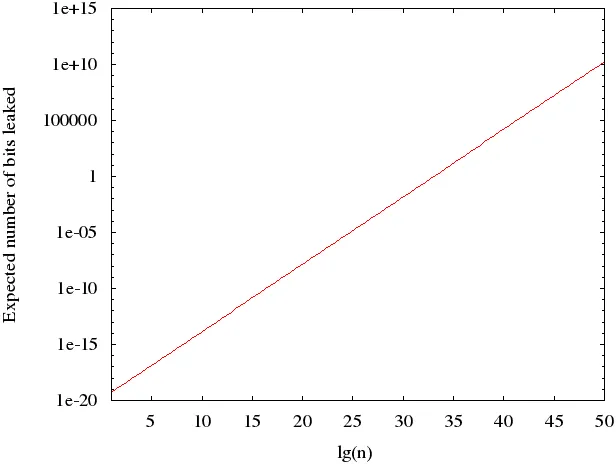
ciphers. Figure 1 illustrates this expected plaintext leakage, and Table 1 shows how dramatically better the security of 128-bit block ciphers is.
Fig. 1: The expected number of bits leaked due to collisions in as a function of the logarithm of the numbernof ciphertext blocks, as per Equation 1, with aw= 64-bit block cipher.
1 Mbit/s for one day 1 Gbit/s for one day 1 Tbit/s for one day w= 64 6.3 bits 6.3×106 bits 6.3×1012bits w= 128 1.7×10−19bits 1.7×10−13bits 1.7×10−7bits Table 1: The expected number of bits leaked due to collisions, as per Lemma 1.
kilobytes per year. Clearly,w= 64 is undesirable at these data rates and should be avoided when possible.
An implementation that uses manually installed keys in a 64-bit block cipher is especially problematic, since it cannot avail itself of the rekeying strategy of Section 2.1. When automated key management is used, there may still be a risk that an attacker can prevent rekeying from taking place by dropping the key establishment messages, and thus prolong the use of a particular key. As a general rule, 64-bit block ciphers are inappropriate for encrypting at high data rates, and 128-bit block ciphers are much more suitable in such scenarios.
Arguably, the vulnerabilities exploited in this work are more rel-evant to security practice than differential, linear, integral, algebraic, and biclique cryptanalysis. The biclique attack on AES with 128-bit keys, for instance, is an important recent advance in the cryptanalysis of block ciphers [3]. Prosecuting that attack requires 288 chosen plain-texts/ciphertexts and takes O(2126) operations, which is a million times as much ciphertext as that needed for collision attacks, and 262 times as much computation. Furthermore, it suffices to observe the victim’s traffic, without interacting with it, in order to prosecute the attacks described in this note. In contrast, attacks based on differential, linear, integral, algebraic, and biclique cryptanalysis typically require that the victim compute the decryption of many ciphertexts, and/or the encryption of many plaintexts, which have been chosen by the attacker. They are thus much harder to perpetrate against real-world systems, most of which use modes of operation like CBC, CFB, and CTR, in which the block ci-pher inputs cannot be controlled by an attacker in a chosen-plaintext or chosen-ciphertext attack.
Interestingly, the modern block cipher modes CCM and GCM are specified only for use with 128-bit block ciphers, and consciously omit smaller block sizes. They also define a maximum on the number of blocks that can be encrypted with a single key. The specifications for the tra-ditional modes accept any value of w, and do not include similar upper bounds. This contrast no doubt reflects the heightened expectations that the modern cryptography community has put onto new techniques, and the newer standards are better because of it.
ciphers for some reason, these modes may be appealing; of course, the best security would be provided by using one of these modes with a 128-bit block cipher!
CTR is more difficult to attack than CBC or CFB; in real-world sce-narios, it appears that CTR leaks information more slowly than the other modes. This fact is evident from a comparison of Equations 4 and 6; an attacker learns much more information from the equality Pi⊕Pj = ∆
than the inequalityPi⊕Pj 6=∆.
5 Conclusions
We show attacks against w-bit block ciphers in CBC, CFB, and CTR modes that can recover an unknown plaintext values when the birthday bound is not respected. These attacks are practical against w = 64-bit block ciphers that are used at, or even slightly below, the birthday bound. The collision-based attacks against CBC and CFB are straightforward and relatively inexpensive to carry out against 64-bit block ciphers; the impossible plaintext attacks against CTR are more involved, but are still feasible. The only protection against these attacks is to stay well below the birthday bound. 128-bit block ciphers provide substantially better security than 64-bit ones, with the exception of scenarios in which all encryption takes place at very low data rates and keys are changed often.
References
1. Mihir Bellare, Anand Desai, Eric Jokipii, and Phillip Rogaway. A concrete security treatment of symmetric encryption. In 38th Annual Symposium on Foundations of Computer Science, pages 394–403, Miami Beach, Florida, October 19–22, 1997. IEEE Computer Society Press.
2. Steven M. Bellovin. Probable plaintext cryptanalysis of the IP security protocols. In ISOC Network and Distributed System Security Symposium – NDSS’97, San Diego, California, USA, February 10–11, 1997. The Internet Society.
3. Andrey Bogdanov, Dmitry Khovratovich, and Christian Rechberger. Biclique cryptanalysis of the full AES. In Advances in Cryptology – ASIACRYPT 2011, Lecture Notes in Computer Science, pages 344–371. Springer, Berlin, Germany, December 2011.
4. V.G. Cerf. ASCII format for network interchange. RFC 20, October 1969. 5. Morris Dworkin. Recommendation for Block Cipher Modes of Operation: Methods
and Techniques. National Institute of Standards and Technology (NIST) Special Publication SP 800-38A, 2001.
7. Morris Dworkin. Recommendation for Block Cipher Modes of Operation: The CCM Mode for Authentication and Confidentiality. National Institute of Stan-dards and Technology (NIST) Special Publication SP 800-38C, 2004.
8. R. Fielding, J. Gettys, J. Mogul, H. Frystyk, L. Masinter, P. Leach, and T. Berners-Lee. Hypertext Transfer Protocol – HTTP/1.1. RFC 2616 (Draft Standard), June 1999. Updated by RFCs 2817, 5785.
9. J. Franks, P. Hallam-Baker, J. Hostetler, S. Lawrence, P. Leach, A. Luotonen, and L. Stewart. HTTP Authentication: Basic and Digest Access Authentication. RFC 2617 (Draft Standard), June 1999.
10. Geoffrey Grimmett and David Stirzaker. Probability and Random Processes. Ox-ford University Press, 1992.
11. Tetsu Iwata. New blockcipher modes of operation with beyond the birthday bound security. In Matthew J. B. Robshaw, editor,Fast Software Encryption – FSE 2006, volume 4047 ofLecture Notes in Computer Science, pages 310–327, Graz, Austria, March 15–17, 2006. Springer, Berlin, Germany.
12. Tetsu Iwata. Authenticated encryption mode for beyond the birthday bound secu-rity. In Serge Vaudenay, editor,AFRICACRYPT 08: 1st International Conference on Cryptology in Africa, volume 5023 ofLecture Notes in Computer Science, pages 125–142, Casablanca, Morocco, June 11–14, 2008. Springer, Berlin, Germany. 13. G. Klambauer. Problems and propositions in analysis, 1979.
14. Donald E. Knuth. The art of computer programming, volume iii: Sorting and searching. InThe Art of Computer Programming, Volume III: Sorting and Search-ing, 1973.
15. Joshua Mason, Kathryn Watkins, Jason Eisner, and Adam Stubblefield. A natural language approach to automated cryptanalysis of two-time pads. In Ari Juels, Rebecca N. Wright, and Sabrina De Capitani di Vimercati, editors, ACM CCS 06: 13th Conference on Computer and Communications Security, pages 235–244, Alexandria, Virginia, USA, October 30 – November 3, 2006. ACM Press.
16. David A. McGrew and Scott R. Fluhrer. Attacks on additive encryption of re-dundant plaintext and implications on internet security. In Douglas R. Stinson and Stafford E. Tavares, editors,SAC 2000: 7th Annual International Workshop on Selected Areas in Cryptography, volume 2012 of Lecture Notes in Computer Science, pages 14–28, Waterloo, Ontario, Canada, August 14–15, 2001. Springer, Berlin, Germany.
17. Willi Meier and Othmar Staffelbach. Fast correltaion attacks on stream ciphers (extended abstract). In C. G. G¨unther, editor, Advances in Cryptology – EURO-CRYPT’88, volume 330 of Lecture Notes in Computer Science, pages 301–314, Davos, Switzerland, May 25–27, 1988. Springer, Berlin, Germany.
18. Alfred J. Menezes, Paul C. van Oorschot, and Scott A. Vanstone. Handbook of Applied Cryptography. The CRC Press series on discrete mathematics and its applications. CRC Press, 2000 N.W. Corporate Blvd., Boca Raton, FL 33431-9868, USA, 1997.
19. Ralph C. Merkle. A certified digital signature. In Gilles Brassard, editor,Advances in Cryptology – CRYPTO’89, volume 435 ofLecture Notes in Computer Science, pages 218–238, Santa Barbara, CA, USA, August 20–24, 1990. Springer, Berlin, Germany.
20. National Institute of Standards and Technology. FIPS PUB 46-3: Data Encryption Standard (DES), October 1999.
22. V. Popov, I. Kurepkin, and S. Leontiev. Additional Cryptographic Algorithms for Use with GOST 28147-89, GOST R 34.10-94, GOST R 34.10-2001, and GOST R 34.11-94 Algorithms. RFC 4357 (Informational), January 2006.
23. J. Postel. Internet Protocol. RFC 791 (Standard), September 1981. Updated by RFC 1349.
24. J. Postel. Transmission Control Protocol. RFC 793 (Standard), September 1981. Updated by RFCs 1122, 3168.
25. Y. Rekhter, B. Moskowitz, D. Karrenberg, G. J. de Groot, and E. Lear. Address Allocation for Private Internets. RFC 1918 (Best Current Practice), February 1996.
26. Technical Specification Group Services and 3G Security System Aspects. Specifica-tion of the 3GPP Confidentiality and Integrity Algorithms; Document 2: KASUMI Specification, V3.1.1 . 3rd Generation Partnership Project,, 2001.
27. W. Tuchman. Hellman presents no shortcut solutions to DES. IEEE Spectrum, 16(7):40–41, July 1979.
A Proof of Lemma 1
Proof. Assume that the set of all k ciphertexts corresponding to known plaintexts is fixed; the probability that a single unknown ciphertext will collide with a known plaintext is 2kw, under the reasonable assumption
that the ciphertexts are random1. LetXdenote the random variable that counts the number of collisions after r unknown ciphertexts have been generated. There are exactly rxdistinct ways thatxcollisions can occur. Thus X has a binomial distribution with probability 2kw and parameter
r. The expectation of X is therefore 2rkw (see for instance [10]) and the
main result follows from the linearity of the expectation operator.
B Collision attack
An efficient algorithm for finding all of the exploitable collisions present in CBC and CFB modes of operation is presented in Algorithm 3, in which K= {Ij :j ∈ K}is the set of block cipher inputs corresponding to known plaintexts, and U = {Ii : i /∈ K} is the set of block cipher
inputs corresponding to unknown plaintexts. If a radix sort [14] is used, a set of sizeu can be sorted inO(u) operations on w-bit words; then the algorithm takesO(n) operations, and requires storage on the same order.
1
Algorithm 3 Collision attack
sortKandUinto ascending order i←1, j←1
while i < u, j < kdo if Kj>Ui then
i←i+ 1
else if Kj<Ui then j←j+ 1
else
Pi=Pj⊕∆ij i←i+ 1,j←j+ 1 end if
end while
C Estimating the success probability of impossible
plaintext cryptanalysis
The elements of E ×Γ are not, of course, uniformly and independently random, but there is some evidence supporting our assumption of treating them as though they are. The most important consideration is the size of that set; our model implicitly assumes that it is at least as large as a set ofkr elements chosen uniformly at random. We consider thek×rmatrix M :Mij =i⊕γj. The elements ofE, and the elements ofΓ, are distinct
because of the invertibiltiy of the block cipher, and because of this, there cannot be any collisions among the elements within each row, and each column of M. Additionally, there can be at most one collision between each pair of rows, and between each pair of columns. Therefore, in some ways the structure of E ×Γ avoids collisions that would reduce its size. Interestingly,M is a rectangular sub-array of a latin square.
D Fast attacks using cosets
If the attacker has more known plaintext than the minimum required, it may be possible to structure the attack in such a way that its computa-tional cost is lower than described in Section 3.3. This situation is similar to that of fast correlation attacks on stream ciphers [17]. IfE0⊂ E is a lin-ear subspace of{0,1}w, thenE0⊕γ is a coset ofE0. Each coset is distinct,
that is, for any distinct values γi, γj ∈ Γ, E0⊕γi and E0⊕γj are either
identical or distinct. Thus{0,1}w = (E0⊕γ
1)∪(E0⊕γ2)∪ · · · ∪(E0⊕γr),