18th International Conference on Structural Mechanics in Reactor Technology (SMiRT 18) Beijing, China, August 7-12, 2005 SMiRT18-C06-5
BENDING LOAD ANALYSIS FOR THE SIMULATOR OF FUEL
ASSEMBLY
Jing WEN*
China Institute of Atomic Energy, Beijing
Phone: 69358491, Fax: 69358472
E-mail: [email protected]
Daogang LU
North China Electric Power University,
Beijing
Hailong LI
China Institute of Atomic Energy, Beijing
Huajin YU
China Institute of Atomic Energy, Beijing
Feng SHENG
China Institute of Atomic Energy, Beijing
Jiayi LIU
China Institute of Atomic Energy, Beijing
ABSTRACT
Fuel assemblies always bend for some reasons in the reactor core. To simulate the transportation and the operation of the deformed fuel assemblies inside and outside of the core, the simulator of fuel assembly should be get some expected residual deformation by loading and offloading before being used in the following test. This paper presents three loading-unloading ways and corresponding restraint ways which are used to make the simulator of CEFR fuel assembly be requested permanent deformed. Mean while, finite element program ANSYS are used to calculate the values of load and the corresponding deformation by taking nonlinear material properties into account.
Keywords: Simulator of fuel assembly, CEFR, Bending load, ANSYS
1. FOREWORD
China Experiment Fast Reactor (CEFR) is the first fast breeder reactor in China. Such loads as high radiation, high temperature and pressure will deform the fuel assemblies (FAs) in the core when the fuel assemblies reach to the expected burnup fraction. To simulate the operation and transportation of the deformed fuel assembly in and out of the core, it is necessary to take some experiments on the deformed FA. And the new straight simulator of FA will be bent to be the expected deformed shape.
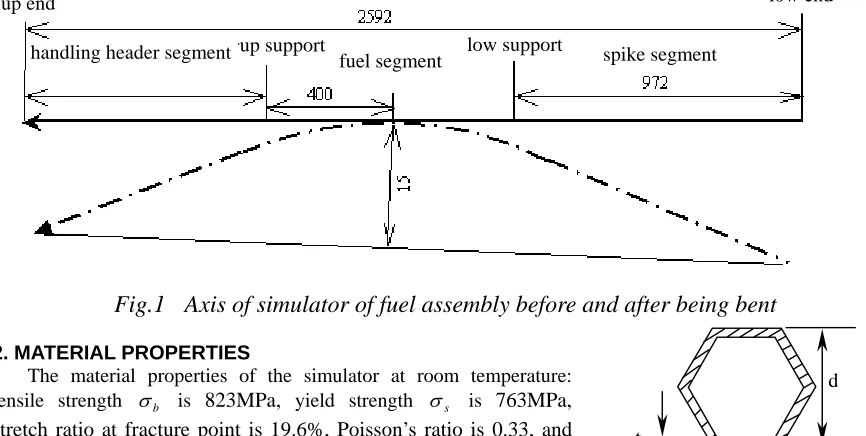
deformation respectively (the deformation is magnified in the figure). Therefore we need to suppose how to apply the bending load and then determine the values of the load by computation.
handling header segment up support fuel segment low support spike segment
up end low end
Fig.1 Axis of simulator of fuel assembly before and after being bent
d 2. MATERIAL PROPERTIES
The material properties of the simulator at room temperature:
tensile strength σb is 823MPa, yield strength σs is 763MPa,
stretch ratio at fracture point is 19.6%, Poisson’s ratio is 0.33, and
Young’s modulus E is 2.035×10⁵MPa. t
3. COMPUTATION MODELS AND RESULTS
Fig.2 Cross section of the simulator
3.1 MAKING UP STRESS-STRAIN CURVEFor some reason the true stress-strain curve has not been given, which need to be obtain by experiments. This paper presents two imaginary stress-strain curves as shown in Fig.3. and the true one should have been envelop in the two imaginary ones. The points of the two curves are listed in Table 1. Obviously, the results from the true stress-strain curve should be between the results from the two imaginary ones.
Table 1. Points on the stress-strain curves
stress-stain curve 1 stress-stain curve 2
Strain(%) Stress(MPa) Strain(%) Stress(MPa)
0 0 0 0
0.374939 763 0.404423 823
19.6 823 19.6 823
stress-strain curve 1 stress-strain curve 2 3.2 COMPUTATION MODEL
It is clear that the bending load should be applied only on the fuel segment to keep the median axes of the handling header segment and the spike segment being a straight line. Three kinds of method of applying the bending load are considered here: 1. pure bending moment load; 2. surface uniformly distributed load; 3. concentrated line load. By increasing the load very slowly from zero to the expected maximum and then decreasing back to zero, the expected residual deformation of FA could be obtained. When the load increases up to one certain value, which is called critical load, FA will come to be part plastic from full elastic. And the expected maximum value is called maximum load during the increasing of the load. The resultant load can be determined by the following steps: 1. Estimating the critical load by theoretic analysis [1] or by
FEM; 2. Computing the residual deformation greater than the expected one by applying a load much greater than critical load and decreasing the load successively; 3. Determining the maximum load by dichotomy till the residual deformation (i.e. the distance 15mm) reach the acceptable deviation to the expected one. The critical and maximum loads are listed in Table 2 in chapter3.3.4.
The fuel segment is simulated by shell elements in the model. The spike segment and the handling header segment are load free, so the two segments are simulated to be not in real shape but hexagonal cross section similar with the fuel segment.
3.3 RESULSTS
3.3.1PURE BENDING MOMENT LOAD AND CONSTRAINT The z-direction is the horizontal axis along the
length of FA. The y-direction is the vertical axis perpendicular to two flats of the simulator cross section. And the x-direction can be determined according to the right-handed rule. It is shown as Fig.4. The simulator is held at the low support and applied x-moment at the up support. The moment increases sub-statically from zero up to the maximum value and decreases back to zero. The critical load and the maximum load and corresponding deformation is listed in Table 2 of chapter3.3.4 in detail.
held at low support
Fig.4 Pure bending moment load and constraint
bending moment at up support3.3.2 SURFACE UNIFORMLY DISTRIBUTED LOAD AND CONSTRAINT
The x-direction, y-direction and z-direction are identical with those in Fig.4. The simulator is simply supported both at the low support and the up support. The distributed load is applied along the fuel segment as shown in Fig.5. Similarly, the load increases quasi-statically from zero up to the maximum value and decreases back to zero. The critical load and the maximum load and corresponding deformation is listed in Table 2 of chapter3.3.4 in detail.
simply supported at up support simply
supported at low support
left view of simulator (magnified)
Fig.5 Surface uniformly distributed load and constraint
3.3.3 CONCENTRATED LINE LOAD AND CONSTRAINT
maximum value and decreases back to zero. The critical load and the maximum load and corresponding deformation is listed in Table 2 of chapter3.3.4 in detail.
left view of simulator (magnified) simply
supported at up support simply
supported at low support
Fig.6 Concentrated line load and constraint
3.3.4 LOAD AND CORRESPONDING DEFORMATION
The deformations of the simulator at maximum load by stress-strain curve 1 are shown as Fig.7, Fig.8 and Fig.9, respectively. And the deformations are similar with those by stress-strain curve 2.
up support low
support
Fig.7 Deformation at maximum bending moment
middle point of fuel segment
up support low support
middle point of fuel segment
up support low support
Fig.9 Deformation at maximum concentrated line load
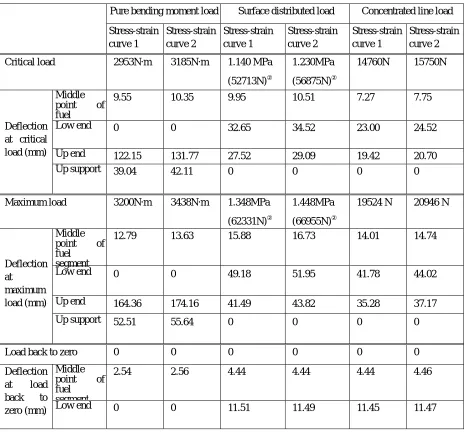
The critical loads and the maximum loads and the corresponding deformations are listed in Table 2.
Table 2. Loads and the corresponding deformations
Pure bending moment load Surface distributed load Concentrated line load
Stress-strain curve 1 Stress-strain curve 2 Stress-strain curve 1 Stress-strain curve 2 Stress-strain curve 1 Stress-strain curve 2
Critical load 2953N·m 3185N·m 1.140 MPa
(52713N)
1.230MPa (56875N)
14760N 15750N
Middle
point of fuel
9.55 10.35 9.95 10.51 7.27 7.75
Low end 0 0 32.65 34.52 23.00 24.52
Up end 122.15 131.77 27.52 29.09 19.42 20.70
Deflection at critical load (mm)
Up support 39.04 42.11 0 0 0 0
Maximum load 3200N·m 3438N·m 1.348MPa
(62331N)
1.448MPa (66955N)
19524 N 20946 N
Middle
point of fuel
segment
12.79 13.63 15.88 16.73 14.01 14.74
Low end 0 0 49.18 51.95 41.78 44.02
Up end 164.36 174.16 41.49 43.82 35.28 37.17
Deflection at
maximum load (mm)
Up support 52.51 55.64 0 0 0 0
Load back to zero 0 0 0 0 0 0
Middle po fue int of l segment
2.54 2.56 4.44 4.44 4.44 4.46 Deflection
at load back to
Up end 33.13 33.19 9.72 9.71 9.68 9.70
Up support 10.56 10.58 0 0 0 0
Note: The deflections are absolute value. The deflections will change direction with the load direction’s changing, but the absolute value will be the same.
The value in the cell is the pressure (in MPa) distributed on the surface of simulator. And the value in the parentheses is the resultant force (in N) of the pressure.
4. CONCLUSIONS
Three kinds of method of applying the bending load are given to get the expected residual deformation of the simulator. Taking the inelasticity of the properties into account, the corresponding constraints and the loads are obtained in this paper by using finite element method. The true loads should be between the computed loads by stress-strain curve 1 and those by stress-strain curve 2.
REFERENCES