Number Sense Ability Of Elementary Students
Through ―Mathematical Games‖
Sulistiawati, Surya Wijaya
Abstract: This research was motivated by most of junior high school students‘ first grade face difficulties in calculating 15 × 6 with mental calculation. Based on a diagnostic test can be seen that many students lack of number sense understanding when they were in 4th or 5th grade. It happened in some of Papuan Students in Surya Intensive Program (SIP) Tangerang - Indonesia, Indonesia who learned arithmetic operation like addition, multiplication, subtraction, and division. This research aimed to find out how students use mathematical games, how students‘ number sense ability was, and what students‘ response toward the learning. This research was conducted using qualitative research method. Participants of this study were 13 students 4th graders in year 2013. The result of this study showed that learning with mathematical games like game 24 and game 15 could be one of learning strategies to stimulate students‘ number sense in arithmetic operation. Students‘ number sense ability increased with percentage was 18.91%. Students also have positive response after the learning used game 24 and game 15. This percentage was 69.75%.
Index Terms: Number sense, Mathematical games, Arithmetic operation, Game 24, Game 15
————————————————————
1
I
NTRODUCTIONAN observation result that was conducted in Bandung, Indonesia showed that teachers apply formal and rigid approaches in teaching [1]. Teachers were in front of the class to explain and students sat upright to listen and record what teachers wrote on the whiteboard. After explaining and giving examples of questions, teachers provide exercises for students with more mechanistic competence instead of reasoning competence, for example exercises related to number sense. As in [1] found that most of junior high school students‘ first grade in Bandung had difficulties in calculating 15 × 6 with mental calculation. They inclined to finish it with writing algorithmic. Research in US found that 45% Senior High School students (age 17 year) could not calculate 90 × 70 with mental computation [1]. Number Sense is not only a competence to recognize and able in calculating but also to that must be controlled so that children could have a good number sense, those are have a good intuition to recognize numbers, good understanding of numbers properties, and knowing the relation of numbers very well. Either The Curriculum and Evaluation Standards for School Mathematics (NCTM) or The National Statement on Mathematics for Australian School (AEC) described that number sense is a major essential part as outcome of school mathematics [2]. Based on the diagnostic test of students from Surya Intensive Program (SIP) in Tangerang, Indonesia we got students‘ number sense was very less. It was shown by the right answers percentage of number sense questions answered by the students, which is 23.33% for fourth grade and 32.83% for fifth grade. For this reason, we studied the use of mathematical games to develop students‘ number sense. The research was aimed to investigate: a) how was learning trough mathematical games (game 15 and game 24), b) how was students‘ number sense ability that used mathematical games (game of 15 and gam 24) in arithmetic operation learning? And c) what was students‘ response after the learning?
1.1 Number Sense
According to [2], number sense is related to numbers comprehension as well as their operations. Furthermore, it also refers to one‘s capability in using this comprehension in such a way to be flexible and innovative in dealing with numbers and their operations mathematically. As in [3] number sense has defined as an intuitive feel for numbers and a common sense approach to use them. Number sense is a topic of great interest in school [2]. It is also nebulous and difficult to describe, although it is recognizable in action. Continuous productive discussion of number sense (by researchers, teachers and curriculum developers) must at some stage be based on a definition, characterization, or model which portrays number sense in a clear yet comprehensive manner. The Curriculum and Evaluation Standard for School Mathematic has mentioned that characteristics of student who have a good number sense are: 1) understand the meaning of numbers, 2) recognize relative number size, 3) recognize the number‘s properties very well, 4) understand number operation and its properties, 5) apply the understanding of numbers in daily life [4].
New Jersey Curriculum Number Sense framework [3] has stated that indicators and activities of students which are related to topics addition, subtraction, multiplication, and division are: 1) understand and use of the meaning and size of numbers, 2) understand and use of equivalent forms and representations of numbers, 3) understand the meaning and effect of operations, 4) understand and use of equivalents expressions, 5) Compute and count strategy, and 6) Measurement benchmark. This research use indicators which had developed by [2], that are 1) Understanding of the meaning and size of numbers (Numbers Concept), 2) Understanding of the meaning and size of numbers (Numbers Concept), 3) Understanding the meaning and effect of operations (Effect of Operation), 4) Understanding and use of equivalent expressions, 5) Computing and Counting Strategy.
1.2 Mathematical Games
Mathematics can be seen as knowledge about pattern and connection in mathematical idea and connection of each other. Students must be able to see whether mathematical idea has similarities or difference from the previous idea. For instance, students who understand about a basic concept of addition 3 + 4 = 7 have a connection with a basic concept of subtraction 7 – 3 = 4. Another example is a basic fact of multiplication 2 × 3 ————————————————
Sulistiawati is a lecturer at Sekolah Tinggi Keguruan dan Ilmu Pendidikan Surya (Surya College of Education), Indonesia, Email: [email protected]
= 6 has connection with basic concept of 6 ÷ 2 = 3. As a teacher, we need to understand all facts, so that teacher must use variety of activities in mathematics learning to make students enjoy mathematics, be active in learning, and understand the meaning of mathematics learning or concept. One way to realize those conditions is to use mathematical games in learning. As in [5], game has been defined as a set of criteria of which includes task or activity. These are: (1) a game involves a challenge against either a task or an opponent, (2) a game is governed by a definite set of rules, (3) a game is freely engaged in, (4) psychologically, a game is an arbitrary situation clearly separate from real-life activity, (5) socially, the events of a game situation are considered, in and of themselves, to be of minimal importance, (6) a game has a definite number of possible solutions; that is, only a finite number of things can happen during play, (7) a game must always be ended, although the end may come simply because time has run out. In [6], [7], it can be found that children enjoy playing games. Based on experience, games give positive contribution in learning activities, included in mathematics learning. Teacher need to consider the use of games when teaching mathematics, teacher should distinguish between an ‗activity‘ and a ‗game‘. Moreover, Gough stated that ―A ‗game‘ needs to have two or more players, who take turns, each competing to achieve a ‗winning‘ situation of some kind, each able to exercise some choice about how to move at any time through the playing‖. The key idea in this statement is that of ‗choice‘ [6]. Oldfield stated that mathematical games are ‗activities‘ which: 1) involve a challenge, usually against one or more opponents; 2) Are governed by a set of rules and have a clear underlying structure; 3) Normally have a distinct finishing point; 4) Have specific mathematical cognitive objective [8]. Davies stated the advantages of using game are: (1) Students have meaningful situations to implicate mathematics skill, (2) Students have motivation which children freely choose to participate and enjoy playing, (3) Increased learning because games can increase the interaction between students and give opportunity to test intuitive ideas and problem solving strategies, (4) Game can provide ‗hands on‘ activities, (5) Children can work independently of the teacher, (6) Students have positive attitude which games build self-concept and develop positive attitudes towards mathematics, through reducing the fear of failure and error [9].
1.3 Mathematical Games Varieties
There are many kinds of mathematical games to enhance students‘ activities in mathematics learning, such as domino, Sudoku, close to zero, close to 20, close to 100, close to 1000, the game 24, the game 15, geometry bingo, etc. In this study the researchers used game 24 and game 15 to investigate students‘ number sense ability.
1.3.1 The Game 24
Triplett stated that the 24 game is commercially available game made by Nasco [10]. You are given a card with four digits taken from 1–9. The objective is to add, subtract, multiply and/or divide and get a result of 24. The result state that you must use all four digits on a card and you must use each digit only once. The game sounds easy, but most people find it very challenging. Basic level of mathematics competence is involved in this game and it enhances mathematician paid their interest on it. The 24 Game is an arithmetical card game in which the object is to find a way to
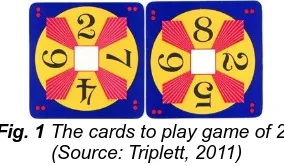
manipulate four integers so that the end result is 24. The players can use addition, subtraction, multiplication, or division, but sometimes, they can use other operations to make four digits from one to nine equal to 24. For example, card with the numbers 4, 7, 8, 8, have solution: (7 – (8/8)) × 4 = 24. In this research we just use four operations like addition, subtraction, multiplication, and division. Below is an example of the 24 game cards:
Fig. 1 The cards to play game of 24
(Source: Triplett, 2011)
For example, a card consist of numbers 9, 4, 8, and 5 has possible solutions of ((9-5) × 4) + 8 and (9+5-8) × 4. Another card consist of numbers 1, 7, 3, and 4 has possible solutions such as ((1+3) × 7) – 4, (4-1) + (7×3) and ((4-1)) × 7 + 3. Many combinations of numbers can be manipulated to have result 24 but some of them are impossible. List of four digits combination from 1 to 9 for which it is impossible to form 24 is showed a box at figure 2 which there are 91 combinations.
Fig. 2 The impossible combination to form 24
(Source: Triplett, 2011)
1.3.2 The Game 15
TABLE 1
POSSIBLE PLAYING OF GAME 15(POSSIBILITY 1)
TABLE 2
POSSIBLE PLAYING OF GAME 15(POSSIBILITY 2)
2
M
ETHODS2.1 Research Design
Research method of this study was qualitative method. Data is collected directly from the source. In this method, the researchers are the key instrument because the tools used to collect data could be changing anytime according to the researchers‘ need. Qualitative method emphasizes more on processes rather than products or [12].
2.2 Research Instrument
The researchers were the key instrument developed test form, questionnaire form, interview guideline, and observation form. Test instrument was used to explore students‘ number sense ability. The test questions were same as diagnostic test at preliminary study. Questionnaire was used to explore students‘ response about the use of mathematical games in mathematics learning, which is game 24 and game 15. Interview guideline was used to guide researchers to interview students related to the learning. Observation was used to observe the students‘ activities along the learning. Test instrument was developed refers to number sense indicators. To give score to students‘ works, researcher used rubric score with minimum score is 0 and maximum score is 3 for each number. Indicators and questions represented either numbers sense or score. Rubric is presented in table 3 and table 4 below.
TABLE 3
INDICATORS AND QUESTIONS REPRESENT NUMBERS SENSE
No Number Sense Indicators Number Sense Aspects Question
1 Understanding of the meaning and size of numbers (Numbers Concept)
Students understand simple inequality
6
Students can estimate the number of boxes needed without doing actual division
8
2 Understanding and use of equivalent forms and representations of numbers (Multiple Representations)
Students can get the answer without doing any calculation, but by understanding the meaning of arithmetics operations
4
3 Understanding the meaning and effect of operations (Effect of Operation)
Students able to estimate the result without doing actual multiplication and division
5
4 Understanding and use of equivalent expressions
Students can find the answer efficiently
3
5 (Equivalent Expressions) Computing and Counting Strategy
Students are expected to use informal strategies
1, 2
Students can estimate the money needed without adding actual numbers
7
TABLE 4
NUMBER SENSE SCORING RUBRIC
TABLE 5
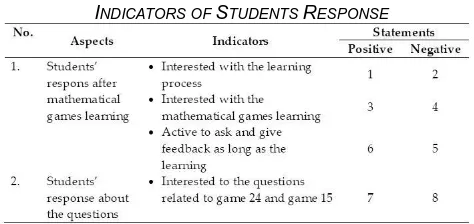
INDICATORS OF STUDENTS RESPONSE
An interview was used to support questionnaire to explore students‘ response after the learning. This interview was guided interview because we used an interviewing guidance that consists of 5 questions. We also wanted to find what students‘ problems or what students taught of game 24 and game 15 so we can scaffold them to solve the game. Otherwise, this interview to help students to solve the given questions after the mathematical games learning. Interview could be done as long as we observed of the learning.
2.3 Research Subject
The subject of this study was 13 fourth grade students from SIP. While participants in diagnostic test are 20 grade fifth grade and 13 fourth grade students in year 2013..
2.4 Data Analysis
Data analysis of this research was descriptive analysis. Descriptive means data collected is in the form of words or figures rather than numbers. Descriptive analysis is used by examining the data collected throughout the research; they are test, questionnaire, interview, and observation.
3
R
ESULT ANDD
ISCUSSION3.1 Learning trough Mathematical Games Analysis
Learning trough mathematical game 24 and game 15 is given to 13 students grade IV. These games use card like bridge card. Below is analysis of learning process use game 24 and game 15.
3.1.1 Learning Use Game of 24
Game 24 is game use card consist of number from 1 to 9 and the players are asked to use sign arithmetical operation like +, ×, -, and ÷ to get the result 24. Mathematics learning use game 24 was held in two meetings.
3.1.1.1 First Meeting of Game of 24
First meeting was started with explanation about the game rule and some examples about how to play. Furthermore, make group students consist of 4 persons (in this case one group consist of 5 persons) so that there were 3 groups. Students play bridge card consist of Ace, number 2 to 9 and find the result is 24 use arithmetic operations. After finishing the game students were asked to do the questions including: a) 6, 6, 5, 10; b) 5, 5, 4, 5; c) 3, 5, 4, 1; d) 4, 7, 2, 3; e) 5, 4, 7, 8; f)7, 7, 4, 1; g) 3, 5, 6, 7; h) 7, 7, 3, 10; i) 9, 3, 4, 9 and j) 4, 10, 1, 4. Students were asked to arrange those number use +, ×, -, and ÷ signs to get the result 24. Most of students got the right answer with mental computation when playing game but had problems when communicating their mathematical ideas in
writing. Specifically, they lack of understanding on meaning of equal signs. This finding is supported by research conducted by Helmy, etc. that students focus to solve the problems in calculations or operations and did not understand the meaning [13]. Furthermore, students also lack of understanding on order of arithmetic operation and using of brackets. It shows that students ignore the set of brackets, as in [14], [15]. Some of students were reluctant to write their answer; instead they come to us and try to explain their answer orally. See table 6 below.
TABLE 6
EXAMPLES OF STUDENTS’ ANSWERS
For problem number 1, there are five students who answered like first solution and five students who answered like second solution. The following is some interesting cases which show that students have problems in communicating their mathematical ideas in writing. Problem number 2, there are six students who answered like the first solution, one student who answered like the second solution, and three students who answered like the third solution. Some interesting cases of students answer show that students still have problem in communicating and writing their idea. Figure 4 shows some examples of students‘ work.
Fig. 3 Students’ Works of Game 24
Fig. 3 shows that students have problems in communicating mathematical ideas in writing. It can be said that students can not share and clarify their ideas to others [16]. Meanwhile, National Council of Teachers of Mathematics has mentined that communication is an essetial part in mathematics education, that is mathematics learning [16].
3.1.1.2 Second Meeting of Game of 24
activities can be seen in figure 4 below.
Fig. 4 Students’ Activities in Playing the Game 24
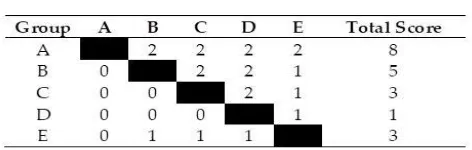
At the first of game many students have difficulties to recognize what operation should be used. For example, some students in different group need more time to understand or to get a sense until they choose a strategy to use +, ×, -, and ÷ signs. Then, they solved the problem. If any group is too long to solve the problem, the researcher comes on them to give scaffolding. The score of groups can be seen in table 7 below.
TABLE 7
SCORE OF PLAYING THE GAME 24 AT THE SECOND MEETING 2
From the winning groups, each group compete each other. After finishing the second game, students are given questions, as in the first meeting but with different set of numbers, including a) 1, 2, 6, 6; b) 2, 4, 8, 8; c) 1, 5, 5, 9; d) 5, 6, 8, 9; e) 2, 2, 4, 7; f) 1, 3, 4, 7; g) 2, 5, 6, 8; h) 2, 2, 3, 5; i) 3, 3, 6, 8; j) 2, 3, 5, 7. The result of this test is some problems persist and they can write slightly better than their first try. Students were fluent in fast calculation competition to get the result in this game, but some of students difficult to write the answer in writing. Moreover, there was student who were very fast in mental computation did not want to write the answer. Most students have to understand how to put the operation signs. As an example, a student does not understand that the result of 1 × 2 × (6 + 6) and 1 × 2 × 6 + 6 was different. This was a constraint of student to write the answer in mathematical writing.
3.1.2 Learning Use Game of 15
In this game 15, students understand about numbers sense in arithmetic operation if the game was draw. Game 15 activities were held in two meetings with explanations following.
3.1.2.1 First Meeting of Game of 15
Learning was started with technical explanation about game 15 rules by researchers. Furthermore, students were divided in two groups and compared them in a competition with the role as player 1 and player 2. Before competition was started students tried in the group to exercise game 15. In this process researchers act as controllers of the class let students play by themselves. When students finished, researchers ask the winner of the game about their strategy. The game 15 activities can be seen in figure 5 below.
Fig. 5 Students’ Activities in Playing the Game 15
After each group finished exercises, two groups were asked to come in front of the class to play the game and researchers act as instructors to finish the game. Instructor writes numbers 1-9 in the whiteboard and the groups must be finished the game. Each group get opportunity to be first player to make fair competition. Based on this first game, strategy that is used still not appear yet because some of groups were seen just mention the numbers and focus on their own expectation result. In this game the number sense of students has not been seen.
3.1.2.2 Second Meeting of Game of 15
The meeting is started by make a student group with member two persons with the name of the groups are A, B, C, D, and E. Two groups were compete each other, which shown by figure 6 below.
Fig. 6 Students Compete Game 15 in Front of The Class
In the second meeting the game was held in two rounds. First round is competing groups each other and each group gets twice opportunities to make fair game. The result of the first round can be seen in table 8.
TABLE 8
It can be seen from table 8 that most of students only focus on how to get 15 but often fail to prevent their opponent to get 15. After finishing the game 15, students are given 3 tasks as follows:
1. List all the three different numbers, choose among 1, 2, 3, 4, 5, 6, 7, 8, 9 so that their sum equal to 15.
2. List all the three different numbers, choose among 10, 20, 30, 40, 50, 60, 70, 80, 90 so that their sum equal to 150.
3. List all the three different numbers, choose among 11,12, 13, 14, 15, 16 , 17, 18, 19 so that their sum equal to 45
There are relations among the questions number 1, number 2, and number 3. Based on students‘ works, it can be seen that students were not difficult to finish those questions but there were things that were not understood by students. As an example, if questions number 1 has been finished then question number 2 does not need to be calculated. Students just have to see the relation that question number 1 has a relation with question number 2 that is the kind of tens and question number 1 is ones, similarly to question number 3. What was happened to the works are most of students struggle to solve the second and third tasks. Almost all students got the ideas after we gave them some clues, such as this dialog.
Researcher : ―Look at the equations that you have written before!‖
Students : Common reactions ―ah, add a zero!‖ Researcher : ―What the meaning of adding zero?‖
Students : Common Answer ―Just add zero, multiply by
zero‖
When we further asked the meaning of ‗adding zero‘, the students got confused. Few students realize that to change 4 to 40, just have to multiply by 10. The same thing happened, when we ask how to change 8 to 18.
Researcher : ―Look at this, how to change 8 to 18‖,
Students : Common reaction ―add 1, or multiply by 1!‖. Students have common answer ‗add 1‘ and ‗multiply by 1‘, students learned by rote learning. Then, we continue the questions.
Researcher : ―How about 4 × 300?‖ Students : ―1200‖
Researcher : ―How it can be?‖
Students : ―4 × 3 = 12, then add 2 zeros‖
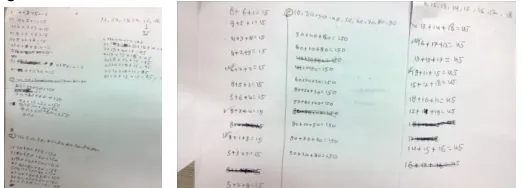
When we asked what 4 × 300 is, most students immediately found the answer. But, when we asked the process, most of students said 4 × 3 = 12 and simply add 2 zeros. They have no idea what the mathematical meaning of adding those two zeros is. The examples of students‘ works can be seen in figure 7.
Fig. 7 Students’ Works of Game 15 Questions
3.2 Number Sense Ability Analysis After the Learning used Mathematical Games
Diagnostic test is given to assess students‘ prior knowledge of numbers sense. Diagnostic test consist of 8 questions that contain 5 indicators. Subject of this diagnostic test are Surya Intensive Program (SIP) students grade V and grade IV. Students do diagnostic test for arithmetic operation like addition, subtraction, multiplication, and division related to number sense. Diagnostic test questions was also used to number sense test for participants to see a changes students‘ number sense ability after mathematics learning use mathematical game 24 and game 15. A number sense question that is tested has been validated by mathematics lecturer in Surya College of Education, Tangerang, Indonesia. Based on diagnostic test we saw that students lack of numbers sense understanding, students grade IV have correct answer as many as 23.38% and students grade V have correct answer as many as 32.83%. Moreover, average score of students based on grade are very low. The average score of grade IV is 1.06 and average score of grade V is 1.45. As comparison the highest score is 3 correspond to numbers sense rubric score. Diagnostic test score of students grade IV that is used as a pretest score of participants. Moreover, this score was compared with posttest score after mathematics learning use game 24 and game 15. It can be seen in table 9.
TABLE 9
SCORE OF STUDENTS OF THE FINAL PLAYING OF THE GAME 15
It can be seen from table 8 that many students easily solved the problems related to computing and counting strategy, especially on using informal strategy, as many as 2.23 out of 3. The lowest ability was when students were asked to estimate the number of boxes needed without doing actual division, as many as 0.48 out of 3. The average of number sense posttest score was 1.27 out of 3. There was increasing of the number sense score. The difference of the score was 0.57 and the percentage as many as 18.91%. It can be concluded that students have better number sense ability after the learning used game 24 and game 15.
3.3 Students’ Response
strategies used in solving the problems.
4
C
ONCLUSIONLearning used mathematical games like game 24 and game 15 can be one of learning strategies to stimulate students‘ number sense in arithmetic operation. It was implemented by separating students in groups to make students compete and cooperate with others. This learning can also improve students‘ number sense ability. The difference of pretest and posttest is 0.57 out of 3 or as many as 18.91%. Students are so actively participate with this learning. It shows from the positive response of students about the learning which gain 69.75%. Otherwise, we found that participants Papuan Students were usually get bored easily, physically active and aggressive but also they need some time to adjust with a new teacher. The outcome of this research shows that learning mathematics used game 24 and game 15 in arithmetic operation improved students‘ number sense ability, therefore this learning strategy recommended to use in other mathematical topics such as algebra, geometry, probability, etc. On the other hand students‘ mathematical games learning also recommended to find other students‘ abilities, are more specific in mathematics. Students had good response related to mathematical games learning, game 24 and game 15 specifically. As a result, future learning could use other mathematical games as an innovative strategy. Because this research was qualitative method which is carried out to 13 students of 4th grader in private school, the major limitation of the research was the generalization of its conclusion. However, this research could be a reference for researchers in research, course, or other studies. Furthermore, the future research can be conducted to address such this issue in quantitative research or in bigger population.
A
CKNOWLEDGMENTWe would like to express our gratitude to Miss Ani Fransisca as a class advisor of grade IV in SIP who help us to control and monitor students in this study. We would also like to thank to lecturers in Mathematics Education Department of Surya College of Education, the students and all stake holders who support our research. This research was fully funded by Surya College of Education.
R
EFERENCES[1] T. Herman, Mental Strategies that Used by Elementary School Students in Numeracy ―Strategi Mental yang Digunakan Siswa Sekolah Dasar dalam Berhitung,‖ presented in National Seminar of Mathematics Education in Universitas Negeri Yogyakarta (UNY), Yogyakarta-Indonesia, 2001,
available at
http://file.upi.edu/Direktori/FPMIPA/JUR._PEND._MATEMATIK A/196210111991011-TATANG_HERMAN/Artikel/Artikel16.pdf, Jun. 2013.
[2] A. McIntosh, B. J. Reys, and R. E. Reys, ―A Proposed Framework for Examining Basic Number Sense," For the Learning Mathematics, vol. 12 no. 3, pp. 2–8, 1992.
[3] J. G. Rosenstein, J. H. Caldwell, and W. D. Crown, ―New Jersey Mathematics Curriculum Framework: A Collaborative Effort of the New Jersey Mathematics Coalition and the New Jersey Department of Education,‖ New Jersey: Rutgers University, 1996.
[4] National Council of Teachers of Mathematics Commission on Standards for School Mathematics. Curriculum and evaluation standards for school mathematics. Reston VA: The Council, 1989. Available at http://www.standards.nctm.org/index.htm, May 2013.
[5] G. W. Bright, J. G. Harvey, & Mqr, ―Learning and mathematics games. Journal for Research in Mathematics Education. Monograph, 1, i-189, 1985.
[6] J. Gough, ―Playing mathematical games: When is a game not a game?,‖ Australian Primary Mathematics Classroom, vol. 4 no. 2 pp. 12-15, 1999.
[7] J. Way. Learning Mathematics Through Games Series: 1. Why Games?, 2011. Available at https://nrich.maths.org/2489, Jun 2013.
[8] B. Oldfield, Games in the Learning of Mathematics. Part 1: A Classification. Mathematics in School, vol. 20 no. 1, pp. 41-43, 1991.
[9] Davies, B. ―The role of games in mathematics. Square One . Vol.5. No. 2, 1995.
[10] A. M. Triplett, A Closer at the 24 Game. International Journal of Applied Science and Technology, vol. 1 no.5, pp. 161-164, 2011.
[11] J. Mahoney, What the Name of this Game. Mathematics Teaching in the Middle School, vo. 11 no. 33, pp. 150-154, 2005.
[12] Sugiyono, Research Methods in Education ―Metode Penelitian Pendidikan‖, Bandung: Alfabeta, 2013.
[13] N.F. Helmy, R. Johar, and Z. Abidin, ―Student‘s Understanding of Numbers Through the Number Sense,‖ Proc. The 6th South East Asia Design Research International Conference (6th SEA-DR IC), 2018.
[14] J.A. Blando, A.E. Kelly, B.R. Schneider, & D.Sleeman, ―Analyzing and modeling arithmetic errors,‖ Journal for Research in Mathematics Education, Vol. 20 No. 3, pp. 301-308, 1989
[15] I. Papadopoulus and R. Gunnarson, ―The Use of ‗Mental‘ Brackets When Calculating Arithmetic Expressions,‖ Proceedings of the 42nd Conference of the International Group for the Psychology of Mathematics Education, Vol. 3, pp. 451-458, 2018.