Twin Mammals and COVID-19: Life and Science of the Suspects
Naser A. Anjum
Department of Botany, Aligarh Muslim University, Aligarh – 202 002 U.P. (India) e-mail: [email protected]; [email protected]
SCOPUS author ID: https://www.scopus.com/authid/detail.uri?authorId=23097123400
Abstract
The world is puzzling over the origin of the current outbreak of the coronavirus
disease (COVID-19) that is caused by a novel coronavirus-2019 (2019-nCoV). As
of 26th March 2020, the World Health Organization has reported 46,2,684
confirmed cases and 20,834 confirmed deaths in total due to COVID-19. To this
end, two unique mammals namely bats and pangolins are being investigated for
their potential link to COVID-19. However, the evidence so far gathered in this
context is far from clear. This paper aimed to: (i) enlighten the major aspects of
life of bats and pangolins; (ii) briefly discusses their potential link to COVID-19;
and also (iii) to highlight the way forward. The outcomes may contribute to future
research on the subject.
1. Introduction
In humans, several respiratory infections ranging from the common cold to more
severe diseases such as Middle East Respiratory Syndrome (MERS) and Severe
Acute Respiratory Syndrome (SARS) are known to be due a large family of
viruses called as coronaviruses. On 31st December 2019, the World Health
Organization (WHO) was informed of a cluster of cases of pneumonia of unknown
cause detected in Wuhan City, Hubei Province of China. Later, the WHO named
an infectious disease as the coronavirus disease (COVID-19) and confirmed as to
worldwide pandemic outbreak caused by a newly discovered coronavirus the
novel coronavirus (2019-nCoV). The world is puzzling over the origin of
COVID-19. In fact, COVID-19 is one of the infectious diseases (zoonotic diseases or
zoonoses) that are transmitted between species from animals to humans (or from
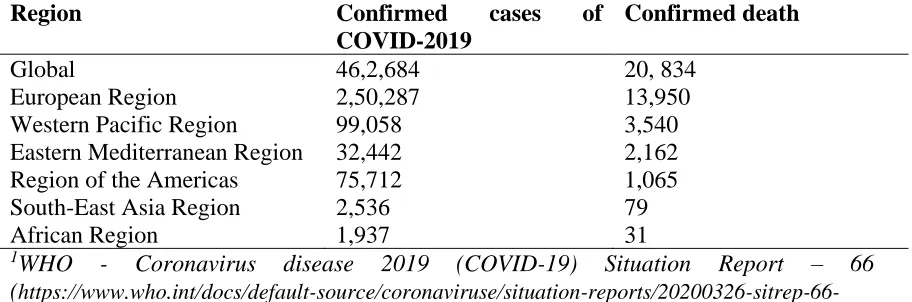
humans to animals). As of 26th March 2020, the World Health Organization has
reported 46,2,684 confirmed cases and 20,834 confirmed deaths in total due to
COVID-19 (WHO 2020a) (Table 1). The WHO has declared the COVID-19
outbreak a global health emergency. Notably, two unique mammals namely bats
and pangolins are being investigated for their potential link to COVID-19.
However, the evidence so far gathered in this context is far from clear. Given
above, in this paper, the major aspects of life of bats and pangolins are
enlightened; recent reports on the potential link of bats and pangolins to
COVID-19 are briefly discussed; and also the way forward is highlighted.
2. Bats
Bat is an exceptional creature and remarkable flying social mammal, and belongs
to order Chiroptera and family Microchiroptera. Bats are divided into two main
types: megabats (sub-order: Megachiroptera) and microbats (sub-order:
Microchiroptera). Megabats include flying foxes and Old-World fruit bats, roost in
On the other, microbats are smaller in size; most live in the Western Hemisphere
and most eat insects (insectivorous) using their echolocation ability.
Bats have true wings and flight, where wings are modified forelimbs; four
fingers support and skin covers the flight surface/ a wing membrane (patagium).
With over 1300 species distributed across six continents, Indonesia hosts 219 bat
species, 114 species are found in India, and about 50 bat species live in national
parks across the United States. In India, Andhra Pradesh state is home to 38
species, 17 species of bats found in Hyderabad. Overall, bats make up one-fifth of
the mammal population on Earth (Bat Conservation International 2020) . Bats can
be found in many parts of the world. Missing only from Polar regions and from
some isolated islands, bats live in cities, deserts, grasslands and forests in tropical
and temperate regions of the globe (Wund and Myers 2005). Bats are social
animals and stay together in large groups. About 1.5 million bats are supposed to
live under the Congress Avenue Bridge in downtown Austin, Texas (Simmons and
Conway 1997).
Bats exhibit a great variation in body size, weight, lifespan and food habit.
The body size of bats greatly varies. Craseonycteris thonglongyai
(Microchiroptera) is the smallest bat, 29–34 millimetres (1.1–1.3 inches) long with
a 150 millimetres (5.9 inches) wingspan and weighs between 2–2.6 grams (0.071–
0.092 oz) (Wikipedia, https://en.wikipedia.org/wiki/Kitti%27s_hog-nosed_bat). On the other, with 1.6 kilograms (3.5 lb) body weight and a wingspan of 1.7
metres (5.6 ft) few species of genus Pteropus megabats (such as Pteropus poliocephalus; Pteropus conspicillatus; Pteropus melanotus) and the giant golden-crowned flying fox (Acerodon jubatus) are the largest bats (Nowak 1999).
There occurs a relationship between the body size and the lifespan of
mammals, where, the larger mammals are assumed to live longer lives. Against
this relationship, the lifespan of bats may range between 10 - 25 years, and can
live over 30 years in the wild (Wund and Myers 2005). Additionally, hibernating
longer than males depending on their species. Bats are omnivores and most bats
eat insects, but many feed on leaves, pollen, nectar, petals, bracts, fruits (such as
avocados, mangoes, bananas and wild dates) or seeds. Three species of vampire
bats (the common vampire bat, Desmodus rotundus; the hairy-legged vampire bat,
Diphylla ecaudata; the white-winged vampire bat, Diaemus youngi), all native to the Americas, ranging from Mexico to Brazil, Chile, Uruguay and Argentina,
depend on blood as their food source (blood mostly that of other mammals); a
dietary trait called hematophagy (Wikipedia,
https://en.wikipedia.org/wiki/Vampire_bat).
Humans are varyingly benefitted with bats. For example, procured from
caves, bat dung is used as fertilizer; bats reduce the use of pesticides; and are also
used as food across Asia and the Pacific Rim. Bats have immense ecological and
economic importance and the most bat populations are important for agriculture
and the environment. Due to their unique echolocation ability to find flying or
crawling insects and their superb flying skills to catch them, the most bats are
insectivores and are voracious predators of nocturnal insects, including many crop
and forest pests. It has been estimated that insect-eating bats can catch and eat 600
mosquitos in an hour and thereby control their population and impacts (Simmons
and Conway 1997). Researchers have also anticipated agricultural losses of > $3.7
billion/year year in pest-control costs due to loss of bats in North America (Boyles
et al. 2011). In addition, bats have aesthetic values and are equally important in
tourism, and education and research (Kasso and Balakrishnan 2013). Regarding
the role of bats in pollination (act of transferring pollen grains from the male
anther of a flower to the female stigma) > 528 species of 67 families and 28 orders
of angiosperms worldwide are benefitted with bat pollination (Fleming et al.
2009). In particular, Pteropodid bats from bat-family Pteropodidae are usually
fruit-eaters (frugivorous), known to pollinate flowers of about 168 species of 100
genera and 41 families (Fleming et al. 2009) and are responsible for propagating at
provide economically important resources and products including fruits, drinks,
foods, ornamental plants, timbers, fibres, tannins, dyes, medicines, and animal
fodder (Sudhakaran and Doss 2012; Aziz et al. 2016). On the other, the leaf-nosed
bats (with elongated snout and tongue) from bat-family Phyllostomidae are also
nectivorous and known to pollinate flowers of about 360 species of 159 genera
and 44 families (Fleming et al. 2009). Notably, bats are also traditionally eaten in
Indonesia by the Minahasan people from North Sulawesi as whole bats including
the head and wings in the form of a curry-like dish called Paniki (Reuters News, https://www.reuters.com/article/us-china-health-indonesia-bats/bat-meat-still-popular-in-parts-of-indonesia-despite-coronavirus-fears-idUSKBN20511R).
Taking into account the ecological and economical importance, the United Nations
Environment Programme (UNEP), the Convention on the Conservation of
Migratory Species and many bat conservation organizations had declared the year
2011 as the Year of the Bat. Additionally, the International Union for the
Conservation of Nature (IUCN) has considered approximately 25% of all species
bats (within Chiroptera; nearly 240 species) as threatened.
3. Pangolins
The solitary, primarily nocturnal and scaly anteaters, pangolins are mammals and
belong to the order Pholidota and family Manidae. The genus Manis has eight
species distributed on two continents namely Africa and Asia. In Africa,
black-bellied pangolin (Phataginus tetradactyla), white-bellied pangolin (Phataginus tricuspis), giant ground pangolin (Smutsia gigantea) and Temminck's ground pangolin (Smutsia temminckii) are found. Asia is the house of the other four species namely Indian pangolin (Manis crassicaudata), Philippine pangolin (Manis culionensis), Sunda pangolin (Manis javanica) and the Chinese pangolin (Manis pentadactyla). Exhibiting 30 to 100 cm (12 to 39 in) size range, these species possess a range of adaptive features (long sharp claws, strong forelimbs,
this unique mammal is protect against bites and stings being decorated with
fibrous hair and keratinized scales (Ashokkumar et al. 2017).
Pangolins help to keep insect and termite populations under control, aerate
soil by digging burrows; and also serve as a host for several organisms including
Amblyomma javanese, Cylicospirura species, and Strongyloides species (Thapa 2013; Li et al. 2010; Escobedo 2019). Despite their aforesaid economic
importance for humans, all the eight species of pangolins are one of the most
highly trafficked mammals in the world, and are hunted primarily for their scales,
carcasses and also for their delicacy meat (bush meat) and other body parts.
Pangolin scales are believed to have curative medicinal properties and are used in
traditional medicine throughout China and Southeast Asia (Mohapatra et al. 2014;
EcoHealth Alliance, https://www.ecohealthalliance.org/2018/02/the-plight-of-the-pangolin). The list of countries where pangolins are smuggled and poached for their live use and/or body parts includes China, Indonesia, India, Nigeria, USA
and Europe. In terms of the trade of scales, China was the most common
destination as part of large-quantity shipments of pangolin scales; whereas, whole
pangolins are mostly traded within Asia (maximally in Indonesia) followed by the
United States and Europe ( https://www.aa.com.tr/en/environment/pangolins-still-under-global-threat-in-2020/1734744). India is among the major countries where pangolins are smuggled and poached, where nearly 6000 pangolins were poached
between 2009 and 2017. In addition, considering the China’s voracious appetite
for the mammal live pangolins are also being smuggled to this country
(Choudhary et al. 2018; Ghosh 2019). Given these, pangolins are protected under
national and international laws owing to their Vulnerable to Critically Endangered
status on the IUCN Red List of Threatened Species
(https://www.worldwildlife.org/species/pangolin; Escobedo 2019). In January 2020, the Nigerian customs officers have seized a staggering 9.5-tonne shipment
https://eia- international.org/news/huge-9-5-tonne-bust-of-pangolin-scales-must-sharpen-nigerias-appetite-to-tackle-wildlife-crime/).
4. Potential link of bats and pangolins to COVID-19
The novel coronavirus (2019-nCoV), the cause of the recent outbreak COVID-19
is a zoonotic virus, and like SARS, nCoV-2019 also belongs to genera
betacoronaviruses of the sub-family Orthocoronavirinae in the family
Coronaviridae, of the order Nidovirales. Notably, these types of viruses are
enveloped, positive-sense, single-stranded RNA viruses of zoonotic origin. There
is strong indication of the animal origin of this virus. Evidences demonstrated the
link between the 2019-nCoV and other similar known coronaviruses (CoV)
circulating in bats, and more specifically those of the Rhinolophus bat sub-species abundant and widely present in Southern China, and across Asia, the Middle East,
Africa and Europe (Salata et al. 2019; WHO 2020b).
The link of the twin mammals (bats and pangolins) and a reptile (snake) to
COVID-19 has been suspected. However, the claim of Ji et al. (2020) regarding
the snakes as the source of nCoV-2019) has been rejected by researachers. In
support of the rejection of this claim, lack of evidence regarding the capability of
2019-nCoV for infecting snakes and weak evidence in support of the snakes
serving as a host of the virus (Callaway and Cyranoski 2020). Nevertheless, bats
are mostly seen as a transmitter of the coronavirus, pangolins have also been
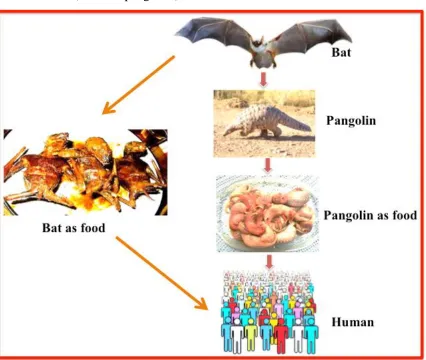
argued as potential intermediate hosts of the virus (Bir 2020). Theory behind the
relation of the twin mammals is that the insectivore bats flit across the sky; leave a
trace of potential 2019-nCoV in its droppings, which reach to the forest floor,
where the soil/leaf-insect/termite-eating pangolins pick up the infection from the
excrement. Eventually, pangolins and/or bats are captured and eaten by humans,
and the spread of disease occurs from infected person to heath person, and a global
A large variety of zoonotic viruses are known to naturally house bats. In a
recently study, Mendenhall et al. (2019) reported up to 47 different virus families
were detected from bat fecal samples). Moreover, as of 2017, over 130 virus
species including several emergent human pathogens have been detected in bats
(cited in Liu et al. 2019; Hu et al. 2017). In particular, bats act as reservoirs for
more than 60 different viruses that can infect humans (Live Science 2013). Bats
have also been reported to carry significantly more viruses than any other mammal
species on planet (Olival et al. 2017). Notably, bats have been argued in several
studies as the main reservoir of the major historic outbreaks of Nipah virus
infection in Malaysia (1998–1999) and Bangladesh (2001), Hendra virus infection
in Australia (1994), the severe acute respiratory syndrome (SARS) (2003), Middle
East respiratory syndrome (MERS) and recent ongoing COVID-19, epidemic of
acute respiratory syndrome in China and other countries (Li et al. 2005; Zhou et al.
2020). Bats are known to harbor 61 zoonotic viruses; on average, each bat species
hosts 1.79 zoonotic viruses, compared with rodents' 1.48 viruses per species (Live
Science, https://www.livescience.com/12951-10-infectious-diseases-ebola-plague-influenza.html). The first metagenomic study of virus diversity done in endangered pangolin species in China and also speculated the capability of direct or indirect
crossing over of coronaviruses into other mammals (Liu et al. 2019).
On the other, pangolins themselves are not known to carry any viruses,
which can infect humans; however, pangolins do carry parasites in their scales like
ticks, which can spread vector-borne diseases (EcoHealth Alliance, https://www.ecohealthalliance.org/2018/02/the-plight-of-the-pangolin). The major ectoparasites housing in the pangolin scales include Amblyomma javanese,
Cylicospirura species, and Strongyloides species (Thapa 2013; Li et al. 2010; Escobedo 2019). Earlier, Liu et al. (2019) have argued coronaviruses as dominant
pathogens responsible for the death of Malayan pangolins (Manis javanica) (Liu et al. 2019). Using genomic sequencing to compare the DNA of 2019-nCoV in
found a 99% match with pangolins and argued pangolins as an intermediate host
of the virus (Cyranoski 2020).
To varying extents, both pangolins and bats are eaten in China and other
parts of world. As mentioned also above that pangolins are highly sought-after in
China for their meat and their scales; the latter are used in traditional medicine.
Bats are also traditionally eaten in Indonesia by the Minahasan people from North
Sulawesi as whole bats including the head and wings in the form of a curry-like
dish called Paniki (Reuters News, https://www.reuters.com/article/us-china-
health-indonesia-bats/bat-meat-still-popular-in-parts-of-indonesia-despite-coronavirus-fears-idUSKBN20511R).
In the present context, series of studies have been done in order to reveal
the connection of bats with the mentioned COVID-19. However, the transmission
routine of COVID-19-causing 2019-nCoV virus among hosts is yet to reveal
(Zhou et al. 2020). Mystery deepens also over animal source of coronavirus,
where both the mammals, namely ant-eating pangolins and mostly-insect eating
bats are considered as prime suspects (Cyranoski 2020; Zhou et al. 2020).
Notably, both pangolins and bats are unique in the sense that the former is the only
known mammal with large, protective keratin scales covering their skin. On the
other, bats are remarkable flying social mammals with true wings and flight.
Additionally, a slew of genetic analyses have yet to find conclusive proof
(Cyranoski 2020; Hollingsworth et al. 2020; Kaba and Kitaw 2020; Zhou et al.
2020).
5. Conclusions and the way forward
Earlier, a number of major outbreaks including Ebola, HIV, Severe Acute
Respiratory Syndrome (SARS) have crossed over from wild animals. A range of
wild animal species could be the host of corona virus; however, owing to their
known role in harboring a large number of different coronaviruses particularly
rid of pangolins and/or bats such as through their killings is not the way to avoid
disease or for reducing the disease transmission. Due to their smugglings and
poaching, and also due to habitat alteration and loss of life of both bats (Jones et
al. 2003; Wund and Myers 2005) and pangolins (Challender et al. 2015;
Choudhary et al. 2018) are at great risk. Hence, restriction and/or a permanent ban
must be called for on trade in wildlife and closure of the markets where wild
animals including pangolins and bats are sold for food and medicines. The
intensive research and critical discussion are in progress. If not exactly the cause
and/or transmission of the current outbreak of COVID-19 are revealed the future
outbreaks of new or emerging human diseases could be prevented with the major
outcomes of the ongoing global efforts. At this moment, we must rely only on
concrete evidence and avoid rapidly increasing speculations. We should also be
very cautious about claims of blaming bats, pangolins or other organisms as the
prime suspects unless the researchers over the globe are able to establish to a
plausible extent genetic match between coronavirus in bats and pangolins with
humans. Overall whoever may be the reservoir for new viruses (such as
2019-nCoV) having capability of infecting humans, studies can be designed and the
outcomes of these studies can be used as strategy for preventing the future
emergence of new zoonotic agents.
References
Ashokkumar M, Valsarajan D, Suresh M, Kaimal A, Chandy G (2017) Stomach contents of the Indian pangolin Manis crassicaudata (Mammalia: Pholidota: Manidae) in tropical forests of southern India. Journal of Threatened Taxa, 9/5:10246-10248.
Aziz SA, Olival KJ, Bumrungsri S, Richards GC, Racey PA (2016) The conflict between pteropodid bats and fruit growers: species, legislation and mitigation. In: Bats in the Anthropocene: Conservation of Bats in A Changing World, Springer, Cham, pp. 377-426.
Bat Conservation International (2020) http://www.batcon.org/why-bats/bats-are/bats-are-important (accessed on 24 March 2020).
Bir B (2020) Pangolins still under global threat in 2020. World, Life and Environment, https://www.aa.com.tr/en/environment/pangolins-still-under-global-threat-in-2020/1734744 (accessed on 23 March 2020).
Boyles JG, Cryan PM, McCracken GF, Kunz TH (2011) Economic importance of bats in agriculture. Science 332(6025):41-42
Challender DWS, Harrop SR, MacMillan DC (2015) Understanding markets to conserve trade-threatened species in CITES. Biological Conservation 187:249-259.
Choudhary AN, Badola S, Fernandes M, Chhabra DB (2018) TRAFFIC India, http://static1.1.sqspcdn.com/static/f/157301/27831860/1518777807917/factsheet__scale_of_pang olin_trade_in_india___2009_2017.pdf?token=Otz4%2BWPC7U4qd287Cgtf416rWuQ%3D (accessed on 22 March 2020).
Choudhary AN, Badola S, Fernandes M, Chhabra DB (2018) TRAFFIC India (https://www.traffic.org/site/assets/files/2647/factsheet_scale_of_pangolin_trade_in_india_2009_2 017.pdf. accessed on 26 March 2020).
Cyranoski, D. (2020). Did pangolins spread the China coronavirus to people? Nature doi:10.1038/d41586-020-00364-2.
Cyranoski D (2020) Mystery deepens over animal source of coronavirus. Nature 579(7797):18.
EcoHealth Alliance, https://www.ecohealthalliance.org/2018/02/the-plight-of-the-pangolin, accessed on 23 March 2020
Environmental Investigator Agency, https://eia-international.org/news/huge-9-5-tonne-bust-of-pangolin-scales-must-sharpen-nigerias-appetite-to-tackle-wildlife-crime/ (accessed on 23 March 2020). Escobedo M (2019) Manis (On-line), Animal Diversity Web, https://animaldiversity.org/accounts/Manis/
(accessed on 22 March 2020).
Fleming TH, Geiselman C, Kress WJ (2009) The evolution of bat pollination: a phylogenetic perspective. Annals of Botany 104 (6):1017-1043.
Hollingsworth J, Renton A, George S, Reynolds E, Hayes M, Bowman R, et al. Coronavirus news. CNNNews, March 4, 2020, https://edition.cnn.com/asia/live-news/coronavirus-outbreak-03-04-20-intl-hnk/h_76c73f9c9163bd6fba6b9dc90873d71d (accessed on 25 March 2020).
https://en.wikipedia.org/wiki/Vampire_bat (accessed on 22 March 2020).
https://www.aa.com.tr/en/environment/pangolins-still-under-global-threat-in-2020/1734744 (accessed on 22 March 2020).
https://www.worldwildlife.org/species/pangolin (accessed on 22 March 2020).
Hu D, Zhu C, Wang Y, Ai L, Yang L, Ye F et al. (2017) Virome analysis for identification of novel mammalian viruses in bats from Southeast China. Sci Rep 7:10917.
Ji W, Wang W, Zhao X, Zai J, Li X (2020) Cross-species transmission of the newly identified coronavirus 2019-nCoV. J Medical Virol 92(4):433-440.
Jones K, Purvis A, Gittleman J (2003) Biological correlates of extinction risk in bats. American Naturalist 161:601-614
Kaba M, Kitaw Y (2020) Novel coronavirus (2019-nCoV)–reminiscent of Spanish flu: A challenge to global public health systems. The Ethiopian Journal of Health Development (EJHD), 34(1). Kasso M, Balakrishnan M (2013) Ecological and economic importance of bats (Order Chiroptera). ISRN
Biodiversity doi:10.1155/2013/187415
Li W, Shi Z, Yu M, Ren W, Smith C, Epstein JH et al. (2005) Bats are natural reservoirs of SARS-like coronaviruses. Science 310:676-679.
Li Y, Chao S, Fu-Hua Z, Shi-Bao W, Guang-Zhi M (2010) Age structure and parasites of Malayan pangolin (Manis javanica). J Economic Animal 14/1:22-25.
Liu P, Chen W, Chen JP (2019) Viral metagenomics revealed sendai virus and coronavirus infection of Malayan pangolins (Manis javanica). Viruses 11(11):979.
Live Science (2013) https://www.livescience.com/26898-bats-host-human-infecting-viruses.html (accessed on 22 March 2020).
Live Science, https://www.livescience.com/12951-10-infectious-diseases-ebola-plague-influenza.html (accessed on 22 March 2020).
Mendenhall IH, Wen DLH, Jayakumar J, Gunalan V et al. (2019) Diversity and evolution of viral pathogen community in cave nectar bats (Eonycteris spelaea). Viruses 11:250.
Mohapatra R, Panda S (2014) Behavioural descriptions of Indian pangolins (Manis crassicaudata) in captivity. Intl J Zoology doi:10.1155/2014/795062.
Nowak RM (1999) Walker's Mammals of the World, vol. 1st., 6th edition, pp. 264-271.
Olival KJ, Hosseini PR, Zambrana-Torrelio C, Ross N, Bogich TL, Daszak P (2017) Host and viral traits predict zoonotic spillover from mammals. Nature 546(7660):646-650.
Ghosh S (2019) Out of India: The illegal trade routes for pangolin trafficking, https://india.mongabay.com/2019/09/out-of-india-the-illegal-trade-routes-for-pangolin-trafficking/ (accessed on 22 March 2020).
Salata C, Calistri A, Parolin C, Palù G (2019) Coronaviruses: a paradigm of new emerging zoonotic diseases. Pathogens Disease 77(9):ftaa006.
Simmons NB, Conway T (1997) Chiroptera. Bats. Version 01 January 1997. http://tolweb.org/Chiroptera/15966/1997.01.01 in The Tree of Life Web Project, http://tolweb.org/ (accessed on 22 March 2020).
Smithsonian Institution, https://www.si.edu/spotlight/bats (accessed on 22 March 2020).
Sudhakaran MR, Doss PS (2012) Food and foraging preferences of three pteropodid bats in southern India. J Threatened Taxa 4(1):2295-2303.
Thapa P (2013) An overview of Chinese pangolin (Manis pentadactyla): its general biology, status, distribution and conservation threats in Nepal. The Initiation doi:10.3126/init.v5i0.10267.
WHO (2020a) Coronavirus disease 2019 (COVID-19) situation report – 66 (Coronavirus disease 2019 (COVID-19) Situation Report – 66. https://www.who.int/docs/default-source/coronaviruse/situation-reports/20200326-sitrep-66-covid-19.pdf?sfvrsn=9e5b8b48_2; accessed on 27 March 2020.
WHO (2020b) Novel coronavirus (2019-nCoV) situation report – 22.
https://www.who.int/docs/default-source/coronaviruse/situation-reports/20200211-sitrep-22-ncov.pdf?sfvrsn=fb6d49b1_2 (accessed on 24 March 2020).
Wikipedia, https://en.wikipedia.org/wiki/Kitti%27s_hog-nosed_bat (accessed on 22 March 2020).
Wund M, Myers P (2005) Chiroptera (On-line), Animal Diversity Web., https://animaldiversity.org/accounts/Chiroptera/ (accessed on 24 March 2020).
Figure legends
Fig. 1 Diagrammatic representation of the theory behind the potential link of the
twin mammals (bats and pangolins) with COVID-19 in human.
(Photo credits: https://www.dkfindout.com/uk/animals-and-nature/bats/; https://wildlifejustice.org/no-rest-for-pangolins-trafficking-rates-spike/;
https://www.google.com/url?sa=i&url=https%3A%2F%2Fwww.cnn.com%2Finteractive%2F2014%2F04%2Fopinion%2Fsutter-
change-the-list-pangolin-trafficking%2Findex.html&psig=AOvVaw1D3IsbeOvsvv4fPlAyXnAU&ust=1585208281285000&source=images&cd=vfe&ved=0CA 0QjhxqFwoTCNjjxJaPtegCFQAAAAAdAAAAABAH;
https://www.google.com/url?sa=i&url=https%3A%2F%2Fwww.youtube.com%2Fwatch%3Fv%3DKcsRBFmyMcg&psig=AOvVaw11
Table 1. COVID-2019 confirmed cases and deaths as of 26th March 20201
Region Confirmed cases of
COVID-2019
Confirmed death
Global 46,2,684 20, 834
European Region 2,50,287 13,950
Western Pacific Region 99,058 3,540
Eastern Mediterranean Region 32,442 2,162
Region of the Americas 75,712 1,065
South-East Asia Region 2,536 79
African Region 1,937 31
1WHO - Coronavirus disease 2019 (COVID-19) Situation Report – 66