VICTORIA
~UNIVERSITY
•
,~
0 0 ~
DEPARTMENT OF COMPUTER AND
MATHEMATICAL SCIENCES
Object-Oriented Fuzzy Cognitive Maps
Richard Satur and Zhi-Qiang Liu
(48COMP17)
December, 1994
(AMS: 68T35)
TECHNICAL REPORT
VICTORIA UNIVERSITY OF TECHNOLOGY
(P 0 BOX 14428) MELBOURNE MAIL CENTRE
MELBOURNE, VICTORIA, 3000
AUSTRALIA
TELEPHONE (03) 688 4249
I
4492
FACSIMILE (03) 688 4050
Object-Oriented Fuzzy Cognitive Maps
Richard Satur and Zhi-Qiang Liu ([email protected]. OZ.AU)
CMS - Computer and Mathematical Sciences Victoria University of Technology
Abstract:
Most data sets that describe and evolve from real-world systems are by nature semi-quantitative rather than
quantitative. This can mean large variations in the significance of results that are derived from this data for
decision making processes where the original database provides training and prototypical examples of parallel
systems. In this paper we propose a Knowledge-Based System (KBS) that is derived using significance within
given contextual domains. Data that would ordinarily be classified by simple attribute classification techniques
is now categorized by understanding patterns and value distributions for attributes and attribute domains that
exist within rich databases such as in the case of census databases1 ; rich by the very number of fields and
interpretations, depending on the context in which the data is to be reviewed. The structure we have
implemented for capturing and structuring se~-quantitative information is the Fuzzy Cognitive Map (FCM).
We also reduce the number of false patterns labeled "significant" by incorporating the knowledge used by
human experts to find significance within the census data. We treat this knowledge as initial background
knowledge and as a minimal set for distinguishing significance for particular attribute values within a given
context.
l. Introduction
Knowledge acquisition is an important step in developing expert systems in which human experts play an
essential role [Bonissone 1985} [Parsaye 1988] [Turban 1988]. However, the lower level organisation of the
experts knowledge is often obscured by years of practical and intuitive experience that have led them to make
judgments based on generalisations. Multi-level reasoning and, in particular their ability to generalise and
associate are two of the most salient characteristics of the human expert. Even more important is to make
1 The Census Data was provided by the Australian Bureau of Statistics (ABS) but any results inferred by our
decisions based on "context" both in time and space. For instance, the human expert may produce varying and in many cases different levels of reasoning for apparently equivalent instances with a collection of data sets.
In order to solve real-world problems, it is necessary that knowledge-based systems (KBS) be used to model the real-world. However, modeling the real-world has been proven a challenge. Several major issues have to be considered:
1. the structure to perform the representational tasks of a real-world system,
2. generalisations of the data such that the system is non-committal about details that cannot be resolved at the first instance but is able to explain minute differences in apparently similar instances,
3. contradictory (negative instances) and incomplete knowledge,
4. spatial and temporal references in data, and, finally,
5. dynamic knowledge structures that adapt to new data sets and expert intervention.
A knowledge representation system's task is to support activities of perception, learning, and planning to act [Woods 1991]. To fulfill these primary tasks, it is necessary to assimilate rules into a taxonomic knowledge structure to facilitate discovery of interactions of objects (ie: concepts) at input time, and to formalise a compact structure in the specification of these rules. This structure can be considered to be a generalised description of the real-world problem, representing contextual information, and one that is able to adapt causally. We have developed a multi-layered structure which possesses the following basic characteristics [Fike 1985] namely,
I. expressiveness in its representation of the human knowledge and hence of the data itself, and 2. the structure allows the human expert to interact with the system; including providing
reinforcement.
In this paper we endeavor to present an Object-Oriented Context-Based System (OOCBS). Fuzzy Cognitive Maps (FCMs) [Kosko 1986] are the building blocks of our system. We use the supervised learning paradigm that also use processes of generalisation for reducing search spaces. We demonstrate the effectiveness our system using a census database provided by the Australian Bureau of Statistics2 .
2. FUZZY Cognitive Maps
In dynamic environments human knowledge describes relevant concepts and causes for certain actions to be
taken. In order to capture the adaptive nature of the human knowledge and to assist decision making, Axelrod
[Axelrod 1976] proposed cognitive maps for representing social knowledge. However, such cognitive maps are
based on a rigid structure with fixed measures of causality between different social events. It is unable to handle
dynamically changing environments and uncertainty involved in concepts and descriptions. As a result it is not
effective in adaptive reasoning systems.
Based on these concerns, in the late 1980's Kosko [Kosko 1986) introduced the fuzzy cognitive map
(FCM) which incorporates fuzzy causality measures in the original cognitive maps. FCM provides a :flexible
and more realistic representation scheme for dealing with knowledge. This scheme is potentially useful in the
problem domains that we are dealing with, which are commonly referred to as the soft knowledge domain
where both system concepts and relationships and the meta-system knowledge can only be represented to a
certain degree. In addition, subtle (spatial and temporal) variations in the knowledge base can often result in
completely different outcomes or decisions.
FCM provides a mechanism for representing such hazy degrees of causality between events/objects.
This enables the constructed paths to propagate causality in a more natural fashion through the use of such
techniques as forward and backward chaining. In this paper we propose an object oriented FCM for knowledge
representation and adaptive inference.
3. The Object Representations
A model for representing knowledge within the database has to encompass the significance human experts
place on certain value attribute pairs while allowing for the propagation of relationships between objects. The
solution we provide is a hierarchy of generalised FCM's where each FCM is a context graph of related object
types (related by context). Each FCM itself forms an object where an Object-FCM (OFCM) has child FCM's of
This inheritance propagates through the structure linking FCM' s by common attribute types. These attribute
types are significant as determined by the hwnan expert although "more prominent" features and additional
feature-pairs are learned during a learning phase based on a supervised inductive learning paradigm with initial
background knowledge. Additions to the significant pairs database (learned patterns during the learning phase)
are verified by the human expert after each inductive and/or generalisation step [Satur 1994].
The FCM' s form a generalised network of OFCM' s, in which each parent for child OFCM' s is related
by context. Child OFCM's inherit attribute-types and relationships of their ancestors but may also have
attribute-types and relationships that are unique to itself. For instance, we may have the following object
hierarchy for modeling shopping centers (see Figure 1).
Regional Shopping Centers <Location to primary road, On Street Parking, ... >
Community Centers Small Comunity Ce:r;ters Community Deli <Location to Post Office, ... >
Figure 1: Part of the FCM hierarchy for the context goal "Building Shopping Centers".
In this example, the object type "Community Deli" inherits <Location to primary road, On Street Parking, ... >
and any relationships (fuzzy causal links) that may exist between these objects from its ancestor as well as
having its own unique attribute types <Location to Post Office, ... >. It is also important to note that the object
type "Regional Shopping Cented' does not have to be partitioned into these particular subset object types.
Depending on the context, the partition may vary. The context goal for the above partitioning rules is based on
"Building Shopping Cented'. Data stored within each object is both spatial and temporal. Spatial data include
definite relationships to other physical objects related by fuzzy sets, for example, "Near a primary road" is a
fuzzy set with physically locatable quantities, in this case the type of shopping centers and the primary road.
Temporal data on the other hand are non-spatial data attributes related to the object and changing with time.
These are often calculated using statistical data sets. An example might be the socio-economic background of
the community's population as determined by a census gathering exercise. Both data types (spatial and
gaining some insight into the decision making that human experts employ during their scan of the available
data. This hierarchy or network structure has been used for single object types by GIS researchers to solve
difficult problems that are not ordinarily solved using just spatial data [Gahegan 1988, 1993][Roberts 1991].
Although we have used a GIS environment to provide community boundaries and hence the important features
(ie: primary road) within community boundaries, we have not attempted to provide any solutions to the image
processing problems inherent in spatial data. This is beyond the scope of this paper.
Each object type is itself an OFCM, therefore each object type is a description of other object types
connected by context and the granularity of the FCM model for each context is determined by the data set and
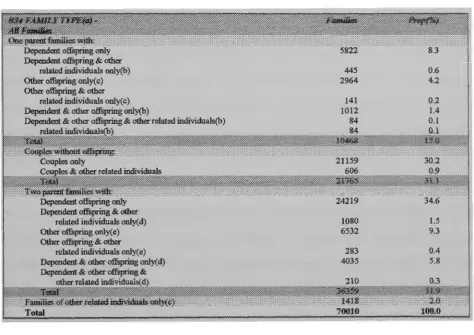
the human expert. For instance, for the above network of objects, a corresponding FCM based on the available
data (See Figure 2) [Satur 1994] might look like Figure 3.
~
J.tfml-~
4
!tJ{~'~fi!.:~11rr~~~~
Dependent offspring & other j
related individuals only(b) 445 0.6
I
Other offspring only(c) 2964 4.2
Other offspring & other
related individuals only(c) 141 0.2 I
Dependent & other offspring only(b) IO 12 1.4
I
Dependent & other offspring & other related individuals(b) 84 0 .1
ffffH
t~f:·~filmm
:
mffi
m
11
:
ill~
:
i®~
tfWlftitlllMHttftllttffm'llMilfflftlltffff1It1
M~
tlmtlfiffftll@
~
~
,
1llll:
1 • • •• • (J()ijpl¢s~ :o.Jf.sptiiig: ... : ••••••..••••..Couples only 21159 30.2
~
-·,~~7}
'f4%Jiffr%if£4jlf41§ij[%11¥1tM@jlft'i¥¥ff
.
£1#illifii%7
~
~}~ljlf~
Dependent offspring only 24219 34.6 1
Dependent offspring & other
related individuals only(d) 1080 1.5
Other offspring only(e) 6532 9.3
Other offspring & other
related individuals only(e) 283 0.4
Dependent & other offspring only( d) 403 5 5. 8
Dependent & other offspring & I
Total 70010 100.0
Figure 2: Part of the statistics provided in census data.
Nodes that are labeled with an asterix are object types that only relate to that particular OFCM and should not
be inherited by any successor OFCM's. The generation of each of the FCM's from data and the relationships
ancestors as well as relationships between the nodes (ie: nodes and relationships not marked by an asterix).
These nodes and their relationships may be found in the successor OFCM as pairs of objects with the same
relationship. For example in Figure 3, for the OFCM "Regional Shopping Center", the pair of nodes and their
relationship <Primary Road (increased) ~Visibility> is inherited and duplicated somewhere in the successor
OFCM "Community Deli". The fragment <Primary Road (increased) ~ Visibility> can and in most cases will
take on a different implication in the successor OFCM but since the data sets are finite and self contained for
all objects, the fragment is established once and then duplicated throughout the network.
4. Context Representation
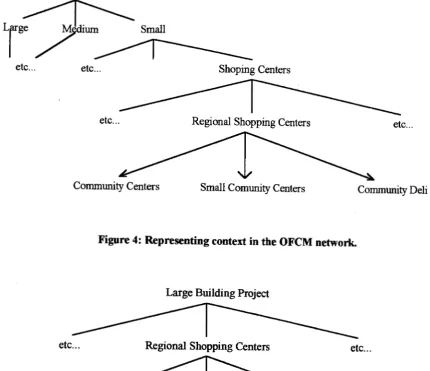
If we expand the network shown in Figure 1 to include the next three levels of ancestors, the relevance of
contextual links within the hierarchy becomes obvious (see Figure 4).
The original context would be related to community size and type, and as we progress down the
network, form ancestors to successors, many of the attribute types and relationships are inherited by the
proceeding levels and so on until we get to the goal OFCM. This traverse realises a rich representation based on
contextual references obtained at each level Tiris structure is not a tree structure as described by our simple
examples,
ii
is in fact a graph where OFCM's inherit different attribute types based on the ancestor OFCM.This emphasizes the fact that there need not be just one partitioning scheme or set of partitioning rules and that
in fact a number of different partitioning schemes maybe be employed, often with the help of the human expert.
Furthermore although the network maybe a graph, each OFCM is static with respect to its construction and the
nodes that originally builds the FCM. Figure 5 illustrates a different contextual reference for "Regional
shopping center", where the FCM for "Regional shopping center'' has a slightly different representation based
on inheriting different attribute and attribute pairs (connected by fuzzy causal links) from different parents;
"Shopping center" from one partition (see Figure 4) and "Large Building Project" by another partitioning
Community Centers Community Deli
Community Size
r~Sm~
etc ... etc ... Shoping Centers
etc ... Regional Shopping Centers etc ...
Community Centers Small Comunity Centers Community Deli
Figure 4: Representing context in the OFCM network.
Large Building Project
etc ... Regional Shopping Centers etc ...
Community Centers Small Comunity Centers Community!
Figure 4: Regional shopping center with contextual reference to "Large Building Project".
5. Query optimisation
This structure becomes very useful when trying to query the database with some temporal information as well
as spatial data [Jarke 1984]. If we seek to verify or justify decisions based on data then this contextual graph
provides a mechanism to propagate decision making interpretations in terms of context. If we seek the more
common attribute types (or OFCM's), this graph provides a mechanism of searching for both spatial and
temporal determinates by queering the structure as a human expert might seek knowledge while adding an
extra layer of clarity to each step of the search, in terms of fuzzy sets. For example, we can seek the importance
is an object oriented one where child OFCM's inherit from ancestor OFCM's, a certain degree of analogy might be applied to solving sub-problems, once again as a human expert might attempt to do.
This network is also useful for data mining for acquiring knowledge in terms of attribute correlations.
Since each pair of nodes form single representations of an entire data set, correlation coefficients and significance measures [Cohen 1982] [Kohonen 1980] may be used to test for significance for pairs of attribute values and in turn using the product rule we can test for significance with respect to the entire OFCM. As a
consequence general significance for context levels for a given set of attribute values can be inferred.
By ordering queries to include context and by reordering the queries from the rarest qualifiers to the most common, we are able to traverse this graph efficiently, guided by both context and the rarity of features. For example, if we wanted to search for a decision process for the justification of a community deli, we might order the influences involved in the decision making process; as a human expert might do and then search the graph using important criteria such as the community size and searching the structure from the most important context to the least important contextual reference, we gather significance. In affect, the query expands based on a context driven search and solving the query will mean solving its context specific parts and sub-parts.
6. Conclusion
Acknowledgments
Many thanks to Professor Terry Caelli for providing an atmosphere and environment for productive research
and to Mark Gahegan and Jan Hurst for their many hours of explanation of GIS data and their expert
knowledge. I would also like to thank Smallworld Systems (Australia) P/L and in particular Mike Bundock
(Director), for providing me with an Object-Oriented GIS software package that endorsed efficient and
productive coding hours. Without their help and software, this work would have taken many more months to
realise its usefulness. This research is partially funded by grants from The Australian Research Council.
References
1. [Axelrod 1976] Axelrod R. "Structure of Decision: the Cognitive Maps of Political Elites", Princeton,
NJ: Princeton University Press (1976).
2. [Bonissone 1985] Bonissone, P.P., and H.E. Johnson, Tr. "Expert System for Diesel Electric
Locomotive Repair." Human Systems Management 4 (1985).
3. [Cohen 1982] Cohen PR., and EA Feigenbaum, "The Handbook of Artificial Intelligence" Vol 3,
William Kaufmann, Los Altos, CA, 1982
4. [Fike 1985] Fikes R., and T. Kehler "The Roles of Frame-Based Representation in Reasoning"
Communications of the ACM, Vol 28, No 9, September 1985, pp 904-920 (1985).
5. [Gahegan 1988] Gahegan M. N., and S. A. Roberts "An Intelligent, Object-Oriented Geographical
Information System" International Journal of GIS, Vol 2, No 2, pp 101-110 (1992).
6. [Gahegan 1993] Gahegan M. N., and S. A. Roberts "The use of Context and Significance within an
Geographic Information System" Proc. 1st Australia & New Zealand Conference on Intelligent
Information Systems (ANZIIS), University of Western Australia, Perth, Australia (1993).
7. [Jarke 1984] Jarke, M., and J. Koch, "Query Optimisation in Database Systems'', Communications of
ACM Computing Surveys, No 16, (1984)
8. [Kohonen 1980] Kohonen T, "Content Addressable Memories'' Springer-Verlag, Berlin, Heidelberg,
9. [K.osko 1986) Kosko B., "Fuzzy Cognitive Maps" Int. J. Man-Machine Studies, No 24, pp 65-75
(1986)
10. [Parsaye 1988) Parsaye, K., and M. Chignell, "Expert Systems for Experts" New York: John Wiley
and Sons (1988).
11. [Roberts 1991] Roberts S. A., and M. N. Gahegan "Supporting the Notion of Context within a
Database Environment for Intelligent Reporting and Query Optimisation" Eur. J. Inf. Systems. Vol I,
No 1, pp 13-22 (1991).
12. [Satur 1994) Satur R., Zhi-Qiang Liu and M. Gahegan, "Multi-Layered FCM's Applied to Context
Dependent Learning", to be presented at the FUZZ-IEEE/IFES'95, March 20-24 1995, Yokohama,
Japan (1994)
13. [Turban 1988) Turban, E., and P. Watkins, eds. "Applied Expert Systems" Amsterdam: North Holland
(1988).
14. [Woods 1991) Woods, W. A., "Important Issues in Knowledge Representation" Knowledge-Based