POLYNOMIALS
STAVROS KOUSIDIS AND ANDREAS WIEMERS
Abstract. We improve on the first fall degree bound of polynomial
systems that arise from a Weil descent along Semaev’s summation poly-nomials relevant to the solution of the Elliptic Curve Discrete Logarithm Problem via Gr¨obner basis algorithms.
KEYWORDS. Polynomial systems, Gr¨obner bases, Discrete logarithm problem, Elliptic curve cryptosystem.
2010 MATHEMATICSSUBJECTCLASSIFICATION.13P15 Solving polyno-mial systems, 13P10 Gr¨obner bases, 14H52 Elliptic curves.
1. Introduction
Finding solutions to algebraic equations is a fundamental task. A common approach is a Gr¨obner basis computation via an algorithm such as Faug`ere’s
F4 andF5 (see [4, 5]). In recent applications Gr¨obner basis techniques have become relevant to the solution of the Elliptic Curve Discrete Logarithm Problem (ECDLP). Here one seeks solutions to polynomial equations arising from a Weil descent along Semaev’s summation polynomials [13] which represents a crucial step in an index calculus method for the ECDLP, see e.g. [12, 14]. The efficiency of Gr¨obner basis algorithms is governed by a so-called degree of regularity, that is the highest degree occurring along the subsequent computation of algebraic relations. It is widely believed that this often intractable complexity parameter is closely approximated by the degree of the first non-trivial algebraic relation, the first fall degree. In particular, the algorithms for the ECDLP of Petit and Quisquater [12] are sub-exponential under the assumption that this approximation is in o(1).
In the present paper, we will improve Petit’s and Quisquater’s [12] first fall degree boundm2+ 1 for the system arising from the Weil descent along Semaev’s (m+ 1)-th summation polynomial. That is, we prove that a degree
Federal Office for Information Security, Godesberger Allee 185–189, 53175 Bonn, Germany
E-mail address: [email protected].
Date: June 13, 2019.
2010 Mathematics Subject Classification. 13P15 Solving polynomial systems, 13P10 Gr¨obner bases, 14H52 Elliptic curves.
Key words and phrases. Polynomial systems, Gr¨obner bases, Discrete logarithm problem, Elliptic curve cryptosystem.
fall occurs at degreem2−m+1 by exhibiting the highest degree homogeneous part of that polynomial system. In fact, this degree is m2−m, so that we expect the bound to be sharp except for the somewhat pathological case
m= 2 that has been discussed by Kosters and Yeo [10]. This allows us to sharpen the asymptotic run time of the index calculus algorithm for the ECDLP as exhibited in the complexity analysis of Petit and Quisquater [12].
2. The first fall degree
The notion of the first fall has been described by Faug`ere and Joux [6, Section 5.1], Granboulan, Joux and Stern [7, Section 3], Dubois and Gama [3, Section 2.2], and Ding and Hodges [2, Section 3]. Although the concept of the first fall degree has been calledminimal degree [6] anddegree of regularity
[2, 3, 7], we actually adopt the terminology and definition of Hodges, Petit and Schlather [8]. For readability reasons we include a brief and tailored account of the first fall degree and refer the reader to [8, Section 2] for details and greater generality.
Our considerations take place over a degreen extensionF2n of the binary
fieldF2. Consider the decomposition of the graded ring
S=F2n[X0, . . . , XN−1]/(X02, . . . , X 2 N−1)
into its homogeneous components
S=S0⊕S1⊕ · · · ⊕SN.
EachSj is the F2n-vector space generated by the monomials of degreej. Let
I be an ideal in S generated by homogeneous polynomials h1, . . . , hr ∈Sd
all of the same degree d. Then we have a surjective map
φ: Sr −→ I
(g1, . . . , gr) 7→ g1h1+· · ·+grhr.
Without loss of generality we furthermore assume 0< r= dimF
2n
Pr
j=1F2nhj.
Letei denote the canonicali-th basis element of the freeS-module Sr. The
S-moduleU generated by the elements
hjei+hiej and hkek, wherei, j, k= 1, . . . , r,
is a subset of ker(φ). If we restrictφ to theF2n-subvector spaceS r
j−d⊂Sr
we obtain a surjective map
φj−d: Sj−dr −→ I ∩Sj
whose kernel contains the F2n-subvector spaceUj−d=U∩Sj−dr and hence
factors through
¯
φj−d:Sj−dr /Uj−d→I∩Sj.
Definition 2.1 (Cf. [8, Definition 2.1]). The first fall degree of a homoge-neous system h1, . . . , hr∈Sd and its linear span Pr
j=1F2nhj, respectively,
that is the smallestj such that dimF
2n(I∩Sj)<dimF2n(S
r
j−d/Uj−d). It is
denoted by Df f( Pr
j=1F2nhj).
Following [8] we now consider the ring of functions
AF
2n =F2
n[X0, . . . , XN−1]/(X02−X0, . . . , XN−12 −XN−1) as a finite-dimensional filtered algebra whose filtration components [AF
2n]d, d∈N, are given by the polynomials up to degree d. The associated graded ring ofAF
2n is
Gr(AF
2n) =F2
n[X0, . . . , XN−1]/(X02, . . . , XN2−1) whose graded components
[Gr(AF
2n)]d= [AF2n]d/[AF2n]d−1, ford∈N,
are given by the homogeneous polynomials of degreed. Any linear subspace
V ⊂ [AF
2n]d induces a homogeneous linear subspace ¯V ⊂ [Gr(AF2n)]d via
the canonical projection πd: [AF
2n]d→[Gr(AF2n)]d.
Definition 2.2 (Cf. [8, Definition 2.2]). Consider a polynomial system
p1, . . . , pr ∈[AF
2n]d and its linear span V =
Pr
j=1F2npj ⊂[AF2n]d,
respec-tively. We assume without loss of generality that dimF
2nV =r > 0. The
first fall degree ofV is
Df f(V) = (
d , dimF
2n
¯
V <dimF
2nV, Df f( ¯V) , else,
where Df f( ¯V =Pr
j=1F2nπd(pj)) is given in Definition 2.1.
3. Weil descent along summation polynomials
We prove that the first fall degree of the polynomial system that arises from a Weil descent along Semaev’s summation polynomialSm+1 is bounded from above bym2−m+ 1. This is an improvement overm2+ 1 that results from [8, Theorem 5.2] and [12, Section 4]. Let us briefly introduce the summation polynomials and describe the Weil descent.
Semaev [13] introduced them-th summation polynomialSm(x1, . . . , xm)∈ K[x1, . . . , xm] on an elliptic curveE :y2=x3+a4x+a6 over a finite field
K with char(K) 6= 2,3 by the following defining property: for elements x1, . . . , xm in the algebraic closure ¯Kone hasSm(x1, . . . , xm) = 0 if and only
if there exist y1, . . . , ym ∈ K¯ such that (x1, y1), . . . ,(xm, ym) ∈ E( ¯K) and
E : y2 + xy = x3 +a2x2 +a6, and the projection to the x-coordinate
x(Pi) =x(xi, yi) =xi of Pi ∈E . Then, still
S2(x1, x2) =x1−x2
and from Diem’s general description [1, Lemma 3.4, Lemma 3.5] one can deduce
S3(x1, x2, x3) = (x21+x22)x23+x1x2x3+x21x22+a6
Sm+1(x1. . . , xm, xm+1) = ResX(Sm(x1, . . . , xm−1, X), S3(xm, xm+1, X))
and the degree ofSm+1in each variablexi is 2m−1. Note that these formulas have also been outlined by Petit and Quisquater [12, Section 5] who also refer to Diem [1].
To describe the Weil descent along those summation polynomials (see e.g. [12, Section 4]) we fix a basis 1, z, . . . , zn−1 of F2n overF2 and letW be
a subvector space inF2n of dimension n 0
and basis ν1, . . . , νn0 over F2. We introduce mn0 variablesyij that model the linear constraints
xi= n0 X
l=1
yilνl,
set xm+1 to an arbitrary elementc∈F2n, and obtain the equation system
Sm+1(x1, . . . , xm, c) =Sm+1
n0 X
l=1
y1lνl, . . . ,
n0 X
l=1
ymlνl, c
=f0(yij) +zf1(yij) +· · ·+zn−1fn−1(yij)
The first fall degree of interest is that of the reduced polynomial system
sk ≡fkmod (y112 −y11, . . . , y2mn0−y
mn0), where k= 0, . . . , n−1.
(3.1)
Note thats0, . . . , sn−1 ∈F2[y11, . . . , ymn0]/(y 2
11−y11, . . . , y 2
mn0−ymn0).
By the definition of the first fall degree we are interested in the highest degree homogeneous part of s0, . . . , sn−1 whose degree can be determined as
follows.
Lemma 3.1. Let m ≥ 3. The highest degree homogeneous part of the polynomial systems0, . . . , sn−1∈F2[y11, . . . , ymn0]/(y
2
11−y11, . . . , y 2
mn0−ymn0)
from Equation 3.1 is induced by the monomial
(x1· · ·xm)2 m−1
−1·
xm+1
in the summation polynomial Sm+1(x1, . . . , xm, xm+1), and hence its degree
is less than or equal to m2−m.
Proof. First, we show the existence of the monomial (x1· · ·xm)2 m−1
−1·
xm+1
inSm+1(x1, . . . , xm, xm+1). We have
Sm+1(x1. . . , xm, xm+1) = ResX(Sm(x1, . . . , xm−1, X), S3(xm, xm+1, X))
and the degree of Sm+1 in each variable xi is 2 m−1
. The resultant of
f, g∈F2n[X] of degreek and lis the determinant of the Sylvester matrix ResX(f, g) = det Syl(f, g)
= det
fk · · · f0
fk · · · f0
. .. . ..
fk · · · f0 gl · · · g0
gl · · · g0
. .. . ..
gl · · · g0
That is, with
S3(xm, xm+1, X) = (x2m+x2m+1)X2+xmxm+1X+x2mx2m+1+a6 Sm(x1, . . . , xm−1, X) =c2m−2
,mX 2m−2
+· · ·+c0,m
where each ci,m∈F2n[x
1, . . . , xm−1], we have
Sm+1(x1. . . , xm, xm+1) = det Syl(Sm, S3)
.
To be concrete, Syl(Sm, S3) is the matrix
c2m−2
,m c2m−2−1,m · · · c0,m 0
0 c2m−2
,m · · · c1,m c0,m
x2m+x2m+1 xmxm+1 x2mx2m+1+t
. .. . ..
x2m+x2m+1 xmxm+1 x2mx2m+1+t
with a total of 2m−2+ 2 rows and columns. In order to prove our claim we have to identify specific summands in the Leibniz formula of the determinant. That is, we consider
det Syl(Sm, S3)
=X
π
sgn(π)
2m−2+2 Y
i=1
Syl(Sm, S3)i,πi (3.2)
and argue that for the relevant summands no cancellation over F2n occurs.
Note that the sign of a permutation is 1∈F2n.
Step 1: Prove by induction (start with x21x22 in S3) that Sm+1 contains the monomial (x1· · ·xm)2
m−1
in its term c0,m+1. For that we consider the
permutation
σ =
σ1, . . . , σ2m−2
+2
=
2m−2+ 1,2m−2+ 2,1,2, . . . ,2m−2
and obtain
Sm+1(x1. . . , xm, xm+1) = sgn(σ)
2m−2+2 Y
i=1
Syl(Sm, S3)i,σi +· · ·
=c0,mc0,m
2m−2 Y
i=1
(x2m+x2m+1) +. . .
=
(x1· · ·xm−1)2
m−22
·x2
m−1
m +. . .
= (x1· · ·xm−1xm) 2m−1
+. . .
Note that specifyingσ1= 2m−2+ 1 andσ2= 2m−2+ 2 determinesσ since the remaining entries in Syl(Sm, S3) form an upper triangular matrix with
x2m+x2m+1 on the diagonal.
Step 2: Prove by induction (start withx1x2x3 inS3) thatSm+1 contains the monomial (x1· · ·xm)2
m−1−1
·xm+1, i.e. (x1· · ·xm)2 m−1−1
in its term c1,m+1. For that we consider the permutation
τ =τ1, . . . , τ2m−2
+2
(3.4)
=2m−2,2m−2+ 2,1, . . . ,2m−2−1,2m−2+ 1 and obtain
Sm+1(x1. . . , xm, xm+1)
= sgn(τ)
2m−2+2 Y
i=1
Syl(Sm, S3)i,τ i+· · ·
=c1,mc0,m·xmxm+1
2m−2−1 Y
i=1
(x2m+x2m+1) +. . .
= (x1· · ·xm−1)2
m−2
−1·
(x1· · ·xm−1)2
m−2
·xmxm+1(x2m)2 m−2
−1
+. . .
= (x1· · ·xm−1xm)
2m−1−1·
xm+1+. . .
Note that specifying τ1 = 2 m−2
and τ2 = 2 m−2
+ 2 determines τ since the remaining entries in Syl(Sm, S3) form an upper triangular matrix with
x2m+x2m+1, . . . , xm2 +x2m+1, xmxm+1 on the diagonal.
Second, in order to exclude potential cancellations we have to show that the permutations σ in (3.3) and τ in (3.4) are the only possible choices to produce the monomials (x1· · ·xm)2
m−1
and (x1· · ·xm)2 m−1−1
·xm+1 in
that the only multiples of (x1· · ·xm)2 m−1−1
in the coefficients ofSm+1 are (x1· · ·xm)2
m−1
in c0,m+1 and (x1· · ·xm)2 m−1
−1
in c1,m+1. Indeed, the factor (x1· · ·xm−1)2
m−1−1
in the variables x1, . . . , xm−1 can only be produced by
productsci,m·cj,m of entries taken from the first two rows of the Sylvester matrix Syl(Sm, S3). Since the degree of Sm in each variable x1, . . . , xm−1
is 2m−2, each of the entries c0,m, . . . , c2m−2
,m is a sum of monomials in the
variablesx1, . . . , xm−1 where each monomial is either
(i) no multiple of (x1· · ·xm−1)2
m−2
−1
or
(ii) a multiple (x1· · ·xm−1)2
m−2
−1
·xδ1
1 · · ·x δm−1
m−1, withδi∈ {0,1}.
Therefore, the monomials in the products ci,m·cj,m that contribute to the
determinant (3.2) occur in the following forms
((x1· · ·xm−1)2
m−2
−1
)2·xδ1+δ
0
1
1 · · ·x δm−1+δ
0 m−1
m−1
(3.5)
(x1· · ·xm−1)2
m−2−1 ·xδ1
1 · · ·x δm−1
m−1 ·µ
(3.6)
µ·µ0
(3.7)
where µandµ0 denote elements that are no multiples of (x1· · ·xm−1)2
m−2
−1
. Consequently, a monomial in the productci,m·cj,m that is now a multiple of
(x1· · ·xm−1)2
m−1
−1
can only arise in case (3.5) if for each k= 1, . . . , m−1 the following condition holds
2·2m−2−1
+δk+δ 0 k≥2
m−1
−1 ⇐⇒ δk+δ 0 k ≥1.
Due to the degree restriction ofSm a productci,m·cj,mwhere the monomials inci,m and cj,m are all of the form (3.6) or (3.7) cannot produce a multiple of (x1· · ·xm−1)2
m−1
−1
. Therefore, we are left with products of the terms
c0,m andc1,m by the induction hypothesis. Sincec1,m·c1,m only produces (x1· · ·xm−1)2
m−1
−2
, the permutationsπ = (π1, π2, . . . , π2m−2
+2) in the
Leib-niz formula (3.2) that produce multiples of the monomial (x1· · ·xm−1)2
m−1
−1
must have either (π1, π2) = (σ1, σ2) or (π1, π2) = (τ1, τ2) as given in (3.3) and
(3.4), respectively. This determines our permutationsσ and τ completely. To finish the proof, our degree claim in Lemma 3.1 is argued as follows. The variables yij of the sk are over F2 where taking squares is a linear
operation. Therefore the degrees of the homogeneous parts of the system
s0, . . . , sn−1depend only on the Hamming weight wt(xα11· · ·x αm
m ) = P
wt(αi) of a monomial inSm+1. Since the degree ofSm+1 in each variable xi is 2m−1 the monomial (x1· · ·xm)2
m−1
−1
·xm+1, when xm+1 is set to an elementc∈ F2n, produces the highest Hamming weight
Pm i=1wt(2
m−1
To be precise, we consider
x2
j
i = ( n0 X
l=1
yilνl)2 j
=
n0 X
l=1
yilν2
j
l
and obtain
(3.8) (x1· · ·xm)2 m−1
−1·
c=c
m Y i=1 m−2 Y j=0 n0 X l=1
yilν2
j
l
which is of degree less than or equal to m(m−1) in the variablesyij. We are ready to prove the main result.
Theorem 3.2. Let n0 ≥ m ≥3 and c∈ F2n \ {0}, and consider the
poly-nomial system s0, . . . , sn−1 ∈ F2[y11, . . . , ymn0]/(y 2
11−y11, . . . , y 2
mn0 −ymn0)
from Equation 3.1, that results from the Weil descent along the summation polynomial Sm+1(x1, . . . , xm, c). The first fall degree of s0, . . . , sn−1 is less
than or equal tom2−m+ 1.
Proof. Consider the finite-dimensional filtered algebra
AF
2 =F2[y11, . . . , ymn0]/(y
2
11−y11, . . . , y 2
mn0−ymn0).
The linear span
n−1 X
j=0
F2sj
is inside the degree d=m2−m subspace of the filtered algebra AF2 due to Lemma 3.1. By [8, Corollary 2.4] an extension of the base field, i.e.
AF
2n =F2
n[y11, . . . , y
mn0]/(y 2
11−y11, . . . , ymn2 0 −y
mn0),
does not affect the first fall degree. That is,
Df f
n−1 X
j=0
F2sj
=Df f
n−1 X
j=0
F2nsj
.
By [8, Definition 2.2], the first fall degree of the subspace Pn−1
j=0F2nsj of
AF 2n is
Df f
n−1 X
j=0
F2nsj
= (
d=m2−m , dimF
2n
¯
V <dimF
2nV, Df f( ¯V) , else,
where ¯V denotes the induced homogeneous subspace ofPn−1
j=0F2nsj in the
associated graded ring
Gr(AF
2n) =F2
n[y
11, . . . , ymn0]/(y 2
If dimF
2n
¯
V < dimF
2nV, our claim follows. Otherwise we consider the
polynomial
P0 =c
m Y i=1 m−2 Y j=0 n0 X l=1
yilν2
j
l
which is an element of the homogeneous subspace ¯V by Lemma 3.1, and in particular Equation 3.8. Now, for any
xk= n0 X
l=1
yklνl
we have a non-trivial relation
xkP0 =c
n0 X
l=1
y2klνl2·
m−2 Y j=1 n0 X l=1
yklν2
j l · m Y i=1,i6=k m−2 Y j=0 n0 X l=1
yilν2
j
l = 0∈Gr(AF2n)
of degree d+ 1 = m2 −m+ 1 unless P0 = 0 ∈ Gr(AF
2n). Therefore it
remains to show that P0 6= 0. For that purpose, we recall thatc∈F2n\ {0},
v1, . . . , vn0 are linearly independent, and n0≥m. Consider the linear change of variables
Yij =x2
j
i = ( n0 X
l=1
yilνl)2
j =
n0 X
l=1
yilν2
j
l .
This is induced by the m×n0 matrix
ν1 · · · νn0
ν12 · · · νn20 ..
. . .. ...
ν2
m−2
1 · · · ν2
m−2
n0
that can be completed to an invertible linear transform by [11, Lemma 3.51], since we have assumed v1, . . . , vn0 to be linearly independent and n0 ≥m. By using such an invertible linear transform on any block of variables
yi1, . . . , yin0 we get new variables
Y10, . . . , Ym,n0
−1.
Under this change of variablesP0 is mapped to the non-zero element
c m Y i=1 m−2 Y j=0
Yij ∈F2n[Y10, . . . , Ym,n0
−1]/(Y 2
10, . . . , Ym,n2 0
Remark 3.3. Our Theorem 3.2 remains true also in the case m= 2 with first fall degree less than or equal to 2·1 + 1 = 3. This bound is not sharp though, in fact the first fall degree in the case m= 2 equals 2 [10, Corollary 4.11 and Remark 4.12].
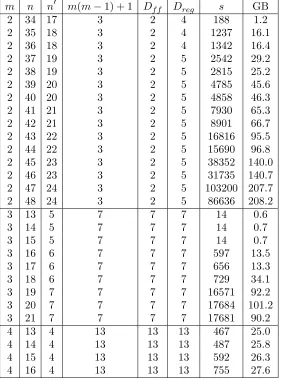
Table 1. Empirical data for the Weil descent along the summation polynomial Sm+1 over F2n with n
0
-dimensional factor basis. Displayed are the observed first fall degreeDf f, degree of regularity Dreg, the time in seconds s and space
requirement in gigabyte GB. All values are averaged over 10 repetitions. For the casem= 2 see also Remark 3.3.
m n n0 m(m−1) + 1 Df f Dreg s GB
2 34 17 3 2 4 188 1.2
2 35 18 3 2 4 1237 16.1
2 36 18 3 2 4 1342 16.4
2 37 19 3 2 5 2542 29.2
2 38 19 3 2 5 2815 25.2
2 39 20 3 2 5 4785 45.6
2 40 20 3 2 5 4858 46.3
2 41 21 3 2 5 7930 65.3
2 42 21 3 2 5 8901 66.7
2 43 22 3 2 5 16816 95.5
2 44 22 3 2 5 15690 96.8
2 45 23 3 2 5 38352 140.0
2 46 23 3 2 5 31735 140.7
2 47 24 3 2 5 103200 207.7
2 48 24 3 2 5 86636 208.2
3 13 5 7 7 7 14 0.6
3 14 5 7 7 7 14 0.7
3 15 5 7 7 7 14 0.7
3 16 6 7 7 7 597 13.5
3 17 6 7 7 7 656 13.3
3 18 6 7 7 7 729 34.1
3 19 7 7 7 7 16571 92.2
3 20 7 7 7 7 17684 101.2
3 21 7 7 7 7 17681 90.2
4 13 4 13 13 13 467 25.0
4 14 4 13 13 13 487 25.8
4 15 4 13 13 13 592 26.3
4. Experiments and Conclusion
In the light of the first fall degree bound given in Theorem 3.2 we computed a Gr¨obner basis for the ideal resulting from the Weil descent along the summation polynomialSm+1(x1, . . . , xm, xm+1) form= 2,3,4 on an AMD
Opteron CPU with Magma’sGroebnerBasis() function. Again, we set the verbose level to 1 and extracted the empirical first fall degree Df f as the
step degree of the first step where new lower degree (i.e. less than step degree) polynomials are added. The empirical degree of regularityDreg is
the highest step degree that appears during the Gr¨obner basis computation. In each experiment we chose a random non-singular elliptic curve overF2n, a
random subvector space of dimensionn0 =dn/meas the factor basis, and set
xm+1 to thex-coordinate of a random point on the curve. The experimental
results that extend the ones present in the literature by Petit and Quisquater [12] and Kosters and Yeo [10] are displayed in Table 1.
Like Kosters and Yeo [10, Section 5] we observed a raise in the regularity degree form= 2 in our experiments and were able to verify their observation that with the low degree polynomialsW = span{1, z, . . . , zn
0
} chosen as the factor basis (Cf. [14, Section 4.5]) the raise in the regularity degree was produced for slightly greatern= 45. It would be very interesting to observe a raise in the degree of regularity for higher Semaev polynomials, but time and memory amounts become a serious issue for m ≥ 3. However, such observations might neither falsify [12, Assumption 2] thatDreg =Df f+ o(1)
nor lead to further evidence that the gap between the degree of regularity and the first fall degree depends onn as discussed in [9, Section 5.2].
However, we believe our first fall degree bound m2−m+ 1 for Semaev polynomials to be sharp form≥3, and rephrase [12, Assumption 2] as the following question:
Dreg =m2−m+ 1 + o(1) ? (4.1)
Note that our upper bound on the first fall degree of summation polynomials is a first step towards answering this question. The first fall degree generically bounds the degree of regularity from below. Hence, any further lower bound on the degree of regularity associated to the specific case of a Weil descent along summation polynomials can potentially answer (4.1).
logarithm can asymptotically be solved in sub-exponential time
O
2clog(n)
n2/3+1
,
(4.2)
where c= 2ω/3,ω is the linear algebra constant (ω= log(7)/log(2) is used in the following estimates), andn2/3+ 1 is an upper bound for the first fall degree of them-th summation polynomial whenm=n1/3 [12, Proposition 1]. They state that, by following this analysis the index calculus approach beats generic algorithms with run timeO(2n/2) for anyn≥N whereN is an integer approximately equal to 2000. Now, based on Theorem 3.2 we assume Dreg ≈m2−m+ 1 =n2/3−n1/3+ 1 and sharpen (4.2) to
O
2clog(n)
n2/3−n1/3+1
.
(4.3)
Hence, the turning point to solve the ECDLP faster than a generic algorithm is an integer approximately equal to 1250. Note that this is still far from cryptographically relevant sizes ofnup to 521.
References
1. Claus Diem,On the discrete logarithm problem in elliptic curves, Compositio Mathe-matica147(2011), no. 1, 75–104.
2. Jintai Ding and Timothy J. Hodges,Inverting HFE systems is quasi-polynomial for all fields, CRYPTO, 2011, pp. 724–742.
3. Vivien Dubois and Nicolas Gama, The degree of regularity of HFE systems, ASI-ACRYPT, 2010, pp. 557–576.
4. Jean-Charles Faug`ere,A new efficient algorithm for computing Gr¨obner bases (F4), Journal of Pure and Applied Algebra139(1999), no. 1–3, 61–88.
5. Jean-Charles Faug`ere,A new efficient algorithm for computing Gr¨obner bases without reduction to zero (F5), Proceedings of the 2002 International Symposium on Symbolic and Algebraic Computation, ISSAC ’02, 2002, pp. 75–83.
6. Jean-Charles Faug`ere and Antoine Joux,Algebraic cryptanalysis of hidden field equation (HFE) cryptosystems using Gr¨obner bases, CRYPTO, 2003, pp. 44–60.
7. Louis Granboulan, Antoine Joux, and Jacques Stern,Inverting HFE is quasipolynomial, CRYPTO, 2006, pp. 345–356.
8. Timothy J. Hodges, Christophe Petit, and Jacob Schlather,First fall degree and Weil descent, Finite Fields and Their Applications30(2014), 155–177.
9. Ming-Deh Huang, Michiel Kosters, and Sze Ling Yeo,Last fall degree, HFE, and Weil descent attacks on ECDLP, CRYPTO, 2015, pp. 581–600.
10. Michiel Kosters and Sze Ling Yeo,Notes on summation polynomials, Preprinthttp: //arxiv.org/abs/1505.02532(2015).
11. Rudolf Lidl and Harald Niederreiter,Introduction to finite fields and their applications, Cambridge University Press, New York, NY, USA, 1986.
12. Christophe Petit and Jean-Jacques Quisquater,On polynomial systems arising from a Weil descent, ASIACRYPT, 2012, pp. 451–466.
13. Igor Semaev,Summation polynomials and the discrete logarithm problem on elliptic curves, IACR Cryptology ePrint Archive2004(2004), 31.
14. ,New algorithm for the discrete logarithm problem on elliptic curves, Preprint