An Efficient and Secure Multicast Key
Management Scheme based on Star Topology
Neha Mittal1, Vinod Kumar2
1Student, CDAC Noida, GGSIPU, Delhi,India 2Assistant Professor, CDAC Noida, GGSIPU, Delhi,India
Abstract-The today’s world relies heavily over the applications, such as e-commerce, which are using the multicast communications, carried out over the insecure channel like internet, henceforth, the need for secure group communication is realized. The secure group communication helps in transmitting data in such a way that only the members of the group are able to receive the message. In 2012, K. Saravanan and T. Purusothaman proposed a scheme for multicast key management in which the group members generated the individual private keys and henceforth, reduced the burden upon the server. However, in some cases, the forward secrecy and backward secrecy may be violated upon member’s leaving and joining the group respectively. In this paper, we proposed an improvement on the Saravanan-Purusothaman scheme to solve the above problem. The proposed scheme preserves the forward secrecy and backward secrecy in multicast group key management and therefore, is more secure. In addition, it also eliminates the rekeying process whenever a member joins/ leaves a group.
Keywords:- Group key management, Rekeying, Multicast
1. INTRODUCTION
With the growth of the Internet, the usage of group communication becomes more popular. These applications include the pay TV channels, secure videoconferencing, multi-partner military action, wireless sensor, and ad hoc networks. In today’s era, information security is the prime concern as with the technological advancements, the attackers are provided with more powerful and sophisticated tools. Today, the Internet is not totally secure for privacy. The usage of multicast applications increases day by day so it needs secure multicast services.
Multicasting is a simple way to send one stream of data to multiple users simultaneously. It helps in reducing the required bandwidth significantly, as it enables splitting of a single transmission between multiple users [9]. Multicasting not only optimizes the performance, but also enhances the efficiency of the network. For these reasons, multicasting has become the preferred transmission method for most group communication.
Group key management plays an important role in group communication. A common group key is required for individual users in the group for secure multicast communication. Group key has to be updated frequently whenever a member joins and leaves in order to provide forward and backward secrecy. Forward secrecy ensures that an expelled member cannot gather information about future multicast communication and backward secrecy ensures that a joining member cannot gather information
about past multicast communication [11]. For this reason, group key needs to be updated with each membership change and given away to the authenticated users. This process is known as group re-keying.
For group communication , Wong et al. and Waller et al. has proposed a scheme ‘logical key hierarchy (LKH) tree approach’ [3, 4] which provides an efficient and secure mechanism to maintain the keys. In addition, communication and computation cost increases logarithmically with the group size for a join or depart request. Communication cost in LKH is reduced from O(n) to O(logn) in the rekeying method, where n is the number of group members. One-way function (OFT) scheme was proposed by Sherman and McGrew [5] to reduce the communication cost from 2logn−1 to logn. These schemes need to rekeying message whenever member joins/leaves the group [3, 4, 5, 6, 7] . To overcome the above problem, Lin et al. [2] proposed the SBMK scheme using the star based architecture, in which there is no need for rekeying when a member joins and leaves the group. In SBMK, secret key is calculated by the key server using RSA algorithm [10] and then is unicast to every group member separately. Therefore, it increases the burden on the server. Efficient star topology based multicast key management algorithm was proposed by Saravanan, K. and T. Purusothaman [1] which is based on the RSA algorithm [10] in which secret keys are calculated by the group members. This eliminates the need to unicast the secret keys to every member separately, henceforth, reducing the load on the server to great extent. In that scheme when a member A leaves the group, the forward secrecy is thwarted if pA equals pB or qB and qAequals pC or qC, where pi, qi for i
The rest of the paper is organized as follows. In section 2, review work is discussed in brief. In section 3, we present our proposed scheme for multicast key management. Section 4 gives an example to illustrate our scheme. Section 5 provides security analysis .A comparison of our scheme with other schemes proposed is discussed in section 6. Finally the conclusions are made in section7.
2. BRIEF REVIEW OF SARAVANAN–
PURUSOTHAMAN SCHEME
In this scheme, whenever a member wants to join the group, he/she is allowed to select two prime numbers and compute the secret information X as the product of their prime numbers. The private key is then computed by the member using Extended Euclidean algorithm and is unicast to the key server. The scheme eliminates the rekeying process when a member joins/leaves the group [1]. The Saravanan-Purusothaman scheme consists of three phases: the key assignment phase, the message encryption phase, the message decryption phase. We briefly describe the three phases as follows:-
Key assignment phase
The following steps have been performed for key assignment in the scheme.
1. The server declares the public parameter e to the users and also authenticates the member who wants to join the group
2. The individual member Ui chooses two prime number
pi and qi randomly and also compute the product Xi and where, Xi = pi × qi and Ф(Xi)=(pi-1) × (qi-1)
3. The member calculates the private key by applying the extended Euclidean algorithm, computing a unique integer di > Ф(Xi), such that
e×di≡ 1 mod (Ф(Xi)) eq (1) 4. The authenticated individual members deliver their X
value to the key server.
5. The server checks and accepts that Xivalue only if it is unique among the other group members’ values and stores the Xi value.
Message encryption phase
The steps to be performed by the key server for message encryption are described as follows:-
1. After determining the set of registered users, the server uses public key e as well as secret values of message Xi to encrypt a message M by using the following formulae [5]:-
C = (M)e mod Π X
i; i=1 to n eq (2) Where n is equals to no of selected members to whom secret message is to be sent
2. After computing the cipher text C by the key server, the server sends a broadcast message to all the registered member of the group..
Message decryption phase
The process of message decryption by the members is as follows:-
Upon receiving the cipher text C, the individual member Ui can use its private key di and his/her public parameter Xi to decrypt the cipher text C sent from the key server and obtain the confidential message M by using the following formulae [5]:-
Ui→ M = (C mod Xi)di mod Xi eq (3)
When a new member Ui+1 want to join the group, the key assignment procedure is repeated. Also, when a member Ui leaves the group, the key server deletes the secret value Xi, thereby, removing the modulus operation w.r.t. Xi(pi × qi) in the cipher text computation.
In that scheme when a member A leaves the group, the forward secrecy is thwarted if pAequals pB or qB and qA equals pC or qC, where A, B, C are group members and p, q represents their respective prime numbers. Also, when a new joining member D selects the prime numbers such that pD equals pE or qE and qD equals pF or qF for some anonymous members E and F, then the backward secrecy becomes questionable. For example , Assume that there are three members U1, U2, U3 in the group .
U1 selects p1=11, q1=17 computes X1=11*17= 187
U2 selects p2=31, q2=47 computes X2=31*47= 1457
U3 selects p3=17, q3=47 computes X3=17*47= 799
X1≠X2≠X3, so all the three members are registered in the multicast group. Let us say, U3 leaves the group. Therefore, the modulus operation in cipher text computation is performed with respect to X1 and X2. Although member U3 has left the group, but both his factors p3 and q3 of X3are already present in X1 and X2 respectively. Therefore, he can decrypt the future cipher text to obtain the original confidential message M using secret information X3 and private key d3. Hence, forward secrecy is not preserved in this case.
Similarly, when a U4 wants to join the group, he can decrypt the past cipher text to obtain original confidential message M using secret information X4 and private key
d4.Thus, backward secrecy is violated
3. PROPOSED SCHEME
In this section, we describe the proposed scheme which is based on RSA algorithm [10]. Our scheme differs from the Saravanan-Purusothaman scheme [1] as it is based on the uniqueness of the Xi values, but our scheme states that even the prime factors contributing to the Xi values must be unique. This characteristic always maintains the forward and backward secrecy in the proposed algorithm. In addition, our scheme does not need to maintain the key tree topology and eliminates the rekeying process whenever member joins/leaves from the group.
3.1 Efficient and secure GKM scheme
Our improvement is divided into three phases: the key assignment phase, the message encryption phase, the message decryption phase. Brief description of three phases is given as:
3.1.1 Key assignment phase
The following steps have been performed for key assignment in our proposed scheme.
1. The server declares the parameter e to the users and also authenticates the member who wants to join the group.
2. The individual member Uichooses two prime number
piand qi randomly and also compute the product Xi and Ф(Xi)
3. The member calculates the private key by applying the extended Euclidean algorithm [10], computing a unique integer di, such that
e×di≡ 1 mod (Ф(Xi)) eq (4) 4. The authenticated members deliver their Xi value to the
key server.
5. The server registers the member if and only if
gcd (Z, Xi) = 1 and keeps Xi as secret. Then, the server stores the product of Xi values in Z.
3.1.2 Message encryption phase
The steps to be performed by server for message encryption are described as follows:-
1. After determining the set of registered user, the server uses e as well as secret values of message xi to encrypt message M by using the following formulae [1,2]:-
C = (M)e mod Π X
i; i=1 to n eq (5) where, n is the no. of selected members to whom secret message is to be sent.
2. After computing the cipher text C by the key server , the server sends a broadcast message to all the registered member of the group..
3.1.3 Message decryption phase
The process of message decryption by the members is as follows:-
After the cipher text C is received, the individual member Ui can decrypt C, using his private key di and secret information Xi, to obtain the confidential message M as follows [1,2]:-
Ui→ M = (C mod Xi)di mod Xi eq (6)
The proposed scheme ensures that only the members whose Xi values are used to encrypt the message are able to decrypt it.
3.2 Member joining and leaving the group 3.2.1 Member joining the group
Whenever a new member Ui+1 wants to join the group , the server repeats the same procedure as that of key assignment. The rekeying process for existing members is eliminated because their secret information Xi and private key di remains unaffected.
3.2.2 Member leaving off the group
Whenever a member Ui want to leave the group, the remaining members do not need to modify the secret information Xand private key d. The key server deletes the secret value Xi from the active list.
In the cipher text computation, the modulus operation is performed with the subset of Xkvalues of the remaining members Uk. For example, if the key server sends a message to the remaining group members, the encryption is performed as:
C=Me mod(X
1 × X2 × …× Xi-1 × Xi+1 ×… ×Xn ) Thus, Ui cannot decrypt the message.
4. AN EXAMPLE
In this section, a simple example is discussed to illustrate our scheme for group communication.
Key assignment phase
Suppose that there are six members U1, U2, U3, U4, U5 and
U6 who want to join the group. Then the following steps are performed for key assignment:-
1. The server declares the parameter e=101 to the members and also authenticates the member who wants to join the group.
2. The individual member Ui chooses two prime number
pi and qi randomly and also compute the product Xi and Ф(Xi)
Where, Xi = pi × qi and Ф(Xi) = (pi-1) × (qi-1)
U1 chooses p1 = 283 and q1 =367 computes
X1 = 103861 and Ф(X1) = 103212
U2 chooses p2= 163 and q2 =181 computes
X2 = 29503 and Ф(X2) = 29160
U3 chooses p3 = 137 and q3 =191 computes
X3 = 26167and Ф(X3) = 25840
U4 chooses p4 = 109 and q4 =179 computes
X4 = 19511 and Ф(X4) = 19224
U5 chooses p5 = 193 and q5 =139 computes
X5 = 26827 and Ф(X5) = 26496
U6 chooses p6 = 163 and q6 =191 computes
X6 = 31133 and Ф(X6) = 30780
3. The private key is calculated by members using extended Euclidean algorithm as mentioned in eq(4). 101×d1≡ 1 mod (Ф(X1)) ≡ 1 mod 103212 and
d1 = 92993
101×d2≡ 1 mod (Ф(X2)) ≡ 1 mod 29160 and
d2 = 2021
101×d3≡ 1 mod (Ф(X3)) ≡ 1 mod 25840 and
d3 = 4861
101×d4≡ 1 mod (Ф(X4)) ≡ 1 mod 19224 and
d4 = 18653
101×d5≡ 1 mod (Ф(X5)) ≡ 1 mod 26496 and
d5 = 25709
101×d6≡ 1 mod (Ф(X6)) ≡ 1 mod 30780 and
d6 =29561
4. The authenticated individual member send their X1, X2,
X3, X4, X5,X6 values to the server.
5. In this step, server checks that p and q should be unique for all members using gcd function
Server computes, gcd(Z,X1) =
gcd (1,103861)=1, U1 is registered in the group. Then, Z = Z × X1 =1×103861=103861
Server computes, gcd(Z,X2)
= gcd(103861,29503)=1, U2 is registered in the group Then, Z = Z × X2 =103861×29503
= 3064211083
Server computes, gcd(Z,X3)
= gcd(3064211083,26167)=1, U3 is registered in the group
Then, Z = Z × X3 = 3064211083 × 26167
= 80181211408861
Server computes, gcd(Z,X4)
= gcd(80181211408861,19511)= 1, U4 is registered in the group
Then, Z = Z × X4 = 80181211408861 × 19511
= gcd(1564415615798286971,26827)=1, U5 registered in the group
Then, Z = Z × X5 = 1564415615798286971 × 26827
= 41968577725020644571017 Server computes, gcd(Z,X6)
= gcd(41968577725020644571017,31133)≠1, U6 is not registered in the group
Then, Z = 41968577725020644571017
In Saravanan-Purusothaman scheme [1], the member U6 gets successfully registered in the group. Whenever a member U6 leaves, he / she also obtain confidential message M because factors p6and q6 are already present in
U2 and U3respectively. Our proposed scheme does not add the member U6 and hence, the forward secrecy is maintained.
Message encryption phase
1. When the server wants to send a secret message M = 7 to selected group members U1, U2, U4 among a group of five members (U1, U2, U3, U4, U5) then the key server uses public key e = 101 as well as the values X1,
X2, X4, to encrypt the message .The cipher text is generated by the key server as follows
C = 7103 mod (X
1×X2×X4 )
C = 7103 mod (103861 *29503 *19511)
C= 376363539506
2. The key server then broadcasts cipher text C to all the members of the group.
Message decryption phase
After receiving the cipher text C, the members U1, U2, U4 in the group can decrypt the encrypted message using their respective private keys d1, d2, d4 and secret information X1,
X2, X4. The message M is decrypted by the members as follows:-
U1→M = (CmodX1)d1 mod X1
= (376363539506 mod103861)92993mod103861 = 7
U2→M = (CmodX2)d2 mod X2
= (376363539506 mod29503)2021mod29503 = 7
U3→M = (CmodX3)d3 mod X3
= (376363539506 mod26167)4861mod26167 = 451
U4→M = (CmodX4)d4 mod X4
= (376363539506 mod19511)18653mod19511 = 7
U5→M = (CmodX5)d5 mod X5
= (376363539506 mod26827)25709mod26827
= 21592
As shown, only members U1, U2, U4 can obtain the original message.
Member joining
When a new member U6 wants to join the group, the server performs the following steps :-
1. The server informs his public key e=101 to the member U6 and also authenticates the member U6. 2. The Member U6 chooses two prime numbers p6=149
and q6=113 randomly and also compute the product X6 and Ф(X6)
Where, X6 = p6 × q6 and Ф(X6) = (p6-1) × (q6-1)
X6 = 16837and Ф(X6) = 16576
3. Private key is calculated by member U6 using the extended Euclidean algorithm
101*d6≡ 1 mod (Ф(X6)) ≡ 1 mod 26496 and d6 = 6897 4. The Member U6 sends his X6 value to the server
5. The server registers the member if and only if gcd (Z, X6) = 1.
Server computes, gcd(Z,X6) =
gcd(41968577725020644571017,16837)=1 U6 is
registered in the group
Z=Z×X6 =41968577725020644571017*16837
Z= 706624943156172592642213229
When the key server wants to send a new confidential message M= 5 to all the members in the group. The server will compute new cipher text using the following formulae:-
C = 5103 mod (X
1 ×X2 × X3 ×X4 × X5 × X6 )
C=5103mod (103861×29503×26167×19511×26827 ×
16837 )
C= 698424121352690019387071398
Then, the key server broadcast cipher text C to all the members of the group.
After receiving the cipher text C, all the pre-existing members U1,U2,U3,U4,U5 and the new member U6 in the group can decrypt the encrypted message using their private keys di and his/her secret information Xi, where, i=1 to 5 as shown below:-
U1→M = (CmodX1)d1 mod X1
(698424121352690019387071398mod103861)92993mod103
861 = 5
U2→M = (CmodX2)d2 mod X2
(698424121352690019387071398 mod29503)2021mod29503 = 5
U3→M = (CmodX3)d3 mod X3
(698424121352690019387071398 mod26167)4861mod26167 = 5
U4→M = (CmodX4)d4 mod X4
(698424121352690019387071398 mod19511)18653mod19511 = 5
U5→M = (CmodX5)d5 mod X5
(698424121352690019387071398 mod26827)25709mod26827 = 5
U6→M = (CmodX6)d6 mod X6
(698424121352690019387071398 mod16837)6897mod16837 = 5
Member leaving
Suppose the member U1, U4 and U6 want to leave the group, the remaining members U2, U3, U5 do not need to change their private keys d2, d3, d5 and secret information
X2, X3, X5. The key server deletes the secret values X1, X4,
X6, corresponding to U1, U4, U6, from the active list. Thus, the key server does not include X1, X4, X6 in the cipher text computation.
Now, if the key server wants to send a confidential message M= 15 to all the members in the group. .The cipher text is generated by the key server as follows
C = 15103 mod (X
2 × X3 × X5 )
= 15103 mod (29503 * 26167 * 26827 )
The key server broadcast cipher text C to all the group member. After receiving the cipher text C, the confidential message M is decrypted by members as given below:- U1→M = (CmodX1)d1 mod X1
=(16499470714897mod103861)92993mod103861 =29942
U4→M = (CmodX4)d4 mod X4
=(16499470714897mod19511)18653mod19511
= 10413
U6→M = (CmodX6)d6 mod X6
=(16499470714897mod16837)6897mod16837
= 6204
Members U1, U4, U6are not able to decrypt the message correctly. Thus, forward secrecy is maintained.
5. SECURITY ANALYSIS
We discuss the security analysis of the proposed scheme in this section.
5.1 Group key Secrecy
It ensures that for any adversary A, it is computationally difficult to obtain the private key dfrom publicly available parameter, similar to the difficulty of factoring the large integers as in RSA algorithm. Therefore, the security of the proposed scheme depends on RSA cryptosystem [10]. According to our scheme, when any member wants to join the group, then the two large prime numbers p, q are selected by the member. Server checks that p and q should be unique for all members and stores the value Xi as secret information. This secret value is known only to the corresponding member and the key server, then, it is extremely difficult for the adversary A to compute private key. Hence group secrecy is preserved.
5.2 Forward secrecy
It ensures that when any adversary A leaves the group, the key server deletes the secret information XAfrom the active list .Therefore, in the cipher text computation, the modulus operation with respect to XA is removed. Although, A has his private key dA and secret information XA but, he cannot access original future confidential message M. Hence, forward secrecy is always preserved.
5.3 Backward secrecy
Suppose that if adversary A wants to join the group, the server checks that pA and qA should be unique for all the members. Thus, the value XA = pA×qA was not used to calculate the past cipher texts. Although, A has his own private key dA and secret information XA but, he cannot obtain the original past confidential message M. Hence backward secrecy is not violated.
5.4 Preventing the unauthorized access:-
Proposed scheme ensures that any unauthorized member cannot access the original message. The original message is decrypted by only those members whose X value is used to compute cipher text C. Suppose if unauthorized member Uk tries to use decryption method to obtain confidential message M then he fails to access the original message M. The decryption process is described below:
Uk→ M = (C mod Xk)dk mod Xk
= (Me mod Π X
i)dk mod Xk
=(Medk mod Π X
i)mod Xk
≠Medjmod X j≠M
Therefore, the unauthorized member cannot obtain the original plaintext.
5.5 Collaborative attacks
Suppose some collutive members U1,U2....Uk having their private keys d1,d2....dk and secret information X1,X2....Xk, want to obtain private keys of some other members. Then, these members will reveal their private keys to each other in ordet to achieve the goal. The Private keys are generated using extended Euclidean algorithm [10] as follows: e×d1≡ 1 mod (Ф(X1))
e×d2≡ 1 mod (Ф(X2))
e×dk≡ 1 mod (Ф(Xk))
The parameter e is already known to all the members, then even after revealing their private keys colluted members cannot obtain the private keys and secret information of the other members. Hence, collaborative attack is not possible in our scheme.
6. COMPARATIVE ANALYSIS
In this section, we compare the security parameters, computation overhead, communication overhead and storage overhead of the proposed scheme with the LKH scheme [3,4], OFT scheme [5], SBMK scheme [2] and Efficient SBMK scheme [1].
In Table 1, we compare the security parameter of the proposed scheme with the previous schemes [1, 2, 3, 4, 5]. As compare to the Efficient SBMK scheme [1], our scheme is more secure as it preserves the forward and backward secrecy in multicast group key management.
Schemes Group secrecy
Forward secrecy
Backward Secrecy
LKH Yes Yes Yes
OFT Yes Yes Yes
SBMK Yes Yes Yes
Efficient
SBMK Yes No No
Proposed
scheme Yes Yes Yes
Table 1. A comparison of security parameter
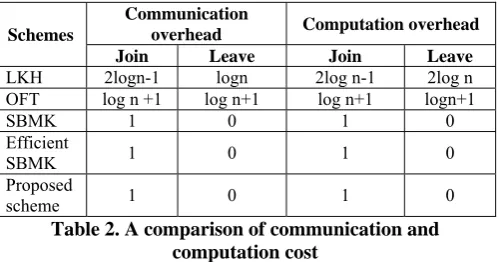
Schemes
Communication
overhead Computation overhead Join Leave Join Leave
LKH 2logn-1 logn 2log n-1 2log n
OFT log n +1 log n+1 log n+1 logn+1
SBMK 1 0 1 0
Efficient
SBMK 1 0 1 0
Proposed
scheme 1 0 1 0
Table 2. A comparison of communication and computation cost
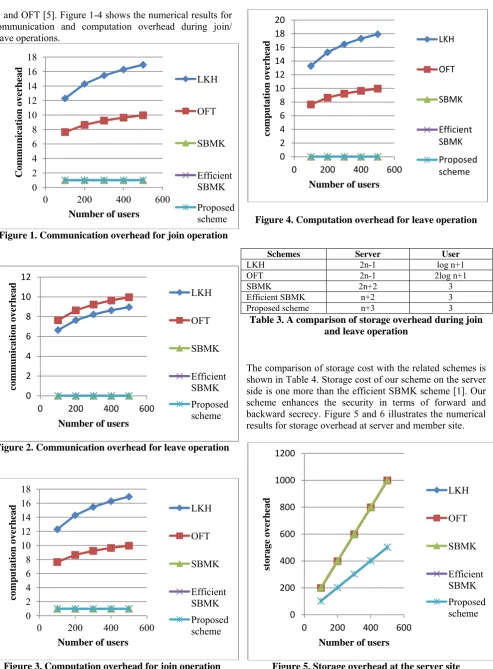
4] and OFT [5]. Figure 1-4 shows the numerical results for communication and computation overhead during join/ leave operations.
Figure 1. Communication overhead for join operation
Figure 2. Communication overhead for leave operation
Figure 3. Computation overhead for join operation
Figure 4. Computation overhead for leave operation
Schemes Server User
LKH 2n-1 log n+1
OFT 2n-1 2log n+1
SBMK 2n+2 3
Efficient SBMK n+2 3
Proposed scheme n+3 3
Table 3. A comparison of storage overhead during join and leave operation
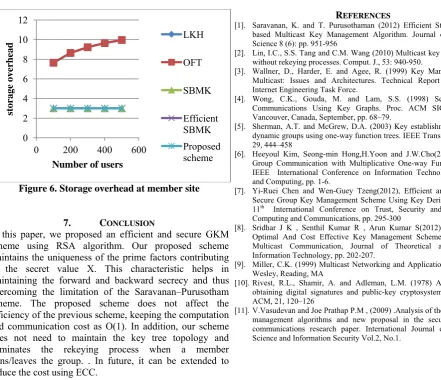
The comparison of storage cost with the related schemes is shown in Table 4. Storage cost of our scheme on the server side is one more than the efficient SBMK scheme [1]. Our scheme enhances the security in terms of forward and backward secrecy. Figure 5 and 6 illustrates the numerical results for storage overhead at server and member site.
Figure 5. Storage overhead at the server site
0 2 4 6 8 10 12 14 16 18
0 200 400 600
Communication overhead
Number of users
LKH
OFT
SBMK
Efficient SBMK
Proposed scheme
0 2 4 6 8 10 12
0 200 400 600
communication overhead
Number of users
LKH
OFT
SBMK
Efficient SBMK Proposed scheme
0 2 4 6 8 10 12 14 16 18
0 200 400 600
computation overhead
Number of users
LKH
OFT
SBMK
Efficient SBMK Proposed scheme
0 2 4 6 8 10 12 14 16 18 20
0 200 400 600
computation overhead
Number of users
LKH
OFT
SBMK
Efficient SBMK
Proposed scheme
0 200 400 600 800 1000 1200
0 200 400 600
storage overhead
Number of users
LKH
OFT
SBMK
Figure 6. Storage overhead at member site
7. CONCLUSION
In this paper, we proposed an efficient and secure GKM scheme using RSA algorithm. Our proposed scheme maintains the uniqueness of the prime factors contributing to the secret value X. This characteristic helps in maintaining the forward and backward secrecy and thus overcoming the limitation of the Saravanan–Purusotham scheme. The proposed scheme does not affect the efficiency of the previous scheme, keeping the computation and communication cost as O(1). In addition, our scheme does not need to maintain the key tree topology and eliminates the rekeying process when a member joins/leaves the group. . In future, it can be extended to reduce the cost using ECC.
REFERENCES
[1]. Saravanan, K. and T. Purusothaman (2012) Efficient Star Topology based Multicast Key Management Algorithm. Journal of Computer Science 8 (6): pp. 951-956
[2]. Lin, I.C., S.S. Tang and C.M. Wang (2010) Multicast key management without rekeying processes. Comput. J., 53: 940-950.
[3]. Wallner, D., Harder, E. and Agee, R. (1999) Key Management for Multicast: Issues and Architectures. Technical Report RFC 2627, Internet Engineering Task Force.
[4]. Wong, C.K., Gouda, M. and Lam, S.S. (1998) Secure Group Communications Using Key Graphs. Proc. ACM SIGCOMM’98, Vancouver, Canada, September, pp. 68–79.
[5]. Sherman, A.T. and McGrew, D.A. (2003) Key establishment in large dynamic groups using one-way function trees. IEEE Trans. Softw. Eng. 29, 444–458
[6]. Heeyoul Kim, Seong-min Hong,H.Yoon and J.W.Cho(2005), Secure Group Communication with Multiplicative One-way Functions, Proc IEEE International Conference on Information Technology:-Coding and Computing, pp. 1-6.
[7]. Yi-Ruei Chen and Wen-Guey Tzeng(2012), Efficient and Provably- Secure Group Key Management Scheme Using Key Derivation, IEEE 11th International Conference on Trust, Security and Privacy in
Computing and Communications, pp. 295-300
[8]. Sridhar J K , Senthil Kumar R , Arun Kumar S(2012), Design An Optimal And Cost Effective Key Management Scheme For Secure Multicast Communication, Journal of Theoretical and Applied Information Technology, pp. 202-207.
[9]. Miller, C.K. (1999) Multicast Networking and Applications. Addison-Wesley, Reading, MA
[10].Rivest, R.L., Shamir, A. and Adleman, L.M. (1978) A method for obtaining digital signatures and public-key cryptosystems. Commun. ACM, 21, 120–126
[11].V.Vasudevan and Joe Prathap P.M , (2009) .Analysis of the various key management algorithms and new proposal in the secure multicast communications research paper. International Journal of Computer Science and Information Security Vol.2, No.1.
0 2 4 6 8 10 12
0 200 400 600
storage overhead
Number of users
LKH
OFT
SBMK