Short Variable Length Domain Extenders With
Beyond Birthday Bound Security
Yu Long Chen1, Bart Mennink2, and Mridul Nandi3
1
imec-COSIC, KU Leuven, Belgium
2 Digital Security Group, Radboud University, Nijmegen, The Netherlands [email protected]
3 Indian Statistical Institute, Kolkata, India [email protected]
Abstract. Length doublers are cryptographic functions that transform ann-bit cryptographic primitive into an efficient and secure cipher that length-preservingly encrypts strings of length in [n,2n−1]. All currently known constructions are only proven secure up to the birthday bound, and for all but one construction this bound is known to be tight. We consider the remaining candidate, LDT by Chen et al. (ToSC 2017(3)), and prove that it achieves beyond the birthday bound security for the domain [n,3n/2). We generalize the construction to multiple rounds and demonstrate that by adding one more encryption layer to LDT, beyond the birthday bound security can be achieved for all strings of length in [n,2n−1]: security up to around 22n/3 for the encryption of strings close tonand security up to around 2nfor strings of length close to 2n. The security analysis of both schemes is performed in a modular manner through the introduction and analysis of a new concept called “harmonic permutation primitives.”
Keywords: length doublers, LDT, beyond birthday bound, harmonic primitives, chi-squared
1
Introduction
Block ciphers are keyed deterministic functions that encrypt bit strings of a fixed size nbits to ciphertext blocks of the same size. They play a predominant role in cryptography, and yet, most cryptographic applications deal with arbitrary-length messages. To achieve this, the applications evaluate a block cipher in a certain mode of operation.
A simple example of this is counter mode encryption. Given block cipherEK on n bits, counter mode encrypts a message M of arbitrary length as follows. First, the message is partitioned into blocksM1, . . . , M`, where the first`−1 are of sizenbits, and the last one may be smaller. Second, the message is encrypted as
where the `-th ciphertext block is truncated to have the same size as M`, and where ctr is a carefully specified counter.
Counter mode is unique in the sense that it allows for easy length-preservation due to its “streaming” property. Whereas this property is fine in some use cases, in many others it is lacking. For example, stream cipher encryption is inapplica-ble to disk sector encryption for security reasons. Alternative encryption modes like CBC [47], OCB [26,38,39], XTS [15], and TC3 [41], however, feed the mes-sage to the block cipher and there is no easy way of keeping length preservation. One often pads input to size a multiple ofn-blocks and takes ciphertext expan-sion for granted [1,2,26,28]. Ciphertext expanexpan-sion is, in many cases, not desirable: it creates overhead, making it unsuitable for disk encryption and low-bandwidth network protocols.
A generic method for length-preserving variable-length encryption is cipher-text stealing [13,40]. Informally, it encrypts the first `−1 blocks as is, but to encrypt the non-integral `-th block, it is first expanded to n bits by scraping sufficiently many ciphertext bits from the (`−1)-th block and gluing these to M`. The approach is appealing, but it only works on modes of use for which ciphertext blocks can be decrypted independently of each other: otherwise one cannot recover the ciphertext bits scraped off ofC`−1.
Besides these two generic solutions, many dedicated designs that support variable-length encryption have appeared, e.g., EME [20], TET [21], HEH [43], HCTR [46], HCH [10], and XCB [27], but a golden method for generically trans-forming an existing block cipher mode of operation for integral data to one for arbitrary-length data was long due.
1.1 Length Doublers
In 2007, Ristenpart and Rogaway [37] introduced length doublers as an ele-gant way of achieving variable-length encryption. A length doubler is a length-preserving encryption mode on the set of bit strings of size betweennand 2n−1 bits, wherenis the state size of the underlying primitive.
By allowing flexibility of the size of the second block, length doublers suit well as modular building blocks for variable-length encryption and authenticated encryption. For example, whereas the possibility to apply ciphertext stealing depends on the mode in consideration, length doubling can be used generically for black-box authenticated encryption schemes as demonstrated by Chen et al. [11]. We discuss further applications of length doublers in Section1.4.
Chen et al. considered the design of length doublers from tweakable block ciphers and introduced LDT [11]. It makes two calls to a tweakable block cipher and uses a pure mixing function, noting that an-good mixing function is pure but not necessarily vice versa. The transition to using tweakable block ciphers is a natural one: 18 initial submissions to the CAESAR competition were based on tweakable block ciphers, various novel cryptographic authentication and/or encryption modes use a tweakable block cipher as black box [23,35,41,45], and dedicated tweakable block ciphers like TWEAKEY [24] and SKINNY [5] are gaining traction. The recently announced ARMv8.3 [36] uses an implementation of the lightweight tweakable blockcipher QARMA [4]. The approach allows for more modular (and thus simpler) security proofs.
1.2 Towards Beyond Birthday Bound Security
All of the length doublers mentioned so far, barring XLS, are proven secure up to 2n/2. For DE and HEM this bound is tight as there is an attack matching this complexity. For LDT, Chen et al. [11] derived an attack in approximately 2n−s/2queries, as long as all queries are of size at leastn+s. The bound suggests tightness fors=n−1, but it leaves the possibility of proving beyond birthday bound security forsn−1 open.
Although all length doublers known to date have only birthday bound proven security, beyond birthday bound secure length doublers are relevant for various scenarios. First, consider the case of a cryptographic mode that uses a length doubler in a black-box manner and achieves beyond birthday bound security. If it is instantiated with any off-the-shelf solution (DE, HEM, LDT) the provable security guarantee degrades to birthday bound security. Second, considering the case of format-preserving encryption and electronic product code tag encryption (see Section1.4), using a birthday bound secure length doubler with a lightweight 64-bit block cipher yields 32-bit security at best. A beyond birthday bound secure length doubler would guarantee security up to well beyond 32 bits.
1.3 Our Contribution
We challenge the problem of proving beyond birthday bound security of length doublers. The starting point of our work is Chen et al.’s LDT: it is simple, modular, and so far the only existing candidate that may offer beyond birthday bound security.
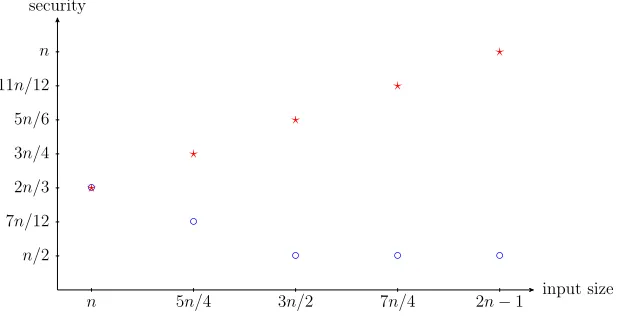
Fig. 1: Security bound of 2-LDT and 3-LDT for various choices of input size, where◦ stands for 2-LDT and? stands for 3-LDT.
input size security
n 5n/4 3n/2 7n/4 2n−1
n/2 7n/12 2n/3 3n/4 5n/6 11n/12
n
◦
◦
◦ ◦ ◦
?
?
?
?
?
security for the entire domain [n,2n−1]. As proven so far, the security of 3-round LDTincreases withs: for evaluations of size around nwe achieve 2n/ 3-bit security, and for evaluations of size around 2nwe get optimaln-bit security. Figure1plots the simplified security results of 2-LDT and 3-LDT for bit strings of length in{n,5n/4,3n/2,7n/4,2n−1}(these data are taken from the discussion in Sections5and6). In aforementioned example of an 80-bit cipher using a 64-bit primitive, 3-LDT achieves 23n/4= 248 security.
Central to our proofs is the introduction and usage of a new concept: “har-monic permutation primitives.” These can be seen as lazily-sampled permuta-tions where one part of the state is always sampled uniformly at random and the other part in such a way that permutation consistency is maintained. We de-scribe two harmonic primitives: a harmonic tweakable permutation in Section4.1 and a harmonic variable-length pseudorandom permutation in Section4.2.
These harmonic permutation primitives allow for compact, neat, and modu-lar security proofs of both 2-round and 3-round LDT. Both proofs use the two harmonic permutation primitives of Section4in a different setting, but using the chi-squared method by Dai et al. [14] and properties of the hypergeometric dis-tribution, security of both LDT modes is reduced to the security of the harmonic permutation primitives. What then remains is an analysis of these primitives in Sections7 and8.
1.4 Application
An example use case of length doublers is format-preserving encryption, a field that got significant attention recently in light of the standardization [16] of FF1 [6] and FF3 [8]. Format-preserving encryption considers the problem of en-crypting data from a small domain that does not fit the parameters of standard-ized block ciphers. For example, there is no practical way to length-preservingly encrypt 80-bit strings using AES-128 (other than streaming-based). Whereas the standardized FF1 and FF3 are made to facilitate arbitrary types of domains, for certain cases this can equally well be resolved using a length doubler. Above example of 80-bit strings can be resolved with a birthday bound secure length doubler on top of a lightweight 64-bit tweakable block cipher, but that would only give 32-bit security. As shown in Figure1, for this scenario 2-LDT would achieve around 37-bit security and 3-LDT even 48-bit security.
A more concrete example is that of electronic product code tag encryption, which is considered as a replacement for bar codes using low-cost passive RFID-tags. The standard EPC Class 1 Gen 2 RFID tag [18] proposes to use a unique 96-bit identifier for any physical item [19]. As for above generic case, a birthday bound secure length doubler on top of a 64-bit block cipher would give 32-bit security at best. Our bound of 2-LDT does not improve for this regime (see Figure1), but 3-LDT does achieve beyond birthday bound security: instantiated with a 64-bit tweakable block cipher, it reaches around 53-bit security.
It is straightforward to transform r-LDT into a tweakable length doubler, where the tweak is fed as additional tweak input to the underlying tweakable block ciphers (this requires extending the tweak space of the underlying prim-itive). This observation has two implications. First, one can obtain multi-user security of r-LDT by considering user IDs as tweak inputs and feeding those to the underlying tweakable block cipher. Second,r-LDT is an interesting and non-obvious generalization of the tweakable block cipher based domain exten-der of Coron et al. [12]. Stated simply, Coron et al. consiexten-dered the problem of transforming a tweakable block cipher with 2n-bit tweaks andn-bit blocks into a domain extender withn-bit tweaks and 2n-bit blocks. They presented a 2-round scheme (achieving birthday bound security) and a 3-round scheme (achieving optimaln-bit security). Our tweakable length doublers, instead, transform that tweakable block cipher into a length doubler with n-bit tweaks and [n,2n− 1]-bit blocks, therewith enabling support for variable length input. For the specific case ofs≈n, our schemes achieve the same level of security as those of [12].
universal hash functions, whereas 3-LDT uses three tweakable block ciphers. The latter could be beneficial for implementation on constrained devices. Finally, SBC is ultimately still a fixed input length cipher, whereas 3-LDT allows for inputs of size [n,2n−1].
2
Preliminaries
For n ∈N, we denote the set of all bit strings of lengthn as {0,1}n, and the set of all bit strings of arbitrary length as {0,1}∗. For m ∈
N and m ≤ n we define {0,1}[m,n] = S
m≤i≤n{0,1}
i. Given two bit strings X, Y ∈ {0,1}∗,
we use bothXkY and XY interchangeably to denote their concatenation. The length of X is denoted|X|, and ifX andY satisfy|X|=|Y|, we denote their bitwise addition asX⊕Y. ForX ∈ {0,1}n, we denoteleft
m(X) themleftmost bits of X and rightm(X) the m rightmost bits of X, in such a way that X =
leftn−m(X)krightm(X).
For n ∈ N and X ∈ {0,1}[0,n−1], we define a padding function pad(X) = Xk10n−|X|−1. We denote its inverse unpad that on input of a string of length n removes the rightmost string 10∗ and returns the resulting string. Note that
unpadis an injective mapping.
The expressionS←T denotes the assignment of the valueT to variableS, L ←−∪ S the addition of S to list L, and S ←− S$ for finite set S the uniformly random sampling of S from S. For an algorithm D and a function/oracle O, DO represents the evaluation ofDwith oracle interaction toO, and∆
D
O;P represents the advantage ofDin distinguishingOfrom an oracleP.
2.1 (Tweakable) Block Ciphers
For arbitrary finite key space K and n ∈ N, a block cipher is a function E : K × {0,1}n → {0,1}n such that for every fixed key K ∈ K, EK(·) = E(K,·) is a permutation on{0,1}n. We denote its inverse for fixed keyK byE−1
K (·) = E−1(K,·). Denote by Perm(n) the set of all permutations on{0,1}n. Tweakable block ciphers generalize over ordinary block ciphers by input of a t-bit tweak, fort∈N. More detailed, a tweakable block cipher is a function ˜E:K × {0,1}t× {0,1}n → {0,1}n such that for every fixed key K ∈ Kand tweak T ∈ {0,1}t,
˜
EK(T,·) = ˜E(K, T,·) is a permutation on {0,1}n. Its inverse for fixed key K and tweak T is denoted by ˜EK−1(T,·) = ˜E−1(K, T,·). Denote byPerm(] t, n) the set of all families of permutations ˜π : {0,1}t× {0,1}n → {0,1}n indexed by tweakT ∈ {0,1}t.
The security of a tweakable block cipher ˜E is measured by considering a distinguisher D that has two-sided query access to either ˜EK for a randomly drawn keyK←− K, or a random tweakable permutation ˜$ π←−$ Perm(] t, n), and its goal is try to distinguish the real construction from the ideal one:
Advsprpg
˜
E (D) =
Pr
h
K←− K$ :DE˜K± = 1i−Prh˜π $
←−Perm(] t, n) :D˜π± = 1i
For the left probability, the key space Kis a fair representation of the random-ness of ˜E±K. Often, it is the set ofk-bit strings, wherekis the key size. In proofs, specifically in hybrid arguments within proofs, one regularly considers tweakable block ciphers with idealized primitives. For example, one may consider the con-struction of a tweakable block cipher ˜Efrom a secret permutation (that could, in turn, be instantiated using a block cipher with secret key). In this case, the key space of ˜E isK= Perm(n). More involved examples appear if the construction internally consists of lazy sampling, as will for instance be the case with our harmonic tweakable SPRP in Section4.1.
2.2 Chi-Squared Method
Our proof will rely on the chi-squared method by Dai et al. [14].
Consider two stateless systemsO0,O1 and any computationally unbounded deterministic distinguisher Dthat has query access to either of these systems. The distinguisher’s goal is to distinguish both systems. If we denote the maxi-mum amount of queries byq, we can define a transcriptτ = (τ(1), . . . , τ(q)) and letτ(i) = (τ(1), . . . , τ(i)) for everyi≤q. DistinguisherD can make its queries adaptively, but as it makes them in a deterministic manner, the (i+ 1)-th query input is determined by the firsti query-responsesτ(i).
For systemO ∈ {O0,O1}and fixed tuple τ(i), we denote bypO,D(τ(i)) the
probability that distinguisher D interacting with O obtains transcript τ(i) for its first i queries. If pO,D(τ(i))>0, then we denote by pO,D(Y(i+1) | τ(i)) the
conditional probability thatDreceives responseY(i+1)upon its (i+ 1)-th query, given transcriptτ(i) of the firstiqueries (that deterministically fixes the input to the (i+ 1)-th query). Define for anyi ∈ {1, . . . , q} and any query-response tupleτ(i):
χ2(τ(i−1)) =X
Y(i)
pO1,D(Y
(i)|τ(i−1))−p
O0,D(Y
(i)|τ(i−1))2
pO0,D(Y
(i)|τ(i−1)) , (1)
where the sum is taken over allY(i) in the support of the distributionp
O0,D(· | τ(i−1)). The chi-squared method states the following:
Lemma 1 (Chi-squared method [14]). Consider a fixed deterministic dis-tinguisher D and two systems O0,O1. Suppose that for anyi ∈ {1, . . . , q} and any query-response tuple τ(i),pO0,D(τ
(i))>0 wheneverp
O1,D(τ
(i))>0. Then:
∆D
O0;O1
=kpO0,D(·)−pO1,D(·)k ≤ 1 2
q
X
i=1
Exp[χ2(τ(i−1))]
!1/2
, (2)
2.3 Hypergeometric Distribution
The hypergeometric distribution HG(N, K, n) considers the case ofndraws with-out replacement from a set of sizeN elements, denote byKthe total number of successes out ofN andhthe number of successes present in a sample of sizen. It is well-known that forh∼HG(N, K, n),
Exp[h] =n·K N ,
Var[h] =n·K N ·
(N−K)
N ·
N−n N−1.
3
Length Doublers and LDT
Following Chen et al. [11], we recall the formalization of length doublers in Section3.1, and present generalized LDT in Section3.2.
3.1 Length Doublers
For arbitrary finite key space K and n ∈ N, a length doubler is a function E : K × {0,1}[n,2n−1] → {0,1}[n,2n−1] such that for every fixed key K ∈ K, EK(·) =E(K,·) is a length preserving invertible function on {0,1}[n,2n−1]. We denote its inverse for fixed key K by EK−1(·) = E−1(K,·). Note that E should behave like a random permutation for every length input in [n,2n−1]. Denote by VPerm([n,2n−1]) the set of all length-preserving and invertible functions on{0,1}[n,2n−1]. The security ofE is measured by considering a distinguisherD that has two-sided query access to eitherEK for a randomly drawn keyK←− K,$ or a random length-preserving permutationρ←−$ VPerm([n,2n−1]), and its goal is to try to distinguish the real construction from the ideal one:
AdvvsprpE (D) = Pr
h
K←− K$ :DEK± = 1 i
−
Prhρ←−$ VPerm([n,2n−1]) :Dρ± = 1i
.
As in Section2.1, the key spaceK corresponds to the source of randomness of the constructionEK±. It may take various shapes, but it will always be clear from the context.
3.2 Generalized LDT
simplest possible option:mix(A, B) = (B, A), i.e., a function that swaps the two halves of its input. This simplification is without loss of generality: all results in this work generalize to arbitrary pure mixing functions with some notational overhead. For completeness, we describe pure mixing functions as defined by Chen et al. [11] in Appendix A.
Algorithm 1Round functionF[ ˜EK]
Input: K∈ K,M ∈ {0,1}[n,2n−1]
Output: C∈ {0,1}|M| 1: s← |M| −n
2: M1←leftn(M),M2←rights(M)
3: Y ←EK˜ (pad(M2), M1) 4: C←leftn−s(Y)kM2krights(Y)
5: returnC
Algorithm 2 Round functionF−1[ ˜EK]
Input: K∈ K,C∈ {0,1}[n,2n−1]
Output: M ∈ {0,1}|C| 1: s← |C| −n
2: C1←leftn(C),C2←rights(C)
3: Y ←leftn−s(C1)kC2
4: M←E˜−1
K (pad(rights(C1)), Y)krights(C1)
5: returnM
Consider finite key spaceK and let n∈N. Let ˜E :K × {0,1}n× {0,1}n → {0,1}n be a tweakable block cipher. Consider the round function F (and its inverse) that uses ˜EK for secret keyK∈ K, and length-preservingly transforms a plaintext M ∈ {0,1}[n,2n−1] (resp. a ciphertext C ∈ {0,1}[n,2n−1]) into a ciphertext C (resp. a plaintext M) as in Algorithm1 (resp. Algorithm 2). For r≥2, the r-round length doublerr-LDT is defined as
r-LDTK(M) =FKr◦ · · · ◦FK1(M), (3)
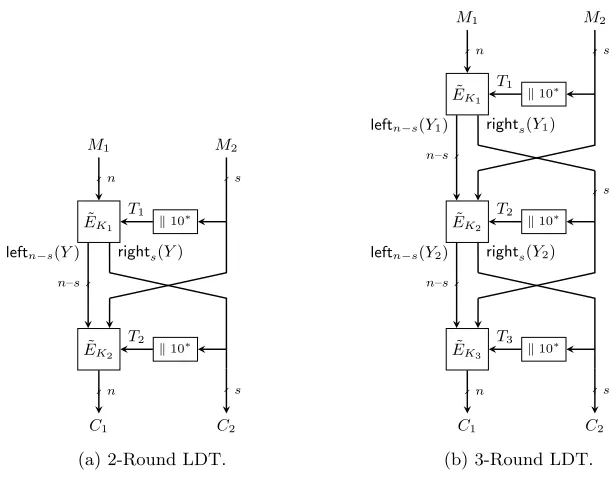
where K = (K1, . . . , Kr) ∈ Kr and M ∈ {0,1}[n,2n−1]. In this evaluation, the mixing of the last round function evaluation is irrelevant for the scheme’s security and therefore ignored. For r = 2 and r = 3, the doubler r-LDT is depicted in Figure2.
Chen et al. proved that two rounds of LDT (with arbitrary pure mixing) is secure against any adversary making around 2n/2 queries.
Proposition 1 (Chen et al. [11]). Let E˜ : K × {0,1}n× {0,1}n → {0,1}n be a tweakable block cipher. Consider two-round 2-LDT. For any distinguisher Dmaking at mostqqueries, there exist distinguishersD0
1 andD02 with the same query complexity such that
Advvsprp2-LDT(D)≤Advsprpg
˜ E (D
0
1) +Advg sprp
˜ E (D
0
2) +
q(q−1)
2n . (4)
M1 M2
˜
EK1 k10
∗
˜
EK2 k10
∗
C1 C2
.n .s
T1
.
n–s
leftn−s(Y) rights(Y)
T2
.n .s
(a) 2-Round LDT.
M1 M2
˜
EK1 k10
∗
˜
EK2 k10
∗
˜
EK3 k10
∗
C1 C2
.n .s
T1
.
n–s
leftn−s(Y1) rights(Y1)
.s
T2
.
n–s
leftn−s(Y2) rights(Y2)
T3
.n .s
(b) 3-Round LDT.
Fig. 2: Depiction of 2-round and 3-round LDT. Here,s=|M| −n.
4
Harmonic Permutation Primitives
In this section we introduce two harmonic permutation primitives: a tweakable SPRP in Section 4.1and a variable SPRP in Section4.2.
4.1 Harmonic Tweakable SPRP Ga,b
We introduce a tweakable pseudorandom permutation Ga,b parameterized by a, b ∈ {0,1}. The primitive will be used as intermediate in the analysis of 2-LDT (for (a, b) = (1,0) and (a, b) = (0,1)) and in the analysis of 3-LDT (for (a, b) = (1,1)).
Ga,bis a tweakable permutation withn-bit tweaks and data blocks (soGa,b∈ ]
Perm(n, n)). It maintains an initially empty list L to store all query-response tuples (T, X, Y). For T ∈ {0,1}n, write dom(L
T) = {X | (T, X,·) ∈ L} and
Algorithm 3 HarmonicG−a,b1
Input: T ∈ {0,1}n\{0n}, X∈ {0,1}n
Output: Y ∈ {0,1}n
1: s← |unpad(T)| 2: if a= 0then 3: Y ←− {0$ ,1}n\
rng(LT)
4: if a= 1then 5: Z ←− {0$ ,1}s
6: Y ←− {{0$ ,1}n−sk
Z}\rng(LT)
7: L←∪−(T, X, Y) 8: returnY
Algorithm 4HarmonicG−a,b1
Input: T ∈ {0,1}n\{0n}, Y ∈ {0,1}n
Output: X ∈ {0,1}n
1: s← |unpad(T)| 2: if b= 0then 3: X ←− {0$ ,1}n\
dom(LT)
4: if b= 1then 5: Z ←− {0$ ,1}s
6: X ←− {{0$ ,1}n−sk
Z}\dom(LT)
7: L←∪−(T, X, Y) 8: returnX
In our work,Ga,b will never be called for tweakT = 0n, hence the assign-ment s← |unpad(T)|is sound. If a=b = 0, G0,0 describes a randomly drawn tweakable permutation from Perm(] n, n) (lazily sampled). We will useGa,b for the case whereaorbis 1.
Lemma 2. Let a, b∈ {0,1}, and considerGa,b. Let smin, smax∈[0, n−1]such
that smin ≤ smax. Let 1 ≤ θ ≤ 2n−smax−2 be an integral threshold. For any
distinguisher D making at most q ≤ 2n−1 queries, all with tweaks satisfying |unpad(T)| ∈[smin, smax], and restricted to making at mostθ inverse queries per
tweak (if a= 1) and at most θforward queries per tweak (if b= 1), we have
Advsprpg Ga,b(D)≤
0 if(a, b) = (0,0),
2q3
22n−smax 1/2
+
q
θ
1
2(θ−1)smin, if(a, b)∈ {(1,0),(0,1)},
4 θ+θ2
q
22n−smax !1/2
, if(a, b) = (1,1).
Note that no limitation is put on the number of times a single tweak is queried in forward direction in casea= 0 or in inverse direction in caseb= 0. The proof will be given in Section7.
4.2 Harmonic VSPRP Permutation H
Algorithm 5 HarmonicH−1 Input: X ∈ {0,1}[n,2n−1]
Output: Y ∈ {0,1}|X| 1: s← |X| −n
2: Z←− {0$ ,1}s
3: Y ←− {{0$ ,1}nk
Z}\rng(Ls)
4: L←∪−(X, Y) 5: returnY
Algorithm 6HarmonicH−1
Input: Y ∈ {0,1}[n,2n−1]
Output: X ∈ {0,1}|Y| 1: s← |Y| −n
2: Z←− {0$ ,1}s
3: X←− {{0$ ,1}nk
Z}\dom(Ls)
4: L←∪−(X, Y) 5: returnX
Lemma 3. Consider H. Letsmin∈[0, n−1]. For any distinguisherDmaking
at mostq≤2n−1 queries, all of length in [n+smin,2n−1]bits, we have
AdvvsprpH (D)≤
2q3 22n+smin
1/2
.
The proof will be given in Section8.
5
2-Round LDT
As main result on 2-LDT, we derive the following reduction to harmonic primi-tivesGa,b andH.
Theorem 1. LetE˜ :K×{0,1}n×{0,1}n→ {0,1}nbe a tweakable block cipher. Consider two-round2-LDT. Letsmin, smax∈[0, n−1]such thatsmin≤smax. Let
1 ≤θ ≤2n−smax−2 be an integral threshold. For any distinguisher D making at
mostqqueries, all of length in[n+smin, n+smax]bits, there exist distinguishers
D0
1, . . . ,D50 with the same query complexity such that
Advvsprp2-LDT(D)≤Advsprpg
˜ E (D
0
1) +Advg sprp
˜ E (D
0
2) +Adv vsprp H (D
0
3) (5a)
+Advsprpg G1,0(D
0
4) +Advg sprp G0,1(D
0
5) +
q
θ
1
2(θ−1)smin, (5b)
where D0
4 may make at most θ inverse queries per tweak and D05 at most θ forward queries per tweak.
We will prove Theorem1in Section5.1. Plugging the bounds of Lemmas2and3 into the equation yields the following corollary.
Corollary 1. LetE˜ :K×{0,1}n×{0,1}n→ {0,1}nbe a tweakable block cipher. Consider two-round2-LDT. Letsmin, smax∈[0, n−1]such thatsmin≤smax. Let
1 ≤θ ≤2n−smax−2 be an integral threshold. For any distinguisher D making at
mostqqueries, all of length in[n+smin, n+smax]bits, there exist distinguishers
D0
1,D02 with the same query complexity such that
Advvsprp2-LDT(D)≤Advsprpg
˜ E (D
0
1) +Advg sprp
˜ E (D
0
2)
+
2q3
22n+smin 1/2
+ 2
2q3
22n−smax 1/2
+ 3
q
θ
1
The first two advantages represent the security of the underlying tweakable block cipher ˜E. By Stirling’s approximation, ifsmin≤θ, the last term satisfies
3
q
θ
1
2(θ−1)smin ≤3·2
smin· qe θ2smin
θ
≤3
2qe
θ2smin
θ
.
As the term decreases withθ but θis limited by side condition θ≤2n−smax−2, it makes sense to chooseθ= 2n−smax−2, and this term equals
3
8qe
2n+smin−smax
θ
.
We obtain security up to approximately min2n+smin 3 ,
2n−smax
3 , n+smin−smax bits, provided that smin ≤2n−smax−2. For smax ≥n/2, the middle term domi-nates and we achieven/2-bit security at most. In this case, the bound of Chen et al. [11] is better. For smax < n/2, our bound guarantees up to at most 2n/3 bits of security, depending of the choice of smax, where smin is adapted tosmin≤2n−smax−2.
5.1 Proof of Theorem 1
Consider any distinguisher D making at most q queries, all of length in [n+ smin, n+smax] bits. It has access to either 2-LDTK forK= (K1, K2)
$ ←− K2 or a random length-preserving invertible permutation ρ←−$ VPerm([n . . .2n−1]). For ease of discussion, write
2-LDTK =E[ ˜EK1,E˜K2].
Let ˜π1,π2˜ ←−$ Perm(] n, n). We have
Advvsprp2-LDT(D) =∆D
E[ ˜EK1,E˜K2]
±; ρ±
≤∆D0
1
˜ EK±
1 ; ˜π
±
1
+∆D0
2
˜ EK±
2 ; ˜π
±
2
+∆D
E[˜π1,π2˜ ]± ; ρ±
=Advsprpg
˜ E (D
0
1) +Advg sprp
˜ E (D
0
2) +∆D
E[˜π1,π2˜ ]±; ρ±, (6)
for some distinguishers D0
1 andD20 with the same query complexity asD. We will focus on the remaining distance in (6). Without loss of generality, we will consider computationally unbounded and deterministic distinguishers. Consider three harmonic primitives,G1,0 andG0,1 of Section4.1andH of Sec-tion4.2. We obtain via the triangle inequality:
∆D
E[˜π1,π2˜ ]±; ρ±≤∆D
E[˜π1,π2˜ ]±; E[G1,0, G0,1]±
+∆D
E[G1,0, G0,1]±; H±
+∆D
H±; ρ±
=∆D
E[˜π1,π˜2]±; E[G1,0, G0,1]±
+∆D
E[G1,0, G0,1]±; H±
+AdvvsprpH (D0
for some distinguisherD0
3with the same query complexity asD(in fact,D30 =D). Below two claims bound the remaining distances in (7) and complete the proof.
Claim. We have∆D
E[G1,0, G0,1]±; H±
= 0.
Proof (of claim). For any query to H of length n+s bits (either forward or inverse), the last s bits of the response are drawn uniformly at random from {0,1}s and the firstn bits are drawn uniformly at random in such a way that the permutativity ofH is retained (see Algorithms5and6). Consider any query to E[G1,0, G0,1], without loss of generality a forward query of lengthn+s bits. The srightmost bits of the output equal the srightmost bits of G1,0, and are generated uniformly at random (see Algorithm3). Denote thiss-bit block byC2. The remaining nbits of the response, say C1, come from the evaluation ofG0,1 for tweakC2, on input of a data block that never appeared for this tweak before. As can be deduced from Algorithm3,G0,1behaves like a tweakable permutation: for every tweak input, it behaves like a permutation. Therefore,C1is generated uniformly at random in such a way that C1kC2 has never appeared before. Concluding,E[G1,0, G0,1]± andH± follow identical distributions. ut
Claim. We have
∆D
E[˜π1,π˜2]±; E[G1,0, G0,1]±
≤Advsprpg G1,0(D
0
4) +Advg sprp G0,1(D
0
5) +
q
θ
1
2(θ−1)smin ,
for some distinguishersD0
4 andD05with the same query complexity asD, where D0
4 may make at most θ inverse queries per tweak and D05 at most θ forward queries per tweak.
Proof (of claim).Consider a computationally unbounded and deterministic dis-tinguisher D making at most q queries. It has access to either E[˜π1,π2˜ ]± or E[G1,0, G0,1]±. Summarize the queries in a transcriptτ = (τ(1), . . . , τ(q)), where thei-th tupleτ(i)= (`(i), X(i), Y(i)) is comprised of a bit`(i)∈ {−1,1}denoting the direction of the query,X(i)is the query input andY(i)the query output, in such a wayY(i)=O`(i)
(X(i)). Writes(i)=|X(i)| −n. We assume that the dis-tinguisherDdoes not repeat any query, which means thatτ(i) does not contain duplicate elements.
For the thresholdθof the theorem statement, define the following bad event:
BAD : max
`∈{−1,1}s∈[smaxmin,smax] max
Z∈{0,1}s {i|`
(i)=`∧s(i)=s∧right
Clearly, writingOπ˜ =E[˜π1,˜π2]± andOG=E[G1,0, G0,1]± for brevity,
∆D
O˜π; OG
= Pr
DO˜π = 1−PrDOG= 1
≤ Pr
DO˜π = 1∧ ¬BAD−PrDOG= 1∧ ¬BAD
+Pr
DOπ˜ = 1∧BAD−PrDOG= 1∧BAD
≤ Pr
DO˜π = 1∧ ¬BAD
−Pr
DOG= 1∧ ¬BAD
+ maxnPr [Oπ˜ setsBAD],Pr [OG sets BAD]
o
. (8)
Denoting the distance in (8) by∆¬BAD
D
O˜π; OG
for brevity, a straightforward
triangle argument shows that
∆¬DBADO˜π; OG
≤Advsprpg G1,0(D
0
4) +Advg sprp G0,1(D
0
5), (9)
for some distinguishersD0
4 andD05with the same query complexity asD, where D0
4 may make at most θ inverse queries per tweak and D05 at most θ forward queries per tweak. These two restrictions follow from the way E evaluates its primitives (˜π1,π2˜ in the left oracle andG1,0, G0,1 in the right oracle) and from the conditioning of the bad event.
Consider the max-term in (8). Consider any`∈ {−1,1}ands∈[smin, smax], and denote the number of queries with`(i)=` ands(i)=sbyq`,s. ForOG, in forward queries therights(Y(i))-values come from the evaluation ofG1,0and are always uniformly randomly drawn (see Algorithm3), whereas in inverse queries they come from evaluations ofG−0,11and are also uniformly randomly drawn (see Algorithm4). Therefore,
Pr [OG sets BADfor (`, s)]≤
q
`,s θ
1
2(θ−1)s.
On the other hand, for Oπ, the˜ rights(Y(i))-values come from a truncated per-mutation evaluation, and we find
Pr [Oπ˜ sets BADfor (`, s)] =
q
`,s θ
·2s· θ−1
Y
i=0
2n−s−i 2n−i ≤
q
`,s θ
1
2(θ−1)s.
We thus obtain
maxnPr [Oπ˜ sets BAD] ,Pr [OG setsBAD]
o
≤
q
θ
1
2(θ−1)smin, (10)
using that qa
θ
+ qb
θ
≤ qa+qb
θ
and the distinguisher maximizes its probability fors=smin. The proof is concluded by combining (8), (9), and (10). ut
6
3-Round LDT
Theorem 2. LetE˜ :K×{0,1}n×{0,1}n→ {0,1}nbe a tweakable block cipher. Consider three-round 3-LDT. Letsmin, smax∈[0, n−1]such that smin≤smax.
Let 1≤θ≤2n−smax−2 be an integral threshold. For any distinguisher Dmaking
at mostqqueries, all of length in[n+smin, n+smax]bits, there exist distinguishers
D0
1, . . . ,D50 with the same query complexity such that
Advvsprp3-LDT(D)≤Advsprpg
˜ E (D
0
1) +Advg sprp
˜ E (D
0
2) +Advg sprp
˜ E (D
0
3) (11a)
+AdvvsprpH (D40) +Advsprpg G1,1(D
0
5) +
q
θ
1
2(θ−1)smin ,(11b)
whereD0
5 may make at most θforward and θ inverse queries per tweak.
We will prove Theorem 2in Section6.1.
The improvement of the bound of 3-LDT over that of 2-LDT of Theorem1 is readily visible: Advsprpg
G1,0+Adv g
sprp
G0,1 has been replaced with Adv g
sprp G1,1, which by Lemma 2achieves a better bound. Plugging the bounds of Lemmas 2and3 into the equation yields the following corollary.
Corollary 2. LetE˜ :K×{0,1}n×{0,1}n→ {0,1}nbe a tweakable block cipher. Consider three-round 3-LDT. Letsmin, smax∈[0, n−1]such that smin≤smax.
Let 1≤θ≤2n−smax−2 be an integral threshold. For any distinguisher Dmaking
at mostqqueries, all of length in[n+smin, n+smax]bits, there exist distinguishers
D01,D02,D30 with the same query complexity such that
Advvsprp3-LDT(D)≤Advsprpg
˜ E (D
0
1) +Advg sprp
˜ E (D
0
2) +Advg sprp
˜ E (D
0
3)
+
2q3
22n+smin 1/2
+ 4 θ+θ 2
q 22n−smax
!1/2
+
q
θ
1
2(θ−1)smin .
The first three advantages represent the security of the underlying tweakable block cipher ˜E. Two of the terms in the remaining portion of the bound depend onθ: the first one increases withθwhereas the latter decreases withθ. Recalling from Section5that, for smin≤θ,
q
θ
1
2(θ−1)smin ≤
2qe
θ2smin
θ
,
equating the twoθ-dependent fractions in the corollary givesθ≈2(2n−smax−smin)/3. This threshold value still has to obey to the conditionsmin≤θ≤2n−smax−2, or stated differently,
smax≤min
(n−6 +smin)/2,2n−smin−3 log2(smin) . (12)
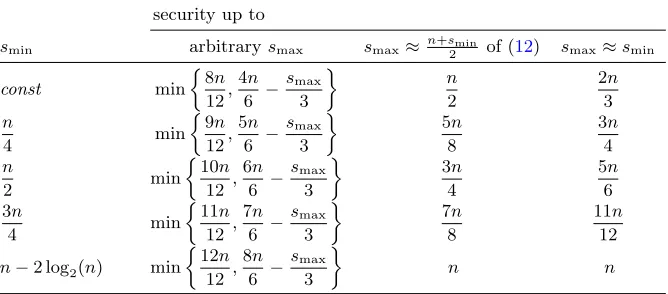
Table 1: Interpretation of the bound of Corollary 2 for various choices ofsmin, where const is a constant to make the bound meaningful. Small constants are omitted in the security upper bound.
security up to
smin arbitrarysmax smax≈n+smin
2 of (12) smax≈smin
const min 8n 12, 4n 6 − smax 3 n 2 2n 3 n 4 min 9n 12, 5n 6 − smax 3 5n 8 3n 4 n 2 min 10n 12 , 6n 6 − smax 3 3n 4 5n 6 3n 4 min 11n 12 , 7n 6 − smax 3 7n 8 11n 12
n−2 log2(n) min 12n 12 , 8n 6 − smax 3 n n
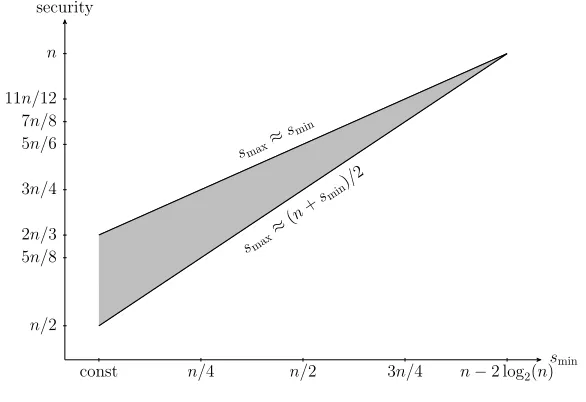
Note that these two choices of smax set its two extremes: for given smin, we require that smin ≤smax ≤(n+smin)/2. The security bounds for the two extremes are plotted in Figure3: the level of security given by Corollary2is in the shaded area of Figure3 and depends onsminandsmax. For example, fixing smin = n/2, the security bound of Corollary 2 lies between 3n/4 (for smax ≈ (n+smin)/2) and 5n/6 (forsmax≈smin), using thatsmin≤smax≤(n+smin)/2 by condition.
6.1 Proof of Theorem 2
The first steps of the proof resemble those of Section 5.1. Consider any dis-tinguisher D making at most q queries. It has access to either 3-LDTK for K= (K1, K2, K3)←− K$ 3 or a random length-preserving invertible permutation ρ←−$ VPerm([n . . .2n−1]). For ease of discussion, write
3-LDTK =E[ ˜EK1,E˜K2,E˜K3].
Let ˜π1,π˜2,˜π3 $
←−Perm(] n, n). We have
Advvsprp3-LDT(D) =∆D
E[ ˜EK1,E˜K2,E˜K3]
± ; ρ±
≤∆D0
1
˜ EK±
1 ; ˜π
±
1
+∆D0
2
˜ EK±
2 ; ˜π
±
2
+∆D0
3
˜ E±K
3; ˜π
±
3
+∆D
E[˜π1,˜π2,π˜3]±; ρ±
=Advsprpg
˜ E (D
0
1) +Advg sprp
˜ E (D
0
2) +Advg sprp
˜ E (D
0
3)
+∆D
E[˜π1,˜π2,π˜3]±; ρ±
Fig. 3: Simplified security bound of 3-LDT for various choices of smin. Lower line is for smax ≈ (n+smin)/2, upper line for smax ≈ smin. Security of 3-LDT is indicated by the shaded area and depends on smin and smax, where smin≤smax≤(n+smin)/2.
smin
security
const n/4 n/2 3n/4 n−2 log2(n)
n/2 5n/8 2n/3 3n/4 5n/6 7n/8 11n/12
n
smax ≈smin
smax ≈(n
+smin )/2
for some distinguishers D0
1,D20, andD02 with the same query complexity asD. We will focus on the remaining distance in (13). Without loss of generality, we will consider computationally unbounded and deterministic distinguishers. Consider two harmonic primitives,G1,1 of Section4.1andH of Section4.2. We obtain via the triangle inequality:
∆D
E[˜π1,π˜2,π˜3]± ; ρ±
≤∆D
E[˜π1,π˜2,π˜3]± ; E[˜π1, G1,1,π˜3]±
+∆D
E[˜π1, G1,1,˜π3]±; H±
+∆D
H±; ρ±
=∆D
E[˜π1,π2,˜ π3˜ ]± ; E[˜π1, G1,1,π3˜ ]±
+∆D
E[˜π1, G1,1,˜π3]±; H±
+AdvvsprpH (D04), (14)
for some distinguisherD0
4with the same query complexity asD(in fact,D40 =D). Below two claims bound the remaining distances in (14) and complete the proof.
Claim. We have∆D
E[˜π1, G1,1,π˜3]± ; H±
= 0.
the permutativity ofH is retained (see Algorithms5and6). Consider any query to E[˜π1, G1,1,π˜3], without loss of generality a forward query of length n+s bits. Thes rightmost bits of the output equal thesrightmost bits of G1,1, and are generated uniformly at random (see Algorithm 3; here, we make explicit use of the fact that G1,1 never receives the same input twice). Denote this s -bit block by C2. The remaining n bits of the response, say C1, come from the evaluation of ˜π3 for tweakC2 on input of a data block that never appeared for this tweak before. For every tweak input, the tweakable permutation ˜π3behaves like a permutation. Therefore, C1 is generated uniformly at random in such a way thatC1kC2has never appeared before. Concluding,E[˜π1, G1,1,π3˜ ]±andH±
follow identical distributions. ut
Claim. We have
∆D
E[˜π1,π˜2,˜π3]±; E[˜π1, G1,1,π˜3]±
≤Advsprpg G1,1(D
0
5) +
q
θ
1
2(θ−1)smin,
for some distinguisher D0
5 with the same query complexity asD, but that may make at mostθforward andθ inverse queries per tweak.
Proof (of claim).The first part of the proof resembles that of the corresponding claim in Section5.1.
Consider a computationally unbounded and deterministic distinguisher D making at mostqqueries. It has access to eitherE[˜π1,˜π2,π˜3]±orE[˜π1, G1,1,π˜3]±. Summarize the queries in a transcript τ = (τ(1), . . . , τ(q)), where thei-th tuple τ(i)= (`(i), X(i), Y(i)) is comprised of a bit `(i)∈ {−1,1}denoting the direction of the query, X(i) is the query input andY(i) the query output, in such a way Y(i) =O`(i)(X(i)). Write s(i) =|X(i)| −n. We further denote by Z(i) the last s bits of the output of ˜π1 (which is also the last s bits of the input of ˜π3) in forward queries, and the last sbits of the output of ˜π−31 (which is also the last sbits of the input of ˜π1−1) in inverse queries. We assume that the distinguisher Ddoes not repeat any query, which means thatτ(i) does not contain duplicate elements.
For the thresholdθof the theorem statement, define the following bad event:
BAD : max
`∈{−1,1}s∈[smaxmin,smax] max Z∈{0,1}s
{i|`
(i)=`∧s(i)=s∧Z(i)=Z} > θ .
As before, writingO˜π=E[˜π1,π˜2,π˜3]± andOG=E[˜π1, G1,1,π˜3]±,
∆D
O˜π; OG
≤ Pr
DO˜π = 1∧ ¬BAD−PrDOG= 1∧ ¬BAD
+ maxnPr [Oπ˜ setsBAD],Pr [OG sets BAD]
o
. (15)
Denoting the distance in (15) by∆¬DBADO˜π; OG
for brevity, a straightforward triangle argument shows that
∆¬DBADO˜π; OG
≤Advsprpg G1,1(D
0
for some distinguisher D0
5 with the same query complexity asD, but that may make at mostθforward andθinverse queries per tweak. These two restrictions follow from the wayE evaluates its primitives (˜π2 in the left oracle andG1,1in the right oracle) and from the conditioning of the bad event.
Consider the max-term in (15). Consider any`∈ {−1,1}ands∈[smin, smax], and denote the number of queries with`(i)=`ands(i)=sbyq
`,s. For bothO˜π andOG, theZ(i)-values come from a truncated permutation evaluation, and we find forO ∈ {Oπ˜,OG}:
Pr [Osets BADfor (`, s)] =
q
`,s θ
·2s· θ−1
Y
i=0
2n−s−i 2n−i ≤
q
`,s θ
1
2(θ−1)s.
We thus obtain
maxnPr [Oπ˜ sets BAD] ,Pr [OG setsBAD]
o
≤
q
θ
1
2(θ−1)smin, (17)
as before. The proof is concluded by combining (15), (16), and (17). ut
7
Proof of Lemma
2
on
G
a,bFor a=b= 0, the lemma is trivial. Let a, b∈ {0,1} such thata+b ≥1, and consider any distinguisherDmaking at mostqqueries, all with tweaks satisfying |unpad(T)| ∈[smin, smax], and it makes at mostθ inverse queries per tweak (if a = 1) and at most θ forward queries per tweak (if b = 1). The distinguisher has access to either random systemGa,bor ˜π
$
←−Perm(] n, n), and without loss of generality,Dis computationally unbounded and deterministic.
We will use the chi-squared method of Section2.2, withO2=Ga,bbeing the real system andO0= ˜πthe ideal system. Define an intermediate worldO1that implementsO2, unless some event “BAD” (defined below) happens, from which point it implements O0. Summarize the communication ofD with its oracle in a transcriptτ = (τ(1), . . . , τ(q)), where τ(i)= (`(i), T(i), X(i), Y(i)) consists of a bit `(i) ∈ {−1,1} indicating the direction of the query (1 means forward, and −1 means inverse), a tweak valueT(i), an input valueX(i), and a responseY(i), in such a way thatO`(i)(T(i), X(i)) =Y(i)forO ∈ {O0,O
2}. By a triangle inequality,
Advsprpg
Ga,b(D) =kpO0,D(·)−pO2,D(·)k
≤ kpO0,D(·)−pO1,D(·)k+kpO1,D(·)−pO2,D(·)k. (18)
hence,
kpO1,D(·)−pO2,D(·)k=
X
τ∈T
max{0, pO1,D(τ)−pO2,D(τ)}
= X
τ∈Tbad
max{0, pO1,D(τ)−pO2,D(τ)}
≤ X
τ∈Tbad
pO1,D(τ) = Pr [O1setsBAD].
We obtain from (18):
Advsprpg
Ga,b(D)≤ kpO0,D(·)−pO1,D(·)k+ Pr [O1sets BAD]. (19) We will formalize and analyze BAD in Section 7.1 and analyze the remaining distance using the chi-squared technique in Section7.2. These will immediately conclude the proof by (19).
7.1 Bad Transcripts
For the thresholdθ of the theorem statement, define the following bad events:
BAD1 : max
s∈[smin,smax]Z,Zmax0∈{0,1}s
{i|a= 1∧`
(i)= 1∧unpad(T(i)) =Z∧right
s(Y(i)) =Z0}
> θ ,
BAD2 : max
s∈[smin,smax]Z,Zmax0∈{0,1}s
{i|a= 1∧` (i)
=−1∧unpad(T(i)) =Z∧rights(X
(i) ) =Z0}
> θ ,
BAD3 : max
s∈[smin,smax]Z,Zmax0∈{0,1}s
{i|b= 1∧` (i)
= 1∧unpad(T(i)) =Z∧rights(X
(i) ) =Z0}
> θ , BAD4 : max
s∈[smin,smax]Z,Zmax0∈{0,1}s
{i|b= 1∧`
(i)=−1∧unpad(T(i)) =Z∧right
s(Y
(i)) =Z0} > θ . DefineBAD=BAD1∨BAD2∨BAD3∨BAD4.
The bad events look complicated, but in fact they are not. If (a, b) = (0,0), none of the four bad events are satisfied, andBADdoes not hold by construction. On the other hand, if (a, b) = (1,1), the distinguisher makes at mostθ forward queries per tweak and at most θ inverse queries per tweak, and also in this case BAD does not hold by construction. The cases (a, b) = (1,0),(0,1) are symmetric, and we treat the former only. If (a, b) = (1,0), BAD3,BAD4 do not hold as b = 0, and BAD2 does not hold as the distinguisher makes at mostθ inverse queries. We are left with BAD1. Consider any s∈ [smin, smax] and any Z ∈ {0,1}s, and denote the number of queries with`(i)= 1 andunpad(T(i)) =Z byqs,Z. Therights(Y(i))-values come from the evaluation ofG1,0and are always uniformly randomly drawn (see Algorithm3). Therefore,
Pr [O1sets BADfor (s, Z)]≤
qs,Z θ
1 2(θ−1)s.
We thus obtain
Pr [O1 setsBAD]≤
q
θ
1
using that qa
θ
+ qb
θ
≤ qa+qb
θ
and the distinguisher maximizes its probability fors=smin. Recalling that the case of (a, b) = (0,1) is symmetric and thatBAD is not set for (a, b) = (0,0),(1,1), we obtain
Pr [O1 setsBAD]≤ |a−b| ·
q
θ
1
2(θ−1)smin.
7.2 Distance Between O0 and O1
Our aim is to bound the term of (1). Consider a given transcriptτ(i−1), which in turn determines the values`(i),T(i), andX(i). Lets=|unpad(T(i))|, and con-sider any valueY(i). As both oracles behave independently for different tweaks, it suffices to focus on earlier queries of the same tweak. We additionally refine into the number of queries with the same or opposite query direction. Let
ipos=
n
j∈ {1, . . . , i−1} |T(j)=T(i)∧`(j)=`(i)o ,
ineg= n
j∈ {1, . . . , i−1} |T(j)=T(i)∧`(j)=−`(i)o ,
and writei0=ipos+inegfor brevity. Let
hpos(Y(i)) =
n
j∈ {1, . . . , i−1} |T(j)=T(i)∧`(j)=`(i)∧right
s(Y(j)) =rights(Y(i))
o ,
hneg(Y(i)) =
n
j∈ {1, . . . , i−1} |T(j)=T(i)∧`(j)=−`(i)∧rights(X(j)) =rights(Y(i))o , wherehpos(Y(i))≤iposandhneg(Y(i))≤ineg, and writeh(Y(i)) =hpos(Y(i)) + hneg(Y(i)). We can distinct the following cases.
(1) `(i)= 1 (forward query) and Y(i)∈rng(LT). This case is excluded as Y(i) is not in the support of both probabilities;
(2) `(i)= 1 (forward query) and Y(i)∈/rng(LT). (a) a= 0. We havepO0,D(Y
(i)|τ(i−1)) =p
O1,D(Y
(i)|τ(i−1)) = 1
2n−i0, as the
response is drawn uniformly at random from a set of size 2n minus the amount of earlier queries for the same tweak;
(b) a= 1. We havepO0,D(Y(i)|τ(i−1)) = 2n1−i0 as before, andpO1,D(Y(i)|
τ(i−1)) = 1
2s(2n−s−h(Y(i))) as rights(Y(i)) is generated uniformly at ran-dom, andleftn−s(Y(i)) from a set of size 2n−sminush(Y(i)). For later
us-age, note that this case fixes (`(i), T(i), Y(i)), and we havehpos(Y(i))≤θ by¬BAD1andhneg(Y(i))≤θby¬BAD2. Therefore, in this case, we have h(Y(i))≤2θ.
(3) `(i)=−1 (inverse query) andY(i)∈dom(LT). The case is symmetric to (1). (4) `(i)=−1 (inverse query) andY(i)∈/ dom(L
T). (a) b= 0. The case is symmetric to (2a).
Cases (2b) and (4b) dominate the chi-squared technique, and we obtain for χ2(τ(i−1)) of (1):
χ2(τ(i−1)) =X
Y(i)
1 2n−i0 −
1 2s(2n−s−h(Y(i)))
2
1 2n−i0
=X
Y(i)
(2n−i0)·
1
2n−i0 −
1
2s(2n−s−h(Y(i)))
2
=X
Y(i)
1
(2n−i0)(2n−s−h(Y(i)))2 ·
h(Y(i))− i
0
2s
2
≤ 1
(2n−i0)(2n−s−2θ)2·
X
Y(i)
h(Y(i))− i
0
2s
2
≤ 8
23n−2s·
X
Y(i)
h(Y(i))− i
0
2s
2
,
using thath(Y(i))≤2θby¬BAD(see above), andi0≤2n−1andθ≤2n−smax−2. We find for its expectation:
Exp[χ2(τ(i−1))]≤ 8 23n−2s ·
X
Y(i) Exp
"
h(Y(i))− i
0
2s
2#
. (21)
Recalling thati0=ipos+inegandh(Y(i)) =hpos(Y(i))+hneg(Y(i)), the remaining expectation satisfies:
Exp
"
h(Y(i))− i
0 2s 2# = Exp "
hpos(Y(i)) +hneg(Y(i))−ipos+ineg 2s
2#
= Exp
"
hpos(Y(i))−ipos 2s
2#
+ Exp
"
hneg(Y(i))−ineg 2s
2#
+ 2·Exp
hpos(Y(i))−ipos
2s hneg(Y
(i))−ineg 2s
= Exp
"
hpos(Y(i))− ipos
2s
2#
+
hneg(Y(i))− ineg
2s
2
+ 2·
Exphhpos(Y(i))i−ipos
2s hneg(Y
(i))−ineg 2s
.
(22)
Ashpos(Y(i))∼HG(2n,2n−s, ipos), by Section2.3it satisfies
Exp[hpos(Y(i))] =ipos 2s ,
Var[hpos(Y(i))] =ipos 2s ·
1− 1 2s
·2 n−ipos
and we obtain that
Exp
"
h(Y(i))− i
0
2s
2#
= ipos 2s ·
1− 1 2s
·2 n−i
pos 2n−1 +
hneg(Y(i))− ineg
2s
2
≤ ipos 2s +
hneg(Y(i))−ineg 2s
2
. (23)
We furthermore claim the following.
Claim. We haveP
Y(i)
hneg(Y(i))− ineg
2s 2
≤i2 neg2n−s.
Proof (of claim).We have
X
Y(i)
hneg(Y(i))−ineg 2s
2
=X
Z(i)
X
Y(i)=∗kZ(i)
hneg(Y(i))−ineg 2s
2
.
Ashneg(Y(i)) =hneg(Y(i)0) forrights(Y(i)) =rights(Y(i)0), we subsequently have
X
Y(i)
hneg(Y(i))−ineg 2s
2
=X
Z(i) 2n−s
hneg(0n−skZ(i))−ineg 2s
2
= 2n−sX
Z(i)
hneg(0n−skZ(i)) 2
−2hneg(0n−skZ(i))ineg 2s +
ineg
2s
2!
≤2n−s i2neg−2i 2 neg 2s +
2si2 neg 22s
!
= 2n−s i2neg− i2
neg 2s
!
≤i2neg2n−s. ut
Equations (21) and (23), alongside above claim, constitute to
Exp[χ2(τ(i−1))]≤ 8
23n−2s· ipos2
n−s+i2 neg2
n−s
= 8 ipos+i 2 neg
22n−s . (24)
If (a, b)∈ {(1,0),(0,1)}, we haveipos, ineg≤(i−1) and
(24)≤ 8 (i−1) + (i−1) 2
22n−s .
Lemma1:
kpO0,D(·)−pO1,D(·)k ≤
1 2
q
X
i=1
8 (i−1) + (i−1)2
22n−smax
!1/2
=
4
3
q3−q 22n−smax
1/2
≤
2q3
22n−smax
1/2
.
On the other hand, if (a, b) = (1,1), we haveipos, ineg≤θ and
(24)≤ 8 θ+θ 2
22n−s .
Again sticking to the maximal s, this gives by Lemma1:
kpO0,D(·)−pO1,D(·)k ≤
1 2
q
X
i=1
8 θ+θ2
22n−smax
!1/2
= 4 θ+θ 2
q
22n−smax
!1/2
.
8
Proof of Lemma
3
on
H
Consider any distinguisherDmaking at mostq≤2n−1 queries, all of length in [n+smin,2n−1] bits. The distinguisher has access to either random systemH orρ←−$ VPerm([n,2n−1]), and without loss of generality, Dis computationally unbounded and deterministic.
We will use the chi-squared method of Section2.2, withO0 =H being the real system and O1=ρthe ideal system. Summarize the communication of D with its oracle in a transcriptτ = (τ(1), . . . , τ(q)), where τ(i)= (`(i), X(i), Y(i)) consists of a bit `(i) ∈ {−1,1} indicating the direction of the query (1 means forward, and −1 means inverse), an input value (X(i)), and a responseY(i), in such a way thatO`(i)(X(i)) =Y(i)forO ∈ {O0,O
1}.
Unlike the proof of Section 7, we will not rely on additional bad events, and there is no need to perform a hybrid argument and to upper bound the probability of bad events. We immediately move to bounding the term of (1), and the proof is very similar to that in Section7.2. Consider a given transcript τ(i−1), which in turn determines the values`(i)andX(i). Lets=|X(i)| −n, and consider any valueY(i). As both oracles behave independently for different input lengths, it suffices to focus on earlier queries of the same size. We additionally refine into the number of queries with the same or opposite query direction. Let
ipos=
n
j∈ {1, . . . , i−1} | |X(j)|=|X(i)| ∧`(j)=`(i)o ,
ineg=
n
j∈ {1, . . . , i−1} | |X(j)|=|X(i)| ∧`(j)=−`(i)o ,
and writei0=ipos+ineg. Let
hpos(Y(i)) = n
j∈ {1, . . . , i−1} | |X(j)|=|X(i)| ∧`(j)=`(i)∧rights(Y(j)) =rights(Y(i))
o ,
hneg(Y(i)) = n
j∈ {1, . . . , i−1} | |X(j)|=|X(i)| ∧`(j)=−`(i)∧right
s(X(j)) =rights(Y(i))
wherehpos(Y(i))≤iposandhneg(Y(i))≤ineg, and writeh(Y(i)) =hpos(Y(i)) + hneg(Y(i)). We can distinct the following cases.
(1) `(i)= 1 (forward query) andY(i)∈rng(Ls). This case is excluded asY(i)is not in the support of both probabilities;
(2) `(i)= 1 (forward query) andY(i)∈/ rng(Ls). We havep
O0,D(Y(i)|τ(i−1)) =
1
2n+s−i0 as the response is drawn uniformly at random from a set of size 2n+s
minus the amount of earlier queries for the same tweak, and pO1,D(Y(i) |
τ(i−1)) = 1
2s(2n−h(Y(i))) as rights(Y(i)) is generated uniformly at random, andleftn(Y(i)) from a set of size 2n minush(Y(i)).
(3) `(i)=−1 (inverse query) andY(i)∈dom(Ls). The case is symmetric to (1). (4) `(i)=−1 (inverse query) andY(i)∈/ dom(Ls). The case is symmetric to (2).
Cases (2) and (4) dominate the chi-squared technique, and we obtain forχ2(τ(i−1)) of (1):
χ2(τ(i−1)) =X
Y(i)
1 2n+s−i0 −
1 2s(2n−h(Y(i)))
2
1 2n+s−i0
=X
Y(i)
2n+s−i0
·
1
2n+s−i0 −
1 2s(2n−h(Y(i)))
2
=X
Y(i)
1
(2n+s−i0)(2n−h(Y(i)))2·
h(Y(i))− i
0
2s
2
≤ 1
(2n+s−i0)(2n−i0)2·
X
Y(i)
h(Y(i))− i
0
2s
2
≤ 8 23n+s ·
X
Y(i)
h(Y(i))− i
0
2s
2
,
using that h(Y(i))≤i0, and i0≤2n−1. We find for its expectation:
Exp[χ2(τ(i−1))]≤ 8 23n+s ·
X
Y(i) Exp
"
h(Y(i))− i
0
2s
2#
. (25)
Recalling thati0=ipos+inegandh(Y(i)) =hpos(Y(i))+hneg(Y(i)), the remaining expectation satisfies (identically to (22)):
Exp
"
h(Y(i))− i
0
2s
2#
= Exp
"
hpos(Y(i))−ipos 2s
2#
+
hneg(Y(i))−ineg 2s
2
+ 2·
Exphhpos(Y(i))
i
−ipos
2s hneg(Y
(i))−ineg 2s
Ashpos(Y(i))∼HG(2n+s,2n, ipos), by Section2.3it satisfies
Exp[hpos(Y(i))] = ipos 2s ,
Var[hpos(Y(i))] = ipos 2s ·
1− 1 2s
·2
n+s−ipos
2n+s−1 ,
and we obtain that
Exp
"
h(Y(i))− i
0
2s
2#
=ipos 2s ·
1− 1 2s
·2 n+s−i
pos 2n+s−1 +
hneg(Y(i))−ineg 2s
2
≤ipos 2s +
hneg(Y(i))−ineg 2s
2
. (26)
We furthermore claim the following.
Claim. We haveP
Y(i)
hneg(Y(i))− ineg
2s 2
≤i2 neg2n.
Proof (of claim).The proof is identical to that of the claim in Section7.2, except that now (n+s)-bit valuesY(i) are involved. ut
Equations (25) and (26), alongside above claim, constitute to
Exp[χ2(τ(i−1))]≤ 8
23n+s· ipos2 n+i2
neg2 n
= 8 ipos+i 2 neg
22n+s
≤ 8 (i−1) + (i−1) 2
22n+s .
This bound is independent of the direction of thei-th query (`(i)∈ {−1,1}), but the parametersdepends on the query, ass=|X(i)|−n. The adversary maximizes its chances by sticking to the minimals. This, finally, gives by Lemma1:
AdvvsprpH (D) =kpO0,D(·)−pO1,D(·)k ≤ 1 2
q
X
i=1
8 (i−1) + (i−1)2 22n+smin
!1/2
=
4
3 q3−q 22n+smin
1/2
≤
2q3
22n+smin
1/2
.
A
Example Mixing Functions
Chen et al. [11] defined pure mixing functions as follows.
Definition 1. Let m, n∈ Nsuch that m≤n, and let mix:∪n
s=m({0,1}s)2 → ∪n
– mixL(A,·)is a permutation for allA∈ {0,1}s, and – mixR(·, B) is a permutation for allB∈ {0,1}s.
Chen et al. already pointed out that the simplest possible pure mixing function,
mix(A, B) = (B, A), is sufficient for LDT.
Acknowledgments.This work was supported in part by the Research Council KU Leuven: GOA TENSE (C16/15/058). Yu Long Chen is supported by a Ph.D. Fellowship from the Research Foundation - Flanders (FWO). Bart Mennink is supported by a postdoctoral fellowship from the Netherlands Organisation for Scientific Research (NWO) under Veni grant 016.Veni.173.017. Mridul Nandi is supported by the Wisekey Project in the R.C.Bose Centre of Cryptology and Security. The authors would like to thank the anonymous reviewers for their comments and suggestions.
References
1. Andreeva, E., Bogdanov, A., Datta, N., Luykx, A., Mennink, B., Nandi, M., Tis-chhauser, E., Yasuda, K.: COLM v1 (2016), submission to CAESAR competition 2. Andreeva, E., Bogdanov, A., Luykx, A., Mennink, B., Tischhauser, E., Yasuda, K.: Parallelizable and Authenticated Online Ciphers. In: Sako and Sarkar [42], pp. 424–443
3. Andreeva, E., Bogdanov, A., Luykx, A., Mennink, B., Tischhauser, E., Yasuda, K.: AES-COPA v.1 (2015), submission to CAESAR competition
4. Avanzi, R.: The QARMA block cipher family. almost MDS matrices over rings with zero divisors, nearly symmetric even-mansour constructions with non-involutory central rounds, and search heuristics for low-latency s-boxes. IACR Trans. Sym-metric Cryptol. 2017(1), 4–44 (2017), https://doi.org/10.13154/tosc.v2017. i1.4-44
5. Beierle, C., Jean, J., K¨olbl, S., Leander, G., Moradi, A., Peyrin, T., Sasaki, Y., Sasdrich, P., Sim, S.M.: The SKINNY Family of Block Ciphers and Its Low-Latency Variant MANTIS. In: Robshaw, M., Katz, J. (eds.) CRYPTO 2016, Part II. LNCS, vol. 9815, pp. 123–153. Springer (2016)
6. Bellare, M., Rogaway, P., Spies, T.: The FFX Mode of Operation for Format-Preserving Encryption (2010), submission to NIST
7. Bertoni, G., Daemen, J., Peeters, M., Van Assche, G.: Sponge Functions. ECRYPT Hash Workshop 2007 (May 2007)
8. Brier, E., Peyrin, T., Stern, J.: BPS: A Format-Preserving Encryption Proposal (2010), submission to NIST
9. Canteaut, A., Viswanathan, K. (eds.): INDOCRYPT 2004, LNCS, vol. 3348. Springer (2004)
10. Chakraborty, D., Sarkar, P.: HCH: A New Tweakable Enciphering Scheme Using the Hash-Encrypt-Hash Approach. In: Barua, R., Lange, T. (eds.) INDOCRYPT 2006. LNCS, vol. 4329, pp. 287–302. Springer (2006)
12. Coron, J., Dodis, Y., Mandal, A., Seurin, Y.: A Domain Extender for the Ideal Cipher. In: Micciancio, D. (ed.) TCC 2010. LNCS, vol. 5978, pp. 273–289. Springer (2010)
13. Daemen, J.: Hash Function and Cipher Design: Strategies Based on Linear and Differential Cryptanalysis. Ph.D. thesis, Katholieke Universiteit Leuven, Leuven, Belgium (1995)
14. Dai, W., Hoang, V.T., Tessaro, S.: Information-Theoretic Indistinguishability via the Chi-Squared Method. In: Katz and Shacham [25], pp. 497–523
15. Dworkin, M.: NIST SP 800-38E: Recommendation for Block Cipher Modes of Op-eration: The XTS-AES Mode for Confidentiality on Storage Devices (2010) 16. Dworkin, M.: NIST SP 800-38G: Recommendation for Block Cipher Modes of
Operation: Methods for Format-Preserving Encryption (2016)
17. Gilboa, S., Gueron, S.: Distinguishing a truncated random permutation from a random function. Cryptology ePrint Archive, Report 2015/773 (2015)
18. GS1: EPCTMRadio-Frequency Identity Protocols Generation-2 UHF RFID, Ver-sion 2.0.1 (2015), https://www.gs1.org/sites/default/files/docs/epc/Gen2_ Protocol_Standard.pdf
19. GS1: EPC Tag Data Standard, Version 1.11 (2017),https://www.gs1.org/sites/ default/files/docs/epc/GS1_EPC_TDS_i1_11.pdf
20. Halevi, S.: EME∗: Extending EME to Handle Arbitrary-Length Messages with Associated Data. In: Canteaut and Viswanathan [9], pp. 315–327
21. Halevi, S.: Invertible Universal Hashing and the TET Encryption Mode. In: Menezes, A. (ed.) CRYPTO 2007. LNCS, vol. 4622, pp. 412–429. Springer (2007) 22. Hall, C., Wagner, D.A., Kelsey, J., Schneier, B.: Building PRFs from PRPs. In: Krawczyk, H. (ed.) CRYPTO ’98. LNCS, vol. 1462, pp. 370–389. Springer (1998) 23. Iwata, T., Minematsu, K., Peyrin, T., Seurin, Y.: ZMAC: A Fast Tweakable Block
Cipher Mode for Highly Secure Message Authentication. In: Katz and Shacham [25], pp. 34–65
24. Jean, J., Nikolic, I., Peyrin, T.: Tweaks and Keys for Block Ciphers: The TWEAKEY Framework. In: Sarkar, P., Iwata, T. (eds.) ASIACRYPT 2014, Part II. LNCS, vol. 8874, pp. 274–288. Springer (2014)
25. Katz, J., Shacham, H. (eds.): CRYPTO 2017, Part III, LNCS, vol. 10403. Springer (2017)
26. Krovetz, T., Rogaway, P.: The Software Performance of Authenticated-Encryption Modes. In: Joux, A. (ed.) FSE 2011. LNCS, vol. 6733, pp. 306–327. Springer (2011) 27. McGrew, D.A., Fluhrer, S.R.: The Security of the Extended Codebook (XCB) Mode of Operation. In: Adams, C.M., Miri, A., Wiener, M.J. (eds.) SAC 2007. LNCS, vol. 4876, pp. 311–327. Springer (2007)
28. McGrew, D.A., Viega, J.: The Security and Performance of the Galois/Counter Mode (GCM) of Operation. In: Canteaut and Viswanathan [9], pp. 343–355 29. Minematsu, K.: Beyond-Birthday-Bound Security Based on Tweakable Block
Ci-pher. In: Dunkelman, O. (ed.) FSE 2009. LNCS, vol. 5665, pp. 308–326. Springer (2009)
30. Minematsu, K., Iwata, T.: Building Blockcipher from Tweakable Blockcipher: Ex-tending FSE 2009 Proposal. In: Chen, L. (ed.) IMACC 2011. LNCS, vol. 7089, pp. 391–412. Springer (2011)
31. Nandi, M.: A Generic Method to Extend Message Space of a Strong Pseudorandom Permutation. Computaci´on y Sistemas 12(3) (2009)