Construction and Evaluation of
Performance Measures for Bayesian
Chain Sampling Plan (BChSP-1)
K. K., Suresh and K., Pradeepa Veerakumari
Bharathiar University
2007
Online at
https://mpra.ub.uni-muenchen.de/10105/
CONSTRUCTION AND EVALUTION OF PERFORMANCE MEASURES FOR BAYESIAN CHAIN SAMPLING PLAN (BChSP-1)
K. K. SURESH* and K. PRADEEPA VEERAKUMARI**
Department of Statistics, Bharathiar University, Coimbatore-641046, Tamilnadu, India
Abstract:
Bayesian Acceptance Sampling Approach is associated with utilization of prior
process history for the selection of Distributions (viz., Gamma Poisson, Beta Binomial)
to describe the random fluctuations involved in Acceptance Sampling. Calvin (1984)
provides procedures and tables for implementing Bayesian Sampling Plan. Dodge (1955)
has proposed Chain Sampling Plan in which Chain Sampling Plan allows significant
reduction in sample size and the condition for a continuing succession of lots from a
stable and trusted supplier. Usha (1991) has proposed procedure for Bayesian Chain
Sampling Plan. Latha (2002) has further studied Bayesian Chain Sampling Plan – 1
involving designing of Bayesian Chain Sampling Plan indexed through AQL, LQL,
OAOQL, and MAAPD.
The main thrust of this paper is to account for the possibility of dependence
among the items of a sample. This paper mainly relates with the procedure for designing
Bayesian Chain Sampling Plan indexed with acceptable and limiting quality levels.
Tables and Procedures are also provided for the selection of the parameters for the plan
with specified h1, h0 and h2. Numerical Illustration are also provided for the shop floor
applications of these procedures.
Keywords:
BAYESIAN ACCEPTANCE SAMPLING, CHAIN SAMPLING PLAN,
BETA-BINOMIAL DISTRIBUTION, GAMMA-POISSON DISTRIBUTION,
Introduction
Acceptance Sampling by Attributes
Acceptance Sampling is necessarily a defensive measure, instituted as protective
device against the threat of deterioration in quality. Bayesian methodology offers a
rational theory of personalistic beliefs in contexts of uncertainty. American National
Standards Institutes/American Society for Quality Control Standard A2 (1987) defines
Acceptance Sampling “as the methodology that deals with procedure through which
decisions to accept or reject are based on the results of the inspection of samples”.
According to Dodge (1969), the major areas of acceptance samplings are
1. Lot-by-lot sampling by the methods of attributes, in which each unit in a
sample is inspected on a go-no-go basis for one or more characteristics;
2. Lot-by-lot sampling by the methods of variables, in which each unit in a
sample is measured for a single characteristic, such as weight or strength;
3. Continuous sampling of a flow of units by the methods of attributes; and
4. Special purpose plans including Chain Sampling, Skip- lot sampling and
small-sample plans etc.,
Bayesian Statistics
Bayesian Statistics is directed towards the use of sample information. Thomas
Bayes (1702-1761) was the first to use prior information in inductive inference and the
approach to statistics, which formally seeks to utilize prior information, is called
Bayesian analysis. Suppose a product in a series is supplying a product, due to random
fluctuations these lots will differ in quality even though the process is stable and in
control. These fluctuations can be separated in to within lot (sampling) variations of
individual units and between lot (sampling and process) variations.
Bayesian Acceptance Sampling
Bayesian Acceptance Sampling Approach is associated with utilization of prior
process history for the selection of distributions (viz., Gamma Poisson, Beta Binomial) to
describe the random fluctuations involved in Acceptance Sampling. Bayesian sampling
The prior distribution is the expected distribution of a lot quality on which the sampling
plan is going to operate. The distribution is called prior because it is formulated prior to
the taking of samples. The combination of prior knowledge, represented with the prior
distribution, and the empirical knowledge based on the sample leads o the decision on the
lot.
Gamma-Poisson Distribution
Let x be the number of defects with λ as expected number of defects per unit, and
let the corresponding Poisson probability be denoted by
g (x, nλ) = e-nλ (nλ) x / x!
Assuming that λ has a Gamma -Poisson distribution is given as
gw (x, nλ) =
ò
8
0
) n (x,
g l w(λ) dλ
Beta - Binomial Distribution
Let x be the outcome of n Bernoulli trials with a fixed probability p, and let the
corresponding binomial probability be denoted by
b (x, n, p) = nCx px qn-x
Assuming that p has a prior distribution with density w(p), the marginal
distribution of x, the mixed binomial distribution is given as
bw (x, n) =
ò
1
0
p) n,
b(x, w(p) dp
Calvin (1984) provides procedures and tables for implementing Bayesian
Sampling Plans. A set of tables presented by Oliver and Springer (1972) are based on
assumption of Beta prior distribution with specific posterior risk to achieve minimum
sample size, which avoids the problem of estimating cost parameters. It is generally true
that Bayesian Plan requires a smaller sample size than a conventional sampling plan with
the same producer and consumer risks. Schafer (1967) discusses single sampling by
attributes using three prior distributions of lot quality. Hald (1960) gives an extensive
and Keats (1982) have provided a table for the classification of attributes sampling plan
design methodologies.
Deepa (2002) has studied the formulation of a Bayesian Sampling Plan using
acceptance probability with Gamma prior distribution for product quality using producer
and consumer quality levels with selection procedure for Bayesian Special type of
Double Sampling Plan with MAAOQ and also the sum of weighted risks and designing
sampling plans of the one plan suspension system and Quick switching system.
Latha (2002) has studied average probability of acceptance function for single
sampling plan with Gamma Prior distribution. Formula of inflection point and tangent at
the inflection point are also derived. A selection procedure for Bayesian Single sampling
attributes plan (with Gamma prior distribution) based on AQL and LQL, point of control
and relative slope at that point, MAAPD and K, measure of sharpness are also explained,
and lot acceptance procedures are developed for Bayesian Single sampling attributes
plans when the acceptance number is fixed and when the sample size is fixed.
Tables of average probability of acceptance for BChSP-1 are constructed and the
selection of BChSP-1 plan, which are based on AQL, LQL, IQL, Inflection Point and
Overall Average Outgoing Quality Limit (OAOQL), are designed. Selection Procedures
for BChSP-1 plan by minimizing the sum of weighted risks, the average cost and regrets
functions for BChSP-1 have been derived and the minimum regret function is also
obtained.
Chain Sampling Plan (ChSP– 1)
Sampling inspection in which the criteria for acceptance and non acceptance of
the lot depend in part on the results of the inspection of immediately preceding lots is
adopted in Chain Sampling Plan. Chain Sampling Plan (ChSP-1) proposed by Dodge
(1955) making use of cumulative results of several samples help to overcome the short
Conditions for application of ChSP -1:
The cost of destructiveness of testing is such that a relatively small sample sizes I
necessary, although other factors make a large sample desirable.
1) The product to be inspected comprises a series of successive lots produced by
a continuing process.
2) Normally lots are expected t be of essentially the same quality.
3) The consumer has faith in the integrity of the producer.
Operating Procedure
The plan is implemented in the following way:
1) For each lot, select a sample of n units and test each unit for conformance to the
specified requirements.
2) Accept the lot if d (the observed number of defectives) is zero in the sample of n
units, and reject if d > 1.
3) Accept the lot if d is equal to 1 and if no defectives are found in the immediately
preceding i samples of size n.
Dodge (1955) has given the operating characteristic function of ChSP-1 as
Pa(p) = P0 + P1 (P0)i,
Where Pj = probability of finding j nonconforming units in a sample of n units for
j = 0.1.
The Chain sampling Plan is characterized by the parameters n and i.
When i= , the OC function of a ChSP -1 plan reduces to the OC function of the
Single Sampling Plan with acceptance number zero and when i = 0, the OC function of
ChSP-1 plan reduces to the OC function of the Single Sampling Plan with acceptance
number 1.
Bayesian Chain Sampling Plan (BChSP-1)
According to Dodge (1955) the operating characteristic function of ChSP-1 is
The Chain Sampling Plan (ChSP-1) is characterized by two parameters n and i,
where n is the sample size and i is the number of preceding samples with zero defective,
using the OC curve, Dodge (1955) has studied the properties of the Chain Sampling Plan.
Clark (1960) has presented additional OC curves, which cover most of the situations.
Soundararajan (1978 a, b) has described procedures and tables for construction and
selection of Chain sampling plans (ChSP-1) indexed by specified parameters.
The probability of acceptance of ChSP-1 based on Poisson Model is provided as
np e
e p i n
P( , / ) = -np + -np(1+i)
Using the Past history of inspection, it is observed that p follows Gamma distribution
with density function,
0
,
0
,
),
(
/
)
(
p
=
e
-p
-t
G
s
s
t
>
p
>
w
pt s i sThe average probability of acceptance is given as
ò
¥
=
0
)
(
)
/
,
(
n
i
p
w
p
dp
P
P
= sS /(s+nm)S +nsS+1m/(s+nm+nim)S+1
Wherem =s/t, is the mean value of the product quality p.
Designing of Bayesian Chain Sampling Plan (BChSP-1) indexed with
Relative slopes of Acceptable and Limiting Quality Levels:
Selection at the Acceptable Quality Level
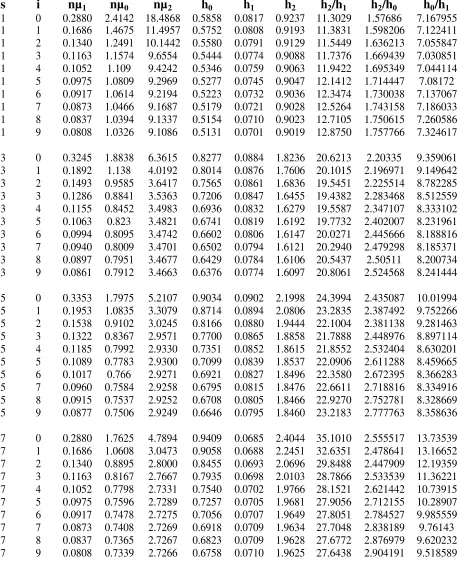
Table 1 is used to select the parameters for Bayesian Chain Sampling Plan
indexed by µ1 and h1. For example, for given µ1 = 0.01 and h1 = 0.07, from Table 1 under
the column headed h1, locate the value equal to or just greater than specified h1.
Corresponding to this h1, the values of associated are nµ1 = 0.0808, s = 1 and i = 9. From
this one can obtain the sample size as n= nµ1/ µ1 8. Thus the parameters are n= 8, s = 1
Selection at the Limiting Quality Level
Table 1 is used to select the parameters for Bayesian Chain Sampling Plan
indexed by µ2 and h2. For example, for given µ2 = 0.02 and h2 = 0.9, from Table 1 under
the column headed h2, locate the value equal to or just greater than specified h2.
Corresponding to this h2, the values associated are nµ2 = 9.1086, s = 1 and i = 9. From
this one can obtain the sample size as n= nµ2/ µ2 10. Thus the parameters are n = 10, s
= 1 and i= 9.
Selection through Inflection Point
Table 1 is used to select the parameters for Bayesian Chain Sampling Plan
indexed by µ0 and h0. For example, for given µ0 = 0.01 and h0 = 0.5, from Table 1 under
the column headed h0, locate the value equal to or just greater than specified h0.
Corresponding to this h0, the values associated are nµ0 = 1.0326, s = 1 and i = 9. From
this one can obtain the sample size as n= nµ0/ µ0 10. Thus the parameters are n =10, s =
1 and i= 9.
Selection through ratio of relative slopes
Table 1 is used to select the Bayesian Chain Sampling Plan parameters for
specified AQL (or LQL) with h2 and h1. For example, for given µ1 = 0.01; h1 = 0.07; h2 =
0.9, h0 = 0.5, one can find that h2 / h1 = 12.86. Using Table 1 under the column headed h2 /
h1, locate the value which is equal to or just greater than desired ratio. Corresponding to
this located ratio, the values associated are nµ1 = 0.0808, s = 1 and i = 9. From this one
can obtain the sample size as n= nµ1/ µ1 8. Thus the selected parameters are n = 8, s = 1
and i= 9. For the ratio h0 / h1 = 7.14, using Table 1 under the column headed h0 / h1, locate
the value which is equal to or just greater than desired ratio. Corresponding to this located
ratio, the values associated are nµ1 = 0.0917, s = 1 and i =6. From this one can obtain the
Conversion of Parameters
It is necessary to convert a given set of parameters to another familiar set
providing information on other related parameters. Conversions are arrived using Table
1. For example when µ1 = 0.01; h1 = 0.07 are specified the other set of parameters are
found using these tables. Corresponding to h1 = 0.07 one finds using table 1, s = 1, i = 9,
nµ1 = 0.0808, nµ0 = 1.0326, nµ2 = 9.1086, h1 = 0.0701, h2 = 0.9019, h0 = 0.5131. Dividing
nµ1 by µ1 one gets n = 8 for the Bayesian Multiple Deferred State Sampling Plan with µ2
= 1.1386, µ0 = 0.1291. When µ1 = 0.01 and h1 = 0.07 the other set of parameters are
µ1 = 0.01; h1 = 0.07
µ0 = 0.1291; h0 = 0.5131
µ2 = 1.1386; h2 = 0.9019
µ* = 0.0117; h* = 0.0821
Construction of Tables.
The expression for APA function for Bayesian Chain Sampling Plan P is given in
equation
ò
¥=
0)
(
)
/
,
(
n
i
p
w
p
dp
P
P
(
)
(
)
11 + + + + + + = s s s s in n s s n n s s P m m m m
Wherem =s/t, is the mean value of the product quality p. Differentiating the APA function with respect to µ gives
(
)
(
)
(
)
22 1 1 1 + + + + + + -+ + -= s s s s i n n s i n n ns n s ns d P d m m m m m m
The relative slope h at µ is,
m m m m d P d P
h ( )
) (
-=
Differentiating the APA function with respect to µ and evaluating at µ we get various
equation and the relative slopes at µ = µo, µ1, µ2, µ*, the values h0, h1, h2 and h* are
obtained and tabulated in Table 1.
Comparison with Conventional Plan
The values obtained from Bayesian MDS are compared with Conventional MDS.
On comparison it is observed that n µ1 value is much less than n p1 for smaller values of s
and as s increases n µ1 tends to n p1. But n µ2 is much greater than n p2 for smaller values
of s and as increases n µ2 tends to n p2. So, when it is known from the past history that the
product is very good, more lots will be accepted under the current process of production.
OAOQL for Bayesian plan is lesser than AOQL values for conventional plan for small
values of s and as s increases OAOQL reaches AOQL of conventional plan.
Conclusion
Bayesian Acceptance sampling is the technique, which deals with procedures in
which decision to accept or reject lots or process is based on the examination of past
history or knowledge of samples. The present work mainly relates to the construction and
selection of tables for Bayesian Chain Sampling plan indexed through relative slopes of
Acceptable and Limiting Quality Levels. Conversions of parameters are also given for
convenience. Tables are provided here which tailor- made, handy and ready- made use to
REFERENCES
1. AMERICAN NATIONAL STANDARDS Institute/American Society for Quality
Control (ANSI / ASQC) Standard A2 (1987), Terms, Symbols and Definition for
Acceptance Sampling, American Society for Quality Control, Milwaukee,
Wilconsion. USA.
2. CALVIN. T. W. (1984). How and When to Perform Bayesian Acceptance
sampling, 7, American Society for Quality Control.
3. CASE. K.E., J.B. KEATS. (1982). On the Selection of a Prior Distribution in
Bayesian Acceptance sampling, Journal of Quality Technology 14, No. 1, 10-18.
4. CLARK, C. R. (1960), OC Curve for ChSP-1 Chain Sampling Plans, Industrial
Quality Control, Vol.17, No. 4, pp. 10-12.
5. GOVINDARAJU, K. (1990), Selection of ChSP-1 Chain Sampling Plans for
given Acceptable Quality level Communications in Statitics, Theory and Methods
Vol.19, No. 6, pp. 2179-2190.
6. HALD. A. (1965). Bayesian Single Sampling Plans for Discrete Prior
Distributions, Maty, Fys. Dan. Vid. Selsk 3.
7. LATHA. M. (2002). Certain Studies Relating to Bayesian Acceptance Sampling
Plans, Ph.D Thesis, Bharathiar University, Tamilnadu.
8. MANDELSON. J. (1962). The Statistician, the Engineer and Sampling plans,
Industrial Quality Control 19,. 12 – 15.
9. OLIVER. L. R., SPRINGER. M.D. (1972). A General Set of Bayesian Attribute
Acceptance Plans, American Institute of Industrial Engineers, Norcross, G. A.
10.SURESH. K.K. (1993). A Study on Acceptance Sampling using Acceptable and
Table 1. Relative slopes for Acceptable and Limiting Quality Levels
s i nµ1 nµ0 nµ2 h0 h1 h2 h2/h1 h2/h0 h0/h1
1 0 0.2880 2.4142 18.4868 0.5858 0.0817 0.9237 11.3029 1.57686 7.167955 1 1 0.1686 1.4675 11.4957 0.5752 0.0808 0.9193 11.3831 1.598206 7.122411 1 2 0.1340 1.2491 10.1442 0.5580 0.0791 0.9129 11.5449 1.636213 7.055847 1 3 0.1163 1.1574 9.6554 0.5444 0.0774 0.9088 11.7376 1.669439 7.030851 1 4 0.1052 1.109 9.4242 0.5346 0.0759 0.9063 11.9422 1.695349 7.044114 1 5 0.0975 1.0809 9.2969 0.5277 0.0745 0.9047 12.1412 1.714447 7.08172 1 6 0.0917 1.0614 9.2194 0.5223 0.0732 0.9036 12.3474 1.730038 7.137067 1 7 0.0873 1.0466 9.1687 0.5179 0.0721 0.9028 12.5264 1.743158 7.186033 1 8 0.0837 1.0394 9.1337 0.5154 0.0710 0.9023 12.7105 1.750615 7.260586 1 9 0.0808 1.0326 9.1086 0.5131 0.0701 0.9019 12.8750 1.757766 7.324617
3 0 0.3245 1.8838 6.3615 0.8277 0.0884 1.8236 20.6213 2.20335 9.359061 3 1 0.1892 1.138 4.0192 0.8014 0.0876 1.7606 20.1015 2.196971 9.149642 3 2 0.1493 0.9585 3.6417 0.7565 0.0861 1.6836 19.5451 2.225514 8.782285 3 3 0.1286 0.8841 3.5363 0.7206 0.0847 1.6455 19.4382 2.283468 8.512559 3 4 0.1155 0.8452 3.4983 0.6936 0.0832 1.6279 19.5587 2.347107 8.333102 3 5 0.1063 0.823 3.4821 0.6741 0.0819 1.6192 19.7732 2.402007 8.231961 3 6 0.0994 0.8095 3.4742 0.6602 0.0806 1.6147 20.0271 2.445666 8.188816 3 7 0.0940 0.8009 3.4701 0.6502 0.0794 1.6121 20.2940 2.479298 8.185371 3 8 0.0897 0.7951 3.4677 0.6429 0.0784 1.6106 20.5437 2.50511 8.200734 3 9 0.0861 0.7912 3.4663 0.6376 0.0774 1.6097 20.8061 2.524568 8.241444
5 0 0.3353 1.7975 5.2107 0.9034 0.0902 2.1998 24.3994 2.435087 10.01994 5 1 0.1953 1.0835 3.3079 0.8714 0.0894 2.0806 23.2835 2.387492 9.752266 5 2 0.1538 0.9102 3.0245 0.8166 0.0880 1.9444 22.1004 2.381138 9.281463 5 3 0.1322 0.8367 2.9571 0.7700 0.0865 1.8858 21.7888 2.448976 8.897114 5 4 0.1185 0.7992 2.9330 0.7351 0.0852 1.8615 21.8552 2.532404 8.630201 5 5 0.1089 0.7783 2.9300 0.7099 0.0839 1.8537 22.0906 2.611288 8.459665 5 6 0.1017 0.766 2.9271 0.6921 0.0827 1.8496 22.3580 2.672395 8.366283 5 7 0.0960 0.7584 2.9258 0.6795 0.0815 1.8476 22.6611 2.718816 8.334916 5 8 0.0915 0.7537 2.9252 0.6708 0.0805 1.8466 22.9270 2.752781 8.328669 5 9 0.0877 0.7506 2.9249 0.6646 0.0795 1.8460 23.2183 2.777763 8.358636