Volume 2007, Article ID 68985,8pages doi:10.1155/2007/68985
Research Article
Linear Motion Blur Parameter Estimation in Noisy Images
Using Fuzzy Sets and Power Spectrum
Mohsen Ebrahimi Moghaddam and Mansour Jamzad
Department of Computer Engineering, Sharif University of Technology, 11365-8639 Tehran, Iran
Received 17 July 2005; Revised 11 March 2006; Accepted 15 March 2006
Recommended by Rafael Molina
Motion blur is one of the most common causes of image degradation. Restoration of such images is highly dependent on accurate estimation of motion blur parameters. To estimate these parameters, many algorithms have been proposed. These algorithms are different in their performance, time complexity, precision, and robustness in noisy environments. In this paper, we present a novel algorithm to estimate direction and length of motion blur, using Radon transform and fuzzy set concepts. The most important advantage of this algorithm is its robustness and precision in noisy images. This method was tested on a wide range of different types of standard images that were degraded with different directions (between 0◦and 180◦) and motion lengths (between 10 and 50 pixels). The results showed that the method works highly satisfactory for SNR>22 dB and supports lower SNR compared with other algorithms.
Copyright © 2007 Hindawi Publishing Corporation. All rights reserved.
1. INTRODUCTION
The aim of image restoration is to reconstruct or estimate an uncorrupted image by using the degraded version of the same image. One of the most common degradation func-tions is linear motion blur with additive noise. Equation (1) shows the relationship between the observed imageg(x,y) and its uncorrupted version f(x,y) [1]:
g(x,y)= f(x,y)∗h(x,y) +n(x,y). (1)
In this equation, h is the blurring function (or point spread function (PSF)), that is, convolved in the original image and n is the additive noise function. According to (1), in order to determine the uncorrupted image, we need to find the blurring function (h) (i.e., blur identification) which is an ill-posed problem. Finding motion blur parame-ters in none additive noise environments was addressed in [2–4], where these researchers tried to extend their algo-rithms to noisy images as well. The authors in [4,5] have divided the image into several windows to reduce noise ef-fects and to extend their methods to support noisy images. Linear motion blur identification in noisy images was also addressed using bispectrum in [3,6]. This method is not precise enough because theoretically, to remove the noise by using this method, many windows are required, which in practice is impossible. The authors in [3,6] did not specify
the lowest SNR that their method can support. A different method was presented for noisy images in [2] where authors used AR (auto regressive) model to present images and have proved the lowest allowed SNR that their method can sup-port. In [7], we presented a method based on mathemati-cal modeling to estimate parameters in noisy images at low SNRs.
In many other research areas, fuzzy concepts have been used to improve the application performance and speed. In the field of image restoration, some researchers have applied fuzzy concepts as well, however, most of these works are in blind restoration. For example, authors in [8] presented a method that incorporated domain knowledge while pre-serving the flexibility of the scheme. In the most of other papers, only the noise removal methods were presented. In [9,10] a method was presented using fuzzy concepts to re-move MF (median filter) side effects such as distortion using an HFF (histogram fuzzy filter). Authors in [11] presented a PAFF (parametric adaptive fuzzy filter), which works ef-fectively when the noise ratio is greater than 20%. In [12], a rule-based method using local characteristics of the signal was presented which reduced Gaussian noise effect and pre-served the edges. In [13], a hierarchical fuzzy approach was used to perform detail sharpening.
|H(u,v)|
π/2 u
π/2 v
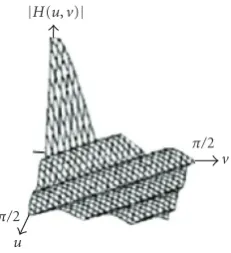
Figure1: The frequency response of the uniform linear motion blur (a SINC shape function) withL=7.5 pixels,φ=π/4.
transform to find the motion blur parameters in presence or absence of additive noise. This new method improves our last works (presented in [1,7]) by supporting lower SNRs (i.e., an improvement between 3–5 dB) and providing more precise answers.
We have implemented our method using Matlab 7 func-tions and tested it on 80 randomly selected standard images of 256×256 pixels. The accuracy of our method was evalu-ated by determining the mean and standard deviation of dif-ferences between actual and estimated angle/length param-eters (in the following sections this difference is referred to as an error). In comparison with other methods listed above, our method supports lower SNRs. We measured the lowest allowed SNR in our method experimentally which was about 22 dB in average.
The rest of the paper is organized as follows. InSection 2, the motion blur parameters are introduced. Section 3 de-scribes finding parameters in noise free images. The problem in noisy images and the use of fuzzy sets in motion length es-timation are addressed inSection 4. Experimental results are provided inSection 5. InSection 6, we compare our method with other methods and finally we present the conclusion in Section 7.
2. MOTION BLUR ATTRIBUTES
The general form of the motion blur function is given as fol-lows [7]:
h(x,y)=
⎧ ⎪ ⎨ ⎪ ⎩
1 L, if
x2+y2≤L
2, x
y = −tan(φ), 0, otherwise.
(2)
As seen in (2), motion blur function depends on two parameters: motion length (L) and motion direction (φ). Figure 1shows the frequency response of this function for L=7.5 pixels andφ=π/4.
The frequency response ofhis a SINC function. This im-plies that “if an image is affected only by motion blur and there is no additive noise, then we can see dominant par-allel dark lines in its frequency response (Figure 2(b)) that correspond to very low near-zero values [2,5,6,14,15].” Figure 2shows the lake image corrupted by motion blur with
(a) (b)
Figure2: (a) The lake image degraded by linear motion blur using
L=20 pixels,φ=45◦, (b) Fourier spectrum of (a).
no additive noise and its Fourier spectrum, in which the par-allel dark lines are obvious. These parpar-allel dark lines and the SINC structure in the frequency response of the degrada-tion funcdegrada-tion are the most critical data that are used in our method.
3. MOTION BLUR PARAMETER ESTIMATION IN
NOISE FREE IMAGES
In this section, we propose a solution for cases in which the image is corrupted by a degradation function without addi-tive noise (i.e.,n(x,y)=0).
In the absence of noise, (3) concludes that
G(u,v)=F(u,v)·H(u,v), (3)
whereG(u,v),F(u,v), andH(u,v) are frequency responses of the observed image, original image, and the degradation function, respectively. In this case, the motion blur parame-ters are determined as described in the following subsections.
3.1. Motion direction estimation
To find motion direction, we used the parallel dark lines that appear in the Fourier spectrum of a degraded image, an ex-ample of which is shown inFigure 2(b). In [1], we showed that the motion blur direction (φ) is equal to the angle (θ) between any of these parallel dark lines and the vertical axis. Therefore, to find motion direction, it is enough to find the direction of these parallel dark lines. However, we supposed I = log|G(u,v)|is a gray-scale image in spatial domain to which we can apply any line fitting method to find the di-rection of a line. Among many line fitting methods that were applicable, we used Radon transform [16] either in the form of (4) or (5):
R(ρ,θ)=
∞
−∞
∞
−∞g(x,y)δ(ρ−xcosθ−ysinθ)dx d y, (4)
R(ρ,θ)=
∞
The advantage of Radon transform to other line fitting algorithms, such as Hough transform and robust regression [17], is that one does not need to specify candidate points for the lines. To find direction of these lines, let R be the Radon transform of an image, then the position of high spots along theθaxis ofRshows the direction [16].Figure 4shows the result of applying Radon transform to the log of Fourier transform of an image which was corrupted by a linear mo-tion blur (direcmo-tion 45◦) with no additive noise. To find the high spots, we can use any peak detection algorithm like Cep-strum analysis.
More details of using Radon transform for finding mo-tion direcmo-tion are given in our previous work [7].
3.2. Motion length estimation
After finding motion direction, we rotated the coordinate system of log|G(u,v)|, rather than rotating the observed im-age, to align it with motion direction. Rotating the coordi-nate system solves the problems that occur in image rotation such as interpolation and out of range pixels. Because of the rotation effect, some parts of Fourier spectrum will appear in areas out of the coordinate system support, as a result the same number of valid data will not be available in all columns in the new coordinate system. Most of valid data is located in the column passing through frequency center. The pre-sented algorithm is based on the central peaks and valleys in the Fourier spectrum, therefore this rotation has no effect on precision and robustness of the algorithm.
In this case, the uniform motion blur equation is one-dimensional like (6) [18]:
h(i)=
⎧ ⎪ ⎨ ⎪ ⎩
1 L if −
L 2 ≤i≤
L 2, 0 otherwise.
(6)
The continuous Fourier transform ofh, which is a SINC function is shown in (7) [19]:
Hc(u)= 2 Sin(uπL/2)
uπL . (7)
The discrete version ofHin horizontal direction is shown in (8) [2,19]:
H(u)= Sin(Luπ/N)
LSin(uπ/N), 0≤u≤N−1, (8)
where N is the image size. To findLwe tried to solve the equationH(u)=0, (i.e., finding zero values of a SINC func-tion). Solving this equation leads to solving (9):
Sin
Luπ
N =0, (9)
u= kπ
LW such thatW= π
N,k >0. (10) If u0 and u1 are two successive zero points such that
H(u0)=H(u1)=0, then
u1−u0=N
L (11)
(a) (b)
(c) (d)
Figure3: (a) A motion blurred image withL=10 pixels,φ=45◦, (b) Fourier spectrum of (a), (c) motion blurred image withL=30 pixels,φ=45◦, (d) Fourier spectrum of (c). The sizes of (a) and (c) are 256×256 pixels.
0 45
90
135
180 N Peak corresponding with line direction
Figure 4: The result of applying Radon transform to the log of Fourier transform of an image that was degraded using linear mo-tion blur with direcmo-tion 45◦and no additive noise.
which results in
L= N
d, (12)
wheredis the distance between two successive dark lines in log(|G(u,v)|).
(a) (b)
Figure5: (a) The image (256×256) of Barbara which is degraded by motion blur with parametersL=30 pixels,φ=45◦and Gaussian additive noise with zero mean and variance=0.04 (SNR=30 dB). (b) its Fourier spectrum.
zero are categorized into two groups. The first group corre-sponds to the straight dark lines that are created by motion blur (H(u)= 0) and the second group is created by actual pixel values (F(u)=0). To calculated, we should use the first group ofu. To do this robustly, we used fuzzy set as described inSection 4.2.
4. MOTION BLUR PARAMETER ESTIMATION IN
NOISY IMAGES
When noise, usually with a Gaussian distribution, is added to a degraded image, the parallel dark lines in frequency re-sponse of degraded image become weak and some of them disappear. If noise variance increases, then more such dark lines disappear. Figure 5(a)shows Barbara image degraded by motion blur and additive noise,Figure 5(b)shows the fre-quency response ofFigure 5(a). To overcome the noise effect, in the following sections we propose a novel, simple, and ro-bust algorithm based on Radon transform and fuzzy sets to estimate motion direction and length, respectively.
4.1. Motion direction estimation in noisy images
The concepts we have used here is similar to the one used for noiseless images. Looking at Figure 5(b) we can see a white bound around the image center. This white bound is generated by the SINC structure of frequency response of motion blur function shown in Figure 1. The direction of white bound exactly matches with the direction of disap-peared dark lines, so it also corresponds to the direction of motion blur. Therefore, to find motion blur direction, it is enough to find the direction of this white bound, consisting of several parallel white lines. Using Radon transform, we can find the direction (θ) of these white lines [7].
4.2. Motion length estimation in noisy images using fuzzy sets
In presence of noise, the parallel dark lines in frequency re-sponse of a degraded image become weak and some of them disappear. In low SNRs, these dark lines disappear com-pletely. Equation (13) shows frequency domain version of (1)
0 0.2 0.4 0.6 0.8 1
20 50 100 150 200 230 250
Figure6: TheZ-structure of membership function introduced by (15) whena=20 andc=230.
in the presence of noise. HereW(u,v) has different parame-ters in Gaussian distribution compared tow(x,y):
G(u,v)=H(u,v)·F(u,v) +W(u,v). (13)
Since noise is a random parameter, its effect on pixels of a dark line is different. The question is which pixels belong to the disappeared dark lines. In log(|G(u,v)|), darker pixels are better candidates to be a part of a dark line than others. Which pixels are dark pixels? And can we certainly claim that the other pixels are not part of a dark line? Because of noise effects, we cannot answer these questions with certainty. This uncertainty leads us to use fuzzy concepts to find dark lines in frequency response of degraded images. In fact, each pixel in the frequency response of a degraded image can be a part of a dark line with different possibility, therefore, we define a fuzzy set for each row of log(|G(u,v)|) in rotated coordinate system as follows:
Ai=
x,μn(x)
|x∈(1,. . .,N), n(x)=logG(i,x), (14)
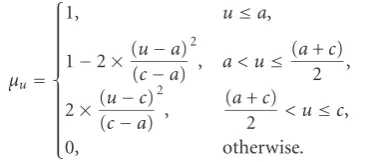
whereNis the number of columns in image andiis the row number. We define the membership functionμu as the Z-function, because the darker pixels are better candidates to belong to disappeared dark lines while lighter ones are worse candidates. Thez-function models this property using the following equation:
μu=
⎧ ⎪ ⎪ ⎪ ⎪ ⎪ ⎪ ⎪ ⎪ ⎪ ⎪ ⎨ ⎪ ⎪ ⎪ ⎪ ⎪ ⎪ ⎪ ⎪ ⎪ ⎪ ⎩
1, u≤a,
1−2×(u−a) (c−a)
2
, a < u≤(a+c) 2 ,
2×(u−c) (c−a)
2
, (a+c)
2 < u≤c,
0, otherwise.
(15)
0 0.1 0.2 0.3 0.4 0.5 0.6 0.7 0.8 0.9 1
f
(
x
)
0 50 100 150 200 250
x
Specified valleys
Figure7:f(x) of an image with no additive noise.
lines. Therefore, we used Zadeht-norms [20] to find inter-section of these sets:
B=x,μx
|μx=t
μ1x,. . .,μMx
,x∈(1,. . .,N). (16)
In this equation, Bis intersection of sets, M is number of rows in log(|G(u,v)|),μixshows the membership value ofx inAi, andtis Zadeht-norm. Now we define f(x), the possi-bility that columnxdoes not belong to a dark line, as follows:
f(x)=
⎧ ⎨ ⎩
1−μx, x∈B,
0, otherwise. (17)
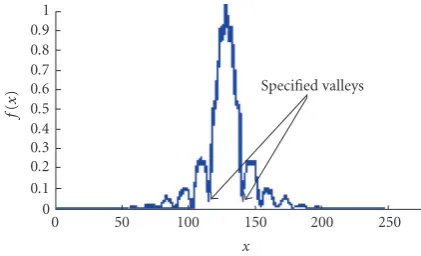
Figure 7shows the f(x) that was obtained from a de-graded image with L = 30 pixels with no additive noise. Looking carefully at this figure, it is obvious that f(x) has a SINC structure and valleys in f(x) (valleys in the Fourier spectrum of degradation function) correspond to the dark lines.
Figure 8shows f(x) of an image corrupted by linear mo-tion blur withL=30 pixels and added Gaussian noise with σ2
w=1 and SNR=25 dB.
All valleys of f(x) are candidates of dark line places but some of them may be false. The best ones are valleys that correspond to SINC structure in Fourier spectrum of degra-dation function. These valleys are in two sides of the cen-tral peak as shown in Figures7and8. By finding these val-leys using a conventional pitch detection algorithm, their dis-tance can be calculated. Because of the SINC structure, this distance is twice the distance between two successive paral-lel dark lines. Therefore, by using (12) we can find motion length using the following equation:
L= 2×N
r , (18)
wherer is the distance between these valleys and N is the image size. This equation is derived from (12), by setting d=r/2, wheredis successive lines distance. It is important to note that the values of f(x) are not the same in diff er-ent images, while f(x) consists of peaks and valleys which depend on degradation function but not on the image. The advantage of this algorithm is that it works in low SNR and its robustness does not depend onLandφ.
0 0.1 0.2 0.3 0.4 0.5 0.6 0.7 0.8 0.9 1
f
(
x
)
0 50 100 150 200 250
x
Specified valleys
Figure8: f(x) of an image corrupted by linear motion blur with
L=30 pixels and additive Gaussian noise (SNR=25 dB).
5. EXPERIMENTAL RESULTS
We have applied the above algorithms on 80(256×256) stan-dard images such as Camera-man, Lena, Barbara, Baboon, that were degraded by different orientations and lengths of motion blur (i.e., 0◦ ≤φ ≤180◦and 10 ≤L ≤50 pixels). Then we added Gaussian noise with zero mean and diff er-ent variances (0.01 ≤σ2
w ≤0.61) to these images. To create a blurred image, three random variables were produced as follows:
(1) rL∈[0,. . ., 13], (2) rφ∈[0,. . ., 36], (3) rσ∈[0,. . ., 12].
Then the blur parameters were calculated using the following equations:
L=rL×3 + 10;
φ=rφ×10;
σ2
w=rσ×0.05 + 0.01.
(19)
In each iteration, a degraded image was created using these parameters. Therefore, regarding intervals defined forrL,rφ, rσ, and (19), 14 different lengths, 37 different directions and 13 different Gaussian noise variances could be combined to create a sample set of degraded images. We selected 80 im-ages from this set to test our algorithm. Then we used our algorithm to find motion blur parameters of the blurred im-ages created by the mentioned procedure. Cepstrum analysis, that is, a standard pitch detection algorithm was used to find valleys in f(x). Additionally, the properties of SINC struc-ture off(x) were used to discard false detected valleys and to increase the precision of the method. Using this customized Cepstrum analysis, the valleys around the central peak with the same distances were accepted. After finding motion blur parameters, Wiener filter was used to restore the original im-ages.
Table1: Experimental results of our algorithm on 80 degraded standard images (256×256) with no additive noise.
Cases Angle tolerance Length tolerance (degree) (pixels)
Best estimate 0 0.0
Worst estimate 2 1.9
Average estimate 0.6 0.9
Standard deviation 0.7 0.4
Table2: Experimental results of our algorithm on 80 degraded standard images (256×256) with additive noise with zero mean and 0.01 to 0.6 variance (SNR>22 dB).
Cases Angle tolerance Length tolerance (degree) (pixels)
Best estimate 0 0.0
Worst estimate 2 2.5
Average estimate 0.9 0.9
Standard deviation 0.69 0.55
standard deviation of errors show the high precision of our algorithm. The worst case of the algorithm in estimation of motion length occurred whenL >40 pixels and its best case happened when 10≤L≤26 pixels.
For estimating motion direction, there was no specific range for worst and best cases of the algorithm. These cases may occur in each direction.
If we define SNR as (20):
SNR=10 log10
σ2 f σ2 w
, (20)
whereσ2
f denotes image variance andσw2 defines noise vari-ance, then our algorithm shows a robust behavior at SNR >22 dB. Decreasing SNR values increases algorithm estima-tion error. As an example for a specified image withL=18 pixels and SNR=15 dB, the motion length estimation error was about 10 pixels. At SNR= 20 dB, the estimation error was about 7 pixels for the same image. Figures9and10show noisy degraded images with low SNRs. Their motion blur pa-rameters were estimated successfully by our algorithm. Also we studied the effect of changing the values of parameters aandcin (15) on the algorithm. The best values for these parameters werea =20 andc = 230, that were calculated heuristically. Changing the values ofaandcin the range of ±5 and±10, respectively, did not have significant effect on algorithm precision. But changing these parameters beyond these ranges decreases the precision of the algorithm.
6. COMPARISON WITH RELATED METHODS
A comparison with related methods shows that the method presented in this paper is more robust, has higher precision, and supports lower SNRs.
Figure9: Camera picture which was degraded byL =20 pixels,
φ = 60◦and Gaussian additive noise (SNR= 30 dB). Estimated values for this image using our algorithm wereL=21.8 pixels and
φ=58.7◦.
Figure10: Baboon picture which was degraded byL=10 pixels,
φ=135◦and Gaussian additive noise (SNR=25 dB). Estimated values for this image using our algorithm wereL = 8 pixels and
φ=136.8◦.
In [2], the experimental results were presented briefly and there was no overall experimental results. Their algo-rithm was tested only on two degraded images in horizontal direction usingL=11 pixels. As authors said, the estimated length for the first image with SNR= 40 dB wasL = 11.1 pixels which was the same as results for the second image with SNR=30 dB. In addition, the authors presented a re-stored image with SNR=23.3 dB, but they did not present parameter estimation for this image. The weak point of this method was that the authors presented results for only two images. To compare our algorithm with method presented in [2], we applied our algorithm to similar images with the same parameters, which resulted in estimation ofL =11.6 pixels when SNR = 40 dB and L = 11.8 pixels when SNR =30 dB.
images was 3.0◦ in direction and 4.1 pixels in length which were both worst than the ones found in our method under similar conditions.
In another paper [15] authors presented an estimation error of 1◦–3◦in direction and 4–6 pixels in length for noise free images which are not as good as the ones obtained with our method.
The authors in [14] did not discuss the precision and SNR support of their method. It has also a limitation in mo-tion length whereL <15 pixels. Our method has no limita-tion in molimita-tion length in theory. We tested it usingL ≤ 50 pixels and the results were satisfactory.
The researchers in [6] did not show the lowest SNR that their method could support. They reported that their method worst case estimation error was about 5◦ in direc-tion and 2.5 pixels in length. These results were analyzed with noise variances of 1 and 25.
In addition, the methods given in [3,22] were valid for SNR as low as 40 dB. The authors did not provide any infor-mation about the precision of their methods.
The algorithms presented in [4,5] have no exhaustive ex-perimental results.
In our latest work we provided a method that had a pre-cise estimation of parameters in BSNR > 30 dB (which is about SNR>25 dB [7]). Overall, our method supports lower SNR than other methods and it gives better precision in most cases.
7. CONCLUSION
In this paper we presented a robust method to estimate the motion blur parameters, namely, direction and length. Al-though fuzzy methods are used in many research areas, but to the best of our knowledge, their usage in blur identifica-tion have not been reported yet. We used fuzzy set concepts to find motion length. This is a novel idea in this field. We showed the robustness of this method for noisy and noiseless images. To estimate motion direction we used Radon trans-form. This helped us to overcome the difficulties with Hough transform and similar methods to find the candidate points for line fitting.
The main advantage of our algorithm is that it does not depend on the input image. To evaluate the performance of our method, we degraded 80 standard images with different values of motion direction and length. The motion blur pa-rameters that were estimated by our method were compared with their initial values for each image. The comparison of the low value for mean and standard deviation of errors be-tween the estimated values and the actual ones showed the high accuracy of our method.
We believe that the performance of motion blur param-eter estimation algorithms can be improved if the noisy de-graded images are processed with specific noise removal al-gorithms which are able to remove noises while preserving edges. After applying such noise removal methods we can implement our algorithm for motion blur parameter estima-tion to obtain better results. In future, we plan to extend our work to develop such noise removal methods.
ACKNOWLEDGMENT
We highly appreciate Iran Telecommunication Research Cen-ter for its financial support to this research, that is part of a Ph.D. thesis.
REFERENCES
[1] M. E. Moghaddam and M. Jamzad, “Finding point spread function of motion blur using radon transform and modeling the motion length,” inProceedings of the 4th IEEE International Symposium on Signal Processing and Information Technology (ISSPIT ’04), pp. 314–317, Roma, Italy, December 2004. [2] Q. Li and Y. Yoshida, “Parameter estimation and restoration
for motion blurred images,” IEICE Transactions on Funda-mentals of Electronics, Communications and Computer Sciences, vol. E80-A, no. 8, pp. 1430–1437, 1997.
[3] M. M. Chang, A. M. Tekalp, and A. T. Erdem, “Blur identifi-cation using the bispectrum,”IEEE Transactions on Acoustics, Speech, and Signal Processing, vol. 39, no. 10, pp. 2323–2325, 1991.
[4] M. Cannon, “Blind deconvolution of spatially invariant image blurs with phase,”IEEE Transactions on Acoustics, Speech, and Signal Processing, vol. 24, no. 1, pp. 58–63, 1976.
[5] R. Bhaskar, J. Hite, and D. E. Pitts, “An iterative frequency-domain technique to reduce image degradation caused by lens defocus and linear motion blur,” inIEEE Geoscience and Re-mote Sensing Symposium (IGARSS ’94), vol. 4, pp. 2522–2524, Pasadena, Calif, USA, August 1994.
[6] C. Mayntz, T. Aach, and D. Kunz, “Blur identification using a spectral inertia tensor and spectral zeros,” inIEEE Interna-tional Conference on Image Processing (ICIP ’99), vol. 2, pp. 885–889, Kobe, Japan, October 1999.
[7] M. E. Moghaddam and M. Jamzad, “Blur identification in noisy images using radon transform and power spectrum modeling,” inProceedings of the 12th IEEE International Work-shop on Systems, Signals and Image Processing (IWSSIP ’05), pp. 347–352, Chalkida, Greece, September 2005.
[8] K.-H. Yap and L. Guan, “A fuzzy blur algorithm to adaptive blind image deconvolution,” inProceedings of the 7th IEEE In-ternational Conference on Control, Automation, Robotics and Vision (ICARCV ’02), pp. 34–38, Singapore, Republic of Sin-gapore, December 2002.
[9] J.-H. Wang, W.-J. Liu, and L.-D. Lin, “Histogram-based fuzzy filter for image restoration,” IEEE Transactions on Systems, Man, and Cybernetics—Part B: Cybernetics, vol. 32, no. 2, pp. 230–238, 2002.
[10] J.-H. Wang and M.-D. Yu, “Image restoration by adaptive fuzzy optimal filter,” inProceedings of the IEEE International Conference on Systems, Man and Cybernetics, vol. 1, pp. 845– 848, Vancouver, BC, Canada, October 1995.
[11] J.-H. Wang and L.-D. Lin, “Image Restoration using paramet-ric adaptive fuzzy filter,” inIEEE Conference of the North Amer-ican Fuzzy Information Processing Society (NAFIPS ’98), Pen-sacola, Fla, USA, August 1998.
[12] K. Arakawa, “Fuzzy rule-based signal processing and its appli-cation to image restoration,”IEEE Journal on Selected Areas in Communications, vol. 12, no. 9, pp. 1495–1502, 1994. [13] S. Suthaharan, Z. Zhang, and A. Harvey, “FFF: fast fuzzy
[14] Y. Li and W. Zhu, “Restoration of the image degraded by linear motion,” inProceedings of the 10th IEEE International Confer-ence on Pattern Recognition (ICPR ’90), vol. 2, pp. 147–152, Atlantic City, NJ, USA, June 1990.
[15] I. M. Rekleitis, “Optical flow recognition from the power spec-trum of a single blurred image,” inIEEE International Confer-ence on Image Processing (ICIP ’96), vol. 3, pp. 791–794, Lau-sanne, Switzerland, September 1996.
[16] P. Toft, The radon transform—theory and implementation, Ph.D. thesis, Department of Mathematical Modeling, Techni-cal University of Denmark, Copenhagen, Denmark, June 1996. [17] R. C. Gonzalez and R. E. Woods, Digital Image Processing, Prentice Hall, Upper Saddle River, NJ, USA, 2nd edition, 2002. [18] M. R. Banham and A. K. Katsaggelos, “Digital image restora-tion,”IEEE Signal Processing Magazine, vol. 14, no. 2, pp. 24– 41, 1997.
[19] A. V. Oppenheim, A. S. Willsky, and S. H. Nawab,Signals and Systems, Prentice Hall, Upper Saddle River, NJ, USA, 2nd edi-tion, 1996.
[20] H. J. Zimmermann,Fuzzy Set Theory, Kluwer Academic, Dor-drecht, The Netherlands, 1996.
[21] I. M. Rekleities, “Steerable filters and cepstral analysis for op-tical flow calculation from a single blurred image,” in Proceed-ings of the Vision Interface Conference, pp. 159–166, Toronto, Ontario, Canada, May 1996.
[22] A. T. Erdem and A. M. Tekalp, “Blur identification based on bispectrum,” inProceedings of the European Signal Processing Conference (EUSIPCO ’90), Barcelona, Spain, September 1990.
Mohsen Ebrahimi Moghaddam received his M.S. degree in software engineering from Sharif University of Technology, Tehr-an, Iran. Currently, he is a Ph.D. Candidate in the Department of Computer Engineer-ing, Sharif University. The present work is the main core of his Ph.D. thesis. His main research interests are image processing, ma-chine vision, data structures, and algorithm design.
Mansour Jamzadhas obtained his M.S. de-gree in computer science from McGill Uni-versity, Montreal, Canada and his Ph.D. de-gree in electrical engineering from Waseda university, Tokyo, Japan. For a period of two years after graduation he worked as a Post Doctorate Researcher in the Depart-ment of Electronics and Communication Engineering, Waseda University. He became an Assistant Professor at the Department of