Volume 2007, Article ID 57354,13pages doi:10.1155/2007/57354
Research Article
Array Processing and Fast Optimization Algorithms for
Distorted Circular Contour Retrieval
Julien Marot and Salah Bourennane
GSM, Institut Fresnel, CNRS-UMR 6133, Ecole Centrale Marseille, Universit´e Aix-Marseille III, D.U. de Saint J´erˆome, 13397 Marseille Cedex 20, France
Received 19 July 2006; Revised 20 December 2006; Accepted 17 February 2007
Recommended by Wilfried Philips
A specific formalism for virtual signal generation permits to transpose an image processing problem to an array processing prob-lem. The existing method for straight-line characterization relies on the estimation of orientations and offsets of expected lines. This estimation is performed thanks to a subspace-based algorithm called subspace-based line detection (SLIDE). In this paper, we propose to retrieve circular and nearly circular contours in images. We estimate the radius of circles and we extend the estimation of circles to the retrieval of circular-like distorted contours. For this purpose we develop a new model for virtual signal generation; we simulate a circular antenna, so that a high-resolution method can be employed for radius estimation. An optimization method permits to extend circle fitting to the segmentation of objects which have any shape. We evaluate the performances of the proposed methods, on hand-made and real-world images, and we compare them with generalized Hough transform (GHT) and gradient vector flow (GVF).
Copyright © 2007 J. Marot and S. Bourennane. This is an open access article distributed under the Creative Commons Attribution License, which permits unrestricted use, distribution, and reproduction in any medium, provided the original work is properly cited.
1. INTRODUCTION
Circular features in digital images are sought very often in digital image processing. An image containing one or several contours is composed of black pixels with value “1” which represent the contours, over a white background with pixel value “0.” Circle fitting, in particular, is faced in several appli-cation fields such as quality inspection for food industry and mechanical parts, fitting particle trajectories [1,2]. Circle fit-ting also has applications in microwave engineering, and ball detection in robotic vision systems [3]. Several methods have been proposed for solving this problem using, among others, the generalized Hough transform (GHT) [4,5], array pro-cessing methods [6,7], contour-based snakes methods [8,9]. The formalism proposed by Aghajan [6] permits to detect circular or elliptic contours. The coordinates of the center of a circle are estimated by an array processing method [6] that works on virtual signals generated from the image. Each row or column of the image is associated with a sensor of a linear antenna.
In this paper, we propose a new approach which employs a circular antenna for the estimation of the radius of a circle, and we propose to adapt an optimization method to retrieve
the distortions between any nearly-circular contour and a circle. We adopted a similar strategy in [10], in the case of the retrieval of approximately rectilinear distorted contours, by means of a uniform linear antenna.
We choose to employ either the fixed step gradient method or DIRECT [11] combined with spline interpolation as an optimization method for the retrieval of the distortions between the expected distorted contour and a circle that is a rough approximation of this contour.
circular antenna with a constant propagation parameter. In
Section 6 we present the results obtained by all proposed methods through an application to hand-made and real-world images. We compare the performances of the proposed methods to those of GHT [5] and GVF [8].
2. PROBLEM SETTING AND VIRTUAL SIGNAL GENERATION
Our purpose is to estimate the radius of a circle, and the dis-tortions between a closed contour and a circle that fits this contour. We propose to employ a circular antenna that per-mits a particular signal generation.
2.1. Problem setting
Figure 1(a) presents a binary digital image I. An object in the image is made of edge pixels with value “1,” over a background of zero-valued pixels. The object is close to a circle with radius value r and center coordinates (lc,mc).
Figure 1(b)shows a subimage extracted from the original im-age, such that its top left corner is the center of the circle. We associate this subimage with a set of polar coordinates (ρ,θ), such that each pixel of the expected contour in the subimage is characterized by the coordinates (r+Δρ,θ), whereΔρis the shift between the pixel of the contour and the pixel of the circle that roughly approximates the contour and which has the same coordinateθ. We seek for star-shaped contours, that is, contours that can be described by the relationρ = f(θ), where f is any function that maps [0, 2π] toR+. The point with coordinateρ=0 corresponds then to the center of grav-ity of the contour. For instance to the center in the case of a circle. A classical method of finding the parameters of circles is the generalized Hough transform (GHT) [4]. More details about a fast version of GHT are available in [5]. We apply
r r+Δρ lc
mc
(a)
θ r+Δρ
(b)
Figure1: (a) An image containing a contour close to a circle with center coordinates (lc,mc); (b) bottom right quarter of the contour and pixel coordinates in the polar system (ρ,θ) having its origin on the center of the circle.ris the radius of the circle.Δρis the value of the shift between a pixel of the contour and the pixel of the circle having the same coordinateθ.Δρcan be either positive or negative.
the GHT to obtain the radius of concentric circles when their center is known. Its basic principle is to count the number of pixels that are located on a circle for all possible radius values. The estimated radius value corresponds to the maxi-mum number of pixels. Some faster versions were proposed [5], which avoid the application of the Laplacian operator on the whole image and restrict the possible radius values to an a priori-fixed interval. However, the drawback of GHT is still its elevated computational load.
Hence, there is a need for a faster procedure for estimat-ing the radius. In [7], Aghajan and Kailath proposed to place the Hough transform by the SLIDE algorithm for re-trieving straight lines. SLIDE relies on faster algorithms, the so-called high-resolution methods of array processing [7]. Therefore, we expect that such methods lead to faster algo-rithms for circle detection as well, compared to GHT.
The existing methods that combine array processing with optimization methods employ a signal generation scheme such that only one unknown parameter of the optimization problem is contained in one component of the generated sig-nal. In previous work [10,12], the optimization method that is set retrieves the phase shift between a linear phase model and the phase of a signal which is generated from the image. The phase shift corresponding to each component of the sig-nal generated on a linear antenna is proportiosig-nal to the pixel shift between an approximately-linear contour made of one pixel per row or column and an initialization straight con-tour. The purpose of this paper is to retrieve contours which are no longer approximately linear but approximately circu-lar. Contours which are approximately circular are supposed to be made of more than one pixel per row for some of the rows and more than one pixel per column for some columns. Therefore, the principles of signal generation which are rele-vant for the retrieval of approximately linear contours are no longer relevant for nearly circular contours.
Section 2.2shows how to associate one sensor of the an-tenna with one specific orientation in the image for signal generation.
2.2. Virtual signal generation
We set an analogy between the estimation of a circular con-tour in an image and the estimation of a wavefront in array processing. Our basic idea is to obtain a linear phase signal from an image containing a contour which is a quarter of circle. The phase of the signals which are virtually generated on the antenna is constant or varies linearly as a function of the index of the sensor.
SensorS
Sensori
Sensor 1
Di
θi
1 r Ns
Figure2: A subimage is extracted from the processed image: its top left corner is the center of the expected circle of radiusr. The subimage is associated with a circular array composed ofSsensors.
the extracted subimage is possibly rotated such that its top left corner is the estimated center. A squared image is ob-tained by zero-padding. Therefore, the antenna has radius
Rantenna such thatRantenna = √
2·Nsubimage, whereNsubimage
is the number of rows or columns in the subimage. When we consider the subimage which includes the right bottom part of the expected contour, we have the relationNsubimage=
max(N−lc,N−mc), wherelc andmc are the vertical and horizontal coordinates of the center of the expected contour in a Cartesian set centered on the top left corner of the whole processed image (seeFigure 1). Coordinateslcandmcare es-timated by the method proposed in [6], which is based on the generation of signals on a linear antenna by a variable speed propagation scheme.
The signal generation scheme on a circular antenna is such that the directions adopted for signal generation go from the top left corner of the subimage to the correspond-ing sensor. If the antenna is composed ofSsensors, there are
Ssignal components. Let us considerDi, the line that makes
an angleθiwith the vertical axis and goes through the top left corner of the subimage. Theith componentz(i) (i=1,. . .,S) of the signalzgenerated out of the image is given by
z(i)=
l,m=Nsubimage
l,m=1 (l,m)∈Di
I(l,m) exp−jμl2+m2. (1)
The integerl(resp.,m) indexes the lines (resp., the columns) of the image. Parameterμis the propagation parameter [13]. Each sensor indexed by iis associated with a line Di
hav-ing an orientation θi = ((i−1)·π/2)/S. The constraint (l,m) ∈ Di, that is, the pixel with coordinates (l,m)
be-longs to the line with orientation θi, is performed in two steps: let setlbe the set of indexes along the vertical axis, setm
the set of indexes along the horizontal axis, ifθiis less than or equal toπ/4, setl = [1 : Nsubimage] and setm = [1 :
Nsubimage]·tan(θi), ifθi is greater thanπ/4, setm = [1 :
Nsubimage] and setl= [1 : Nsubimage]·tan(π/2−θi). Sym-bol·means integer part. Dividing the generation process
in two steps allows to work with low-valued angles and ob-tain lower errors when integer parts are computed. The min-imum number of sensors that permits a perfect characteriza-tion of any possibly distorted contour is the number of pixels that would be virtually aligned on a quarter of circle having radius√2·Nsubimage. Therefore, the minimum numberSof
sensors is√2·Nsubimage. In this equation, the presence of the
term (l,m)∈Dishows that only the pixels of the image that
are crossed by lineDiare taken into account for signal
gen-eration. The termI(l,m) indicates that only pixels that have value different from 0 are taken into account for signal gen-eration.
3. PROPOSED METHOD FOR RADIUS ESTIMATION
In the most general case, there exists more than one circle for one center. We show how several possibly-close radius values can be estimated with a high-resolution method. For this, we use a variable speed propagation scheme toward cir-cular antenna. We propose a method for the estimation of the number dof concentric circles, and the determination of each radius value. For this purpose, we employ a variable speed propagation scheme [13]. We setμ=α(i−1), for each sensor indexed byi=1,. . .,S. From (1), the signal received on each sensor is
z(i)= d
k=1
exp−jα(i−1)rk
+n(i), i=1,. . .,S, (2)
where rk,k = 1,. . .,dare the values of the radius of each circle, and n(i) is a noise term that can appear because of the presence of outliers. All components z(i) compose the observation vectorz. From the observation vector we build
K vectors of lengthMwithd < M ≤ S−d+ 1. Note that the number of sensors can be chosen relatively low, as soon asS > d: the linear phase relationship holds whatever the number of sensorsS. In order to maximize the number of subvectors [10], we chooseK =S+ 1−M. By grouping all subvectors in matrix form, we obtain
ZK =
z1,. . .,zK
, (3)
where
zl=AMsl+nl, l=1,. . .,K. (4)
AM=[a(r1),. . .,a(rd)] is a Vandermonde type matrix of size
M×d,
ark
=1, exp−jαrk
, exp−jα2rk
,. . ., exp−jα(S−1)rk
T (5)
T denotes transpose,sl = [1, 1,. . ., 1]T is a lengthdvector with all values equal to one.
the measurements obtained from two overlapping subarrays, and falls into two parts: the estimation of a covariance ma-trix and the application of a total least squares criterion. The estimated radius values are obtained in the same way as the orientation of straight lines are obtained in [13]:
rk= 1
αIm ln λk
λk, k=1,. . .,d, (6)
whereImdenotes imaginary part,{λk,k=1,. . .,d}are the eigenvalues of a diagonal unitary matrix that relates the mea-surements from the first subarray to the meamea-surements re-sulting from the second subarray. At this point, any circle is characterized by its center coordinates and its radius.
4. NUMERICAL COMPLEXITY OF THE METHODS
In the general case, the image contains outlier pixels and sev-eral concentric circles. First, as concerns the estimation of the coordinates of the center [6]: it is performed by signal gen-eration upon a linear antenna located on one horizontal and then one vertical side of the image, followed by TLS-ESPRIT method. This antenna containsN-sensors, each correspond-ing to one row or column. The estimation of the coordinate of the center requires the following operations and computa-tional complexity, for each coordinate along horizontal and vertical axes [6]:
(i) variable speed propagation scheme upon a linear an-tenna aside the image:N2operations [7];
(ii) application of TLS-ESPRIT to the covariance matrix of the generated signals: for the estimation, and respec-tively the fast eigendecomposition, of the covariance matrix in TLS-ESPRIT method [13,16]:N·M, and, respectively,M2.
We choose M = √N, as recommended in [13]. The com-putational complexity for center retrieval is thenN2+N·
(√N+ 1).
As concerns the estimation of the radius values, we re-mind thatdis the number of concentric circles and the di-mension of the signal subspace in the covariance matrix in TLS-ESPRIT method. The computational complexity of the steps of our method for radius estimation is
(i) for signal generation [7,16]: the number of sensors multiplied by the number of pixels that are crossed by each lineDi, that is,S·Nsubimageor equivalentlyS·N;
(ii) for the estimation, and, respectively, the fast eigende-composition, of the covariance matrix in TLS-ESPRIT method [13,16]:S·M, and, respectively,d·M2.
We chooseM =√S, as recommended in [13]. The compu-tational complexity of the angle estimation method is then
S·N+S·(√S+d). In practice, the order of magnitude of
SisN, and the computational load of the proposed method for center and radius estimation isN2.
As concerns the generalized Hough transform, we dis-cretize theρaxis to the minimum required number of val-ues, that is,√2·Nfor the computation of the accumulator. Also, theθaxis for counting the edge pixels is discretized to
√
2·Nvalues (√2·Nis the minimum number of orientations that permits to characterize any contour in the image, see
Section 2.2). In these conditions, the order of magnitude of the computational load of the generalized Hough transform, for the estimation of the center and the radius of the circles, isN3[5]. To conclude, the computational complexity of the
proposed method is N2, as compared toN3 for the
gener-alized Hough transform. The same order of magnitude of computational loads was obtained in [7] when SLIDE algo-rithm was compared with the Hough transform for straight line retrieval.
5. OPTIMIZATION METHOD FOR THE ESTIMATION OF NEARLY CIRCULAR CONTOURS
The optimization methods proposed in [10,12] assume that one component of the generated signal is associated with only one unknown for the optimization method, namely the pixel shift between the initialization contour and the ex-pected contour at one row (or column) of the image. We pro-pose to employ a circular antenna and to retrieve the shift values between an initialization circle and the expected con-tour, along several directions in the image. These directions go through the center of the initialization circle and have sev-eral orientations.
We work successively on each quarter of circle, and re-trieve the distortions between one quarter of the initializa-tion circle and the part of the expected contour that is lo-cated in the same quarter of the image. As an example, in
Figure 1, the right bottom quarter of the considered image is represented inFigure 1(b). Here is an optimization strategy inspired by [10]: a contour in the considered subimage can be described in a set of polar coordinates by{ρ(i),θ(i), i = 1,. . .,S}. We aim at estimating the S unknowns ρ(i),
i=1,. . .,Sthat characterize the contour, forming a vector
ρ=ρ(1),ρ(2),. . .,ρ(S)T. (7)
The basic idea is to consider that ρ can be expressed as
ρ=[r+Δρ(1),r+Δρ(2),. . .,r+Δρ(S)]T(seeFigure 1), where
ris the radius of a circle that approximates the expected con-tour. The optimization method that we employ aims at esti-mating{Δρ(i), i =1,. . .,S}, that is, the shifts between the initialization circle and the expected contour.
By making an analogy with (2) and keeping a constant propagation parameter, the components of signalz gener-ated out of the image containing the expected contour are the following:
z(i)=exp−jμρ(i), ∀i=1,. . .,S. (8) Equation (8) is obtained from (2) by replacing one constant
withkindexing the steps of this recursive algorithm, we min-imize
Jρk
=z−zestimated forρk2, (9)
where · represents the norm induced by the usual scalar product ofCS. The components ofz
estimated forρkare defined
in the same way as the components of z as a function of the components of ρk, and the components of ρk are ob-tained from the components of ρ0 by adding a shiftρk = [r+Δρk(1),r +Δρk(2),. . .,r +Δρk(S)]T. In this paper, we use the fixed step gradient method. The variable step gradi-ent method could also be used. The vectors of the series are obtained by the relation
∀k∈N:ρk+1=ρk−λ∇Jρk
, (10)
where 0< λ < 1 is the step for the descent. The recurrence loop is
ρk−→zestimated forρk−→J
ρk. (11)
The gradient is estimated using finite differences. When k
tends to infinity, the criterion J tends to zero and ρk(i) =
r+Δρ(i)=ρ(i), for alli=1,. . .,S.
We denote byρthe vector containing all estimated val-ues ρk(i), i = 1,. . .,S, with k tending to infinity. A more elaborated method based on DIRECT algorithm and spline interpolation can be adopted in order to reach the global minimum of the criterion J of (9) to be minimized. This method is applied to modify recursively signalzestimated forρk;
at each step of the recursive procedure vectorρkis computed by making an interpolation between some “node” values that are retrieved by DIRECT.
The interest of the combination of DIRECT with spline interpolation comes from the elevated computational load of DIRECT. Details about DIRECT algorithm are available in [11]. Its main property is that it is a global optimiza-tion method it permits to obtain the global minimum of a function. DIRECT normalizes the research space in a hy-percube and evaluates the solution which is located in the center of this hypercube. Then, some solutions are evaluated and the hypercube is divided into smaller cubes supporting the zones were the evaluations are small. LetObe an inte-ger lower thanS. A cubic spline f interpolating on the par-tition y(1),. . .,y(O) that we call “node points,” to the ele-mentsρ(1),. . .,ρ(S), is a function for which f(y(k))=ρ(k) fork =1,. . .,O. It is a piecewise polynomial function that consists ofO−1 cubic polynomials fkdefined on the ranges [y(k),y(k+ 1)]. Furthermore, each fkis joined at y(k), for
k =2,. . .,O−1, such thatρ(k) = f(y(k)) andρ(k) =
f(y(k)) are continuous. Thekth polynomial curve, fk, is defined over the fixed interval [y(k),y(k+ 1)] and is a third-order polynomial. Then interpolation provides an approxi-mate value ofSelements starting fromO < Selements.
Spline interpolation permits to obtain a continuous esti-mated contour and cubic splines provide a good compromise between computational load and accuracy of the interpola-tion.
The computational load of DIRECT algorithm grows rapidly when the number of sensors, or equivalently the number of unknown phase values, increases. We accelerate DIRECT algorithm by reducing the number of retrieved un-knowns and then we propose spline interpolation to obtain theScomponents ofρ; we interpolate a subset of values of
ρk, which are retrieved by DIRECT algorithm. The more the interpolation nodes are, the more precise the estimation be-comes, but the slower the algorithm becomes.
6. RESULTS OBTAINED BY THE PROPOSED METHODS
We apply here the proposed methods to hand-made and real-world images. First we compare our methods based on sig-nal generation upon a circular antenna with the generalized Hough transform (GHT). Secondly we compare our meth-ods with gradient vector flow (GVF) when images with dis-torted contours are considered. The efficiency of the pro-posed methods is measured from the final result thanks to the criterionMEρ, which is the mean error over the estimation
of coordinates of the pixels of the curve. For the four quar-ters of an image, the coordinates of the pixels of the curve are contained in vectorρdefined in (7), and their estimates are contained in vectorρ.MEρis defined by
MEρ=1
S
S
i=1
ρ(i)−ρ(i), (12)
where| · |stands for absolute value. The error over all pix-els of the contour is the mean of the error obtained with each quarter of image. When several contours are retrieved for one image, the mean value of the error over all contours is pro-vided.
6.1. Circle retrieval
The proposed method for circle fitting is applied to hand-made and real-world images havingN =200 columns and rows. We adopt a number of sensorsS=400 for each quar-ter of image, which is larger than the minimum acceptable value. Procedures for center and radius estimation are run with propagation parameterα = 1.35·10−2. When
TLS-ESPRIT method is run the length of each subarray, as rec-ommended in [13],M = √S = 20. The signal generation scheme dedicated to distortion estimation is run with con-stant propagation speedμ=5·10−3. This value avoids phase
indetermination [12].
6.1.1. Nonnoisy image: computational times
20 40 60 80 100 120 140 160 180 200 200
180 160 140 120 100 80 60 40 20
(a)
20 40 60 80 100 120 140 160 180 200 200
180 160 140 120 100 80 60 40 20
(b)
Figure3: Center and radius estimation, two circles: (a) processed, (b) result (superimposed), with the proposed method for radius estima-tion or equivalently with GHT:MEρ=0.1 (resp., 0.3 for GHT).
radius of each circle. The expected radius values are 85 and 90 pixels (seeFigure 3(a)) thus, differing by only 6%. The es-timated radius values obtained with the proposed method are 85.1 and 89.9 pixels, and the required computational time is 0.359 seconds, on a 3.0 GHz Pentium 4 PC running Win-dows. The same processor and the same software are used throughout all experiments. The slight bias may come from the signal generation process. When GHT is applied to ob-tain an estimation of the radius values,ρandθ parameters are both quantized toSvalues to create the accumulator. Esti-mated radius values are 84.7 and 90.3 pixels, and the required computational time is 2.2 seconds. Visually, there is no diff er-ence between the results of both methods (seeFigure 3(b)).
6.1.2. Noisy images: statistical results
We now consider the case of a noisy image. High-resolution methods are known to cope with noisy signals. In particular, TLS-ESPRIT method works optimally in the case of uncorre-lated white noise [14]. This condition holds for signals gen-erated out of an image by a propagation scheme, they are im-paired by an uncorrelated white Gaussian noise if the noisy pixels are randomly distributed in the image [7]. This per-mits to predict that TLS-ESPRIT method should work opti-mally with this kind of noisy image. We performed a statisti-cal study (1000 trials) in order to compare the robustness of the proposed method and the generalized Hough transform, for radius estimation. In order to impair our hand-made im-ages, we add 20% of Gaussian noise with mean 0.02 and standard deviation 0.009.Figure 4shows an example of pro-cessed image containing a circle with radius valuer, and the result obtained with the proposed method (seeFigure 4(a)), and an example of processed image and the result obtained with GHT (seeFigure 4(b)). Mean errorMErover the radius value is defined byMEr =(1/1000)(
1000
j=1 |r−rj|), wherej indexes the trials andrjis the radius estimation obtained at thejth trial. The second criterion is the root mean square er-ror RMSEr, defined by RMSEr =
(1/1000)1000j=1(rj−r)2.
50 100 150 200 50 100 150 200
200 180 160 140 120 100 80 60 40 20
200 180 160 140 120 100 80 60 40 20
(a)
50 100 150 200 50 100 150 200
200 180 160 140 120 100 80 60 40 20
200 180 160 140 120 100 80 60 40 20
(b)
0 2 4 6 8 Noise (%) 0
0.1 0.2 0.3 0.4 0.5 0.6 0.7 0.8 0.9 1
ME
GHT
Proposed method
0 2 4 6 8
Noise (%) 0
0.005 0.01 0.015 0.02 0.025 0.03 0.035 0.04
RMSE
GHT
Proposed method
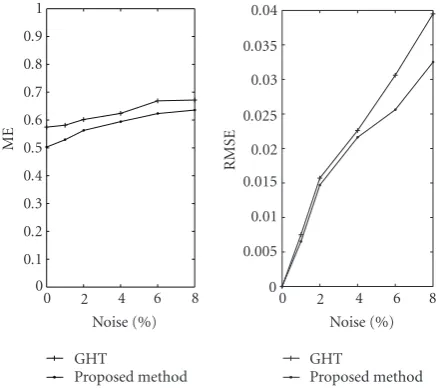
Figure5: Mean value (pixels) and root mean square error (pixels) of the mean bias over the radius value, as a function of the percent-age of noisy pixels.
The results presented inFigure 5show thatMErvalues differ by less than 0.1 pixel and are always less than 1 pixel. RMSEr values differ by less than 0.05 pixel. Therefore, statistical re-sults obtained with both methods are very close, slightly bet-ter for the GHT, at the expense of a larger computational time.
6.1.3. Circle fitting: real-world images
Proposed methods can be applied to practical issues. We as-sume that all expected contours are centered on the middle of the image. We first give the result obtained by circle fitting (seeFigure 6).
Figure 6shows that the contour of each object presented is efficiently retrieved.
6.1.4. Ellipse fitting and limitations
An ellipse is no longer characterized by a constant radius, but by two axial parameters which are the largest and the small-est distances between the contour and its center. In the case where an ellipse is expected, the signal model proposed in (2) does not hold because one cannot define one constant fre-quency in the generated signal, as it was done in the case of a circle. However, when we perform the eigendecomposition of the covariance matrix of the recorded signal snapshots, we note that there exist two dominant eigenvalues. Therefore, the dimension of the signal subspace is fixed to two. Equation (6) leads to the two approximate values of the axial param-eters of the ellipse. Then the proposed optimization method cancels the shift between the initialization ellipse and the ex-pected contour. As a comparison, we expose the result ob-tained with the method proposed in [6] that leads to the
ax-ial parameters of the ellipse through signal generation upon a linear antenna. Figure 7shows the results obtained from an image containing a slightly distorted ellipse, with axial parameters 65 and 75 pixels. The estimated values provided by the method proposed in [6] are 65.6 and 65.6 pixels (see
Figure 7(b)). The bias on one axial parameter can be due to the presence of a slight distortion. The estimation provided by the GHT, which aims at retrieving only one radius pa-rameter, is 65.7 pixels (seeFigure 7(c)). The estimated val-ues provided by our method are 67.0 and 78.6 pixels (see
Figure 7(d)). The slight bias on these values can come from the distortion of the ellipse. This bias is lower than in the case ofFigure 7(b); when the circular antenna is used, all sen-sors receive a nonzero signal component and then all com-ponents contribute in the estimation of the expected param-eters. This permits to our circular antenna to cope more ef-ficiently with slight distortions than when a linear antenna is used. When our method for retrieval of the distortions is run with 3000 iterations of gradient, with descent step parame-terλ=0.02, the bias between initialization contour and ex-pected contour is canceled (see Figures7(e)and7(f)). Then our method based on a circular antenna copes with the harsh case of a slightly distorted ellipse, for this we choose cor-rectly the dimension of the signal subspace obtained from the generated signal. We consider now the case of an ellipse for which the ratio between axial parameters is far from unity.
Figure 8shows the results obtained from an image contain-ing an ellipse with axial parameters 45 and 85 pixels. The es-timated values provided by the method proposed in [6] are 47.3 and 88.6 pixels (seeFigure 8(b)). The estimation pro-vided by the GHT, which aims at retrieving only one radius parameter, is 45 pixels (seeFigure 8(c)). The estimated val-ues provided by our method are 49.7 and 96.8 pixels (see
Figure 8(d)). The bias on these values can come from a signal model which is not adequate. Then our method based on a circular antenna copes with the case of an ellipse whose axial parameters are close to each other but is limited as soon as the ratio between axial parameters is far from unity. This is due to the assumption of linear phase in the signal generated on the circular antenna (see (2)). In the next subsection we will focus on distorted circles.
6.2. Distorted contours
In this subsection we illustrate the performances of the opti-mization methods proposed for the estimation of the distor-tions between an initialization circle and the expected con-tour. We compare the abilities of our methods with the abil-ities of GVF. gradient algorithm, which is less robust but faster than DIRECT combined with spline interpolation, is employed for hand-made images. Descent step parameter is
λ=0.02, and 3000 iterations are necessary.
6.2.1. Illustration of the results obtained with gradient algorithm: hand-made images
20 40 60 80 100 120 140 160 180 200 200
180 160 140 120 100 80 60 40 20
20 40 60 80 100 120 140 160 180 200 200
180 160 140 120 100 80 60 40 20
(a)
20 40 60 80 100 120 140 160 180 200 200
180 160 140 120 100 80 60 40 20
20 40 60 80 100 120 140 160 180 200 200
180 160 140 120 100 80 60 40 20
(b)
Figure6: (a) Processed image, (b) result obtained with the proposed method for radius estimation.MEρ=0.4 and 0.6 pixel.
20 40 60 80 100 120 140 160 180 200 200
180 160 140 120 100 80 60 40 20
(a)
20 40 60 80 100 120 140 160 180 200 200
180 160 140 120 100 80 60 40 20
(b)
20 40 60 80 100 120 140 160 180 200 200
180 160 140 120 100 80 60 40 20
(c)
20 40 60 80 100 120 140 160 180 200 200
180 160 140 120 100 80 60 40 20
(d)
20 40 60 80 100 120 140 160 180 200 200
180 160 140 120 100 80 60 40 20
(e)
20 40 60 80 100 120 140 160 180 200 200
180 160 140 120 100 80 60 40 20
(f)
Figure7: Ellipse fitting: (a) processed. (b) Difference processed and result by the existing method for ellipse retrieval [6]. (c) Difference
processed and result by the GHT. (d) Difference processed and result obtained after applying the proposed method:MEρ =2.8 pixel. (e) Difference processed and result obtained after applying gradient method:MEρ=0.7 pixel. (f) Superposition processed and result obtained
20 40 60 80 100 120 140 160 180 200 200
180 160 140 120 100 80 60 40 20
(a)
20 40 60 80 100 120 140 160 180 200 200
180 160 140 120 100 80 60 40 20
(b)
20 40 60 80 100 120 140 160 180 200 200
180 160 140 120 100 80 60 40 20
(c)
20 40 60 80 100 120 140 160 180 200 200
180 160 140 120 100 80 60 40 20
(d)
Figure8: Ellipse fitting: (a) processed. (b) Difference processed and result by the existing method for ellipse retrieval [6]. (c) Difference
processed and result by the GHT. (d) Difference processed and result obtained after applying the proposed method.
the optimization method finds the expected circle. The case ofFigure 9is not handled easily by GVF which has to be ini-tialized close to the expected contour to converge in the same computational time as gradient.
We now consider the case of a noisy image. A least-squares criterion gives an optimal result in the case of Gaus-sian noise. Then, as the proposed optimization methods are applied to minimize a least-squares criterion over the gen-erated signal (see (9)), the result obtained should be opti-mal. We consider then a noisy image containing a slightly distorted circle. In order to impair our hand-made images, we add a Gaussian noise to a percentage pof the pixels of the nonnoisy image. We adopt the same parameters as in
Section 6.1.2. The image considered inFigure 10is impaired byp=20% of noisy pixels.
We also give the result obtained with GVF, from the same image, the same initialization contour and another noise re-alization with the same parameters. Indeed, there exists only one continuous contour to be retrieved and the initialization circle is close to the expected contour, which leads to a com-putational time which is the same as when the gradient op-timization method is used. We choose the following param-eters, that lead to a good result in terms of mean error and requires an acceptable computational time: parameter values are [8]αGVF = 0.5 (tension, rather elevated because of the
presence of noise),βGVF =0.01 (rigidity),γGVF =1
(regu-larization coefficient),κGVF = 0.8 (Gradient strength
coef-ficient),μGVF = 0.15 (regularization parameter in the GVF
formulation), and 120 iterations are asked for the deforma-tion.
Gradient method cancels the pixel shifts between the ini-tialization circle and the expected circle. GVF method also cancels the pixel shifts. Computational (CPU) times which are needed for center estimation and radius estimation are, respectively, 3.8·10−2seconds and 7.8·10−1seconds. Signal
generation lasts 0.14 seconds and fixed step gradient method lasts 1.9 seconds each time they are run. Thus 8.2 seconds are needed for the four quarters of image. Running GVF method lasts 9.1 seconds. We tested the variable step gradient method, which gives the same visual result and is ten times faster than the fixed step gradient method for this example. However, we will use fixed step gradient in the following. In this way, the performances of gradient and GVF in terms of mean error are evaluated for computational times that differ by only 10%.
6.2.2. Statistical results obtained with gradient algorithm applied to noisy hand-made images
20 40 60 80 100 120 140 160 180 200 200
180 160 140 120 100 80 60 40 20
(a)
20 40 60 80 100 120 140 160 180 200 200
180 160 140 120 100 80 60 40 20
(b)
20 40 60 80 100 120 140 160 180 200 200
180 160 140 120 100 80 60 40 20
(c)
Figure9: One circle: biased radius estimation, and application of gradient algorithm: (a) processed. (b) Initialization. (c) Superposi-tion processed and result obtained after applying gradient method:
MEρ=0.15 pixel.
noise percentage values. All these images are similar to the processed image ofFigure 10. In order to evaluate only the performances of the proposed optimization method and GVF, both methods are initialized assuming the a priori knowledge of the center and the radius of the distorted cir-cle. The parameters of signal generation and signal process-ing methods, for the proposed optimization method, are the same as in Section 6.1. Statistical results presented be-low are obtained with 15 images, each containing a diff er-ent distorted circle. Noise parameters are the same as those
employed for the study of radius estimation, propagation parameter is μ = 5· 10−3. 1000 iterations are necessary
for gradient algorithm. Computational times are respectively 4.5 seconds for gradient algorithm on each quarter of im-age and 17 seconds for GVF method. So performances are compared for the same computational time. GVF method is run with the same parameter values as in Section 6.1. The first criterion that is employed to measure the accuracy of the results is the mean value ofMEρ. Mean errorMEis
de-fined byME=(1/1500)15i=1(100j=1MEρi j), where jindexes
the trials andMEρi j is the mean error over all pixels of the
contour obtained at the jth trial for theith image. The sec-ond criterion is the root mean square error RMSE, defined by RMSE = (1/1500)15i=1100j=1(MEρi j)2. The right
im-age ofFigure 11shows that mean error values are less than one pixel for each noise percentage value and for both meth-ods, thus, acceptable for many applications. The error values obtained with GVF method are between 11 and 27% higher for the considered values of noise percentage. The low-root mean square error values show that both methods are ro-bust to noise impairment. The left image ofFigure 11shows that the root mean square error values obtained with GVF are between 28 and 41% higher than the values obtained with the proposed method. The errors obtained with the proposed method are not due to the optimization method, which leads to a value zero for the criterion to be optimized. Errors come from the signal generation process: for noisy images the gen-erated signal is corrupted and its phase exhibits unexpected fluctuations. The errors obtained with GVF come from a nonoptimal interplay between all parameters for all images.
6.2.3. Distorted circle fitting: real-world images
20 40 60 80 100 120 140 160 180 200 200
180 160 140 120 100 80 60 40 20
(a)
20 40 60 80 100 120 140 160 180 200 200
180 160 140 120 100 80 60 40 20
(b)
20 40 60 80 100 120 140 160 180 200 200
180 160 140 120 100 80 60 40 20
(c)
20 40 60 80 100 120 140 160 180 200 200
180 160 140 120 100 80 60 40 20
(d)
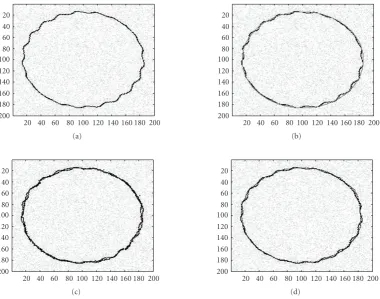
Figure10: (a) Processed. (b) Initialization by the existing method for center estimation [6] and the proposed method for radius estimation. (c) Superposition processed and result obtained after applying gradient method:MEρ=0.55 pixel. (d) Superposition processed and result
obtained after applying GVF method [8]:MEρ=0.75 pixel.
0 2 4 6 8
Noise (%) 0.75
0.8 0.85 0.9 0.95 1
ME
GVF method Proposed method
0 2 4 6 8
Noise (%) 0.075
0.08 0.085 0.09 0.095 0.1 0.105 0.11 0.115
RMSE
GVF method Proposed method
Figure11: Mean value (pixels) and root mean square error (pixels), as a function of the percentage of noisy pixels, of the mean pixel bias value over the circle.
method are the same as the parameters used inSection 6.1.
Figure 12(d)gives the result obtained with GVF, run with the
same parameters as inSection 6.2.2. Mean error valueMEρ
is 1.9 pixel. With this method, the result obtained is continu-ous and exhibits low-curvature variations, but the numercontinu-ous noise pixels prevent the active contour from converging ex-actly toward the expected contour.
Figure 12(e)gives the result obtained by DIRECT com-bined with spline interpolation. When this robust optimiza-tion method is used, the mean error valueMEρ is 1.6 pixel.
Parameters used for running DIRECT and spline interpola-tion are the following: 6 interpolainterpola-tion nodes, and 5 iterainterpola-tions for DIRECT. Computational times are, respectively, 30 and 40 seconds for GVF and the proposed method.
7. CONCLUSION
20 40 60 80 100 120 140 160 180 200 200
180 160 140 120 100 80 60 40 20
(a)
20 40 60 80 100 120 140 160 180 200 200
180 160 140 120 100 80 60 40 20
(b)
20 40 60 80 100 120 140 160 180 200 200
180 160 140 120 100 80 60 40 20
(c)
20 40 60 80 100 120 140 160 180 200 200
180 160 140 120 100 80 60 40 20
(d)
20 40 60 80 100 120 140 160 180 200 200
180 160 140 120 100 80 60 40 20
(e)
Figure12: (a) Processed image. (b) Initialization. (c) Result obtained with gradient method. (d) Result obtained with GVF. (e) Result obtained with DIRECT combined with spline interpolation.
of distorted circles. The proposed method for radius esti-mation is faster than the generalized Hough transform and exhibits a good statistical behavior. This also holds for our optimization methods that we compared with GVF. We ap-plied the robust optimization method based on DIRECT and spline interpolation to real-world images coming from prac-tical issues. Real-world images were processed successfully, low pixel bias are obtained compared with the other consid-ered methods. Further work could consist in estimating the parameters of multiple circles with different radius and also different center.
ACKNOWLEDGMENT
The authors would like to thank the anonymous reviewers who contributed to the quality of this paper by providing helpful suggestions.
REFERENCES
[1] J. F. Crawford, “A noniterative method for fitting circular arcs to measured points,”Nuclear Instruments and Methods in Physics Research, vol. 211, no. 2, pp. 223–225, 1983.
[2] V. Karim¨aki, “Effective circle fitting for particle trajectories,” Nuclear Instruments and Methods in Physics Research Section A, vol. 305, no. 1, pp. 187–191, 1991.
[3] G. Coath and P. Musumeci, “Adaptive arc fitting for ball detec-tion in robocup,” inProceedings of APRS Workshop on Digital Image Computing (WDIC ’03), pp. 63–68, Brisbane, Australia, February 2003.
[4] D. H. Ballard, “Generalizing the Hough transform to detect arbitrary shapes,”Pattern Recognition, vol. 13, no. 2, pp. 111– 122, 1981.
[5] C. L. Tisse, L. Martin, L. Torres, and M. Robert, “Person iden-tification technique using human iris recognition,” in Inter-national Conference on Vision Interface (VI ’02), pp. 294–299, Calgary, Canada, May 2002.
[6] H. K. Aghajan, “Subspace techniques for image understanding and computer vision,” Ph.D. dissertation, Stanford University, Stanford, Calif, USA, 1995.
[7] H. K. Aghajan and T. Kailath, “Sensor array processing tech-niques for super resolution multi-line-fitting and straight edge detection,”IEEE Transactions on Image Processing, vol. 2, no. 4, pp. 454–465, 1993.
[8] C. Xu and J. L. Prince, “Gradient vector flow: a new external force for snakes,” inProceedings of the IEEE Computer Soci-ety Conference on Computer Vision and Pattern Recognition, pp. 66–71, San Juan, Puerto Rico, USA, June 1997.
[9] X. Xie and M. Mirmehdi, “RAGS: region-aided geometric snake,”IEEE Transactions on Image Processing, vol. 13, no. 5, pp. 640–652, 2004.
[11] D. R. Jones, C. D. Perttunen, and B. E. Stuckman, “Lips-chitzian optimization without the Lipschitz constant,” Jour-nal of Optimization Theory and Applications, vol. 79, no. 1, pp. 157–181, 1993.
[12] S. Bourennane and J. Marot, “Optimization and interpolation for distorted contour estimation,” inProceedings of IEEE Inter-national Conference on Acoustics, Speech and Signal Processing (ICASSP ’06), vol. 2, pp. 717–720, Toulouse, France, May 2006. [13] H. K. Aghajan and T. Kailath, “SLIDE: subspace-based line de-tection,”IEEE Transactions on Pattern Analysis and Machine Intelligence, vol. 16, no. 11, pp. 1057–1073, 1994.
[14] R. Roy and T. Kailath, “ESPRIT-estimation of signal param-eters via rotational invariance techniques,”IEEE Transactions on Acoustics, Speech, and Signal Processing, vol. 37, no. 7, pp. 984–995, 1989.
[15] H. K. Aghajan, B. H. Khalaj, and T. Kailath, “Estimation of multiple 2-D uniform motions by SLIDE: subspace-based line detection,”IEEE Transactions on Image Processing, vol. 8, no. 4, pp. 517–526, 1999.
[16] J. Sheinvald and N. Kiryati, “On the magic of SLIDE,”Machine Vision and Applications, vol. 9, no. 5-6, pp. 251–261, 1997.
Julien Marotreceived the Physics engineer-ing degree from ENSP Marseille, France, in 2003 and the Image Processing DEA in 2004. Since December 2004, he works as Ph.D. student in the multidimensional sig-nal processing group (GSM), Fresnel Insti-tute (CNRS UMR-6133). His research inter-ests include applied image processing and signal processing.