International Journal of Computer Science and Mobile Computing
A Monthly Journal of Computer Science and Information Technology
ISSN 2320–088X
IJCSMC, Vol. 4, Issue. 3, March 2015, pg.259 – 264
RESEARCH ARTICLE
An Adaptive Fault Analysis Approach for
Test Path Optimization
Deepti
Student, M.Tech (CSE), Gurgaon College of Engineering, Gurgaon
Haramveer Yadav
HOD, M.Tech (CSE), Gurgaon College of Engineering, Gurgaon
Abstract- To improve the software reliability, the major requirement is to test it under different aspects in terms of test cases and constraints. A software product is described as the number if relative stages and each stage can be analyzed by number of associated test cases. Testing each test case increases the cost and time of testing process. Because of this, there is the requirement to perform effective test case selection so that each stage will be analyzed effectively. In this present work, an adaptive approach is defined to generate cost effective test sequence under test criticality analysis. The obtained results show that the presented work has reduced the overall cost of testing the software system.
Keywords: Testing, Fault Analysis, Black box Testing. Failure
I. INTRODUCTION
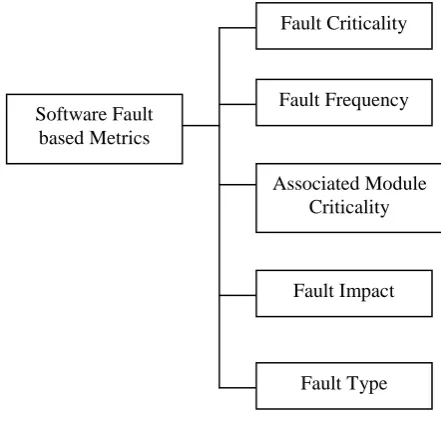
Figure 1 : Fault Criticality Type
Black Box is the testing process defined on the ready software product. The implementation of the software system is here tested based on input values. The software system itself it for different values along with associated constraint. This examination is performed respective to the description of the tested element with block level specification to identify the error cases and the cases with good results. This testing approach is able to identify interface error, process error, performance challenges, module level error identification etc. There are number of associated approaches comes under blackbox testing given here under
Boundary Value Analysis Equivalence Class Partitioning Stress Testing
Interface Testing
The boundary value analysis identifies the limit range analysis on software system for different values. These values can be identified as the valid and invalid data ranges so that the valid process identification and error case identification will be done. This approach itself includes zero value analysis, negative value analysis to generate the possible cases. The equivalence partitioning is defined to drive the test cases under different classes for the equivalence class formation so that the partitioning over the class level for different input domains will be obtained. The design level analysis comes under this testing category so that reliable test cases can be generated over the software system.
The stress testing includes the performance testing in critical situation. This critical situation can be identified in terms of heavy load over the system or in case of restricted resource availability. The resource and the load ratio is the main constraint to analyze such kind of testing over the software module or over the software system. Other kind of testing includes in these software system is interface testing. This testing approach is able to identify relationship between different modules. If the system is connected to some other environment or architecture, the testing will check that for different data values.
In this paper, the black box testing is defined under fault cases and defined an adaptive approach to generate the optimal test sequence. The test case prioritization is here defined using fault based analysis. In this section, the significance of black box testing and fault based analysis is described. In section II, the work defined by earlier researchers is discussed. In section III, the proposed work is explained along with algorithmic approach. In section IV, the results obtained from the work are discussed. In section V, the conclusion obtained from the work is presented.
Software Fault based Metrics
Fault Criticality
Fault Frequency
Associated Module Criticality
Fault Impact
II. EXISTING WORK
Different researchers included their contribution to perform black box testing using different approaches. Some of their achievements are discussed in this section. Last et al. [1] proposed a new, GA-based approach to generate effective black-box test cases. From the case study, they conclude that the Fuzzy- Based Age Extension of Genetic Algorithm (FAexGA) is much more efficient for this problem than the two other evaluated algorithms (SimpleGA and GAVaPS). In this paper, they introduced a new, computationally intelligent approach to generation of effective test cases based on a novel, Fuzzy-Based Age Extension of Genetic Algorithms (FAexGA). The basic idea was to eliminate bad test cases that are unlikely to expose any error. The promising performance of the FAexGA based approach was demonstrated on testing a complex Boolean expression. Tang et al.
[2] proposed first trial to discuss the effects of test suite reduction under selective-form regression testing. Here the total set of test requirements were divided into two subsets: one was the set of concerned test requirements which ought to be covered by current regression test cases; the other was the set of irrelevant test requirements which avoided to save the test effort, ease the failure analysis, enable missing parts and stubs, or avoid failure protecting codes. Author have been defined the multi-objective test suite reduction problem to model the selective coverage test suite reduction, and put forward the HATS algorithm to solve the problem. HATS have been applied three strategies to select the best-for-now test case(s) which proposed the maximum fitness value, or is the only one left to cover certain concerned test requirement(s). Experimental results has been compared with the total-coverage test suite reduction techniques, with proper settings of α, the HATS have been largely decrease the size of the regression test bucket. Tao et al. [3] proposed how to apply hierarchical slicing technique to regression test selection. Experimental studies indicate that the approach provide selected test cases step by step, and can improve the precision of regression test selection. From high level to low level of program, this approach was a stepwise procedure of regression test selection.
For a large-scale object-oriented program, hierarchical slicing was used to select regression test cases step by step. Chen et al. [4] proposed a dependence analysis based test case prioritization technique for Web Service regression testing. First, they analyzed the dependence relationship using control and data flow information in an orchestration language: WS-BPEL. Then they construct a weighted graph. After that, they prioritize test cases according to covering more modification-affected elements with the highest weight. Finally authors conduct a case study to illustrate the applicability of method. A weighted dependence propagation model wasproposed to facilitate prioritization process.
Yang and Wu [5] proposed a regression testing method for Composite Web service. The method can instruct the tester in locating fault in Composite Web Service, and make test data and test behavior independent of each other. Author developed a prototype, and put a system under testing into practical use, the result indicates the method is effective to Composite Web. Engström [6] proposed a method to develop and evaluate strategies for improving system test selection in a SPL. Method: Initially industrial practices and research in both SPL testing and traditional regression test selection have been surveyed. Two systematic literature reviews, two industrial exploratory surveys and one industrial evaluation of a pragmatic test selection approach have been conducted. Jin and Orso [7] proposed a novel approach called Behavioral Regression Testing (BERT). Given two versions of a program, BERT identifies behavioral differences between the two versions through dynamical analysis, in three steps. First, it generates a large number of test inputs that focus on the changed parts of the code. Second, it runs the generated test inputs on the old and new versions of the code and identifies differences in the tests’ behaviour. Third, it analyzes the identified differences and presents them to the developers. Do, Mirarab [8] conducted a series of experiments to assess the effects of time constraints on the costs and benefits of prioritization techniques. Author first experiment manipulated time constraint levels and shows that time constraints to play a significant role in determining both the cost-effectiveness of prioritization and the relative cost-benefit trade-offs among techniques.
Chun et al. [9] proposed performance analysts must manually analyze performance regression testing data to uncover performance regressions. The proposed approach was used to compare new test results against correlations pre-computed performance metrics extracted from performance regression testing repositories. Case studies show that our approach scales well to large industrial systems, and detected performance problems that are often overlooked by performance analysts. Zhang et al.
III. RESEARCH METHODOLOGY
One of the major aspect to analyze a software system under the testing process is the path testing. The path testing can be defined either a white box or the black box testing approach. In this presented work, we have defined the fault analysis based on the path testing. The presented work is divided in two main phases. In first phase, each code block will be defined respective to the different test cases and based on these test case analysis some priorities will be assigned to these test cases. The main focus of presented work is about to analyze the prioritization process. In this work fault based analysis approach is defined for prioritization. Once the prioritization will be assigned, the second phase will define the optimal sequence of the implementation of these test cases. For this sequence generation the genetic approach is analyzed based on the associated vector. Where the prioritization is taken as the main criteria to decide the next generation sequence. The presented work is the analytical work that will be done under some examples and based on the analysis the results will be driven.
In this present work a software module criticality is analyzed on the associated fault. The fault vector can be defined to generate the criticality so that more adaptive analysis over the software system will be performed. The work is here defined to analyze the modules based on the associated test vector and each test vector is able to identify different kind of fault over the system. The criticality of the fault itself represent the priority to the associated test case. These associated faults are defined here under different vectors shown in table 1.
Table 1 : Software Fault Association
Fault Type Priority
Warning Low
Error Medium
Fault Medium
Failure High
Independent Low
Dependent High
Application Based Low
System Based High
The work is defined in a layered model. At the initial stage, the software system is defined in terms of smaller modules. Once the modules are described, the identification of the test cases associated with particular module is done. A software module can be associated with one or more test case. Once the test cases are identified, the next work is to perform the test cost analysis using different approaches. One of such approach is to perform the estimation base of fault analysis. The software fault analysis is defined as the classification of the test case criticality as well as relative module criticality. A test case is defined with higher priority if it is representing some fatal error or the fault. If the test is defining some normal fault then the priority will be medium. If the test case is resolving some warning then the priority will be lowest. Once the priorities are assigned to these test cases, the cost estimation is also done based on priority analysis.
Figure 2 : Flow of Work
IV. RESULTS
The presented work is been implemented in Matlab 7.8 Environment. The work is here defined with dummy module set with assignment of the priority under fault vector. The proposed approach is here been implemented to obtain the fault sequence and to generate the optimal sequence results. The obtained results are here analyzed under cost vector.
Start
Define Software System with N modules
Identify the Faults associated with each module
Identify the test cases associated with the fault
Identify the fault based criticality
Assign the priority to test cases under fault criticality
Define the adaptive approach to generate test sequence based on criticality vector
Identify the cost of the test path sequence
Perform comparative analysis to represent criticality vector
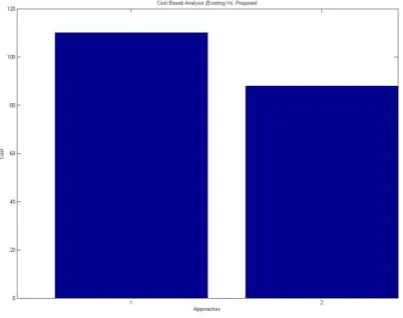
Figure 3 : Cost Based Analysis
Here figure 3 is showing the cost based analysis of prsented work. The obtained results shows that the presneted work has reduced the cost of optimal sequence generation under fault based analysis.
V. CONCLUSION
In this present work, an fault adaptive approach is defined to generate the optimal test sequence under black box testing approach. The work is here based on the prioritization assigned to the test cases under fault based analysis. The obtained results shows the effective sequence generation for test sequence optimization.
References
[1] Last M., Eyal S., and Kandel A.,”Effective Black-Box Testing with Genetic Algorithms”,2005
[2] Gu1 Q., Tang B.,” Optimal Regression Testing based on Selective Coverage of Test Requirements”, International Symposium on Parallel and Distributed Processing with Applications,978-1-7695-4152-7/10 $26.00 © 2010 IEEE [3] Tao C., et al.,” An Approach to Regression Test Selection Based on Hierarchical Slicing Technique”, 34th Annual IEEE
Computer Software and Applications Conference Workshops, 978-0-7695-4105-1/10 $26.00 © 2010 IEEE.
[4] Gu Q., Chen Q.,” Optimal Regression Testing based on Selective Coverage of Test Requirements”, International
Symposium on Parallel and Distributed Processing with Applications, 978-0-7695-4190-7/10 $26.00 © 2010 IEEE [5] Bo Yang, Ji Wu, Chao Liu, Luo Xu [2010], “A Regression Testing Method for Composite Web Service”.
[6] Engström E., “Regression Test Selection and Product Line System Testing”, Third International Conference on Software Testing, Verification and Validation, 978-0-7695-3990-4/10 $26.00 © 2010 IEEE
[7] Jin W., Orso A., “Automated Behavioral Regression Testing”, Third International Conference on Software Testing, Verification and Validation 978-0-7695-3990-4/10 © 2010 IEEE
[8] Do H., Mirarab S., “The Effects of Time Constraints on Test Case Prioritization: A Series of Controlled Experiments”, IEEE Transaction on Software engineering, vol. 36, no. 5, September, 0098-5589/10/ 2010 IEEE
[9] King Chun Foo, Zhen Ming Jiang, Bram Adams [2010], “Mining Performance Regression Testing Repositories for Automated Performance Analysis”.
[10] Zhang C., et al. “An Improved Regression Test Selection Technique by Clustering Execution Profiles”, 10th International Conference on Quality Software 1550-6002/10 © 2010 IEEE