k.s~,3.
DD
0
APPLICATION
OF INFORMATION
AND COMMUNICATION
TECHNOLOGY
IN TEACHING AND LEARNING PROCESS IN
PRIMARY TEACHER EDUCATION:
A CASE OF KAMWENJA
TEACHERS
TRAINING COLLEGE,
NYERI COUNTY, KENYA
i.ours
MATTHIAS CHANDA-NDEDA
E55/7344/200 1
A RESEARCH PROJECT
SUBMITTED TO THE DEPARTMENT OF
EDUCATIONAL
MANAGEMENT,
POLICY AND CURRICULUM
STUDIES
IN PARTIAL FULFILLMENT
FOR THE AWARD OF THE
DEGREE OF MASTER OF EDUCATION OF KENYATTA
UNIVERSITY
JULY 2016
DECLARATION
I declare that this research project is my original work and has not been presented in any other university/institution for consideration of any certification. This research project report has been complemented by referenced sources duly acknowledged. Where text and data have been borrowed from other sources including internet, these are specifically accredited and references cited using the APA system and in accordance with anti-plagiarism regulations.
___I~~2/~iL
DATECHANDA -NDEDA LOUIS MATHIAS E55/7344/0 1
This research project has been submitted with our approval as the university supervisors
~~.
---.-.----.---
..-~----(--- ---DR. OGETA O.NOBERT...
?!1ti~
.
f6
...
DATELecturer,
Department of Educational Management, Policy and Curriculum Studies,
Kenyatta University, Kenya
----~---
--DR. MURAGE MICHAEL DATE
Lecturer,
Department of Educational Management, Policy and Curriculum Studies,
Kenyatta University, Kenya
DEDICATION
To the memory of my parents, Christopher and Safina Gakeyi; for my wife Agnes and Children John, Florence and David.
ACKNOWLEDGEMENT
Iam grateful to the Almighty God for giving me the strength and wisdom.
My sincere thanks go to my supervisors Dr. N. Ogeta and Or. M. Murage who guided me keenly and dedicatedly through my work.
I also take this opportunity to thank the principal, students and colleagues of Kamwenja Teachers Training College for having given me the authority to conduct this research.
TABLE OF CONTENTS
DECLARATION ii
DEDICATION iii
ACKNOWLEDGEMENT iv
TABLE OF CONTENTS v
LIST OF TABLES viii
LIST OF FIGURES ix
ABBREVIATION AND ACRONyMS x
ABSTRACT xi
CHAPTER ONE: INTRODUCTION 1
1.0 Introduction 1
1.1 Background of the Study 1
I.2 Statement of the Problem .5
1.3 Purpose of the Study 6
1.4 Objectives of the Study 6
1.5 Research Questions 7
1.6 Significance of the Study 7
1.7 Limitations of the Study 8
1.8 Delimitations of the Study 8
1.9 Assumptions of the Study 8
1.10 Theoretical Framework 9
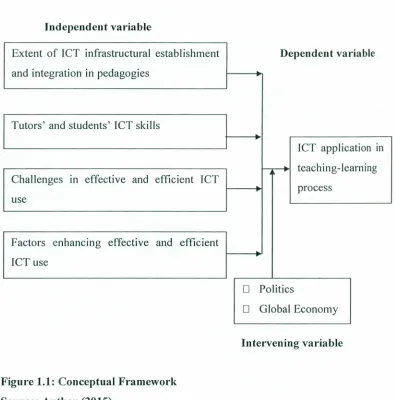
1.11 Conceptual Framework: Application of ICT in Teaching and Learning
process in Primary Teacher Education 11
1.12 Operational Definition of Terms 12
CHAPTER TWO: LITERATURE REVIEW 14
2.0 Introduction 14
2.1 Information and Communication Technologies (IC'Ts) 14
2.2 ICT Infrastructure in Academic Departments 16
2.3 The Level of ICT skills among Tutors and Students Influence Application
in Teaching and Learning Process 17
2.4 ICT Integrated in Teaching and Learning Pedagogies 17
2.5 The Challenges Affecting Adoption of ICT inTeaching and Learning ....20 2.6 The Interventions for Enhancing Adoption of ICT InTeaching and
Learning 22
2.7 Empirical Review 23
2.8 Summary 25
CHAPTER THREE: RESEARCH METHODOLOGY 27
3.1 Introduction 27
3.2 Research Design 27
3.3 Variables 27
3.4 Locale of the Study 28
3.5 Target Population 28
3.6 Sampling Technique 28
3.7 Sample size 29
3.8 Research Instruments 29
3.9 Piloting .30
3.9.1 Validity of the Instruments .30
3.9.2 Reliability of the Instruments .31
3.10 Data Collection Techniques .31
3.11 Method of Data analysis .32
3.12 Logistical and Ethical Issues .32
CHAPTER FOUR: RESULTS AND DISCUSSIONS 33
4.1 Introduction .33
4.2 Response Rate .33
4.3 Demographic Information .34
4.3.1 Response by Category .34
4.3.2 Response by Age .35
4.3.3 Response by Gender .36
4.3.4 Response by Education Background .37
4.3.5 Response by Subject Studied/Taught... .38
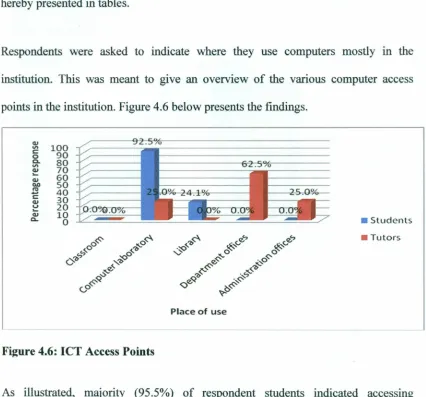
4.4 ICT Infrastructure in Academic Departments in Kamwenja TTC .39 4.5 Level of ICT Skills among Tutors and Students in Karnwenja TTC .41
VI
4.6 Degree to which ICT is Integrated In Teaching Learning Pedagogies in
Kamwenja TIC .45
4.7 Challenges Affecting Adoption of ICT in Teaching and Learning in
Kamwenja TTC 50
4.8 Ways of Enhancing Adoption of ICT inTeaching and Learning in
Kamwenja TIC 53
4.9 Pearson Correlation Analysis 55
4.9 Regression Analysis .56
4.9.1 Model Goodness of Fit.. .57
4.9.2 Analysis of Variance (ANOVA) 57
4.9.3 Regression Coefficients of Determination .58
CHAPTER FIVE: SUMMARY, CONCLUSIONS AND
RECOMMENDATIONS 60
5.1 Introduction 60
5.2 Summary of Findings 60
5.3 Conclusions 63
5.4 Recommendations 65
5.5 Suggestions for Further Studies 66
REFERENCES 67
APPENDICES 76
APPENDIX 1: INTRODUCTORY LETTER 76
APPENDIX 2: QUESTIONNAIRE FOR TUTORS AND STUDENTS 77
APPENDIX 3: INTERVIEW GUIDE FOR THE PRINCIPAL 83
APPENDIX 4: OBSERVATION SCHEDULE 84
APPENDIX 5:AUTHORIZATION LETTER 85
APPENDIX 6: RESEARCH PERMIT 86
LIST OF TABLES
Table 3.1: Sampling Frame 29
Table 4.1: Response Rate .33
Table 4.2: Duration of the ICT Course .43
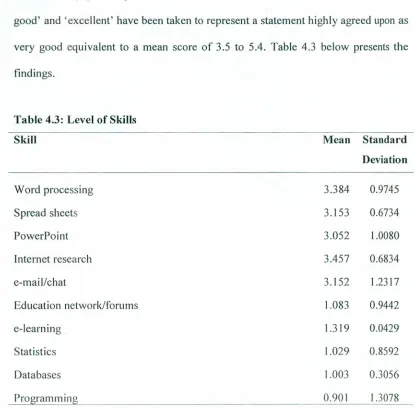
Table 4.3: Level of Ski lis .44
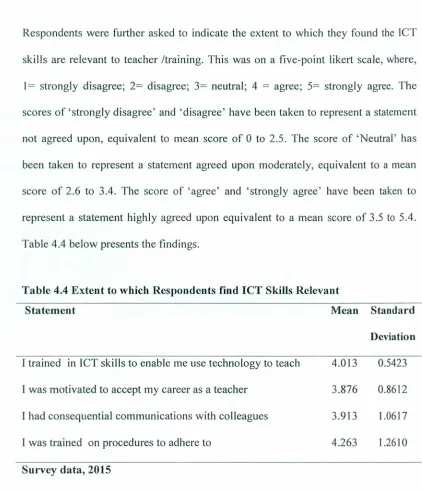
Table 4.4 Extent to which Respondents find ICT Skills Relevant.. .46
Table 4.5: Frequency of lCT Resources Use .48
Table 4.6: Challenges Affecting Adoption of lCT inTeaching and Learning ..51 Table 4.7: Ways of Enhancing Adoption of ICT in Teaching and Learning .53
Table 4.8: Pearson Correlation Matrix 55
Table 4.9: Model Goodness of Fit.. .57
Table 4.10: Analysis of Variance (ANOVA) .58
Table 4.11: Regression Coefficient Results 59
LIST OF
F
IG
U
RE
S
Figure 1.1: Conceptual Framework 11
Figure 4.1: Response by Category .34
Figure 4.2: Response by Age .35
Figure 4.3: Response by Gender .36
Figure 4.4: Response by Education Background .37
Figure 4.5: Response by Subject Studied/Taught.. .38
Figure 4.6: lCT Access Points .39
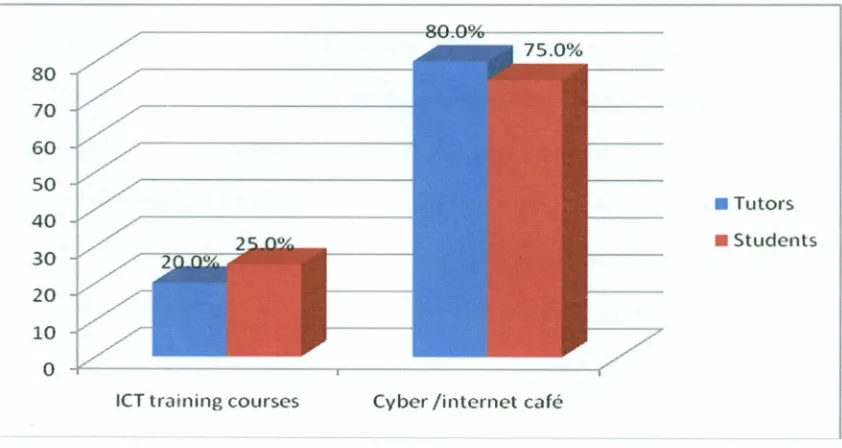
Figure 4.7: Alternative ICT Access Points .40
Figure 4.8: Initial lCT Training .42
Figure 4.9: Subjects most ICT Integrated .47
AIDS BOM
DEEP EFA
GOK HIV
ICT
ICT4D IT
KAMCO KICD
MOE MOEST
ODEL
SPSS
UNESCO
ABBREVIATION AND ACRONYMS
Acquired Immune Deficiency Syndrome
Board of Managers
Digital Education Enhancement Project Education for All
Government of Kenya Human Immune Virus
Information and Communication Technology
Information and Communication Technology for Development Information Technology
Kamwenja Teachers' Training College Kenya Institute of Curriculum Development
Ministry of Education
Ministry of Education Science and Technology
Open Distance and E-Learning
Statistical Package for Social Sciences
United Nations Education, Scientific and Cultural Organization
ABSTRACT
Despite the importance associated with Information and Communication Technology (lCT), and Kenya's heavy investment towards its successful implementation in schools and training institutions, research shows that many institutions have not embraced ICT in teaching and learning process as well as in managerial activities and Kamwenja Teachers Training College (KAMCO) where the study was conducted is no exception. The purpose of this study therefore was to establish the factors influencing the effective and efficient ICT application in the teaching and learning process in primary teacher education through the case study of Kamwenja Teachers Training College, Nyeri County Kenya. The research objectives included: to assess ICT infrastructure in academic departments in Kamwenja TIC; to investigate the level of ICT skills among tutors and students; to establish the degree to which lCT is integrated in teaching learning pedagogies; to investigate the challenges affecting adoption of ICT in teaching and learning and to suggest ways of enhancing adoption of ICT in teaching and learning in Kamwenja TIC. The study adopted case study research design which is a form of descriptive research. A case study generated in-depth data from KAMCO as single institutions to enable the researcher determine the gaps in lCT application. The target population was 925 students and 75 tutorial staff. In the study, 10% of tutors and students were sampled from the target population. The researcher employed stratified random sampling technique to ensure equitable distribution in terms of gender and year of study of the students during the sampling process. The sample population comprised of 8 tutors and 92 students and 1 principal totaling to 101 respondents. Questionnaires were administered to the 100 respondents, while the principal was interviewed. Data was analyzed by use of statistical methods including frequencies, percentages and mean. Results were presented in tables and figures and conclusions and recommendations made thereof. Findings reveal that as regards the infrastructure, a number of access points with respect to computer use can be noted in the study area, key among which include the computer laboratory and the library for use among students and department offices and administration offices among tutors. The majority of respondents are proficient with mainly basic ICT skills, as opposed to advanced ones. ICT can further be said to be fairly integrated in a number of subjects taught in the institution, most notably: ICT, mathematics, creative arts, education and integrated science, both by the tutors and the students. Challenges most inhibiting the adoption of ICT in teaching and learning in the institution include lack of initial training and the perceived insufficiency of time. Based on these findings, it is imperative to come up with adequate measures and policies that will enhance adoption of lCT in teaching and learning at the institution.
CHAPTE
R O
NE
INTR
OD
UCTION
1.0 Introduction
This chapter presents the background to the study, statement of the problem, purpose
of the study objectives, research questions and the significance of the study. Further
entailed are the limitations and delimitations, assumptions as well as the theoretical
and conceptual frameworks. The definition of significant operational terms were
included.
1.1 Background of the Study
Teacher training colleges are like "incubation and innovation" centres for skills and
knowledge creation in any country and for this, public primary teacher Training
Colleges should assume leadership role in education transformation in the swirl of
rapid technological change. There is high uptake of information and communication
technology (lCT) in the world and as a member of the global family, Kenya should
take full advantage of the innovation in education in order to reap the full benefits of
[CTs to effectively turn-around itsteachers' pre-service and in- service programmes.
UNESCO (2002) urges teacher education institutions and programmes to provide
leadership for pre-service and in- service teachers' programmes and model the new
pedagogies and tools for learning.
Goko (2012) notes that education helps to mitigate poverty and its effects by
developing human capital, consequently increasing the level of social and private
benefits. ICT is key to effective education delivery. Nevertheless, an obvious
Kenya is among the 3rd world countries that have not effectively embraced lCT (Tendai, 2014). The UN and the World Bank enthusiastically uphold Information and Communication Technology meant for progress (ict4d) as an avenue of promoting ICT in all sectors. As per the EU, the importance of Information and Communication Technology has its roots in its capacity to build entry to ICT m marginalized regions relative tothe technical knowhow ideally.
Kozma (2000) posits that lCT is at the centre of education reform efforts that involve its use in co-ordination with the changes in curriculum, teacher training, pedagogy and assessment. ICT is an effective tool that, if well integrated forms a key pillar of education and training (Tomar and Kumari, 2005). Use of ICT inpublic primary teachers training institutions in Kenya would have requisite ripple effect to
the economy and the society by creating a digitally enabled economy that will be responsible for generating economic growth and prosperity (Bollon, 2006).
Information and communication technology integration is not new in Kenya as other technologies other than digital have been used in education practice before (Goko, 2012). They include radio, telephone and television in school broadcasting programmes. What is new is the technology of using micro processor in computers (Farewell, 2007). The Government of Kenya recognizes the potential [CT has to
boost the accessibility of quality schooling resources via interactivity and universal access and by distribution of information, resources and databases rapidly and less costly, irrespective of regional disparities (World Bank, 2003). Efforts to implement ICT in Kenya's learning institutions were first started by developing sessional Paper No. I of 2005, where Information and Communication Technology was given significance (Laaria, 2013). The thought was to furnish public schools with ICT
resources and incorporate it in existing programs so as to address the problems of information society.
Karimi (2009) notes that "full integration of computers into the educational system is a distant goal unless there is reconciliation between teachers and computers. To understand how to achieve a sufficient level of lCT integration, a study had to be conducted on teachers and identify what makes them use computers effectively.
There has been growing advocacy for computer application in teaching and learning process from the last quarter of the
zo"
century, to date. Papert (2007) encourages that there is need to set out to grow "a new education culture" in an environment permeated with particular use of "computer culture". lCT enabled communications build human capabilities and freedoms and also offer students the opportunity to learn how to use electronic tools to access information and develop research skills m solving problems (Spencer and Smith, 2009). UNESCO (2004) laid down strategies of moving education from approaches based on memories and repetition of facts to a vision of meaningful and relevant learning. The United Nations andthe World Bank have also reported that ICTcan increase access to education network for teacher-trainees and broaden availability of quality education materials for emerging global economies (World Bank, 2003).Kamwemja Teachers College (KAMCO) has made tremendous strides in its quest to integrate quality lCT. Apart from infrastructure installation, internet connectivity, technical support and development of digital content, the most important factor is the teacher training in lCT skills. But these skills are never utilized when these first - order (external) barriers are resolved, "teachers do not automatically use
technology to achieve advocated meaningful outcomes", (Pachler et aI., 2013).
Owing to this factor, teachers need to consider the internal obstacles derailing ICT
incorporation by tutors. Internal obstacles are associated to tutor related variables
and processes that affect their teaching behaviour and approaches towards learning
(Sang, 2010). These are disguised and intensely entrenched in every day practices
(Ertmer, 2005). Instances of these inside obstacles are among others: instructors'
beliefs, instructors' self-efficacy and instructors' feelings.
Preston, Cox, and Cox (2000), state that in order to integrate ICT, a teacher: (l)
ought to consider that the application of the technology can more successfully
address educational aims or accomplish elevated rank objectives than could
otherwise have been accomplished and (2) must believe that he/she has the
assurance, capability, and admission to essential materials to use the technology in
instruction and learning procedures. The research endeavored to establish that: tutor
educational bel iefs (constructivist and traditional beliefs), tutor self efficacy beliefs,
tutor perceptions, (about ICT/ ICT policies), tutor attitudes to use ICT, tutor ICT
motivation, tutor computer self efficacy, inter alia, are major determinants of
effective ICT use in teacher training. This, if well implemented would resonate well
with the Jubilee Government's laptop project for standard one pupils. The initiative
to integrate ICT in teaching and learning process was anchored in Kenya's sessional
paper No. I of 2005 and further provided for in the National ICT Policy of 2006.
JCT is given more prominence in Kenya's Vision 2030, which aims at
industrializing the country by using JCT to propel it to middle level economy by
improving security, lowering the cost of doing business and making Kenya a safe
and viable business destination in the year 2015 and beyond. Already this vision is
within sight. What with the plethora of ICT innovations, among them the M-pesa
money transfer platform, which is transforming lives and providing an enabling
environment for doing business in Kenya!
1.2 Statement.of the Problem
Kenya's vision 2030 (GOK, 2007) aims at industrializing the country by using ICT
to propel it to average level financial system by enhancing safety, reducing the
price of conducting business and giving Kenyans with a forthcoming operational
atmosphere amongst others. One of the flagship projects in attaining vision 2030 is
education, in which teacher training course should be modernized to foster needs
and aspirations of Kenyans in the twenty first century. Regardless of its significance
and the approaches set in place by the nation on accomplishment ofICT in schools,
studies have recognized that these schools are not efficiently using rCT to sustain
education, instruction, research and administration as planned by the Kenya National
ICT Policy (Laaria, 2013). Meori (2007) postulates that in spite of efforts by
different stakeholders and the significance of lCT in schooling, the national ICT
strategy has to a great level stayed behind in draft structure.
Regardless of its significance and approaches designed by the government to apply
lCT in educational institutions, investigations conducted in many schools and
colleges in the country have identified that the majority of them are not leT compliant to sustain learning, instruction and administration behavior as
anticipated (Manduku, Kosgey and Sang, 2012). Laaria (2013) stipulates that regardless of efforts by different players and the significance of ICT in education
sector, the national ICT policy on education of 2006 has received inadequate
achieved over 41% implementation of [CT in classroom in public secondary
schools, the percentage remains significantly small in Kenya. This may be as a result
of the unsuitable tactics implemented by the government by not paying due attention
to teachers' skills, attitudes and reactions towards these new tools. This study
examined at length the issues at stake, with regard to the level of [CT adoption in
teaching and learning in Kamwenja Teacher's Training College.
1.3 Purpose of the Study
The purpose of the study was to establish the factors that influence lCT application
in teaching and learning process at Kamwenja Teachers' Training College in Nyeri
County, Kenya.
1.4 Objectives of the Study
The objectives of this study are:
1. To assess lCT infrastructure in academic departments in Kamwenja TTC
2. To investigate the level of lCT skills among tutors and students in Kamwenja
TTC.
3. To establish the degree to which lCT is integrated 111 teaching learning
pedagogies in Kamwenja TTC.
4. To investigate the challenges affecting adoption of lCT in teaching and learning
in Kamwenja TTC
5. To suggest ways of enhancing adoption of lCT 111 teaching and learning in
Kamwenja TTC
1.5 Research Questions
I. To what extent does JCT infrastructure in academic departments influence
application in teaching and learning process in Kamwenja TTC?
2. To what extent does the level of ICT skills among tutors and students influence
application in teaching and learning process in Kamwenja TTC?
3. To what extent is ICT integrated in teaching and learning pedagogies 111
Kamwenja TIC?
4. What are the challenges affecting adoption of ICT in teaching and learning in
Kamwenja TIC?
5. What are the interventions for enhancing adoption of ICT m teaching and
learning inKamwenja TTC?
1.6 Significance of the Study
The information gathered from this study would help education stakeholders to
understand factors that affect the application of ICT in the education system and
make relevant decisions. The ministry of education would use the findings to
formulate appropriate ICT policies for use in teacher education in line with the
National JCT policy (2006). The college management would use the findings in
deciding on the type of ICT infrastructure to acquire as well as the technical support
necessary. The curriculum designers would discover the outcomes of this research
essential in mounting the digital information that would exploit the latent of leT in
education. The KAMCO tutors would better understand how technology affects their
instructional materials positively in class and may find it necessary to adopt the
available ICT resources in the college. Other teachers' training colleges would find
the results critical in developing educator courses to enhance pre-service and
in-service ICT training thus improve their lCT application in the classroom. The study
would form valuable reference materials to both tutors and teacher-trainees to the
research topic in the education subject for the PI course. The community would
benefit from human capital development of leT infrastructure in colleges, and that
will cascade down to the entire Kenyan society.
1.7 Limitations of the Study
Some of the respondents were not willing to disclose information about their
institutions due to fear that by giving such information, the organization would be
exposed in a negative way. Further, due to the busy nature of work at the institution,
it was anticipated that respondents would not be fully available when required, thus
delaying the data collection procedure.
1.8 Delimitations of the Study
The researcher however recruited, trained and engaged a research assistant to help in
data collection. The researcher further explained to the respondents on the
importance of the study and the ethical requirement of confidentiality of information
provided by the respondents. The study was confined to the five objectives of the
study. Further, the study was undertaken at Kamwenja Teachers Training College
and the respondents were the tutors and students who are directly involved inthe
learning process.
1.9 Assumptions of the Study
During the study, it was assumed that the respondents would be available during
data collection, and that they would be honest in responding to research instruments.
Also assumed was that the study would enhance a community of practice among
stakeholders of Kamwenja and that this would trickle down to the grassroots where
the teacher trainees come from.
1.10 Theoretical Framework
This study was based on constructivists' learning theories whose foundations are in
Jean Piaget's studies on intellectual growth and in Brunner's and Vygostsky's
conversational and normal technological dimensions (Driscoll, 1994).
Constructivism premises of schooling presuppose that the information acquired
concerning worldwide isnot just areproduction of the exterior environment that was
placed into our minds by some learning procedure (Magambo, 2007). Magambo
(2007) further posits that in a constructivist knowledge atmosphere, learners create
their individual information and relate it to fresh jobs, environments and
surroundings, incorporating the innovative information into their previously
accessible information systems.
Constructivism posits that significant knowledge arises when learners create and
present their connotation to the information based on their previous familiarity
(Fosnot, 1996). Schunk (2000) also holds that correcting learners help in their
learning. Circumstances that promote such information creation comprises of an
instructional approach that is referred to as "cognitive apprenticeship", the genuine
application of instruction jobs and experience to numerous viewpoints (Biehler and
Snowman, )997). Agherdian (2007) asserts that constructivism as a theory and pedagogy shifts learning from teacher-centered (traditional approach) to learn
er-centered approach.
Kaffash et al (20I0) contend that the accomplishment of any instructive work is
fundamentally combined with the connection amid the instructor and the student.
Such activities come about within the school environment, which are also
predisposed by outside features at the district, regional and National levels. Thus the
whole program for learning lCT practice has to be studied within the three
concentric contexts of micro level (classroom), meso level (school) and macro level
(community). They should be mutually interactive with no distinct boundaries
(Kozma, 1999).
Although research shows that lCT affects students' attitude (Cox et aI, 2004), results
exemplify that lots of aspects reduce the execution of lCT programs. Consequently,
the majority of the traits of computer-based instruction are context reliant, such as
curriculum context, or the managerial set up of institutions; consequently they do not
lie under the stringent control of teachers (Kaffash et aI, 2010). They are somewhat
dependent by school board of management (BOM) and instructional policy
guidelines.
Furthermore, numerous advancements are unsuccessful since instructors do not have
information on the values underlying the advances they are anticipated to carry out,
and have not had adequate instruction in the talents required to apply the technology.
They frequently do not see a fit connecting technology, their objectives and purposes
as instructors (Cuban, 1998). In conclusion, the Impact 2 (2001) recommended a
combination of ICT and mechanical groups for resolving the challenges and
attaining superlative outcomes. This study addressed the factors affecting the use of
ICT in teacher education and how it impacts on students and the community at large.
1.11 Conceptual Framework: Application of ICT in Teaching and Learning
Process in Primary Teacher Education
Independentvariab~
Extent of ICT infrastructural establishment Dependent variable and integration in pedagogies
Tutors' and students' ICT skills
ICT application in
1-..-+ teaching-learning Challenges m effective and efficient ICT
process use
Factors enhancing effective and efficient ICT use
0 Politics
0 Global Economy
Intervening variable
Figure 1.1: Conceptual Framework Source: Author (2015)
11
1.12 Operational Definition of Terms
Application of ICT: Use of lCT to enhance and create rich environment tohelp
each individual teacher-trainee develop a depth of
understanding and critical thinking.
Refers to the information available for download or
Digital content:
distribution on electronic media such as an e-book or
tunes song. Forms of digital content include information
that is digitally broadcast, streamed or contained in
computer files.
Refers to the inequality to access to lCT services such as
telephone, computers and internet.
It is a branch of philosophy that studies knowledge. It
translates into issues of scientific methodology: how one
can develop theories or models that are better than
competing theories. Constructivism assumes that
knowledge is constructed from scratch by the learner,
Physical equipment/ hardware and software that enables a
networking to function.
Information and Communication Technology (ICT): include technologies both
Digital divide:
Epistemology:
ICT infrastructure:
Innovation:
traditional (radio, television, print and video) and internet
(virtual reality, distance education, mobile phones etc) that
are intended to fulfill information and communication.
An idea, practice or object that is perceived as new by an
individual.
IT capacity building: The procedure of crafting or improving local human and organizational abilities to use information technologies
(IT) to perform specific tasks in organizations in order to
attain organizational objectives, and it is based on the
idea of human capital - that individual people invest
themselves either at an individual or social level in
education, migration or health for the sake of present or
future gains.
Refers to the inequality in the capability and skills to Knowledge- divide:
Paradigm shift:
Pedagogy:
Technical support:
generate and use knowledge
Refers to a change in basic assumptions within a ruling
theory of science.
Commonly defined as the science and art of education. It
refers to the actual teaching skills a teacher uses to impart
content knowledge related to a specific subject.
Are basic skills to overcome technical problems when
ICTs are applied: It can be provided by the technical staff
both in the college or external service providers.
CHAPTER TWO
LITERATURE REVIEW
2.0 Introduction
This chapter presents a review of the studies undertaken by past researchers in
relation to leT and application in teaching and learning. The chapter entails the
overview, theoretical review, empirical review as well as the gaps to the study. The
reviews enabled the researcher to conceptualize the study and then undertake the
primary sourcing of data for the study.
2.1 Information and Communication Technologies (ICTs)
Information and communication technologies (leTs) are a variety of electronic
technologies that can comprise a broad collection of media, such as telephone, fax,
television and radio. New leTs can embrace the Internet, e-mail, computers, mobile
phones, digital cameras, databases and portals. The spread of leT is rampant in all
parts and its utility across various processes in organizations is seemingly beneficial,
(Baro, 2011). Global education systems needs to apply l'C'T in teaching learners in
this era of technology. Alam and Islam (2008) declared that for the past two
decades, the majority of urbanized nations have observed momentous
transformations that can be related to information and communication technologies
(K'Ts). These multidimensional transformations (technological, monetary and
economic, cultural, social and geo-political) have been witnessed in nearly all
aspects of life: economic, education, communications, leisure, and travel.
Additionally, the transformations experienced in these nations have led to the
knowledge society.
ICTs have made it probable to locate rapid access to, and sharing of data as well as
new methods of conducting business in actual time at a lower cost. The intentional
use of communication to foster development is not new. According to Walker and
Shepard (20 11) so-called Development Communication research during the 1960s
and 1970s placed the position for the majority accessible growth programs and
institutions in the area of ICT, with Wilbur Schramm, Nora C. Quebral and Everett
Rogers being significant figures in this educational discipline. In contemporary era,
ICT has been separated into three periods. As information and communication
technologies progress, so does ICT: more lately it has been recommended that large
information can be used as a significant ICT instrument for growth and that it
symbolizes anormal progression of the ICT pattern.
Through the past two decades the development and capabilities of ICT have changed
the way we converse, exist and learn.· It has transformed the modern society to
knowledge culture (Kozma, 2004). The inventive aspects of ICT and its use
facilitate individuals to improve the value of life via the upgrading of instruction and
learning. That is the reason ICT is thought as a "transformative tool" and also a
mind tool. Jonassen et al (2003) postulates that inthe framework of schooling, these
new-fangled ICT equipments may function as " cognitive tool kits" and academic
associates that permit individuals of this age to generate new information from
distinct bits of information personally or collectively, by use of multiple resources
(Alam, and Islam, 2008).
Njuru (2011) accords that the Government's general plan for national expansion is
incorporated in its Vision 2030 document, which was agreed upon in 2007. Its
object is for Kenya to become a'internationally competitive and affluent nation with
an elevated excellence of life by 2030.' It rests on three pillars of economic, social
and political development with determined objects for developmental advancement,
including a predictable 10% rate of increase in GDP p.a. from 2012. The leT
segment appears in this vision for national progress, with a meticulous importance
on commercial procedure outsourcing (BPO), consequently redefined m
development planning documents in the more extensive term 'IT-enabled services'
(ITES). An important part of the accountability for bringing out these leT-enabled
enlargements aims lies with the leT Board, which was established in 2007 to
encourage Kenya as a target for business procedure outsourcing, build leT
capability inside the country, and manage other leT-enabled expansion
involvements.
2.2 I'C'I'Infrastructure in Academic Departments
Infrastructure is an additional contextual aspect distressing leT implementation m
schools. The resources requisite for the application of K'Ts in instruction includes
physical space, fittings, power and internet connectivity (Gulati, 2008).
While the accessibility of such infrastructure may not be a confront in developing
countries or in schools in prosperous areas, their accessibility (or ease of acquisition)
in underprivileged schools is not certain (Garcia, 2004). Devoid of a steady and
dependable power supply, it is intricate for the ordinary running of fC'f amenities.
Law (2009) opines that the school managers are in a situation where they can extend
and execute strategies and plans for the school and choose what the teachers have to
give priority during the school year. Nevertheless, it seems that Norwegian school
managers hardly ever use their power for initiating transformations in school culture,
for example through specialized growth programs or teacher partnership
inventiveness (Ottestad, 2008, 20I0).
2.3 The level of ICT skills among tutors and students influence application
in teaching and learning process
Fundamentally, accords Tee (2011) that the sluggish access to fundamental ICT
equipments, poor internet connectivity of the computers and the insufficiency in the
use of audiovisual learning resources and equipment including films, slides,
transparencies, projectors, globes, charts, maps, bulletin boards, plus programmed
materials, information retrieval systems and instructional television in teacher
education programmes are challenges to the effectual and specialized improvement
of instructors. Consequently managers and instructors ought to make instructive
technology an essential part of the instructional process to offer a comprehensible
exhibition of the way to apply ICT in teaching. This can tackle the individual's
instructors and students' needs and common concerns of the instructional process in
Kenya. According to Abas, et al. (20 I 0) any teaching programme is thus concerned
with enhanced method of conducting business or carrying out a range of actions in a
specialized method via application of ICT methods.
2.4 ICT Integrated in Teaching and Learning Pedagogies
Olakulehin (2007) gave emphasis on ICT being applied as teaching aids are vital in
the instructional environments, relatively than being a complement to the teacher.
The pervasiveness of [CT has brought about rapid changes in technology, social,
political and global economic transformation. However, Abdous, M. & Yen, C.J. (20 I0) opine that the educational field has been affected by the impact of
information and communication technology. Incontestably, ICTs ha ve intluenced on
the superiority and amount of instruction, learning and studies in teacher education.
Consequently, lCT offers chances for student-teachers, teaching and non teaching
personnel to converse with each other efficiently throughout official and unofficial
teaching and learning situations (Yusuf, 2005). In the same situation, teachers
require guidance not only incomputer literacy but also in the application of a variety
of kinds of instructive software in teaching and learning (Ololube, 2006). Besides,
they require to study how to incorporate lCTs into their classroom roles and school
organization. The excellence of teachers is recognized in nearly all countries to be a
critical determinant of students learning (Ololube, 2006). Therefore, teacher training
is improved using lCTs because lCTs can facilitate teachers training and enable
them obtain complete benefits of the abilities of technology to improve student
learning (UNESCO, 2003).
Teachers taking part in a group of students come across instructional environments
that support and identify the significance of thought occasions and highlight the
centre of joint communications and numerous viewpoints in the thought procedure
(Smith et al 2003). When teachers contribute in these communities, their
contribution steadily changes from a marginal to vigorously rising involvement that
is habitually unintended and relatively premeditated. These supportive and
thoughtful learning occasions are connected to the social- constructivist theory, in
which students enthusiastically and helpfully create knowledge (Vygotsky, \978).
These collaborations for example, engage a number of associate colleges that
operate to counsel educators, advised/supervised by teacher trainers from higher
education institutions- who together with teacher students discover and think about
instruction (Davis, 2003).
Tutor self-efficacy is acknowledged as a vital aspect that explains personal
individual disparities in instruction efficacy (Sang et al.20 10.) Teachers with a
strong sense of self-efficacy are open to new ideas and more enthusiastic to try with
modern methods, demand for superior instruction techniques and try with a variety
of teaching resources (Allinder, (994). Self-efficacy in relation to computers refers
to a individual discernment of potentialities to influence computers (Compeau and
Higginns, (995). Computer self-efficacy is optimistically interrelated with an
personal eagerness to prefer and contribute in computer connected activities,
expectations of accomplishments in such activities and perseverance or effectual
handling behaviours when faced with computer connected challenges (Campeau and
Higgins, (995).
Tutors with elevated altitudes of self-efficacy on lCT utilize computers more
frequently and practice a smaller amount of associated apprehension and
technophobia. Additionally, tutors with lesser altitudes of self-efficacy about ICT
turn into additional upset and are uneasiness and falter to use computers when they
bump into challenges. Ropp (1999) uses the term, "computer self-efficacy"; to
maintain that while many teachers have optimistic thoughts to the use of educational
technologies, they do not essentially trust in their own capabilities to apply
technology in their classroom. Compeau, Higgins and Huff (1999) did a longitudinal
investigation to test the impact of computer self-efficacy beliefs, result expectations
and nervousness on computer application. Their research findings point out that
computer self-efficacy beliefs have a significant positive influence on computer use
(Sang 20 I 0).
Information and communication technologies facilitate teacher education
extensively. On the positive side, there exist numerous accounted advantages of
initiating and applying lCT as an element of the instruction process in the classroom.
Mullamaa (2010) argues that there are noteworthy paybacks inapplication of leT as,
part of the instruction and learning procedure as long as instructors identify the
connection amid application of lCT and the general curricula. With regard to the
Kenyan conditions, the ICT strategy for teaching also pressures the significance of
incorporating fCT in the curriculum, relatively to training regarding ICT.
Additionally, there exists necessity for meticulous curricula preparation for
victorious incorporation of ICTs.
Haddad and Jurich (2002) assert that dissimilar ICTs do create some precious
impacts to a variety of parts of instructive improvement and effectual learning
through increasing access, supporting effectiveness, promoting the excellence of
learning, promoting the value of instruction and enhancing organizational systems.
Roberts (2013) addresses on how the application of lCT techniques can improve
instruction in the classroom to progress student achievements and give access to a
diversity of educational resources, (Hayes, D. (2007). Nevertheless, potentialities of
lCT for learning may not be achieved devoid of an effectual academic plan put in
action facilitating solid choices on instructing with lCT while ensuring the essential
equipments are put in place, having adequate pertinent content, prioritize specialized
advancement and choose on how itmust be incorporated.
2.5 The Challenges Affecting Adoption of ICT in Teaching and Learning
There are numerous obstacles facing the implementation of ICTs in teacher training
universally. These obstacles encompass incomplete ICT infrastructure, deficiency of
information Iiteracy in tutors and tutor trainers fear of technology, deprived or lack of connectivity, insufficient instruction materials which include associated
instructive resources, course curriculum and other learning resources, feelings of teacher-trainees and teacher-trainers which designate unpleasant lack in independent
learning talents and unwillingness to take accountability for their own learning, software license and exceedingly exorbitant prices linked with the safeguarding and technological support as well as deprived power provision (Gao, 2010).
It is upsetting to observe that some education institutions are still low use of leT in
teacher training programmes. Law (2009) states that the discrepancy in accessing
knowledge and technology is caused by numerous and varied troubles including, short bandwidth for internet access, shortage of finances to embark on complete scale computerization, uneven supply of electricity, insufficient working telephone
lines and other infrastructural amenities desirable to sustain the proficient and
effectual introduction and growth of the technology.
There is also a scarcity of human ware for effectual operation of software and for maintenance. Qualified programmers, engineers and technicians are uniformly hard
to find and when they are found, the (public) education sector cannot manage to pay to hold them as competition from the private sector is severe. Mullamaa (20I0) opines that this deficiency of manpower results to a combination of other numerous challenges. Teachers can only pass on skills and thoughts to the students, if they are masters of their trade and they are at the cutting-edge of information and advancement in their subjects of specialization. This is unluckily the situation in Kenya's educational institutions; the majorities of teachers in all levels of the education system have negligible or little IC'F skills and barely use accessible
chances to expand them. This generation cannot endure the obstacles posited by the
modern social realities with this level of unawareness, technophobia and information
paranoia of the instruction personnel. This expansion, consequently calls for a
re-thinking of the methods that are adopted for teacher training in order to improve the
force towards considerable advancement.
Huang and Liaw (2005) also posit that that amongst the aspects that influence the
triumphant application of.leT in instruction, tutors' feelings on use of computers
perform a critical purpose. A study by van Braak et al (2004) also maintains that,
classroom application of computers was powerfully affected by attitudes towards
computers. Furthermore, it's imperative to realize what affects pre-service tutors'
feelings on computers application in instruction (Fisher, 2000).
2.6 The Interventions for Enhancing Adoption of I'C'I' In Teaching and
Learning
Kenyas' leT policy (2006) sets out the National aims, principles and strategies for
the delivery of leT to improve the livelihood of Kenyans. The Ministry of
Education (MOE) introduced the National leT strategy for education and training
(Farrell 2007). The [eT policy gives an opportunity for establishment of grass root
based infrastructure for knowledge sharing (Mureithi and Munyua, 2006). An leT
plan itself does not mechanically effect in the implementation of innovation except
all players concerned are obviously thoughtful of this plan, (Sang, 20I0). Fullan
(1991) states that the acceptance of innovation in schools is dependent on the
autonomous procedure of planning transformations by incorporating all school
related actors, (Sang 20I0). More in particular, the discernment of teachers about
this plan is critical. If teachers share the principles articulated within a school plan
and appreciate the implications, this plan IS more probable to affect the practice
(Kennewell et ai, 2000).
Moon and his contemporaries (DEEP project), agree that the current situation offew
institutions for teachers training to serve in this era, new progress in educators
training ought to focus on materialization of new methods; centralize schools "site
for learning" in the teacher training. The appearance of fresh form of specialized
"communities of practice", operating via modern methods of interaction (Leach et
al: 2004). Instructors require specialized growth of educational applications new
techniques to progress instruction and schooling procedure relative to conventional
instructor training which have not been effective (Magambo, 2007).
2.7 Empirical Review
In their study, Bower, Hedberg and Kuswara (2010) established that the learning
from and learning with leT viewpoint as projected by Ringstaff and Kelly (2002)
presented a good theoretical structure on how JeT might be applied and
incorporated. They supplementary promoted it to embrace the invention and
collaborative magnitudes. These perceptions and viewpoints of learning from and
with l'C'I', with or devoid of production and with or devoid of
association might be used to broaden educational technology structure and theory.
Additionally, this research also recommended the essential function played by the
teacher in the application and incorporation of leT for instruction.
Vanderl inde and van Braak (2010) have designed a hypothetical structure
under! ining the e-capacity of a school. They portray the e-capacity of a school as
"the cooperative capability of a school to realize lC'T in a method that is a level for
instructional transformation" (Vanderlinde & van Braak, 20 I 0, p. 542). The thought
of e-capacity appears to include two main proportions. First, e-capacity is what the
managers and the personnel of the school can attain collectively by distribution their possessions and enthusiasm. Dexter (2008) also argues, "lCT management must be well thought-out as a school-level property" (Vanderlinde, Dexter & van Braak, in press, p. 4). Second, the e-capacity thought also lay emphasis on that the group is enthusiastic and able to go through transformations and gain an inventive application
of ICT. Other researchers - i.e. Kozrna (2003), Erstad (2008), Drent & Meelissen
(2008) and Ainley et al (2008) - also support the significance of discovery with
technology.
Nonetheless, according to Ainley et al (2008), the school system is short of suppleness, and therefore, the execution of ICT is frequently founded on applying
technology to uphold the conventional educational structure (Erstad, 2008). Generally, one constraint in the e-capacity structure is the deficiency of explanation information, not only of the instruction circumstances, but moreover of the
procedure of incorporating ICT in instruction. Instructors' skills and enthusiasm to approve ICT is frequently connected with sociological aspects such as age and
instruction familiarity using [CT (Cox &Marshall, 2007).
Instructors' approach to pedagogy may have an effect on whether the ICTs should
be incorporated into the instruction and education procedure. If an instructor supposes in and grasps on to conventional techniques of instruction, he/she may not
be probable to transform his/her techniques to utilize ICT in instruction and learning. On the contrary instructors with the principle schemes were more disposed to constructivist
principles and are supplementary expected to vision students as vigorous contestants
in the educational procedure and consequently, enthusiastically incorporate leT in
their instructional practices.
2.8 Summary
The study gathered its literature on leT integration and its attending challenges from
both developed and developing countries. It is the view of this researcher that these
challenges face both developed and developing countries but in varying degrees.
They are more critical inthe less developed world, though.
Regionally, Kenya is the trailbrazer, when compared with the other two East African
traditional partners. Rwanda and Burundi are leT compliant in the newly formed
East African community. The research sought to establish relevant literature from
the best practices to enable Kenya realize its laptop project that the Jubilee
government has promised to implement in favour of class one pupils in 2014. This
is a major milestone in response to the global clamour to use the new leTs to teach
students knowledge and skills for the 21stcentury.
To do this, there is need for Kenya to lay its foundations carefully in terms of
workable policy for IC'T. It needs also to be alive to the technological changes and
the attendant paradigm shift. The pedagogical approaches are to be in tandem with
ICT integration in teacher education. There are impediments in IC']"integration that
might hinder smooth implementation of leT in Kenya. They are in respect to teacher
attitudes towards leT in education, teacher IC'T motivation and teacher lCT policy.
These issues are discussed with a view to remove the hiccups the government might
experience in its noble endeavor of bridging the digital-divide.
Further, Kenya should put in place mechanisms that will make education affordable
by using methods of mass education. One way of doing this is the use of the modern
techniques for provision of numerous educational opportunities to the Kenyan
society. Web based learning has become fashionable in urbanized and emerging
countries. It is popular because once the enabling environment has been put in place
the ultimate goal achievement are cost- effective and self-regulating. In a nutshell
the government has to make the cost of owning computer hardware affordable as
well as ensuring there is internet connectivity to make on-line learning a reality.
CHAPTER THREE
RESEA
R
CH METH
O
D
O
LOGY
3.1 Introduction
This chapter describes the methodology of the study, research design, locale of the
study, target population, sample of the study, research instruments, validity and
reliability of the instruments and the data analysis techniques.
3.2 Research Design
Research design is the overall plan for collecting data in order to answer research
questions. This research adopted case study design. Case study research design
studies a single unit, viz an individual, a group, an institution, an organization or a
community. Data is generated from this unit. It examines the unit in depth. The
study is descriptive in nature and data and information were collected based on the
views and perceptions of tutors and students in regard to lCT application at
Kamwenja Teachers Training College. The in-depth study of an individual, group
or an institution enables aresearcher to determine the factors and how they influence
the current behavior or status of the subject(s). The preferable techniques for
gathering data in case study design are: observation, interviews and questionnaire
(Sekaram, 2007). It is therefore appropriate for the current study as it endeavors to
investigate the effective and efficient lCT application in the teaching and learning
process at KAMCO.
3.3 Variables
The dependent variable for the study is the influence of ICT on the effective
teaching and learning process in institutions. The factors influencing application will
compose the independent variables and include and not limited to: leT
infrastructure in academic departments; the level of ICT skills among tutors and
students; the degree to which ICT is integrated in teaching learning pedagogies.
Further, included are the challenges affecting adoption of ICT in teaching and
learning and interventions of enhancing adoption of ICT in teaching and learning in
Kamwenja TTC.
3.4 Locale of the Study
The study was conducted at Kamwenja Teachers' Training College, Nyeri County,
Kenya. Kamwenja T.T.C (KAMCO) is approximately 160 kilometers, North of
Nairobi. It is one of the 22 public primary teachers training colleges in Kenya. The
college is connected to the national electricity grid. It has a good number of
computers and it also enjoys some internet connectivity around the tuition area. The
study looked into the challenges of adopting and application of ICT and the
hindrances to its integration in the learning curriculum at Kamwenja TIC.
3.5 Target Population
Orodho (2008) notes that identifying the population that is targeted for the study is
significant as it assists the investigator to formulate choices based on sampling and
resource utilization. This is a case study at KAMCO in Nyeri County, Kenya. The
college is co-educational with a student population of 925 and 75 tutorial staff. This
was the target population for the study.
3.6 Sampling Technique
Kombo (2006) notes that investigators choose a sample owing to a variety of factors
that might hamper studying the total population; while Sekararn, (2007) states that
sampling methods are plans or processes that are used to choose a sample from a
target population. Stating the sample size and sampling process is imperative in
order to institute representativeness of the sample for general ity (Gay 2002).
Stratified random sampling was applied to choose respondents in order to ensure
that each layeris adequately represented in the sample. Simple random method was
thereafter used to select respondents from the various strata. These included; the
administrative staff, the teaching staff and the students.
3.7 Sample size
The target population comprises the (Principal), seven academic departments
(education, languages, integrated science, social sciences, mathematics, creative arts
and K'T subject) and a student body comprised of first years and second years.
To ease data collection the target population was sampled by stratification at 10%.
The sample size was thus comprised of Iprincipal, 8 tutors and 92 students totaling
to 101 respondents.
Table 3.1: Sampling Frame
Category of respondents Target population Sample size Percentage
0/0
Students 925 92 10
Tutors 75 8 10
Principal 100
3.8 Research Instruments
Questionnaires were used as the main instruments for data collection. An interview
guide was used however, to gather information from the Principal to establish the
ICT policy and use of ICT in the college. According to Kombo (2006),
questionnaires are widely used to obtain information about current conditions and
practices and to make enquiries concerning attitudes and opinions quickly and in a
precise manner. Orodho (2008) notes that questionnaires provide a cheap means of
collecting data from a large number of a population. The questionnaires collected
bio-data of tutors and students, background information of the college and the use of
ICTs in teaching and learning.
3.9 Piloting
This is the process of exposing the instruments to a small number of respondents to
test the validity and the reliability. The instruments were piloted in two departments
and forty students -twenty from either year. The piloting helped the researcher to
eliminate any ambiguity in the research instruments to ensure they generate valid
and reliable data. The tutors and the students that took part in the piloting were from
aneighbouring diploma TTC which was not part of the study sample to avoid biased
results of the study.
3.9.1 Validity of the Instruments
Validity is a measure of how well a test measures what it is supposed to measure
(Kombo 2006; Orodho, 2009; Mugenda 1999). Validity is the degree to which atest
measures what it is supposed to measure (Gay, 2002). The validity was established
through close consultation and expert judgment of the researcher's supervisors who
verified the validity of the research instruments that were used in the study.
3.9.2 Reliability of the Instruments
Reliability is the measure of the degree to which a research instrument yields
consistent results after a repeated trial (Mugenda and Mugenda, 1999; Orodho,
2009). Test re-test method was used to test the reliability of the instruments. Test
re-test technique involved administering the same instruments twice to the same group
within two weeks. Reliability correlation coefficient (r) were calculated using the
spearman's rank order Rho(r).
Where:
r spearmans coefficient of correlation
d difference between results of pairs of the two variables.
n the number of pairs of observation
A correlation (r) higher than 0.75 is recommended by researchers (Ordho, 2009).
This was considered high enough to judge the instruments as reliable.
3.10 Data Collection Techniques
The letter of introduction to conduct this study was sought from the graduate school
and other relevant authorities. The letter was taken to the National commission for
science, technology and innovation (NACOSTl) for the research permit. The District
Education officer for Nyeri central was contacted to inform him/her of the
impending research in the district. The researcher visited the sampled respondents
and administered the questionnaire. Appointments to the sampled respondents were
sought prior to the visits to avoid any inconveniences. The researcher emphasized
that the information given would be specifically for the study and that it would be
private and confidential and reveal ing respondents' names was not necessary.
3.11 Method of Data analysis
Orodho (2009) defines data analysis as the process of systematically searching and
arranging completed research instruments after field work, with the aim of
increasing understanding and hence enabling one to present them to others. Data
collected was coded, cleaned and analyzed using frequencies percentages and
means, standard deviation, correlation (r) and p-value regression method. The
coding involved arranging the data to show occurrence of the different responses to
the matrix questions, closed ended and open ended items. Tallies were calculated
against each question and their frequencies recorded. The frequencies and
percentages as well as Karl Pearson's correlation coefficient and the regression
methods were adopted during the analysis. This was supported by the computer
package of Statistical Packages for Social Studies (SPSS) VERS ION 21. The data
was then presented in terms of graphs and tables, in the course of discussing the
findings. It is from this that the researcher was able to draw inferences, conclusions
and recommendations.
3.12 Logistical and Ethical Issues
The researcher personally administered the instruments to the respondents. An
informed consent was sought from all the respondents so that they voluntarily
participate. The information so collected was confidential and used only for the
purpose of the study. Clarifications were given to respondents where there arose
need. There were no threats or victimization whatsoever, to the respondents who
declined or withdrew from the study. The consent of the respondents was ensured as
well as confidentiality of information provided during the study. Respect for gender,
minorities and people living with disability were a core value during the study.
CHAPTER FOUR
RESULTS AND DISCUSSIONS
4.1 Introduction
This chapter covers the results and discussions. The general objective of the study
was to establish the factors that influence lCT application in teaching and learning
process at Kamwenja Teachers' Training College in Nyeri County, Kenya. More
specifically, the study sought to: assess lCT infrastructure in academic departments
in Kamwenja TTC; investigate the level of lCT skills among tutors and students in
Kamwenja TTC; establish the degree to which lCT is integrated inteaching learning
pedagogies in Kamwenja TIC; investigate the challenges affecting adoption of lCT
in teaching and learning in Kamwenja TTC; and to suggest ways of enhancing
adoption of lCT in teaching and learning in Kamwenja TIC .. The reliability and
viability of the data collected for the study was determined through pre-testing by a
pilot study.
Table 4.1:Response Rate
Questionnaires Frequency Percent (%)
Returned 101 100.0
Unreturned
o
0.0Distributed 101 100.0
Source: Survey data, 2015
4.2 Response Rate
The study achieved a response rate of 100.0% with all the 101 respondents targeted
sufficient for a study and reporting; a rate of 60% is good and a response rate of 70%
and over is excellent. This research consequently achieved an excellent response rate
as presented in table 4.1 below. This can be attributed to the fact that the researcher
works at the study area and was hence able to have an adequate access to the
respondents.
4.3
Demographic Information
This section captures the respondents' category as whether tutor or students, gender,
educational backgrounds, as well as subjects taught or studied, described and
presented in figures and tables below.
4.3.1
Response by Category
The study sought to determine the response by category, that is, student or teacher.
This would help determine the response rate by category and assure adequate
representation of the categories. The finding is as presented in figure 4.1 below.
100
90
80
70
60
50
40
30
20
10 o
Students Tutors Principal
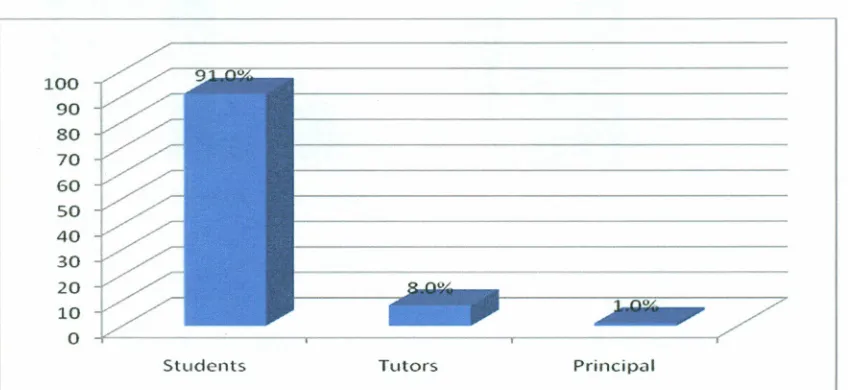
Figure 4.1: Response by Category
As presented in figure 4.1, students registered the majority, 92 (91
.
0), followed by
teachers as indicated by 8.0% of the respondents then the principal,
1 (1
.
0%). As
such,
as anticipated, proportional to the targeted population,
students were the
majority respondents followed by the tutors and then the principal
.
In this regard,
the
study can be deemed representative of all the determined categories.
4.3.2
Response
byAge
The study also deemed it significant to establish respondents' ages. This would give
a general indication of the age distribution across both the student and tutor
categories. The finding would also help determine whether or not various age
categories in the institution are adequately represented in the study. Figure 4.2 below
presented the findings.
80
70
C1I
'"
g
60Co
~ 50
•
..
:0
40ro C 30
C1I
~ 20
C1I
a...
• Students
• Tutors
10
o
~---
-
==
==-
--
-
=~
~
~
16-25 years 26-35 years 36-45 years 46- above
years
Age in years
Figure 4.2: Response
byAge
As illustrated, across the student body population, majority fell within the 16-25
years category as indicated by 76.1% of the respondents, quite distantly followed by
16
.
3% within the 26-35 years category while only 7.6% of the students were
between 36-45 years of age. Across the tutor population, majority is 46 years and
above as represented by 62.5% of the population, followed by 37.5% falling within
the 36-45 years category. As such, the study can be deemed representative of the
various age categories in the school across both categories. Overall, students can be
said to be largely youthful, with majority below 25 years while for tutors, majority
aremiddle aged, falling above 46 years of age.
4.3.3
Re
sp
on
se
byGe
nd
er
To demonstrate the gender distribution and equality in the study area, this research
required to establish the respondents' gender in both groups. Results are presented in
figure 4.3 below.
70
60
50
40
30
20
10
0
Students
.Male
• Female
Tutors
Fi
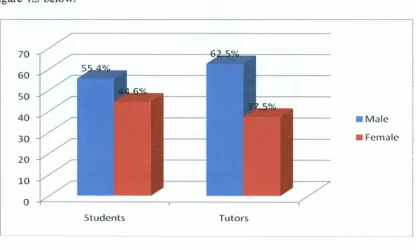
gure 4.3: Response
byGe
nd
er
As indicated in Figure 4.3.3 majority 55% of student respondents, were male, while
44.6% were female. The same trend is observed in the tutor population, with the
majority being male, 62.5%, and female 37.5%. It was further established from the
interview conducted that the principal also falls within the female gender. From the