ISSN 2286-4822 www.euacademic.org
Impact Factor: 3.1 (UIF)
DRJI Value: 5.9 (B+)
Basel III Potential Impact of Implementation –
The Response Of Banks
AVIS ANDONI
European University of Tirana Tirana, Albania
Abstract:
Discussing the target of the Basel III agreement, its upgrades or its actions is simple, because at the end the goal remains positive and unanimous: economic and financial stability and harmony across the globe. On the other hand it is advisable and necessary to observe from a bit more skeptical and scenarist view in order to detect expectation and potential response in both financial sphere and real economy. Throughout the analysis conducted under this article we will start by defining the implementation effects of these new rules on banks as well as on the real economy and shareholders, observing also the dichotomy of qualitative or quantitative effects. Following we will build possible scenarios of the impact on banks and their response to ensure adaptation towards the new structure of regulatory oversight.
Key words: International banking supervision, Basel III, banking, banking strategy.
JEL: G01, G15, G2, G28
Application of Basel III and the potential impacts on banks
banks will not only retain capital in larger quantities but also will be asked to maintain a capital with better quality. In this way, the banks enable a more stable and robust capital to cope with crises more easily without adverse contaminant effects through international banking systems, thus ensuring higher financial stability. Basel III will have several impacts on the financial system, first of all by lowering the risk of systemic banking crises but also has will be having undesirable effects such as the lowering of lending capacity, reducing investors' thirst for capital and bank debt as a result of lower dividends, and the risk of international arbitration in case of different implementations by various entities. On the other hand these adjustments and changes will directly reflect their impact on banks as emptying the weak banks; significant pressure on profitability and ROE , change in demand for the long- term financing and legal organization of various banking entities. To enable the increase of regulatory capital, banks possess various alternatives. To reflect more clearly alternatives that banks can take we can rely on the theory of the financing modes hierarchy. In fact the starting point of the latter will be capital growth through internal funding by transforming or passing gains into capital reserves (retained earnings), secondly by issuing new shares.
Domestic financing through the "blocking" of profits is the best way of funding based on the theory of hierarchy. However, considering that as a result of the impasse of retained earnings banks cannot perform investments in improving computer systems, research on customer information, etc. On the other hand, the choice of issuing new shares represents a major problem. This action is a negative signal and a condensation of current shareholders' equity in force.
dividend payment policy should be stable. When the capital increase carried out by issuing shares we can observe a capital contraction because by issuing shares, the bank will seek a lower price than the current market price to attract new investors. So the only thing seen by shareholders when using this option to increase regulatory capital is the depreciation of their shares. Basel III agreement implies increasing the weight of capital in the balance sheet, while shareholders see a performance decrease. In fact, the Return on Equity (ROE) before the crisis was estimated to be weighed about 15 % while the average estimation after the implementation of the latest agreement, this indicator is expected to decrease by 400 percentage points.
Regarding the analysis of the implications on shareholders, we must distinguish between investment banks and commercial banks. Investment banks undertake operations as long-term financing, pension funds and so on, which are far more dangerous than the operations of commercial banks, which take basically undertake short-term borrowing and lending (low risk activities). While the level of regulatory capital should be in accordance with the risks undertaken, investment banks will face much stronger growth, which will reduce shareholder returns much more. The latter results in sensitively decreasing shareholders profits in the investment banks compared with profits of commercial banks' shareholder. But we must not forget that there are also positive implications for shareholders. Given that banks should have regulatory capital level commensurate with the risk of operations undertaken, the latter will try to eliminate extremely dangerous activities, reducing the probability of loss and bankruptcy, which is actually beneficial to shareholders.
new shares. At first glance, one might think that capital requirements will force banks to issue shares in the immediate and could not "play" when the market is profitable. But the problem is covered by the transition to the implementation of the agreement on regulatory capital, which leaves banks an adequate period of time to act optimally for each individual situation of theirs.
This strong influence can be seen in the last Quantitative Impact Study (QIS)1 published by the Basel
Committee in September of 2012. The study is based on rigorous reporting processes set forth by the Committee to periodically review the implications of Basel III standards for financial markets. In the study participated a total of 209 banks, including 102 "Group1" banks (categorization of banks that have Tier 1 capital more than 3 billion Euros and are internationally active) and 107 "Group 2" banks ( i.e. all other banks). While the structure of the Basel III provides transitional arrangements for implementing the new standards, the results of this monitoring exercise assume full implementation of the final Basel III package based on data from 31 December 2011.
Based on these data and implementing changes in the definition of capital and risk -weighted assets, average common equity ratio of Tier 1 capital under the counter in Group 1 was 7.7 %, compared with the minimum requirements of Basel III at 4.5%. In order for all Group 1 banks to reach the 4.5 % minimum requirement, it will be required an increase of EUR 11.9 billion in common equity under Tier 1. The total absence amounts to 374.1 billion Euros in order to match the standard of the target level of 7.0 % (including capital conservation buffers). As a benchmark, the amount of profit after tax and before all the distributions of the same sample of Group 1 banks in 2011 was 356 billion Euros. For Group 2 banks, the average common equity under Tier 1 stood at 8.8 %. In order for all
Group 2 banks in the sample to meet the new ratio of common equity under Tier 1 of 4.5 %, the additional capital needed is estimated to be 7.6 billion Euros. This would require an additional 21.7 billion Euros to reach a target of 7.0 % of common equity under Tier 1, knowing that the sum of these banks earnings after tax and before distribution, in 2011, was at 24 billion Euros.
According the analysis of expectations, there will be generated significant capital deficits for the European banking market as well as for the American one. Meanwhile we must distinguish between big banks and small ones, clearly recognizing that large groups will find it easier to generate additional capital to meet capital requirements. The deficit in question is partly due to increased capital requirements and the introduction of new liquidity ratios but also partly because of the exclusion of certain categories of assets under Tier 1 and Tier 2 capital. According to McKinsey on 20102 solutions
adopted by banks should be three dimensional: better management of capital and liquidity, balance sheet restructuring and new models of adaptability.
Concerning the better management of capital and liquidity, banks will develop two actions. First, they can improve the effectiveness of their capital in their trading book, secondly, they can implement liquidity management practices and alternative financing through three levers: 1- developing management and liquidity funds in the enterprise level, 2 - creating a detailed summary table for a more accurate picture of the bank's liquidity position and 3- implementing an integrated financial plan for the company. In connection with the balance sheet restructuring, banks will optimize their balance sheets and will tend to have them more balanced than before.
How can this be accomplished? Simple, they need to place assets and their financing in mutual levels of maturity,
short-term assets financed with short-term liabilities and long-term assets financed with long-long-term liabilities. Finally, banks will have to develop new models considering reviewing the profitability of their business operations and financing costs due to lack of capital and its cost in the future. Thus, banks can develop new range of products, and review the basic cost of asset prices.
Application of Basel III and the potential impacts on the real economy
It is totally normal that the impacts of Basel III regulation will extend to the real sphere. To analyze this optic we can observe and comment on the potential impacts on credit or debit agents. The effects of the announcement of the new agreement and its implementation will, in fact restore investor confidence in the banking system. As a result, they are more likely to put large amounts of savings in banks. However, the investors may decide to question the issue of payment of the deposit, and in fact, the bank may reduce the rate of return on deposits to increase its margin. Banks undertake this action in order to increase their profits, profits that will have to place on reserves for the capital increase. Therefore we can see that the banks creditors face positive and negative aspects.
immediately, the solution to this problem is the transition period established by the Basel Committee.
Second, banks will have to raise their own funds, causing a decrease in current assets in the balance. The amount of capital depends on the amount and level of risks undertaken, so if the bank has to raise its capital by increasing the risks, it will have a tendency to reduce risk, so automatically it will reduce crediting. We can observe so a tightening of credit by banks, pushed by fears of a credit crisis.
We can also discern a significant impact on the real economy. In fact, households and businesses will have less access to credit which could hinder economic recovery. Concerning the level of household consumption, knowing that they will borrow less in the future, households will tend to save more today to finance future consumption based on the assumption that individuals "extend" their consumption over time. At the firm level, if we rely on the theory of hierarchy, they will find other ways of financing. They may be financed by the issuance of shares or securities trading. The first option will allow them to increase their capital without risk. This option is preferred by managers because shares do not oblige strict payment obligations for them. However, this funding is reserved for large companies only.
Challenges and potential responses of banks
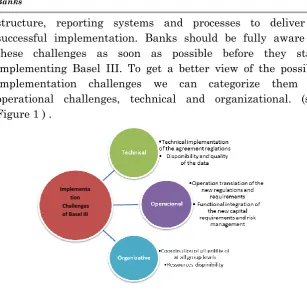
structure, reporting systems and processes to deliver a successful implementation. Banks should be fully aware of these challenges as soon as possible before they start implementing Basel III. To get a better view of the possible implementation challenges we can categorize them as operational challenges, technical and organizational. (see Figure 1 ) .
Figure 1 Implementation challenges of Basel III
Operational challenges include the development of specifications for new regulatory requirements, such as the demarcation of positions (assets and liabilities) to the new liquidity and funding categories in the calculation of Liquidity Coverage Ratio (LCR) and NSFR reports, as well as stricter capital categories. Further challenges refer functional specification of new applications for positions within the trade book and the risking of the other party, as well as the adaptation regarding new capital and liquidity ratios. Crucial is the integration of new regulatory requirements on risk management.
Technical challenges of implementing Basel III include the availability of data quality and consistency of the data to calculate the new reports. Further technical challenges
Implementa tion Challenges
result from adjustments to the financial reporting system about new reports and from the creation of an effective interface it with existing systems of risk management. Compared with Basel II, with its major focus on credit and operational risk, Basel III requirements cover a wide range of subject areas, including bank capital, liquidity and risk management, so for a successful implementation is necessary to create a working group that will consider dependencies between different topics and coordinate different functional units, technical and operational.
Organizational challenges should be managed to develop a broad response and responsibilities include scheduling within the framework of the implementation, and further efforts to rebuild profitability and allow an integrated management, capital, liquidity and risk. In achieving these objectives, identifying and securing resources should be carried out to meet the full range of initiatives required.
The impact of Basel III on banks calls for actions centered and well justified. Aside from simply achieving compliance with the new rules, banks will go well beyond minimum compliance and will take measures to restore profitability. Banks will assess their business lines, levels of risk profiles and capital income, as well as their financing strategies to take appropriate steps towards compliance as healthy as possible.
Operational Responses
Basel III creates incentives for banks to improve their operational processes to not only meet, but to increase the efficiency and to lower costs. Banks have begun to explore areas such as:
• Optimization of risk -weighted assets (RWA), including more sophisticated models, process improvement, improve data quality, and the extent of the supervisory framework.
stringent approval processes credit particularly in relation to the exposures of banks.
• Improving liquidity risk management, including the processes of “stress testing” and developing contingency funding plans. • Promotion of closer integration of risk and finance functions. • Integration of all subsidiaries in the analysis of risk management in accordance with the general appearance of the whole group as well as capital management standards.
Tactical Responses
Besides operational responses rather short, banks have a wider range of possible tactical actions to address several concerns, especially the profitability. These types of actions include the price of financing and restructuring assets. Given the definition, tactical responses do not affect long-term strategic issues, but can be extremely helpful in relieving the pressure on profitability. Among tactical responses available to banks we may list:
• Adjusting lending rates, depending on competition within specific segments and strategic importance to the banks every segment.
• Incorporation of higher capital and liquidity costs through more sensitive prices and measuring performance through risk. • Shifting into less risky segments in the portfolio, reduction of trade exposures and activities especially as derivatives.
• Increase the level of high quality liquid assets.
• Changing the mixture of financing for example by replacing the debt by interbank long-term financing and by increasing the deposit maturity.
• Reduction of the total exposure, both inside and out of balance.
Strategic Responses
institution. These include direct initiatives, such as keeping the profits to raise capital under Tier 1, but also include a wide range of options such as:
• Issuance of new equity as a result of new criteria of adequacy of agreement.
• Change in the funding strategy to cover liquidity risk.
• Taking a proactive approach to optimize and balance the management of the balance sheet.
• Engage in active customer management.
• Undertake strategic cost reductions, including rationalization of branch structures, rationalization of product or implementation of a shared services model.
• Change of business model, which can bring high risk distribution in the business units, entering so into new segments, products or businesses.
• Changing the structure of the group, for example, by selling minority interests in financial institutions.
Conclusions
addressed all the criticisms of its predecessors and has provided full innovation both qualitative and quantitative.
This agreement is mainly characterized by a redefinition of the capital, as well as introducing new elements as pillows and liquidity ratios. However, this deal is far from being perfect. It is to be appreciated that banking regulation has evolved, based on this trend, banks are adapting and finding new ways to avoid significant increases in their capital, including the provision of loans. Despite the emphasis on providing loans, banking regulation has been and will continue to be useful to solve the problems identified in the system.
Also, another question emerges: whether to “kill” an over dose supervision regulation? Ultimately the issue of selection or approval of Basel III lies in weighing the cost - profitability (or not losing) to financial system / international banking. This article describes exactly the effects of Basel III, the potential effects it will have on the economy, the real economy in the banking level. From where, after analyzing the positive and negative effects , we can conclude that Basel III is costly in the short term , but in the long run it will " pay " , ie TJA will apply . However, this agreement to be effective, must develop measures for systemic banks and institutions “ghosts”. Finally, note that the effects presented are estimates based on economic reasoning, so, under Basel III is a much more rigorous and consistent global regulatory level, which despite the high amount of requests impacts tends to harmonize the financial and banking systems, which necessarily requires the full support of banks internationally.
BIBLIOGRAPHY:
Asogwa, Rober. 2006. “Regulatory Financial Global Harmonization, Central Banks ' Supervisory Effectiveness and Macroeconomic Performance in the West African Monetary Zone (WAMZ) Countries: Analyzing the Role of Institutional Factors.” 7th Annual
Global Development Network Conference, St. Petersburg,
Russia, January 2006.
Barth, James, Gerard Caprio, and Ross Levine. 2006.
Rethinking Bank Regulation: Till Angels Govern? New
York: Cambridge University Press.
Barth, James, Gerard Caprio, and Ross Levine. 2007. “Bank Regulations are Changing: But for Better or Worse?”
World Bank Discussion Paper.
Barth, James R., Gerard Caprio Jr., and Ross Levine. 2012. "The evolution and impact of Bank Regulations." Policy
Research Working Paper Series 6288, The World Bank.
Barth, James R., Daniel E. Nolle, Triphon Phumiwasana and Glenn Yago. 2003. “A Cross-Country Analysis of the Bank Supervisory Framework and Bank Performance.”
Financial Markets, Institutions and Instruments. 12(2):
67–120. doi: 10.1111/1468-0416.t01-2-00001
Härle, Philipp, Erik Lüders, Theo Pepanides, Sonja Pfetsch, Thomas Poppensieker, Uwe Stegemann. 2010. “Basel III and European banking: Its impact, how banks might respond, and the challenges of implementation.” McKinsey working papers on risk, Number 26. McKinsey and Company.
Levine, Ross, Norman Loayza, and Thorsten Beck. 2000. “Financial Intermediation and Growth: Causality and Causes.” Journal of Monetary Economics 46.
Majone, Giandomenico. 1997. “From the Positive to the Regulatory State: Causes and Consequences of Changes in the Mode of Governance.” Journal of Public Policy
17(2).