Preventive Maintenance Scheduling of Ship Fleet
Using Integer Programming
Dr Yousef Alhouli1, Dr Mohsen Alardhi1 and Dr Taha Elhag2
1
Department of Automotive and Marine Engineering, College of Technological Studies, PAAET, Kuwait
2
School of Energy, Geoscience, Infrastructure and Society, Heriot-Watt University, United Kingdom
Abstract
Dry docking scheduling is an important feature for any merchant shipping company. To remove a ship from operation service to facilitate dry-docked maintenance activities is a critical decision because it has significant effect upon the overall availability levels of the fleet as well as the flexibility and downtime. Therefore optimum scheduling is important as it can reduce any losses and increase revenue and cash flow levels.
This paper describes a decision support model developed to schedule the preventive maintenance activities in ships that require the use of a dry dock while satisfying number of maintenance constraints. The decision support model consists of the following constraints: (a) maintenance window; (b) maintenance completion; (c) ship limit constraints; and (d) budget constraints. The proposed methodology is based on a mixed integer programming model which maximizes the availability of ships within the fleet. To verify that the model can be implemented for a real system, a case study of scheduling the preventive maintenance tasks of a ships fleet company in Kuwait is illustrated.
Keywords: Preventive maintenance, ship fleet dry dock,
mercantile maintenance, integer programming.
1. Introduction
Operating ships are very expensive since they need a lot of running and service costs, but at the same time they are high revenue yielding assets. This type of asset needs highly competent personnel for its operations and maintenance.
Ship owners and ship operators always seek the best performance from their ships, and this is most likely to occur when the ships are in a good working condition. To keep any ship in good condition, maintenance must be planned and managed in an optimum and appropriate way. Efficient scheduling of ship maintenance that requires dry docking is a vital component in the overall strategic management of a merchant shipping fleet; when this process is managed well, significant revenue and efficiency
gains can be made, since downtime will be minimised (Stopford 2009).
Ordinarily, ships are scheduled to undergo maintenance at a shipyard every two and a half years for an intermediate classification survey and every five years for a major classification survey (Stopford 2009). Usually, shipping companies attempt to conduct only the five-year major surveys with the classification societies, especially for their new vessels. This is possible because the specifications for new ships require much higher standards of design and construction than were previously the case.
In dry docking, a ship is removed from the water to enable work to be performed on the exterior of the vessel, which is ordinarily below the waterline. The owners usually plan and schedule their ships for dry docking based on the dates of previous maintenance and on the latest date by which the classification society’s inspection requirements must be met. The problem is that such scheduling is not planned to provide the optimum solution; therefore, optimum scheduling is needed to maximise the availability of ships while ensuring safe operation (House 2016).
In this paper, an optimum scheduling solution for the five-year major surveys is presented by a mathematical formulation developed for the scheduling of the dry docking maintenance of ships. The mathematical technique used is an integer model in order to formulate the relationship between the variables and solve the resultant scheduling problem. A branch-and-bound algorithm was used to solve the developed integer programming model.
2. Literature review
Deris et al. (1999) modelled ship maintenance scheduling as a constraint satisfaction problem (CSP) to maximise the availability of a ship, squadron, or fleet for operations that satisfies maintenance requirements, dockyard availability, and operational requirements.
The theory of constraints (TOC), which was developed by Goldratt and Cox (1984), has been applied by Manti et al. (2003) for ship maintenance planning. The application was implemented on the operation and maintenance scheduling of vessels to reduce the duration and increase efficiency. A case study was conducted on a repairing dock for maintenance of vessels.
Baliwangi et al. (2006) developed ship maintenance scheduling management integrated with a risk evaluation and Lifecycle cost (LCC) assessment approach. The approach was proposed to establish optimal maintenance scheduling in several steps, which includes determining component function, generating the time predicted and possible component combinations, analysing associated alternatives and uncertainties, and selecting the best alternative using LCC.
Charles-Owaba et al. (2008) developed a model to evaluate the sensitivity of a preventive maintenance scheduling scheme that is based on an integrated operations maintenance activity schedule in a resource-constrained environment. The model was tested on a shipping company. The results showed that some shipping maintenance scheduling parameters are sensitive and could be manipulated for the best performance of maintenance scheduling models.
Jessop et al. (2008) presented a condition-based maintenance (CBM) decision support software tool that leverages real-time (current and future) health condition information to optimise maintenance resources, tasking, and planning; in order to maximise the readiness of the system or process. The decision support tool is a multi-sweep optimisation algorithm that is tuned to the maintenance scheduling problem.
Zhang and Yan (2010) studied the contradiction between ship maintenance plans, maintenance resources and maintenance requirements. They used Constrained Satisfaction Problem (CSP) to develop “task arranging model” for ship maintenance planning.
Verma et al. (2011) suggested a method for scheduling minor maintenance of equipment of steam turbine ships, within the time frame of the major maintenance interval based upon the deterioration of the components. The model considers only the most important wearing components which play a direct role in the deterioration of performance of the steam turbine. MLE and Gibbs sampling method was used to estimate the parameters of distribution of gamma wear processes for the components of the steam turbine.
Verma et al. (2012) presented non-dominated sorting genetic algorithm which is based on multi-objective optimization approach. The purpose of the model is to achieve an optimum maintenance plan for the vast variety of machinery in order to improve the average reliability of ship's operations at sea at minimum cost. The advantages that can accrue from the model include: introducing short maintenance periods presented for a selected group of machinery, within the constraints of mandatory operational time, over the method of following a common maintenance interval for all machinery.
Rose and Coenen (2015) compared the performance of four different metaheuristics methods for solving a constraint satisfaction scheduling problem of the outfitting process of shipbuilding. The methods compared are genetic algorithms (GA), simulated annealing (SA), genetic simulated annealing (GSA) and discrete particle swarm optimisation (PSO). Each of these methods relies on a list of scheduling heuristic to transform the solution space into feasible schedules. They find that all methods generated schedules with sufficiently high resource utilization.
3. Problem Description
In any merchant shipping company, dry docking maintenance is very important for ensuring that the ships are seaworthy and ready to conduct the required operations. This can only be guaranteed if effective planning and management of maintenance are achieved.
In the current situation, dry docking maintenance is conducted based on two factors i.e., previous dry docked maintenance and the due date for the classification society survey. However, it is clear that other factors must also be considered in order to optimise the dry docking maintenance of ships, including factors such as the demand on a ship‘s operations and dockyard availability (Raunek 2017).
4. Mathematical Model Formulation
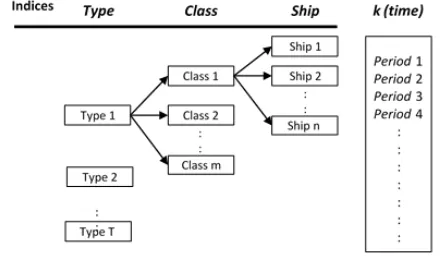
A mathematical model of ship maintenance scheduling is presented in this section, using zero-one integer programming. The first step after identifying the problem in model formulation is to establish the decision variables, which are the controllable parameters, i.e. parameters that have values and the decision maker can control and that affect the functioning of the system, (i.e. zero-one values). Then an objective function is identified that should satisfy all constraints on the decision variables. The objective function for this model is to maximise the availability of the ships. The constraints to which the model is subjected have limited values as explained later (Taha 2011). A shipping fleet typically contains various types of vessels, with each type comprised of several classes of ships. The fleet maintenance planning horizon is usually around five years (60 months). The aim is to schedule the dry docking maintenance tasks for different types of vessels with each type consisting of different classes of ships in order to maximise each ship’s availability over the planning period , all of that subject to ship maintenance constraints. Figure 1 shows the indices used in this model.
Fig. 1 Model Indices.
4.1 Decision Variables
The first step in developing the mathematical model is to identify the decision variables that may be controlled and serve to determine the outcome of the maximisation or minimisation decisions. The development of such values will provide the optimal solution (Taha 2011). The decision variables for dry docking ship maintenance scheduling problems are designed as follows:
Also, define
where:
L k
k
n s
s
m c
c
T t
t
., … … 1,2,3, = period horizon planning the
of number the represents
., … … 1,2,3, = ship the represents
., … … 1,2,3, = class the represents
., … … 1,2,3, = type the represents
The decision variable can be set to in two situations: When the ship in class of type is undergoing maintenance work during period
)
0
(
y
tcsk=
, when it is idle (ytcsk =1) . Thus, when the shipis not under maintenance (ytcsk =1) , this does not
necessarily imply that it is in operation (xtcsk =1), since it
could simply be idle. Therefore, the following constraints are needed to link variables
x
tcsk with variablesy
tcsk.tcsk tcsk
y
x
≤
for allt
,
c
,
s
andk
4.2 The Set of Constraints
The ship maintenance scheduling problem is one of constraints optimisation. The objective function has to be maximised or minimised according to certain constraints (Taha 2011). In this model, the following constraints will be considered:
• Maintenance window
• Maintenance completion
• Ships limit constraints
4.2.1 Maintenance Window
According to the requirements of the classification society, a ship must go into dry docking for maintenance regularly (every five years for a major survey and key maintenance) in order to keep the ship’s efficiency at the required standard level (House 2016). This can be achieved by specifying the latest time that the ship can be operating without maintenance and the earliest time it can be idled for maintenance. Mathematically, the maintenance window can be expressed as follows:
≤
≤
>
<
=
tcs tcs
tcs tcsk
tcsk
B
k
E
B
k
E
k
y
if
0
or
if
1
where:
tcs
E
= Earliest time that ship s of the class c of type t can be taken for maintenance.tcs
B
= Latest time that ship s of the class c of type t can be taken for maintenance.Thus
y
tcsk is fixed at 1 before the earliest and after the latest times to allow for the starting period for maintenance of ship s in class c of type t and can be 0 or 1 between those times.4.2.2 Maintenance Completion
The purpose of this constraint is to ensure that the maintenance time (dry docking period) for each ship occupies the required duration without interruption. This means that, once the ship is in dry dock for maintenance, the work must be conducted without stopping until the maintenance is finished and the ship is returned to operation.
To model this constraint, a zero-one decision variable should be introduced to represent the start of a ship’s maintenance period. Therefore, let
=
otherwise 1
period on maintenace its
starts in type class of ship a if
0 s c t k
Ztcsk
Therefore, the maintenance completion constraint will take the following form:
≤ ≤ + +
−
− + ≤ ≤ +
− =
∑
∑
− + = =
tcs tcs
tcs k
D k q
tcsq tcs
tcs tcs tcs
k
q tcsq
tcsk
B k D E Z
D
D E k E Z
k y
tcs
for 1
1 for
1
1 1
∑
− +=
− =
1
1
tcs tcs D B
k
tcs tcs tcsk B D
Z
∑
=
− = tcs B
k
tcs tcs tcsk B E
Z
1
Where,
D
tcs = duration of maintenance for ship s in classc of type t.
The first equation ensures that a job will be completed once the work begins on any ship s in period k . The other two equations ensure that in period(Btcs−Dtcs)and onwards, no new maintenance job will be started, but that in these periods the maintenance jobs which have been started can be completed.
4.2.3 Ships limit constraints
There are always a maximum number of ships which can go for maintenance during certain periods without the shipping company experiencing an unacceptable loss of fleet carrying capacity or revenue earning potential. A limited number of ships of one type in each class can, therefore, be sent for maintenance work, and the remaining ships must stay in operation. Thus, this constraint is used to limit the number of ships of one type in one class that can be sent for maintenance at any one time. The mathematical representation of such a constraint can be presented as follows:
r
n
x
n
s
tcsk
≥
−
∑
=1
Where, k runs across all time intervals:
k
=
1
,
2
,
3
,...,
L
4.2.3 Budget constraints
The following constraints will ensure that no more than the available budgets for maintenance are committed:
k tcs n s tcsk m c T t TBU BU y ≤ −
∑
∑
∑
= = = ) 1 ( 1 1 1 Where: k b TBU t c s b BU …….,b , , b= b L k k n s s m c c T t t k tcs period during available budget of number total The type class ship by needed budget of number The 3 2 1 ship of budget of amount the represent ., … 1,2,3, = period horizon planning the of number the represents ., … … 1,2,3, = ship the represents ., … … 1,2,3, = class the represents ., … … 1,2,3, = type the represents5. Objective Function
The objective function of the model can be presented as follows:
∑
∑
∑
∑
= = = = L k tcsk n s m c T tx
Max
1 1 1 1.
Where
x
tcsk represents the number of ships s available in class c of type t throughout the maintenance planning period k.Subject to:
tcsk
tcsk
y
x
≤
≤ ≤ + + − − + ≤ ≤ + − =∑
∑
− + = = tcs tcs tcs k D k q tcsq tcs tcs tcs tcs k q tcsq tcsk B k D E Z D D E k E Z k y tcs for 1 1 for 1 1 1∑
− + = − = 1 1 tcs tcs D B k tcs tcstcsk B D
Z
∑
= − = tcs B k tcs tcstcsk B E
Z 1 r n x n s
tcsk ≥ −
∑
=1 k tcs n s tcsk m c T t TBU BU y ≤ −∑
∑
∑
= = = ) 1 ( 1 1 16. Validation and Results
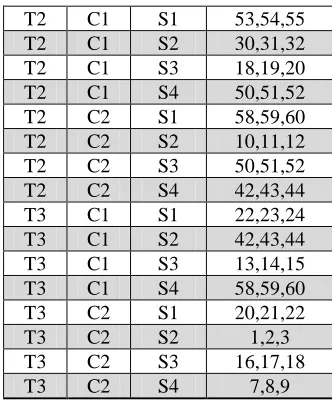
In order to validate the methodology, a scheduling of dry docking maintenance for ships of Kuwait Oil Tanker Company’s (KOTC’s) has been produced. KOTC is mainly involved in the ownership and management of tankers engaged in the transport of crude oil, refined petroleum products and liquefied petroleum gases (LPG) (KOTC 2017). The scheduling was conducted using data obtained from the KOTC fleet (Table 1), which consists of 24 vessels and includes three different types of tankers Crude oil tankers, Product oil tankers and Liquefied petroleum gas tankers. (t = 1 for crude oil tankers, t = 2 for product oil tankers, and t = 3 for gas tankers). In addition, each ship type has two different classes’ class 1 tanker and class 2 tanker. Planning horizon scheduling time is 60 months for each tanker.
time, which is month one Etcs= 1; and ends at the latest chosen time, which is month 60,
L
tcs = 60. On average, the maintenance period takes two to three months. For this validation process, a three-month maintenance period was selected.The completion constraint was determined to ensure that if a ship is in dry dock, it has to complete the docking time without any interruption to the work. The ship limit constraint ensures that the minimum number of ships is in the dockyard for maintenance during the same period. For the validation process, the maximum number of ships in the fleet allowed to be in dry dock is two. Budget constrain is also used in this model to ensure that dry-dock maintenance is applied within the monthly available company maintenance budget.
An integer programming approach has been applied to develop the maintenance scheduling model by using LINGO modelling and optimisation package.
LINGO is a software tool designed to efficiently build and solve linear, nonlinear, and integer optimization models. It consists of three parts Objective function, Variables, and Constraints. LINGO provides a completely integrated package that includes a powerful language for expressing optimization models, a full featured environment for building and editing problems, and a set of fast built-in solvers (Schrage 1999).
The summary of data and results are presented in Table 1 and Figure 2 respectively. The LINGO model identified the dry docking period for every ship in the KOTC fleet, (Figure 2). The development of the LINGO model has three basic stages as follows:
• Definition of the sets of the model (e.g. variables, constraints).
• Input data section (KOTC ship fleet data – Table
1).
• Entry of the logic of model by using specific
LINGO commands and functions (identification of the model objectives).
Table 1: Maintenance Scheduling for Dry Docking of KOTC Fleet
Ship Type
Ship Class
Ship number
Maintenance duration due in months
T1 C1 S1 23,24,25
T1 C1 S2 13,14,15
T1 C1 S3 28,29,30
T1 C1 S4 9,10,11
T1 C2 S1 55,56,57
T1 C2 S2 38,39,40
T1 C2 S3 1,2,3
T1 C2 S4 45,46,47
T2 C1 S1 53,54,55
T2 C1 S2 30,31,32
T2 C1 S3 18,19,20
T2 C1 S4 50,51,52
T2 C2 S1 58,59,60
T2 C2 S2 10,11,12
T2 C2 S3 50,51,52
T2 C2 S4 42,43,44
T3 C1 S1 22,23,24
T3 C1 S2 42,43,44
T3 C1 S3 13,14,15
T3 C1 S4 58,59,60
T3 C2 S1 20,21,22
T3 C2 S2 1,2,3
T3 C2 S3 16,17,18
T3 C2 S4 7,8,9
The results from the KOTC fleet data show that dry docking maintenance is scheduled between months 1 and 60 (5 years). The outcome also shows that once the dry docking maintenance task starts, it will continue until it is completed, which in this case is three months. The findings show that the maximum number of ships scheduled for the shipyard to carry out dry docking maintenance is two ships at a time, with limited monthly maintenance budget. Therefore, the integer programming model offers successful results, as shown in Figure 2.
From Figure 2 it can be seen that the mathematical model has maximised ships availability during the total time of 60 months. That means for 21.7% of that period all of the 24 ships are available in service (100% availability of ships), i.e. all 24 ships are available for operation for around 13 months out of the five years. On the other hand, for 36.7% of that period only one ship is out of service for maintenance, which means that 23 ships are available for 22 months out of the five years (96% of the ships are in service). Then, for 41.7 % of that period only two ships have been removed from service for maintenance, indicating that 92% of the ships are still in service. That indicates 22 ships are available in operation for 25 months out of the five years. The mathematical model managed to keep at least 22 out of 24 ships in service at all times.
7. Conclusions
Dry docking scheduling is one of the most important aspects that decision makers must consider carefully. In fact, the target of the decision makers is that the fleet to be seaworthy and at the same time ensuring that the ships are ready to conduct any required operations. Therefore, the decision making process requires a tool to optimise the fleet preventive maintenance and maximise the ships’ availabilities.
This paper present a method for solving maintenance scheduling problem and the model has been developed for ship fleet that requires dry docking. The mathematical maintenance model was formulated as zero-one integer programming problem. The mixed integer programming method has been proven to be a useful modelling technique for scheduling maintenance activities.
The data used to develop and validate the mathematical model was based on ship fleet of Kuwait Oil Tanker Company (KOTC). The objective function of this model is to maximise the ships’ availability subject to number of constraints, i.e. maintenance window, maintenance completion, budgets and ships limit constraints. The main benefits of the integer programming model include: (a) it could be used as a decision support system for preventive maintenance scheduling; and (b) it also optimises the maintenance requirements with ship availability, which affect the revenues and operation.
References
[1] Baliwangi, L., Ishida, K., Arima, H., & Artana, K. B. (2006). Optimizing Ship Machinery Maintenance Scheduling Through Risk Analysis and Life Cycle Cost Analysis. Paper presented at the 25th International Conference on Offshore Mechanics and Arctic Engineering.
[2] Charles-Owaba O. E., Oluleye A. E., Oyawale F. A. and Oke S. A. (2008). Sensitivity Analysis of A Preventive
Maintenance Scheduling Model. International Journal of Industrial and Systems Engineering 3(3): 298-323.
[3] Deris, S., Omatu S., Ohta H.and Shaharudin Kutar L. (1999). Ship Maintenance Scheduling By Genetic Algorithm and Constraint-Based Reasoning. European Journal of Operational Research 112(3): 489-502.
[4] Goldratt E. M., Cox J. (1984). The Goal: A Process of Ongoing Improvement. North River Press. Great Barrington, USA. [2] Charles-Owaba O. E., Oluleye A. E., Oyawale F. A. and Oke S. A. (2008). Sensitivity Analysis of A Preventive Maintenance Scheduling Model. International Journal of Industrial and Systems Engineering 3(3): 298-323. [5] Hamdy A. Taha (2011). Operation Research: an introduction
Ninth Edition. Prentice Hall Publisher.
[6] House D. J. (2016). Dry Docking and Shipboard Maintenance A Guide for Industry Second Edition. Routledge Publisher, New York.Jessop, S., Valentine S.and Roemer M. (2008). CBM Integrated Maintenance
Scheduler.Berlin, Germany. American Society of Mechanical Engineers.
[7] KOTC. (2017). Kuwait Oil Tanker Company S.A.K. Retrieved 21/08/2017, 2017, from http://www.kotc.com.kw/ [8] Manti, M. F., Fujimoto H.and Chen L. Y. (2003). Applying
the TOC Project Management to Operation and Maintenance Scheduling of A Research Vessel. JSME International Journal, Series C (Mechanical Systems, Machine Elements and Manufacturing) 46(1): 100-106. [4] Goldratt E. M., Cox J. (1984). The Goal: A Process of Ongoing
Improvement. North River Press. Great Barrington, USA. [9] Raunek (2017). What is Extended Dry-Docking of Ships.
Marine Insight. Retrieved 21/08/2017, 2017 from http://www.marineinsight.com.
[10]Rose C. D., Coenen J.M.G. (2015). Comparing four metaheuristics for solving a constraint satisfaction problem for ship outfitting scheduling. International Journal of Production Research,.53(19):5782-5796.
[11]Schrage, L. (1999). Optimization Modeling With Lingo, Lindo Systems.
[12] Stopford M. (2009). Maritime Economics Third Edition. Routledge Publisher, New York. [4] Goldratt E. M., Cox J. (1984). The Goal: A Process of Ongoing
Improvement. North River Press. Great Barrington, USA. [13] Verma A, ; Srividya A. , Anil R., (2011). Optimal time
scheduling for carrying out minor maintenance on a steam turbine. : International Journal of System Assurance Engineering and Management, 2(3):241-252. [5] Hamdy A. Taha (2011). Operation Research: an introduction Ninth Edition. Prentice Hall Publisher.
[14]Verma, A., Srividya A. , Commander R. ; Khattri S. (2012). Optimization of maintenance scheduling of ship borne machinery for improved reliability and reduced cost. International Journal of Reliability, Quality and Safety Engineering 19(3):1250014-1250016. [7] KOTC. (2017). Kuwait Oil Tanker Company S.A.K. Retrieved 21/08/2017, 2017, from http://www.kotc.com.kw/.