Study of the
D
-mixing parameter
y
in the
factorization-assisted topological-amplitude approach
QinQin1,∗
1Theoretische Physik 1, Naturwissenschaftlich-Technische Fakultät, Universität Siegen,
Walter-Flex-Strasse 3, D-57068 Siegen, Germany
Abstract. The contributions to the D0 −D¯0 mixing parameter y from the
D0→PP,PVchannels are calculated, based on the corresponding decay
ampli-tudes extracted from data in the factorization-assisted topological-amplitude ap-proach. It is found that thePP,PVcontributions amount up toyPP+PV=(0.21±
0.07), about one third of the experiment measurementyexp=(0.63±0.08)%.
1 Introduction
Neutral meson mixings, as flavor-changing-neutral-current processes, have been regimes for searching new physics in different periods. For example, kaon andBdmixings played crucial roles in the discoveries of the charm quark [1] and the top quark [2, 3]. Even today, it is still very important to study the mixing dynamics precisely to probe higher-scale physics. While the Bd(s) meson mixings have been studied quite well in the heavy quark effective theory [4, 5], the tentative similar study of theDmixing [6] found a number for theyparameter smaller than the fit result of the datayexp = (0.63±0.08)% [7] assuming no CP violation in charm decays by three orders of magnitude. It indicates that 1/mc withmc being the charm quark mass might be too large to allow perturbative expansion. On the other hand, the so-called "exclusive approaches" to theDmixing dynamics have been attempted in the literature (see e.g. [8–11]). In such approaches, contributions toyfrom allD0decay channels are summed up, and the SU(3) flavor symmetry breaking effects, or more precisely the U-spin symmetry breaking effects, are crucial to evaluate theDmixing parameters. It was found by [8, 9] that the SU(3) breaking effects from only the phase spaces of different decay final states can naturally give a prediction foryat the percent level as the data. A quantitative study [11] summing up the measured branching ratios (and the unmeasured ones obtained from fit in the diagrammatic approach) gave the following predictions for thePPandPV contributions to y,yPP=(0.86±0.41)×10−3,yPV =(2.69±2.53)×10−3(A,A1) andyPV =(1.52±2.20)×
10−3(S,S1) from two different solutions. The results have very large uncertainties, which are dominated by the worst measured channels. In the factorization-assisted topological-amplitude (FAT) approach [12, 13], the topological-amplitude information is extracted from data through a global fit, and the uncertainties are well controlled by the most precisely measured channels. Therefore, we expect FAT to be a proper approach to the evaluation of theDmixing parameter y. Moreover, the FAT approach has been applied to studies of manyDandBdecays [12–18], and the SU(3) breaking effects are well captured.
Precise data are available forD0 → PPandPVdecay channels [19], and make it possi-ble to extract the corresponding hadronic amplitudes in the FAT approach and to thus make predictions for yPP andyPV [20]. The results turn out to be yPP = (0.10±0.02)% and yPV =(0.11±0.07)% [20], which constitute about one third of the data of the totaly param-eter. Therefore, it is also necessary to evaluate the contributions from other two-body and multi-particle hadronicDmeson decays, probably in a different approach at the current stage because of lack of data.
The rest of the article is organized as follows. In Section 2 we present how theD0 → PP andPV amplitudes are determined by data in the FAT approach, based on which the corresponding contributions toyare predicted. Section 3 is the conclusion.
2 Calculation of
y
PPand
y
PVTheD-mixing parameteryis defined by
y≡ Γ1−Γ2
2Γ , (1)
whereΓ1,2are the decay widths of the two mass eigenstatesD1,2, andΓis their average. We neglect the tiny CP violation in Dmeson decays, and thus the CP eigenstates are identical to the mass eigenstates, i.e.,|D1,2i =|D±i = (|D0i ± |D
0
i)/√2. Here we have adopted the
conventionCP|D0i= +|D0i. Then, theyparameter is further expressed as
y= 1
2Γ X
n ρn
|A(D+→n)|2− |A(D−→n)|2
=Γ1X n
ηCP(n)ρnRe h
A(D0→n)A∗(D0→n)¯ i, (2)
whereρnis the phase-space factor for theD→ndecay, andηCPis given byCP|ni=ηCP|n¯i. We haveηCP = +1 for both thePPand PV modes. Formula (2) is what we will take to compute theyparameter, and the unknown decay amplitudes will be extracted in the FAT approach.
In the FAT approach, each decay amplitude is factorized into short-distance Wilson coef-ficients and long-distance hadronic matrix elements. The matrix elements are formulated in different categories according to their corresponding different topological diagrams, includ-ing the color-favored tree-emission diagramT, the color-suppressed tree-emission diagram C, the W-exchange diagram E, and theW-annihilation diagram A. For each type of these diagrams, there are both factorizable contributions and nonfactorizable contributions. While factorizable contributions are either known in the literature or negligible, nonfactorizable contributions are parametrized by magnitudes with complex phases. We emphasize that the SU(3) breaking effects have been considered as many as we can in such a parametrizaion. The explicit formulations of the parametrizaions of theD→ PPandPV amplitudes can be found in [12] and [13], respectively. Through the global fits to the data, the free parameters are determined with uncertainties as,
χC=−0.81±0.01, φC=0.22±0.14, S
π=−0.92±0.07, χE
q =0.056±0.002, φ E
q =5.03±0.06, χ E
s =0.130±0.008, φ E
Table 1.Branching ratios in units of 10−3for theD0→PPdecays. PredictionsB(FAT) in the FAT
approach are compared with the experimental dataB(exp) [19].
Modes B(exp) B(FAT)
π0K0 24.0±0.8 24.2±0.8 π+K− 39.3±0.4 39.2±0.4 ηK0 9.70±0.6 9.6±0.6
η0K0 19.0±1.0 19.5±1.0 π+π− 1.421±0.025 1.44±0.02 K+K− 4.01±0.07 4.05±0.07
K0K0 0.36±0.08 0.29±0.07
π0η 0.69±0.07 0.74±0.03 π0η0 0.91±0.14 1.08±0.05
ηη 1.70±0.20 1.86±0.06 ηη0 1.07±0.26 1.05±0.08 π0π0 0.826±0.035 0.78±0.03
π0K0 0.069±0.002
π−K+ 0.133±0.009 0.133±0.001
ηK0 0.027±0.002
η0K0 0.056±0.003
for theD0→PPdecays, and
Sπ=−1.88±0.12, χCP =0.63±0.03, φ C
P =1.57±0.11, χC
V =0.71±0.03, φ C
V =2.77±0.10, χ E
q =0.49±0.03, (4)
φE
q =1.61±0.07, χ E
s =0.54±0.03, φ E
s =2.23±0.08,
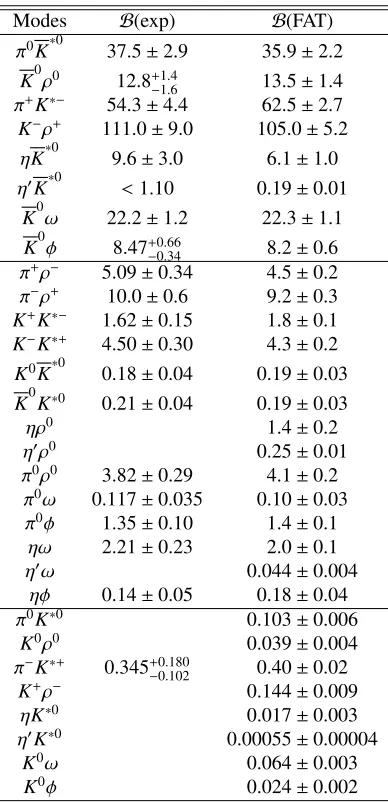
for theD0 → PV decays. The theoretical inputs are the same as in [12, 13], except that the decay constants of the vector mesons are taken from [21]. Theχ2’s per degree of freedom are 1.1 for thePPfit with 13 data, and 1.8 for the PV fit with 19 data. The PPandPV branching ratios calculated based on the parameters in (3) and (4) are listed in Table 1 and Table 2, respectively, compared to data. The consistence of the FAT and the experimental results suggests that the parametrizaions are reasonable.
Since now thePPandPVdecay amplitudes can be calculated taking the fit results of the parameters (3) and (4), the corresponding contributions toy,yPPandyPVare computed using the formula (2) to be
yPP=(1.00±0.19)×10−3, (5)
yPV =(1.12±0.72)×10−3, (6)
respectively. Combing them together, we have
yPP+PV=(0.21±0.07)%, (7)
Table 2.Same as Table I but for theD0→PVdecays.
Modes B(exp) B(FAT)
π0K∗0 37.5±2.9 35.9±2.2 K0ρ0 12.8+−11..46 13.5±1.4
π+K∗− 54.3±4.4 62.5±2.7 K−ρ+ 111.0±9.0 105.0±5.2
ηK∗0 9.6±3.0 6.1±1.0
η0K∗0 <1.10 0.19±0.01
K0ω 22.2±1.2 22.3±1.1
K0φ 8.47+−00..6634 8.2±0.6
π+ρ− 5.09±0.34 4.5±0.2 π−ρ+ 10.0±0.6 9.2±0.3 K+K∗− 1.62±0.15 1.8±0.1
K−K∗+ 4.50±0.30 4.3±0.2
K0K∗0 0.18±0.04 0.19±0.03
K0K∗0 0.21±0.04 0.19±0.03
ηρ0 1.4±0.2
η0ρ0 0.25±0.01
π0ρ0 3.82±0.29 4.1±0.2 π0ω 0.117±0.035 0.10±0.03 π0φ 1.35±0.10 1.4±0.1
ηω 2.21±0.23 2.0±0.1
η0ω 0.044±0.004
ηφ 0.14±0.05 0.18±0.04
π0K∗0 0.103±0.006
K0ρ0 0.039±0.004
π−K∗+ 0.345+0.180
−0.102 0.40±0.02
K+ρ− 0.144±0.009
ηK∗0 0.017±0.003
η0K∗0 0.00055±0.00004
K0ω 0.064±0.003
K0φ 0.024±0.002
3 Conclusion
In conclusion, while the heavy quark effective theory fails in the study of theD0−D¯0mixing dynamics, an exclusive approach might be feasible to evaluate the mixing parametery. In the FAT approach, theD0 → PPandPV decay amplitudes can be extracted from the abundant precise data of the corresponding decay channels, and the SU(3) symmetry breaking effects are under control. With the extracted amplitudes, we were able to make the prediction for the PPandPVcontributions toy, asyPP+PV =(0.21±0.07)%. We emphasize that this result is the most precise one up to now. Comparing it to the datayexp=(0.63±0.08)%, we find that the order of the measuredycan be naturally explained and that the contributions toyfrom other decay channels are also important. However, the estimation of the other contributions in the FAT approach is very difficult, if not impossible, owing to lack of data at the current stage. More data or a new strategy is expected to solve this problem.
Acknowledgements
The author is grateful to Hua-Yu Jiang, Hsiang-nan Li, Cai-Dian Lü and Fu-Sheng Yu for collaborations on the papers related to this talk. This author also thanks the organizers for the invitation to the 9th International Workshop on Charm Physics. The travel to the workshop was supported by DFG Forschergruppe FOR 1873 “Quark Flavour Physics and Effective Field Theories".
References
[1] M. K. Gaillard and B. W. Lee, Phys. Rev. D10, 897 (1974).
[2] H. Albrechtet al.[ARGUS Collaboration], Phys. Lett. B192, 245 (1987).
[3] C. Albajaret al.[UA1 Collaboration], Phys. Lett. B186, 247 (1987) Erratum: [Phys. Lett. B197, 565 (1987)].
[4] A. Lenz and U. Nierste, JHEP0706, 072 (2007) [hep-ph/0612167]. [5] A. Lenz and U. Nierste, arXiv:1102.4274 [hep-ph].
[6] M. Bobrowski, A. Lenz, J. Riedl and J. Rohrwild, JHEP 1003, 009 (2010) [arXiv:1002.4794 [hep-ph]].
[7] Y. Amhis et al. [HFLAV Collaboration], Eur. Phys. J. C 77, no. 12, 895 (2017) [arXiv:1612.07233 [hep-ex]], "updated results and plots available at https://hflav.web.cern.ch".
[8] A. F. Falk, Y. Grossman, Z. Ligeti and A. A. Petrov, Phys. Rev. D65, 054034 (2002) [hep-ph/0110317].
[9] A. F. Falk, Y. Grossman, Z. Ligeti, Y. Nir and A. A. Petrov, Phys. Rev. D69, 114021 (2004) [hep-ph/0402204].
[10] M. Gronau and J. L. Rosner, Phys. Rev. D86, 114029 (2012), [arXiv:1209.1348 [hep-ph]].
[11] H. Y. Cheng and C. W. Chiang, Phys. Rev. D81, 114020 (2010) [arXiv:1005.1106 [hep-ph]].
[12] H. n. Li, C. D. Lü and F. S. Yu, Phys. Rev. D86, 036012 (2012) [arXiv:1203.3120 [hep-ph]].
[13] H. n. Li, C. D. Lü, Q. Qin and F. S. Yu, Phys. Rev. D 89, 054006 (2014) [arXiv:1305.7021 [hep-ph]].
[14] Q. Qin, H. N. Li, C. D. Lü and F. S. Yu, Int. J. Mod. Phys. Conf. Ser.29, 1460209 (2014).
[15] S. H. Zhou, Y. B. Wei, Q. Qin, Y. Li, F. S. Yu and C. D. Lü, Phys. Rev. D92, 094016 (2015) [arXiv:1509.04060 [hep-ph]].
[16] S. H. Zhou, Q. A. Zhang, W. R. Lyu and C. D. Lü, Eur. Phys. J. C77, 125 (2017) [arXiv:1608.02819 [hep-ph]].
[17] C. Wang, Q. A. Zhang, Y. Li and C. D. Lu, Eur. Phys. J. C 77, 333 (2017) [arXiv:1701.01300 [hep-ph]].
[18] F. S. Yu, D. Wang and H. n. Li, Phys. Rev. Lett. 119, no. 18, 181802 (2017) doi:10.1103/PhysRevLett.119.181802 [arXiv:1707.09297 [hep-ph]].
[19] M. Tanabashiet al. [Particle Data Group], Phys. Rev. D 98, no. 3, 030001 (2018). doi:10.1103/PhysRevD.98.030001
[20] H. Y. Jiang, F. S. Yu, Q. Qin, H. n. Li and C. D. Lü, Chin. Phys. C42, no. 6, 063101 (2018) doi:10.1088/1674-1137/42/6/063101 [arXiv:1705.07335 [hep-ph]].
![Table 1. Branching ratios in units of 10−3 for the D0 → PP decays. Predictions B(FAT) in the FATapproach are compared with the experimental data B(exp) [19].](https://thumb-us.123doks.com/thumbv2/123dok_us/8019343.1333646/3.482.156.327.94.318/table-branching-ratios-decays-predictions-fatapproach-compared-experimental.webp)