62
A Hybrid Feature Selection Method Based on
Harmony Search
Yurou ZhangP
*
P
,Jing ZhangP
*
* Chongqing Key Laboratory of network and information security technology, Chongqing University
of Posts and Telecommunications,Chongqing 400065, P. R. China
Abstract: Spammer as the release of spam in
social networks has seriously affected the
other users' experience in social networking platform. Micro-blog has a huge amount of
registered account, and a large number of users' behaviors have brought some difficulties for the detection of spammer. So
the feature selection has become a primary problem of detecting spammer. This paper
puts forward a hybrid feature selection method based on harmony search (HS)and ReliefF, so this method is called ReF-HS. Because HS is a
heuristic algorithm, and ReliefF is a feature selection algorithm based on filter. This
method considers not only the measure of single feature but also the correlation between the features. Compared with traditional
method, this method converges quickly and is better to avoid the local optimal. Experimental
results show that the feature subset selected by ReF-HS is small in size, and the selected feature subset leads to a higher accuracy rate
of spam detection.
Key words:Harmony Search;ReliefF;Feature
Selection
1.Introduction
Micro-blog as the representative of the service website has gradually becomes the main media which can generate information
and diffuse the public opinions. Users through a variety of intelligent terminals post no more
than 140 characters of the text in real time to
share and discuss everything (including news,
jokes, comments, and even their emotions, etc.) on micro-blog. Micro-blog brings people a
variety of convenience, at the same time, it is also used by the attacker. The attackers create lots of false accounts and stole normal users'
accounts to publish advertisements, pornography, phishing and other malicious
information on social networking sites. These accounts are collectively called as spammer. Because there is trust relationship between
users, the malicious information is more dangerous than the malicious information contained by traditional spam. These
malicious behaviors cause a serious threat for the normal user's privacy information, account
security and the experience of users. Malicious interaction[1], adding friends[2], like[3] and other acts for obtaining benefits
are serious harmful to the reputation evaluation system of online social network
and the users' trust relationship. In order to solve the security problem caused by spam, the research on the behavior of the account
has become an important issue. However, micro-blog has a huge amount of registered
accounts, the accounts have different forms of expression. And the performance of the account is a dynamic process, this produces a
lot of behaviors. It has brought some difficulties for the detection of spammer, so
the selection of the user's features has become a primary problem.
The main objective of feature selection
63
accurately. The detection spammer is
essentially a problem of classification of two values. And the data without feature selection
may be redundant or noisy, which may decrease the accuracy of classification. Typically, feature selection can be divided into
three types: filter, wrapper and hybrid methods.
The method based on filter is usually ranked
or weighted, such as correlation measure, distance measure, information theory, etc. An obvious advantage of the filter is that it can
quickly eliminate a large number of non critical noise features, and reduce the scale of
the search of the optimized feature subset. The filter has high computational efficiency and good generality. But it does not guarantee that
an optimal feature subset is selected. Especially when the feature and classifier are
closely related, even if it can find an optimal subset which satisfies the condition, its scale will be quite large and contain some obvious
noise features. The computing speed of wrapper is slower than the filter. But the scale
of the optimized feature subset is relatively small, which is very advantageous to the identification of key features. At the same
time, its accuracy is relatively high, but the generalization ability is poor. The hybrid
method takes both the measurement of the single feature and the correlation between the features into account. In this paper, it focuses
on the feature selection method based on the hybrid method.
A hybrid feature selection method based on harmony search is proposed in this paper. Harmony search (HS) [4] is a kind of meta
heuristic algorithm, which imitates the music player's improvisation process. Harmony
search algorithm has certain advantages compared to the traditional optimization technology, and has achieved a great success
for a variety of optimization problems. ReliefF is a kind of feature selection algorithm based
on filter, which is pre filter of features to get
solution space. So this method is called
ReF-HS. ReF-HS takes both the measurement of individual features and considers the correlation between features into account.
Compared with the traditional methods, it is better to avoid falling into the local optimal.
First of all, the ReliefF is used to select the features which have strong classification ability. This process can reduce the search
space of HS and form the solution space that provides a range of options for musicians. And
then the new harmony is obtained by HS. The fitness function is used to evaluate the new harmony, if achieves good scores, then it will
replace the worst harmony of the harmony memory, instead, it will be discarded. The rest
of this paper is as follows: the second part summarizes the current research work; third part gives a brief overview of the concept used
in this paper; the fourth part is experiment which focuses on the data source,
experimental setup and experimental results; the fifth part is the conclusion of the paper and propose future work.
2 Related work
In recent years, researchers have made a lot of research on the application of feature selection to Spam detection or classification.
Rajalaxmi et al.[5]employed a binary bat approach to select the best features. This
method performs feature selection based on the echolocation behavior of bats. They collected real data from Facebook profile of
different users containing normal and spam profiles, and used JRip classification
algorithm to classify the profiles. The results show that the binary bat approach is better than other methods. Trivedi et al.[6]compared
64
Chi-Squared, Information Gain (IG), Gain
Ratio (GR), ReliefF (RF), and One R (OR). Then they used Bayesian Classifier to classify
the spam for validation of the results. Results of this study show that RF is the excellent feature selection technique among other in
terms of classification accuracy and false positive rate. Dhawan et al.[7]presented
Bayesian Classifier with Correlation Based Feature Selection which can key out relevant features as well as redundancy among relevant
features without pair wise correlation analysis. Zhang et al.[8]proposed a novel spam
detection method which used the wrapper-based feature selection method to reduce the false positive error of mislabeling
legitimate user as spammer. Result of this research shows clearly that the proposed
method is effective. Behjat et al.[9]applied a genetic algorithm (GA) to decrease the number of useless features in a collection of
high-dimensional email body and subject. They employed LingSpam benchmark corpora
as the dataset, and used a Multi-Layer Perceptron (MLP) to classify features. The results showed that a GA feature selector with
the MLP classifier does not only decrease the data dimensionality but increase the spam
detection rate as compared against other classifiers. Cervante et al.[10]proposed two new filter feature selection methods for
classification problems. The first method is based on binary particle swarm optimization
(BPSO) and the mutual information of each pair of features, and the other method is based on BPSO and the entropy of each group of
features. Experimental results show that the two algorithms can effectively reduce the number of features, in most cases they can get
a higher classification accuracy. The first algorithm usually can obtain a smaller feature
subset, and the second algorithm can obtain a higher classification accuracy. In previous studies, many techniques were used to carry
out Spam detection. A hybrid feature selection
method based on harmony search is proposed to obtain the feature subset of smaller scale and improve the accuracy of Spam detection.
Chen et al.[11] extracted 12 lightweight features for tweet representation. The results
showed the streaming spam tweet detection was still a big challenge and a robust detection technique should take into account the three
aspects of data, feature, and model. Abulaish et al.[12] presented an ensemble learning
method for online social network security by evaluating the performance of some basic ensemble classifiers over novel
community-based social networking features of legitimate users and spammers in online
social networks. The experimental resulted reveal that the identified features were highly discriminative to identify spammers in online
social networks. Dang et al.[13] Due to the evolving nature and hidden behavior of user,
found spammer who hijacked the trending topics with a deliberate point of view which would affect people’s judgments and decisions
seriously. They had to deal with two important issues to solve the problem of detecting this
type of spammer groups. The experimental results demonstrated that our similarity measure keeped a leading performance in all
evaluation metrics. Zheng et al.[14] proposed a supervised machine learning based solution
for an effective spammer detection. They collected a dataset from Sina Weibo and extracted a set of feature from message
content and users' social behavior, and applied into SVM (Support Vector Machines) based
spammer detection algorithm. The experiment shows that the proposed solution is capable to provide excellent performance with true
positive rate of spammers and non-spammers reaching 99.1% and 99.9% respectively. Mccord et al.[15] discussed some user based
65
they used these features to facilitate spam
detection. Their results based on the 100 most recent tweets also showed that spam detection
based on their suggested features could achieve 95.7% precision and 95.7% F-measure using the Random Forest classifier.
Zhao et al.[16] characterized two type of spammers on micro blogging platforms,
namely advertised spammers and following spammers, and then presented preliminary approaches to detect these spammers.
Specially, they introduced a new feature named duplication for spammer detection. In
experimenting they ran several classification methods on the characterized features to test the effectiveness.
3 Related concepts
3.1 ReliefF
ReliefF algorithm is based on the Relief algorithm proposed by Kononenko[17]. The ReliefF algorithm calculates the weight value
of the feature by Euler distance. The value of the feature weight value indicates the ability
of each feature to distinguish the different samples. The same with ReliefF algorithm, ReliefF algorithm is relatively simple and high
efficiency. It can select the features who have a strong classify ability. In addition, the ReliefF algorithm overcomes the problem of
noise data and data missing. Each weight in ReliefF algorithm updates is as follows:
1
( ) 1
( , , ) ( ) ( )
( , , ( )) ( )
[ ]
1 ( ( ))
i
k
i j j
k
i j
C class R i j
diff A R H
W A W A
mk
diff A R M C P C
P class R mk
=
≠ =
= − +
−
∑
∑
∑
m
represents the number of sampling.( )
j
M C
represents thejth
nearestneighbor samples from the different category
C
.class R
(
i)
represents theR
i's category.( )
P C
represents the proportion of the targetsample which belongs to category
C
to the total number of samples. Function( ,
i,
j)
diff A R R
is used to calculate thedistance between the sample instance
R
i andj
R
about a feature. Specific formula is asfollows:
| ( ) ( ) |
continuous ,
max( ) min( )
( , , ) 0 discrete ( ) ( )
1 , discrete ( ) ( )
i j
i j i j
i j
R A R A
A is
A A
diff A R R A is and R A R A
A is and R A R A
−
−
= =
≠
,
It can see that for the feature A the
smaller the distance between the two samples of the same class is or the greater the distance between the two samples of different classes is,
and the more favorable for classification the feature is. Specific ReliefF algorithm pseudo
code as shown in Table 1.
Table 1 ReliefF algorithm pseudo code
Algorithm 1. ReliefF Algorithm
Input: training data set D , frequency in
sampling
m
, the number of the nearestneighbors k
Output: feature weight vector W
Procedure begin
1. set all feature weight to be 0 2. for i=1 to m do
3. randomly select a sample R
4. find k nearest samples H of
R from the same sample set
5. for each class C≠class R( ), find
66
6. for A=1 to N do
7. update each feature weight
1 () 1
( , , ) ( ) ( , , ( ))
( ) ( ) [ ]
1 ( ( ))
i
k k
i j i j
j C class R i j
diff A R H P C diff A R M C
W A W A
mk P class R mk
= ≠ =
= − +
−
∑ ∑ ∑
8. end for
9. end for
Procedure end
3.2 Harmony search
Harmony search is a improvisation
process of musicians. Music harmony is a kind of beautiful sound combination which comes from the aesthetic view. The music
performance is to seek for an optimal state that is determined by the aesthetic evaluation.
When applied to the optimization problem, the musicians represent the objective function of the decision variable, and HS is used as a
heuristic algorithm to find the optimal state that is determined by the value of the
objective function. Geem et al.[4] took the musician analogy to the decision variables of the optimization problem. The note that a
musician plays is the value of every decision variable. Harmony memory consists of the
harmony which is played by the musician, or is a storage space for the solution vector. In particular, the harmony memory is a
two-dimensional matrix, in which the row vector representation harmony (the solution
vector), and the number of rows represents the size of the harmony memory. Each column stores the harmony that is played by different
musicians, that is, the harmony threshold of each musician. The following is the specific
iterative steps and algorithm description: (1) initialization of five variables
The parameters of the HS includes:
Harmony memory Size(HMS), Harmony
memory considering rate(HMCR), Pitch
adjusting rate(PAR), tone tuning bandwidthbw,
the maximum number of iterations.
(2) initialization of the harmony memory
Harmony memory is filled with randomly generated solution vectors 1
x , 2
x ,, HMS
x ,
and the form of harmony memory is as
follows:
1
1 1 1
1 1
1 2
2
2 2
2 2 2
1 2 1 2 ( ) ( ) ( ) ( ) ( ) ( ) N N
HMS HMS HMS HMS HMS HMS N f f f f HM f f
x
x
x
x
x
x
x
x
x
x
x
x
x
x
x
x
x
x
= =
(3) produce a new harmony
In the HS algorithm, the influence of a
new harmony generation of has three main factors: HMCR, PAR, random selection. The value range of HMCR is [ ]0,1 . The first
variable x1' of the new solution has HMCR
probability to be selected from any value in HM, and it has 1-HMCR probability to be selected from any value outside of the HM
(and within the range of the variable). The way it produces is as follows:
' 1 2 '
'
( , , ),
, ; 1, 2, ,
HMS i i i i i
i i
if rand HMCR
otherwise i N
x
x x
x
x
x
X
∈ <
= ∈ =
If the value of HMCR is low, musicians will continue to search for other regions of the
solution space, while a higher value of HMCR will restrict the musicians.
If the new harmony ' 1
x comes from the
HM, the PAR parameter is used to tune the tone, the specific way is as follows:
}
{
' ' ' ' (Continuous) * ,( ), 1,1 , , Discrete
, , 1, 2, ,
i
i i
i
rand bw if rand PAR
k m m if rand PAR
otherwise i N
x
x
x
x
+ <
= + ∈ − <
=
( )
bw is an arbitrary distance bandwidth,
rand is a random number in [0,1].
(4)Update harmony memory
Compared with the worst solution in the initial HM, if the new harmony has the better
67
replaces the worst harmony in the HM.
Whether the current iteration number has reached the maximum number of iteration or
not. If not, then repeat the process of 3 and 4 until the maximum number of iteration to reach.
3.3 ReF-HS algorithm specific description
According to the evaluation method of feature subset, it can be divided into two types: Filter and Wrapper. They each have their own
advantages and disadvantages, and complement each other. Harmony search is
one kind of feature selection based on Wrapper, and ReliefF is one kind of feature selection based on Filter. So here a feature
selection algorithm based on ReliefF algorithm and harmony search algorithm is
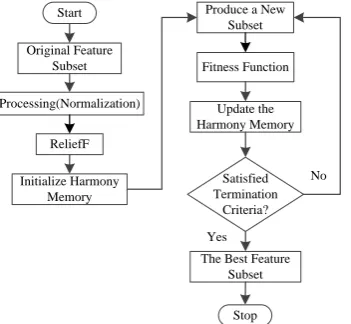
proposed. The specific process is as follows:
(1) Filtering: using the ReliefF algorithm to select the features which have strong classification ability to reduce the size of the
search space. The purpose of using the ReliefF algorithm is that it removes the features which
are weak for classifying or irrelevant, reduces the dimension of the original feature set initially and improves the efficiency of the
algorithm.
(2) Initialization: initializing the five parameters of the harmony search: HMS, HMCR, PAR, bw, the maximum number of
iterations. According to (1), the solution space
of the harmony search algorithm is obtained by the ReliefF algorithm , which provides a range of choices for each selector. The
solution space randomly generates a harmony memory.
(3) Creates a new subset: randomly generating a variable rand1 which value is
[0,1] and comparing it with the HMCR above.
If rand1 is less than HMCR, then getting a
set of harmony from the initialization of the
harmony memory, otherwise getting a set of
harmony in the solution space above. In the end, a set of harmony is gotten. If this set of
harmony is obtained from the harmony memory, it needs to tune the set of harmony. A variable rand2 whose value is chosen from
[0,1] is generated randomly generated. If
2
rand is less than PAR, it needs to use
formula (5) to get a new set of harmony, otherwise, do not.
(4) Update harmony memory
In order to evaluate the new feature subset, the fitness function of this paper considers two factors: the classification
accuracy and the dimension of the feature subset. So the fitness function is designed as
follows:
| |
( ) ( ) (1 X )
f X Acc X
N
δ ϕ
= + −
Among them, the dimension of the feature subset is represented by |X|.N is the
dimension of the original feature set, δ and
ϕ are the control parameters, which measures the proportion between the classification
accuracy and the size of the feature subset. In this paper, it is considered that classification accuracy is more important, so δ =0.9 ,
0.1
ϕ= .Acc X( ) is the classification accuracy,
the average accuracy is obtained by using the
Naive Bayes(NB) on the test set.
Compared with the worst solution in the
initial HM, if the new harmony has the better solution of fitness function, the new harmony replaces the worst harmony in the HM.
Whether the current iteration number has reached the maximum number of iteration or
not. If not, then repeat the process of 3 and 4 until the maximum number of iteration to reach.
68
Figure 1 the flow chart of the ReF-HS algorithm
3.4 Micro-blog Users' Feature Analysis
The study found that the related information of accounts in micro-blog
platform mainly includes basic information, historical posts, friends, personal interest, etc.. In this paper, the features is extracted from the
state of the accounts, the historical posts. The state of the account comes from basic account
information. This reflects the basic state of the account which includes the number of followers, follow, the number of posts,
account level, account age, etc.. The historical posts refers to the feature extracted from
publishing or forwarding historical posts of the accounts, which can reflect personal habits and the quality of posts. This includes the
frequency of posts, the proportion of the original posts, the proportion of the spam
forwarding, the average number of posts forwarded and the number of comments, etc. In the end, the 17 features are selected as
shown in Table 2.
Table 2 users' feature
Category Feature Num
ber
The number of
followings f1
The number of f2
followers
The number of posts f3
The state of
the accounts feature
Reputation f4
The number of friends f5
VIP f6
Authentication f7
The frequency of posts f8
The average number of like f9
The average number of comments f10 The average length of
posts f11 The proportion of the
original posts f12 The
historical
posts feature
Content similarity f13
The average number
of @ f14
The average number
of pictures f15 The average number
of URL f16 The average number
of topic f17
4 Experimental
4.1 Data Set Description
API provided by sina can only download
the latest posts of authorized users, and these information for Spammer detection is far from enough. In order to solve this problem, the web
crawler program is used to crawl the ID, the number of posts, the number of follower, nearly
50 posts, the number of forwarding, the comments and so on. This experiment randomly Start
Original Feature Subset
Processing(Normalization)
ReliefF
Initialize Harmony Memory
Produce a New Subset
Fitness Function
Update the Harmony Memory
Satisfied Termination
Criteria?
The Best Feature Subset
Stop Yes
69
selects 4500 users. and the data set is marked. the marked rules are as follows: (1) to publish
pornographic pictures or information, or publish content with URL pointing to pornographic sites. (2) release a large number of advertising
information, or publish content with URL pointing to the shopping site. (3) released at least one harmful link or phishing network.In the end,
according to the above rules there are 830 spammer to be found, and the number of normal
users is 3670.
4.2 Experimental Methods
In order to validate the hybrid feature selection method based on harmony search, the method is compared with Harmony
Search(HS), Genetic Algorithm (GA) and Particle Swarm optimization (PSO) . All
methods will use the features of Table 2 for feature selection. The parameter setting for all methods is just like this: (1) ReF-HS: the
number of sampling is 1400, the number of the
nearest neighbor is 10, memory size is 100, max iteration is 200, HMCR is 0.9, PAR is 0.3、bw is
0.01; (2) HS: memory size is 100, max iteration is 200, HMCR is 0.9, musician is 10、PAR is 0.3、
bw is 0.01; (3) PSO:
c
1 is 0.8,c
2 is 1.2, maxgeneration is 2000, particles is 100;(4)GA: crossover rate is 1.0, mutation rate is 0.1, max
generation is 2000, population size is 60.
The proportion of normal users and
spammers in the data set is 5 :1. Four feature selection algorithms are run on the data set, and the feature subset size and running time are recorded. The results of feature selection
are combined with the learning algorithm classifier for training. Finally, the test is
carried out on the test set and the results are recorded by micro-blog. At the same time, in order to obtain reliable results, the ten fold
cross validation method is used to verify the classification performance. The learning
algorithms used in the experiments are logical
regression(Logistic Regression, LR), random
forest(RF), decision tree(DT) C4.5 and support vector machine(SVM).
4.3 Experimental results and discussion
For the evaluation of a feature selection
algorithm, it is usually from three aspects: (1) feature subset size. (2) operation efficiency of
the algorithm. (3) the effect on classifier. In this paper, the algorithms are compared from these aspects.
(1) feature subset size
The result of feature selection by ReF-HS,
HS, GA and PSO is shown as table 3. The minimum feature subset's scale obtained by ReF-HS algorithm is 7, The minimum feature
subset's scale obtained by HS algorithm is 9, The minimum feature subset's scale obtained
by PSO algorithm is 13, The minimum feature subset's scale obtained by GA is 9. So ReF-HS algorithm to obtain the smallest feature subset
and the result of PSO dimensionality reduction is the worst.
Table 3 the result of feature selection by ReF-HS, HS, PSO and GA
Algorithm the features
ReF-HS { ,f1 f4,f5,f12,f13,f14,f15}
HS { ,f1 f4,f5,f9,f10,f12,f13,f14,f15}
PSO 1 3 4 5 6 7 9 10 11 12
13 14 15
{ , , , , , , , , , ,
, , }
f f f f f f f f f f
f f f
GA { ,f1 f3,f4,f5,f12,f13,f14,f15,f16}
(2) operation efficiency of the algorithm In order to compare the computational time of the algorithm, all algorithms ran 10
70
Figure 2 algorithms' run time comparison The average time for ReF-HS, HS, PSO
and GA are 23.07s, 15.73s, 35.07s and 29.28s. The running time of ReF-HS algorithm is obviously lower than that of PSO and GA.
This is because although ReF-HS has one more step, but ReliefF regarded as the profiler
runs fast and reduces searching space of the HS algorithm, while other algorithms are in search of the original feature space. The
running time of ReF-HS algorithm is higher than that of HS algorithm, but in practical
application, ReliefF algorithm can be run in advance. In this way, the running time of ReF-HS algorithm and HS algorithm are
approximately .
(3) the effect on classifier
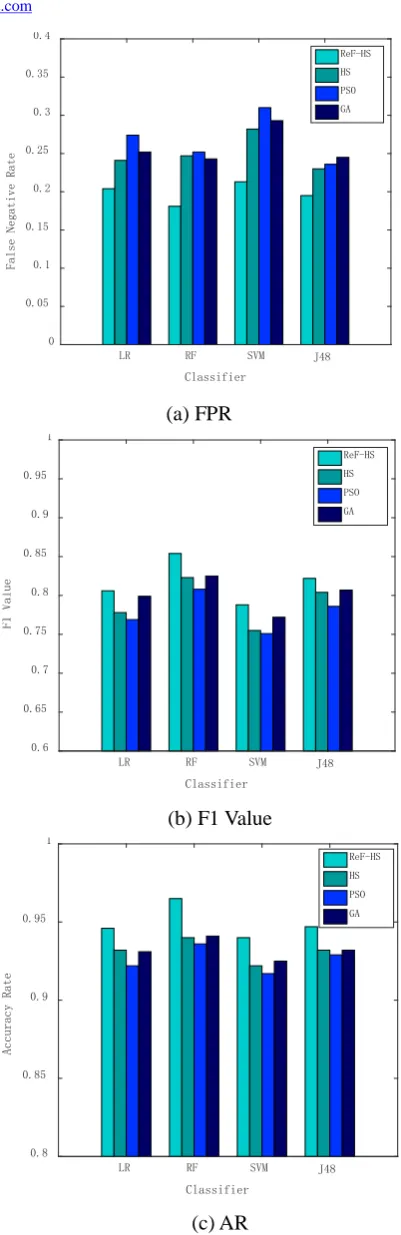
In this paper, it uses the accuracy rate(AR), false positive rate (FPR) and the comprehensive evaluation index (F1 value) to
measure the classifier's ability to detect spammer. The experimental results are shown
in figure 3.
(a) FPR
(b) F1 Value
(c) AR
Figure. 3 the performance of classifiers with four feature selection algorithms
From figure 3.6, it can see that, the spammer detection based on HS, based on
PSO and based on user GA, after the feature
Run1 Run2 Run3 Run4 Run5 Run6 Run7 Run8 Run9 Run10
Times(s)
0 10 20 30 40 50 60
ReF-HS HS PSO GA
Classifier
LR RF SVM J48
False Negative Rate
0 0.05
0.1 0.15 0.2 0.25 0.3 0.35 0.4
ReF-HS HS PSO GA
Classifier
LR RF SVM J48
F1 Value
0.6 0.65 0.7 0.75 0.8 0.85 0.9 0.95 1
ReF-HS HS PSO GA
Classifier
LR RF SVM J48
Accuracy Rate
0.8 0.85 0.9 0.95 1
ReF-HS HS PSO
71
selection, data still have redundant
information, especially the reduction effect of PSO algorithm is poor and has the most
redundant information. So that spammer detection accuracy rate and the F1 value are low, and the false positives rate is high. In
contrast, for the ReF-HS algorithm proposed by this paper, since the introduction of the
heuristic information of ReliefF, HS is conducive to quickly determine the optimal feature subset, and the obtained feature subset
is small, when detecting spammers, because of the less redundant data set, the accuracy rate
and the F1 value are high, and the false positives rate is low,
5 Conclusions
It can be seen from the experimental results that the ReF-HS algorithm performs
well in the classification accuracy, the feature subset size and the algorithm running time.
Compared with the HS, the classification accuracy and the feature subset size are all excellent, but the algorithm runs a little slower.
The harmony memory solution space has an important influence on the performance of HS
algorithm. For PSO and GA, the initial population also affects the performance of the algorithm, without pre filter it makes the
search space large, the algorithm is not efficient, and easy to fall into local optimum.
Thus affecting the performance of the algorithm. General ReF-HS algorithm can get higher classification accuracy and the
calculation of efficiency is higher than the other search heuristic algorithm. For
micro-blog with a large data, ReF-HS has high competitiveness.
The actual running time of the whole
feature selection process is mainly decided by two main factors: the number of iterations and
the evaluation method of the subset. So
through the study of this paper, the total number of iterations is predefined, and an
optimal subset may be found in the early search process. Building a better stop rule will improve the situation and save the running
time of the algorithm. This will be the direction of research in the future.
Reference
[1] Stringhini G, Wang G, Egele M, et al.
Follow the green: growth and dynamics in twitter follower markets//Proceedings of
the 2013 conference on Internet
measurement conference. Barcelona, Spain, 2013: 163-176.
[2] Xue J, Yang Z, Yang X, et al. VoteTrust: leveraging friend invitation graph to defend
against social network sybils//Proceedings of the 32nd IEEE International Conference on Computer Communications. Turin,
Italy, 2013: 2400-2408.
[3] De Cristofaro E, Friedman A, Jourjon G, et
al. Paying for likes?: understanding
facebook like fraud using
honeypots//Proceedings of the 2014
Conference on Internet Measurement
Conference. Vancouver, Canada, 2014:
129-136.
[4] 1 Geem ZW, Kim JH, Loganathan GV. A new heuristic optimization algorithm:
harmony search. Simulation, 2001,
76(2):60−68.
[5] Rajalaxmi, R R. Binary Bat Approach for Effective Spam Classification in Online Social Networks. Australian Journal of
Basic & Applied
Sciences8.18(2014):383-388.
72
International Conference on Information
and Communication Technology for
Competitive Strategies. ACM, 2016. [7] Dhawan S, Devi M. Spam Detection in
Social Networks Using Correlation Based
Feature Subset Selection. International
Journal of Computer Applications
Technology and Research Volume 4.
2015:629 - 632,
[8] Zhang Y, Wang S, Phillips P, et al. Binary
PSO with mutation operator for feature selection using decision tree applied to
spam detection. Knowledge-Based
Systems, 2014, 64:22-31.
[9] Behjat A R, Mustapha A,
Nezamabadi-Pour H, et al. GA-based
feature subset selection in a
spam/non-spam detection system.
International Conference on Computer and
Communication Engineering.
2012:675-679.
[10] Cervante L, Xue B, Zhang M, et al. Binary particle swarm optimisation for feature
selection: A filter based approach.
2012:1-8.
[11] Chen C, Zhang J, Xie Y, et al. A
Performance Evaluation of Machine
Learning-Based Streaming Spam Tweets
Detection[J]. IEEE Transactions on
Computational Social Systems, 2016,
3(1):42-42.
[12] Abulaish M, Bhat S Y. Classifier
Ensembles Using Structural Features For
Spammer Detection In Online Social Networks[J]. Foundations of Computing &
Decision Sciences, 2015, 40(2):89-105. [13] Dang Q, Zhou Y, Gao F, et al. Detecting
cooperative and organized spammer groups
in micro-blogging community[J]. Data
Mining & Knowledge Discovery,
2016:1-33.
[14] Zheng X, Zeng Z, Chen Z, et al. Detecting
spammers on social networks[J].
Neurocomputing, 2015, 42(1):27-34.
[15] Mccord M, Chuah M. Spam Detection on Twitter Using Traditional Classifiers.[J]. 2011, 6906:175-186.
[16] Jie Zhao, Yan Liu, Shuhan Liu. Towards Spammer Detection in Microblogging
platforms.[J].2016,Vol.9, No.10,
pp:239-250.
[17] Kira K, Rendell L. A. The feature selection
problem: Traditional methods and a new algorithm. In: Proceedings of Ninth
National Conference on Artificial