IJEDR1303018 INTERNATIONAL JOURNAL OF ENGINEERING DEVELOPMENT AND RESEARCH | IJEDR Website: www.ijedr.org | Email ID: [email protected] 84 Abstract: GSM systems are used currently for emergency calling and facsimile. They also find applications in computer to computer communication and emergency calling. The RF ID (Radio Frequency identification) on the other hand is an upcoming method of tracking moving or stationary items. The idea of the project is to combine their applications and use them together in monitoring and tracking the trash collecting vans and continuously display its status at the control room. The system introduced here will track the trash vans circling the city through there predetermined routes. This is done with the help of RF ID Reader placed in the van to determine the position of the van on its route. The co-ordinates of the position will be sent to the control room with the help of GSM MODULE. The control room will receive LIVE notification regarding the exact position of the trash van at a given time. The Van will be identified accurately from the database installed in the control room. Also there will be IR photo sensors and Ultrasonic sensors in the van container to determine the level of trash contained in the container that is collected successfully.
Key Words: GSM module, RF ID Tag, Trash Van, database and sensors.
I. INTRODUCTION
In the current scenario government of any nation provides all the possible services to the citizens. They include delivering day to day used products such as gas cylinders, food items, collecting trash from all possible areas of the city. But these services are not carried out faithfully by the government workers and employees because of carelessness. One of the examples is the service of trash collection provided by the government. The government provides the citizens with the trash vans that collect the trash from their houses periodically. The trash that is collected is then either sends for recycling or dumped at the areas far away from the city skirts. But due to the carelessness of the government employees they do not collect trash on regular basis. Thus the citizens are bound to dispose their trash in the nearby areas. These causes pollution in the city and as a result creates many health problems for the citizens. But these all can be avoided if we find a way to monitor the activities carried out by the government employees and to make sure that they do it faithfully.
The project describes a way to track the trash vans to ensure that they cover their routes on a daily basis. Also there are sensors placed in the carriage of the vans to keep an account on the minimum average trash collected on daily basis. The RF ID is attached on the trash bin. The RF reader is kept in the van. When the van passes through the trash bin the RF ID reader placed in the van reads the RF ID tag attached on the trash bin. After the detection the data containing the position of the van is sent to the control room via transmitter in the van. The control room after receiving the data will turn on the LED corresponding to the determined position on the map. Thus by these method one can keep a track on the trash van.
The photo sensors and ultrasonic sensors are placed in the carriage to keep a track on the amount of the trash collected in it. The photo sensors will determine the level up to which the trash is filled in the van. The ultrasonic sensors on the other hand will help in determining the quantity of the trash collected in the van by projecting them diagonally from upper end to lower end of the van.
II. DESIGN AND IMPLEMENTATION OF THE SYSTEM This system is designed in two major sections; first control room and second van system
A. Section 1: Control Room
This contains 16*2 LCD displays which mean it can display 16 characters per line and there are 2 such lines. In this LCD each character is displayed in 5x7 pixel matrix. Here we have used SIM 300 GSM module to transmit alert data to the mobile receivers already configured. We have included LED that will show the position of van on the map. It also contains GSM module. All the above components are interfaced with microcontroller. In the software section a database will be installed in the control room. It will contain all the information of the trash vans regarding their routes and there uniquely assigned ID numbers.
B. Section 2: Vehicle Unit
These units consist of RFID reader, trash bin information RFID Tag. The data of the position of the vehicle is collected in the RFID reader. We have also included photo sensors and ultrasonic sensors in the van carriage. The data obtained from the sensors is showed on the LCD in the van. The transmitter in the van will transmit the data to the control room LCD is 16*2 LCD which means it can display 16 characters per line and there are 2 such lines. In this LCD each character is displayed in 5x7 pixel matrix. The GSM module present in the van will transmit and receive information from the control station.
III. WORKING OF THE SYSTEM
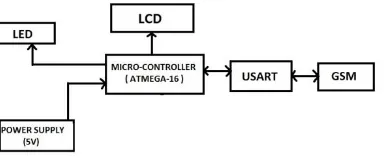
IJEDR1303018 INTERNATIONAL JOURNAL OF ENGINEERING DEVELOPMENT AND RESEARCH | IJEDR Website: www.ijedr.org | Email ID: [email protected] 85 Fig 1 Block Diagram of vehicle unit
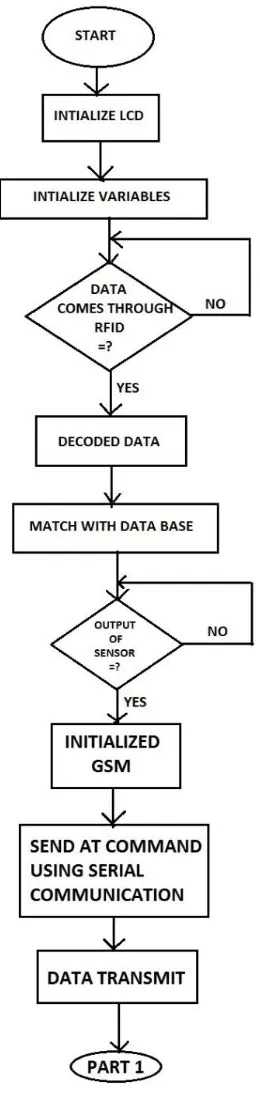
The whole process of detection and monitoring starts when the van arrives at its allocated collecting point. The RF reader placed in the van will read the RF ID tag on the trash bin. These will display the corresponding address of the location of the trash bin on the LCD in the van. The weight sensors will account for the total weight collected in the container of the van. The IR photo sensors and ultrasonic sensors will determine the height level of trash collected in the container. The data from the sensors is displayed on the LCD of the van via micro controller. The baseband signal containing the information of the location of the van, the quantity of trash collected and the level of the trash in the container of the van is modulated and transmitted to the control room via GSM module.
B. Control Room
Fig 2 Block diagram of control room
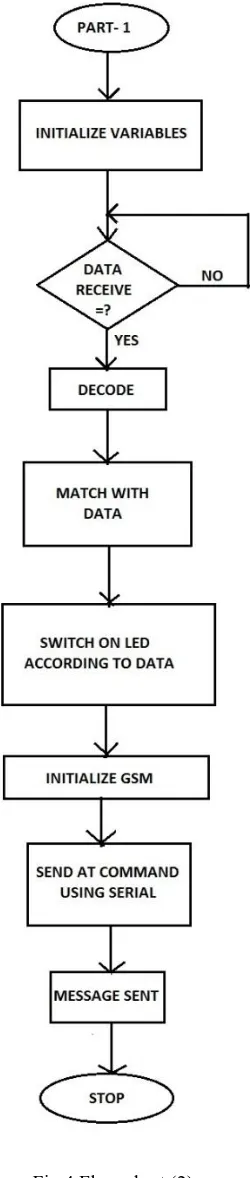
The data received from the van is received at the control room with the help of GSM module. It contains information of the positional coordinates of the van. The decoder will perform the function of demodulation and thus extracting information from the baseband signal. This information is then compared with the database of the control room to determine the trash van and its corresponding route uniquely. This information obtained after comparing is displayed on the LCD. The viewer can thus get the required data and take appropriate actions if required. The control room also has a map of the predetermined routes of the van. We have placed LEDS on the map at the trash collecting points. Thus the LED will be turned on when the van passes through the collection point. This is done on the basis of the data received at the control room. We also have made use of GSM SIM 300 module in the control room. These will perform the function of sending messages to the cell phones of the responsible government officers. The message will contain the information of the average quantity of the trash collected and the number of collection points covered during the day.
IJEDR1303018 INTERNATIONAL JOURNAL OF ENGINEERING DEVELOPMENT AND RESEARCH | IJEDR Website: www.ijedr.org | Email ID: [email protected] 86
IJEDR1303018 INTERNATIONAL JOURNAL OF ENGINEERING DEVELOPMENT AND RESEARCH | IJEDR Website: www.ijedr.org | Email ID: [email protected] 87
Fig 4 Flow chart (2) IV. APPLICATIONS
The tracking of government service providing vehicles can be provided to ensure faithful completion of service. The system can be used for controlling traffic by obtaining the information of location multiple vehicles in a given area. These can be done by allocating unique RF ID tag to the vehicles. The transportation and delivery of the goods by different
IJEDR1303018 INTERNATIONAL JOURNAL OF ENGINEERING DEVELOPMENT AND RESEARCH | IJEDR Website: www.ijedr.org | Email ID: [email protected] 88 Fig 5
ACKNOWLEDGEMENTS
We are thankful to Prof. Sandip Dawda, Prof. Mehul Jajal and Mr. Mayank Chavda for their remarkable contribution and support. There guidance and intellectuality played an important role in the successful completion of our project.
REFERENCES
[1] Lim, Jiwhan, Kim, Sangjin, Oh, Heekuck, Kim, Donghyun, “A designated query protocol for serverless mobile RFID systems with reader and tag privacy”, Tsinghua Science and Technology, Vol.17, No.5, pp.521-536, Oct.2012.
[2] Kromer, P., Martinovic, J., Radecky, M., Tomis, R., Snasel, V., “Ant colony inspired algorithm for adaptive traffic routing,”, Third World Congress Nature and Biologically Inspired Computing (NaBIC) 2011, pp.329-334, 19-21 Oct. 2011
[3] S. Shepard, “RFID Radio Frequency Identification”, McGraw Hill Professional, USA, 2005.
[4] R. Weinstein, "RFID: A technical overview and its application to the enterprise", IT Professional, Vol. 7, pp. 27 -33, May-June 2005.
[5] Lee, H., Kim, J., “Privacy threats and issues in mobile RFID”, Proceedings of the First IEEE International Conference on Availability, Reliability and Security, Vienna, Austria, April 20- 22, 2006.