Answer Validation by Information Distance Calculation
Fangtao Li, Xian Zhang, Xiaoyan Zhu
State Key Laboratory on Intelligent Technology and Systems Tsinghua National Laboratory for Information Science and Technology
Department of Computer Science and Technology, Tsinghua University, Beijing 100084, China [email protected]
Abstract
In this paper,an information distance based approach is proposed to perform answer validation for question answering system. To validate an answer candidate, the ap-proach calculates the conditional informa-tion distance between the quesinforma-tion focus and the candidate under certain condition pattern set. Heuristic methods are de-signed to extract question focus and gen-erate proper condition patterns from ques-tion. General search engines are employed to estimate the Kolmogorov complexity, hence the information distance. Experi-mental results show that our approach is stable and flexible, and outperforms tradi-tionaltfidfmethods.
1 Introduction
Question answering(QA) system aims at finding exact answers to a natural language question. In order to correctly answer a question, several com-ponents are implemented including question clas-sification, passage retrieval, answer candidates generation, answer validation etc. Answer Vali-dation is to decide whether the candidate answers are correct or not, or even to determine the accu-rate confidence score to them. Most of QA systems employ answer validation as the last step to iden-tify the correct answer. If this component fails, it is impossible to enable the question to be correctly answered.
Automatic techniques for answer validation are of great interest among question answering
re-c
°2008. Licensed under the Creative Commons Attribution-Noncommercial-Share Alike 3.0 Unported li-cense (http://creativecommons.org/licenses/by-nc-sa/3.0/). Some rights reserved.
search. With automatic answer validation, the system will carry out different refinements of its searching criteria to check the relevance of new candidate answers. In addition, since most of QA systems rely on complex architectures and the evaluation of their performances requires a huge amount of work, the automatic assessment of can-didates with respect to a given question will speed up both algorithm refinement and testing.
Currently, answer validation is mainly viewed as a classification problem or ranking problem. Different models, such as Support Vector Ma-chine (Shen and Klakow, 2006) and Maximum En-tropy Model (Ittycheriah et al., 2001), are used to integrate sophisticated linguistic features to deter-mine the correctness of candidates. The answer validation exercise (Penas et al. , 2007) aims at developing systems able to decide whether the an-swer is correct or not. They formulate anan-swer val-idation as a text entailment problem. These ap-proaches are dependent on sophisticated linguis-tic analysis of syntaclinguis-tic and semanlinguis-tic relations be-tween question and candidates. It is quite expen-sive to use deep analysis for automatic answer val-idation, especially in large scale data set. Thus it is appropriate to find an alternative solution to this problem. Here, we just consider the English an-swer validation task.
This paper proposes a novel approach based on information retrieval on the Web. The answer val-idation problem is reformulated as distance calcu-lation from an answer candidate to a question. The hypothesis is that, among all candidates, the cor-rect answer has the smallest distance from ques-tion. We employ conditional normalized min dis-tance, which is based on Kolmogorov Complexity theory (Li and Vitanyi, 1997), for this task. The distance measures the relevance between question
focus and candidates conditioned on a surface pat-tern set. For distance calculation, we first ex-tract the question focus, and then a hierarchical pattern set is automatically constructed as condi-tion. Since Kolmogrov Complexity can be approx-imated through frequency counts. Two types of search engine “Google” and “Altavista” are used to approximate the distance.
The paper is organized as follows: Section 2 describes related work. The fundamental Kol-mogorov Complexity theory is introduced in Sec-tion 3. SecSec-tion 4 presents our proposed answer val-idation method based on information retrieval. In Section 5, we describe the experiments and discus-sions. The paper is concluded in Section 6.
2 Related Work
Answer Validation is an emerging topic in Ques-tion Answering, where open domain systems are often required to rank huge amounts of answer candidates. This task can be viewed as a classi-fication problem or re-ranking problem.
Early question answering systems focused on employing surface text patterns (Subbotin and Subbotin, 2001) for answer validation. Xu et al. (2003) identified that pattern-based approaches got bad performances due to poor system recall. Some researchers exploited machine learning tech-niques with rich syntactic or semantic features to measure the similarity between question and an-swer. Ittycheriah et al. (2001) used Maximum En-tropy model to combine rich features and automat-ically learn feature weights. These features in-cluded query expansion features, focus features, named entity features, dependency relation fea-tures, pattern features et al. Shen and Klakow (2006) presented three methods, including feature vector, string kernel and tree kernel, to represent surface text features and parse tree features in Sup-port Vector Machines. Ko et al. (2007) pro-posed a probabilistic graphical model to estimate the probability of correctness for all candidate an-swers. Four types of features were employed, including knowledge-based features, data-driven features, string distance feature and synonym fea-tures.
Started in 2006, the annual Answer Validation Exercise (Penas et al. , 2007) aims to develop sys-tems to decide if the answer to a question is correct or not. The English answer validation task is refor-mulated as a Text Entailment problem. The triplet,
including question, answer and supporting text, is given. The system determines if the supporting text can entail the hypothesis, which is a reformu-lation from the question and answer. All partici-pants used lexical processing, including lemmati-zation and part-of speech tagging. Some systems used first order logic representations, performed semantic analysis and took the validation decision with a theorem proof.
The above approaches should process deep syn-tactic and semantic analysis for either questions or candidate answers. The annotated linguistic re-source is hard to acquire for the supervised clas-sification problem. Another alternative solution for answer validation is to exploit the redundancy of large scale data. Eric et al. (2007) devel-oped AskMSR question answering system. They focus on the Web as a gigantic data repository with tremendous redundancy that can be exploited to extract the correct answer. Lin (2007) im-plemented another Web-based question answering system, named ARANEA, which is used approxi-mate tfidf method for answer validation.
3 Preliminaries
3.1 Kolmogorov complexity
Kolmogorov complexity , or algorithm entropy ,
K(x)of a stringxis the length of the shortest bi-nary program to computex. It defines randomness of an individual string. Kolmogorov complexity has been widely accepted as an information theory for individual objects parallel to that of Shannon’s information theory which is defined on an ensem-ble of objects. It has also found many applications in computer science such as average case analysis of algorithms (Li and Vitanyi, 1997). For a uni-versal Turing machine U, the Kolmogorov com-plexity of a binary string x condition to another binary stringy,KU(x|y), is the length of the short-est (prefix-free) program forU that outputsxwith inputy. It has been proved that for different uni-versal Turing machineU0, for allx, y
KU(x|y) =KU0(x|y) +C,
where the constantCdepends only onU0. Thus we
simply writeKU(x|y)asK(x|y). DefineK(x) =
3.2 Information Distance
Based on the Kolmogovov complexity theory, in-formation distance (Bennett et al., 1998) is a uni-versal distance metric, which has been success-fully applied to many applications. The informa-tion distance D(x, y) is defined as the length of a shortest binary program which can compute x
givenyas well as computeyfromx. It has been proved that , up to an additive logarithmic term,
D(x, y) = max{K(x|y), K(y|x)}. The normal-ized version ofD(x, y), called thenormalized in-formation distance(NID), is defined as
dmax(x, y) = maxmax{K{K(x(|yx)), K, K((yy)|x})} (1)
Parallel to this, the min distance is proposed in (Zhang et al. , 2007), defined as
Dmin(x, y) = min{K(x|y), K(y|x)}. (2)
And the normalized version is
dmin(x, y) = minmin{K{K(x(|xy)), K, K((yy)|x})}. (3)
3.3 Conditional Information Distance Conditional information distance is defined as
dmax(x, y|c) = maxmax{K{(Kx|(y, cx|c)), K, K((yy||cx, c)})}, (4)
dmin(x, y|c) = minmin{K{(Kx(|y, cx|c)), K, K((yy||cx, c)})}. (5)
wherecis given in bothxtoyandytox compu-tation.
The information distance is proved to be uni-versal (Zhang et al. , 2007), that is, if x and y
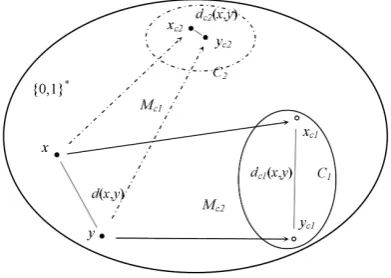
are “close” under any distance measure, they are “close” under the measure of information distance. However, it is not clear yet how to find out such “closeness” in traditional information distance the-ory. Now the conditional information distance pro-vides a possible solution.Figure 1 gives a more in-terpretable explanation: the conditionccould map the original conceptsxandyinto differentxc and
[image:3.595.318.514.73.212.2]yc, thus the variant “closeness” could be reflected by the distance between xc and yc, as shown in Figure1.
Figure 1:Conditional information distances under different conditionsc’s
The Kolmogorov complexity is non-computable, that is, to use the information distance measures, we must estimate the K(x) first. There are traditionally two ways to do this: (1) by compression (Li et al. , 2001), and (2) by frequency counting based on coding theorem (Cilibrasi and Vitanyi, 2007). The second approach is implemented in this paper.
4 Answer Validation with Information Distance
Given a questionq and a candidate answerc, the answer validation task can be considered as deter-mining the degree of relevance of c with respect toq. The intuition of our approach is that the dis-tance between question and the correct answer is smaller than other candidates. Take the question “What is the capital of the USA?” as an example, among all candidates, the correct answer “Wash-ington” is closest to the question under some dis-tance measure. Thus the answer validation prob-lem is to determine a proper distance measure. Fortunately, it has been proved that the informa-tion distance (Bennett et al., 1998) is universal so that the similarity between the question and the an-swer can surely be discovered using this measure.
Figure 2: Sample of conditional information distance calculation.
as:
dmin(x, y|c)
= K
³ c(x,y)
´
−max{K ³
c(x,φ)
´ ,K
³ c(φ,y)
´
}
min{K ³
c(x,φ)
´ ,K
³ c(φ,y)
´
}−K ³
c(φ,φ)
´
where x represents the answer candidates, y is the question focus, andcis condition pattern. The functionc(x, y) will be described in the Distance Calculation section.
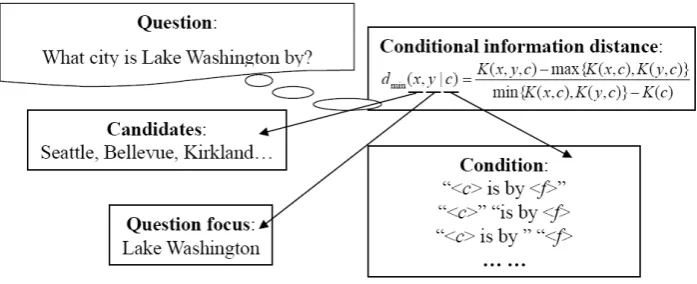
Figure 2 shows the procedure of distance cal-culation. Given a question and a set of candidates, we calculate the min information distance between question focus and candidates conditioned on sur-face patterns. Obviously, in order to calculate in-formation distance, there are three issues to be ad-dressed:
1. Question Focus Extraction: since the question answer distance is reformulated as the mea-sure between question focus and answer con-ditioned on the surface pattern, it is important to extract some words or phrases as question focus.
2. Condition Pattern Generation: Obviously, the generation of the condition is the key part. We have built a well revised algorithm, in which proper conditions can be generated from question sentence according to some heuristic rules.
3. Distance Calculation: after question focus and condition patterns are obtained, the last step is calculating the conditional distance to estimate the relevance between question and answer candidates.
4.1 Question Focus Extraction
Most factoid questions refer to specific objects. A question is asked to learn some knowledge for this object from certain perspective. In our approach, we take the key named entity or noun phrase, usu-ally as the subject or the main object of the ques-tion sentence as the reference object. Take the question “What city is Lake Washington by” as ex-ample, the specific object is “Lake Washington”. The question focus is identified using some heuris-tic rules as follows:
1. The question is processed by shallow parsing. All the noun phrases(NP) are extracted as NP set.
2. All the named entities(NE) in the question are extracted as NE set.
3. If only one same element is identified in both NE and NP set, this element is considered as ques-tion focus.
4. If step 3 fails, but two elements from NE and NP set have overlap words, then choose the ele-ment with more words as question focus.
5. If step 3 and 4 fail, choose the candidate, which is nearest with verb phrase in dependency tree, as question focus.
4.2 Condition Pattern Generation
A set of hierarchical patterns is automatically con-structed for conditional min distance calculation. 4.2.1 Condition Pattern Construction
Several operations are defined for patterns con-struction from the original question sentence. We describe pattern set construction with a sam-ple question “What year was President Kennedy killed?”:
in-clude wh-word phrases, preposition phrases, noun phrases, verb phrases, key verb, etc. The exam-ple question is split into “What year”(wh-word phrase), “was”(key verb) “President Kennedy” (noun phrases), “killed”(verb phrase).
2. Replace the wh-word phrases with the candi-date placeholderhci.Then the words “What year” is replaced with placeholderhci.
3. Replace the question focus with the focus placeholder hfi, and add this pattern to the pat-tern set. The example question focus is identified as “President Kennedy”. It is replaced with place-holderhfi. The first pattern “hciwashfikilled?” is generated.
4. Voice Transformation: with morphology techniques, verbs are expanded with all their tense forms ( i.e. present, past tense and past participle). The tokens’ order is adjusted to transform between active voice and passive voice. Both patterns are added to the patterns set. For sample question, the passive pattern is translated into active pattern, “hcikillhfi”.
5. Preposition addition: for time and location questions, the preposition (i.e. in, on and at) is added before the candidate hci; Then the pattern “hci was hfi killed” is reformulated as “(in |on) hciwashfikilled”.
6. Tokens shift: preposition phrase token could be shifted to the begin or the end of pattern, and “key verb” must be shift before the “verb phrase”. Then the pattern “(in|on)hciwashfikilled” can be reformulated as “hfiwas killed (in|on)hci”.
7. Definitional patterns: several heuristic pat-terns, as introduced at (Hildebrandt et al. , 2004), are added into our final pattern sets, such as “hci, hfi”.
[image:5.595.306.514.510.670.2]By such heuristic rules, the original pattern set is obtained from question sentence. The patterns are initially enclosed in quotation marks, which means exact matching. However, by eliminating these quotations, or reducing the scope that they cover, the matching is relaxed as words co-occurrence. The patterns are expanded into different strict-level patterns by adding or removing quotation marks for each tokens or adjacent tokens combination. Several condition pattern samples are shown in Ta-ble 1
Table 1: Sample condition patterns, ‘ “” ’ denotes exact match in web query.
À“<f>(was|were) killed (in|on)<c>”
Á“ (in|on)<c>,<f>(was|were) killed”
“ (in|on)<c>”&“<f>(was|were) killed”
Ó (in|on)<c>”&“<f>”&“(was|were) killed”
Äin|on<c><f>(was|were) killed
Each operation introduced above is given a pre-defined confidence coefficient(cc). Then the con-fidence coefficient of a pattern is defined as the multiplication of cc for all performed operations to generate this pattern.
4.2.2 Condition Pattern Ranking
From the previous step, a set of condition pat-terns and corresponding confidence coefficient are obtained. Letpidenotes theithpattern in the pat-tern set, andcciis the confidence coefficient for the
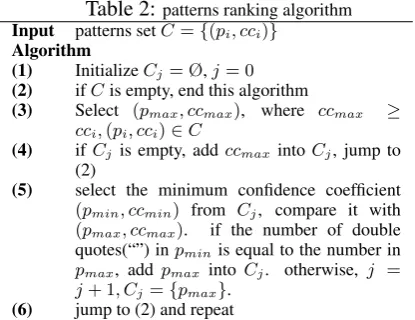
ithpattern. The confidence coefficient estimation in previous section contains much noise. And the patterns with similar confidence coefficient make little difference. Therefore, the exact confidence coefficient value is not directly used. We cluster the patterns into different priority groups. Cj de-notes the pattern cluster with jth priority. Here, the smaller j means higher priority. The condi-tion patterns are ranked mainly based on confi-dence coefficient and the number of double quo-tation marks. The following algorithm shows each step in detail:
Table 2:patterns ranking algorithm Input patterns setC={(pi, cci)}
Algorithm
(1) InitializeCj= Ø,j= 0 (2) ifCis empty, end this algorithm
(3) Select (pmax, ccmax), where ccmax ≥ cci,(pi, cci)∈C
(4) ifCj is empty, addccmax intoCj, jump to (2)
(5) select the minimum confidence coefficient
(pmin, ccmin) from Cj, compare it with
(pmax, ccmax). if the number of double quotes(“”) inpminis equal to the number in pmax, add pmax intoCj. otherwise, j = j+ 1, Cj={pmax}.
(6) jump to (2) and repeat
4.3 Distance Calculation
dmin(x, y|c)
= K
³ c(x,y)
´
−max{K ³
c(x,φ)
´ ,K
³ c(φ,y)
´
}
min{K ³
c(x,φ)
´ ,K
³ c(φ,y)
´
}−K ³
c(φ,φ)
´
= logf
³ c(x,y)
´
−min{logf ³
c(x,φ)
´ ,logf
³ c(φ,y)
´
}
max{logf ³
c(x,φ)
´ ,logf
³ c(φ,y)
´
}−logf ³
c(φ,φ)
´
The functionc(x,∅)means substitutinghciinc
by answer candidate xand removing placeholder hfi if any. Similar definition applies to c(y,∅),
c(x, y). For example, given pattern “hfi was in-vented inhci”, question focus “the telegraph” and a candidate “1867”. c(x,∅) is “was invented in 1867”.c(y,∅)is “the telegraph was invented”, and
c(x, y) is “the telegraph was invented in 1867”. The frequency counts f(x) are estimated as the number of returned pages by certain search en-gine with respect tox. f(c(φ, φ))denote the to-tal pages indexed in search engine. Two types of search engines “Google” and “Altavista” are em-ployed.
The patterns are selected in priority order to cal-culate the information distance for each candidate.
5 Experiment and Discussion
5.1 Experiment Setup
Data set: The standard QA test collection (Lin and Katz, 2006) is employed in our experiments. It consists of 109 factoid questions, covering several domains including history, geography, physics, bi-ology, economics, fashion knowledge, and etc.. 20 candidates are prepared for each questions. All an-swer candidates are first extracted by the imple-mented question answering system. Then we re-view the candidate set for each question. If the cor-rect answer is not in this set, it is manually added into the set.
Performance Metric: The top 1 answer precision and mean reciprocal rank (MRR) are used for per-formance evaluation.The top 1 answer means the correct answer ranks first with our distance calcu-lation method, and MRR = n1 ∗Pi(rank1 i), in which the 1
ranki is 1 if the correct answer occurs in
the first position; 0.5 if it firstly occurs in the sec-ond position; 0.33 for the third, 0.25 for the fourth, 0.2 for the fifth and 0 if none of the first five an-swers is correct.
The open source factoid QA system ARANEA (downloaded from Jimmy Lin’s website in 2005)
is used for comparison, which implements an ap-proximate tfidf algorithm for candidate scoring. Both ARANEA and our proposed approaches use the internet directly. Google is used as the search engine for ARENEA, and our conditional normal-ized min distance is calculated with Google and Altavista respectively.
5.2 Experiment Results
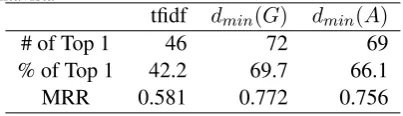
The performances of our proposed approach and ARANEA are shown in Table 3. For top 1 an-swer precision, our conditional min distance cal-culation method through Google achieves 69.7%, and Altavista is 66.1%, which make 56.6% (69.7% v.s.42.2% ) and 50.0% (66.1% v.s 42.2%) improvement compared with ARENEA’s tfidf
[image:6.595.314.516.382.440.2]method. Our proposed methods achieve 0.756 and 0.772 compared with ARENEA’s 0.581 for MRR measure.
Table 3:Performance comparison, wheredmin(G)denotes the distance calculation through “Google”,dmin(A)through “Altavista”
tfidf dmin(G) dmin(A)
# of Top 1 46 72 69
% of Top 1 42.2 69.7 66.1
MRR 0.581 0.772 0.756
Table 4 shows some correct answer validation examples. the Google Condition(GC) and the Al-tavista Condition(AC) columns are the employed condition patterns for distance calculation. For question 1400, the conditional normalized google min distance calculates the distance between ques-tion focus “the telegragh” and all 20 answer can-didates. The minimum distance score is achieved between “the telegraph” and “1837” with the con-dition pattern “hfi was invented inhci”. There-fore, the candidate “1837” is validated as the cor-rect answer. Meanwhile, the minimum value for conditional normalized altavista min distance is achieved on the same condition.
These results demonstrate that the distance cal-culation method provides a feasible solution for answer validation.
In discussion section, we will study three ques-tions:
Table 4: Question Examples in conditional information calculation through Google and Altavista. GC:Google Condition; AC:Altavista Condition
ID Question GC AC Answer Question focus
1400 When was the telegraph
invented? “?y was in-vented in ?s” “?yinvented inwas ?x”
1837 the telegraph
1401 What is the democratic
party symbol? “?y is ?x” “?y is ?x” the don-key theparty symboldemocratic 1411 What Spanish explorer
discovered the Missis-sippi River?
“?x
discov-ered ?y” “?x”covered” “dis-“?y”
Hernando
de Soto theRiver Mississippi
1412 Who is the governor of
Colorado? “?y is ?x” “?y, ?x” Gov. BillRitter the governor ofColorado 1484 What college did Allen
Iverson attend? “?y attended?x” “?x”?y” “did Georgetown Univer-sity
Allen Iverson at-tend
5.3 Discussions
5.3.1 Role of Search Engine
The rise of world-wide-web has enticed millions of users to create billions of web pages. The dundancy of web information is an important re-source for question answering. Our Kolmogorov Complexity based information distance is approx-imated with query frequency obtained by search engine. Two types of search engines “Google” and “Altavista” are employed in this paper. The num-ber of top 1 correct answer is 72 through “Google” and 69 through “Altavista”. There is little differ-ence between two numbers, which shows that the information distance based on Kolmogorov Com-plexity is independent of special search engine. The performance didn’t vary much with the change of search engine. Actually, if the local data is ac-cumulated large enough, the information distance can be approximated without the internet. The quality and size of data set affect the experiment performance.
5.3.2 Role of Condition Pattern
Pattern set offers convenient and flexible condi-tion for informacondi-tion distance calculacondi-tion. In the experiment, there are 61 questions correctly an-swered by both Google and Altavista. 46 ques-tions of them employ different patterns. Consider-ing Question 1412, the condition pattern in Google is “hciishfi”, while in Altavista, it is “hfi,hci”. However, the correct answer “Gov. Bill Ritter” is identified by both methods. The information dis-tance is stable over specific condition patterns.
5.3.3 Role of Question Focus
Question focus is considered as the discrimina-tor for the question. The distance between a ques-tion and a candidate is reformulated as the distance between question focus and candidate conditioned on a set of surface patterns. The proposed ap-proach may not properly extract the question fo-cus, but the answers can be correctly identified when the condition pattern becomes loose enough. Take the question 1484 “What college did Allen Iverson attend?” as example, the verb “attend” is tagged as “noun”, then question focus is mistak-enly extracted as “Allen Iverson attend”, instead of the correct “Allen Iverson”. The two conditional information distance method still identify the cor-rect answer “Georgetown University”. Because they both employed the looser condition patterns ’“hci” “hfi”’ and ’“hci” did “hfi”’.Therefore, our proposed distance answer validation methods are robust to the question focus selection component.
From the discussion above, it can be seen that our algorithm is stable and robust, not depending on the specific search engine, condition pattern, and question focus.
6 Conclusions
with ARANEA’s tfidf method. Furthermore, The experiments show that our approach is stable and robust, not depending on the specific search en-gine, condition pattern, and question focus. In fu-ture work, we will try to calculate information dis-tance in the local constructed data set, and expand this distance measure into other application fields.
Acknowledgement
This work is supported by National Natural Sci-ence Foundation of China (60572084, 60621062), Hi-tech Research and Development Program of China (2006AA02Z321), National Basic Research Program of China (2007CB311003).
References
Abraham Ittycheriah, Martin Franz, Wei-Jing Zhu, Ad-wait Ratnaparkhi, and Richard J.Mammone. 2001.
Question answering using maximum entropy
conm-ponents. In Proceedings of the Second meeting of
the North American Chapter of the Association for Computational Linguistics on Language tecnologies. Anselmo Penas, A. Rodrigo, F. Verdejo. 2007.
Overview of the Answer Validation Exercise 2007.
Working Notes for the CLEF 2007 Workshop. C.H. Bennett, P. Gacs, M. Li, P. Vit´anyi, W. Zurek..
1998. Information Distance. IEEE Trans. Inform.
Theory, 44:4, 1407–1423.
Eric Brill and Susan Dumais and Michele Banko. 2002.
An analysis of the AskMSR question-answering sys-tem. EMNLP ’02: the ACL-02 conference on Em-pirical methods in natural language processing. Hildebrandt W., Katz B., and Lin J. 2004.
Answer-ing Definition Questions UsAnswer-ing Multiple Knowledge
Sources. Proceedings of Human Language
Technol-ogy Conference. Boston, USA.
Jeongwoo Ko, Luo Si, Eric Nyberg. 2007. A Proba-bilistic Graphical Model for Joint Answer Ranking
in Question Answering. In Proceedings of the 30th
annual international ACM SIGIR conference on Re-search and development in information retrieval. Jimmy Lin and Boris Katz. 2006. Building a reusable
test collection for question answering. J. Am. Soc.
Inf. Sci. Technol..
Jimmy Lin. 2007. An Exploration of the Principles Un-derlying Redundancy-Based Factoid Question
An-swering. ACM Transactions on Information
Sys-tems, 27(2):1-55.
Jinxi Xu, Ana Licuanan and Ralph Weischedel. 2003.
Trec 2003 qa at bbn: Answering definitional
ques-tions. In Proceedings of the 12th Text REtrieval
Conference, Gaithersburgh, MD, USA.
Ming Li and Paul MB Vitanyi. 1997. An
Introduc-tion to Kolmogorov Complexity and Its ApplicaIntroduc-tions.
Working Notes for the CLEF 2007 Workshop. M. Li, J. Badger, X. Chen, S. Kwong, P. Kearney,
H. Zhang.. 2001. An information-based sequence distance and its application to whole mitochondrial
genome phylogeny. Bioinformatics, 17:2.
M. Subbotin and S. Subbotin. 2001. Patterns of Po-tential Answer Expressions as Clues to the Right
An-swers. In TREC-10 Notebook papers. Gaithesburg,
MD.
R. Cilibrasi, P.M.B. Vit´anyi. 2007. An Exploration of the Principles Underlying Redundancy-Based
Fac-toid Question Answering. EEE Trans. Knowledge
and Data Engineering, 19:3, 370–383.
Shen, Dan and Dietrich Klakow . 2006.Exploring cor-relation of dependency cor-relation paths for answer
ex-traction. In Proceedings of COLING-ACL, Sydney,
Australia.
Xian Zhang, Yu Hao, Xiaoyan Zhu, and Ming Li. 2007.
Information Distance from a Question to an Answer.