DOI:
act: Face recogn able in literature fication based ap iques of face rec model using LD ssed. Finally the
ords: face recog
in these days ed essential ro
cations are u orization, pred Additionally th with the imag others. Among ntial applicatio eillance, monito
is one of the rent and uniqu cations it is u entication and ble if the recog of face recogn cations. The b tion, partial ca ution images, ovements on t red. The propo ccurate face re nts of faces a ned by the user
efore in this pa loping the face s of faces of t ar discriminant features. The -propagation n
oi.org/10.264 pproach and rec cognition. Addit DA based feature
conclusion and
gnition, partial fa
I.INTRODU
the machine le in various used for patte diction, motion
he machine le ges for motion
them the face ns. That is us oring and authe
e most essent ue for all the used as a biom
access control gnition of the fa
nition can deg basic issues o apturing of face noisy images the traditional e recognition s the same class t analysis) tec multi-pose ba
Savita Bairagi1 Scholar at Lak OD in Comput
3
Technical rch Scholar as
the classical dom arious kinds of construction bas tionally on the b es and BPN (ba future working
aces, neural netw
UCTION
learning and i real world ap ern recognitio n detection an earning algori n detection, act
e recognition is sed in wide r entication [2].
tial identities, e individuals. metric identity [3]. But these aces becomes a grade the perfo of these system
es, small chang and others [4 l face recogni intended to de hnique that w to recognize
dataset is used system which c
s. In addition chnique is use ased features a k for training
1i3.6629
olume 11, No
rnal of Adva
REVIE
ailable Onli
OGNITIO
NEURA
1
, Hemant Gup kshmi Narain C er Science & E Officer (C) in well as Facult
mains of researc f techniques and ed approaches. I basis of conclude ack propagation guidelines are pr
work, LDA, surve
its techniques pplications. Th on, classificati nd various oth thms also wo tivity recognit s one of the m ange of secur
which is alm In a number y and utilized
e applications accurate. The l ormance of th ms are the p ges on faces, l 4]. Due to the ition systems esign and deve orks on differ any of the p
for designing a contains differ
of that the LD ed for comput are used with College of Tech Engineering De ECIL (NPCIL ty from SVBPH
ch and developm d methodologie
In this paper, w ed consequences
neural network rovided.
ey, machine lear
are
earch in Com
LE
w.ijarcs.info
NIQUE U
ORK
nwar3, Bhavana hnology and Sc epartment at LN L), Tarapur, Mu
HSS, Kasrawad
ment. Significant s which can be we are first provi s a new model f k) based is introd
rning.
ng of the neura training face p
section provid dology and t butions placed ure summary uded facts a n y the conclusi ded.
II.
section provid butions and e nizing the faces
Farfade et al [ ion. Current e annotation o also require tra ientations. Aut D), a method ation and abl
ations using a d has minima onents. They an
ferent orientati faces from d ation between ng set and score
mance was ticated data. Ev
mputer Scie
o
IS
USING TH
a Panwar4, cience (RIT), I NCT, Indore, umbai, d, Khargone, M
t contributions o e divided in tw iding the survey for recognizing t
duced. Addition
al network the ose and can re
des the basic the next sect d for recogniz
is offered. A new face reco ion and future
LITERATUR
des the colle efforts that ar
s.
[6] consider the state-of-the-ar f facial landm aining dozens thors propose d that does e to detect a single model al complexity;
nalyzed scores ions and foun different angle
distribution o es of the given improved us valuations on b
ence
SSN No. 0976
HE ARTIF
Indore,
MP
on face recogniti wo major catego y on existing eff
the partial face. nally their functi
system is able cognize accura
overview of tion provides zing the face Additionally on
ognition mode e directions o
RESURVEY
ection of rece re promising
e problem of m rt approaches marks, or annot
of models to c Deep Dense not require faces in a w l based on de
and not requ of the face de nd that 1) met es, 2) there s of positive ex n face detector
sing better benchmark dat
6‐5697
FICIAL
ion technique ar ories i.e. featur ficient and recen In this context ional aspects ar
e to accept any ately.
f the proposed the essentia es. Further th n the basis o el is proposed of the work i
ently availabl for accurately
multi-view fac for this task tation of poses capture faces in
Face Detecto pose/landmark wide range o eep CNN. Th uires additiona etector for face thod is able to seems to be xamples in th r. The method’ sampling and tasets show tha
single-model face detector has better performance compared to the previous methods.
Automatic affect recognition is a challenging task due to the various modalities emotions. Applications can be found in many areas i.e. multimedia retrieval and human computer interaction. P. Tzirakis et al [7] propose an emotion recognition system using auditory and visual modalities. To capture the emotions for various styles of speaking, robust features need to be extracted. This purpose, authors utilize a CNN to extract features from the speech, for visual modality a deep residual network (ResNet). Additionally, a machine learning algorithm needs also to be insensitive to outliers while being able to model the context. To tackle this, Long Short-Term Memory networks are utilized. System is then trained in an end-to-end fashion where – by also taking advantage of the correlations of the each of the streams – author manage to outperform the traditional approaches based on auditory and visual handcrafted features.
Recently, CNN have demonstrated excellent performance on various tasks, including classification of two-dimensional images. W. Hu et al [8], deep CNN are employed to classify hyper-spectral images. More specifically, the architecture of the classifier contains five layers with weights which are the input layer, the convolutional layer, the max pooling layer, the full connection layer, and the output layer. These layers are implemented on each spectral signature to discriminate against others. Results based on several data sets show that the method can achieve better performance than traditional methods, such as SVM and traditional deep learning- methods.
Z. Yu et al [9] report image based static facial expression recognition method for the Emotion Recognition. Authors focus on the sub-challenge of the SFEW 2.0 dataset, where seeks to classify a set of static images into 7 emotions. The method contains a face detection module based on ensemble of three face detectors, followed by a classification module with the ensemble of multiple deep CNN. Each CNN model is initialized randomly and pre-trained on a larger dataset. The pre-trained models are then fine-tuned on the training set. To combine CNN models, author present two schemes for learning: by minimizing the log likelihood loss, and by minimizing the hinge loss. The method generates result on the FER dataset. It also achieves 55.96% and 61.29% respectively.
X. Yin et al [10] explores multi-task learning (MTL) for face recognition. They answer the questions of how and why MTL can improve. First, author propose a multi-task CNN for face recognition where identity classification is the main task and pose, illumination, and expression estimations are the side tasks. Second, they develop a dynamic-weighting scheme to automatically assign the loss weight to each side task. Third, they propose a pose-directed multi-task CNN by grouping different poses to learn pose-specific identity features. They propose an energy-based weight analysis method to explore how CNN-based MTL works. They observe that the side tasks serve as
regularizations to disentangle the variations from the learnt identity features. Experiments demonstrate the effectiveness of the approach. The approach is also applicable for pose-invariant face recognition and better performance.
The problems facing by blind people fall in the category of navigating through indoor and outdoor consisting of various obstacles and recognition of person in front of them. Identification of objects or person only with perceptive and audio information is difficult. This helps blind people to navigate with the help of a Smartphone, global positioning system (GPS) and a system with ultrasonic sensors. Face recognition can be done using neural learning techniques. The images of friends, relatives are stored in the database. Whenever a person comes in front of the blind user, the application gives the voice aid to the user. Thus system can replace the regular imprecise use of guide dogs and white sticks to help the navigation and face recognition process. P. M. Kumar et al [11] have proposed a novel image recognition and navigation system that provides precise and quick messages in the form of audio to visually challenged people.
The complexity of the human face and the changes due to different effects make it more challenging to design and implement a system for face recognition. M. A. Abuzneid et al [12] presented an approach to improve face recognition using a BPNN and features extraction based on correlation. A key contribution is the generation of a new set called the T-Dataset from the training data set, which is used to train the BPNN. The correlated T-Dataset provides a high distinction layer between the training images, it helps BPNN to converge faster and achieve better accuracy. Additionally authors used LBP histogram to prove that there is potential improvement. They applied five distance measurement algorithms and combine them to obtain the T-Dataset. Authors achieved higher recognition accuracy with less computational cost. Furthermore, author evaluates method on one of the benchmark data set, Labeled Faces, where they produce a competitive face recognition performance.
Thermal face recognition has received increasing attention. The traditional methods for TFR concentrate on the hand-crafted features, which requires more efforts to select and extract features and usually has lower recognition rate. Z. Wu et al [13] present CNN architecture for TFR. It is a new type of ANN that can learn features from the raw data. Results on face database show that CNN achieves higher recognition rate.
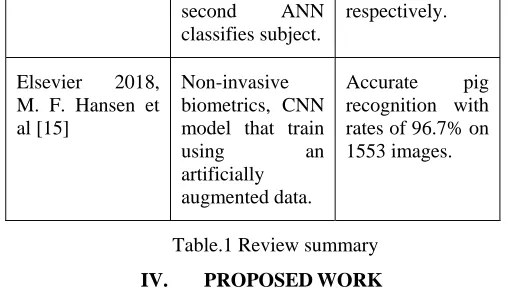
Identification of individual livestock has become a pressing issue as intensification practices continue to be adopted and precise objective measurements are required. Current best practice involves the use of RFID tags which are time-consuming task. To overcome this, non-invasive biometrics is proposed by M. F. Hansen et al [15]. They test this in a farm, on 10 individual pigs using three techniques: Fisher-faces, the VGG-Face pre-trained face CNN model and own CNN model that train using an artificially augmented data. Results show that accurate pig recognition is possible with accuracy rates of 96.7% on 1553 images.
III. LITERATURE SUMMARY
This section provides the summary of the collected literature. The table 3.1 includes the different aspects of the proposed study.
Authors and publication
Contribution Outcomes
2015 ACM, S. S. Farfade et al [6]
Consider problem of
multi-view face detection and proposed Deep Dense Face Detector. That does not require pose/landmark annotation to detect faces of orientations based on deep CNN. They analyzed scores of face detector for faces in different
orientations and found 1) able to detect faces of different angles, 2) a correlation between
distribution of positive samples in the training set and scores of the given face detector.
The method’s performance was improved using sampling and sophisticated
data. Evaluations on datasets show that single-model face detector has better
performance.
Journal of Latex Class Files 2015, P. Tzirakis et al [7]
An emotion recognition
system using auditory and visual modalities. To capture emotions of speaking. A CNN
It outperforms as compared to the traditional approaches based on auditory and visual
handcrafted
to extract features from the speech, for visual modality a deep residual network proposed to be insensitive to outliers to model the context. So, Long Short-Term Memory
networks are utilized. System trained in an end-to-end fashion and also taking advantage of the correlations.
features.
2015 Hindawi, W. Hu et al [8]
Deep CNN are employed to classify hyper-spectral images. The architecture of classifier contains five layers with weights ( input, convolutional, max pooling, full connection, and output layer.
Results based on several data sets show that the method can achieve better performance than traditional methods, such as SVM and traditional deep learning-
methods.
2015 ACM, Z. Yu et al [9]
Focus on SFEW 2.0 dataset, seeks to classify a set of images into 7 emotions. It contains a face detection
module, followed by classification module using ensemble of multiple deep CNN. It is initialized
randomly and pre-trained.
First minimizing the log likelihood
loss, by minimizing hinge
loss. The method generates result on FER dataset. It also achieves 55.96% and 61.29%
respectively.
arXiv 9 May 2017, X. Yin et al [10]
They explore multi-task
learning for face recognition. A multi-task CNN for face recognition
where identity classification is
the main task. Second, develop a weighting scheme to assign the loss weight. Third, a pose-directed multi-task CNN by grouping
different poses to learn features.
the learnt identity features.
Experiments demonstrate the effectiveness of the approach. The approach is also applicable for pose-invariant face recognition and better performance.
Springer Nature 2017, P. M. Kumar et al [11]
The problems facing by blind people fall in the category of navigation
through indoor and outdoor consisting of various obstacles and recognition of person in front of them.
Stored images of friends, relatives in the database to recognize a person in front of blind user, to gives voice aid to user. It is a face recognition and navigation
system. It provides precise and quick messages.
IEEE 2018, M. A. et al [12]
That generates a dataset called the T-Dataset used to train the BPNN. Provides a high distinction layer between training images to converge faster and better accuracy and also used LBP histogram to prove that.
Achieved higher recognition
accuracy with less cost. They produce a competitive face recognition performance.
2016 IEEE, Z. Wu et al [13]
Thermal face recognition
depends on the hand-crafted features, requires efforts to select features and has lower recognition rate.
CNN architecture for TFR. A new type of ANN can learn features from raw data. Results on face database show CNN achieves higher
recognition rate.
2018 IEEE, S. Kumaar et al [14]
It consists of two ANN, first CNN predicts 20 facial key-points in image and
The accuracies are 67.4% and 74.8% for prediction and classification
second ANN classifies subject.
respectively.
Elsevier 2018, M. F. Hansen et al [15]
Non-invasive biometrics, CNN model that train
using an artificially
augmented data.
Accurate pig recognition with rates of 96.7% on 1553 images.
Table.1 Review summary
IV. PROPOSEDWORK
The proposed work is motivated to study the multiple pose based face recognition system. A number of highly accurate models for recognizing faces in multiple poses are presented in recent years by different contributors, but most of the techniques either less accurate or computationally cost effective. Therefore the proposed work is focused on exploring the accurate pose based face recognition model. Additionally the proposed model is extended to offer the technique for partial face recognition. Thus we established solution for two limitations of the current available approaches:
1. Recognition of partial faces
2. Recognition of face after small change in face images (i.e. smiling face, crying face)
Basically, even small changes in face can impact on the performance of the learning algorithm for face recognition. Therefore need to be developing a feature selection and classification method by which we achieve the required consequences. Therefore the required model is demonstrated in figure 3.1.
Figure.1 proposed model
people is used. Among them the 70% of randomly selected images are used to train the model and 30% of data is used for testing. The system accepts the input sample images and for partial pose recognition the images are partitioned. These partitioned dataset is used for training and testing of the system.
Further the features from the face images are computed and stored in a database. In order to compute the features the LDA is used. The stored image features in database are learned by the artificial neural network (ANN). After learning the ANN is able to classify the data or faces by producing the test image samples. Finally based on the classification outcomes the performance of the model is computed. The proposed partial face recognition model is used in various other tasks also using multi-pose face recognition technique.
1. Biometric identity based authentication system
2. Identification of faces even some changes on face are found
This section provides the overview of the proposed model which is being developed in further.
V. CONCLUSION & FUTURE WORK
The face recognition is a classical domain of research and development. Therefore a review of existing tools and technology is presented and summarized first. According to the summary of face recognition models we concluded a number of different domains and applications. A significant developments are contributed in this domain i.e. authentication, navigation, and others. But a number of challenges are remaining to fix. In this work we consider the issue of changes in faces to recognize the multiple poses and also able to recognize the identity by partially captured face images. Therefore in this presented work an artificial neural network is employed for recognizing the human partial faces. Those concept usages the LDA based feature extraction to carry out this task. By using this we demonstrate the model for future development and implementation. The proposed model implemented in near future and their performance is measured and reported.
REFERENCES
[1]D. Bhamare, P. Suryawanshi, “Review on Reliable Pattern
Recognition with Machine Learning Techniques”, Fuzzy
Information and Engineering, 10:3, 362-377
[2]F. P. Mahdia, Md. M. Habibb, Md. A. R. Ahadb, S. Mckeeverc, A. S. M. Moslehuddinb, P. Vasanta, “Face recognition-based real-time
system for surveillance”, Intelligent Decision Technologies 11
(2017) 79–92
[3]A. K. Jain, S. Pankanti, S. Prabhakar, L. Hong, A. Ross, J. L. Wayman, “Biometrics: A Grand Challenge”, Proceedings of International Conference on Pattern Recognition, Cambridge, UK, Aug. 2004
[4]M. Hassaballah, S. Aly, “Face recognition: challenges,
achievements and future directions”, IET Comput. Vis., 2015, Vol.
9, Iss. 4, pp. 614–626, 614 & The Institution of Engineering and Technology 2015
[5]M. P. Beham, S. M. M. Roomi, “A Review of Face Recognition Methods”, International Journal of Pattern Recognition and Artificial Intelligence Vol. 27, No. 4 (2013) 1356005 (35 pages)
[6]S. S. Farfade, M. Saberian, L. J. Li, “Multi-view Face Detection
Using Deep Convolutional Neural Networks”, ICMR’15, June 23–
26, 2015, Shanghai, China Copyright is held by the owner/author(s). ACM 978-1-4503-3274-3/15/06
[7]P. Tzirakis, G. Trigeorgis, M. A. Nicolaou, B. Schuller, S. Zafeiriou, “End-to-End Multimodal Emotion Recognition using
Deep Neural Networks”, Journal of Latex Class Files, Vol. 14, No.
8, Aug 2015
[8]W. Hu, Y. Huang, L. Wei, F. Zhang, H. Li, “Deep Convolutional
Neural Networks for Hyperspectral Image Classification”, Hindawi
Publishing Corporation Journal of Sensors Volume 2015, Article ID 258619, 12 pages
[9]Z. Yu, C. Zhang, “Image based Static Facial Expression
Recognition with Multiple Deep Network Learning”, ICMI 2015,
November 9–13, 2015, Seattle, WA, USA c 2015 ACM ISBN 978-1-4503-3912-4/15/11
[10]X. Yin, X. Liu, “Multi-Task Convolutional Neural Network for
Pose-Invariant Face Recognition”, arXiv:1702.04710v2 [cs.CV] 9
May 2017
[11]P. M. Kumar, U. Gandhi, R. Varatharajan, G. Manogaran, R. Jidhesh, T. Vadive1, “Intelligent face recognition and navigation system using neural learning for smart security in Internet of
Things”, Springer Science+Business Media, LLC, part of Springer
Nature 2017
[12]M. A. Abuzneid, A. Mahmood, “Enhanced Human Face Recognition Using LBPH Descriptor, Multi-KNN, and
Back-Propagation Neural Network”, 2169-3536, 2018 IEEE, Vol 6,
2018
[13]Z. Wu, M. Peng, T. Chen, “Thermal Face Recognition Using
Convolutional Neural Network”, 2016 International Conference on
Optoelectronics and Image Processing, 978-1-5090-0880-3/16/$31.00 ©2016 IEEE
[14]S. Kumaar, R. M. Vishwanath, S. N. Omkar, A. Majeedi, A. Dogra, “Disguised Facial Recognition Using Neural Networks”, 2018 IEEE 3rd International Conference on Signal and Image Processing, 978-1-5386-6396-7/18/$31.00 ©2018 IEEE
[15]M. F. Hansen, M. L. Smith, L. N. Smith, M. G. Salter, E. M. Baxter, M. Farish, B. Grieved, “Towards on-farm pig face recognition using convolutional neural networks”, Computers in Industry, 2018, 98, 145-152
AUTHOR’S
Neural Network, Ad-hoc Networks, MANET, Network Security, Information Security, Web Security, Big Data, Cryptography, Distributed Systems, Information Security , Data Mining & Image Processing. She has attended more than 10 Workshops / Seminars in Various events etc.
HEMANT KUMAR GUPTA M.Tech is working in LNCTS (RIT), Indore (MP) as Asst. Professor besides HOD in CSE Department with over 12 years of experience. He received Best Faculty Awards 2017 for actively handling the examinations and good academic feedback at LNCTS, Indore Madhya Pradesh. He also worked as software developer with ALM software Khargone for 05 month. He has published 11 papers in International journal, 06 papers in International conferences, 02 papers in National conference and 05 papers in National seminar. His area of main research interest include -: Big data analysis, Data security, Hybrid cryptography, 4G wireless network.
ASHOK PANWAR received has Three Year Polytechnic Diploma in Computer Science and Engineering, B.E. / B. Tech. and M.E. / M. Tech. Degree both in Computer Science and Engineering from the University of R.G.P.V. (Rajiv Gandhi Proudyogiki Vishwavidyalaya) Bhopal, Madhya Pradesh. He is currently working as a Technical Officer (C) in ECIL (Electronics Corporation of India Limited), India, against the site requirements of NPCIL (Nuclear Power Corporation of India Limited), TAPS (Tarapur Atomic Power Station 1 to 4) Tarapur, Mumbai, Maharashtra, India. Working in ACS (Access Control System) and Simulator Department. He is Ex. Worker / Employee in Defence Research & Development Organisation (DRDO) in Defence Scientific Information & Documentation Centre (DESIDOC) Lab, Govt. of India, Ministry of Defence, in Department of Knowledge Management
Division (KMD), Metcalfe House, Near Civil Lines, New Delhi, Delhi- 110054, India. He has One year of Teaching Experience in Computer Networking. His area of Main Research Interests include:- Ad-hoc Networks, MANET, Network Security, Cryptography, Big Data, Information Security, Web Security, Distributed Systems, Document Analysis and Cryptanalysis, Cyber Security, Data Mining & Image Processing. He has guided 90 above Graduate Students, and 50 above Post Graduate Students. He is Allotted Membership of London Journal Press. He has Published 03 Research Papers in International Journals. He is many PPT’s Published in Various topics. He has attended One National Level Conference. He has attended Two National Level Event’s of Microsoft Dream Spark Yatra at IET - DAVV, Indore. He has attended Five Day’s National Level Workshop on Android Security System. He has attended Two Day’s National Level Workshop in NS2 (Network Simulator and Design 2) and attended Three Day’s National Level Seminar on Udhyamita Jagrukta Shivir Organized by SADMAP Bhopal. He has attended more than 45 Workshops / Seminars in Various events.