Semi-supervised Representation Learning for Domain
Adaptation using Dynamic Dependency Networks
M in X iao Yuhong Guo Alexander Yates
Department of Computer and Information SciencesTemple University, Philadelphia, PA, USA
{minxiao, yuhong, yates}temple.edu
A
BSTRACTRecently, various unsupervised representation learning approaches have been investigated to produce augmenting features for natural language processing systems in the open-domain learning scenarios. In this paper, we propose a dynamic dependency network model to conduct semi-supervised representation learning. It exploits existing task-specific labels in the source domain in addition to the large amount of unlabeled data from both the source and target domains to produce informative features for NLP tasks. We empirically evaluate the proposed learning technique on the part-of-speech tagging task using Wall Street Journal and MEDLINE sentences and on the syntactic chunking task using Wall Street Journal corpus and Brown corpus. Our experimental results show that the proposed semi-supervised learning model can produce more effective features than unsupervised representation learning methods for open-domain part-of-speech taggers and syntactic chunkers.
1 Introduction
Existing supervised natural language processing (NLP) systems are highly domain-dependent, whose performance degrades significantly when tested on a new domain. Previous works in a variety of NLP tasks, like part-of-speech (POS) tagging (Blitzer et al., 2006; Huang and Yates, 2010; Blitzer et al., 2011), syntactic chunking (Huang and Yates, 2009; Carreras and Màrquez, 2005), named entity recognition (NER) (Daumé III, 2007; Turian et al., 2010; Daumé III and Marcu, 2006), or parsing (Sekine, 1997; McClosky et al., 2010) show that the performance of supervised NLP systems drops a lot on domains whose vocabulary differs from the vocabulary of the training data.
The major reason that causes the increasing of test error on out-of-domain texts is the tradi-tional representation used in the supervised NLP systems. Most NLP systems use the lexical features for predictions. Though it works very well for various in-domain NLP tasks, they per-form poorly when tested on a different domain. There are two main reasons. First, the source and target domains may have very different vocabularies, thus some test words may never appear during the training phase. For example, “sequencing”, “metastases” and “genomic” show up frequently as lexical features in biomedical text but rarely in newswire articles. A classifier trained on newswire data thus will have seen few training examples related to sen-tences with lexical features “sequencing”, “metastases” and “genomic” (Ben-David et al., 2010, 2007). Second, the prediction function based on lexical features may change across domains. For example, “signaling” appears in “signaling that . . .” from a Wall Street Journal (WSJ) arti-cle primarily as a present participle (VBG) (Marcus et al., 1993), but predominantly as a noun in “signaling pathway” from a MEDLINE text (PennBioIE, 2005).
Recently, various unsupervised representation learning techniques are proposed to induce gen-eralizable latent features across domains by exploiting large amount of unlabeled data from both the source and the target domains. Blitzer et al. (2006) and Huang and Yates (2009, 2010) show that their learned representations can yield significant improvements for out-of-domain POS taggers or syntactic chunkers. However, the latent features produced by these unsupervised representation learning techniques provide no task-specific discriminative infor-mation over the labels of NLP tasks.
To tackle this issue, in this paper we propose a semi-supervised Dynamic Dependency Network (DDN) model to induce task-specific discriminative latent features across domains. In addi-tion to exploiting large amount of unlabeled data from two domains, the DDN model will also leverage the already-existing task labels from the source domain. It combines the advantages of semi-supervised learning methods from (Blitzer et al., 2006; Daumé III, 2007) with the se-quence models from (Huang and Yates, 2009, 2010), while maintaining desirable properties like computational tractability and modeling flexibility to incorporate many features. This model is more appealing than unsupervised representation learning techniques when a target NLP task is known. Moreover, though we perform representation learning in a semi-supervised manner, we only exploit the existing labeled data in the source domain. Thus our model can be applied to arbitrary new domains without any extra annotation effort. The proposed model is empirically evaluated for out-of-domain POS tagging systems on articles from WSJ and MEDLINE, and for out-of-domain syntactic chunking systems on articles from WSJ and Brown corpora. It is shown to outperform unsupervised representation learning techniques. Overall, the contributions of this paper include
(DDNs), which is computationally tractable for inference and training.
• We demonstrate how to apply DDNs on cross-domain semi-supervised representation learning for sequence labeling systems.
• Our empirical results show that DDN-based semi-supervised representation learning is superior to unsupervised representation learning for out-of-domain POS tagging and syntactic chunking.
The remainder of the paper is organized as follows. The next section discusses previous work. Section 3 describes representation learning. Section 4 presents the proposed DDN model and semi-supervised representation learning. Section 5 presents experimental results for out-of-domain POS tagging systems. Section 6 presents empirical results for out-of-out-of-domain syntactic chunking systems. We then conclude the paper.
2 Previous Work
Most previous work for domain adaptation tasks has focused on the setting where some la-beled data is available in the target domain (Daumé III and Marcu, 2006; Daumé III, 2007; Jiang and Zhai, 2007; Dredze et al., 2010; Daumé III et al., 2010). Daumé III and Marcu (2006) proposed to tackle domain adaptation tasks by training three separate models to distin-guish source-specific, target-specific and general information using maximum entropy classi-fiers. Jiang and Zhai (2007) adopted instance weighting method for semi-supervised domain adaptation by removing misleading training instances in the source domain, assigning more weights to labeled data, and augmenting training data using target instances with predicted labels. Daumé III (2007) proposed to perform supervised domain adaptation with feature aug-mentation for various NLP tasks. Daumé III et al. (2010) used co-regularization to incorporate unlabeled data for semi-supervised domain adaptation. In contrast, we investigate a more practical setting for domain adaptation where we have no labeled data in the target domain.
3 Representation Learning
Arepresentationis a set of features describing instances in a classification problem. LetXbe the set of all instances. For example, for a sequence labeling task in NLP,Xis the set of all sentences. LetZbe the label set of the classification problem. For POS tagging,Zis the set of all sequences of part-of-speech tags. For syntactic chunking,Zis the set of all sequences of syntactic chunks. Letf :X→Zbe the prediction function. A representation is a function
R:X →Y, for some suitable feature spaceY(such asRd). AdomainD is defined as a distribution over the instance setX. An open-domain system learns a classification model from a set of training instances(R(x),f(x)), where each instance x ∈Xis drawn from a
sourcedomainDsand expressed in a representation space defined by functionR, and classifies test instances drawn from a separatetargetdomainDt.
It has been shown in recent theoretical work that the performance of domain adapta-tion greatly depends on the data representaadapta-tion employed, and tradiadapta-tional data represen-tations in NLP prevent learning systems from generalizing appropriately across domains (Ben-David et al., 2010). Previous work by Ben-David et al. (2007) uses Vapnik-Chervonenkis (VC) theory (Vapnik, 1995) to prove theoretical bounds on an open-domain learning machine’s performance. It demonstrates that the choice of representation is crucial for domain adapta-tion. It is customary in VC theory that a good choice of representation must allow a learning machine to achieve low error rates during training.
In light of Ben-David et al.’s theory findings, traditional representations in NLP are inadequate or problematic for domain adaptation. Traditional representations in NLP tasks are lexical features based on local context. Although many previous studies have shown that lexical fea-tures allow learning systems to achieve impressively low error rates during training, they also make texts from different domains look very dissimilar and create domain divergence prob-lems. For example, a sentence containing “CEO” may be common in a domain of newswire text but scarce or nonexistent in a different domain like biomedical articles. Likewise, a sen-tence containing “path-way” is almost certainly from a biomedical literature rather than from a newswire article. Thus with traditional representations of NLP, a prediction model trained in one source domain can hardly work well in a different target domain.
At the same time, traditional representations contribute todata sparsity, a lack of sufficient training data for the relevant parameters of the system. In traditional supervised NLP systems, there are parameters for each word type in the data, or perhaps even combinations of word types. Since vocabularies can be extremely large, this leads to an explosion in the number of parameters. As a consequence, for many of their parameters, supervised NLP systems have zero or only a handful of labeled examples. No matter how sophisticated the learning technique, it is difficult to estimate parameters without relevant data. Because vocabularies differ across domains, domain adaptation greatly exacerbates this issue of data sparsity.
4 Dynamic Dependency Network for Semi-supervised
Representation Learning
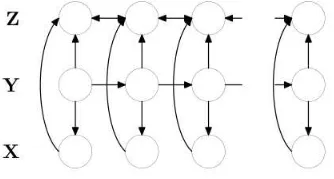
In this section, we present a Dynamic Dependency Network (DDN) model to incorporate task-specific label information in the source domain for semi-supervised representation learn-ing. A dynamic dependency network is a dynamic extension of dependency networks (Heckerman et al., 2000) for modeling data with sequential observations and labels. Depen-dency networks are cyclic directed graphical models. Similar to directed acyclic Bayesian net-works, dependency networks allow simple local parameter estimations given fully observed data. But by dropping acyclicity constraints, dependency networks are more flexible on model-ing interdependencies between variables than acyclic Bayesian networks. Followmodel-ing the same principle of Dynamic Bayesian Networks (DBNs) (Murphy, 2002), we extend dependency net-works into sequential models to form Dynamic Dependency Netnet-works. Although with directed cycles a DDN model will lose the ability of handling time series data that requires time forward directed arcs (not vice versa), it has increased the capacity of modeling word or label interde-pendencies within local contexts of sentences, comparing to DBNs. Figure 1 demonstrates an example of the DDN models we will use for semi-supervised representation learning. In this DDN model (Figure 1), the variables are partitioned into three interconnected sequences
[image:5.420.134.301.408.498.2]X={X1, . . . ,XT},Y ={Y1, . . . ,YT}andZ={Z1, . . . ,ZT}, representing observations, hidden states and labels respectively. Similar to the HMM model used in (Huang and Yates, 2009), the state sequence is hidden in our model and the state variableYtat locationttakes values from a predefined set of state values; the observation sequenceXis produced from the ob-served sentence; givenYt, we assumeXtis conditionally independent ofXt′fort6=t′. But in addition to the two layers,X andY in HMMs, our DDN model adds another task-specific label layerZ. For example, for the POS tagging task, Z will be the sequence of POS tags. More-over, we take the bi-directional sequential dependency between labels into consideration by connecting each neighbor pairs of labels using bi-directional arcs. At each locationt,Xt,Yt are both parents ofZt, since we assume both the sentence observation and the hidden state representation determine the sequence label. This DDN model maintains the same inference complexity as the HMM, since only the state sequenceY is latent during training. While by allowing bi-directional arcs over the label sequenceZ, it has a natural capacity of modeling and incorporating task-specific label information for representation learning. By incorporating the label sequenceZ into the model, we expect to identify more task discriminative latent sequence representations.
4.1 Training and Inference
Although we have an additional bi-directionalZlayer in DDNs, the structures over the hidden layerY, and betweenYand the observed sequenceXare similar to in HMMs. Thus inference over the hidden states and parameter learning in DDNs are as tractable as in HMMs. Assume that we are given a data set ofNi.i.d. samples,{(Xi,Zi)}fori=1, 2, . . . ,N, whereXiis the
ith sentence andZiis the corresponding sequence of labels, e.g., POS tags, forXi. Given the training data, its log-likelihood is
L(θ) = N
X
i=1
logP(Xi,Zi|θ)
whereθdenotes the set of model parameters.
Letq(Y)be any non-zero distribution over hidden variablesY, we can get a lower bound for
L(θ). For notational convenience, we will drop the superscriptiin the following formulas.
ℓ(θ) =logX Y
q(Y)P(Xq,Y,Z|θ)
(Y) (1)
≥X
Y
q(Y)logP(X,Y,Z|θ)
q(Y)
=L(θ)−DK L(q(Y)kP(Y|X,Z,θ)) (2) whereDK L(·)denotes the Kullback-Leibler divergence measure. We denote the objective in (2) asF(q,θ). We then conduct training by maximizing F(q,θ)using iterative Expectation-Maximization (EM) algorithm (Baum et al., 1970; Dempster et al., 1977). For the(k+1)th iteration, in the E-step, we updateqgiven fixedθkfrom previous iteration by
qk+1=arg max q F(q,θ
k) (3)
which has the following solution when theK Ldivergence becomes zero
qk+1(Y) =P(Y|X,Z,θk). (4) In the M-Step, we updateθgiven fixedqk+1
θk+1=arg max
θ
F(qk+1,θ) (5)
Similar to HMMs, the parameter estimation in (5) requires computation ofP(Yt−1,Yt|X,Z) andP(Yt|X,Z)for alltin the E-step. We extend the Baum-Welch algorithm used in HMMs to conduct the required computation with the current model parameters θ. Letαt(y) =
P(X1,Z1,· · ·,Xt,Zt,Yt = y|θ)andβt(y) = P(Xt+1,Zt+1,· · ·,XT,ZT|Yt = y,θ). The set of
{αt(y)}and{βt(y)}can be solved inductively using a forward procedure and a backward procedure respectively, which are analogous to the forward and backward procedures used for HMMs. Then the marginal probabilities can be computed as
P(Yt=y|X,Z,θ) =
αPt(y)βt(y) byαT(by)
P(Yt=y,Yt+1=y′|X,Z,θ) = (7) αt(Py)βt+1(y′)
b yαT(by)
P(Yt+1=y′|Yt=y)P(Zt+1|Zt,Zt+2,Xt+1,Yt+1=y′)
The major difference from HMMs is that the computation of (7) requires the additional local probabilities,P(Zt|Zt−1,Zt+1,Xt,Yt), in the bi-directionalZsequence. The typical conditional probability table (CPT) parameters forP(Zt|Zt−1,Zt+1,Xt,Yt)requires a storage space in the size of(L−1)×L2×V×S, whereLis the number of discrete label values forZ,V is the number of discrete word features for X, andSis the number of discrete states forY. To reduce the computational cost and memory size for storing such a large CPT and increase the scalability of the proposed model, we exploit a multi-class logistic regression model to model this conditional probability distribution and store the model parameters of the logistic regression model instead.
The logistic regression classifier is trained in the M-step with data collected at each locationt, over four types of featuresZt−1,Zt+1,Xt,Yt. Given the model parametersθ, the hidden state values of sequenceYare computed using the Viterbi inference algorithm used in HMMs. Thus the trained logistic regression model only requires a model parameter matrixWin the size of
L×(2L+V+S+1)to calculate the probabilityP(Zt|Zt−1,Zt+1,Xt,Yt,W)for any inputs. The space required to store theWmatrix is much smaller than the space required for the original conditional probability table. To avoid overfitting, we trained aL2-norm regularized logistic regression model using a second-order Newton method.
With the computed marginal probabilities and induced hidden states, the model parametersθ of the DDN can be re-estimated in a similar way as in HMMs in addition to the retraining of the logistic regression classifier.
4.2 Semi-supervised Representation Learning
We have introduced above how to train DDNs with labeled sentences and conduct inference to induce the hidden states. For cross-domain semi-supervised representation learning, we have a small amount of labeled sentences{(Xl,Zl)}in the source domain and a large amount of unlabeled sentences{Xu}in both the source and target domains. This requires the DDN model to handle unlabeled sentences as well. Note in the DDN model we introduced, dropping the label layerZ does not affect either the structure nor the parameter of the other two layers, but simplify a DDN model into a HMM. Thus we can use DDNs as HMMs on unlabeled sen-tences by sharing common model parameters across labeled and unlabeled sensen-tences. With this semi-supervised representation learning, we expect to inference latent features that are not only generalizable in different domains, but also more informative or discriminative about the target task labels.
5 Domain Adaptation for Part-of-Speech Tagging
In this section, we report our empirical study on how semi-supervised representation learning can improve out-of-domain part-of-speech tagging accuracy.
5.1 Datasets
We used the same datasets as (Blitzer et al., 2006; Huang and Yates, 2009, 2010). The source domain contains articles from Wall Street Journal (WSJ), with 39,832 manually tagged sen-tences from sections 02-21 and 100,000 unlabeled sensen-tences from a 1988 subset. The target domain contains bio-medical articles from MEDLINE, with 561 labeled sentences1and 100,000 unlabeled sentences. The task is to assign words with one of the POS tags from the Penn Tree-bank POS tags (Marcus et al., 1993) and two more tags from MEDLINE dataset. Among the tags, two tags cannot be seen in the newswire articles,HYPH(hyphens) andAFX(common post-modifiers for biomedical entities such as genes). These two tags were introduced because of the importance of hyphenated entities in biomedical text, which are about 1.8% of the words in the 561 labeled sentences.
5.2 Representation Learning
We explored both unsupervised representation learning using HMMs and semi-supervised rep-resentation learning using the proposed DDNs. We built a vocabulary with all sentences from the source and target domains. In order to reduce the vocabulary size, we further applied the preprocessing steps used in (Huang and Yates, 2009, 2010): we mapped lower frequency (0-2) words to a single unique identifier and sole-digit words into a single unique identifier in our vocabulary. With these preprocessed sentences, we applied representation learning models (DDNs and HMMs) to derive hidden states as additional features for supervised POS taggers. We used HMMs to perform unsupervised representation learning on 139,832 newswire sen-tences and 100,000 unlabeled biomedical sensen-tences following the work (Huang and Yates, 2009). Then we decoded the hidden states for 39,832 newswire sentences (the labeled sen-tences in the source domain) as well as 561 biomedical sensen-tences (the test sensen-tences in the target domain) as additional features for supervised POS tagging. In the unsupervised repre-sentation training, one hyperparameter, the number of hidden states, has to be set. A large number of hidden states would make the model more capable to derive latent features, how-ever, it also needs more memory storage and high computation cost. We used 80 states in our experiments, following (Huang and Yates, 2009), to produce fair comparisons.
We used the proposed DDN model for semi-supervised representation learning on 39,832 la-beled and 100,000 unlala-beled newswire sentences as well as 100,000 unlala-beled biomedical sentences. The labels we used in semi-supervised representation learning are the same labels we will use later to train POS taggers. Thus comparing to unsupervised representation learn-ing, the semi-supervised representation learning does not require additional annotation effort, but makes use of the existing labels in the source domain. For our semi-supervised representa-tion learning, we need to choose two hyperparameters, the number of hidden states and the L2 regularization parameter. We set the former as 80, same as in unsupervised representation learning. Our model is not sensitive to the L2 regularization parameter and we set it as 0.5.
5.3 Part-of-Speech Tagging Accuracy
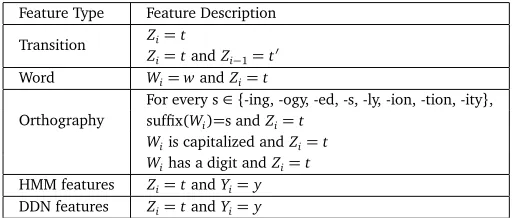
[image:9.420.88.344.252.361.2]For supervised POS tagging, the training data contains 39,832 labeled newswire sentences and the test data contains 561 biomedical sentences. The 561 biomedical sentences contain 14,554 tokens, of which 23% are OOV (Out-Of-Vocabulary) tokens. We tested our semi-supervised representation learning using supervised Conditional Random Field (CRF) POS taggers and used a fast-training CRF package developed by Okazaki (2007). The feature set used for the CRF POS tagger is presented in Table 1. Specifically, we extracted unigram features. We also added orthographical features such as suffix (-ing, -ogy, -ed, -ly, -s, -ion, -tion, -ity), as well as capitalization. Orthographical features contribute to improving tagging accuracy for out-of-vocabulary words as is demonstrated by (Lafferty, 2001). In addition, we added the latent states as state features for each word from the learned representations. For example, a sentence like “He is the CEO .” contains 5 words: 4 regular words and a “period”. A state feature is learned for each of them.
Table 1: CRF feature set used in our supervised CRF POS taggers.Zivariables stand for labels to be predicted,Wis represent word tokens. Yis stand for hidden state values decoded from HMM or DDN models, i.e., the new representation features.
Feature Type Feature Description
Transition Zi=t
Zi=tandZi−1=t′ Word Wi=wandZi=t Orthography
For every s∈{-ing, -ogy, -ed, -s, -ly, -ion, -tion, -ity}, suffix(Wi)=s andZi=t
Wiis capitalized andZi=t
Wihas a digit andZi=t HMM features Zi=tandYi=y DDN features Zi=tandYi=y
Our experimental results in term of per-token accuracy with different representation learning methods are presented in Table 2. For all test results reported in this paper, the “All Words” results are average accuracies over all words in the test data, the “OOV Words” results are average accuracies over only OOV words in the test data that appeared less than 3 times in the training data. We reported the empirical results for the following approaches:
• Baseline:the baseline CRF POS-tagger trained without representation learning.
• ASO:the Alternating Structural Optimization technique in (Ando and Zhang, 2005).
• SELF-CRF:the comparison method using a self-training paradigm. We first train a CRF
without representation learning on the training data and apply it on the test data, then retrain it on the training data plus the test data with predicted labels.
• PLAIN-SEM: the method based on the representation learning technique using
Table 2: Per-token accuracy for out-of-domain words on MEDLINE domain trained with Wall Street Journal articles.
Approaches All Words OOV Words
Baseline 88.3% 67.3%
ASO 88.4% 70.9%
SELF-CRF 88.5% 70.4%
PLAIN-SEM 88.5% 69.8%
SCL 88.9% 72.0%
SEM-CRF 90.0% 71.9%
HMM 90.5% 75.2%
DDN 91.3% 76.1%
• SCL:the method based on the representation learning with the Structural Correspon-dence Learning (SCL) technique, developed by (Blitzer et al., 2006).
• SEM-CRF:the method based on the representation learning in (Huang and Yates, 2010).
• HMM:the method based on the unsupervised representation learning using HMMs in (Huang and Yates, 2009).
• DDN:the method based on the proposed semi-supervised representation learning.
We also investigated how our representation learning benefits supervised POS taggers by vary-ing the number of labeled trainvary-ing sentences from the source domain. For comparison, we consideredBaseline,SCLandHMM, sinceSCLandHMMwork very well among all the other comparison methods. The per-token accuracies on test data are reported in Figure 2.
1 1.5 2 2.5 3 3.5 4 x 10⁴ 85
86 87 88 89 90 91 92
WSJ to MEDLINE
#Labeled training sentences
Accuracy
[image:10.420.137.268.343.456.2]Baseline SCL HMM DDN
Figure 2: Per-token accuracies for out-of-domain POS tagging. WSJ is used as the source domain and MEDLINE is used as the target domain.
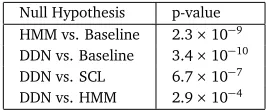
Table 3: Statistical Significance (McNemar’s) tests for out-of-domain experiments with CRF POS taggers. Results are significant withp<0.05.
Null Hypothesis p-value HMM vs. Baseline 2.3×10⁻⁹ DDN vs. Baseline 3.4×10⁻¹⁰ DDN vs. SCL 6.7×10⁻⁷ DDN vs. HMM 2.9×10⁻⁴
more improvements in accuracy compared withBaseline,SCLandHMM. Specifically, DDN
increases accuracy by 2.4% compared withBaseline, by 1.3% compared withSCL, and by 0.6% compared withHMMwhen the labeled training data is 1,000. When the labeled training data reaches 39,832,DDNincreases accuracy by 3.0% compared withBaseline, by 2.4% compared withSCL, and by 0.8% compared withHMM. Those results suggest thatDDNcan produce more effective task-specific features by incorporating existing labels from the source domain, and further assist out-of-domain POS tagging.
We also present results for corresponding significance tests over comparisons betweenBaseline,
SCL,HMMandDDNin Table 3. We followed the experiments in (Blitzer et al., 2006), and used a McNemar paired test for labeling disagreements (Gillick and Cox, 1989) withp<0.05 being significant on all test words. We report the p values in Table 3. We can see thatDDN
significantly improves out-of-domain tagging accuracy overBaseline,SCLandHMM.
6 Domain Adaptation for Syntactic Chunking
In this section, we empirically study how our proposed semi-supervised representation learning can improve out-of-domain performance on syntactic chunking.
6.1 Datasets
We used the datasets from the CoNLL 2005 shared task (Carreras and Màrquez, 2005) for our second set of experiments on syntactic chunking. We used the standard training set, consist-ing of sections 02-21 of the Wall Street Journal (WSJ) portion of the Penn Treebank, and conducted tests on the Brown corpus (Kucera and Francis, 1967). The test data contains 3 sections (ck01-ck03) of propbanked Brown corpus data, which consists of 426 sentences con-taining 7,159 tokens. Besides these labeled data, we also incorporated unlabeled data from both domains. We added 100,000 unlabeled news sentences for the source domain and 57,000 unlabeled sentences for the target domain. In this setting, while the source domain contains newswire text, the test sentences are drawn from the domain of “general fiction” and contain entirely different styles of English.
The original training data and test data from the CoNLL 2005 shared task contain POS tags as well as partial syntax, namely chunks and clauses. In order to perform syntactic chunking task, we mapped the partial syntax labels to chunking labels in IOB2 format. IOB2 format is a standard format for various sequence tasks like syntactic chunking and it is widely used in previous works including the CoNLL 2000 shared task2. In IOB2 format, the chunk tags
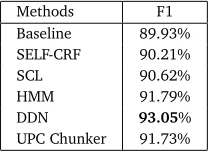
Table 4: Average chunking performance on Brown corpus, with Wall Street Journal articles as training data.
Methods F1
Baseline 89.93% SELF-CRF 90.21%
SCL 90.62%
HMM 91.79%
DDN 93.05%
UPC Chunker 91.73%
consist of two parts. The first part represents the position of the token in this chunk and the second part stands for the name of the chunk type. For example, the chunking type ofVPis used for verb phrase words and the chunking type ofNPis used for noun phrase words. For words forming a chunk of type k, the first word receives the B-k tag (Begin), and the remaining words receive the tag I-k (Inside). Words outside a chunk receive the tag O. Below we give an example of a sentence labeled with chunking tags in IOB2 format from the source domain:
The/B-NP $/I-NP 1.4/I-NP billion/I-NP robot/I-NP spacecraft/I-NP faces/ B-VP a/B-NP six-year/I-NP journey/I-NP to/B-VP explore/I-VP Jupiter/B-NP and/O its/B-NP 16/I-NP known/I-NP moons/I-NP ./O
6.2 Representation Learning
We built a vocabulary with all sentences from the source and target domains. In order to reduce the vocabulary size, we used the same preprocessing steps as in POS tagging experiments, mapping lower frequency (0-2) words to a single unique identifier in our vocabulary and sole-digit words into a single unique identifier. On the preprocessed sentences, we then applied representation learning models (DDNs or HMMs) to derive hidden states of the sentence words, which can be used as additional features for supervised syntactic chunking systems.
We used HMMs to perform unsupervised representation learning on 139,832 newswire source sentences and 57,000 unlabeled “general fiction” sentences from Brown corpus. Then we decoded the hidden states for 39,832 labeled newswire sentences and 426 “general fiction” test sentences as additional features for supervised syntactic chunking, using the trained HMM. In the unsupervised representation training, one hyperparameter, the number of hidden states, has to be set. We used 80 states in our experiments in consideration of the model capability, memory storage and computation cost.
1 1.5 2 2.5 3 3.5 4 x 10⁴ 86
87 88 89 90 91 92 93 94
WSJ to Brown
#Labeled training sentences
F1
[image:13.420.151.282.71.184.2]Baseline SCL HMM DDN
Figure 3: Results in term of F1 measure for out-of-domain syntactic chunking. WSJ is used as the source domain and Brown corpus is used as the target domain.
6.3 Syntactic Chunking Results
For supervised syntactic chunking, the training data contains 39,832 labeled newswire sen-tences and the test data contains 426 “general fiction” sensen-tences. The 426 “general fiction” sentences contain 7,159 tokens. We tested our semi-supervised representation learning with su-pervised Conditional Random Field (CRF) syntactic chunking. We used the same fast-training CRF package developed by Okazaki (2007). For syntactic chunking, in addition to the CRF feature set in Table1 which we used in POS tagging experiments, we also extracted POS tag features. All features are represented with boolean values.
Our experimental results with different representation learning methods are presented in Table 4. The results are in term of F1 measure, since F1 measure is widely used in syntactic chunk-ing tasks (Huang and Yates, 2009; Carreras and Màrquez, 2005). We reported the empirical results of the following approaches for comparison:
• UPC Chunker: a chunking system based on Voted Perceptrons (Carreras and Màrquez,
2003). Carreras and Màrquez (2005) trained such a chunker on WSJ sections 02-21 and tested it on three sections of the Brown corpus (ck01-03). The reported results serve as the currentstate-of-the-artperformance on this experimental setting.
• Baseline:the baseline CRF chunker without representation learning.
• SELF-CRF:the CRF chunker with a self-training paradigm. We first train a CRF without
representation learning on the training data and apply it to the test data, then retrain it on the training data plus the test data with predicted labels.
• SCL:the method based on the representation learning produced using the Structural Correspondence Learning (SCL) technique (Blitzer et al., 2006).
• HMM:the method based on unsupervised representation learning using Hidden Markov Models (Huang and Yates, 2009).
• DDN:the method based on the proposed semi-supervised representation learning.
number of labeled training sentences from the source domain. Its comparison results with
Baseline,SCLandHMMare presented in Figure 3.
From Table 4 and Figure 3, we can see that with semi-supervised representation learning, the DDN based chunker consistently outperforms other methods for out-of-domain syntactic chunking. According to Figure 3, by increasing the number of labeled training data,DDN
can gain more improvements in term of F1 measure comparing toBaseline,SCLandHMM. Specifically,DDNincreases the F1 by 2.52% comparing withBaseline, by 1.91% comparing withSCL, and by 0.74% comparing withHMMwhen the number of labeled training sentences is 1,000. When the number of labeled training sentences reaches 39,832,DDNoutperforms
Baselineby 3.08%, outperformsSCLby 2.43%, and outperformsHMMby 1.26%, in term of F1-measure. These results again suggest that the semi-supervised representation learning method,
DDN, can produce more effective task-specific features by incorporating existing labels from the source domain.
We also produced the results of corresponding significance tests, reported in Table 5. We used a McNemar paired test for labeling disagreements (Gillick and Cox, 1989) withp<0.05 being significant on all test words. We reported the p values in Table 5, from which we can see that
DDNsignificantly improves out-of-domain chunking performance overBaseline,SCLandHMM.
Table 5: Statistical Significance (McNemar’s) tests for out-of-domain experiments with CRF syntactic chunkers. Results are statistical significant withp<0.05.
Null Hypothesis p-value HMM vs. Baseline 5.6×10⁻⁸ DDN vs. Baseline 2.9×10⁻¹⁰ DDN vs. SCL 7.1×10⁻⁸ DDN vs. HMM 4.7×10⁻⁴
Conclusion
In this paper, we proposed a Dynamic Dependency Network model for semi-supervised repre-sentation learning. In addition to the large amount of unlabeled data from two domains, it incorporates the task-specific labels from the source training data into representation learning. We then used the induced generalizable state features to augment source training sentences and target test sentences for two cross domain NLP tasks: part-of-speech tagging and syntac-tic chunking. Our empirical studies show that the proposed semi-supervised representation learning outperforms unsupervised representation learning based on HMMs on out-of-domain test data for both POS tagging system and syntactic chunking system. With the proposed semi-supervised representation learning, the POS taggers and the syntactic chunkers resulted also outperform a set of other POS tagging methods and syntactic chunking methods for out-of-domain predictions. All results suggest the proposed semi-supervised representation learning can better bridge the domain gap between training sentences and test sentences by exploiting task-specific label information in the representation learning process.
Acknowledgments
References
Ando, R. and Zhang, T. (2005). A framework for learning predictive structures from multiple tasks and unlabeled data.Journal of Machine Learning Research (JMLR), 6:1817–1853.
Baum, L., Petrie, T., Soules, G., and Weiss, N. (1970). A maximization technique occurring in the statistical analysis of probabilistic functions of markov chains.The Annals of Mathematical Statistics.
Ben-David, S., Blitzer, J., Crammer, K., Kulesza, A., Pereira, F., and Vaughan, J. (2010). A theory of learning from different domains.Machine Learning, 79:151–175.
Ben-David, S., Blitzer, J., Crammer, K., and Pereira, F. (2007). Analysis of representations for domain adaptation. InAdvances in Neural Information Processing Systems (NIPS).
Blitzer, J., Foster, D., and Kakade, S. (2011). Domain adaptation with coupled subspaces. In
Proceedings of the International Conference on Artificial Intelligence and Statistics (AISTATS).
Blitzer, J., McDonald, R., and Pereira, F. (2006). Domain adaptation with structural correspon-dence learning. InProceedings of the Conference on Empirical Methods in Natural Language Processing (EMNLP).
Carreras, X. and Màrquez, L. (2003). Phrase recognition by filtering and ranking with percep-trons. InProceedings of the Recent Advances in Natural Language Processing (RANLP).
Carreras, X. and Màrquez, L. (2005). Introduction to the conll-2005 shared task: semantic role labeling. InProceedings of the Conference on Computational Natural Language Learning (CoNLL).
Collobert, R. and Weston, J. (2008). A unified architecture for natural language processing: deep neural networks with multitask learning. InProceedings of the International Conference on Machine Learning (ICML).
Daumé III, H. (2007). Frustratingly easy domain adaptation. InProceedings of the Annual Meeting of the Association for Computational Linguistics (ACL).
Daumé III, H. and Marcu, D. (2006). Domain adaptation for statistical classifiers.Journal of Artificial Intelligence Research, 26:101–126.
Daumé III, H., Kumar, A., and Saha, A. (2010). Co-regularization based semi-supervised domain adaptation. InAdvances in Neural Information Processing Systems (NIPS).
Dempster, A., Laird, N., and Rubin, D. (1977). Maximum likelihood from incomplete data via the EM algorithm.Journal of the Royal Statistical Society, Series B, 39(1):1–38.
Dredze, M., Kulesza, A., and Crammer, K. (2010). Multi-domain learning by confidence-weighted parameter combination.Machine Learning, 79(1-2):123–149.
Heckerman, D., Chickering, D., Meek, C., Rounthwaite, R., and Kadie, C. (2000). Dependency networks for inference, collaborative filtering and data visualization. Journal of Machine Learning Research (JMLR), 1:49–75.
Huang, F. and Yates, A. (2009). Distributional representations for handling sparsity in super-vised sequence labeling. InProceedings of the Annual Meeting of the Association for Computa-tional Linguistics (ACL).
Huang, F. and Yates, A. (2010). Exploring representation-learning approaches to domain adaptation. InProceedings of the Annual Meeting of the Association for Computational Linguis-tics (ACL).
Jiang, J. and Zhai, C. (2007). Instance weighting for domain adaptation in nlp. InProceedings of the Annual Meeting of the Association of Computational Linguistics (ACL).
Kucera, H. and Francis, W. (1967). Computational analysis of present-day American English. Brown University Press.
Lafferty, J. (2001). Conditional random fields: Probabilistic models for segmenting and label-ing sequence data. InProceedings of the International Conference on Machine Learning (ICML). Marcus, M., Santorini, B., and Marcinkiewicz, M. (1993). Building a large annotated cor-pus of english: The penn treebank. InProceedings of the Annual Meeting of Association of Computational Linguistics (ACL).
McClosky, D., Charniak, E., and Johnson, M. (2010). Automatic domain adaptation for pars-ing. InProceedings of Human Language Technologies: The Annual Conference of the North American Chapter of the Association for Computational Linguistics (ACL).
Mnih, A. and Hinton, G. (2009). A scalable hierarchical distributed language model. In
Advances in Neural Information Processing Systems (NIPS).
Murphy, K. (2002).Dynamic Bayesian Networks: Representation, Inference and Learning. PhD thesis.
Okazaki, N. (2007). CRFsuite: a fast implementation of conditional random fields (CRFs). http://www.chokkan.org/software/crfsuite/.
PennBioIE (2005). Mining the bibliome project. http://bioie.ldc.upenn.edu.
Sekine, S. (1997). The domain dependence of parsing. InProceedings of the Conference on Applied natural language processing.
Smith, N. and Eisner, J. (2005). Contrastive estimation: Training log-linear models on unla-beled data. InProceedings of the Annual Meeting of the Association for Computational Linguis-tics (ACL).
Turian, J., Ratinov, L., and Bengio, Y. (2010). Word representations: a simple and general method for semi-supervised learning. InProceedings of the Annual Meeting of the Association for Computational Linguistics (ACL).