Semi-supervised Dependency Parsing
using Bilexical Contextual Features from Auto-Parsed Data
Eliyahu KiperwasserComputer Science Department Bar-Ilan University
Ramat-Gan, Israel
Yoav Goldberg
Computer Science Department Bar-Ilan University
Ramat-Gan, Israel
Abstract
We present a semi-supervised approach to improve dependency parsing accuracy by using bilexical statistics derived from auto-parsed data. The method is based on estimating the attachment potential of head-modifier words, by taking into ac-count not only the head and modifier words themselves, but also the words sur-rounding the head and the modifier. When integrating the learned statistics as features in a graph-based parsing model, we ob-serve nice improvements in accuracy when parsing various English datasets.
1 Introduction
We are concerned with semi-supervised depen-dency parsing, namely how to leverage large amounts of unannotated data, in addition to anno-tated Treebank data, to improve dependency pars-ing accuracy. Our method (Section 2) is based on parsing large amounts of unannotated text us-ing a baseline parser, extractus-ing word-interaction statistics from the automatically parsed corpus, and using these statistics as the basis of additional parser features. The automatically-parsed data is used to acquire statistics about lexical interactions, which are too sparse to estimate well from any realistically-sized Treebank. Specifically, we at-tempt to infer a function assoc(head, modifer)
measuring the “goodness” of head-modifier rela-tions (“how good is an arc in whichblackis a mod-ifier ofjump”). A similar approach was taken by Chen et al. (2009) and Van Noord et al. (2007). We depart from their work by extending the scoring to include a wider lexical context. That is, given the sentence fragment in Figure 1, we score the (incorrect) dependency arc(black,jump)based on the triplets(the black fox,will jump over). Learn-ing a function between word triplets raises an
extreme data sparsity issue, which we deal with by decomposing the interaction between triplets to a sum of interactions between word pairs. The decomposition we use is inspired by recent work in word-embeddings and dense vector rep-resentations (Mikolov et al., 2013a; Mnih and Kavukcuoglu, 2013). Indeed, we initially hoped to leverage the generalization abilities associated with vector-based representations. However, we find that in our setup, reverting to direct count-based statistics achieve roughly the same results (Section 3).
Our derived features improve the accuracy of a first-order dependency parser by 0.75 UAS points (absolute) when evaluated on the in-domain WSJ test-set, obtaining a final accuracy of 92.32 UAS for a first-order parser. When comparing to the strong baseline of using Brown-clusters based fea-tures (Koo et al., 2008), we find that our triplets-based method outperform them by over 0.27 UAS points. This is in contrast to previous works (e.g. (Bansal et al., 2014)) in which improvements over using Brown-clusters features were achieved only by adding to the cluster-based features, not by re-placing them. As expected, combining both our features and the brown-cluster features result in some additional gains.
2 Our Approach
Our departure point is a graph-based parsing model (McDonald et al., 2005):
parse(x) = argmax
y∈Y(x) score(x, y)
score(x, y) =w·Φ(x, y) = X
part∈y
w·φ(x, part)
Given a sentencexwe look for the highest-scoring parse treeyin the spaceY(x)of valid dependency trees overx. The score of a tree is determined by a linear model parameterized by a weights vectorw, and a feature functionΦ(x, y). To make the search
Features inφijlex(x, y) bin(Sij(x, y))
bin(Sij(x, y))◦dist(x,y)
bin(Sij(x, y))◦pos(x)◦pos(y)
bin(Sij(x, y))◦pos(x)◦pos(y)◦dist(x,y)
Table 1: All features are binary indicators. xand yare token indices. Sijis estimated from auto-parsed corpora as
described in the text. The values ofS(·,·)are in the range (0,1), which is split bybininto 10 equally-spaced intervals.
distis the signed and binned sentence-distance betweenx andy. pos(x) is the part of speech of tokenx. ◦indicates a concatenation of features.
tractable, the feature function is decomposed into local feature functions over tree-partsφ(x, part). The features inφare standard graph-based depen-dency parsing features, capturing mostly structural information from the parse tree.
We extend the scoring function by adding an ad-ditional term capturing the strength of lexical as-sociation between head wordhand modifier word
min each dependency arc:
score(x, y) = X
part∈y
w·φ(x, part) + X
(h,m)∈y
assoc(h, m)
The association functionassocis also modeled as a linear modelassoc(h, m) =wlex·φlex(h, m).
While the weightswlexare trained jointly withw
based on supervised training data, the features in
φlex do not look at h andmdirectly, but instead
rely on a quantityS(h, m)that reflects the “good-ness” of the arc (h, m). The quantity S(h, m)
ranges between 0 and 1, and is estimated based on large quantities of auto-parsed data. Given a value for S(h, m),φlex is composed of indicator
functions indicating the binned ranges ofS(h, m), possibly conjoined with information such as the binned surface distance between the tokenshand
m and their parts of speech. The complete spec-ification of φlex we use is shown in Table 1 (the
meaning of theijindices will be discussed in Sec-tion 2.2).
2.1 EstimatingS(h, m)
One way of estimating S(h, m), which was also used in (Chen et al., 2009), is using rank statistics. LetDbe the list of observed(h, m)pairs sorted by their frequencies, and letrank(h, m)be the index of the pair(h, m)inD. We now set:
SRANK(h, m) = rank|D(h, m| )
While effective, this approach has two related shortcomings: first, it requires storing counts for all the pairs (h, m) appearing in the auto-parsed data, resulting in memory requirement that scales quadratically with the vocabulary size. Second, even with very large auto-parsed corpora many plausible head-modifier pairs are likely to be un-observed.
An alternative way of estimating S(h, m) that does not require storing all the observed pairs and that has a potential of generalizing beyond the seen examples is using a log-bilinear embedding model similar to the skip-gram model presented by Mikolov et al. (2013b) to embed word pairs such that compatible pairs receive high scores. The model assigns two disjoint sets ofd-dimensional continuous latent vectors,uandv, whereuh ∈Rd
is an embedding of a head wordh, andvm ∈Rdis
an embedding of a modifier wordm. The embed-ding is done by trying to optimize the following corpus-wide objective that is maximizing the dot product of the vectors of observed(h, m)pairs and minimizing the dot product of vectors of random
handmpairs. Formally:
X
h,m∈C
"
ln(σ(uh·vm))− k
X
i=1
E
mi∼Pmln(σ(uh·vmi))
#
whereσ(x) = 1/(1 +e−x), andkis the number
of negative samples, drawn from the corpus-based Unigram distributionPm. For further details, see
(Mikolov et al., 2013b; Goldberg and Levy, 2014). We then take:1
SEMBED(h, m) =σ(uh·vm)
In contrast to the counts based method, this model is able to estimate the strength of a pair of words even if the pair did not appear in the corpus due to sparsity.
Finally, Levy and Goldberg (2014b) show that the skip-grams with negative-sampling model de-scribed above achieves its optimal solution when
uh·vm=P MI(h, m)−log k. This gives rise to
another natural way of estimatingS:
m−1 m0 m+1 . . . h−1 h0 h+1
[image:3.595.312.521.436.551.2]the black fox . . . will jump over
Figure 1:Illustration of the bilexical information including context. When scoring the (incorrect) arc betweenh0 and m0, we take into account also the surrounding wordsh−1, h+1,m−1andm+1.
SPMI(h, m) =σ(P MI(h, m)) = p(h,mp)+(h,mp(h))p(m)
where p(h, m), p(h) and p(m) are unsmoothed maximum-likelihood estimates based on the auto-parsed corpus.
Like SRANK and unlike SEMBED, SPMI requires storing statistics for all observed word pairs, and is not able of generalizing beyond (h, m) pairs seen in the auto-parsed data. However, as we see in Section 3, this method performing similarly in practice, suggesting that the generalization ca-pabilities of the embedding-based method do not benefit the parsing task.
2.2 Adding additional context
Estimating the association between a pair of words is effective. However, we would like to go a step further and take into account also the context in which these words occur. Specifically, our com-plete model attempts to estimate the association between word trigrams centered around the head and the modifier words.
A naive solution that defines each trigram as its own vocabulary item will increase the vocab-ulary size by two orders of magnitude and re-sult in severe data sparsity. An alternative so-lution would be to associate each word in the triplet(h−1, h0, h+1) with its own unique vocab-ulary item, and likewise for modifier words. In the embeddings-based model, this results in 6 vec-tor setsu−1, u0, u+1, v−1, v0, v+1, wherev−1
dog, for
example, represents the word “dog” when it ap-pears to the left of the modifier word, andu+1
walk
the word “walk” when it appears to the right of the head word.2 This amounts to only a 3-fold increase in the required vocabulary size. We then model the strength of association between
h−1h0h+1andm−1m0m+1as a weighted sum of
2Sentences are padded by special sentence-boundary symbols.
pairwise interactions:3
assoc(h−1h0h+1, m−1m0m+1) =
1
X
i=−1 1
X
j=−1
αij associj(hi, mj)
As before, the pairwise association measure
associj(hi, mj)is modeled as a linear model:
associj(hi, mj) =wlexij ·φijlex(hi, mj)
Where φijlex is again defined in terms of a goodness function Sij(x, y). For example,
S−1,+1(the, over)corresponds to the goodness of a head-modifier arc where the word to the left of the head word is “the” and the word to the right of the modifier word is “over”. Sij(hi, mj), the
goodness of the arc induced by the pair(hi, mj),
can be estimated by eitherSRANK,SEMBEDorSPMI as before. For example, in the embeddings model we setSij(x, y) =σ(ui
x·vyj).
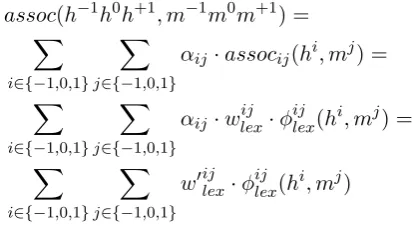
We update the bilexical features to include con-text as explained above. Instead of learning α
andwlexcoefficients separately, we absorb theαij
terms intowlex, learning both at the same time:
assoc(h−1h0h+1, m−1m0m+1) = X
i∈{−1,0,1}
X
j∈{−1,0,1}
αij ·associj(hi, mj) =
X
i∈{−1,0,1}
X
j∈{−1,0,1}
αij ·wijlex·φijlex(hi, mj) =
X
i∈{−1,0,1}
X
j∈{−1,0,1}
w0ijlex·φijlex(hi, mj)
Finally, the parser selects a dependency tree which maximizes the following:
w0·Φ(x, y) = X
part∈y
w·φ(x, part)
+ X
(h,m)∈y
1
X
i=−1 1
X
j=−1
wlexij ·φijlex(hi, mj)
3In the word embeddings literature, it is common to rep-resent a word triplet as the sum of the individual component vectors, resulting inux,y,z ·va,b,c = (ux−1 +u0y+u+1z )·
(v−1
a +v0b+v+1c ). Expanding the terms will result in a very
similar formulation to our proposal, but we allow the extra flexibility of associating a different strength αij with each
Dev Test Brown Answers Blogs Email News Reviews Baseline 91.97 91.57 86.86 81.58 84.88 79.75 82.59 83.22 Base + Brown 92.16 92.05 87.16 81.96 85.46 80.27 83.02 83.56 Base + HM(SRANK) 92.16 91.74 87.01 82.06 85.36 80.29 82.72 83.62 Base + HM(SEMBED) 92.29 91.98 87.04 81.97 85.34 79.93 82.76 83.33
Base + HM(SPMI) 92.35 92.00 87.14 82.20 85.65 80.34 82.83 83.81
Base + TRIP(SRANK) 92.23 91.91 87.02 82.31 85.59 80.50 83.30 83.79
Base + TRIP(SEMBED) 92.38 92.27 87.15 82.34 85.71 80.41 83.21 83.68
Base + TRIP(SPMI) 92.61 92.32 87.29 82.58 85.88 80.43 83.57 84.18
Base + Brown + TRIP(SRANK) 92.43 92.33 87.23 82.60 85.75 80.57 83.48 84.00 Base + Brown + TRIP(SEMBED) 92.51 92.45 87.33 82.42 86.06 80.44 83.40 83.87
[image:4.595.123.480.62.188.2]Base + Brown + TRIP(SPMI) 92.70 92.40 87.42 82.74 86.08 80.72 83.78 84.26
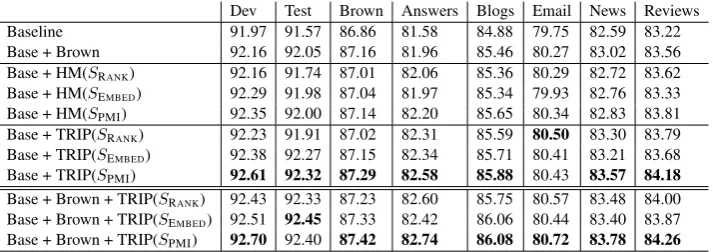
Table 2: Parsing accuracies (UAS, excluding puctuation) of the different models on various corpora. All models are trained on the PTB training set. Dev and Test are sections 22 and 23. Brown is the Brown portion of the PTB. The other columns correspond to the test portions of the Google Web Treebanks. Automatic POS-tags are assigned in all cases. HM indicates using assoc(h, m)and TRIP usingassoc(h−1h0h1, m−1m0m1). + BROWNindicate using features based on Brown clustering.
3 Experiments and Results
Data Our experiments are based on the Penn Treebank (PTB) (Marcus et al., 1993) as well as the Google Web Treebanks (LDC2012T13), cov-ering both in-domain and out-of-domain scenar-ios. We use the Stanford-dependencies represen-tation (de Marneffe and Manning, 2008). All the constituent-trees are converted to Stanford-dependencies based on the settings of Version 1.0 of the Universal Treebank (McDonald et al., 2013).4 These are based on the Stanford Depen-dencies converter but use some non-default flags, and change some of the dependency labels. All of the models are trained on section 2-21 of the WSJ portion of the PTB. For in-domain data, we evaluate on sections 22 (Dev) and 23 (Test). All of the parameter tuning were performed on the Dev set, and we report test-set numbers only for the “most interesting” configurations. For out-of-domain data, we use the Brown portion of the PTB (Brown), as well as the test-sets of different do-mains available in the Google Web Treebank: An-swers, Blogs, Emails, Reviews and Newsgroups.
All trees have automatically assigned part-of-speech tags, assigned by the TurboTagger POS-tagger.5 The train-set POS-tags were derived in a 10-fold jacknifing, and the different test datasets receive tags from a tagger trained on sections 2-21. For auto-parsed data, we parse the text of the BLLIP corpus (Charniak, 2000) using our base-line parser. This is the same corpus used for deriv-ing Brown clusters for use as features in (Koo et
4https://github.com/ryanmcd/ uni-dep-tb/raw/master/universal_ treebanks_v1.0.tar.gz
5http://www.ark.cs.cmu.edu/ TurboParser/
al., 2008). We use the clusters provided by Terry Koo6. Parsing accuracy is measured by unlabeled attachment score (UAS) excluding punctuations.
Implementation DetailsWe focus on first-order parsers, as they are the most practical graph-based parsers in terms of running time in real-istic parsing scenarios. Our base model is a re-implementation of a first-order projective Graph-based parser (McDonald et al., 2005), which we extend to support the semi-supervised φlex
fea-tures. The parser is trained for 10 iterations of online-training with passive-aggressive updates (Crammer et al., 2006). For the Brown-cluster fea-tures, we use the feature templates described by (Koo et al., 2008; Bansal et al., 2014).
The embedding vectors are trained using the freely available word2vecf software7, by con-joining each word with its relative position (-1, 0 or 1) and treating the head words as “words” and the modifier words to be “contexts”. The words are embedded into 300-dimensional vectors. All code and vectors will be available at the first au-thor’s website.
Results The results are shown in Table 2. The second block (HM) compares the baseline parser to a parser including theassoc(h, m)lexical com-ponent, using various ways of computings(h, m). We observe a clear improvement above the base-line from using the lexical component across all domains. The different estimation methods per-form very similar to each other.
In the third block (TRIP) we switch to the triplet-based lexical association. With SRANK,
6http://people.csail.mit.edu/maestro/ papers/bllip-clusters.gz
there is very little advantage over looking at just pairs. However, withSEMBEDorSPMIthe improve-ment of using the triplet-based method over using just the head-modifier pairs is clear. The counting-based PMI method performs on par with the Em-bedding based approximation of it.
The second line of the first block (Base+Brown) represents the current state-of-the-art in semi-supervised training of graph-based parsing: using Brown-cluster derived features (Koo et al., 2008; Bansal et al., 2014). The Brown-derived features provide similar (sometimes larger) gains to using our HM method, and substantially smaller gains than our TRIP method. To the best of our knowl-edge, we are the first to show a semi-supervised method that significantly outperforms the use of Brown-clusters without using Brown-clusters as a component.
As expected, combining our features and the Brown-based features provide an additional im-provement, as can be seen in the last block of Table 2 (Base+Brown+TRIP).
4 Related Work
Semi-supervised approaches to dependency pars-ing can be roughly categorized into two groups: those that use unannotated data and those that use automatically-parsed data. Our proposed method falls in the second group.
Among the words that use unannotated data, the dominant approach is to derive either word clus-ters (Koo et al., 2008) or word vectors (Chen and Manning, 2014) based on unparsed data, and use these as additional features for a supervised pars-ing model. While the word representations used in such methods are not specifically designed for the parsing task, they do provide useful features for parsing, and in particular the method of (Koo et al., 2008), relying on features derived using the Brown-clustering algorithm, provides very com-petitive state-of-the-art results. To the best of our knowledge, we are the first to show a substantial improvement over using Brown-clustering derived features without using Brown-cluster features as a component.
Among the words that use auto-parsed data, a dominant approach is self-training (McClosky et al., 2006), in which a parser A (possibly an en-semble) is used to parse large amounts of data, and a parser B is then trained over the union of the gold data and the auto-parsed data produced
by parser A. In the context of dependency-parsing, successful uses of self-training require parser A to be stronger than parser B (Petrov et al., 2010) or use a selection criteria for training only on high-quality parses produced by parser A (Sagae and Tsujii, 2007; Weiss et al., 2015). In contrast, our work uses the same parser (modulo the feature-set) for producing the auto-parsed data and for train-ing the final model, and does not employ a high-quality parse selection criteria when creating the auto-parsed corpus. It is possible that high-quality parse selection can improve our proposed method even further.
Works that derive features from auto-parsed data include (Sagae and Gordon, 2009; Bansal et al., 2014). Such works assign a representation (ei-ther cluster or vector) for individual word in the vocabulary based on their syntactic behavior. In contrast, our learned features are designed to cap-tureinteractionsbetween words. As discussed in sections (1) and (2), most similar to ours is the work of (Chen et al., 2009; Van Noord, 2007). We extend their approach to take into account not only direct word-word interactions but also the lexical surroundings in which these interactions occur.
Another recent approach that takes into account various syntactic interactions was recently intro-duced by Chen et al. (2014), who propose to learn to embed complex features that are being used in a graph-based parser based on other features they co-occur with in auto-parsed data. Similar to our approach, the embedded features are then used as additional features in a conventional graph-based model. The approaches are to a large extent com-plementary, and could be combined.
Finally, our work adds additional features to a graph-based parser which is based on a linear-model. Recently, progress in dependency parsing has been made by introducing non-linear, neural-network based models (Pei et al., 2015; Chen and Manning, 2014; Weiss et al., 2015; Dyer et al., 2015; Zhou et al., 2015). Adapting our approach to work with such models is an interesting research direction.
5 Conclusions
References
Mohit Bansal, Kevin Gimpel, and Karen Livescu. 2014. Tailoring continuous word representations for dependency parsing. InProc. of ACL.
Eugene Charniak. 2000. Bllip 1987-89 wsj corpus re-lease 1. In Linguistic Data Consortium, Philadel-phia.
Danqi Chen and Christopher D Manning. 2014. A fast and accurate dependency parser using neural net-works. InProc. of EMNLP, pages 740–750. Wenliang Chen, Jun’ichi Kazama, Kiyotaka Uchimoto,
and Kentaro Torisawa. 2009. Improving depen-dency parsing with subtrees from auto-parsed data. InEMNLP, pages 570–579.
Wenliang Chen, Yue Zhang, and Min Zhang. 2014. Feature embedding for dependency parsing. In
Proc. of COLING.
Koby Crammer, Ofer Dekel, Joseph Keshet, Shai Shalev-Shwartz, and Yoram Singer. 2006. Online passive-aggressive algorithms. The Journal of Ma-chine Learning Research, 7:551–585.
Marie-Catherine de Marneffe and Christopher D. Man-ning. 2008. The stanford typed dependencies rep-resentation. In Coling 2008: Proceedings of the workshop on Cross-Framework and Cross-Domain Parser Evaluation, CrossParser ’08, pages 1–8, Stroudsburg, PA, USA. Association for Computa-tional Linguistics.
Chris Dyer, Miguel Ballesteros, Wang Ling, Austin Matthews, and Noah A Smith. 2015. Transition-based dependency parsing with stack long short-term memory. InProc. of ACL.
Yoav Goldberg and Omer Levy. 2014. word2vec explained: deriving Mikolov et al.’s negative-sampling word-embedding method. arXiv preprint arXiv:1402.3722.
Terry Koo, Xavier Carreras, and Michael Collins. 2008. Simple semi-supervised dependency parsing. InProc. of ACL, pages 595–603.
Omer Levy and Yoav Goldberg. 2014a. Dependency-based word embeddings. In Proc. of ACL, pages 302–308, Baltimore, Maryland.
Omer Levy and Yoav Goldberg. 2014b. Neural word embeddings as implicit matrix factorization. In
Proc. of NIPS, pages 2177–2185.
Mitchell P. Marcus, Beatrice Santorini, and Mary Ann Marcinkiewicz. 1993. Building a large annotated corpus of English: The Penn Treebank. Computa-tional Linguistics, 19:313–330.
David McClosky, Eugene Charniak, and Mark John-son. 2006. Effective self-training for parsing. In
Proc. of NAACL, pages 152–159.
Ryan McDonald, Koby Crammer, and Fernando Pereira. 2005. Online large-margin training of de-pendency parsers. InProc. of ACL.
Ryan T McDonald, Joakim Nivre, Yvonne Quirmbach-Brundage, Yoav Goldberg, Dipanjan Das, Kuzman Ganchev, Keith B Hall, Slav Petrov, Hao Zhang, Oscar T¨ackstr¨om, et al. 2013. Universal depen-dency annotation for multilingual parsing. InACL (2), pages 92–97.
Tomas Mikolov, Kai Chen, Gregory S. Corrado, and Jeffrey Dean. 2013a. Efficient estimation of word representations in vector space. InProceedings of the International Conference on Learning Represen-tations (ICLR).
Tomas Mikolov, Ilya Sutskever, Kai Chen, Gregory S. Corrado, and Jeffrey Dean. 2013b. Distributed rep-resentations of words and phrases and their compo-sitionality. InAdvances in Neural Information Pro-cessing Systems, pages 3111–3119.
Andriy Mnih and Koray Kavukcuoglu. 2013. Learning word embeddings efficiently with noise-contrastive estimation. InNIPS.
Wenzhe Pei, Tao Ge, and Baobao Chang. 2015. An effective neural network model for graph-based de-pendency parsing. InProc. of ACL.
Slav Petrov, Pi-Chuan Chang, Michael Ringgaard, and Hiyan Alshawi. 2010. Uptraining for accurate de-terministic question parsing. In Proc. of EMNLP-2010, October.
Kenji Sagae and Andrew S. Gordon. 2009. Clustering words by syntactic similarity improves dependency parsing of predicate-argument structures. InIWPT, pages 192–201.
Kenji Sagae and Jun’ichi Tsujii. 2007. Dependency parsing and domain adaptation with LR models and parser ensembles. InProc. of CoNLL-2007 Shared Task.
Gertjan Van Noord. 2007. Using self-trained bilexical preferences to improve disambiguation accuracy. In
Proceedings of the 10th International Conference on Parsing Technologies, pages 1–10. Association for Computational Linguistics.
David Weiss, Chris Alberti, Michael Collins, and Slav Petrov. 2015. Structured training for neural network transition-based parsing. InProc. of ACL.