Tag Dispatch Model with Social Network Regularization
for Microblog User Tag Suggestion
Zhi yuan Liu Cunchao Tu M aosong Sun
Department of Computer Science and Technology State Key Lab on Intelligent Technology and Systems National Lab for Information Science and Technology
Tsinghua University, Beijing 100084, China
{lzy.thu,tuunhao}gmail.om, smstsinghua.edu.n
A
BSTRACTMicroblog is a popular Web 2.0 service which reserves rich information about Web users. In a microblog service, it is a simple and effective way to annotate tags for users to represent their interests and attributes. The attributes and interests of a microblog user usually hide behind the text and network information of the user. In this paper, we propose a proba-bilistic model, Network-Regularized Tag Dispatch Model (NTDM), for microblog user tag suggestion. NTDM models the semantic relations between words in user descriptions and tags, and takes the social network structure as regularization. Experiments on a real-world dataset demonstrate the effectiveness and efficiency of NTDM compared to other baseline methods.
T
ITLE ANDA
BSTRACT INC
HINESE^^^uuuÆÆÆ^^^rrIrII\\\ííí¬¬¬äääKKKzzzIII\\\©©©uuu...
Æ´Web2.0A^§Ù¥¹´Lä^r&E"3Æ¥§I\´
«L«^r,Úá5{ükª"Æ^rá5Ú,ǑÏ~Û
õ3/¨©Úä¥"©JÑ«VÇ.§äKzI\©u.
£NTDM¤ § ^ 5 ? 1 Æ ^ r I \ í "NTDMé ^ r <0 ¥ ÚI \ m
 ' X ? 1 ï § Ó ò Ù ¤ 3 ä( &E ÏL Kz ª Ä ?5 " 3ý ¢ê â
þ¢L²§NTDMÙ{'\k"
K
EYWORDS:
user tag suggestion, microblog, tag dispatch model, random walks.1 Introduction
As a popular application in Web 2.0 era, microblog provides a new scheme for sharing information and expressing opinion (Java et al., 2007). Microblog users are able to post short messages within a certain length, and may also follow other users that they are inter-ested in. A microblog service is a typical social network of microblog users with rich text information.
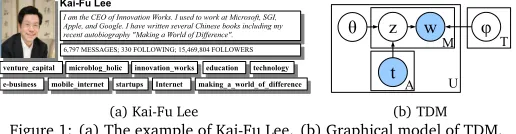
In order to better model user profile and provide high-quality personalized services, many microblog services (e.g., Sina Weibo) allow a user to annotate itself with several tags, which may either describe their interests or attributes. As shown in Fig. 1a, we take Kai-Fu Lee as an example, who is the CEO of Innovation Works and also a famous IT activist. Lee describes himself with several short sentences under his name and also assigns ten tags for himself.
(a) Kai-Fu Lee (b) TDM
Figure 1: (a) The example of Kai-Fu Lee. (b) Graphical model of TDM.
In order to collect more accurate tags, many Web services provide tag suggestion to help users annotate. Many studies have been done to suggest tags for products such as books, movies and restaurants (Jaschke et al., 2008; Rendle et al., 2009; Iwata et al., 2009; Si et al., 2010; Liu et al., 2011). However, it is still rarely explored to suggest tags for mi-croblog users. Due to the huge gap between the hidden attributes/interests of microblog users and their tags, it is non-trivial to build an efficient tag suggestion system. In this paper, we focus on this problem and propose a framework for efficient user tag suggestion. Microblog services contain rich information of users, which can be roughly divided into two major types: (1)Text Information. A microblog user may fill a short description about itself and also post many messages. Both of them reveal the attributes or interests of the user (Liu et al., 2012). (2)Network Information. A user may follow other users that it is interested in, and can also be followed by other users. Following-behaviors form a social network of microblog users. The neighborhood of a user in this social network also indicates the interests of the user (McPherson et al., 2001). It is intuitive to suggest tags for a user by comprehensively considering both text and network information of the user. The idea of incorporating text and network information has been explored in many tasks such as news recommendation (De Francisci Morales et al., 2012).
[image:2.420.75.333.207.274.2]TDM (NTDM). In NTDM, the distributions of user tags are smoothed all over social network. When given a new user, NTDM will suggest tags based on its text and neighbors.
2 The Framework
In this section, we present Network-Regularized Tag Dispatch Model as our framework for user tag suggestion. The data to be analyzed is a set of microblog users with their text and network information. Without loss of generality, we use the description of a user as text information, and use the following-relation to build the network. We now formally give some related concepts.
Suppose we have a set of microblog usersU. Each useru∈Uprovides a short description du, which can be represented as a sequence of wordsx1,x2, . . . ,xNu, whereNuis the number
of words in the description, and each word tokenxiis from a fixed word vocabularyW, i.e., xi=w∈W. Following the assumption of bag-of-words,duis represented asxu={xi}iM=u1, whereMuis the number of unique words that occur in the description, and we usec(du,w) to represent the number of times that wordwoccurs in the description. Microblog users also form a social network according to their following-behaviors. We denote the network asGU= (U,E), whereUdenotes the network nodes (i.e., microblog users) andEdenotes the network edges. We denote the weight of an edge(ui,uj)ase(ui,uj). We define the weights of all edges inEare equal. A microblog user may annotate itself with some tags. For a useru, we denote the annotated tags asau={zi}Ai=u1, whereAuis the number of tags inauand each tag tokenziis from a fixed tag vocabularyT, i.e.,zi=t∈T.
The task of user tag suggestion is formalized as follows. Given a useruwith no anno-tated tags, we have to find a set of tagsauto maximize Pr(au|u,xu,G). Under independent assumption of tags, we have arg maxauPr(au|u,xu,G) =arg maxau
Q
t∈auPr(t|u,xu,G).
Sup-pose the number of suggested tagsAuis pre-defined, the task becomes a problem of ranking tags according to Pr(t|u,xu,G), and select top-Auones as user tags.
2.1 Tag Dispatch Model (TDM)
Tag Dispatch Model (TDM) is a probabilistic graphical model. Like Probabilistic Latent Se-mantic Analysis (PLSA) (Hofmann, 1999) and Latent Dirichlet Allocation (LDA) (Blei et al., 2003), TDM models each user description as a distribution over tags and generates each word from a tag. Hence, TDM is different from PLSA and LDA in the following two aspects. (1) TDM considers each tag as anexplicittopic. In other words, TDM models withexplicit tagsrather than latent topics. TDM incorporates user-annotated tags by regarding each word in user descriptions as generated from a tag. This is similar to the setting of Labeled LDA (Ramage et al., 2009). (2) When learning the mixture of tags for the description of a user, TDM constrains the distribution only having values on those tags that have been annotated by the user.
restricted to its annotated tags, we set Pr(t|u,au) =0 for all t ∈/ au. In other words,
P
t∈auPr(t|u,au) =1. The log likelihood of generating a collectionDUin TDM is formalized
asL(DU) =
P
du∈DU P
w∈xuc(xu,w) P
t∈TPr(w|t)Pr(t|u,au). In TDM, the parameters areθ andφ, whereθtu=Pr(t|u,au)andφwt =Pr(w|t). Since eachdubelongs to a useru, we also say Pr(t|u) =Pr(t|u,au), which indicates the probabilistic distribution over tags given a user.
The parameters of TDM (i.e.,θandφ) can be estimated using the Expectation Maximiza-tion (EM) algorithm (Dempster et al., 1977). EM algorithm will iteratively computes a local maximum ofL(DU). In the E-step of(p+1)th iteration of TDM, the posterior probabilities of latent variables (i.e., the distribution over tags on eachzicorresponding to wordxi=w inxuwithau) are calculated according to the parameters estimated in thepth iteration (i.e., θ(p)andφ(p)) as follows,
Pr(zi=t|xi=w,u,au) =
Pr(p)(w|t)Pr(p)(t|u,a u)
P
t∈auPr(
p)(w|t)Pr(p)(t|u,au). (1)
Following the common practice as shown in PLSA (Hofmann, 1999), we obtain the update equations for the M-step of the(p+1)th iteration in TDM as follows:
φ(p+1)
wt =Pr(p+1)(w|t) =
P
u∈Uc(xu,w)Pr(t|w,u,au) +β
P
w∈W
P
u∈Uc(xu,w)Pr(t|w,u,au) +|W|β
, (2)
θ(p+1)
tu =Pr(p+1)(t|u,au) =
P
w∈Wc(xu,w)Pr(t|w,u,au) +α
P
t∈au P
w∈Wc(xu,w)Pr(t|w,u,au) +Auα
. (3)
In Equation (2) and Equation (3), we follow the comparative analysis of latent Dirichlet allocation (Blei et al., 2003), and introduce hyper-parametersαandβto avoid over-fitting. In this paper, we setα=50/|T|andβ=0.01. EM algorithm of TDM will run iteratively until a termination condition is satisfied.
After estimating parametersθ andφof TDM, we can suggest tags for a new microblog useruwith descriptionxuas follows. Suppose all tags inTare candidates for this user. We perform EM algorithm to estimate Pr(t|u,xu)while keeping Pr(t|w)fixed. Then we rank candidate tags according to Pr(t|u,xu)and select top-Auas suggested tags.
We havec(xu,w)in Equation (2) and (3), which indicates the importance ofwinxu. In practice, a word that occurs frequently doest not indicate it is important. In this paper, we estimate the importance of a wordwinxuusing term frequency and inverse user frequency (TFIUF) as follows:
Pr(w|xu) =
c(xu,w)
P
w∈xuc(xu,w)
×log |U|
|{w∈xu}u∈U|. (4) Here the first part is term frequency of wordwinxu, and the second is the inverse user frequency, where user frequency is the proportion of users who use wordwin their de-scriptions. The idea of TFIUF is similar to term frequency and inverse document frequency (TFIDF) (Salton and Buckley, 1988) which is widely adopted in information retrieval.
2.2 Network-Regularized Tag Dispatch Model (NTDM)
share more interests and attributes, and thus should have similar tag distributions, i.e., for a connected user pair(u,v)∈E, Pr(t|u,au)is similar to Pr(t|v,av).
Formally, given a collection of microblog users U with their descriptions DU and so-cial networkGU, we define the regularized likelihood as L(DU,GU) = (1−α)L(DU)− αR(DU,GU), where L(DU) is the log likelihood of generating user descriptions, and R(DU,GU) is a harmonic regularizer defined on the social network GU. Similar to graph harmonic function (Zhu et al., 2003), we define R(DU,GU) as R(DU,GU) =
1 2
P
(u,v)∈Ee(u,v)
P
t∈T Pr(t|u,au)−Pr(t|v,av)
2
, wheree(u,v)is the weight of edge(u,v), andαis the harmonic factor ranging from 0 to 1. SinceL(DU)indicates the probability that user descriptions are generated from the model, we can maximizeL(DU)to find optimal model parameters (i.e.,θandφ) with respect to user descriptions.R(DU,GU)indicates the weighted average distance in terms of tag distributions between any two connected users in the social network. We maximize−R(DU,GU)(i.e., minimizingR(DU,GU)) to smooth the tag distributions over the social network, i.e., the neighbored users will tend to share similar tag distributions. The harmonic factorαcontrols trade-off between data likelihood and reg-ularization. Whenα=0, the regularized likelihood will be the same to TDM. Whenα=1, the regularized likelihood will only consider the network structure, which likes clustering based on network structure.
We will also use EM algorithms to estimate parameters of NTDM. We can see that NTDM and TDM share the same latent variables, i.e., tag distribution conditional over a word in user description Pr(t|w,u,au). We can also use Equation (1) to compute the latent variables for NTDM. The M-step in NTDM is more complicated than that in TDM due to the harmonic regularization. The estimation of Pr(w|t)does not have relations to regularization. Hence we can updateφwt=Pr(w|t)in the same way as in Equation (2). Sinceθis involved in the regularizer, we do not have a closed form solution to updateθ. As proposed in (Mei et al., 2008; Cai et al., 2008), we can iteratively update and obtain
Pr(p+1)
i+1 (t|u,au) = (1−λ)Pr(ip+1)(t|u,au) +λ
P
(v,u)∈Ee(v,u)Pri(p+1)(t|v,av)
P
(v,u)∈Ee(v,u)
, (5)
wherei is the number of the inner iterations, andλis a damping factor ranging from 0 to 1. Whenλ=0, NTDM becomes into TDM without considering network structure. Whenλ=1, it indicates that the new tag distribution ofuis the average of the old tag distributions of its neighbors. In experiments, we setλ=0.15 which follows most settings in random walks (Langville and Meyer, 2004). The iterative random walks with Equation (5) will make the tag distributions smoother over the microblog social network. In practice, not all users in the dataset have annotated themselves with tags. For a useruthat has not annotated itself with tags, we setau=T. In Equation (5) of NTDM, we set Pri+1(p+1)(t|u,au) = 0 ift∈/au. This will avoid tag drift during iteration.
2.3 User Tag Suggestion based on NTDM
Given a useruwith its descriptionxu, NTDM suggests tags as follows. Ifubelongs to the dataset (i.e.,u∈U), we have obtained its tag distribution with Equation (5) with learning of NTDM, and can suggest top-ranked tags according to Pr(p+1)(t|u,au).
ways: (1) We use EM algorithm to estimate the tag distribution ofubased on user descrip-tionxuand NTDM parametersφ. The difference is in the process we do not necessarily modifyφand just updateθu. We denote the text-based tag distribution as PrT(t|u,au). (2) We estimate the tag distribution ofubased on its neighbors. We assume that all neigh-bors ofubelong toU, and denote the set of neighbors asUu. We estimate the tag distri-bution as Pr(t|u,au) =
P
v∈Uue(v,u)Pr(t|v,av)/ P
v∈Uue(v,u), where Pr(t|v,av)is the tag
distribution ofv∈Uestimated in NTDM. We denote the network-based tag distribution as PrN(t|u,au). Finally, we integrate the text-based and network-based tag distribution to-gether with smoothing factorλ: Pr(t|u,au) = (1−λ)PrT(t|u,au) +λPrN(t|u,au). Similar to Equation (5), we also setλ=0.15.
3 Experiments
We crawled 2 million users from Sina Weibo for experiments. These users are all active and post messages frequently. In order to better demonstrate the effectiveness of our method, from these users we select 341, 353 users who have both descriptions and tags as the dataset. We further divide the dataset by randomly selecting 10, 000 users as test set and the rest users as training set. We use precision/recall for evaluation. For a user, we denote the original tags (gold standard) asTa, the suggested tags asTs, and the correctly suggested tags asTs∩Ta. Then, precision and recall are defined asp= (Ts∩Ta)/Tsandr= (Ts∩Ta)/Ta.
3.1 Evaluation on User Tag Suggestion
To evaluate the performance of NTDM for social tag suggestion, we select two major types of baseline methods for comparison: context-based methods which suggest tags relying on user descriptions, and network-based methods which suggest tags according to the neigh-borhood information of users.
Text-Based Methods. There are many text-based methods proposed for social tag sug-gestion. In this paper, we use the following text-based methods as baselines. (1)Feature Driven Methods. We regard user tag suggestion as a multi-label classification task, and use feature driven methods to train classifiers. In these methods, the probability of a useru be-ing annotated with tagtis computed as Pr(t|u) =Pw∈xuPr(t|w)Pr(w|xu). We use TFIUF
build semantic relations between words and tags.
Network-Based Methods.Network-based methods consider the network structure for so-cial tag suggestion. The basic idea is that a tag will be suggested to a user if the tag is widely annotated by the neighbors of the user. Similar to text-based methods, we use the tags annotated by neighbors as features to build feature-driven classifiers. We formalize the probability oftgiven a useruas Pr(t|u) =Ps∈TPr(s|t)Pr(s|Uu), whereUuis the neigh-bors ofu, Pr(s|Uu)is the importance of a tagsin neighbors ofu, and Pr(s|t)indicates the probability ofsgivent. In this equation, Pr(s|Uu)is estimated as Pr(s|Uu) = (|Utu|)/(|Uu|), where|Utu|is the number of neighbors that annotate tags, and|Uu|is the total number of neighbors. Pr(s|t)can be measured using either PMI or NGD. In experiments, we denote the two methods as PMI-N and NGD-N, respectively.
Hybrid Methods. We can also take text features and network features together and use NB, PMI and NGD as classifiers. Under the assumption of naive Bayes, it is straight-forward to combine the two types of features as Pr(t|u) = Pw∈xuPr(t|w)Pr(w|xu) + P
s∈TPr(t|s)Pr(s|Uu). In hybrid methods, we can also use either PMI or NGD. Hence, in experiments, we denote the two hybrid methods as PMI-H and NGD-H.
3.1.1 Evaluation Results and Analysis
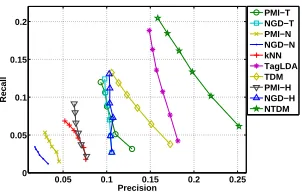
In Figure 2 we show the precision-recall curves of various baseline methods and NTDM on test set. Each point of a precision-recall curve represents different numbers of suggested tags fromM=1 (bottom right, with higher precision and lower recall) toM=6 (upper left, with higher recall but lower precision) respectively. The closer the curve to the upper right, the better the overall performance of the method. Hence, in experiments we focus on evaluating the performance whenM≤6 since the average number of tags per user in the dataset is 6.0.
0.05 0.1 0.15 0.2 0.25 0
0.05 0.1 0.15 0.2
Precision
Recall
[image:7.420.142.293.337.435.2]PMI−T NGD−T PMI−N NGD−N kNN TagLDA TDM PMI−H NGD−H NTDM
Figure 2: Evaluation results when suggesting tags fromM=1 toM=6.
take network structure into consideration. (2) PMI-H and NGD-H perform poor compared to NTDM. Both methods are even worse than PMI-T and NGD-T. This suggests that naive hybrid of text and network information will not eventually lead to better results. Essentially, we have to find a smart way to combine the two types of information. This is what NTDM is proposed to do, and the experiment results demonstrate its effectiveness.
3.1.2 Case Studies
In Table 1 we show top words ranked by Pr(w|t)for several tags of Kai-Fu Lee. We observe that NTDM can sufficiently capture the semantic relations between words and tags, while TDM introduces noise. For example, in TDM the top words “optimization”, “factory” and “Jinan” of the tag “e-business” are, to some extent, not tightly correlated with the tag.
Tag Top Words Ranked by Pr(w|t)
venture_capital venture_capital, VC, early_stage, copartner, minor_enterprises education parents, children, coaching, normal_university, admission e-business B2C, supply, Alibaba, supermarket, B2B
mobile_Internet Internet, terminal, LBS, summit, android
Table 1: Top words ranked by Pr(w|t)for some tags of Kai-Fu Lee.
With accurate semantic relations, NTDM suggests better tags for microblog users. Take Kai-Fu Lee for example, top-5 tags suggested by NTDM are “startups”,“Internet”, “Google”, “e-business” and “mobile_Internet”. In this list, although “Google” is not annotated by Lee, it reflects the fact that Lee used to work as President of Google China from 2005 to 2009. Meanwhile, TDM suggests “Google”, “Apple”, “startups”, “photographing” and “post_80s”; TagLDA suggests “post_80s”, “Internet”, “music”, “movie” and “travel”. We have the follow-ing observations: (1) TagLDA tends to suggest common tags irrelevant to the user. This is the common issue shared by latent topic models, which project both descriptions and tags into topic space for measuring relatedness and suffer from the over-generalization problem. (2) The last two tags suggested by TDM are roughly not correlated to Lee, which is a natural consequence of not considering network structure for regularization.
Conclusion and Future Work
This paper presents NTDM for microblog user tag suggestion. NTDM models the semantic relations between words and tags, as well as taking social network structure as regular-ization. Experiments on the real-world dataset demonstrate that NTDM is sufficient to combine the text information and network information of users for user tag suggestion. We design the following research plans. (1) NTDM considers edge weights of all connected users being equal for simplicity. In future, we plan to incorporate more microblog informa-tion to estimate edge weights, and further make the network regularizainforma-tion more accurate. (2) This paper does not take user posts into consideration. We plan to model more complex text and network information for user tag suggestion.
Acknowledgments
References
Blei, D., Ng, A., and Jordan, M. (2003). Latent dirichlet allocation.JMLR, 3:993–1022. Cai, D., Mei, Q., Han, J., and Zhai, C. (2008). Modeling hidden topics on document manifold. InProceedings of CIKM, pages 911–920.
Cilibrasi, R. and Vitanyi, P. (2007). The google similarity distance. IEEE Transactions on Knowledge and Data Engineering, 19(3):370–383.
De Francisci Morales, G., Gionis, A., and Lucchese, C. (2012). From chatter to headlines: harnessing the real-time web for personalized news recommendation. InProceedings of WSDM, pages 153–162.
Dempster, A., Laird, N., Rubin, D., et al. (1977). Maximum likelihood from incomplete data via the em algorithm.Journal of the Royal Statistical Society. Series B (Methodological), 39(1):1–38.
Hofmann, T. (1999). Probabilistic latent semantic indexing. InProceedings of SIGIR, pages 50–57.
Iwata, T., Yamada, T., and Ueda, N. (2009). Modeling social annotation data with content relevance using a topic model. InProceedings of NIPS, pages 835–843.
Jaschke, R., Marinho, L., Hotho, A., Schmidt-Thieme, L., and Stumme, G. (2008). Tag recommendations in social bookmarking systems.AI Communications, 21(4):231–247. Java, A., Song, X., Finin, T., and Tseng, B. (2007). Why we twitter: understanding mi-croblogging usage and communities. InProceedings of the 9th WebKDD and 1st SNA-KDD 2007 workshop on Web mining and social network analysis, pages 56–65.
Krestel, R., Fankhauser, P., and Nejdl, W. (2009). Latent dirichlet allocation for tag recom-mendation. InProceedings of ACM RecSys, pages 61–68.
Langville, A. and Meyer, C. (2004). Deeper inside pagerank. Internet Mathematics, 1(3):335–380.
Li, X., Snoek, C., and Worring, M. (2009). Learning social tag relevance by neighbor voting.IEEE Transactions on Multimedia, 11(7):1310–1322.
Lin, D. (1998). An information-theoretic definition of similarity. InProceedings of ICML, pages 296–304.
Liu, Z., Chen, X., and Sun, M. (2011). A simple word trigger method for social tag sugges-tion. InProceedings of EMNLP, pages 1577–1588.
Liu, Z., Chen, X., and Sun, M. (2012). Mining the interests of chinese microbloggers via keyword extraction.Frontiers of Computer Science, 6(1):76–87.
McPherson, M., Smith-Lovin, L., and Cook, J. (2001). Birds of a feather: Homophily in social networks.Annual review of sociology, pages 415–444.
Mishne, G. (2006). Autotag: a collaborative approach to automated tag assignment for weblog posts. InProceedings of WWW, pages 953–954.
Ramage, D., Hall, D., Nallapati, R., and Manning, C. (2009). Labeled lda: A supervised topic model for credit attribution in multi-labeled corpora. InProceedings of EMNLP, pages 248–256.
Rendle, S., Balby Marinho, L., Nanopoulos, A., and Schmidt-Thieme, L. (2009). Learning optimal ranking with tensor factorization for tag recommendation. InProceedings of KDD, pages 727–736.
Salton, G. and Buckley, C. (1988). Term-weighting approaches in automatic text retrieval. Information processing and management, 24(5):513–523.
Si, X., Liu, Z., and Sun, M. (2010). Modeling social annotations via latent reason identifi-cation.IEEE Intelligent Systems, 25(6):42 – 49.
Si, X. and Sun, M. (2009). Tag-LDA for scalable real-time tag recommendation. Journal of Computational Information Systems, 6(1):23–31.