Cascading Multiway Attention for Document-level Sentiment
Classification
Dehong Ma, Sujian Li, Xiaodong Zhang, Houfeng Wang, Xu Sun
MOE Key Lab of Computational Linguistics, Peking University, Beijing 100871, China {madehong, lisujian, zxdcs, wanghf, xusun}@pku.edu.cn
Abstract
Document-level sentiment classification aims to assign the user reviews a sentiment polarity. Previous methods either just uti-lized the document content without con-sideration of user and product information, or did not comprehensively consider what roles the three kinds of information play in text modeling. In this paper, to reasonably use all the information, we present the idea that user, product and their combination can all influence the generation of atten-tion to words and sentences, when judg-ing the sentiment of a document. With this idea, we propose a cascading multiway attention (CMA) model, where multiple ways of using user and product informa-tion are cascaded to influence the genera-tion of attengenera-tion on the word and sentence layers. Then, sentences and documents are well modeled by multiple representa-tion vectors, which provide rich informa-tion for sentiment classificainforma-tion. Experi-ments on IMDB and Yelp datasets demon-strate the effectiveness of our model.
1 Introduction
Document-level sentiment classification aims to predict an overall sentiment polarity (e.g., 1-5 stars or 1-10 stars) for a user review document. This task recently draws increasing research concerns and is helpful to many downstream applications, such as user and product recommendation.
Early work focuses on traditional machine learning associated with handcraft text features for
sentiment classification (Pang et al., 2002; Ding
et al., 2008; Taboada et al., 2011). With the
development of deep learning techniques, some researchers design neural networks to
automati-cally learn features from document content and
achieve comparable performance (Glorot et al.,
2011; Kalchbrenner et al., 2014; Yang et al.,
2016), though they ignore the use of user and
product information. Almost at the same time, deep learning techniques exhibit another advan-tage that product and user information can be flex-ibly modeled with document content for
senti-ment classification (Tang et al.,2015a;Chen et al.,
2016). Tang et al.(2015a) design user and
prod-uct preference matrices to tune word representa-tions, based on which convolutional neural net-works (CNNs) are used to model the whole doc-ument. To avoid the high-cost preference
ma-trix,Chen et al.(2016) develop the two-layer (i.e.,
word and sentence layers) model, where the com-bination of user and product information is used to generate attention to words and sentences respec-tively on each layer.
Though previous studies achieve improvements in synthesizing text, user and product for senti-ment classification, they are somewhat limited to either of the following two aspects. First, when considering user and product information, previ-ous work mostly models their combination which may cause adverse effects on sentiment classifi-cation. As we can see, user and product infor-mation also have their own influence on sentence and document representations. For example, a lenient user tends to focus on the good aspects, while a picky user is always concerned about un-satisfactory clues, no matter which product is re-viewed. In another view, different products have their own concerns. For example, a car is closely related with fuel consumption while a hotel with bed or food, which are relatively independent of users. Second, in previous hierarchical modeling method, different layers are usually treated with similar means. In our opinion, different linguistic units (e.g., words and sentences) should be given
different treatment to achieve good performance. As we can see, words are closely related with each other and sentences are relatively independent in reflecting their sentimental polarity. Take a
restau-rant review for example, the review “Its dinner
environment is good. But the pizza is not worth the money!” is comprised of two sentences. For this review, a user who values environment may mark 5 stars, while a user who thinks highly of food may mark 1 star. Thus, we can not simply combine the two sentences together in judging its sentiment polarity. It is better to model each sen-tence independently before knowing the users’ or products’ attention.
To address the two issues above, we propose to comprehensively make use of the information of user, product, and their combination to generate attention on the word and sentence layers, and fur-ther cascade the multiple ways of attention on the generation of sentence and document representa-tions. Here, we name our proposed model the cas-cading multiway attention (CMA) model. Specif-ically, each sentence is first represented with mul-tiple representation vectors through using differ-ent ways of attdiffer-ention to focus on the important part. Next, the similar multiple ways of generat-ing attention are applied on the sentence level and used to tune the generation of document represen-tations. In such a case, document representation is not simply treated as a sequence of sentences, but considers more about the influence of user and product information. Finally, we can get a well modeled document representation for sentiment classification. Experiments on three real-world datasets demonstrate that CMA achieves state-of-the-art performance and fully considers the contri-butions from user and product information.
2 Cascading Multiway Attention Model for Sentiment Classification
In this section, we first give an overview of the cas-cading multiway attention (CMA) model for sen-timent classification. Then, we focus on introduc-ing how to design multiway attention for modelintroduc-ing sentences and documents through using user and product information. Next, we show the training details of CMA.
2.1 Model Overview
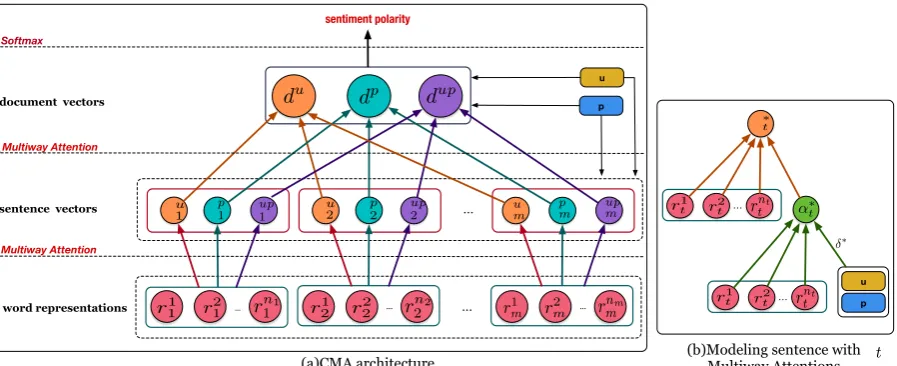
Figure1(a) shows the overall architecture of our
CMA model, which is mainly composed of four
levels including word level, sentence level, docu-ment level, classification level. With word embed-dings as input, we can employ convolutional neu-ral networks or recurrent neuneu-ral networks to obtain deeper semantic of words on the word level. On the sentence level, we design the multiway atten-tion networks to generate attenatten-tion to words from three different views and get three representation vectors to represent a sentence. On the document level, we keep generating multiple kinds of atten-tion to sentences and get the document representa-tion, which is fed into a softmax function for clas-sification.
Specifically, let us first formalize the
nota-tion. We suppose that a document contains m
sentences{S1, S2, ..., Sm} whose lengths are set
n1, n2, ..., nm respectively. For SentenceSt(1 ≤
t ≤ m), it is composed of a sequence of
wordsw1
t, w2t,· · · , wntt wherewjt denotes a
spe-cific word. To represent a word, we embed each word into a low dimensional real-value vector,
called word embedding (Bengio et al.,2003).
Then, we can getwjt ∈ RdfromMv×d, where
t is the sentence index in a document, j denotes
the word index in sentence t, d means the
em-bedding dimension and v gives the vocabulary
size. Word embeddings can be regarded as pa-rameters of neural networks or pre-trained from
proper corpus via language model (Collobert and
Weston, 2008; Mnih and Hinton, 2007;Mikolov
et al.,2010;Huang et al.,2012). In our model, we
choose the second strategy.
Next, deeper word semantics representations can be learned by using the neural network mod-els, such as convolutional neural networks (CNN) or recurrent neural networks (RNN). In this paper, the LSTM model is employed to obtain the word representation, since it has the good performance of learning the long-term dependencies and can well model the dependence between words.
For-mally, for sentenceSt, we input its word
embed-dings w1
t, w2t, ..., wtnt to the LSTM networks and
get the final word representationsr1
t, r2t, ..., rntt .
With deeper word representations as input, we adopt the attention mechanism to model sentences.
As Section 1 stated, we consider the influence
from three views: user (δu), product (δp), and
combination of user and product (δup), which can
represen-Multiway Attention
(a)CMA architecture (b)Modeling sentence with Multiway Attentions
u
Figure 1: Overall Architecture of CMA.
tation vectors for each sentence. Formally,
sen-tence St is represented by the concatenation of
three vectors su
t,spt,supt . On the document level,
we still useδu,δpandδuprespectively to generate
attention to sentences and get three vectorsdu,dp,
dup for representing the document. The concrete
design is introduced in the next subsection.
Finally, the three vectors du, dp, dup are
con-catenated to a vectord for a classifier. Here, we
use a non-linear layer to projectd into the space
of the targetedCclasses. That is,
x=tanh(Wl·d+bl) (1)
where Wl and bl are the weight matrix and bias
respectively. The probability of labeling document
with sentiment polarityi(i ∈ [1, C])is computed
by:
yi= PCexp(xi)
i=1exp(xi) (2)
The label with highest probability is set as the final result.
2.2 Cascading Multiway Attention
Now, we detail how to model user and product information and cascade their influence on repre-senting sentences and documents.
As stated in Section 1, the meaning of a
sen-tence has different interpretations from different views including user, product and their combina-tion, under which words may be paid different at-tention on. With consideration of each view, only some specific parts are focused on. And differ-ent views have their own focuses which contribute
to sentiment classification. Thus, we propose the multiway attention mechanism to capture sentence focuses with repsect to different views.
Specifically, in our model, we represent each user and each product with a representation vec-tor which is learned from the model, notated with
uandphere. To consider the influence from user
and product, we formalize user view, product view and their combination view respectively as:
δu=W
for tuning the influence ofuandp.
We take sentence St for example to describe
the sentence modeling process, as shown in
Fig-ure1(b). With word representationsr1
t, rt2, ..., rtnt,
we can generate three attention vectors usingδu,
δp andδup respectively. For convenience we use
δ∗ to denote δu, δp or δup. Then, the attention
mechanism generates the attention vectorα∗
t with
respect toδ∗. Thejthdimension[α∗
t]jdenotes the
attention weight of thejthwordrj
t.
whereγ is a score function that measures the
im-portance ofrjt in the sentence. The score function
γis defined as:
whereWH andbs are weight matrix and bias
re-spectively, and vT is the transpose of the weight
vectorv.
After computing the word attention weights, we
can get sentence representationss∗
t using different
Then, we get a multi-vector sentence
representa-tion:[su
t,spt,supt ]for sentenceStfrom three views.
On the sentence level, we apply the similar mul-tiway attention strategy to get the document repre-sentation. Unlike the word level, each sentence is relatively independent of other sentences and takes its own part in determining the document sentiment. Thus, we ignore modeling the depen-dence between sentences and directly use the sen-tence representations derived from the word level. As we see, from different views each sentence plays a different role, and from a specific view all the sentences should be paid different attention, in document-level sentiment classification. Here, we still consider the influence from user, prod-uct and their combination, and get the
correspond-ing document representationdu,dp,dup, whered∗
tis the sentence representation of sentence
Stwith respect toδ∗. βt∗ denotes the
correspond-ing attention weight ofSton the view ofδ∗, and
theγ function is the same as in Eq. (7).
2.3 Model Training
In CMA, we need to optimize all the parameters
notated asΘwhich are from all the user and
prod-uct embedding vectors, LSTM networks, two mul-tiway attention layers and the softmax layer.
We use cross entropy with L2regularization as
the loss function, which is defined as:
J =−XC
where gi ∈ RC denotes the ground truth,
repre-sented by one-hot vector.yi ∈RCis the estimated
probability for each class, computed as in Eq. (2).
λris the coefficient forL2regularization.
After learningΘ, we test the instances by
feed-ing their text with user and product information into CMA, and the label with the highest proba-bility stands for the predicted sentiment polarity.
3 Experiments
In this section, we first introduce the datasets and metrics used in our experiments. Then, we show the hyperparameter setting of our model. Next, we present the results of our model and compare our model with other state-of-the-art methods. Finally, we use a case study to examine the experimental results of CMA.
Datasets
To validate the effectiveness of our model, we use three real-world datasets: IMDB, Yelp 2013 and
Yelp 2014 collected byTang et al. (2015b). For
these data, we preprocess the text including
us-ing Stanford CoreNLP (Manning et al., 2014) to
split the review documents into sentences and
to-kenizing all words. Table1 shows the details of
the three datasets including number of documents (#docs), average number of documents per user posts(#docs/user) etc. It is also noted that IMDB is rated with 10 sentiment labels (i.e., 1-10 stars) while Yelp has 5 labels (i.e., 1-5 stars). We also
adopt the same data partition used in (Tang et al.,
2015b) and (Chen et al.,2016) for training,
devel-oping and test. Evaluation Metrics
To evaluate the performance of sentiment
classi-fication, we adopt the metrics of Accuracy and
RMSE. Accuracy measures the overall perfor-mance. Given the number of correctly predicted
samples T and the total number of samples N,
Accuracyis defined as:
Acc= T
N. (12)
RMSE evaluates the divergence between
pre-dicted labels and ground truth labels and is defined as:
RMSE =
qPN
k=1(lk−lk0)2
N (13)
wherelk andl0k denote the ground truth and
pre-dicted label of samplekrespectively. Generally, a
Dataset #docs #users #products #docs/user #docs/product #sents/doc #words/doc #labels
IMDB 84919 1310 1635 64.82 51.94 16.08 24.54 10
Yelp2013 78966 1631 1633 48.42 48.36 10.89 17.38 5
Yelp2014 231163 4818 4194 47.97 55.11 11.41 17.26 5
Table 1: Data Statistics of IMDB, Yelp2013 and Yelp 2014.
Hyperparameter Setting
Following (Chen et al., 2016) and (Tang et al.,
2015b), we set the dimensions of word, user and
product embeddings as 200 in our experiments. We train the word embeddings through using the training and developing sets of each dataset with
word2vec tool (Mikolov et al., 2013). The user
and product embeddings are initialized randomly. All the weight matrices are initialized by uniform distribution, and all biases are assigned as zero. We also set the dimensions of the LSTM hidden states and attention vectors as 200.
To train our model, we utilize AdaDelta (Zeiler,
2012), which adopts a self-adaptive learning rate,
to optimize the parameters. The coefficient of
penalty in the objective function is set to10−5.
3.1 Method Comparison
To comprehensively evaluate the performance of
CMA, we list some baseline methods for
compari-son. The baselines are introduced as follows. •Majorityassigns the largest sentiment polar-ity occurred in the training set to each sample in the test set.
•Trigramuses the unigrams, bigrams and tri-grams features to train a SVM classifier for senti-ment classification.
•TextFeatureextracts word/character ngrams, sentiment lexicon features, negation features, etc. for a SVM classifier.
•UPFextracts user-leniency features and
prod-uct features from training data (Gao et al.,2013).
There features can be concatenated with the
fea-tures ofTrigramandTextFeature.
•AvgWordvec averages the word embeddings in a document to generate the document represen-tation as features for a SVM classifier.
• SSWE first learns the sentiment-specific
word embeddings and then utilizes three kinds of pooling (i.e., max, min and average) to generate the document representation for a SVM
classi-fier (Tang et al.,2014).
• PV(Paragraph Vector) is an unsupervised framework to learn distributed representations for
text of any length (Le and Mikolov,2014). (Tang
et al.,2015a) implements the distributed memory
model of paragraph vectors (PV-DM) to get docu-ment representations for sentidocu-ment classification.
•RNTN+RNN models sentences using
recur-sive neural tensor networks (RNTN) (Socher et al.,
2013). Then sentence representations are fed into
the recurrent neural networks (RNN) and their hid-den states are averaged to get the document repre-sentation.
•UPNN designs preference matrices for each
user and product to modify word representations
(Tang et al.,2015b). Word representations are then
fed into the convolution neural networks (CNNs) and concatenated with the user/product represen-tation to generate document represenrepresen-tation before a softmax layer. Without considering user and
product information, the UPNN(noUP) method
just uses CNN to model the documents.
• NSC+UPA proposes the hierarchical neu-ral networks which are composed of two LSTM models to generate word and sentence
representa-tions (Chen et al.,2016). The combination of user
and product information is used to generate atten-tion to words and sentences on the sentence and document levels. The document representation is
fed into a softmax layer. TheNSCmodel is similar
toNSC+UPA, but ignores user and product infor-mation and directly applies two layers of LSTM and attention mechanism to model sentences and documents using only document content.
When comparing with our model, we directly use the results of the above baselines reported in
(Chen et al.,2016), as we conduct the experiments
on the same datasets.
• CA-nullis a simplified version of our CMA model without consideration of user and product information. We use one LSTM with attention to model sentences. Based on the sentence represen-tations, we directly use the attention mechanism to model documents for sentiment classification.
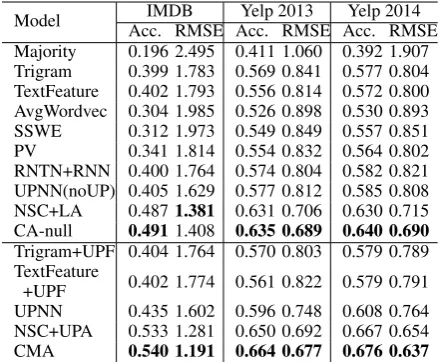
The performance comparison of CMA and all
baselines are shown in Table2. All the baseline
Model Acc. RMSE Acc. RMSE Acc. RMSEIMDB Yelp 2013 Yelp 2014 Majority 0.196 2.495 0.411 1.060 0.392 1.907 Trigram 0.399 1.783 0.569 0.841 0.577 0.804 TextFeature 0.402 1.793 0.556 0.814 0.572 0.800 AvgWordvec 0.304 1.985 0.526 0.898 0.530 0.893 SSWE 0.312 1.973 0.549 0.849 0.557 0.851 PV 0.341 1.814 0.554 0.832 0.564 0.802 RNTN+RNN 0.400 1.764 0.574 0.804 0.582 0.821 UPNN(noUP) 0.405 1.629 0.577 0.812 0.585 0.808 NSC+LA 0.4871.381 0.631 0.706 0.630 0.715 CA-null 0.4911.408 0.635 0.689 0.640 0.690
Trigram+UPF 0.404 1.764 0.570 0.803 0.579 0.789 TextFeature
+UPF 0.402 1.774 0.561 0.822 0.579 0.791 UPNN 0.435 1.602 0.596 0.748 0.608 0.764 NSC+UPA 0.533 1.281 0.650 0.692 0.667 0.654
CMA 0.540 1.191 0.664 0.677 0.676 0.637
Table 2: Methods Comparison on IMDB, Yelp 2013 and Yelp 2014 Datasets.
product information.
In the first category of methods, the Majority
method is the worst, meaning the majority senti-ment polarity occupies 19.2%, 42.1% and 39.2% of all samples. All the other methods are
bet-ter than the Majoritymethod, showing that
man-ual or automatic features can both bring perfor-mance improvement for sentiment classification. Though techniques of deep neural networks are widely used and have made a success in
docu-ment modeling, its simple application (e.g.,
Ave-Wordvec,PV) does not achieve better results than
using manually selected features (e.g., Trigram,
TextFeature) with respect to the accuracy metric. As for the three kinds of carefully designed neural
networks, the CA-nullandNSC+LAmethods
ex-hibit obvious advantages with high accuracy and
low RMSR, compared to the RNTN+RNN and
UPNN(noUP) methods. The main reason may
be thatCA-null andNSC+LA can learn the
long-distance dependencies with LSTM networks and make full use of the important words and
sen-tences with attention. We can also see that
CA-nulloutperformsNSC+LAregarding the accuracy
on the three datasets. This verifies that we may not consider sentence dependence when model-ing documents for sentiment classification, as the
main difference betweenCA-nullandNSC+LAis
thatCA-nulldoes not apply LSTM to model sen-tences.
From Table 2, we observe that user and
prod-uct information can promote the performance
of sentiment classification. Even the worst
method (TextFeature+UPF) in the second
cate-Model IMDBAcc. RMSE Acc. RMSE Acc. RMSEYelp 2013 Yelp 2014 CA-null 0.491 1.408 0.635 0.689 0.640 0.690 CA-δu 0.513 1.397 0.641 0.688 0.653 0.687 CA-δp 0.508 1.423 0.640 0.694 0.652 0.685 CA-δup 0.520 1.281 0.645 0.684 0.658 0.670 MA-max 0.528 1.314 0.654 0.680 0.663 0.667 MA-avg 0.521 1.341 0.651 0.678 0.662 0.672
CMA 0.540 1.191 0.664 0.677 0.676 0.637
Table 3: Analysis of Cascading and Multiway At-tention.
gory is comparable to the state-of-the-art system (RNTN+RNN) in the first category. For the meth-ods with manually designed features, their perfor-mance improvement is smaller than those methods
with deep learning methods. Both Trigram-UPF
andTextFeature-UPF concatenate more user and product features, but have little improvement
com-pared withTrigram andTextFeature. The reason
may be that the text features are huge (1M trigram) enough and the newly added user and product fea-tures can not work well. Adding user and product
information, CMAoutperformsCA-nullby about
5 percent with respect to the accuracy metric on
IMDB dataset. At the same time, CMAperforms
stably better than NSC+UPA with higher accuracy and lower RMSE on three datasets, with cascad-ing multiway attention on word and sentence lev-els and keeping independency between the sen-tences. This validates that only a combination of user and product information can not boost perfor-mance much and more ways of attention should be explored in text modeling. It is also noted that words need to be modeled with consideration of their dependence while sentences should be inde-pendently modeled.
3.2 Model Analysis
In this section, we design a series of models to
verify the effectiveness of our model CMA. On
one hand, we design three simplified models, i.e.,
CA-δu, CA-δp and CA-δup, which only consider
one-way attention from user, product, combina-tion of user and product respectively when model-ing sentences and documents. On the other hand, we just keep the multiway attention on modeling sentences and directly adopt the maximization or average operation on sentence representations to
model a document, which are namedMA-maxand
MA-avgrespectively. Table 3shows the results of all the models.
worst result compared with other models utilizing user and product information, which indicates that both information is useful for document sentiment.
The performance of CA-δu and CA-δp are worse
than CA-δup, this is because CA-δu and CA-δp
just uses one kind of information (user or product),
but CA-δupuses both information. CMA achieves
a much better result than the ‘CA’ models, which can verify the effectiveness of introducing
mul-tiway attention. We also observe that CA-δu is
slightly better than CA-δp, verifying user
infor-mation plays a more important role than product
information as in (Chen et al.,2016).
As for MA-max and MA-avg, multiway
atten-tion on modeling sentences bring much
perfor-mance improvement compared toCA-null, though
the cascading structure is not adopted. MA-avg
seems to treat each sentence equally while
MA-max tries to seek the most represented sentences
contributing to sentiment classification. We can
see that MA-max performs better than MA-avg,
verifying that sentences should not be treated equally and multiway attention are a good mecha-nism for computing the contributions of each sen-tence to representing a document.
We can also see that CMA achieves the best
performance among all the models, since CMA
fully considers the word importance to a sen-tence and sensen-tence importance to a document via sentence-level and document-level multiway at-tention. Next, we give an example to illustrate the cascading multiway attention captured by CMA. Case Study
Here, we use a five-star review document from
Yelp as a case study, and the document is
“Bis-cuits made from scratch, not frozen. Homemade pancakes with real buttermilk, not from a mix or box. Homemade blueberry jam, no jam or can. True dinner coffee. A group of friendly, engag-ing staff. Five stars... need I say more.”. We
ap-plyCMAon the document and achieve the correct
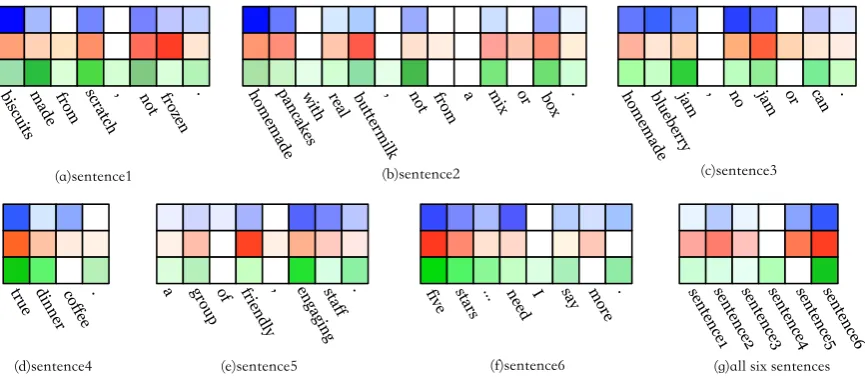
sentiment polarity. Figure 2 visualizes the
mul-tiway attention weights on the sentence and
docu-ment levels computed byCMA. We represent three
ways of attention, i.e., user(δu), product(δp), and
combination of user and product (δup), with blue,
red and green color series respectively. The deeper color means higher weight.
Figure2(a)∼(f) display the three ways of
atten-tion to words for sentence1 ∼ sentence6
respec-tively. We can see that different words are
as-signed high weight values when using different ways of attention. For example, for sentence1, the word “biscuits” is paid more attention from the user view while “frozen” is focused on from the product view and “made” is emphasized con-sidering the combination of user and product. At the same time, an interesting phenomenon is that all the three views pay little attention to some common words like “,” and function words “a” “of”. This conforms to our intuition: some func-tion words and punctuafunc-tion marks contribute little to sentiment classification, but different words are focused on from different views. Thus, multiple ways of using user and product information can well gather information which is helpful to repre-senting a sentence.
Figure2(g) shows the three ways of attention to
sentences for the example document. We can see that the three ways are consistent with focusing on the sixth sentence, which gives high attention weights to the words “five” and “stars” reflecting the sentiment polarity. From the user view, high attention is also paid to sentence5, which includes the obvious sentiment word “friendly”. Hence, we infer that the user may like to express his/her senti-ment to a product with sentisenti-ment word. From the product view, we can see that the document rep-resentation is also closely related to many other sentences such as sentence2 (w.r.t food) and sen-tence5 (w.r.t. staff), which can show different at-tributes of a product.
This case study shows that cascading two layers of multiway attention are necessary to modeling a document in the sentiment classification task.
4 Related work
Document-level sentiment classification methods can be divided into two kinds of research lines, i.e., traditional machine learning methods and neural networks methods.
For the first kind of research line, Pang et al.
(2002) validate the effectiveness of various
ma-chine learning methods with bag-of-words
fea-tures on sentiment classification. Goldberg and
Zhu (2006) use a graph-based semi-supervised
learning algorithm with unlabeled data to predict the sentiment of reviews. There are also some work which focus on extracting effective features.
Ganu et al. (2009) identify user experience
in-formation from free text. Qu et al. (2010)
bis
e stars … need I say more . sentence1sentence2sentence3sentence4sentence5sentence6
1 2 ) ( 1 2 ) ) 1 2 )
1 2 ) 1 2 ) 1 2 ) 1 3 1 2 ) 1
Figure 2: Case Study: Illustration of Attention Weights.
Kiritchenko et al. (2014) extract surface,
seman-tic, and sentiment features from text. User
infor-mation is also used in traditional methods. Tan
et al. (2011) employ social relationships to
im-prove user-level Twitter sentiment analysis. Gao
et al.(2013) estimate the sentiment polarity by
re-ferring to the user leniency and product popularity
computed during testing.Li et al.(2014)
incorpo-rate the user and product information into a topic model for sentiment analysis.
Recently, neural network approaches have achieved a comparable performance on
document-level sentiment classification. Glorot et al.(2011)
first propose a deep learning approach which learns to extract a meaningful representation for each review in an unsupervised fashion. Then,
Socher et al. (2011, 2012, 2013) introduce
re-cursive neural networks to document-level
senti-ment classification. Kim (2014) employ
convo-lutional neural networks to model sentences with two kinds of embeddings for sentiment
classifi-cation. Le and Mikolov (2014) introduce an
un-supervised algorithm that learns fixed-length fea-ture representations from variable-length pieces of
texts.Tai et al.(2015) utilize tree-structured
long-short memory networks to learn semantic repre-sentation for sentiment classification. In addition, user and product information are flexibly modeled for sentiment classification in the neural network
methods (Tang et al., 2015b;Chen et al.,2016).
Tang et al.(2015a) design preference matrices for
each user and each product to tune word represen-tations, based on which convolutional neural net-works (CNNs) are used to model the whole
doc-ument. Chen et al. (2016) employ two layers of
long-short term memory (LSTM) with attention to model sentences and documents.
5 Conclusion
In this paper, we propose the cascading multi-way attention networks for document-level sen-timent classification. The main idea of CMA is to use multiway attention rather than one-way at-tention to learn representations for sentences and documents, as user, product and their combination can provide different views for modeling text and weaken the dependencies between sentences for better depicting the influence from user preference for document sentiment. On the sentence level, CMA uses three ways of exploiting user and prod-uct information to generate attention to words and get sentence representations. On the document level, CMA keeps using the multiway attention mechanism to generate attention to sentences. Ex-perimental results on IMDB, Yelp 2013 and Yelp 2014 verify that CMA can learn efficient represen-tations for sentences and documents and provide rich information for judging the document-level sentiment polarity.
Acknowledgments
this paper are Houfeng Wang & Sujian Li.
References
Yoshua Bengio, R´ejean Ducharme, Pascal Vincent, and Christian Jauvin. 2003. A neural probabilistic lan-guage model. journal of machine learning research, 3(Feb):1137–1155.
Huimin Chen, Maosong Sun, Cunchao Tu, Yankai Lin, and Zhiyuan Liu. 2016. Neural sentiment classifica-tion with user and product attenclassifica-tion. InProceedings of EMNLP.
Ronan Collobert and Jason Weston. 2008. A unified architecture for natural language processing: Deep neural networks with multitask learning. In Pro-ceedings of the 25th international conference on Machine learning, pages 160–167. ACM.
Xiaowen Ding, Bing Liu, and Philip S Yu. 2008. A holistic lexicon-based approach to opinion mining. InProceedings of the 2008 international conference on web search and data mining, pages 231–240. ACM.
Gayatree Ganu, Noemie Elhadad, and Am´elie Marian. 2009. Beyond the stars: Improving rating predic-tions using review text content. In WebDB, vol-ume 9, pages 1–6. Citeseer.
Wenliang Gao, Naoki Yoshinaga, Nobuhiro Kaji, and Masaru Kitsuregawa. 2013. Modeling user leniency and product popularity for sentiment classification. InIJCNLP, pages 1107–1111.
Xavier Glorot, Antoine Bordes, and Yoshua Bengio. 2011. Domain adaptation for large-scale ssentiment classification: A deep learning approach. In Pro-ceedings of the 28th International Conference on Machine Learning (ICML-11), pages 513–520. Andrew B Goldberg and Xiaojin Zhu. 2006.
See-ing stars when there aren’t many stars: graph-based semi-supervised learning for sentiment categoriza-tion. InProceedings of the First Workshop on Graph Based Methods for Natural Language Processing, pages 45–52. Association for Computational Lin-guistics.
Eric H Huang, Richard Socher, Christopher D Man-ning, and Andrew Y Ng. 2012. Improving word representations via global context and multiple word prototypes. InProceedings of the 50th Annual Meet-ing of the Association for Computational LMeet-inguis- Linguis-tics: Long Papers-Volume 1, pages 873–882. Asso-ciation for Computational Linguistics.
Nal Kalchbrenner, Edward Grefenstette, and Phil Blunsom. 2014. A convolutional neural net-work for modelling sentences. arXiv preprint arXiv:1404.2188.
Yoon Kim. 2014. Convolutional neural
net-works for sentence classification. arXiv preprint arXiv:1408.5882.
Svetlana Kiritchenko, Xiaodan Zhu, and Saif M Mo-hammad. 2014. Sentiment analysis of short infor-mal texts. volume 50, pages 723–762.
Quoc V Le and Tomas Mikolov. 2014. Distributed rep-resentations of sentences and documents. InICML, volume 14, pages 1188–1196.
Fangtao Li, Sheng Wang, Shenghua Liu, and Ming Zhang. 2014. Suit: A supervised user-item based topic model for sentiment analysis. InAAAI, pages 1636–1642.
Christopher D Manning, Mihai Surdeanu, John Bauer, Jenny Rose Finkel, Steven Bethard, and David Mc-Closky. 2014. The stanford corenlp natural lan-guage processing toolkit. In ACL (System Demon-strations), pages 55–60.
Tomas Mikolov, Martin Karafi´at, Lukas Burget, Jan Cernock`y, and Sanjeev Khudanpur. 2010. Recur-rent neural network based language model. In Inter-speech, volume 2, page 3.
Tomas Mikolov, Ilya Sutskever, Kai Chen, Greg S Cor-rado, and Jeff Dean. 2013. Distributed representa-tions of words and phrases and their compositional-ity. InAdvances in neural information processing systems, pages 3111–3119.
Andriy Mnih and Geoffrey Hinton. 2007. Three new graphical models for statistical language modelling. InProceedings of the 24th international conference on Machine learning, pages 641–648. ACM. Bo Pang, Lillian Lee, and Shivakumar Vaithyanathan.
2002. Thumbs up?: sentiment classification using machine learning techniques. InProceedings of the ACL-02 conference on Empirical methods in natural language processing-Volume 10, pages 79–86. As-sociation for Computational Linguistics.
Lizhen Qu, Georgiana Ifrim, and Gerhard Weikum. 2010. The bag-of-opinions method for review rating prediction from sparse text patterns. InProceedings of the 23rd International Conference on Computa-tional Linguistics, pages 913–921. Association for Computational Linguistics.
Richard Socher, Brody Huval, Christopher D Manning, and Andrew Y Ng. 2012. Semantic compositional-ity through recursive matrix-vector spaces. In Pro-ceedings of the 2012 Joint Conference on Empiri-cal Methods in Natural Language Processing and Computational Natural Language Learning, pages 1201–1211. Association for Computational Linguis-tics.
Richard Socher, Alex Perelygin, Jean Y Wu, Jason Chuang, Christopher D Manning, Andrew Y Ng, and Christopher Potts. 2013. Recursive deep models for semantic compositionality over a sentiment tree-bank. InProceedings of the conference on empirical methods in natural language processing (EMNLP), volume 1631, page 1642. Citeseer.
Maite Taboada, Julian Brooke, Milan Tofiloski, Kim-berly Voll, and Manfred Stede. 2011. Lexicon-based methods for sentiment analysis. Computational lin-guistics, 37(2):267–307.
Kai Sheng Tai, Richard Socher, and Christopher D Manning. 2015. Improved semantic representations from tree-structured long short-term memory net-works. arXiv preprint arXiv:1503.00075.
Chenhao Tan, Lillian Lee, Jie Tang, Long Jiang, Ming Zhou, and Ping Li. 2011. User-level sentiment anal-ysis incorporating social networks. InProceedings of the 17th ACM SIGKDD international conference on Knowledge discovery and data mining, pages 1397–1405. ACM.
Duyu Tang, Bing Qin, and Ting Liu. 2015a. Docu-ment modeling with gated recurrent neural network for sentiment classification. In Proceedings of the 2015 Conference on Empirical Methods in Natural Language Processing, pages 1422–1432.
Duyu Tang, Bing Qin, and Ting Liu. 2015b. Learn-ing semantic representations of users and products for document level sentiment classification. InProc. ACL.
Duyu Tang, Furu Wei, Nan Yang, Ming Zhou, Ting Liu, and Qin Bing. 2014. Learning sentiment spe-cific word embedding for twitter sentiment classifi-cation. InProc. ACL, pages 1555–1565. Association for Computational Linguistics.
Zichao Yang, Diyi Yang, Chris Dyer, Xiaodong He, Alex Smola, and Eduard Hovy. 2016. Hierarchical attention networks for document classification. In
Conference of the North American Chapter of the Association for Computational Linguistics: Human Language Technologies, pages 1480–1489.