Exploiting Document Level Information to Improve Event Detection via
Recurrent Neural Networks
Shaoyang Duan1,2 and Ruifang He1,2 and Wenli Zhao1,2
1School of Computer Science and Technology, Tianjin University, Tianjin, China 2Tianjin Key Laboratory of Cognitive Computing and Applications, Tianjin, China
{syduan,rfhe}@tju.edu.cn, [email protected]
Abstract
This paper tackles the task of event de-tection, which involves identifying and categorizing events. The previous work mainly exists two problems: (1) the tradi-tional feature-based methods apply cross-sentence information, yet need taking a large amount of human effort to de-sign complicated feature sets and infer-ence rules; (2) the representation-based methods though overcome the problem of manually extracting features, while just depend on local sentence representation. Considering local sentence context is in-sufficient to resolve ambiguities in identi-fying particular event types, therefore, we propose a novel document level Recurrent Neural Networks (DLRNN) model, which can automatically extract cross-sentence clues to improve sentence level event de-tection without designing complex reason-ing rules. Experiment results show that our approach outperforms other state-of-the-art methods on ACE 2005 dataset nei-ther the external knowledge base nor the event arguments are used explicitly. 1 Introduction
Event detection is a crucial subtask of event ex-traction, which aims to extract event triggers (most often a single verb or noun) and classify them in-to specific types in text. For instance, accord-ing to the ACE 2005 annotation guideline1, in the
sentence “central command saystroops were in-volved in a gun battle yesterday”, an event de-tection system should be able to detect anAttack
event with the trigger word “battle”. However, this
1https://www.ldc.upenn.edu/sites/www.ldc.upenn.
edu/files/english-events-guidelines-v5.4.3.pdf.
task is very challenging, as the same event might appear with various trigger words and a trigger ex-pression might evoke different event types in dif-ferent context.
Most of the existing methods either employed feature-based models with cross-sentence level information (Ji and Grishman, 2008)(Liao and Grishman, 2010)(Hong et al., 2011)(Huang and Riloff, 2012) or followed representation-based architectures with sentence level context (Chen et al., 2015)(Nguyen and Grishman, 2015)( Li-u et al., 2016)(Nguyen and Grishman, 2016)( N-guyen et al., 2016)(Liu et al., 2017)(Chen et al.,
2017). Both models have some inherent flaws: (1) featurbased approaches not only need to e-laborately design rich features and often suffer er-ror propagation from the existing natural language processing tools (i.e part of speech tags and de-pendency), but also the cross-sentence clues are embodied by devising complex inference rules, which is difficult to cover all the semantic laws; (2) though representation-based models can ef-fectively alleviate the problem of manually ex-tract features, local sentence context information may be insufficient for event detection models or even humans to classify events from isolated tences. For example, consider the following sen-tences from ACE2005 dataset:
S1: Saba hasn’t delivered yet.2
S2: I knew it was time to leave.3
It is very difficult to identify S1 as a Be-Born event with the trigger “delivered”, which means that a person entity is given birth to. Similarly, we have low confidence to tag “leave” as a trigger for End-Position event in the S2, which means that a person entity stops working for an organization. However, the wider context that “She wants to
cal-2Selected from the file “CNN IP 20030414.1600.04”. 3Selected from the file “CNN CF 20030303.1900.05”.
l her pregnant daughter Saba in Sweden to see if she has delivered.” would give us more confidence to tag “delivered” as a Be-Born event in the S1. It is easy to identify the “leave” as a trigger for End-Position event in the S2, if we know the pre-vious information that “ this is when you were in the Senate – less and less information was new, fewer and fewer arguments were fresh, and the repetitiveness of the old arguments became tire-some. I was becoming almost as cynical as my constituents”.
In fact, each document often has a main con-tent in ACE 2005 English corpus. For example, if the content of a document is about terrorist at-tack, the document is more likely to contain Injure events, Die events, Attack events, and is unlike-ly to describe Be-Born events. In other words, there is a strong association between events ap-pearing in a document. In addition, event type-s contained in documenttype-s with the related topic-s are altopic-so contopic-sitopic-stent. Therefore how to utopic-se intra and inter document information becomes particu-larly important. Although there have been already some work to capture the clues beyond sentence to improve sentence level event detection (Ji and Grishman,2008)(Liao and Grishman,2010)(Hong et al., 2011), they still exist the following dis-advantages: (1) inherent defects in feature-based models; (2) document level information was used by a large number of inference rules, this is not only complicated and time-consuming, but also d-ifficult to cover all of the semantic laws.
In this paper, we propose a document level recurrent neural networks (DLRNN) model for event detection to solve the above problems. First-ly, to capture lexical-level clues and minimize the dependence on supervised tools and resources for features, we introduce a distributed word repre-sentation model (Mikolov et al., 2013a), which has been proved very effective for event detec-tion (Chen et al., 2015)(Nguyen and Grishman,
2015)(Nguyen and Grishman, 2016). Secondly, we employ bidirectional recurrent networks to en-code sentence level clues, which can effectively reserve the history clues and the following infor-mation of the current word. Thirdly, to capture document level and cross-document level clues without complicated inference rules. We introduce a document representation, which uses a distribut-ed vector to represent a document and has been showed to be able to get better performance on text
classification and sentiment analysis tasks (Le and Mikolov,2014). Finally, we use BILOU labeling method to solve the problem that a trigger contains multiple words.
In summary, our main contributions are as fol-lows: (1) we prove the importance of document level information for event detection. (2) to cap-ture document level clues, we devise a document level Recurrent Neural Networks (DLRNN) model for event detection, which can automatically learn features beyond sentence. (3) moreover, to solve the problem that a trigger word contains multiple words, we introduce BILOU labeling method. (4) finally, we improve the performance and achieve the best performance on ACE 2005 dataset neither the external knowledge base nor the event argu-ments are used explicitly.
2 Task Description
This paper focuses on addressing event detection task, which is a crucial subtask of event extrac-tion. According to Automatic Context Extraction (ACE) evaluation4, which annotates 8 types and
33 subtypes for event mention. An event is defined as a specific occurrence involving one or more par-ticipants. Firstly, we introduce some ACE termi-nologies to facilitate the understanding of event extraction task:
Entity: an object or a set of objects in one of the semantic categories of interests.
Entity mention: a reference to an entity (typi-cally, a noun phrase).
Event trigger: the main word that most clearly expresses an event occurrence.
Event arguments: the mentions that are in-volved in an event (participants).
Event mention: a phrase or sentence within which an event is described, including the trigger and arguments.
Given an English document, an event extrac-tion system should identify event triggers and their corresponding arguments with specific subtypes or the roles for each sentence, but an event detec-tion system only needs to identify event trigger and their subtype. For instance, for the sentence “central command says troops were involved in agun battle yesterday”, an event extraction sys-tem is supposed to detect the word “battle” as the event trigger ofAttackevent and identify the word
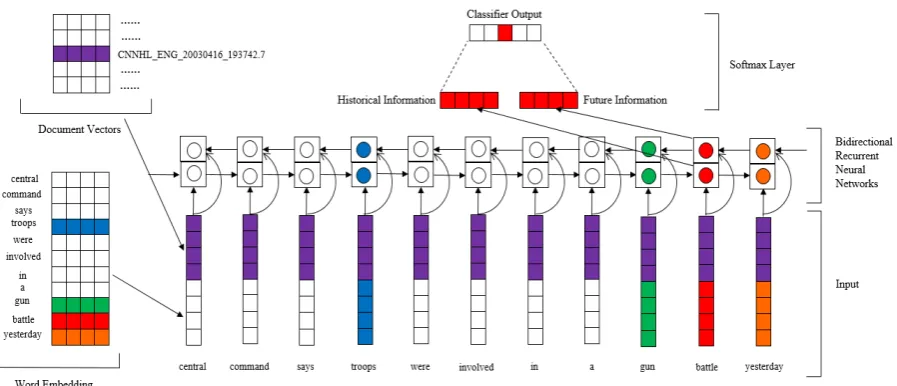
Figure 1: An illustraction of our DLRNN model for detecting the trigger word “battle” in the input sentence “central command says troops were involved in a gun battle yesterday”.
“troops”, “gun” and “yesterday” as event argu-ment whose roles are Attacker,Instrument and
Time-Within. However, for an event detection system, identifying the word “troops”, “gun” and “yesterday” as event argument whose roles are At-tacker, Instrument andTime-Within is not in-volved. Following previous work, we treat these simply as 33 separate event types and ignore the hierarchical structure among them.
3 Model
In this section, we give the details for the DLRNN model (show in Figure 1). First of all, we formal-ize the event detection task as a multi-classes clas-sification problem following previous work. More precisely, for each word in a sentence, our goal is to classify them into one of 34 classes (33 trigger types and None class).
Our DLRNN model primarily includes four parts: (i) word embedding, which contains lexical information for each word and is trained from ex-ternal corpus in an unsupervised manner; (ii) doc-ument vector, which reveals the topic of a docu-ment is trained in an unsupervised mechanism; (i-ii) bidirectional recurrent neural networks encod-ing, which can learn the historical and future ab-stractive representation of a candidate trigger; (iv) trigger prediction, which calculates a confidence score for each event subtype candidate.
3.1 Word Embedding
The representation of the words as continuous vectors (word embedding) are proved more pow-erful than discrete representation (Bengio et al.,
2003)(Mikolov et al., 2013b). Word embedding not only addresses the problem of dimension dis-aster, but also makes the word vector contain rich-er semantic information. The closrich-er the vector s-pace, the closer the semantic. In addition, word embedding can automatically learn lexical-level clues in the process of pre-training. Not only does not require human ingenuity, but also effectively alleviates the error propagation brought by other NLP lexical analysis toolkits. Recent work has demonstrated that using word embedding can en-hance the robustness of event detection model ( N-guyen and Grishman,2015)(Chen et al.,2015)( N-guyen and Grishman,2016).
In this paper, we pre-trained word embedding via skip-gram model (Mikolov et al.,2013b) and New York Times corpus5. Given a sequence
of training wordsw1,w2,w3,...,wT, the skip-gram model trains the embedding by maximizing the av-erage log probability:
1
T
TX−k
t=k
logp(wt−k, ...,wt+k|wt) (1)
where wt−k,...,wt+k is the context ofwt and the window size is k, usually it is expressed by the concatenation or sum of all word vectors in the
context;p(wt−k,...,wt+k|wt) is calculated via soft-max. There, we have:
p(wt−k, ...,wt+k|wt) = e
ywt−k,...,wt+k
P
ieyi (2) where each ofyi is un-normalized log-probability for each output context of the wordi, computed as
y =b+Uwt (3)
whereU,bare the sofmax parameters.
3.2 Document Vector
In order to illustrate the importance of the docu-ment vector for event detection in terms of disam-biguity. we propose three hypotheses from intra and inter document context perspectives.
H1: As we all know, the same word in different context often has different meanings. For instance, the word “delivered” in S1 can mean that someone is born or bring something to a destination, when given different context.
H2: Events in a document exist consistency. For example, Die events and Marry events almost never appear in the same document, but Die events often occur with Attack events and Injure events in a document.
H3: The event types in documents with the re-lated topics exist consistency. For instance, if the document that describing a financial crisis con-tains End-Position events and End-Org events, and then another document related to the financial cri-sis topic is more likely to happen End-Position events and End-Org events.
Based on the above three assumptions, we in-troduced an advanced document representation method. Documents are represented by the dis-tributed vector like word embedding, which not only contains the main content of a document, but also the more relevant documents, the closer the document vector. For all the words in a document, the document vector is shared and is concatenat-ed with word embconcatenat-edding, serving as the semantic representation of a word, as shown in Figure 1. Concatenating the document vector to word em-bedding has the following advantages: (i) a word is no longer represented by a unique word vec-tor, but expressed by different vector in different documents. This can help event detection mod-el to disambiguate event type; (ii) the consistency of events in a document is guaranteed. Since all the words in a document share a document vector,
which passes the identified event subtype informa-tion. For example, if some candidate triggers con-taining a particular document vector are mostly i-dentified as Attack events, Die events, and Injuries events, and then the other candidate triggers that containing the document vector will be less likely to be identified as Marry events or Be-Born events. (iii) documents with related topic almost contain the same event types. Due to the fact that the more relevant topic of the documents, the closer docu-ment vectors, the model will be given high confi-dence to label candidate trigger in a document as the types that appearing in the relevant topic of the documents.
In this paper, we trained document vectors by using the PV-DM model (Le and Mikolov,
2014), which is very similar to the CBOW model that is another word embedding model (Mikolov et al., 2013a). Unlike the skip-gram model, given a document that contains training word-s w1,w2,w3,...,wT, document vector is trained by maximizing the average log probability:
1
T
TX−k
t=k
logp(wt|wt−k, ...,wt+k, doc) (4)
where wt−k,...,wt+k is the context ofwt and the window size isk;docis the document vector con-taining the training words, which can be randomly initialized to a fixed dimension of vector like word embedding, see (Le and Mikolov,2014) for detail-s.
3.3 Bidirectional Recurrent Neural Networks Encoding
Recurrent neural networks (RNN) has been shown to perform considerably better than standard feed-forward architecture (Hammerton,2003)( Sutskev-er et al., 2011)(Liu et al., 2014)(Sundermeyer et al., 2014). In this paper, we used RNN to en-code word level information and document level clues. In the following, we describe our encoding model in detail.
suf-fers from gradient vanishing or gradient explod-ing problems durexplod-ing trainexplod-ing via backpropagation (Bengio et al.,1994). To remedy this problem, we used long short-term memory (LSTM) (Hochreiter and Schmidhuber,1997) that is a variant of RNN to replace the standard RNN.
Formally, given candidate input sequence X =
{x1,x2, ...,xn}. We run LSTM1 to get the hidden representation {hf1,hf2, ...,hfn} and run LSTM2
to get the hidden representation{hb1,hb2, ...,hbn}.
Eachhfi andhbi are computed by:
hfi =
−−−−→
LST M(xi, hfi−1) (5) hbi =
←−−−−
LST M(xi, hbi+1) (6)
wherexi is the concatenation of the word embed-ding of token i in candidate sentence and docu-ment vector that contains tokeni, as shown in Fig-ure 1;hfi−1 contains the historical information
be-fore xi; hbi+1 contains the future clues after xi.
Eventually, we obtain the context information over the whole sentence {h1,h2, ...,hn} with a greater focus on the positioniby concentrating {hf1,hf2,
...,hfn}and{hb1,hb2, ...,hbn}, wherehi= [hfi,hbi].
3.4 Trigger Prediction
In the actual situation, due to the fact that a trig-ger may contain multiple words, we introduce the BILOU labeling method, which has been shown to be able to achieve better results than BIO labeling in entity recognition tasks (Gupta et al.,2016). In the BILOU labeling method, B represents the be-ginning of a trigger word, I indicates that the word is inside a trigger word, L represents that the word is the last word for a trigger word, O signifies that the word is not a trigger word, U denotes the trig-ger word contains unique word.
After bidirectional long short-term memory (BiLSTM) encoding, we get the global abstract representation hi that encapsulates all context of the input sentence (see in section 3.3). And then, we feedhiinto a feed-forward neural network with a softmax layer (as shown in Figure 1). In the end, we get a 34 dimensions vector 6, where the k-th
termok is the probability value for classifyingxi to thek-th event type.
Given all of our (suppose T) training samples (x(i);y(i)), we can then define the loss function as 6As a result of the BILOU tag, the actual dimension is
more than 34 dimensions, but it is described as 34 dimensions for ease of understanding.
the average negative log-likelihood:
J(θ) =−T1 XT
i=1
logp(y(i)|x(i), θ) (7)
In order to compute the network parameterθ, we minimize the average negative log-likelihoodJ(θ) via stochastic gradient descent (SGD) over shuf-fled mimi-batches with Adam update rule ( King-ma and Ba,2014) and the dropout regularization (Zaremba et al.,2014).
4 Experiments
4.1 Dataset and Experimental Setup
We evaluate our DLRNN model on the ACE2005 English corpus. For fair comparisons, the same with (Ji and Grishman,2008)(Liao and Grishman,
2010)(Hong et al., 2011)(Liu et al., 2017)(Chen et al.,2017), we select the same 40 newswire doc-uments as the test set, the same 30 docdoc-uments from different genres as development set and the remaining 529 documents are used as training set. Furthermore, we also follow the criteria of the previous work (Ji and Grishman, 2008)(Liao and Grishman,2010)(Hong et al.,2011)(Li et al.,
2013)(Liu et al.,2017)(Chen et al.,2017) to judge the correctness of the predicted event mentions and usePrecision(P),Recall(R),F-measure(F1)
as the evaluation metrics.
We set the the dimension of word embedding to 200, the dimension of document vectors to 100, the size of hidden layer to 300, the size of mini-batch to 100, the dropout rate to 0.5, the learning rate to 0.002. All of the above hyper-parameter are adjusted on the development set.
4.2 Baseline Methods
In order to validate our DLRNN model, we choose the following models as our baselines, which are the state-of-the-art methods in sentence level and cross-sentence level event detection models.
Cross-Sentence Level Baselines:
1) Cross-Document Inference: It is the feature-based model proposed by (Ji and Grish-man, 2008), which is the first time to use docu-ment information to assist in sentence level event detection. They employed document theme clus-tering and designed a lot of reasoning rules to en-sure event consistency within the scope of the doc-ument and clustering.
Methods P R F1
Ji’s cross-document† 60.2 76.4 67.3 Liao’s cross-event† 68.7 68.9 68.8 Hong’s cross-entity† 72.9 64.3 68.3 Li’s joint model 73.7 62.3 67.5
Ngyuen’s JRNN 66.0 73.0 69.3
Chen’s DMCNN 75.6 63.6 69.1
Chen’s DMCNN+DS 75.7 66.0 70.5
Liu’s ANN 79.5 60.7 68.8
Liu’s ANN+Attention 78.0 66.3 71.7
[image:6.595.76.287.60.217.2]Our DLRNN† 77.2 64.9 70.5
Table 1: Overall Performance on Blind Test Da-ta. “†” designates the model that employs the evi-dences beyond sentence level. The boldface indi-cates that the model is representation-based mod-el.
2010), which not only used the consistency infor-mation of the same type events in a document, but also explored the clues from the co-occurrence of different event types in the same document.
3) Cross-Entity Inference: It is the feature-based approach proposed by (Hong et al.,2011), which used the entity co-occurrence as a key fea-ture to predict event mention.
Sentence Level Baselines:
4) Joint Model: It is the feature-based mod-el proposed by (Li et al., 2013), which exploit-ed argument information implicitly and capturexploit-ed the dependencies between two triggers within the same sentence.
5) Joint RNN: It is the representation-based method proposed by (Gupta et al., 2016), which exploited the inter-dependence of event trigger and event argument.
6) DMCNN + Distant Supervision: It is the representation-based method proposed by (Chen et al., 2017), which used the Freebase and FrameNet to extend the training corpus through distant supervision.
7) ANN + Attention: It is the representation-based approach proposed by (Liu et al., 2017), which exploited argument information explicitly for event detection via supervised attention mech-anisms.
4.3 Performance Comparison
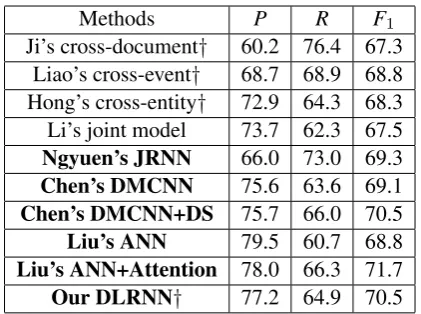
Table 1 are the comparisons of experimental re-sults of our method with the baseline methods on the same blind test dataset. Seen from Table 1, we
make the following observations:
1) The performance of representation-based models is better than that of feature-based mod-els. It indicates the artificially well-designed fea-tures are not sufficient for event detection, and automatically extracting features based on neu-ral networks can capture richer semantic clues. In detail, the F1 score of our DLRNN model is
higher than state-of-the-arts feature-based mod-el (Liao’s cross-event) by 1.7%; the other three representation-based models achieved better ex-perimental results than that of Liao’s cross-event model, which gain 0.5%,1.7% and 2.9% improve-ment, respectively.
2) The feature-based models that using cross-sentence information is more advantageous than the sentence level model. More accurately, in the cross-sentence models, only the performance of the Ji’s cross-document method is slightly lower than Li’s joint model (-0.2%), but the performance of the remaining models is better than Li’s joint model (an improvement of 0.8% and 1.3% inF1
s-core). It proves the clues beyond sentence are very important for event detection.
3) Our DLRNN method outperforms all cross-sentence level feature-based event detection mod-els. In detail, DLRNN gains 3.2% improvement onF1 score than Ji’s cross-document, gains 1.7%
improvement onF1 score than Liao’s cross-event
and gains 2.2% improvement on F1 score than
Hong’s cross-entity. The reasons are as follows: on the one hand, artificially constructed inference rules are difficult to cover all semantic laws; on the other hand, our DLRNN is better able to capture document level clues (including intra and inter-document context).
4) In spite that the performance of our DLRNN model does not improve the F1 score compared
with Chen’s DMCNN+DS model, even the per-formance is not as good as Liu’s ANN+Attention model. However, our method neither explicitly utilized event argument information, nor extend-ed training data through using world knowlextend-edge (Freebase) and linguistic knowledge (FrameNet). If removed the event argument information and the knowledge base (Chen’s DMCNN and Liu’s ANN), theF1 score of our DLRNN model is
also prove that the effectiveness of the proposed method.
4.4 The Effectiveness of Document Vector
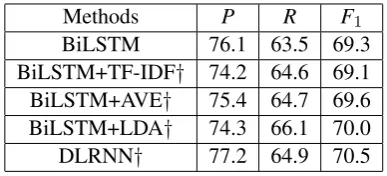
In order to verify the effectiveness of the docu-ment vector trained by PV-DM model for even-t deeven-teceven-tion, we design four experimeneven-ts as base-lines for comparison with our DLRNN (as shown in Table 2): BiLSTM, BiLSTM+TF-IDF, BiLST-M+AVE and BiLSTM+LDA.
1)BiLSTM:BiLSTM is similar to DLRNN ex-cept for removing the document vectors, only uses word embedding as the input of model.
2)BiLSTM+TF-IDF:Selected the word vector of the most important word for each document as the document vector for the document.
3)BiLSTM+AVE:The document vector is ob-tained by averaging the vector of each word in the document.
4) BiLSTM+LDA: The probability that each document corresponds to each topic is the docu-ment vector of the docudocu-ment.
5)DLRNN:DLRNN model uses the document vector, which is trained by PV-DM approach in-stead of averaging the word vector in the docu-ment7.
Methods P R F1
[image:7.595.84.278.435.523.2]BiLSTM 76.1 63.5 69.3 BiLSTM+TF-IDF† 74.2 64.6 69.1 BiLSTM+AVE† 75.4 64.7 69.6 BiLSTM+LDA† 74.3 66.1 70.0 DLRNN† 77.2 64.9 70.5 Table 2: Overall Performance on Blind Test Da-ta. “†” designates the model that employs the ev-idences beyond sentence level.“+TF-IDF” repre-sents the document vector was obtained by TF-IDF.“+LDA” represents the document vector was obtained by LDA.“+AVE” represents the docu-ment vector was obtained by averaging the word vector in the document.
Seen from Table 2, we get the following obser-vations: 1) in addition to BiLSTM+TF-IDF, the event detection models with the document vector can achieve better experimental results. In de-tail, BiLSTM+AVE, BiLSTM+LDA and DLRN-N are 0.3%, 0.7% as well as 1.2% better than
7we clean the documents up by converting everything to
lower case and removing punctuation and the stop words.
BiLSTM on F1 score, respectively. This
indi-cates that document level clues can contribute to sentence level event detection model. 2) com-pared to BiLSTM+TF-IDF, BiLSTM+AVE, BiL-STM+LDA, DLRNN gains 1.4%, 0.9%, 0.5% on F1score. This illustrates PV-DM model is able to
capture richer semantic information.
In addition, in order to illustrate the documents that their vectors are similar contain the consistent event types. We visualize the document vectors. In detail, we randomly selected a document con-taining the events from ACE2005 English corpus, and found a document that is most similar to the selected document by calculating the cosine sim-ilarity of document vectors. Finally, we system-atically compared the events contained in the two documents.
We randomly selected the document C-NNHL ENG 20030624 133331.33 as a source document, and found the document CNNHL ENG 20030624 230338.34 is most similar to it by computing the cosine similarity of document vectors8. Seen from Figure 2,
we observe that the two documents contain the same event types, except that the document CNNHL ENG 20030624 133331.33 does not contain Attack event. Event type overlapping rate is up to 80%. This proves that there is correlation between the documents of similar document vectors.
Figure 2: The comparison of event types on the most similar documents.
4.5 The Event Consistency in a Document
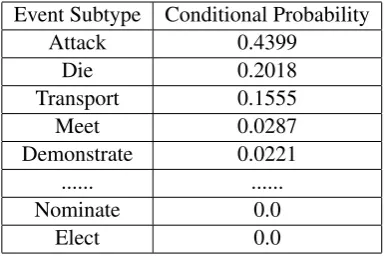
Seen from the Table 3, we observe that the In-jure event often appears along with the Attack events, the Die events, and the Transport events
[image:7.595.309.527.479.622.2]Event Subtype Conditional Probability
Attack 0.4399
Die 0.2018
Transport 0.1555
Meet 0.0287
Demonstrate 0.0221 ... ...
Nominate 0.0
[image:8.595.85.279.62.192.2]Elect 0.0
Table 3: The ranking probability of events co-occurrence with Injure events.
in the same document. The total probability of the above three types of events concurrence with In-jure event is about 0.797. Furthermore, the Nomi-nate events, the Elect events, and so on, have nev-er been appeared in the same document containing the Injure events. This indicates that only certain types of events can occur in the same documen-t, therefore the introduction of the document vec-tor will help to predict event types in a document. Thus, the inter-document information reflected in document vector is useful to event detection.
4.6 The Effectiveness of BILOU Labeling
According to statistics, ACE2005 English corpus contains 235 trigger words, which are composed of multiple words, about 4.39% of the total trig-ger words. It is not appropriate to treat identifying the triggers that contains multiple words as a word classification task, because most of the triggers of multiple words contain prepositions. However, the prepositions in such triggers do not trigger event independently. Therefore, using BILOU encoding helps to treat the multiple words trigger as a w-hole. Table 3 demonstrates the effectiveness of the BILOU encoding (an improvement of 0.2% onF1
score).
Methods P R F1
DLRNN-BILOU 78.8 63.5 70.3 DLRNN 77.2 64.9 70.5
Table 4: Overall Performance on Blind Test Da-ta. “-BILOU” indicates that the model has not the BILOU labeling.
5 Related Work
Event detection is a challenging task in the field of natural language processing, which has
attract-ed more and more researchers’ attention in recen-t years. The currenrecen-t evenrecen-t derecen-tecrecen-tion models can roughly be divided into: (1) the sentence level event detection models and (2) the cross-sentence level event detection models.
(1) The sentence level event detection models: they are designed to use the sentence information for event classification. According to the differ-ences in how to use sentence information, they can be divided into two categories: the feature-based models and the representation-based models. The early event detection models are almost all feature-based models, which transformed lexical features, syntactic features and semantic features into one-hot vectors by other natural language processing toolkits, and then sended these well-designed fea-tures into the classifiers (eg: structure percep-tron or support vector machine) and eventually completed the event classification (Ahn,2006)(Li et al.,2013). With the success of deep learning in entity identification and relationship classification (Collobert and Weston, 2008)(Zeng et al.,2014), many event detection researchers turned to focus on the representation-based models. This kind of models do not need to extract the features man-ually. They used the distributed word vector as the input and encoded the word vector into low-dimensional abstractive representation by the neu-ral network to complete event detection (Nguyen and Grishman, 2015)(Chen et al., 2015)(Nguyen et al., 2016)(Nguyen and Grishman, 2016)(Liu et al.,2016)(Liu et al.,2017)(Chen et al.,2017).
[image:8.595.93.273.606.650.2]per-formance of event detection.
6 Conclusion
In this paper, we propose a novel model (DLRN-N) to automatically extract cross-sentence level clues for event detection by concatenating word vector and document vector. Moreover, we use BILOU encoding to solve the problem that con-tains multiple words in a trigger word. In order to prove the effectiveness of the proposed method, we systematically conduct a series of experiments on ACE2005 dataset. Experimental results show that the proposed method is better than state-of-the-arts cross-sentence level feature-based models and the sentence level representation-based mod-els without using argument information and exter-nal corpus, such as Freebase and FrameNet ( Li-u et al., 2017)(Chen et al., 2017), which demon-strates that intra and inter-document context is ef-fective for event detection.
Acknowledgments
This work was supported by the National Science Foundation of China (No. 61472277), the Nation-al Key Basic Research and Development Program of China (973 Program, No. 2013CB329301).
References
David Ahn. 2006. The stages of event extraction. In Proceedings of ACL,pages 1–8.
Yoshua Bengio, Rejean Ducharme, Pascal Vincent, and Christian Jauvin. 2003. A neural probabilistic lan-guage model. The Journal of Machine Learning Re-search3(6):1137–1155.
Yoshua Bengio, Patrice Simard, and Paolo Frasconi. 1994. Learning long-term dependencies with gradi-ent descgradi-ent is difficult. The Journal of IEEE trans-actions on neural networks5(2):157–166.
Yubo Chen, Shulin Liu, Xiang Zhang, Kang Liu, and Jun Zhao. 2017. Automatically labeled data genera-tion for large scale event extracgenera-tion. In Proceedings of ACL.
Yubo Chen, Liheng Xu, Kang Liu, Daojian Zeng, and Jun Zhao. 2015. Event extraction via dynam-ic multi-pooling convolutional neural networks. In Proceedings of IJCNLP,pages 167–176.
Ronan Collobert and Jason Weston. 2008. A unified ar-chitecture for natural language processing:deep neu-ral networks with multitask learning. In Proceed-ings of ICML,pages 160–167.
Pankaj Gupta, Hinrich Schtze, and Bernt Andrassy. 2016. Table filling multi-task recurrent neural net-work for joint entity and relation extraction.In Pro-ceedings of COLING,pages 2537–2547.
James Hammerton. 2003. Named entity recognition with long short-term memory. In Proceedings of NAACL,pages 172–175.
Sepp Hochreiter and Jurgen Schmidhuber. 1997. Long short-term memory. The Journal of Neural Compu-tation,9(8):1735–1780.
Yu Hong, Jianfeng Zhang, Bin Ma, Jianmin Yao, Guodong Zhou, and Qiaoming Zhu. 2011. Using cross-entity inference to improve event extraction.
In Proceedings of ACL,pages 1127–1136.
Ruihong Huang and Ellen Riloff. 2012. Modeling tex-tual cohesion for event extracion. In Proceedings of AAAI,pages 1664–1670.
Heng Ji and Ralph Grishman. 2008. Refining even-t exeven-traceven-tion even-through cross-documeneven-t inference. In Proceedings of ACL,pages 254–262.
Diederik Kingma and Jimmy Ba. 2014. Adam: A method for stochastic optimization. arXiv preprint arXiv:1412.6980.
Quoc Le and Tomas Mikolov. 2014. Distributed repre-sentations of sentences and documents. In Proceed-ings of ICML,pages 1188–1196.
Qi Li, Heng Ji, and Liang Huang. 2013. Joint event extraction via structured prediction with global fea-tures.In Proceedings of ACL,pages 73–82. Shasha Liao and Ralph Grishman. 2010. Using
doc-ument level cross-event inference to improve event extraction. In Proceedings of ACL,pages 789–797. Shujie Liu, Nan Yang, Mu Li, and Ming Zhou. 2014.
A recursive recurrent neural network for statistical machine translation. In Proceedings of ACL,pages 1491–1500.
Shulin Liu, Yubo Chen, Shizhu He, Kang Liu, and Jun Zhao. 2016. Leveraging framenet to improve auto-matic event detection. In Proceedings of ACLpages 2134–2143.
Shulin Liu, Yubo Chen, Kang Liu, and Jun Zhao. 2017. Exploiting argument information to improve event detection via supervised attention mechanisms. In Proceedings of ACL.
Tomas Mikolov, Kai Chen, Greg Corrado, and Jef-frey Dean. 2013a. Efficient estimation of word rep-resentations in vector space. arXiv preprint arX-iv:1301.3781.
Thien Huu Nguyen, Kyunghyun Cho, and Ralph Gr-ishman. 2016. Joint event extraction via recurrent neural networks. In Proceedings of NAACL,pages 300–309.
Thien Huu Nguyen and Ralph Grishman. 2015. Even-t deEven-tecEven-tion and domain adapEven-taEven-tion wiEven-th convoluEven-tion neural networks. In Proceedings of IJCNLP,pages 365–371.
Thien Huu Nguyen and Ralph Grishman. 2016. Mod-eling skip-grams for event detection with convolu-tion neural networks. In Proceedings of EMNLP,
pages 886–891.
Martin Sundermeyer, Tamer Alkhouli, Joern Wuebker, and Hermann Ney. 2014. Translation modeling with bidirectional recurrent neural networks.In Proceed-ings of EMNLP,pages 14–25.
Ilya Sutskever, James Martens, and Geoffrey Hinton. 2011. Generating text with recurrent neural net-works. In Proceedings of ICML,pages 1017–1024. Wojciech Zaremba, Ilya Sutskever, and Oriol
Vinyal-s. 2014. Recurrent neural network regularization.
arXiv preprint arXiv:1409.2329.