An Efficient Algorithm to Induce Minimum Average Lookahead Grammars
for Incremental LR Parsing
Dekai WU1 Yihai SHEN
[email protected] [email protected]
Human Language Technology Center HKUST
Department of Computer Science
University of Science and Technology, Clear Water Bay, Hong Kong
Abstract
We define a new learning task, minimum average lookahead grammar induction, with strong poten-tial implications for incremental parsing in NLP and cognitive models. Our thesis is that a suitable learn-ing bias for grammar induction is to minimize the degree of lookahead required, on the underlying tenet that language evolution drove grammars to be efficiently parsable in incremental fashion. The in-put to the task is an unannotated corpus, plus a non-deterministic constraining grammar that serves as an abstract model of environmental constraints con-firming or rejecting potential parses. The constrain-ing grammar typically allows ambiguity and is it-self poorly suited for an incremental parsing model, since it gives rise to a high degree of nondetermism in parsing. The learning task, then, is to in-duce a deterministic LR (k) grammar under which it is possible to incrementally construct one of the correct parses for each sentence in the corpus, such that the average degree of lookahead needed to do so is minimized. This is a significantly more dif-ficult optimization problem than merely compiling
LR (k) grammars, since k is not specified in ad-vance. Clearly, na¨ıve approaches to this optimiza-tion can easily be computaoptimiza-tionally infeasible. How-ever, by making combined use of GLR ancestor ta-bles and incremental LR table construction meth-ods, we obtain an O(n3+ 2m)greedy approxima-tion algorithm for this task that is quite efficient in practice.
1 Introduction
Marcus’ (1980) Determinism Hypothesis proposed that natural language can be parsed by a mechanism that operates “strictly deterministically” in that it does not simulate a nondeterministic machine. Al-though the structural details of the deterministic LR
1The author would like to thank the Hong Kong Research
Grants Council (RGC) for supporting this research in part through research grants RGC6083/99E, RGC6256/00E, and DAG03/04.EG09.
parsing model we employ in this paper diverge from those of Marcus, fundamentally we adhere to his constraints that (1) all syntactic substructures
cre-ated are permanent, which prohibits simulating
de-terminism by backtracking, (2) all syntactic
sub-structures created for a given input must be part of the output structure assigned to that input, which
prohibits memoizing intermediate results as in dy-namic programming or beam search, and (3) no
temporary syntactic structures are encoded within the internal state of the machine, which prohibits
the moving of temporary structures into procedural codes.
A key issue is that, to give the Determinism Hy-pothesis teeth, it is necessary to limit the size of the decision window. Otherwise, it is always possible to circumvent the constraints simply by increasing the degree of lookahead or, equivalently, increasing the buffer size (which we might call the degree of “look-behind”); either way, increasing the decision window essentially delays decisions until enough disambiguating information is seen. In the limit, a decision window equal to the sentence length ren-ders the claim of incremental parsing meaningless. Marcus simply postulated that a maximum buffer size of three was sufficient. In contrast, our ap-proach permits greater flexibility and finer grada-tions, where the average degree of lookahead re-quired can be minimized with the aim of assisting grammar induction.
Since Marcus’ work, a significant body of work on incremental parsing has developed in the sen-tence processing community, but much of this work has actually suggested models with an increased amount of nondeterminism, often with probabilistic weights (e.g., Narayanan & Jurafsky (1998); Hale (2001)).
Meanwhile, in the way of formal methods, Tomita (1986) introduced Generalized LR parsing, which offers an interesting hybrid of nondetermin-istic dynamic programming surrounding LR parsing methods that were originally deterministic.
minimizing finite-state machines are well known (e.g., Mohri (2000), B al & Carton (1968)). How-ever, such methods (a) do not operate at the context-free level, (b) do not directly minimize lookahead, and (c) do not induce grammars under environmen-tal constraints.
Unfortunately, there has still been relatively lit-tle work on automatic learning of grammars for de-terministic parsers to date. Hermjakob & Mooney (1997) describe a semi-automatic procedure for learning a deterministic parser from a treebank, which requires the intervention of a human expert in the loop to determine appropriate derivation or-der, to resolve parsing conflicts between certain ac-tions such as “merge” and “add-into”, and to iden-tify specific features for disambiguating actions. In our earlier work we described a deterministic parser with a fully automatically learned decision algo-rithm (Wong and Wu, 1999). But unlike our present work, the decision algorithms in both Hermjakob & Mooney (1997) and Wong & Wu (1999) are pro-cedural; there is no explicit representation of the grammar that can be meaningfully inspected.
Finally, we observe that there are also trainable stochastic shift-reduce parser models (Briscoe and Carroll, 1993), which are theoretically related to shift-reduce parsing, but operate in a highly nonde-terministic fashion during parsing.
We believe the shortage of learning models for deterministic parsing is in no small part due to the difficulty of overcoming computational complexity barriers in the optimization problems this would in-volve. Many types of factors need to be optimized in learning, because deterministic parsing is much more sensitive to incorrect choice of structural fea-tures (e.g., categories, rules) than nondeterministic parsing that employ robustness mechanisms such as weighted charts.
Consequently, we suggest shifting attention to the development of new methods that directly address the problem of optimizing criteria associated with deterministic parsing, in computationally feasible ways. In particular, we aim in this paper to develop a method that efficiently searches for a parser under a minimum average lookahead cost function.
It should be emphasized that we view the role of a deterministic parser as one component in a larger model. A deterministic parsing stage can be ex-pected to handle most input sentences, but not all. Other nondeterministic mechanisms will clearly be needed to handle a minority of cases, the most ob-vious being garden-path sentences.
In the sections that follow, we first formalize the learning problem. We then describe an efficient
ap-proximate algorithm for this task. The operation of this algorithm is illustrated with an example. Fi-nally, we give an analysis of the complexity charac-teristics of the algorithm.
2 The minimum average lookahead (MAL) grammar problem
We formulate the learning task as follows:
Definition Given an unannotated corpus
S = {S1, . . . , S|S|} plus a constraining
gram-marGC, the minimum average lookahead grammar
GMAL(S, GC)is defined as
arg minG⊂GC∧∀i:parse
G(Si)=∅
ˆ
k(G)
where the average lookahead objective function
ˆ
k(G) is the average (overS) amount of lookahead that an LR parser forGneeds in order to determinis-tically parse the sampleS without any shift-reduce or reduce-reduce conflicts. IfGis ambiguous in the sense that it generates more than one parse for any sentence inS, then ˆk(G) = ∞ since a conflict is unavoidable no matter how much lookahead is used. In other words, GMAL is the subset of rules of GC that requires the smallest number of lookaheads on average so as to make parsingSusing this subset ofGdeterministic.
Note that the constraining grammar GC by na-ture is not deterministic. The constraining gram-mar serves merely as an abstract model of envi-ronmental constraints that confirm or reject poten-tial parses. Since such feedback is typically quite permissive, the constraining grammar typically al-lows a great deal of ambiguity. This of course ren-ders the constraining grammar itself poorly suited for an incremental parsing model, since it gives rise to a high degree of nondeterminism in parsing. In other words, we should not expect the constraining grammar alone to contain sufficient information to choose a deterministically parsable grammar.
more complex incremental semantic interpretation mechanisms into this framework could be explored as well.)
Finding the minimum average lookahead gram-mar is clearly a difficult optimization problem. To compute the value ofˆk(G), one needs the LR table for that particularG, which is expensive to compute. Computing the LR table for allG ⊂ GC would be infeasible. It is a natural conjecture, in fact, that the problem of learning MAL grammars is NP-hard. We therefore seek an approximation algorithm with good performance, as discussed next.
3 An efficient approximate algorithm for learning incremental MAL parsers
We now describe an approximate method for effi-ciently learning a MAL grammar. During learning, the MAL grammar is represented simultaneously as both a set of standard production rules as well as an LR parsing table. Thus the learning algorithm out-puts an explicit declarative rule set together with a corresponding compiled LR table.
3.1 Approximating assumptions
To overcome the obstacles mentioned in the previ-ous section, we make the following approximations:
1. Incremental approximation for MAL rule set
computation. We assume that the MAL
gram-mar for a given corpus is approximately equal to the sequential union of the MAL grammar rules for each sentence in the corpus, where the set of MAL grammar rules for each sentence is determined relative to the set of all rules se-lected from preceding sentences in the corpus.
2. Incremental approximation for LR state set
computation. We assume that the correct set
of LR states for a given set of rules is approx-imately equal to that obtained by incremen-tally modifying the LR table and states from a slightly smaller subset of the rules. (Our ap-proach exploits the fact that the correct set of states for LR(k)parsers is always independent ofk.)
Combining these approximation assumptions en-ables us to utilize a sentence-by-sentence greedy ap-proach to seeking a MAL grammar. Specifically, the algorithm iteratively computes a minimum aver-age lookahead set of rules for each sentence in the training corpus, accumulating all rules found, while keeping the LR state set and table updated. The full algorithm is fairly complex; we discuss its key as-pects here.
3.2 Structure of the iteration
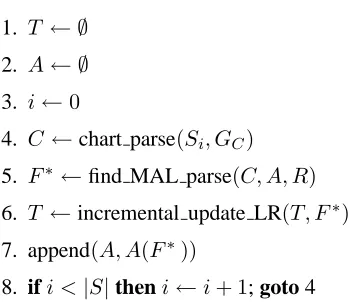
As shown in Figure 1, find MAL parser accepts as input an unannotated corpusS ={S1, . . . , S|S|}
plus a constraining grammarGC , and outputs the LR table for a parser that can deterministically parse the entire training corpus using a minimum average lookahead.
The algorithm consists of an initialization step followed by an iterative loop. In the initialization step in lines 1–3, we create an empty LR table T, along with an empty set A of parsing action quences defined as follows. A parsing action
se-quenceA(P) for a given parse P is the sequence of triples (state, input, action) that a shift-reduce parser follows in order to constructP. At any given point,T will hold the LR table computed from the MAL parse of all sentences already processed, and
Awill hold the corresponding parsing sequences for the MAL parses.
Entering the loop, we iteratively augment T by adding the states arising from the MAL parseF∗of each successive sentence in the training corpus and, in addition, cache the corresponding parsing action sequence A(F∗) into the set A. This is done by first computing a chart for the sentence, in line 4, by parsingSiunder the constraining grammarGC us-ing the standard Earley (1970) procedure. We then call find MAL parse in line 5, to compute the parse that requires minimum average lookahead to resolve ambiguity. The items and states produced by the rules inF∗are added to the LR table T by calling incremental update LR in line 6, and the parsing action sequence of F∗ is appended to A in line 7. Note that the indices of the original states in T are not changed and only items are added into them if need be so that A is not changed by adding items and states to T, and there might be new states introduced which are also indexed.
By definition, the true MAL grammar does not depend on the order of the sentences the learning al-gorithm inspects. However, find MAL parser pro-cesses the example sentences in order, and attempts to find the MAL grammar sentence by sentence. The order of the sentences impacts the grammar produced by the learning algorithm, so it is not guar-anteed to find the true MAL grammar. However the approximation is well motivated particularly when we have large numbers of example sentences.
3.3 Incrementally updating the LR table
find MAL parser(S, GC)
1. T ← ∅
2. A← ∅
3. i←0
4. C←chart parse(Si, GC)
5. F∗←find MAL parse(C, A, R)
6. T ←incremental update LR(T, F∗)
7. append(A, A(F∗))
[image:4.595.80.258.84.235.2]8. ifi <|S|theni←i+ 1; goto 4
Figure 1: Main algorithm find MAL parser.
current MAL grammar. Otherwise, every time a rule is found to be capable of reducing average looka-head and therefore is added into the MAL gram-mar, the LR table must be recomputed from scratch, which is sufficiently time consuming as to be infea-sible when trying to learn a MAL grammar with a realistically large input corpus and/or constraining grammar.
The incremental update LR function incre-mentally updates the LR table in an efficient fash-ion that avoids recomputing the entire table. The inputs to incremental update LR are a pre-existing LR tableT, and a set of new rulesR to be added. This algorithm is derived from the incremental LR parser generator algorithm ilalr and is relatively complex; see Horspool (1988) for details. Histor-ically, work on incremental parser generators first concentrated on LL(1) parsers. Fischer (1980) was first to describe a method for incrementally updat-ing an LR(1) table. Heerupdat-ing et al.(1990) use the principle of lazy evaluation to attack the same prob-lem. Our design of incremental update LR is more closely related to ilalr for the following reasons:
• ilalr has the property that when updating the
LR table to contain the newly added rules, it does not change the index of each already ex-isting state. This is important for our task as the slightest change in the states might affect significantly the parsing sequences of the sen-tences that have already been processed. • Although worst case complexity for ilalr is
ex-ponential in the number of rules in the gram-mar, empirically it is quite efficient in practical use. Heuristics are used to improve the speed of the algorithm, and as we do not need to com-pute lookahead sets, the speed of the algorithm can be further improved.
compute average lookahead(r, A)
1. h←lookahead(r, A)
2. if∃v1 = (i, s, a1, k1, r1, d1) • thenk=k1 = (m1, l1) • elsek= (0,∞)
3. // note v = (i, s, a, k, r, d) and k =
(m, l)
4. l= mml+1+h
5. ifl’’< l
• thenl=l • elsem =m+ 1
Figure 2: Algorithm compute average lookahead.
The method is approximate, and may yield slight, acceptable deviations from the optimal table. ilalr is not an exact LR table generator in the sense that it may create states that should not exist and may miss some states that should exist. The algorithm is based on the assumption that most states in the original LR table occur with the same kernel items in the updated LR table. Empirically, the assump-tion is valid as the proporassump-tion of superfluous states is typically only in the 0.1% to 1.3% range.
3.4 Finding minimum average lookahead parses
The function find MAL parse selects the full parse
F∗ of a given sentence that requires the least
av-erage lookahead kˆ(A(F)) to resolve any shift-reduce or shift-reduce-shift-reduce conflicts with a set A of parsing action sequences, such that F∗ is a sub-set of a chart C. The inputs to find MAL parse, more specifically, are a chart C containing all the partial parses in the input sentence, and the set A
[image:4.595.322.541.86.268.2]is the case with most parsing problems. We fol-low Kipps (1991) in modifying Tomita’s algorithm to allow it to run in time proportional to n3 for grammars with productions of arbitrary length. The most time consuming part in Tomita’s algorithm is when reduce actions are executed in which the an-cestors of the current node have to be found in-curring time complexitynρ. To avoid this we em-ploy an ancestor table to keep the ancestors of each node in the GLR forest which is updated dynam-ically as the GLR forest is being constructed. This modification brings down the time complexity of re-duce actions ton2in the worst case, and allows the function build GLR forest to construct the graph-structured stack inOn3. Aside from constructing the graph-structured stack, we compute the average lookahead for each LR state transition taken during the construction. Whenever there is a shift or re-duce action in the algorithm, a new vertex for the graph-structured stack is generated, and the func-tion compute average lookahead is called to ascer-tain the average lookahead of the new vertex. Fi-nally, reconstruct MAL parse is called to recover the full parse F∗ for the MAL parsing action se-quence.
Figure 2 shows the
com-pute average lookahead function, which es-timates the average lookahead of a vertex v
generated by an LR state transitionr. To facilitate computations involving average lookahead, we use a 6-tuple (i, s, a, k, r, d) instead of the more common triple form (i, s, a) to represent each vertex in the graph-structured stack, where:
• i: The index of the right side of the coverage of the vertex. The vertices with the same right sideiwill be kept inUi.
• s: The state in which the vertex is in. • a: The ancestor table of the vertex.
• k: The average lookahead information, in the form of a pair (m, l) wherelis the minimum average lookahead of all paths leading from the root to this vertex andmis the number of state transitions in that MAL path.
• r: The parsing action that generates the ver-tex along the path that needs minimum average lookahead. r is a triple(d1, d2, f)denoting
ap-plying the actionf on the vertexd1to generate
the vertexd2.
• d: The unique index of the vertex.
[image:5.595.375.480.100.250.2]The inputs to compute average lookahead are an LR state transition r = (d, d, f) taken in the con-struction of the graph-structured stack whered and
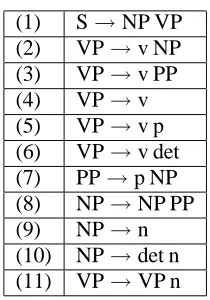
Table 1: Example constraining grammar.
(1) S→NP VP (2) VP→v NP (3) VP→v PP
(4) VP→v
(5) VP→v p (6) VP→v det (7) PP→p NP (8) NP→NP PP
(9) NP→n
(10) NP→det n (11) VP→VP n
dare the index of vertices and f is an action, and the setAcontaining the parsing action sequences of the MAL parse of all sentences processed so far. Let
v= (i, s, a, k, r, d)be the new vertex with indexd, and letv = (i, s, a, k, r, d) be the vertex with indexd. The function proceeds by first computing the lookahead needed to resolve conflicts betweenr
andA. Next we check whetherv is a packed node and initializekinv; if not,kis initialized to(0,0), and otherwise it is copied from the packed node. We then compute the average lookahead needed to go fromv tov and check whether it provides a more economical way to resolve conflicts. The average lookahead of a vertex v generated by applying an actionf on vertexvcan be computed fromkofv
and the lookahead needed to generatevfromv. v
can be generated by applying different actions on different vertices and k keeps the one that needs minimum average lookahead and f keeps that ac-tion.
Finally, the reconstruct MAL parse function is called after construction of the entire graph-structured stack is complete in order to recover the full minimum average lookahead parse tree. We as-sume the grammar has only one start symbol and rebuild the parse tree from the state that is labelled with the start symbol.
4 An example
We now walk through a simplified example so as to fix ideas and illustrate the operation of the algo-rithm. Table 1 shows a simple constraining gram-marGC which we will use for this example.
Now consider the small training corpus:
1. I did.
2. He went to Africa.
Table 2: LR state transitions and lookaheads for sentence 1.
[S[NPIn] [VPdidv] ] ˆk (0, 1, sh, 0) (1, 2, re9, 0) (2, 4, sh, 0) (4, 5, re4, 0) (5, 3, re1, 0) (3, acc) 0*
To begin with, find MAL parser considers sen-tence 1. In this particular case, chart parse(S1, GC) finds only one valid parse. The GLR forest is built, giving the LR state transitions and parsing actions shown in Table 2, where each tuple (d’, d, f, k)
gives the state prior to the action, the state resulting from the action, the action, and the average looka-head. Here compute average lookahead determines that the average lookahead ˆkis 0. From this parse tree, incremental update LR accepts rules (1), (4), and (9) and updates the previously empty LR table
T.
Next, find MAL parser considers sentence 2. Here, chart parse(S1, GC) finds two possible parses, leading to the LR state transitions and pars-ing actions shown in Table 3. This time, the average lookahead calculation is sensitive to the what was already entered into the LR tableT during the pre-vious step of processing sentence 1. For example, in the first parse, the fourth transition (4, 6, sh, 1) requires a lookahead of 1 in order to avoid a shift-reduce conflict with (4, 5, re4, 0) from sentence 1. The sixth transition (1, 9, re9, 2) requires a looka-head of 2. It turns out that the first parse has an aver-age lookahead of 0.20,while the second parse has an average lookahead of 0.33. We thus prefer the first parse tree, calling incremental update LR to further update the LR tableT using rules (3) and (7).
Finally, find MAL parser considers sentence 3. Again, chart parse(S1, GC) finds two possible parses, leading this time to the LR state transi-tions and parsing actransi-tions shown in Table 4. Vari-ous lookaheads are again needed to avoid conflicts with the existing rules inT. The first parse has an average lookahead of 0.22, and is selected in pref-erence to the second parse which has an average lookahead of 0.33. From the first parse tree, in-cremental update LR accepts rules (2) and (10) to again update the LR tableT.
[image:6.595.314.566.127.248.2]Thus the final output MAL grammar, requiring a lookahead of 1, is shown in Table 5.
Table 3: LR state transitions and lookaheads for sentence 2.
[S[NPHen] [VPwentv[PPtop[NPAfrican] ] ] ] ˆk (0, 1, sh, 0) (1, 2, re9, 0) (2, 4, sh, 0)
(4, 6, sh, 1) (6, 1, sh, 0) (1, 9, re9, 1) (9, 7, re7, 0) (7, 5, re3, 0) (5, 3, re1, 0)
(3, acc) 2/10
[S[NPHen] [VP[VP wentvtop] African] ] (0, 1, sh, 0) (1, 2, re9, 0) (2, 4, sh, 0) (4, 6, sh, 1) (6, 5, re5, 0) (5, 8, sh, 1)
(8, 5, re11, 0) (5, 3, re1, 1) (3, acc) 3/9
Table 4: LR state transitions and lookaheads for sentence 3.
[S[NPIn] [VPboughtv[NP adetticketn] ] ] ˆk (0, 1, sh, 0) (1, 2, re9, 1) (2, 4, sh, 0)
(4, 8, sh, 1) (8, 11, sh, 0) (11, 12, re10, 0) (12, 5, re12, 0) (5, 3, re1, 0) (3, acc) 2/9 [S[NPIn] [VP[VPboughtv adet] ticketn] ] (0, 1, sh, 0) (1, 2, re9, 1) (2, 4, sh, 0) (4, 8, sh, 1) (8, 5, re6, 0) (5, 10, sh, 1)
(10, 5, re11, 0) (5, 3, re1, 0) (3, acc) 3/9
Table 5: Output MAL grammar.
(1) S→NP VP (2) VP→v NP (3) VP→v PP
(4) VP→v
(7) PP→p NP
(9) NP→n
(10) NP→det n
5 Complexity analysis
5.1 Time complexity
Since the algorithm executes each of its five main steps once for each sentence in the corpus, the time complexity of the algorithm is upper bounded by the sum of the time complexities of those five steps. Supposenis the maximum length of any sentence in the corpus, andm is the number of rules in the grammar. Then for each of the five steps:
1. chart parse isOn3.
the graph-structured stack to be built inO(n3)
in the worst case.
3. compute average lookahead is On2. As the number of lookaheads needed by each ing action is computed by comparing the pars-ing action with the MAL parspars-ing action se-quences for all previous sentences, the time complexity of this function depends on the maximum length of any sentence that has al-ready been processed, which is bounded byn. The dynamic programming method used to lo-cate the most economical parse in terms of av-erage lookahead, described above, can be seen to be quadratic inn.
4. reconstruct MAL parse is On2. This is bounded by the number of LR state transi-tions in each full parse of the sentence, which is is On2. Note, however, that Tanaka et
al. (1992) propose an enhancement that can
re-construct the parse trees in time linear ton; this is a direction for future improvement of our al-gorithm.
5. incremental update LR is O(2m). As with
ilalr, theoretically the worst time complexity is
exponential in the number of rules in the exist-ing grammar. However, various heuristics can be employed to make the algorithm quicker, and in practical experiments the algorithm is quite fast and precise in producing LR tables, particularly since m is very small relative to |S|.
The time complexity of the algorithm for each sentence is thus On3 + On3 + On2 + On2+O(2m)which isO(n3+ 2m). Given|S|
sentences in the corpus, the total training time is
O((n3+ 2m)· |S|).
5.2 Space complexity
As with time complexity, an upper bound on the space complexity can be obtained from the five main steps:
1. chart parse isOn3.
2. build GLR forest isOn2. The space com-plexity of both Tomita’s original algorithm and the modified algorithm isn2.
3. compute average lookahead is On2. The space usage of compute average lookahead di-rectly corresponds to the dynamic program-ming structure, like the time complexity.
4. reconstruct MAL parse is O(n). This is bounded by the number of vertices in the graph-structured stack, which is isO(n).
5. incremental update LR is O(2m). As with time complexity, although the worst time com-plexity is exponential in the number of rules in the existing grammar, in practice this is not the major bottleneck.
The space complexity of the algorithm is thus
On3+On2+On2+O(n) +O(2m)which is againO(n3+ 2m).
6 Conclusion
We have defined a new grammar learning task based on the concept of a minimum average lookahead (MAL) objective criterion. This approach provides an alternative direction for modeling of incremen-tal parsing: it emphatically avoids increasing the amount of nondeterminism in the parsing models, as has been done in across a wide range of recent models, including probabilized dynamic program-ming parsers as well as GLR approaches. In con-trast, the objective here is to learn completely de-terministic parsers from unannotated corpora, with loose environmental guidance from nondeterminis-tic constraining grammars.
Within this context, we have presented a greedy algorithm for the difficult task of learning approx-imately MAL grammars for deterministic incre-mental LR(k) parsers, with a time complexity of
O((n3 + 2m) · |S|) and a space complexity of
O(n3 + 2m). This algorithm is efficient in prac-tice, and thus enables a broad range of applications where degree of lookahead serves as a grammar in-duction bias.
Numerous future directions are suggested by this model. One obvious line of work involves experi-ments varying the types of corpora as well as the nu-merous parameters within the MAL grammar learn-ing algorithm, to test predictions against various modeling criteria. More efficient algorithms and heuristics could help further increase the applicabil-ity of the model. In addition, the accuracy of the model could be strengthened by reducing sensitiv-ity to some of the approximating assumptions.
References
Marie-Pierre Beal and Olivier Carton. Determiniza-tion of transducers over finite and infinite words.
Theoretical Computer Science, 289(1), 1968.
Ted Briscoe and John Carroll. Generalised prob-abilistic LR parsing for unification-based gram-mars. Computational Linguistics, 19(1):25–60, 1993.
algo-rithm. Communications of the Association for Computing Machinery, 13(2), 1970.
G. Fischer. Incremental LR(1) parser construction as an aid to syntactical extensibility. Technical report, Department of Computer Science, Univer-sity of Dortmund, Federal Republic of Germany, 1980. PhD Dissertation, Tech. Report 102.
John Hale. A probabilistic Earley parser as a psy-cholinguistic model. In NAACL-2001: Second
Meeting of the North American Chapter of the Association for Computational Linguistics, 2001.
Jan Heering, Paul Klint, and Jan Rekers. Incremen-tal generation of parsers. IEEE Transactions on
Software Engineering, 16(12):1344–1351, 1990.
Ulf Hermjakob and Raymond J. Mooney. Learn-ing parse and translation decisions from examples with rich context. In ACL/EACL’97:
Proceed-ings of the 35th Annual Meeting of the Associa-tion for ComputaAssocia-tional Linguistics and 8th Con-ference of the European Chapter of the Associ-ation for ComputAssoci-ational Linguistics, pages 482–
489, 1997.
R. Nigel Horspool. Incremental generation of LR parsers. Technical report, University of Victoria, Victoria, B.C., Canada, 1988. Report DCS-79-IR.
James R. Kipps. GLR parsing in time O(n3). In M. Tomita, editor, Generalized LR Parsing, pages 43–60. Kluwer, Boston, 1991.
Mitchell P. Marcus. A Theory of Syntactic
Recog-nition for Natural Language. MIT Press,
Cam-bridge, MA, 1980.
Mehryar Mohri. Minimization algorithms for se-quential transducers. Theoretical Computer
Sci-ence, 234(1–2):177–201, 2000.
Srini Narayanan and Daniel Jurafsky. Bayesian models of human sentence processing. In
Pro-ceedings of CogSci-98, 1998.
Hozumi Tanaka, K.G. Suresh, and Koiti Yamada. A family of generalized LR parsing algorithms us-ing ancestors table. Technical report, Department of Computer Science, Tokyo Institute of Technol-ogy, Tokyo, Japan, 1992. TR92-0019.
Masaru Tomita and See-Kiong Ng. The Generalized LR parsing algorithm. In Masaru Tomita, edi-tor, Generalized LR Parsing, pages 1–16. Kluwer, Boston, 1991.
Masaru Tomita. Efficient Parsing for Natural
Lan-guage. Kluwer, Boston, 1986.
Aboy Wong and Dekai Wu. Learning a
lightweight robust deterministic parser. In
EU-ROSPEECH’99: Sixth European Conference on Speech Communication and Technology,