A Novel Cyberspace-Oriented Access Control Model
Fenghua Li, Yanchao Wang, Rongna Xie, Jinbo Xiong and Fangfang Shan
State Key Laboratory of Information Security, Institute of Information Engineering, Chinese Academy of Sciences, China
Abstract
With the developments of mobile communication, networks and information technology, many new information service patterns and dissemination modes emerge with some security and privacy threats in access control, i.e., the ownership of data is separated from the admin-istration of them, secondary/mutiple information distribution etc. Existing access control models, which are always proposed for some specific scenarios, are hardly to achieve fine-grained and adaptive access control. In this paper, we propose a novel Cyberspace-oriented Access Control model, termed as CoAC, which avoids the aforementioned threats by compre-hensively considering some vital factors, such as the access requesting entity, general tense, access point, resource, device, networks, internet-based interactive graph and chain of re-source transmission. By appropriately adjusting these factors, CoAC covers most of typical access control models and fulfills the requirements of new information service patterns and dissemination modes. We also present the administrative model of our proposed CoAC mod-el and formally describe the administrative functions and methods used in the administrative model by utilizing Z-notation. Our CoAC is flexible and scalable, it can be further refined and expanded to figure out new opportunities and challenges in the upcoming access control techniques.
1
Introduction
The rapid developments of mobile communication, networks and information technology, es-pecially the emerging technologies such as cloud computing and big data, cause a set of new information service patterns, novel information dissemination modes and at the same time launch a revolution on people’s social activities. They accelerate the information service patterns and dissemination modes into a novel pattern, accessing resources in ”system of system” via ”network of network”. Through this way, ”people”, ”machines” and ”things” will be combined together by the ubiquitous networks, we can easily access resources anytime, anywhere with any devices and via any internet access available. However, every coin has two sides, these comfortable con-veniences come at cost of the system security and our privacy. Thus, how to effectively manage and control users’ accessing behaviors in the information systems becomes a vital problem.
As a core technology of information system security, access control can monitor the access-ing activities effectively, guarantee the rights and permissions for the legitimate users while
preventing unauthorized users from accessing system resources. Researchers have proposed
and time-associated access control [7, 8], attribute-based access control [9, 10] and action-based access control [11], etc. To solve the new problems brought by the well developed cloud com-puting, such as the ownership of the data is separated from the administration, multi-tenant, etc., researchers proposed some cryptographic tools-based access control models [12, 13].
However, the aforementioned access control models are always proposed for some specific scenarios, which are hardly to achieve fine-grained and adaptive access control. In this paper, we propose a novel Cyberspace-oriented Access Control model, termed as CoAC, with compre-hensively considering the access requesting entity, general tense, access point, resource, device and networks, etc. CoAC covers most of existing access control models, the characteristics and its novelties can be concluded as follows.
1) We propose CoAC, taking some key factors in the access control into consideration, including the access requesting entity, general tense, access point, resource, device, networks, internet-based interactive graph and chain of resource transmission. CoAC can guarantee fine-grained and adaptively access control, and achieve flexible information sharing in the ubiquitous network environments.
2) CoAC covers most of existing access control models. It can be utilized in different scenar-ios, and describe some popular access control models like DAC, MAC, RBAC and ABAC, etc., by adjusting the factors involved in our CoAC.
3) We present the definition of administrative scene and the construction of the
admin-istrative model. We describe the control relationship between the ARE (access requesting
entity)-ADSC (administrative scene) and ADSC (administrative scene)-ADP (administrative permission). We also formally define the management function used in the scenes and show the administrative methods in CoAC.
The rest of this paper is organized as follows. In Section 2, we review related work. Section 3 and 4 present our CoAC model and the related administrative model, respectively. Section 5 presents how to use our model to describe existing models. We draw the conclusions in Section 6.
2
Related work
Existing access control models enable authorized user to gain reasonable access while preventing unauthorized user from accessing system resource by effectively managing and controlling user’s accessing behaviors on the information resources. From the 1970s, the access control technology have gone through the following stages of development.
Role-Based Access Control (RBAC) model and Task-Based Access Control (TBAC) based on DAC and MAC. RBAC [3, 15, 16, 17, 18] gives each user a role, which is mapped to the related permission to implement access policy. Each particular user has multiple roles, and each role can be granted to multiple users simultaneously. It simplifies permission administration under various environments. TBAC, an application and business oriented access control model, constructs security model and implements security mechanism from the task point of view. TBAC provides dynamic and real-time security administration [4, 19, 20] during task processing. Besides, as a context-sensitive access control model, TBAC can perform fine-grained security policies on either tasks in a single workflow or different workflows. It can be applied to workflows, security administrations, information processing as well as distributed processing.
With the rapid development of internet technology, various access control models are pro-posed, including distributed environment and cross-domain oriented access control fitting into B/S structure [5, 6], access control associated with space and time [7, 8, 21, 22, 23], attribute-based access control [9, 10, 24, 25] and action-attribute-based access control [11]. Authors in [5] proposed Distributed Role-Based Access Control (DRBAC) based on RBAC, DRBAC provides cross-domain cooperation with a extensible distributed trust management and access control mecha-nism. However, there may exist several security risks when performing role mappings. Bertino
et al. [7, 8] extended space and time-based RBAC model, they constructed GEO-RBAC access control model. It uses spatial entity to describe objects, user locations and geographical-position-based roles. It also supports the physical locations as well as logical locations. Authors in [21]
proposed TRBAC by adding temporal constraints to the RBAC model. Wanget al. [22] achieved
dynamic access control based on roles by defining a novel tense hierarchy mechanism. Xu et
al.[23] extended single subject to multiple subjects in TRBAC and fit for the complex network
environments. Attribute-Based Access Control (ABAC) [9, 10, 24, 25] solved problems of fine-grained access control and large-scale user dynamic extension in complex information system and
provided open networks a desired access control model. Li et al.[11] proposed a Action-Based
Access Control (ABAC) model and discussed the relations among role, tense and environment in ABAC. It also provides the definitions of administration action and ABAC administration model. Compared with existing models, ABAC model is more suitable for the access control in information system, which supports mobile computing under network environment.
With the rapid development of cloud computing and cloud application, people upload their personal data to the cloud. Users can enjoy the convenience provided by the service providers. However, since the ownership of data is separated from the administration of them, users lose control on their personal data in the unpredictable cloud, who may abuse them later. Tradition-al access control based on policy management cannot guarantee that data would be accessed according to policies drafted by data owner. Encrypting data with Specific encryption algo-rithm is a basic method to ensure data confidentiality in cryptology. Access control mechanism based on policies and storage of ciphertext on cloud servers are mutually complementary. Then access control mechanisms based on cryptographic algorithm were proposed. Access control based on policies can be classified into timed-release encryption (TRE), identity based encryp-tion (IBE), attribute based encrypencryp-tion (ABE) and etc. May[26] firstly proposed TRE in 1993.
Rivestet al.[27] did further research and proposed TRE encryption scheme based on
computa-tional complexity and the trusted third party agent. Cathaloet al.[28] presented an efficient and non-interactive TRE encryption scheme. Existing TRE scheme mainly use trusted time server
to broadcast time trapdoor, but Paterson et al.[29] proposed a new Time-Specific Encryption
trapdoor. Considering huge number of users and the uncertainty in cloud computing, Zhou
et al.[30] presented a role-based encryption cloud security storage system. In this encryption system, only users with specific role can decrypt ciphertext and get the corresponding plaintext. So far the implementation mechanism of ABE includes basic ABE, KP-ABE and CP-ABE. Ba-sic ABE can be only used in application scene with simple policy. KP-ABE and CP-ABE can support complex policies which are widely used in fine-grained data share and management. In
cloud storage system the service providers always come from different trust domains. Wanget
al.[31] proposed a fine-grained hierarchical attribute-based access control mechanism (HABE)
and the constraint conditions. Hong et al.[32] proposed an ciphertext-based access control of
cloud storage which greatly reduce the overload of permission administration. Chenget al.[33] proposed a re-encrypt optimization scheme based on data segment to avoid re-encrypting the
whole data once data changes. Ye et al.[34] proposed an ABE scheme supporting user
revoca-tion. In order to solve the fine-grained attribute revocation problem, Wang et al.[35] presented a CP-ABE scheme supporting fully fine-grained attribute revocation. In cloud and multi-cloud
computing environment, there are always multiple authorities. Chase et al.[36] proposed the
multi-authority ABE scheme. There are multiple authorities and a trusted central authority in this scheme. Every user would get a global identifier (GID) that will be embedded in the keys
of users. This can efficiently prevent collusion attacks from unauthorized users. Then, Chaseet
al.[12] presented a practical multi-authority KP-ABE scheme which could protect privacy of the tenants and did not rely on the trusted central authority. Liuet al.[13] proposed a multi-owner data sharing scheme for dynamic group in the cloud. It leveraged group signature and dynamic broadcast encryption techniques to achieve data sharing anonymously among group users.
3
Construction of our CoAC Model
In this section, we first present the system model. Then we present some basic definitions, its hierarchy structures and their formal description. Finally, we propose our cyberspace-oriented access control model.
3.1 Our System Model
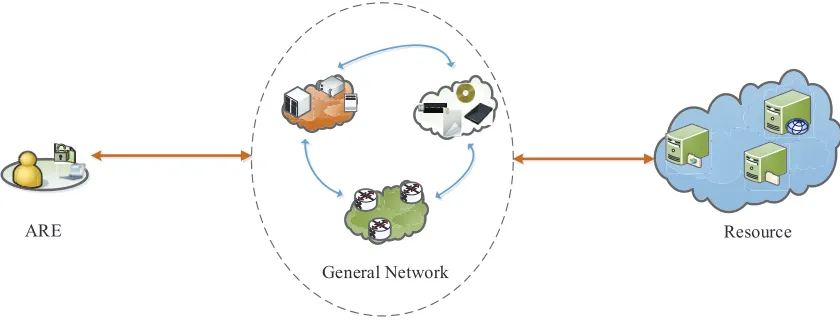
As shown in Fig. 1, the system model of our CoAC model includes three entities, they are Access Requesting Entity (ARE), general network and resources, respectively.
Access Requesting Entity: ARE denotes the initiator of resource access. It sends the accessing request to the resource server through the network/general network. When assigning access permission to ARE, the resource server needs to consider many access control factors such as the device, general temporal status, access point and resource, etc.
Network/general network: it denotes the carriers of information dissemination during information accessing, which can be any network form connected, such as mobile internet and wired network. This concept also includes the network form connected by the traditional dis-semination tools, for example, disk, flash, papers and so on.
ARE Resource
General Network
Figure 1: System Model of CoAC
3.2 Some Basic Definitions
Definition 1. Access requesting entity (ARE) refers to the initiator of an information accessing request. It is denoted by q = ⟨u, a, r⟩, where u represents the user’s unique identity, a means the unique identity of an access agent that can be either a device, process or another user,
r indicates the role of a particular user. We define the user set, access agent and role by
U ={ui|i∈ N∗}, A ={ai|i∈ N∗} and R ={ri|i∈ N∗}, respectively. Thus, the ARE set is
defined asQ={q =⟨u, a, r⟩ |u∈U, a∈A, r∈R}.
Note that, we use q =⟨u,·,·⟩ to describe all the information accessing requests queried by useru,q=⟨u,·, r⟩ represents all the information accessing requests queried by useru, with the role r. For simplicity, we ignore the similar descriptions of the other cases in details.
Definition 2. General tense means all the tense-related information when the ARE access-ing resources. It is denoted by T = {t = ⟨interval,period,duration⟩ |interval ∈ 2TIN,period ∈
R+,duration∈R+}, whereinterval∈2TIN
refers to the starting and ending time of a particular access, and TIN ={[begini,endi]|i∈N∗}. period represents the life cycle of a period, and
du-ration represents the access duration. Note that, we have t=⟨[begin1,end1],[begin2,end]2,· · · , [begin|TIN|,end|TIN|]⟩, if |TIN| ̸= 1. Otherwise, we have t = ⟨[begin,end],period,duration⟩, if |TIN|= 1.
Definition 3. Access point refers to the spatial location and network identity when an ARE accessing the network system and querying the information accessing request for the first time. The accessing system distinguishes different accesses based on the unique network identity. The access point is denoted byl=⟨lSPID, lNETID⟩, wherelSPID=⟨x, y, z⟩ ∈LSPIDmeans the location in three-dimensional coordinate system, i.e.,x,yandzmay be the latitude, longitude and hight. LNETID ={imei,bs,nid,port,ip,domian,· · · } represents the unique identity of network access,
whereimei means the international mobile equipment identity,bs indicates the unique identity
of the base station, nid is the network ID, mac refers to the MAC address, port is the port
interface. ip means the IP address,domainmeans the domain name, etc. Then the access point
set is defined as L ={l =⟨lSPID, lNETID⟩ |lSPID ∈LSPID, lNETID ∈ 2LNETID}, whereLSPID and LNETID represent the spatial location and network identity, respectively.
by o =⟨cO, gO, sO⟩, where cO ∈CO, gO ∈GO and sO ∈SO refer to content, general property and security property of resources, respectively. The general property set of resources is de-fined as GO ={gO =⟨gOSORT, gOSOU RCE, gOSIZE, gOT IM E,· · · ⟩ |gOSORT ∈ GOSORT, gOSOU RCE ∈
GOSOU RCE, gOSIZE ∈ GOSIZE, gOT IM E ∈GOT IM E,· · · }. In this set, GOSORT represents types of
resource, denoted as GOSORT ={database,file,web,· · · }, which are database, file and web, etc.
GOSOU RCE denotes the source of information, denoted asGOSOU RCE ={creat,forward,reconstruct,
· · · }, which means the creation, forwarding, reconstruction and etc. GOSIZE denotes the size
of resource. GOT IM E represents the time property of resource as mentioned in Def. 3.2.
The security property set of resource indicates the security-related permissions on a particu-lar resource, such as permissions of executing, forwarding and destroying etc. It is defined as SO = {sO = ⟨sOOP, sODIS, sODE, sOSEC, sOEN C,· · · ⟩ |sOOP ∈ 2SOOP, sODIS ∈ 2SODIS, sODE ∈
SODE, sOSEC ∈ SOSEC, sOEN C ∈ SOEN C,· · · }. In this set, SOOP represents the allowed
opera-tions, denoted bySOOP ={read,edit,copy,forward,print,revoke,· · · }. SODISmeans the resource
distribution methods, denoted bySODIS ={u-disk,cd/dvd,encryption,network,· · · }. SODE
rep-resents resource destroy methods, denoted bySODE ={logicaldel,physicaldel,· · · }. SOSEC refers
to the security level of resource, denoted by SOSEC ={top secret,secret,· · · }. SOEN C indicates
the encryption methods, denoted by SOEN C ={3DES,RSA,ECC,AES,SM2/3/4,· · · }. Then we
define the set of resources asO={o=⟨cO, gO, sO⟩ |oO∈cO, gO∈GO, sO∈SO}.
Definition 5. Device refers to the equipment, which is used to access resources by the ARE. We define the composition characteristics and relevant properties asd=⟨gD, sD, t⟩, wheregD,sDand trepresent the general property, security property and general tense of device, respectively. They are denoted by D={d=⟨gD, sD, t⟩ |gD∈2GD, sD∈2SD, t∈T}. In this set, GDrepresents the general property set, denoted byGD={cpu,os,interface,memory,disk,app,· · · }, wherecpu,os,
interface,memory,disk and appindicates the CPU, operating system, interface, main memory, disk and applications in the device, respectively. SDrepresents the security property set, denoted by SD={[mincoe, maxcoe],security domain,securitylevel,securitysoftmodule, securityhardmod-ule,· · · }, wheremincoe and maxcoe indicate minimum and maximum risk tolerance coefficient,
securitydomain means security domain,securitylevel refers to security level, securitysoftmodule
shows security software module, and securityhardmodule represents security hardware module,
etc. T represents the general tense set, which covers all the tense-related properties of the device and similar as the definition in Def. 3.2.
Definition 6. Network refers to information transmission carrier that is the set of different
networks. We define the set of network as a directed property graphN G= (V, E), where vertex
of a graph represents a device or a subnetwork in the network, and edge of a graph denotes connected property and security property of vertexes.
Vertex is denoted by v = ⟨nV, gV, sV⟩, where nV ∈ NV, gV ∈ GV and sV ∈ SV represent name, general property and security property of the vertex v, respectively.
The general property set of vertex is defined as GV = {gV = ⟨gVNT, gVIO, gVNP⟩ |gVNT ∈
GVNT, gVIO ∈ GVIO, gVNP ∈ 2GVNP}. In this set, GVNT represents set of network types,
denot-ed by GVNT = {lan,wan,wlan,· · · }. GVIO means set of vertex types, denoted by GVIO = {in,out,inout,interior,· · · }. GVNP refers to set of network protocols, denoted by GVNP = {TCP/IP,Bluetooth,802.11a/b/g/h,ISO1989,CDMA2000/WCDMA/TD-SCDMA,LTE,· · · }.
SV indicates vertex’s security property set. When a vertex represents a device,SVis similar
as the Definition SD in 3.2. When a vertex denotes a network, we define its security property
set as SV = {sV = ⟨sVCON, sVENC, sVPT⟩ |sVCON ∈ SVCON, sVENC ∈ 2SVENC, sVPT ∈ 2SVPT}. In
modes, denoted bySVENC ={3DES,RSA,ECC,AES,SM2/3/4,· · · }. SVPT refers to set of security
protocols, denoted by SVPT ={SSL,SSH,HTTPS,MANCONFIRM,· · · }.
Thus we define Vertex set as V ={vi =⟨niV, gVi , sVi ⟩ |nVi ∈NV, gVi ∈GV, siV∈SV, i∈N∗}.
Edge is denoted by e = ⟨vm, vm, gE, sE⟩, where vm ∈ V, vn ∈ V, gE ∈ GE and sE ∈ SE
represent the starting vertex, the ending vertex, connected property and security property of edgee, respectively.
We define edges’ general property set as GE = {gE = ⟨gEM, gENP⟩ |gEM ∈ 2GEM, gENP ∈
2GENP}, where GEM ={bandwidth,QoS,hop,delay,· · · }represents set of performance
character-istics, andGENP ={TCP/IP,Bluetooth,802.11a/b/g/h,ISO1989,CDMA2000/WCDMA/TD-SCDMA,
LTE,· · · } denotes set of network protocols.
The set of edges’ security properties is denoted by SE = {sE = ⟨sEENC, sEPR⟩ |sEENC ∈
SEENC, sEPR ∈SEPR}, where SEENC ={3DES,RSA,ECC,AES,SM2/3/4,· · · } means set of
en-cryption mode, andSEENC ={SSL,SSH,HTTPS,MANCONFIRM,· · · }indicates set of security
protocols.
Then we define edge set as E = {ei = ⟨vim, vin, g
E
i , sEi⟩ |vim, vin ∈ V, g
E
i ∈ GE, sEi ∈
SE, i, im, in∈N∗}.
Finally, Network is denoted as a directed property graph N G= (V, E).
Definition 7. Internet-based interactive graph refers to the network sub-figure constructed by the connected path between two arbitrary vertexes. We define it based on exchange action and chain of internet transmission.
Exchange action consists of two connected and adjacent nodes and the corresponding edge. If for vertexesv, w ∈N G(V, E) there exits a edgee=⟨v, w, gE, sE⟩ ∈E, we define the exchange
action between v and w asN =⟨v →w, t⟩, where v∈V, w∈W and t∈T represent vertexes
and tense property, respectively. The set of all exchange actions in network graph is defined by NG={Ni=⟨vi →wi, ti⟩ | ∀ei=⟨vi, wi, giE, sEi ⟩ ∈E, i∈N∗, ti ∈T}.
Chain of internet transmission indicates the set of ordered exchange actions. We suppose that uandvrepresent information sender and information receiver. Thus the chain of internet trans-mission betweenuandvis defined byN(v, w) ={Ni(v, w) =⟨Ni1, Ni2,· · · , Nij,· · · , Nik⟩ |i, k, ij ∈
N∗,1 < j ≤ k, v
i1 = v, wik = w, tij ∈ T, Nij = ⟨vij, wij, tij⟩ ∈ N
G, where f or∀1 < j ≤
k, wij =vij+1}. Then we denote the set of all exchange actions in internet transmission chain as
NC(v, w) = {Nij = ⟨vij, wij, tij⟩ | ∀Ni(v, w) = ⟨Ni1, Ni2,· · ·, Nij,· · ·, Nik⟩ ∈ N(v, w), i, k, ij ∈
N∗,1< j≤k}.
Since there are unidirectional edges and bidirectional edges in directed property graphN G= (V, E), interactive graph, consisting of all connected information transmission chains betweenv andw, includes any combination of unidirectional edges and bidirectional edges. It is defined as N GN = (V(v, w), E(v, w)), whereV(v, w) ={vij =⟨n
V ij, g
V ij, s
V
ij⟩ |ij ∈N
∗,∀N
ij =⟨vij, wij, tij⟩ ∈
NC(v, w), vij ∈V} ∪ {w}, andE(v, w) ={eij =⟨vij, wij, g
E ij, s
E
ij⟩ |ij ∈N
∗,∀N
ij =⟨vij, wij, tij⟩ ∈
NC(v, w), eij =⟨vij, wij, g
E ij, s
E
ij⟩ ∈E}.
Definition 8. Chain of resource transmission refers to the whole courses of information ex-change in the process of resource transmission. Resources exex-change action means one resource transmission between two access requesting entities, denoted by I = ⟨s → r, o, t⟩, where s, o, r and t represent resource sender or resource transmitter, resource receiver, resource itself and general tense as defined in the Def.3.2, respectively.
si, ri,k =ri, si ∈Q, ri∈Q, si,l∈Q, ri,l∈Q,1< l≤k−1}, wheresi,riand orepresent initiator
of resource transmission, receiver of resource transmission and resource itself, respectively. We define set of chains of resource transmission as OC = {OiC(s, ri, o)|i ∈ N∗}, where
initiator of resource transmission is represented bys, and receivers of resource transmission are denoted by r1, r2,· · · , ri,· · ·.
Definition 9. Scene screfers to set of all permissions the information access entity needed to
perform a function. It means general tense t, access point l, device dand network information
ng the access entityq needed when q starts session s, where t∈T,l∈L,d∈D and ng∈N G.
Thus we denote scas sc= (t, l, d, ng). In this set, the valuing range of every elements in scis
{tSC},{lSC},{dSC}and {ngSC}.
Definition 10. Scene constraintsConstraints-screpresents that permissions are only obtainable through scene sc when the access entity initiate session safter initiating a session.
Definition 11. Resource access entity-scene assignmentqsc refers to the process that resource access entity is assigned scenesc. We define the corresponding set as QSC.
Definition 12. Entity scene-permission assignmentqscp refers to the process that
Constraints-qsc is assigned permission p. We define the corresponding set asQSCP.
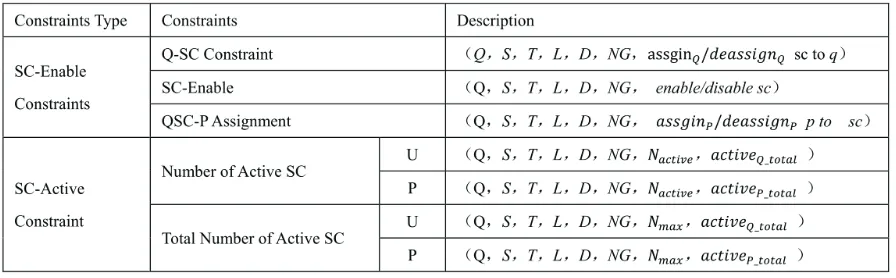
We present Constraints-sc in Fig. 2, where enable, disable and active are similar to the
corresponding definition in [11]. S represents session set. assign/deassign represents relation of
assignment and de-assignment. Nactive means the active number. Nmax denotes maximal active
number. activeQ−total represents the number of all scenes activated by resource access entity. activeP−total represents the number of all activated scenes with a permission.
Figure 2: Scene Constraints Description
3.3 Hierarchy Structure and its Inheritance Mechanism
Since scene comprehensively takes four factors into consideration, including general tense, access point, access device and network, it also has hierarchy structure.
Definition 13. General tense hierarchy structure refers to partial order over general tense set T, defined by T H ⊆T×T. For any ti,tj ∈T, there is (ti, tj)∈T H if and only ifti ≥tj. For
(ti, tj) ∈T H, we define that ti is higher than tj, and denote ti ≥ tj. If for (ti, tj) ∈T H there
exits notk such thatti≥tk and tk ≥tj, we define that ti is directly higher thantj.
(li, lj) ∈ LH, we define that li is higher than lj, and denote li ≥ lj. If for (li, lj) ∈ LH there
exits nolk such that li≥lk andlk ≥lj, we define that li is directly higher thanlj.
Definition 15. General device hierarchy structure refers to partial order over general device setD, defined byDH ⊆D×D. For anydi,dj ∈D, there is (di, dj)∈DH if and only ifdi≥dj.
For (di, dj)∈DH, we define thatdi is higher than dj, and denote di≥dj. If for (di, dj)∈DH
there exits nodk such thatdi≥dk and dk≥dj, we define that di is directly higher thandj.
Definition 16. Network hierarchy structure refers to partial order over network setN G, defined by N GH ⊆ N G×N G. For any ngi, ngj ∈ N G, there is (ngi, ngj) ∈ N GH if and only if
ngi≥ngj. For (ngi, ngj)∈N GH, we define that ngi is higher than ngj, and denotengi≥ngj.
If for (ngi, ngj)∈N GH there exits no ngk such that ngi ≥ngk and ngk ≥ngj, we define that
ngi is directly higher thanngj.
Definition 17. Scene hierarchy structure refers to partial order over scene setSC, defined by SCH ⊆ SC×SC. For any sci, scj ∈ SC, there is (sci, scj) ∈ SCH if and only if sci ≥scj.
For (sci, scj) ∈ SCH, we define that sci is higher than scj, and denote sci ≥ scj. If for
(sci, scj) ∈ SCH there exits no sck such that sci ≥ sck and sck ≥ scj, we define that sci is
directly higher than scj.
3.4 Cyberspace-oriented Access Control Model
According to the definition of scene and formal definition in [11], we construct access control model as follows.
Definition 18. The components of Cyberspace-Oriented Access Control (CoAC) model are as follows:
1) Q, SC,P,S (ARE, scene, permission, session), SC= (T, L, D, N G), whereT,L, D,NG
denotes general tense, access point, resource, access device, network as defined in 3.2.
2)QSC⊆Q×SCrepresents relation of assignment between many-to-many access requiring
entity and scene.
3) QSCP ⊆ QSC×P denotes relation of assignment between many-to-many entity scene
and permissions.
4) entity : session → Q represents the function mapping session sj into access requiring
entity.
5)scene:S→2SC denotes the function mapping session sj into scene set. In this function,
scene(si)⊆ {sc|(∃sc′ ≥sc) [entity(si), a′]∈QSC}, andsihas permission∪SC∈scene(si){p|(∃q
′′ ≤
q)[(q′′, p)∈SCP]}.
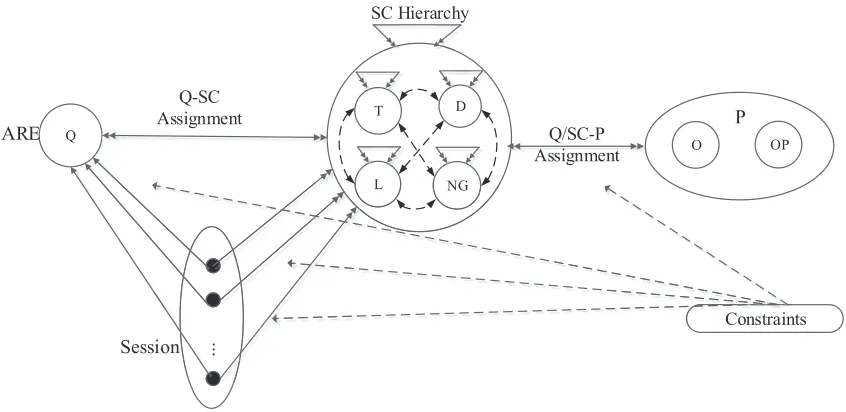
As shown in Fig. 3, the structure of CoAC model including various levels of scene, access point, general tense, access device and network.
Internet-based interactive graph limits access permissions to resource for access requiring entity through restricting transmission routes of resource on network. When access requiring entityq proposes access requirement of resourceoto the resource sever, the sever will gets some
information about q’s network location simultaneously such as IP address, port number and
Q
L NG
D
...
T
Constraints
L NG
Cons
O OP
P
SC Hierarchy
ARE
Q-SC Assignment
Q/SC-P Assignment
Session
Figure 3: Access Model of CoAC
senior executive and his company isn’t included in resource o’s network interactive graph, the
senior executive cannot access resource o.
Chain of resource transmission realize controlled secondary/mutiple distribution, information protection and trace to the source by limiting resource’s forwarding path. When access requiring
entity q proposes access requirement of resource o to the resource sever, the sever will judge
whether q is in the chain of o’s resource transmission or not. If q is included in the chain
of o’s resource transmission, the access requirement, satisfying access control strategy, will be
permitted. Otherwise, it will be refused. Moreover, when q make a request for the operation
permission of forwarding o to the resource sever, the sever will judge whether the receiver ofo is in the chain of o’s resource transmission or not. If yes, permit forwarding, otherwise refuse.
In this sense, we can achieve controlled secondary/mutiple distribution of resource o. We also
trace to the source of resource via chain of resource transmission. Because that resource is transmitted between different AREs lead to the fact that information of every ARE will be recorded in metadata of resource or metadata returned to sever, we can trace to the source of a resource by getting the metadata.
4
Administrative model
4.1 Administrative scene and administrative model
In our CoAC model, the administrative scene is used to realize security management of other scenes. So safety of administrative scene itself, related to overall security of CoAC model, is
a core issue. We use AQ as set of AREs of administrative resource and define administrative
scene by setting limited general tense, access point, access device and network.
adsc∈ADSC, whereADSC={adsc= (aq,limt,liml,limd,limng)|aq∈AQ,limt∈LIMT,liml∈ LIML,limd∈LIMD,limng∈LIMNG}. In this set,AQ,LIMT,LIML,LIMD and LIMNG rep-resent administrative resource access entity, limited general tense, limited access point, limited access device and limited network.
Administration scene can provide more securing service and manage trust for general scenes by introducing trusted platform module to controlled scene. We setADP as set of administrative permission and present administrative model of in view of ABAC [11].
Definition 21. The components of administrative model are as follows:
1)Q: resource access entity. SC: general scene set defined in Def.3.2. ADSC: administrative scene set defined in Def.4.1. P: permission set. ADP: administrative permission set. S: session set.
2)SCSC⊆SC×SCrepresents many-to-many scene-scene assignment relation.
3)QSC⊆Q×SCrepresents many-to-many resource access entity-scene assignment relation.
4)QADSC⊆Q×ADSC denotes many-to-many user-administrative scene assignment rela-tion.
5)ADSCP⊆ADSC×Pdenotes many-to-many administrative scene-permission assignment relation.
6)SCH⊆SC×SC refers to partial order over scene setSC, denoted by≥.
7) ADSCH⊆ADSC×ADSC represents partial order over administrative scene set ADSC, denoted as ≥.
8)Constraints denotes constraint conditions.
9) entity : S → Q represents the function mapping session si into access requiring entity
entity(si). (Session remains unchanged in its lifecycle).
10) scene: S → 2SC∪ADSC denotes the function mapping session si into scene set. In this
function, scene(si)⊆ {sc|(∃sc′≥sc) [(entity(si), a′)∈QSC ∪ QADSC]}, andsi has permission ∪SC∈scene(si){p|(∃q′′≤q)[(q′′, p)∈SCP ∪ ADSCP]}.
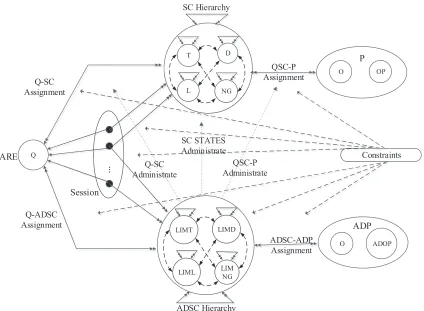
Fig. 4 presents structure of scene administrative model, including various levels of general scene, administrative scene, general tense, access device and network. The figure shows that
scene administrative model use administrative scene setADSC to manage resource access
entity-scene assignment, entity-scene-permission assignment and entity-scene state. Scene administrative model con-trols resource access entity-scene, scene-permission, resource access entity-administrative scene
assignment, administrative scene-administrative permission assignment throughConstraints.
S-ince administrative scene manage general scene, the security of management is able to be guar-anteed.
4.2 Functions of administrative model
We have proposed control relationship among resource access entity-scene assignment, resource access entity-scene revocation, scene-permission assignment and scene-permission revocation in administrative model. Based on it, we define control relationship among resource access entity-administrative scene control relationship, entity-administrative scene-entity-administrative permission and function related to scene state administration in CoAC.
Definition 22. We denote prerequisite as Boolean-expression that operate withxandxthrough operator∨and ∧.
1) x ∈ SC represents general scene. For resource ARE q, if x is true, we have (∃x′ ≥
Q L NG D Q-SC Assignment ADSC-ADP Assignment ... T ARE Constraints L NG SC gnment LIML LIM NG LIMD LIMT Q-ADSC Assignment QSC-P Assignment Co ... NG NG QSC-P Administrate SC STATES Administrate Q-SC Administrate SC Hierarchy ADSC Hierarchy
... QQQ-SCSCSCSC nistra Ad Ad Ad Ad Ad Ad Ad Ad Ad Administra Ad Ad Ad Ad Ad Ad Ad Ad Ad Ad O OP P O ADOP ADP LIML LIM NG LIMD LIMT Session
Figure 4: Administrative Model of CoAC
general scene set SC, setCSC as all prerequisite conditions possibly gain by using SC.
2) x ∈ ADSC represents administrative scene. For resource ARE q, if x is true, we
have (∃x′ ≥ x)((q, x′) ∈ QADSC∨(q, x′) ∈/ QA). If x is true, we have (∀x′ ≥ x)((q, x′) ∈/
QADSC∨(q, x′)∈/ QA). For given administrative scene setADSC, set CADSC as all prerequi-sites administrative scene possibly gain by using ADSC.
Definition 23. Administration model uses following relations to assign resource access entity-administrative scene and revoke resource access entity-entity-administrative scene that has already assigned.
can.assignsq⊆ADA’×CADSC×2ADSC,
can.revokesq⊆ADA’×2{ADSC\{superadsc}}.
In the above relations, ADA′ = ADA{a|@a′ ∈ ADA, a′ < a}. superadsc represents sys-tem setting super administrative scene, located on the top of administrative scene hierarchy
structure, and cannot be revoked. If Z denotes set of administrative scene could be allocated,
can.assignsq(x, y, Z) represents that administrative scene x (or ∀x′ > x) can assign
adminis-trative scene z ∈ Z to users satisfying prerequisite y. If Z denotes revoked administrative
Definition 24. Administration model use following relations to assign administrative scene-administrative permission and revoke scene-administrative scene-scene-administrative permission that has already assigned.
can.assignsq⊆ADA’×CADSC×2ADP,
can.revokesq⊆ADA’×2ADP.
In the above relations, ADA′ =ADA{a|@a′ ∈ADA, a′ < a}. ADP ={ entityad, scenead, per-missionad, qscad, scpad, scsad} represents administrative permission set, where entityad, sce-nead,permissionad,qscad,scpad,scsad denotes resource access entity administration, scene ad-ministration, permission adad-ministration, user-scene assignment adad-ministration, scene-permission assignment administration and scene state administration, respectively. If Z denotes set of ad-ministrative permission could be allocated, can.assignsq(x, y, Z) represents that administrative scene x (or ∀x′ > x) can assign administrative permission z∈Z to administrative scene satis-fying prerequisite y. IfZ denotes revoked administrative behavior set, can.revokesq(x, Z) rep-resents that administrative scenex (or∀x′> x) can revoke administrative scene setZ assigned to user.
We apply Z-notation to formalized definition of add, revise and delete scene in scene state
administration. NAME that denotes abstract data type can represent component of scene model
such as scene, resource access entity, general tense, access point, access device, network, session,
permission and etc. USERS,QUERYS,DEVICES,NETGRAPHS,SESSIONS,OPS and OBS
means USER set, ARE set, access device set, network set, session set, operation set and object set, respectively.
AddScene(scene:N AM E)
scene /∈SCEN ES
if scene.query /∈QU ERY S then QU ERY S′=QU ERY S∪ {role}
if scene.temporalstate /∈T ST AES then T ST AT ES′ =T ST AT ES∪ {temporalstate}
if scene.locate /∈LOCAT ES then LOCAT ES′=LOCAT ES∪ {locate}
if scene.device /∈DEV ICES then DEV ICES′ =DEV ICES∪ {device}
if scene.netgraph /∈N ET GRAP HS then N ET GRAP HS′ =N ET GRAP HS∪ {netgraph}
SCEN ES′ =SCEN ES∪ {scene}
M odif yScene(scene, query, temporalstate, locate, device, netgraph:N AM E)
scene∈SCEN ES
if scene.query /∈QU ERY S then QU ERY S′=QU ERY S∪ {query}
if scene.temporalstate /∈T ST AES then T ST AT ES′ =T ST AT ES∪ {temporalstate}
if scene.locate /∈LOCAT ES then LOCAT ES′=LOCAT ES∪ {locate} if scene.device /∈DEV ICES then DEV ICES′ =DEV ICES∪ {device}
if scene.netgraph /∈N ET GRAP HS then N ET GRAP HS′ =N ET GRAP HS∪ {netgraph}
[∀s∈SESSION S scene∈SCEN E scene(s)⇒DeleteSession(s)]
scene′= (temporalstate, locate, device, netgraph)
SCEN ES′=SCEN ES\ {scent} ∪ {scene′}
QSC′=QSC\ {∀q ∈QU ERY S ·scene7→q} ∪ {scene′7→∅}
SCP′ =SCP \ {∀op∈OP S.∀ob∈OBS ·scene7→(op, ob)} ∪ {scene′7→∅}
DeleteScene(scene:N AM E)
scene∈SCEN ES
[∀s∈SESSION S ·scene∈session.scene(s)⇒DeleteSession(s)]
[∀sc∈SCEN ES\ {scene} ·sc.q≠ scene.q⇒QU REY S′ =QU ERY S\ {scene.q}]
[∀sc∈SCEN ES\ {scene} ·sc.temporalstate̸=scene.temporalstate⇒
T ST AT ES′=T ST AT ES\ {scene.temporalstate}]
[∀sc∈SCEN ES\ {scene} ·sc.locate̸=scene.locate⇒
LOCAT ES′ =LOCAT ES\ {scene.locate}] [∀sc∈SCEN ES\ {scene} ·sc.device̸=scene.device⇒
DEV ICES′=DEV ICES\ {scene.device}]
[∀sc∈SCEN ES\ {scene} ·sc.netgraph̸=scene.netgraph⇒
N ET GRAP HS′ =N ET GRAP HS\ {scene.netgraph}]
QSC′=QSC\ {∀q ∈QU ERY S ·scene7→q}
SCP′=SCP \ {∀op∈OP S.∀ob∈OBS ·scene7→(op, ob)}
SCEN ES′=SCEN ES\ {scene}
We can identify ARE’s user identity, access agent, role information, access point, access device, network and etc, and use functions in the following table to manage ARE-scene, scene-permission as well as the state of scene.
5
Descriptions of Some Typical Models by Using CoAC
Table 1: Administrative Functions Function Name Description
If the user’s identify id is valid, return True, otherwise return False.
verifyid verif yid(userid, certif ication:N AM E.outresult:BOOLEAN)
result= (userid∈U)∧(isvalid(certif ication))
If the scene is valid, return True, otherwise return False.
isnable isnable(scene:N AM E.outresult:BOOLEAN) scene∈SCEN E
result=scene∈EN ABLE∗
If the general temporal state of requestreqtsatisfies the general temporal stateverif yt, return True, otherwise return false.
verif yt(reqt:N AM E.outresult:BOOLEAN) verifyt reqt∈T ST AT ES
result= (∃t1, t2∈validt·t1< reqt < t2)∧(q∈Q.t∈T ST AT ES.l∈LST AT ES. d∈DST AT ES.ng∈N GST AGES.p∈P ERM ISSION S·(q, sc= (reqt, l, d, ng)∈QSC)
∧(sc= (reqt, l, d, ng), p)∈SCP)
If the access point of request statereqlsatisfies the access point stateverif yl, return True, otherwise return false.
verif yl(reql:N AM E.outresult:BOOLEAN)
verifyl reql∈LST AT ES
result= (∃l1, l2∈validt·l1< reql < l2)∧(q∈QU REY S.l∈LST AT ES.t∈T ST AT ES.
d∈DST AT ES.ng∈N GST AGES.p∈P ERM ISSION S·(q, sc= (t, reql, d, ng)∈QSC)
∧(sc= (t, reql, d, ng), p)∈SCP)
If the device state of requestreqdsatisfies the device stateverif yd, return True, otherwise return false.
verif yd(reqd:N AM E.outresult:BOOLEAN) verifyd reqd∈DST AT ES
result= (∃d1, d2∈validd·d1< reqd < d2)∧(q∈QU ERY S.d∈DST AT ES.l∈LST AT ES. t∈T ST AT ES.ng∈N GST AGES.p∈P ERM ISSION S·(q, sc= (t, l, reqd, ng)∈QSC)
∧(sc= (t, l, reqd, ng), p)∈SCP)
If the network state of requestreqtsatisfies the network stateverif yng, return True, otherwise return false.
verif yng(reqng:N AM E.outresult:BOOLEAN)
verifyng reqng∈N GST AT ES
result= (∃ng1, ng2∈validt·ng1< reqng < ng2)∧(q∈QU REY S.ng∈N GST AGES.
t∈T ST AT ES.l∈LST AT ES.d∈DST AT ES.p∈P ERM ISSION S
·(q, sc= (t, l, d, reqng)∈QSC)∧(sc= (t, l, d, reqng), p)∈SCP)
Return the active scene number of the user.
n.activescbyu n.activescbyu(user:N AM E.outresult:N) user∈U SERS
result=NactiveU total(user)
Return the maximal active scene number of the user.
maxn.activescbyp maxn.activescbyu(user:N AM E.outresult:N) user∈U SERS
result=NmaxU total(user)
Return the scene number of the active permission.
n.activescbyp maxn.activescbyu(permission:N AM E.outresult:N) permission∈P ERM ISSION S
result=NactiveP total(user)
Return the scene number of the active permission.
maxn.activescbyp maxn.activescbyu(permission:N AM E.outresult:N) permission∈P ERM ISSION S
result=NmaxP total(user)
5.1 Discretionary Access Control (DAC)
According to the Def1 and Def4, letA=R=GO =SO=∅. Then the DAC model is equivalent
model,O={o=⟨cO,·,·⟩}denotes the object in DAC model, OP denotes the operational type.
5.2 Mandatory Access Control (MAC)
According to the Def1 and Def4, let A = SO = ∅. Then the MAC model is equivalent to
⟨Q, O, OP⟩, that isM AC ∼=⟨Q, O, OP⟩, whereQ={q =⟨u,·, r⟩}denotes the subject in DAC model, O = {o = ⟨cO,·, sO⟩} denotes the object in MAC model, OP denotes the operational type.
5.3 Temporal Role-based Access Control (TRBAC) / Role-based Access Control (RBAC)
According to the Def1, Def2 and Def4, letGO=SO=∅. Then the TRBAC model is equivalent
to ⟨Q, O, T, OP⟩, that is T RBAC ∼=⟨Q, O, T, OP⟩, where Q ={q = ⟨u,·, r⟩} and u, r denote the user and role in TRBAC model respectively, O = {o = ⟨cO,·,·⟩} denotes the resources in
the TRBAC model, OP denotes the operational type.
As above mentioned, if we let T =∅, then the TRBAC model converts to RBAC model. In
another words, RBAC model is equivalent to⟨Q, O, OP⟩, that is RBAC∼=⟨Q, O, OP⟩.
5.4 Action-based Access Control (ABAC)
According to Def1-6, let SD = GO = SO = ∅. Then the ABAC model is equivalent to
⟨Q, O, A, OP⟩, that is ABAC ∼= ⟨Q, O, A, OP⟩ where Q = {q = ⟨u, a, r⟩} and u, a, r denote
the user, agent and role in the ABAC model, O = denotes the resources in the ABAC model,
A=⟨R, L, D, N G, T⟩ and R,L,D={d=⟨gD,·, t⟩},N G,T denote the role, device, network, and general temporal respectively.
6
Conclusions
References
[1] S. Berg, C. Lane, and M. Whittaker, Glossary of Computer Security Terms. National
Computer Security Center, 1989.
[2] D. Bell and L. LaPadula, “Secure computer systems: Mathematical foundations and mod-el.”
[3] D. Ferraiolo, D. R. Kuhn, and R. Chandramouli,Role-based access control. Artech House,
2003.
[4] R. K. Thomas and R. S. Sandhu, “Task-based authorization controls (tbac): A family of models for active and enterprise-oriented authorization management,”DBSec, vol. 113, pp. 166–181, 1997.
[5] E. Freudenthal, T. Pesin, L. Port, E. Keenan, and V. Karamcheti, “drbac: distributed
role-based access control for dynamic coalition environments,” in Distributed Computing
Systems, 2002. Proceedings. 22nd International Conference on. IEEE, 2002, pp. 411–420.
[6] S. Liu and H. Huang, “Role-based access control for distributed cooperation environment,” in Computational Intelligence and Security, 2009. CIS’09. International Conference on,
vol. 2. IEEE, 2009, pp. 455–459.
[7] E. Bertino, B. Catania, M. L. Damiani, and P. Perlasca, “Geo-rbac: a spatially aware rbac,” in Proceedings of the tenth ACM symposium on Access control models and technologies. ACM, 2005, pp. 29–37.
[8] C. A. Ardagna, M. Cremonini, E. Damiani, S. D. C. di Vimercati, and P. Samarati,
“Sup-porting location-based conditions in access control policies,” in Proceedings of the 2006
ACM Symposium on Information, computer and communications security. ACM, 2006, pp. 212–222.
[9] E. Yuan and J. Tong, “Attributed based access control (abac) for web services,” in Web
Services, 2005. ICWS 2005. Proceedings. 2005 IEEE International Conference on. IEEE, 2005.
[10] M. Pirretti, P. Traynor, P. McDaniel, and B. Waters, “Secure attribute-based systems,” in
Proceedings of the 13th ACM conference on Computer and communications security. ACM, 2006, pp. 99–112.
[11] F. Li, W. Wang, J. Ma, and X. Liang, “Action-based access control model and administra-tion of acadministra-tions,”Acta Electronica Sinica, vol. 36, no. 10, pp. 1881–1890, 2008.
[12] M. Chase and S. S. Chow, “Improving privacy and security in multi-authority
attribute-based encryption,” inProceedings of the 16th ACM conference on Computer and
commu-nications security. ACM, 2009, pp. 121–130.
[13] X. Liu, Y. Zhang, B. Wang, and J. Yan, “Mona: secure multi-owner data sharing for
dynamic groups in the cloud,” Parallel and Distributed Systems, IEEE Transactions on,
[14] W. Stallings, Network and internetwork security: principles and practice. Prentice Hall Englewood Cliffs, 1995, vol. 1.
[15] R. S. Sandhu, E. J. Coyne, H. L. Feinstein, and C. E. Youman, “Role-based access control models,”Computer, vol. 29, no. 2, pp. 38–47, 1996.
[16] R. Sandhu, V. Bhamidipati, and Q. Munawer, “The arbac97 model for role-based
adminis-tration of roles,”ACM Transactions on Information and System Security (TISSEC), vol. 2,
no. 1, pp. 105–135, 1999.
[17] R. Sandhu and Q. Munawer, “The arbac99 model for administration of roles,” inComputer
Security Applications Conference, 1999.(ACSAC’99) Proceedings. 15th Annual. IEEE, 1999, pp. 229–238.
[18] S. Oh, R. Sandhu, and X. Zhang, “An effective role administration model using organization
structure,”ACM Transactions on Information and System Security (TISSEC), vol. 9, no. 2,
pp. 113–137, 2006.
[19] E. Bertino, E. Ferrari, and V. Atluri, “The specification and enforcement of authorization
constraints in workflow management systems,” ACM Transactions on Information and
System Security (TISSEC), vol. 2, no. 1, pp. 65–104, 1999.
[20] G. Coulouris, J. Dollimore, and M. Roberts, “Role and task-based access control in the
perdis groupware platform,” inProceedings of the third ACM workshop on Role-based access
control. ACM, 1998, pp. 115–121.
[21] E. Bertino, P. A. Bonatti, and E. Ferrari, “Trbac: A temporal role-based access control
model,” ACM Transactions on Information and System Security (TISSEC), vol. 4, no. 3,
pp. 191–233, 2001.
[22] X.-M. Wang and Z.-T. Zhao, “Role-based access control model of temporal object.”Dianzi
Xuebao(Acta Electronica Sinica), vol. 33, no. 9, pp. 1634–1638, 2005.
[23] C. Xu, Q. Wang, W. Zhang, and Y. Ding, “Temporal access control based on multiple
sub-jects,” inMultimedia Information Networking and Security, 2009. MINES’09. International
Conference on, vol. 2. IEEE, 2009, pp. 438–441.
[24] L. Xiao-Feng, F. Dengguo, C. Zhaowu, and F. Zi-he, “Model for attribute based access control,”Journal on Communications, vol. 29, no. 4, pp. 90–98, 2008.
[25] X.-m. WANG, H. FU, and L.-c. ZHANG, “Research progress on attribute-based access control [j],”Acta Electronica Sinica, vol. 7, p. 033, 2010.
[26] T. May, “Time-release crypto,” 1993.
[27] R. L. Rivest, A. Shamir, and D. A. Wagner, “Time-lock puzzles and timed-release crypto,” 1996.
[28] J. Cathalo, B. Libert, and J.-J. Quisquater, “Efficient and non-interactive timed-release
[29] K. G. Paterson and E. A. Quaglia, “Time-specific encryption,” inSecurity and Cryptography for Networks. Springer, 2010, pp. 1–16.
[30] L. Zhou, V. Varadharajan, and M. Hitchens, “Enforcing role-based access control for secure data storage in the cloud,”The Computer Journal, p. bxr080, 2011.
[31] G. Wang, Q. Liu, and J. Wu, “Hierarchical attribute-based encryption for fine-grained
access control in cloud storage services,” in Proceedings of the 17th ACM conference on
Computer and communications security. ACM, 2010, pp. 735–737.
[32] C. Hong, M. Zhang, and D. Feng, “Ab-accs: A cryptographic access control scheme for cloud
storage,”Journal of Computer Research and Development, vol. 47, pp. 259–265, 2010.
[33] Y. Cheng, J. Ren, Z. Wang, S. Mei, and J. Zhou, “Re-encryption optimization in cp-abe
based cryptographic cloud storage,” inCloud and Green Computing (CGC), 2012 Second
International Conference on. IEEE, 2012, pp. 173–179.
[34] J. Ye, W. Zhang, S.-l. Wu, Y.-y. Gao, and J.-t. Qiu, “Attribute-based fine-grained access
control with user revocation,” inInformation and Communication Technology. Springer,
2014, pp. 586–595.
[35] P.-P. Wang, D.-G. Feng, and L.-W. Zhang, “Cp-abe scheme supporting fully fine-grained attribute revocation,”Ruanjian Xuebao/Journal of Software, vol. 23, no. 10, pp. 2805–2816, 2012.
[36] M. Chase, “Multi-authority attribute based encryption,” in Theory of Cryptography.