An E¢ cient Multi-Message Multi-Receiver
Signcryption Scheme with Forward Secrecy on
Elliptic Curves
Nizamud Din, Arif Iqbal Umar, Abdul Waheed, Noor Ul Amin
Department of Information Technology, Hazara University Mansehra
[email protected], ari…[email protected],
[email protected], [email protected]
July 1, 2015
Abstract
Secure multicast communication has application in growing number of applications. Forward secrecy is of prime importance and insures message con…dentiality even long-term private key compromised. We present an e¢ cient construction of multi message multi receiver signcryption with forward secrecy on elliptic curves. It provides con…dentiality, integrity, authenticity, non-repudiation, public veri…ability, unforgeability and for-ward secrecy of multi message multicast. It is e¢ cient in computation cost and communication overhead and suitable for resource constrained IP-based secure multi message multicast systems.
1
INTRODUCTION
To support several groups of users with ‡exible quality of service(QoS) require-ments [1], multicasting [2]is promising enabling technology for Next Generation Networks(N GN). Compare to unicast communication its security concerns are considerably more complex.
Message security attribute forward secrecy coined by [3]is de…ned as com-promised of sender long-term private key should not result in compromise of session keys. It is one of the important security properties for key agreement, con…dentiality and implicit authentication [4].
integrity, message veri…ability, sender authenticity, signer unforgeability, sender non-repudiation and forward secrecy. It is computational and communication e¢ cient and attractive for scarce multi message multicast communication.
2
PRELIMINARIES
The notations used in the rest of the paper are brie‡y described. Letqbe large prime number, whereq 2160andF
q is a …nite …eld of order
q.
An Elliptic curve E over …nite …eldFq is de…ned by equation of the form:
y2= (x3+ax+b)modq
(4a3+ 27b2)6= 0
Table1. Notation Guide
De…nition 1 ECDLP:
Let P andQbe two given points of an elliptic curve E , Find an integer k , such thatQ=k:P mod n. Computing an integer k is hard for su¢ cient large value of su¢ cient security parameters.
De…nition 2 ECDHP:
Let fd; eg Fq and G,P,Q are points on E and P =x Gand Q=y G.
Without knowingxandy , …nd another pointZ =x:y:G
Computing pointZ =x:y:G is hard for su¢ cient security parameters.
3
PROPOSED MULTI RECEIVER
SIGNCRYP-TION SCHEME
multi-message multi-receiver signcryption with forward secrecy consists of four phases: Setup, Key Generation, Multi-Message Multi-Receiver Signcryption and Unsigncryption.
Setup
Key Generation
In key generation phase member i f1;2; : : : ; tg of the multicast group randomly generate private keydi f1;2; : : : ; n 1g and computes public key
Pi=di:Gwherei f1;2; : : : ; tg.
Each member of the multicast group gets certi…cate of his public key from the certi…cate authority and publish to the group member.
Multi-Message Multi Receiver Signcryption
Let a group member wants to securely multicast a vector of distinct mes-sages mi M to distinct receivers having identityIDi, the sender should run
probabilistic polynomial time (PPT) algorithm M M M RSC, takes inputs: vector of distinct messagesmi M, the sender’s private keysdsand all receiver’s
public keysfP1; P2; : : : ; Ptg, and returns a signcrypted text = ( ; !; s; R).
Algorithm 3 M M M RSC (mi,ds,P1,P2,: : :,Pt)
1. Veri…es each receiver public key di
2. Randomly selects an integer k Rf1; : : : ; n 1g
3. Computes for each recipient
–ComputesKhijjSki =h(k:Pi)
–Computesri=h(mijjKhi)
–Computesci=ESki(mijjKhi)
–Generates =fc1; c2; : : : ; ctg
4. Computessi = (ds+ri:k)modn
5. Generate !=fs1; s2; : : : ; stg
6. ComputesR=k:G
7. Return = ( ; !; R)
Multicast
Unsigncryption Phase
Each receiver in the multicast group having identityIDi selects his
rele-vant information (ci; !; s; R) from multicast signcrypted text = ( ; !; s; R)
and run deterministic polynomial-time Unsigncryption algorithm and out-put the veri…ed message or?.
Algorithm 4 Unsigncryption (ci; R; s; Ps; dri)
1. Veri…es sender public keyPs
2. ComputesKhijjSki =h(dri:R)
3. ComputemijjKhi =DSki(ci)
5. Veri…es(s:G ri:R) =Ps If true then acceptmi else?
Theorem 5 multi-message multi-receiver signcryption and Unsigncryption valid, if sender and receiver con…rm to the equation: dri:R=k:Pi
Proof. dri:R=dri:k:G
=k:dri:G
=k:Pi
Clearly, the equationdri:R=k:Pi is established.
4
SECURITY ANALYSIS
The proposed scheme provides seven securities attribute as: multi message multi-receiver con…dentiality, integrity, unforgeability, forward secrecy, public veri…ability; sender authentication and non-repudiation based on the will known security assumptions that solving ECDLP and ECDHP are hard for su¢ cient security parameters[10] and hash function is one way and collision resistance.
4.1
Con…dentiality
Let an eavesdropper wants to derive the original messages, he must get the secret keysKhi andSki. However, we show that possible ways to generateKhi
andSki is equivalent to solve theECDLP andECDHP.
Case 6 An eavesdropper can compute Khi and Ski from equation (2), if he
computesdrifrom equation (1). The attacker gets each recipient public key Pri
easily but if tries to generate dri from equation (2), and then he has to solve
ECDLP.
Pri = dri:G (1)
KhijjSki = h(dri:R) (2)
Case 7 An eavesdropper can compute Khi and Ski from equation (6), if he
computes Z. The attacker gets each recipient public key Pri and R but
com-putingZ as in equation (5) from equation (3)and (4), and then he has to solve ECDHP.
R = k:G (3)
Pri = dri:G (4)
Z = dri:k:G (5)
KhijjSki = h(Z) (6)
4.2
Integrity
Each recipient in the multicast group can verify whether the received mes-sage is not corrupted one, and original as sent by the sender. Sender com-putes ri=h(mijjKhi), and si = (ds+ri:k) mod n. Receiver Computes r
h(mijjKhi)and verify(s:G r
0
:R) =Ps. It is computationally infeasible for an
attacker to modify c as c0 such that m =6 m0 and r0 =r by the one-way and collision resistant property of hash function.
4.3
Unforgeability
Without sender private keydsand session keykeavesdropper can’t forge valid
(mi; si; R), while the legitimate receiver cannot forge withoutds or session key
k.
The stronger forgery legitimate receiver tries to forge a valid m0i; s0i; R0i
from a previous(mi; si; R), that he received. He must generates
0
ifrom equation
(9) for messagem0i. To computes0i ; he must either computeds from equation
(7) orkfrom equation (8), that is equivalent to solveECDLP; hence proposed scheme is unforgeable.
Ps = ds:G (7)
R = k:G (8)
s0 = (ds+r:k)modn (9)
4.4
Authentication
Each receiver authenticates the sender by using his public keyPscerti…cate and
veri…es the authenticity of the message by using equation
(s:G r:R) = Ps (10)
4.5
Non-repudiation
In key distribution phase, sender obtain certi…cate associated with public keyPs
that is associated with sender private keyds. Sender cannot deny the message
signcrypted by them as the third party= judge can validate the sender public key using his/her certi…cate and settle dispute
4.6
Judge Veri…cation Phase
In case of dispute, receiver only provides (mi,Khi,si,R) to the third party/judge
to decide that original sender sentmi to the recipient or not. The judge run
deterministic algorithm Judge Verify and decide whether the original sender sent message or not.
Algorithm 8 Judge Verify (mi,Khi,si,R)
2. Computes ri=h(mijjKhi)
3. Computes s:G ri:R
4. The message is sent by original sender if s:G ri:R=Ps
Theorem 9 Receiver and judge veri…cation phase is considered valid if sender and receiver/judge conform to the equation: s:G r:R=Ps
Proof.
s:G ri:R
= (ds+ri:k):G ri:R
= (ds+ri:k):G ri:R
= ds:G+ri:k:G ri:R
= Ps+ri:R ri:R
= Ps
Clearly,the equations.G r:R=Ps is established.
4.7
Forward secrecy
Let the sender’s private key ds compromised, the eavesdropper try to recover
any previous message mi from signcrypted text . They can computes k
from equation (11) if computesri from equation (12) without knowing original
messagemi which is infeasible because the hash function is one-way.
ri = h(mijjKhi) (12)
k = (ri+ds) 1s (11)
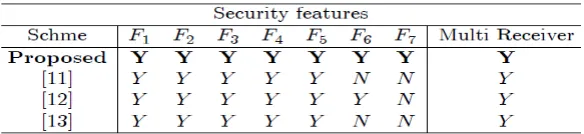
The security attributes of the proposed scheme is compared with existing schemes in Table 2
Table 2 Security Analysis of Proposed Scheme with Existing Schemes
Con…dentiality(F1), Integrity(F2), Authenticity(F3), Unforgeability(F4),
5
EFFICIENCY
The e¢ ciency of public key cryptographic scheme can be measured on the base of computational cost of the major expensive operation Modular Exponentiation (M Exp)and Elliptic Curve Point Scalar Multiplication(ECP M)and com-munication overhead on the base of Extra bits appended for security functions, while sending data from sender to receiver.
1 Computation Cost
The computational e¢ ciency of proposed scheme is analyzed and compared with existing schemes on the base of major operations as shown in Table 3.
Table 3 Comparative Computational Cost Analysis
The execution time of OneM Exp(1024)is220mswhile levelOneECP M
(160bits)is83msbased on In…neon’s SLE66CU X640P (@ 15M Hz), a security controller [15] implementation. The%computational cost reduction of proposed scheme compare to existing schemes is shown in Table 3.
2 Communication Overhead
Communication overhead analysis is based on the NIST recommended se-curity parameters size such that: jpj 21024,jqj 2160,jnj 2160,jhj=160 bits
andjcij=128bits.
The communication overhead of proposed scheme is analyzed and compared with existing schemes in Table 4.
6
CONCLUSION
In this paper, an e¢ cient construction of multi-message multi-receiver signcryp-tion based on elliptic curves is proposed. It provides message con…dentiality, sender authentication, message integrity, message veri…ability, sender unforge-ability, sender non-repudiation and forward secrecy. Forward secrecy preserves message con…dentiality even if sender long-term private key compromised. Cost Analysis shows that proposed scheme is e¢ cient and provides lightweight multi-message multicast secure multi-message dissemination.
References
[1] R. O. Afolabi, A. Dadlani, and K. Kim, “Multicast Scheduling and Re-source Allocation Algorithms for OFDMA-Based Systems: A Survey,” IEEE Commun. Surv. Tutorials, vol. 15, no. 1, pp. 240–254, 2013
[2] A. Keshavarz-Haddad and R. Riedi, “Bounds on the bene…t of network coding for wireless multicast and unicast,”Mob. Comput. IEEE . . . , 2014.
[3] W. Di¢ e, P. van Oorshot, and M. Wiener, “Authentication and Authenti-cated Key Exchange,” Des. Codes Cryptogr., vol. 2, pp. 107–125, 1992.
[4] C. Boyd and J. G. Nieto, “On forward secrecy in one-round key exchange,” Lect. Notes Comput. Sci., vol. 7089 LNCS, pp. 451–468, 2011.
[5] Y. Zheng, “Digital signcryption or how to achieve cost (signature & en-cryption) cost (signature)+ cost (enen-cryption),” in Advances in Cryptology — Crypto ’97, 1997, pp. 165–179.
[6] Y. Zheng, “Signcryption and its applications in e¢ cient public key solu-tions,” in Information Security, LNCS Volume 1396, 1998, pp. 291–312.
[7] H. M. Elkamchouchi, A. M. Emarah, and E. A. A. Hagras, “Public Key Multi-Message Signcryption (PK-MMS) scheme for secure communication systems,” in Proceedings - CNSR 2007: Fifth Annual Conference on Com-munication Networks and Services Research, 2007, pp. 329–334.
[8] H. M. Elkamchouchi, A. A. M. Emarah, and E. a a Hagras, “A new e¢ -cient public key multi-message multi-recipient signcryption (PK-MM-MRS) scheme for provable secure communications,” ICCES’07 - 2007 Int. Conf. Comput. Eng. Syst., pp. 89–94, 2007.
[9] H. Elkamchouchi, M. Nasr, and R. Ismail, “A new e¢ cient multiple broad-casters signcryption scheme (MBSS) for secure distributed networks,”Proc. 5th Int. Conf. Netw. Serv. ICNS 2009, pp. 204–209, 2009.
Comput. Inf. Technol. CIT-2010, 7th IEEE Int. Conf. Embed. Softw. Syst. ICESS-2010, ScalCom-2010, no. Cit, pp. 1577–1581, 2010.
[11] R. Hwang, C. Lai, and F. Su, “An e¢ cient signcryption scheme with for-ward secrecy based on elliptic curve,” vol. 167, pp. 870–881, 2005.
[12] M. Toorani and A. A. B. Shirazi, “Cryptanalysis of an elliptic curve-based signcryption scheme,” Int. J. Netw. Secur., vol. 10, no. 6, pp. 51–56, 2010.
[13] M. Toorani and A. A. B. Shirazi, “Cryptanalysis of an e¢ cient signcryption scheme with forward secrecy based on elliptic curve,”in Proceedings of the 2008 International Conference on Computer and Electrical Engineering, ICCEE 2008, 2008, pp. 428–432.
[14] E. Mohamed and H. Elkamchouchi, “Elliptic Curve Signcryption with En-crypted Message Authentication and Forward Secrecy,” vol. 9, no. 1, pp. 395–398, 2009.