using Shift-Invariant Permutations
?Si Gao, Arnab Roy, and Elisabeth Oswald
University of Bristol
Abstract. The threat posed by side channels requires ciphers that can be efficiently protected in both software and hardware against such at-tacks. In this paper, we proposed a novel Sbox construction based on iterations of shift-invariant quadratic permutations and linear diffusions. Owing to the selected quadratic permutations, all of our Sboxes enable uniform 3-share threshold implementations, which provide first order SCA protections without any fresh randomness. More importantly, be-cause of the “shift-invariant” property, there are ample implementation trade-offs available, in software as well as hardware. We provide imple-mentation results (software and hardware) for a four-bit and an eight-bit Sbox, which confirm that our constructions are competitive and can be easily adapted to various platforms as claimed. We have successfully verified their resistance to first order attacks based on real acquisitions. Because there are very few studies focusing on software-based threshold implementations, our software implementations might be of independent interest in this regard.
Keywords: Shift-invariant·Threshold implementation·Sbox
1
Introduction
In the past decade, side channel analysis (SCA) has become a serious threat to various cryptographic devices. In this adversarial model, an attacker may observe information leakage from a device operating some key-related information. For cryptographic engineers, efficiently implementing a good cipher is then no longer enough. They must also mitigate against the threat of such leakage and integrate a proper countermeasure, which often is a non-trivial task.
Since they were proposed, Threshold Implementations (TI) [1, 2] have become a recognised countermeasure for power analysis [3–7] when hardware implemen-tations are considered. Unlike Boolean masking schemes [8, 9], TI requires more shares, but the “non-completeness” property of TI ensures that in each compu-tation logic gate, at least one of the (input) shares is missing. As a consequence, even in the presence of hardware glitches, this missing share guarantees that the observed leakage will not give out information about any secret intermedi-ate value [2] and thus robustly protects against so-called first-order attacks. In
?
this paper, we only consider threshold implementations that provide first order protections.
One obstacle in threshold implementations is that there is no trivial efficient constructions for arbitrary cryptographic components. Take 3-share TI schemes for instance: in theory, any arbitrary quadratic function can be re-written in a TI-shared form with 3 shares. In practice, however, considering the requirement of “uniformity”, a uniform 3-share TI scheme may not exist [2]. For smaller components (eg. Sboxes), this issue has been extensively studied up to affine equivalence [3, 10–12]. For larger components, there is no generic construction available. On the other hand, solutions for uniform TIs may exist with higher implementation costs, such as increasing the number of shares or adding fresh randomness. Recently, De Meyer, Moradi and Wegener proposed a bit-serialized implementation of the Sbox of AES [13]: although their implementation with AES can be easily deployed in many applications, it comes with the price of adding fresh randomness. Joan Daemen proposed a technique called “Changing of the Guards”, which significantly eases the dilemma between uniformity and fresh randomness [14]. As the “Changing of the Guards” technique borrows randomness from the shares of other concurrent components, engineers no longer need to ensure uniformity for their TI schemes, as long as there are a few extra random bits available in the beginning of the encryption. Considering that the overhead of TI is already high, it is imperative to keep any extra cost as low as possible. Therefore, in this paper, we would like to avoid any fresh randomness and minimize the number of shares.
Instead of searching for efficient TI representations for existing Sboxes, we can also construct new Sboxes that are intrinsically suitable for TI protections. The TI forms of all 4×4 Sboxes were described in [3]. Boss el al. constructed sev-eral 8-bit Sboxes with round-based balanced Feistel, MISTY, SPNs structures, where the core building blocks are 4-bit Sboxes with easier TI protections [15]. The main focus of their paper was in finding Sboxes with efficient hardware TI implementations. However, the authors claimed their approach also “enables an efficient and low-cost implementation in software”(their “software implementa-tion” refers to masked bitslice implementations, rather than TI-based software implementations). De Meyer and Varici further extended this approach to sev-eral new constructions (such as Gensev-eralized Feistel, Lai-Massey, Asymmetric SPN etc.) and provided implementation costs in terms of ASIC logic area [16].
It is not surprising that very few papers actually consider using TI-based soft-ware implementations. To the best of our knowledge, the only available TI con-structions on software are TI-based PRESENT on an 8-bit micro-controller [17] and TI-based ARX ciphers [18]. The reason behind this is straightforward: the main concern that TI solves — glitches — do not exist in software1. The overhead
of using TI-based countermeasures is usually much higher than using (bitsliced) masking. Thus in theory, there is little point in applying TI to software
im-1 Technically, glitches still exist within one instruction. However, the threat that
plementations. In practice however, it has been observed thatd-order bitsliced maskings sometimes fail to provide d-order SCA protections. This is because the internal architecture of micro-processors is not publicly accessible. Now even if a cryptographic engineer carefully writes his/her code in assembly, some im-plicit operations/registers may still mix different shares and produce exploitable leakage such as demonstrated in [19, 20]. In the worst case, as Balasch el al. sug-gested, ad-order masking may only achieved
2
-order security in practice [21].
Our contribution. In this paper, we aim to find several Sboxes that come with easier first order TI protections, in both software and hardware platforms. In contrast to Boss el al.’s work [15] we use shift-invariant quadratic permutations instead of smaller Sboxes [22]. Similar to the χ2 function [23], any coefficient
Boolean function of these permutations is simply a “rotated” version of another. In other words, the bit-width of the elementary computation logic —which we called “granularity” in this paper — can be 1. Combined with the idea of serial threshold implementations [24, 25], the granularity of first order TI implemen-tation can then be 1. Finer granularity brings more flexibility for cryptographic engineers, giving them more fine-grained trade-off options between executing time, logic area as well as power consumption. Specifically, the benefits of such protected Sboxes include:
– No fresh randomness.
– Easier software implementations. Since the shared version of our TI func-tion preserves the “shift-invariant” property to some extent, bit-slicing such protected Sbox becomes easier.
– Flexible hardware implementations. As the granularity of such TI Sboxes is 1, in hardware, it is possible to implement only 1 computation unit, then get all other shared bits by shifting. Such strategy can lead to a very compact footprint, in the price of taking more cycles to execute.
– Full implementations/security evaluations. Despite the fact that all the im-plementations in this paper follow exactly the same rules as standard TI-s, we have verified these implementations with real-world acquisitions.
Outline. In Section 2 we explain a few essential concepts, including the cryp-tographic properties for Sboxes, the principle of threshold implementations and our Sbox searching strategies. Section 3 first introduces the concept of shift-invariance, then presents a search for quadratic TI-uniform shift-invariant per-mutations. Based on the results of this search, we further construct Sboxes with an SPN network. Section 4 and 5 discuss the possible implementation tradeoffs on software/hardware platforms, respectively. Section 6 presents TVLA-based security evaluation results on both an ARM M0 core and a Kintex 7 FPGA.
2
Preliminaries
2.1 Cryptanalytic properties for Sboxes
uniformity, linearity, to thwart the differential and linear attacks. Let :F2n →
F2n be a function.
Definition 1. (Differential uniformity [26]) For any pair(a, b)∈F2n,
de-fine the set
DF(a→b) ={x∈F2n|F(x⊕a)⊕F(x) =b}.
The differential uniformity of F is defined as δ(F) := maxa6=0,b|DF(a → b)|
where the |DF(a → b)| denotes the cardinality of the set DF(a → b) and is determined by the entry at the position (a, b)in the difference distribution table of F.
The Walsh transformation of the function F is defined as W :F2n×F2n →Z
and is given as
WF(a, b) = X
x∈F2n
(−1)a·x+b·F(x).
The linearity of an Sbox gives a measure of its best linear approximation. The linearity ofF is defined as follows,
Definition 2. The linearity ofF is defined as L(F) = maxa,b6=0WF(a, b).
Besides, an Sbox should not have any algebraic properties e.g low degree of the polynomial, which may be exploited by an adversary to mount an attack. It is known that the maximum algebraic degree of anm-bit permutation Sbox will bem−1.
2.2 Threshold Implementation
In side channel research,threshold implementation (TI) usually refers to a coun-termeasure that based on secret sharing. For anm×nvectorial Boolean function f where each input xis shared as ans-length vectorx= x(1), .., x(s), TI im-plements a few shared functionsf(j) that satisfy:
– Correctness. The sum of all shared functions is equal to the original unshared functionf (i.e.Ps
j=1f
(j)=f).
– Non-completeness. Every shared functionf(j)is independent of at least one
share ofx. Specifically, for ad-order TI scheme, the combination of d f(j)
functions is still independent of at least one share.
– Uniformity. For any unshared input value x= x(1)⊕x(2)⊕...⊕x(s), the
corresponding output sharesy= y(1), .., y(s)
are uniformly distributed on ally-s that satisfyf(x) =y(1)⊕y(2)⊕...⊕y(s).
2.3 Constructing TI Sboxes
To ensure non-completeness, threshold implementations need more shares for Boolean functions with higher degrees. As the implementation cost increases with the number of shares, the cheapest protected non-linear functions are quadratic (deg= 2) Boolean functions. For Sbox constructions, it is favourable to use permutations rather than arbitrary quadratic vectorial Boolean functions. Previous studies have sucessfully found uniform TI schemes for many quadratic permutations, including 3×3 and 4×4 Sboxes [3], 5-bit permutations [27] as well as a few observations on 6-bit quadratic permutations [28].
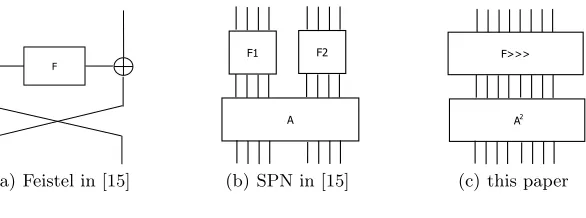
All the results above serve as a perfect building block for larger Sboxes: al-though directly applying TI is difficult, we can always use smaller Sboxes/quadratic permutations with known TIs to build large Sboxes. Boss et al. started search-ing for 8-bit Sboxes with Feistel (Figure 1(a)), SPN (Figure 1(b)), and MISTY structures, using 4-bit TI Sboxes as building blocks [15]. De Meyer and Varici extended this search to other constructions, such as Double Misty, Asymmetric SPN and Generalized Feistel structures [16].
F
(a) Feistel in [15]
F1 F2
A
(b) SPN in [15]
F>>>
A2
(c) this paper
Fig. 1.Structure overview
2.4 The notion of granularity
Irrespective of considering hardware or software implementations, constructions that feature multiple identical computation tasks usually give the cryptographic engineer more flexibility for the speed/cost trade-off. Taking hardware imple-mentations for instance, all 4 bits in a PRESENT Sbox must be implemented with combinational logic, because all 4 bits are based on different Boolean func-tions [29]. Meanwhile, for the Keccak 5-bitχ2 function, it is possible to
imple-ment only the circuit to do a 1 bit computation, as other 4 output bits can be computed through rotating the inputs [23] using the same circuit.
In this paper, we denote the output size of the smallest “gadget” to com-pute an Sbox as the “granularity”. Clearly, the granularity for an unprotected PRESENT Sbox is 4, whereas for an unprotected 5-bit χ2 function is 1. A
finer granularity gives crypto engineers more opportunities for trade-offs: for in-stance, they can opt for a serial (slower) implementation, or a parallel (faster) implementation in hardware. Granularity also plays a critical role in software im-plementations. As most processors have intrinsic bit-widths (8,32 or 64), when performing bitwise operations, most of the bit-width will be wasted unless all the bits require the same operation. In order to take full advantage of the bit-width, a bit-slice implementation usually “slices” the same bits from multiple Sboxes to one register. As the CPU processes multiple Sboxes simultaneously, the overall throughput increases. Implementations with finer granularity provide intrinsic parallelism, which may take the most of the bit-width of our processors without manually “slicing” from a lot of concurrent data blocks (eg. Sboxes).
3
Constructing TI-Sboxes with better granularity
In this section, we present our TI-Sboxes search strategy. To achieve better im-plementation flexibility, we choose a different type of building blocks: instead of using 4 bit Sboxes with known TIs, our search utilizes the “Shift-invariant” [22] permutations. Such constructions usually lead to finer granularity (for each el-emental operation) and give better implementation trade-offs for not only the Sbox itself, but also its TI-protection.
3.1 Shift-invariant: concept and previous works
Technically, an n×n vectorial Boolean function F is shift-invariant if for any rotated shift τ and any state x, F(τ(x))) = τ(F(x)) [22]. As stated in Dae-men’s thesis [22], “shift-invariant transformations can be implemented as an interconnected array of identical 1-bit output ‘processors’”(granularity 1). Dae-men further studied both linear and non-linear shift-invariant transformations, exploring their invertibility, local propagation and correlation properties [22]. As shift-invariance is closely linked to the concept of cellular automaton, Mariot, Picek , Leporati and Jakobovic searched up to 7×7 Sboxes from a cellular au-tomaton perspective [30]. The most well known output of this direction is theχ2
3.2 Quadratic shift-invariant permutation with uniform TI
For an unprotected Sbox, shift-invariance ensures its granularity is equal to 1. However, considering the requirements of first order TI, its granularity also grows with the number of shares. Further reducing the granularity requires not only shift-invariance, but also its TI property: for any Boolean functionf, if its direct shared form (i.e. Section 4.2 in [3]) is uniform, its granularity can be reduced to 1, using a serial TI implementation [24, 25]. Thus, for granularity, our best option would be using quadratic shift-invariant permutations with a uniform direct sharing threshold implementation.
Therefore, our main building blocks for Sbox constructions are quadratic shift-invariant permutations with uniform 3-share TI-s. Although Daemen’s the-sis gave many useful results, it did not cover all possible nonlinear shift-invariant transformations. Fortunately, the search space for common Sbox sizes (n= 4 or n= 8) is small enough. Forn×nshift-invariant transformations, the number of all possible quadratic transformations are equal to the number ofn-bit quadratic Boolean functions 2P2i=0(
n
i). The search space for 4 bit building blocks is 211,
whereas for the 8 bit case is 237. Among these transformations, we are interested
in those satisfy:
– The transformation itself is ann-bit permutation. – Its direct 3-share TI is uniform.
Both properties are easy to check: for TI uniformity we simply check whether the shared form is still a 3n×3npermutation. For early abortion in this permutation check we first examine whether the coefficient Boolean function f is balanced. If it is not balanced, the transformation it derived cannot be a permutation. Additionally, we further limit our search to functions that satisfy:
– For bity0, its Boolean function always contains bitx0. If not, we can always
find a shift transformationτ that ensuresF0=F◦τ (F is the shift-invariant transformation f derived)2. For a shift-invariant F0, τ and F are commu-tative. This means for lower rounds (1 or 2) of SPN network, τ can be integrated into the initial/final linear transformation, which does not affect the cryptographic properties.
– f does not have a constant term. For a shift-invariant transformation, the constant term can be either all-0 or all-1. As an all-1 constant has little impact on the cryptographic property ofF, we simply discard these choices.
For 4-bit quadratic functions, we found that 952 out of 2048 functions contain x0 and 0 as their constant terms. 392 of them are balanced, whereas only 24f
lead to a 4×4 permutation F. Fortunately, all of the direct 3-shares schemes are actually 12×12 permutations (i.e. satisfy uniformity).
On the other hand, for 8 bit permutations, the search space off is 237. Almost
half of the f-s have x0 =c = 0, while only a quarter of f-s are balanced. 520
128 (≈219) can generate an 8-bit shift-invariant permutation F: interestingly, all of these permutations have uniform direct 3-share TI.
2
n Allf Hasx0&c= 0 Balanced Permutation TI Permutation
4 2048 952 392 24 24
Table 1.Shift-invariant quadratic TI permutations:n= 4
n Allf Hasx0&c= 0 Balanced Permutation TI Permutation
8 237 68451041152 29986581632 520128 520128
Table 2.Shift-invariant quadratic TI permutations:n= 8
3.3 Constructing Sboxes
In this section, we further construct cryptographically good 4/8-bit Sboxes with these quadratic permutations. The Sbox search follows exactly the same strat-egy as previous works [15, 16], although the granularity further complicates the situation here.
Design Architectures As shift-invariance ensures each bit can be computed in the same way, generally speaking, we would like to avoid more branches. Take two-branch balanced Feistel structure for instance: although the round function may still have granularity 1, the other branch also contributes to the granularity for the whole Sbox. To this end, we perform our Sbox search with full range Substitution-Permutation Network (SPN) (Figure 1(c)).
Permutation Layer As the substitution layer is chosen from those quadratic TI permutations, the only decision left to make is the permutation layer. Clearly, the most efficient construction would be using shift-invariant linear permuta-tion or nothing at all. Although shift-invariance is a good property for soft-ware/hardware implementations, considering the threat of rotational cryptanal-ysis [31], we prefer not to preserve it in the final Sbox. Thus, our linear trans-formation here needs to stop the propagation of shift-invariance. In general, the cheapest option would be using non-shift permutations. However, a bit-permutation usually have a larger granularity (as each bit has to be implemented respectively), which leads to a penalty on its software performance. Instead, in this paper, we consider a linear transformation that is similar to AES’s “xtime”. More specifically, we search for invertible matrices that satisfy:
A=
a1,1 1 0 . . . 0
a2,1 0 1 . . . 0
. . . . an−1,1 0 0 . . . 1
Leta1={a1,1, a1,2, ..., an−1,1,1}, ifAis indeed invertible, in software, it can
be implemented with a shift and a conditional XOR.
Ax= (
(x <<1)⊕a1, ifhsb(x) = 1 (x <<1), otherwise
As the conditional branch is prone to cache attack, most implementations tend to use a multiplication instruction to achieve a constant control flow
Ax= (x <<1)⊕(a1×hsb(x))
As the n-bit state x is operated as a word, the granularity is determined by this 1-bit multiplication: since this equation only holds 1 bit values, the over-all granularity gets coarser. Nonetheless, from an implementation perspective, it is still much better than arbitrary binary matrix multiplication. To achieve a better diffusion property, in our Sbox search, we use two layers ofA(A2) as our permutation layer.
Selection criteria. In order to achieve a balance between the implementation cost and the cryptographic properties, we have defined a selection criteria for the candidate Sboxes. Specifically, for 4-bit Sboxes,
– the differential uniformity is≤4 and, – the linearity is≤8
For 8-bit Sboxes,
– the differential uniformity is≤8 and, – the linearity is≤72
Besides, the algebraic degree and the degree of the interpolation polynomial should be large enough to resistent algebraic attack and interpolation attack, respectively.
3.4 Results
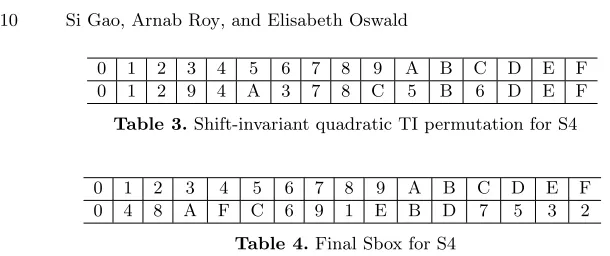
4-bit case. For 4-bit Sboxes, such selection criteria only accepts optimal Sboxes (differential uniformity= 4, linearity = 8) [32]. By enumerating all possible choices ofAand quadratic permutations, we can find 16 such 4-bit Sboxes within 2 rounds. One such Sbox is presented as follow. The algebraic degree of this Sbox is 3, whereas the degree of the interpolation polynomial is 15.
A=
0 1 2 3 4 5 6 7 8 9 A B C D E F 0 1 2 9 4 A 3 7 8 C 5 B 6 D E F
Table 3.Shift-invariant quadratic TI permutation for S4
0 1 2 3 4 5 6 7 8 9 A B C D E F 0 4 8 A F C 6 9 1 E B D 7 5 3 2
Table 4.Final Sbox for S4
8-bit case. For n = 8, the overall search space is around 226, which is quite
feasible for most PCs. 6 Sboxes appear within 3 rounds: all of them have differ-ential uniformity 8 whereas their linearity vary from 64 to 72. Due to the space limit, we present the best one (differential uniformity= 8, linearity = 64) in the Appendix. The algebraic degree of the presented Sbox is 6 and the degree of interpolation polynomial is 252.
4
Software Implementation
The major benefit of an Sbox with small granularity, is that it can be efficiently implemented in both software and hardware platforms. Although software based TIs tend to have higher overhead, in terms of security, they might have their own advantages [5]. In this section, we implement our selected Sboxes with first order TI protections in software and discuss a few possible trade-off options.
4.1 Target Platform
For software implementations, the most common platforms are smart cards or high-end processors (ARM/AMD/Intel). Although different processors may have different instruction sets, for bit-slice computations, most required bit-wise in-structions can be found easily in all instruction sets. The major difference lies in the bit-width of the target processor, which determines how many bits can be computed in parallel. In this paper, our implementation chooses the most common bit-width—32. Implementations for 8-bit and 64-bit follow exactly the same rule. Because our target chip is an NXP ARM M0 core, we wrote our Sbox implementations using the Thumb instruction set [33]. In order to demonstrate the difference between Thumb and ARM instruction sets [34], we also show how those Sboxes can be computed on a more advanced core like the ARM M3.
4.2 Implementation Trade-offs
implementation achieves its best performance when there are 32 concurrent data blocks (Sboxes) available. As the available bit-width is already fully occupied, the shift-invariant property will not provide any benefit in this case.
Size-based optimization. As each bit can be computed in the same way, with shift-invariant transformations, we can pack allnbits into one register. Take an 8 bit Sbox for instance, if there are 4 concurrent Sbox computations forx[1],x[2],
x[3]andx[4], a 32-bit register can be filled with
x[1]1 , x[2]1 , x[3]1 , x[4]1 , ..., x[1]8 , x[2]8 , x[3]8 , x[4]8
wherexiis thei-th bit ofx. Correspondingly, each computation will be adjusted
to ensure it takes the right input bit. Note that the rotated shift is still available in this form: instead of rotating 1 bit, now we are rotating 4 bits. Readers can verify that the transformation can still be computed correctly in this form, while the number of required concurrent data blocks shrinks from 32 to 4. Similar to the unprotected Sbox, the TI protection can be computed in exactly the same way. If all three shares are computed separately, such an optimization does not contradict with any TI requirement.
Extreme optimization. In theory, since the granularity of the TI protection is still 1, packing all 3 shares into one register is possible. Whether it contradicts with TI’s security requirement (i.e. non-completeness) is debatable: ideally, if bit-wise instructions’ leakage can be regarded as a sum of the leakages of all candidate bits (i.e. no “bit-interactions”), such implementation should be as secure as a hardware-based TI3. However, current results seem to suggest this may not
always be the case: Sasdrich et al’s work shows that for lookup tables (i.e. LDR instruction) on smart cards, bit-interaction clearly exists [5]. Our experiments with ARM M0 processors also prove the shift instructions (LSL,LSR,ROR) have the same issue. Moreover, as different bits and shares both get placed in one register, shifting becomes trickier. Only one of the shifts, whether shift bits or shares, can be operated with rotated shift instructions. The other one must be done manually with a few shifts and data masks. Considering the security loss and potential performance gain, we believe this is not a reasonable option.
4.3 Implementation on ARM M0/M3
Throughout this section, our evaluation is based on the size-based optimization. For the quadratic permutation S, we simply computed the TI-protected per-mutation according to its Algebraic Normal Form (ANF). Further customized optimizations may be possible but are out of the scope of this paper. To limit the usage of registers or memories, we compute all shifted results online, even
3
if some of them appear repeatedly in the computation. Although this sounds far from ideal, as most commodity processors have a limited number of general purpose registers, such a compromise is inevitable in practice. For the linear transformation P, as the multiplication operation can only handle 1 bit at a time, alln-bit data shares must be executed one by one.
Despite the fact that our Sbox is computed online (rather than using pre-computed lookup tables), architecturally, its computation procedure is not that different from Sasdrich et al.’s implementation of PRESENT’s Sbox [17]. De-pending on the context, leakage might still show up when the CPU switches from one TI-shared function to another. Nonetheless, as the number of shared functions in TI is quite limited (compared with the number of AND-s in mask-ing), implementing TI correctly requires much less effort than implementing bit-slice Boolean masking.
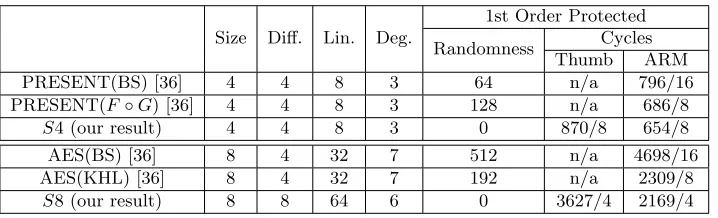
Table 5 illustrates the software implementation costs of our selected Sboxes, along with a few other well-known protected Sboxes, such as AES and PRESENT. It is not hard to see there is a significant performance difference between Thumb [33] and ARM [34] instruction sets. The major difference lies in rotation: as Thumb’s ROR only shifts with a register rather than a constant, rotating r1 by n and storing the result in r2 has to be implemented as
MOV r3,#n
MOV r2,r1 ROR r2,r3
However, with the “Flexible Operand 2” [34] in ARM instruction set, such procedure can be implemented with only one line. In terms of executing cycles, implementations with ARM instructions have a significant bonus.
MOV r2,r1, ROR #n
Size Diff. Lin. Deg.
1st Order Protected
Randomness Cycles Thumb ARM
PRESENT(BS) [36] 4 4 8 3 64 n/a 796/16
PRESENT(F◦G) [36] 4 4 8 3 128 n/a 686/8
S4 (our result) 4 4 8 3 0 870/8 654/8
AES(BS) [36] 8 4 32 7 512 n/a 4698/16
AES(KHL) [36] 8 4 32 7 192 n/a 2309/8
S8 (our result) 8 8 64 6 0 3627/4 2169/4
Table 5.Software Performance of various Sboxes
simultaneously. 4 For 4 bit Sboxes, our shift-invariant Sbox has similar
perfor-mance as the PRESENT Sbox based on quadratic decomposition (654 v.s. 686). With bitslice masking, PRESENT Sbox can be much more efficient [36]. On the other hand, for the 8 bit case, both the KHL and bit-sliced masking are quite efficient, running twice faster than our shift-invariant Sbox. However, we would like to stress that the comparison of Table 5 is not as trivial as comparing the numbers of cycles. First of all, our implementation does not take any fresh ran-domness. As we can see in Table 5, all other Sboxes use quite a lot of random bits, even if they do not use any mask refreshing. Considering the cost of produc-ing (pseudo)random numbers, it is clearly desirable to avoid fresh randomness. On the other hand, although all Sboxes in Table 5 claim first order security, a TI scheme has 3 shares whereas a bit-slice masking only has 2. Since the authors did not give any real traces based SCA evaluation [36], it is hard to argue whether these bit-sliced masking schemes provide the same security level as our threshold implementations. If we simply believe in the order-reduction theorem [21], a fair comparison would be using the second order bit-slice masking (3 shares), which degrades their performance to the same level of ours [36]. Last but not least, enormous effort has been invested in optimizing the implementations of both AES’s Sbox and PRESENT’s Sbox. In fact, the advantage of bit-slice masking is mainly inherited from the circuit optimization of the unprotected Sbox. On the contrary, we simply implemented the ANF of our shift-invariant Sboxes: further optimizations may be possible but they are out of the scope of this paper.
Another interesting observation would be our granularity gains. Technically, granularity determines how many concurrent Sbox computations we need to achieve the best possible throughput. For PRESENT and AES in Table 5, gran-ularity does not cause an issue: both ciphers use SPN networks with many same Sboxes as their confusion layers. However, if the cipher uses smaller round func-tions with less concurrent Sboxes or a confusion layer with different Sboxes, it would be difficult to find enough data to “slice” within one plaintext block. Thanks to the fine granularity of our new Sboxes, in short encryption request, our construction has a better chance to reach its maximal throughput.
5
Hardware Implementation
5.1 Implementation Trade-off
Unlike software platforms, TI on hardware has been extensively studied for years. The only difference our Sboxes bring is a “double-rotating” feature: not only the 3 shares can be generated by rotating the inputs with the same circuit (i.e. serial TI [24]), all n-bit output can also be generated by rotating inputs. Note that these two rotations are different operations: one is rotating bits, the other is ro-tating shares. On software platforms, since there is only one rotation instruction,
4 Note that this does not mean each Sbox can be computed only 109 cycles: if there
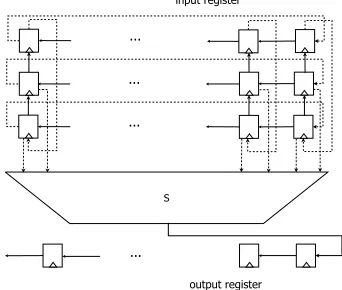
implementing both efficiently is not trivial. On hardware, double-rotation can be simply implemented with multiplexers. Thanks to the fine granularity, now we can implement only 1 bit Boolean function and compute the other 3n−1 bits through rotations.
... ... ...
S
...
output register input register
Fig. 2.Hardware schematic of shift invariant transformation S
As all other implementations are relatively trivial, in this section, our evalu-ation only uses this 1-bit serial implementevalu-ation. Note that this implementevalu-ation is by no means our “reference” design. The point of having a granularity 1 Sbox is that the engineers have the flexibility to choose the right trade-off. Although this 1-bit implementation leads to a very compact logic footprint, it trades area advantages with executing cycles. It takes 3∗n cycles to finish a 3-share n-bit Sbox computation. Besides, the multiple data paths cause the control logic to increase, which may compensate some of the footprint gain. Depending on the specific applications, engineers can also use a “single rotation” version, where only the shares or the bits are generated by rotations.
5.2 Pre-charge Issue
5.3 Implementation on ASIC
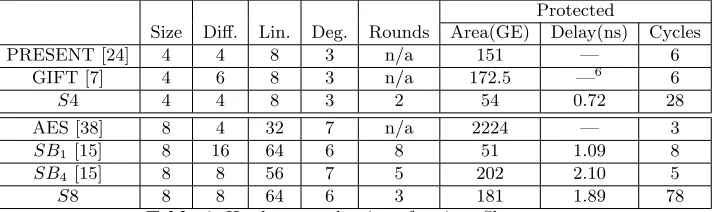
In order to evaluate their performance on hardware, we have implemented our Sboxes with first order TI protections in Verilog. For synthesis, we used Syn-opsys Design Compiler with the TSMC 180nm standard cell library. Their area requirements as well as clock cycles are presented in Table 6. Note that only the combinational part is documented in Table 6: as most previous works excluded the multiplexers and registers as “required extra logic”, we cannot further com-pare the whole design5. For clarity, Table 6 only shows one 8 bit Sbox and one 4 bit Sbox: other alternatives can be found in the Appendix.
Size Diff. Lin. Deg. Rounds
Protected
Area(GE) Delay(ns) Cycles
PRESENT [24] 4 4 8 3 n/a 151 — 6
GIFT [7] 4 6 8 3 n/a 172.5 —6 6
S4 4 4 8 3 2 54 0.72 28
AES [38] 8 4 32 7 n/a 2224 — 3
SB1 [15] 8 16 64 6 8 51 1.09 8
SB4 [15] 8 8 56 7 5 202 2.10 5
S8 8 8 64 6 3 181 1.89 78
Table 6.Hardware evaluation of various Sboxes
Since most results in Table 6 are uniform first order threshold implementa-tions, we did not present their fresh randomness requirements. Only the AES Sbox uses 32 random bits; all others do not take fresh randomness. Thanks to its fine granularity, our protected Sboxes can be implemented with 1-bit combina-tional logic, which leads to very compact implementations (Table 6). However, this is nothing more than a trade-off: the number of cycles clearly shows the price to pay. Besides, for a larger n, shift-invariant constructions lose most of their charms. Table 6 shows the area gain for 8 bit Sbox is neglectable (if any, considering a serial implementation uses more MUX-es), compared with Boss et. al’s construction. The reason for this roots in the philosophy of shift invariance: shift invariance saves area by reducing the outputs of a logic circuit, but not the inputs. Our 1-bit implementation is still a 2n-variate Boolean function. Boss et. al’s construction uses smaller Sboxes, which reduces the input scale of the protected circuit. Technically, for an arbitrary vectorial Boolean function, the implementation cost grows linearly with its output, but exponentially with its input. Having said that, the main advantage of our construction is providing flexible implementation trade-offs, on both software and hardware platforms. Although Boss et. al’s paper also mentioned software-efficiency, their prediction
5
Depending on the specific implementation, such “extra logic” can actually predom-inates the overall area cost. To this end, we would like the stress that our serial implementation is only worthwhile if it has a significant advantage in area cost.
6
is actually based on the number of AND-s. We believe that software perfor-mance evaluation should use actual assembly code: due to the limited resources available (eg. instructions, registers, buses, etc.), high-level estimations could be misleading.
6
Security Evaluation
6.1 Software: ARM M0
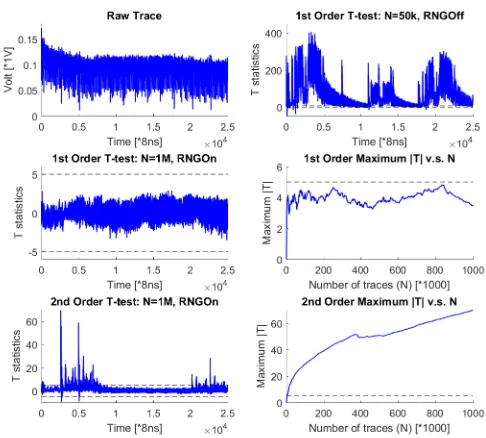
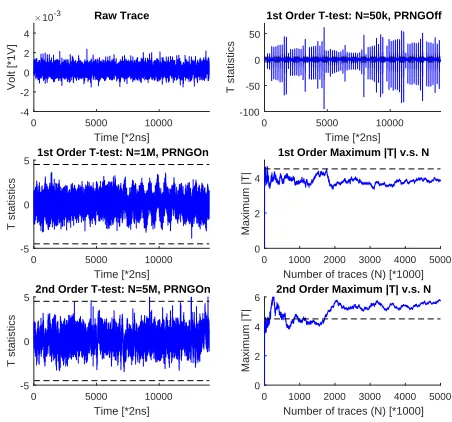
In order to evaluate our protected Sbox in practice, we have implemented such Sboxes on both software and hardware platforms. For software implementation, our target chip is an NXP LPC1114 (ARM Cortex M0) processor. The measure-ment point connects to a 100 Ohm resistor on the VCC end. Power traces were captured with a PicoScope 2206B running at a sampling rate of 125MSa/s. The clock speed of the target core was set to 8MHz. For leakage detection, we use the non-specific fix-vs-random T-test [39]. In order to increase the detection power, we force all parallel Sboxes to use the same input shares (i.e. all the concurrent Sbox computations are exactly the same). Figure 3 shows the evaluation results for our 4 bit Sbox with 1 million traces:
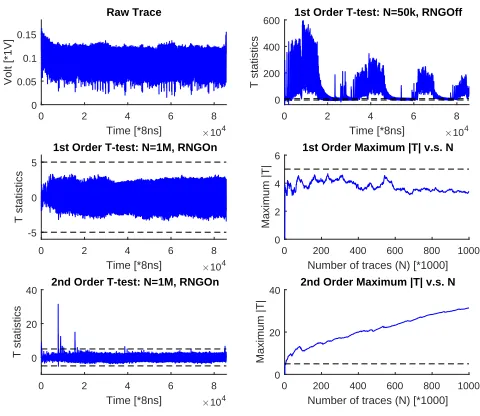
Considering the Sbox computation includes 25000 time points, we increase the T-test threshold to 5 [40]. With 1 million traces, a first order T-test can-not find any significant leakage. As we have only implemented a first order TI protection, second order attacks are still feasible. In theory, the most efficient 2nd order attack should be multi-variate attacks which combine 2 independent samples on the trace. In practice, significant leakage can be detected by simply performing the same T-test on the second moment (Figure 3). Therefore, we did not enumerate all possible second order sample combinations on the trace. The 8-bit case is quite similar: due to the limited space, we present the results forS8
in the Appendix.
6.2 Hardware: SAKURA-X FPGA
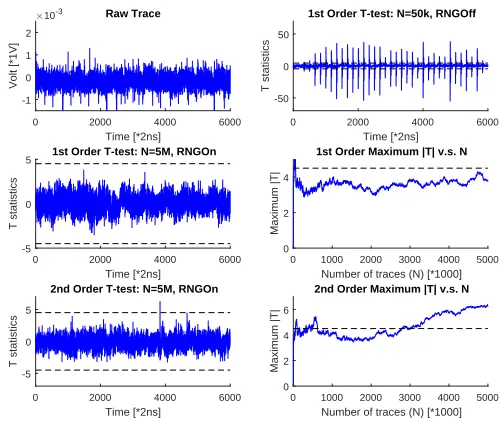
For hardware implementations, we have tested our Sboxes on the SAKURA-X board with SAKURA-Xilinx Kintex-7 FPGA. In order to increase the signal-to-noise ratio, an Agilent 25db amplifier is connected to the measured signal. Moreover, considering our all-serial implementation has very limited power consumption, we extended a 3n-bit protected Sbox to a 384-bit design: for the 4 bit case, this means there are 32 parallel Sboxes implemented on the board. For 8 bit Sboxes, there are 16 parallel Sboxes. Similar to software implementations, all the implemented Sboxes were given the same input shares. Our FPGA design run at 3MHz, while our Lecroy Waverunner 700 Zi scope was capturing traces at 500MSa/s. Obvious outliers were removed before T-test. Figure 4 shows the leakage detection results for our 4 bit Sbox after 5 million traces. Clearly, our protected design is first order secure. Since our implementation is a serial one, technically, the second order detection should use multi-variate T-test. However, it is not hard to see that the second moment already shows some clear leakage. Like the software case, we present the 8-bit results in the Appendix.
7
Conclusion
0 2000 4000 6000 Time [*2ns]
-1 0 1 2
Volt [*1V]
×10-3 Raw Trace
0 2000 4000 6000
Time [*2ns] -50
0 50
T statistics
1st Order T-test: N=50k, RNGOff
0 2000 4000 6000
Time [*2ns] -5
0 5
T statistics
1st Order T-test: N=5M, RNGOn
0 1000 2000 3000 4000 5000
Number of traces (N) [*1000] 0
2 4
Maximum |T|
1st Order Maximum |T| v.s. N
0 2000 4000 6000
Time [*2ns] -5
0 5
T statistics
2nd Order T-test: N=5M, RNGOn
0 1000 2000 3000 4000 5000
Number of traces (N) [*1000] 0
2 4 6
Maximum |T|
2nd Order Maximum |T| v.s. N
Fig. 4.Hardware evaluation of S4
Acknowledgements
We would like to thank all anonymous reviewers for improving the quality of this paper as well as providing insights from some other perspectives. This work has been funded in part by EPSRC under grant agreement EP/N011635/1 (LADA).
References
1. Nikova, S., Rechberger, C., Rijmen, V.: Threshold Implementations Against Side-Channel Attacks and Glitches. In: Information and Communications Security, 8th International Conference, ICICS 2006, Raleigh, NC, USA, December 4-7, 2006, Proceedings. (2006) 529–545
2. Nikova, S., Rijmen, V., Schl¨affer, M.: Secure Hardware Implementation of Nonlin-ear Functions in the Presence of Glitches. J. Cryptology24(2) (2011) 292–321 3. Bilgin, B., Nikova, S., Nikov, V., Rijmen, V., St¨utz, G.: Threshold Implementations
of All 3×3 and 4×4 S-Boxes. In: Cryptographic Hardware and Embedded Systems - CHES 2012 - 14th International Workshop, Leuven, Belgium, September 9-12, 2012. Proceedings. (2012) 76–91
5. Kutzner, S., Nguyen, P.H., Poschmann, A., Wang, H.: On 3-Share Threshold Implementations for 4-Bit S-boxes. In: Constructive Side-Channel Analysis and Secure Design - 4th International Workshop, COSADE 2013, Paris, France, March 6-8, 2013, Revised Selected Papers. (2013) 99–113
6. Bilgin, B., Gierlichs, B., Nikova, S., Nikov, V., Rijmen, V.: A More Efficient AES Threshold Implementation. In: Progress in Cryptology AFRICACRYPT 2014 -7th International Conference on Cryptology in Africa, Marrakesh, Morocco, May 28-30, 2014. Proceedings. (2014) 267–284
7. Gupta, N., Jati, A., Chattopadhyay, A., Sanadhya, S.K., Chang, D.: Threshold Implementations of GIFT: A Trade-off Analysis. IACR Cryptology ePrint Archive
2017(2017) 1040
8. Chari, S., Jutla, C.S., Rao, J.R., Rohatgi, P.: Towards Sound Approaches to Coun-teract Power-Analysis Attacks. In: Advances in Cryptology - CRYPTO ’99, 19th Annual International Cryptology Conference, Santa Barbara, California, USA, Au-gust 15-19, 1999, Proceedings. (1999) 398–412
9. Messerges, T.S.: Securing the AES Finalists Against Power Analysis Attacks. In: Fast Software Encryption, 7th International Workshop, FSE 2000, New York, NY, USA, April 10-12, 2000, Proceedings. (2000) 150–164
10. De Meyer, L., Bilgin, B.: Classification of Balanced Quadratic Functions. IACR Cryptology ePrint Archive2018(2018) 113
11. Bozilov, D., Bilgin, B., Sahin, H.A.: A Note on 5-bit Quadratic Permutations’ Classification. IACR Trans. Symmetric Cryptol.2017(1) (2017) 398–404
12. Beyne, T., Bilgin, B.: Uniform First-Order Threshold Implementations. In: Se-lected Areas in Cryptography - SAC 2016 - 23rd International Conference, St. John’s, NL, Canada, August 10-12, 2016, Revised Selected Papers. (2016) 79–98 13. De Meyer, L., Moradi, A., Wegener, F.: Spin me right round rotational symmetry
for fpga-specific aes. IACR Transactions on Cryptographic Hardware and Embed-ded Systems2018(3) (Aug. 2018) 596–626
14. Daemen, J.: Changing of the Guards: A Simple and Efficient Method for Achieving Uniformity in Threshold Sharing. In: Cryptographic Hardware and Embedded Systems - CHES 2017 - 19th International Conference, Taipei, Taiwan, September 25-28, 2017, Proceedings. (2017) 137–153
15. Boss, E., Grosso, V., G¨uneysu, T., Leander, G., Moradi, A., Schneider, T.: Strong 8-bit Sboxes with efficient masking in hardware extended version. J. Cryptographic Engineering7(2) (2017) 149–165
16. Meyer, L.D., Varici, K.: More Constructions for strong 8-bit S-boxes with efficient masking in hardware. In: Proceedings of the 38th Symposium on Information Theory in the Benelux, Delft,NE, Werkgemeenschap voor Informatie- en Commu-nicatietheorie (2017) 11
17. Sasdrich, P., Bock, R., Moradi, A.: Threshold Implementation in Software - Case Study of PRESENT. In: Constructive Side-Channel Analysis and Secure Design - 9th International Workshop, COSADE 2018, Singapore, April 23-24, 2018, Pro-ceedings. (2018) 227–244
18. Jungk, B., Petri, R., St ottinger, M.: Efficient Side-Channel Protections of ARX Ciphers. IACR Transactions on Cryptographic Hardware and Embedded Systems
2018(3) (Aug. 2018) 627–653
20. de Groot, W., Papagiannopoulos, K., de la Piedra, A., Schneider, E., Batina, L.: Bitsliced Masking and ARM: Friends or Foes? In: Lightweight Cryptography for Se-curity and Privacy - 5th International Workshop, LightSec 2016, Aksaray, Turkey, September 21-22, 2016, Revised Selected Papers. (2016) 91–109
21. Balasch, J., Gierlichs, B., Grosso, V., Reparaz, O., Standaert, F.: On the Cost of Lazy Engineering for Masked Software Implementations. In: Smart Card Research and Advanced Applications - 13th International Conference, CARDIS 2014, Paris, France, November 5-7, 2014. Revised Selected Papers. (2014) 64–81
22. Daemen, J.: Cipher and hash function design, strategies based on linear and differ-ential cryptanalysis, PhD Thesis. K.U.Leuven (1995)http://jda.noekeon.org/. 23. Bertoni, G., Daemen, J., Peeters, M., Assche, G.V.: Keccak. In: Advances in
Cryptology - EUROCRYPT 2013, 32nd Annual International Conference on the Theory and Applications of Cryptographic Techniques, Athens, Greece, May 26-30, 2013. Proceedings. (2013) 313–314
24. Kutzner, S., Nguyen, P.H., Poschmann, A., Wang, H.: On 3-Share Threshold Implementations for 4-Bit S-boxes. In: Constructive Side-Channel Analysis and Secure Design - 4th International Workshop, COSADE 2013, Paris, France, March 6-8, 2013, Revised Selected Papers. (2013) 99–113
25. Gupta, N., Jati, A., Chattopadhyay, A., Sanadhya, S.K., Chang, D.: Threshold Implementations of GIFT: A Trade-off Analysis. IACR Cryptology ePrint Archive
2017(2017) 1040
26. Nyberg, K.: Differentially uniform mappings for cryptography. In Helleseth, T., ed.: Advances in Cryptology — EUROCRYPT ’93, Berlin, Heidelberg, Springer Berlin Heidelberg (1994) 55–64
27. Boˇzilov, D., Bilgin, B., Sahin, H.: A Note on 5-bit Quadratic Permutations’ Clas-sification. IACR Transactions on Symmetric Cryptology2017(1) (2017) 398–404 28. Meyer, L.D., Bilgin, B.: Classification of Balanced Quadratic Functions. Cryptol-ogy ePrint Archive, Report 2018/113 (2018)https://eprint.iacr.org/2018/113. 29. Bogdanov, A., Knudsen, L.R., Leander, G., Paar, C., Poschmann, A., Robshaw, M.J.B., Seurin, Y., Vikkelsoe, C.: PRESENT: An Ultra-Lightweight Block Cipher. In: Cryptographic Hardware and Embedded Systems - CHES 2007, 9th Interna-tional Workshop, Vienna, Austria, September 10-13, 2007, Proceedings. (2007) 450–466
30. Mariot, L., Picek, S., Leporati, A., Jakobovic, D.: Cellular automata based s-boxes. Cryptography and Communications (May 2018)
31. Khovratovich, D., Nikolic, I.: Rotational Cryptanalysis of ARX. In: Fast Software Encryption, 17th International Workshop, FSE 2010, Seoul, Korea, February 7-10, 2010, Revised Selected Papers. (2010) 333–346
32. Leander, G., Poschmann, A.: On the Classification of 4 Bit S-Boxes. In: Arithmetic of Finite Fields, First International Workshop, WAIFI 2007, Madrid, Spain, June 21-22, 2007, Proceedings. (2007) 159–176
33. ARM: Arm and thumb-2 instruction set. http://infocenter.arm.com/help/ topic/com.arm.doc.qrc0006e/QRC0006 UAL16.pdf
34. ARM: Thumb 16-bit instruction set. http://infocenter.arm.com/help/topic/ com.arm.doc.qrc0001m/QRC0001 UAL.pdf
36. Goudarzi, D., Rivain, M.: How Fast Can Higher-Order Masking Be in Software? In: Advances in Cryptology - EUROCRYPT 2017 - 36th Annual International Conference on the Theory and Applications of Cryptographic Techniques, Paris, France, April 30 - May 4, 2017, Proceedings, Part I. (2017) 567–597
37. Wegener, F., Moradi, A.: A First-Order SCA Resistant AES Without Fresh Ran-domness. In: Constructive Side-Channel Analysis and Secure Design - 9th Inter-national Workshop, COSADE 2018, Singapore, April 23-24, 2018, Proceedings. (2018) 245–262
38. Bilgin, B., Gierlichs, B., Nikova, S., Nikov, V., Rijmen, V.: Trade-Offs for Threshold Implementations Illustrated on AES. IEEE Trans. on CAD of Integrated Circuits and Systems34(7) (2015) 1188–1200
39. Goodwill, G., Jun, B., Jaffe, J., Rohatgi, P.: A testing methodology for side channel resistance validation. Technical report, CRI (2011)
40. Ding, A.A., Zhang, L., Durvaux, F., Standaert, F., Fei, Y.: Towards Sound and Optimal Leakage Detection Procedure. In: Smart Card Research and Advanced Applications - 16th International Conference, CARDIS 2017, Lugano, Switzerland, November 13-15, 2017, Revised Selected Papers. (2017) 105–122
A
Full table of
S
8
This Sbox is constructed with 3-layer SPN, whereSis a quadratic shift-invariant permutation: The content ofS8 is presented as follow:
0 1 2 3 4 5 6 7 8 9 A B C D E F
0 00 4c 98 db 31 0a b7 83 62 56 14 2f 6f 2c 07 4b
1 c4 dd ac ba 28 46 5e 3f de bf 58 36 0e 18 96 8f
2 89 ca bb f7 59 6d 75 4e 50 6b 8c b8 bc f0 7e 3d
3 bd ab 7f 66 b0 d1 6c 02 1c 72 30 51 2d 34 1f 09
4 13 82 95 0b 77 91 ef 06 b2 5b da 3c ea 74 9c 0d
5 a0 64 d6 1d 19 aa 71 cd 79 c5 e1 52 fc 37 7a be
6 7b e5 57 c6 fe 17 cc 2a 61 87 a3 4a d8 49 04 9a
7 38 f3 e4 20 60 dc a2 11 5a e9 68 d4 3e fa 12 d9
8 26 ed 05 c1 2b 97 16 a5 ee 5d 23 9f df 1b 0c c7
9 65 fb b6 27 b5 5c 78 9e d5 33 e8 01 39 a8 1a 84
A 41 85 c8 03 ad 1e 3a 86 32 8e 55 e6 e2 29 9b 5f
B f2 63 8b 15 c3 25 a4 4d f9 10 6e 88 f4 6a 7d ec
C f6 e0 cb d2 ae cf 8d e3 fd 93 2e 4f 99 80 54 42
D c2 81 0f 43 47 73 94 af b1 8a 92 a6 08 44 35 76
E 70 69 e7 f1 c9 a7 40 21 c0 a1 b9 d7 45 53 22 3b
F b4 f8 d3 90 d0 eb a9 9d 7c 48 f5 ce 24 67 b3 ff
, where the diffusion layer uses two layers ofA:
A=
1 1 0 0 0 0 0 0 0 0 1 0 0 0 0 0 0 0 0 1 0 0 0 0 0 0 0 0 1 0 0 0 1 0 0 0 0 1 0 0 1 0 0 0 0 0 1 0 0 0 0 0 0 0 0 1 1 0 0 0 0 0 0 0
The overall Sbox is
0 1 2 3 4 5 6 7 8 9 A B C D E F
0 00 6d f1 8f 3d 80 b4 31 50 82 3f 2e 51 0f 1c c1
1 a0 c4 25 12 5d 67 a4 65 81 1e e0 1d 38 e5 97 05
2 19 f3 da 03 ba 91 07 b5 9e 7f c7 77 32 76 a3 e1
3 98 93 94 5c 7e 17 c2 0a 70 43 cb a6 5e ac 7c a1
4 8b a5 d6 2a 18 ed c0 57 9a 6b 23 06 88 08 2b cd
5 24 7b d2 2c e7 59 69 dc 9f 0e 61 75 20 89 fc ff
6 0c bd 27 9d 16 b9 86 fd 73 d7 b1 5a f0 5f 14 40
7 74 e3 df d5 f2 36 e6 64 2f e9 92 e4 fa 71 be b2
8 9c ce 41 42 b6 63 87 a2 30 29 cc ef 8c 68 c6 3c
9 4a 66 b0 c9 bc dd 8e 45 21 90 d1 ae 1f 62 56 db
A48 96 f6 ab 8d a7 58 b7 22 f8 ec 28 0d f7 bb f5
B 2d 6a 4d fe eb 0b 01 13 52 ea 7a 10 f9 72 7d 8a
C 6c 6e 34 95 d0 c5 6f 49 ee 4b b3 4c af 3b a8 4f
D4e 39 c3 9b a9 84 78 11 60 55 aa 85 15 02 fb 09
E 37 ca 79 47 3e f4 d8 e2 53 d9 26 3a 99 e8 c8 33
F de 54 5b b8 1a 83 46 35 d3 ad 44 d4 bf 04 cf 1b
Table 8.The overall Sbox
B
Security evaluation on
S
8
C
Other 8-bit Sbox candidates
C.1 S81
0 2 4 6 8 Time [*8ns] ×104 0 0.05 0.1 0.15 Volt [*1V] Raw Trace
0 2 4 6 8
Time [*8ns] ×104 0
200 400 600
T statistics
1st Order T-test: N=50k, RNGOff
0 2 4 6 8
Time [*8ns] ×104
-5 0 5
T statistics
1st Order T-test: N=1M, RNGOn
0 200 400 600 800 1000
Number of traces (N) [*1000] 0
2 4 6
Maximum |T|
1st Order Maximum |T| v.s. N
0 2 4 6 8
Time [*8ns] ×104 0
20 40
T statistics
2nd Order T-test: N=1M, RNGOn
0 200 400 600 800 1000
Number of traces (N) [*1000] 0
20 40
Maximum |T|
2nd Order Maximum |T| v.s. N
Fig. 5.Software evaluation of S8
0 1 2 3 4 5 6 7 8 9 A B C D E F 0 00 a4 49 24 92 b1 48 a2 25 03 63 8c 90 31 45 2d
1 4a 77 06 f2 c6 7c 19 6a 21 9e 62 14 8a b2 5a ab
2 94 60 ee d3 0c 7f e5 5f 8d fb f8 47 32 c3 d4 ec
3 42 2f 3d 99 c4 2e 28 0b 15 fa 65 43 b4 dc 57 f6
4 29 6c c0 4c dd 1f a7 ac 18 df fe f0 cb 8b be 37
51b c7 f7 e2 f1 aa 8e 1c 64 3a 87 10 a9 70 d9 c9
6 84 91 5e 82 7a e8 33 68 89 1e 5c 02 50 40 16 cf
7 2a a6 f5 b0 ca c1 86 44 69 67 b9 7e ae 27 ed ad
8 52 12 d8 51 81 46 98 96 bb 79 3e 35 4f 0a 59 d5
9 30 e9 bf af fd a3 e1 76 97 cc 17 85 7d a1 6e 7b
a 36 26 8f 56 ef 78 c5 9b e3 71 55 0e 1d 08 38 e4
bc8 41 74 34 0f 01 20 e7 53 58 e0 22 b3 3f 93 d6
c 09 a8 23 4b bc 9a 05 ea f4 d7 d1 3b 66 c2 d0 bd
d13 2b 3c cd b8 07 04 72 a0 1a 80 f3 2c 11 9f 6b
e 54 a5 4d 75 eb 9d 61 de 95 e6 83 39 0d f9 88 b5
f d2 ba ce 6f 73 9c fc da 5d b7 4e 6d db b6 5b ff
Table 9.The quadratic shift-invariant permutationS
A=
0 5000 10000 Time [*2ns] -4 -2 0 2 4 Volt [*1V]
×10-3 Raw Trace
0 5000 10000
Time [*2ns] -100 -50 0 50 T statistics
1st Order T-test: N=50k, PRNGOff
0 5000 10000
Time [*2ns] -5
0 5
T statistics
1st Order T-test: N=1M, PRNGOn
0 1000 2000 3000 4000 5000
Number of traces (N) [*1000] 0
2 4
Maximum |T|
1st Order Maximum |T| v.s. N
0 5000 10000
Time [*2ns] -5
0 5
T statistics
2nd Order T-test: N=5M, PRNGOn
0 1000 2000 3000 4000 5000
Number of traces (N) [*1000] 0
2 4 6
Maximum |T|
2nd Order Maximum |T| v.s. N
Fig. 6.Hardware evaluation of S8
C.2 S82
3 rounds, differential uniformity = 8, linearity = 72:
A=
0 1 0 0 0 0 0 0 0 0 1 0 0 0 0 0 1 0 0 1 0 0 0 0 1 0 0 0 1 0 0 0 0 0 0 0 0 1 0 0 0 0 0 0 0 0 1 0 1 0 0 0 0 0 0 1 1 0 0 0 0 0 0 0
C.3 S83
0 1 2 3 4 5 6 7 8 9 A B C D E F 000 b5 6b 17 d6 e4 2e d5 ad 9a c9 37 5c ec ab d2
15b 77 35 d0 93 38 6e 0c b8 16 d9 be 57 7e a5 45
2b6 53 ee c2 6a 08 a1 0a 27 40 70 de dc 3c 18 31
371 0d 2c 99 b3 48 7d 4f ae 50 fc cb 4b 32 8a 3a
46d 39 a6 3b dd 0e 85 9f d4 02 10 0f 43 12 14 8c
5 4e 83 80 84 e0 aa bd 3e b9 f6 78 fe 30 f8 62 63
6 e2 e6 1a d7 58 db 33 79 67 e1 90 df fa fb 9e 56
75d c0 a0 f4 f9 e3 97 44 96 89 64 b2 15 8d 74 25
8da 8b 72 ea 4d 9b 76 69 bb 68 1c 06 0b 5f 3f a2
9a9 61 04 05 20 6f 1e 98 86 cc 24 a7 28 e5 19 1d
a 9c 9d 07 cf 01 87 09 46 c1 42 55 1f 7b 7f 7c b1
b73 eb ed bc f0 ef fd 2b 60 7a f1 22 c4 59 c6 92
c c5 75 cd b4 34 03 af 51 b0 82 b7 4c 66 d3 f2 8e
d ce e7 c3 23 21 8f bf d8 f5 5e f7 95 3d 11 ac 49
e ba 5a 81 a8 41 26 e9 47 f3 91 c7 6c 2f ca 88 a4
f 2d 54 13 a3 c8 36 65 52 2a d1 1b 29 e8 94 4a ff
Table 10.The quadratic shift-invariant permutationS
0 1 2 3 4 5 6 7 8 9 A B C D E F
000 4a 94 8e 29 4e 1d 2a 52 56 9c c8 3a 13 54 2d
1a4 77 ac 2f 39 c7 91 3f 74 e9 26 eb a8 18 5a ba
249 ca ee 3d 59 f7 5e a0 72 bf 8f 12 23 c3 7e ce
3 e8 f2 d3 99 4c 7b d7 b0 51 05 30 34 b4 cd 75 5c
492 93 95 c4 dd f1 7a 06 b2 fd ef f0 bc de 41 73
5 e4 7c 7f b7 1f aa 24 c1 46 90 87 01 fc 07 9d 36
6d1 19 e5 7d a7 42 33 86 98 1e f6 20 af 04 61 9a
7a2 f3 0a 0b 60 1c 68 44 69 76 9b d4 ea d8 b8 da
825 47 27 15 2b 64 89 96 bb 97 e3 9f f4 f5 0c 5d
965 9e fb 50 df 09 e1 67 79 cc bd 58 82 1a e6 2e
a c9 62 f8 03 fe 78 6f b9 3e db 55 e0 48 80 83 1b
b 8c be 21 43 0f 10 02 4d f9 85 0e 22 3b 6a 6c 6d
c a3 8a 32 4b cb cf fa ae 4f 28 84 b3 66 2c 0d 17
d31 81 3c dc ed 70 40 8d 5f a1 08 a6 c2 11 35 b6
e 45 a5 e7 57 14 d9 16 8b c0 6e 38 c6 d0 53 88 5b
f d2 ab ec c5 37 63 a9 ad d5 e2 b1 d6 71 6b b5 ff
Table 11.The quadratic shift-invariant permutationS
A=
C.4 S84
3 rounds, differential uniformity = 8, linearity = 72:
0 1 2 3 4 5 6 7 8 9 A B C D E F 0 00 5b b6 42 6d 1b 84 5d da 30 36 73 09 ce ba d2
1 b5 77 60 0d 6c 83 e6 a6 12 61 9d 41 75 2b a5 54
2 6b 06 ee 2c c0 80 1a f5 d8 04 07 74 cd 3c 4d 13
3 24 d0 c2 99 3b e2 82 f4 ea af 56 bc 4b 23 a8 6f
4 d6 c6 0c b3 dd e0 58 ca 81 20 01 0f 34 b8 eb c8
5 b1 38 08 2e 0e aa e8 e3 9b a3 78 ef 9a 8f 26 9c
6 48 6e a1 28 85 8e 33 97 76 e1 c5 fd 05 bf e9 fc
7 d5 6a 5f 4f ac 3e 79 44 96 98 46 e7 51 72 de 52
8 ad 21 8d ae 18 b9 67 69 bb 86 c1 53 b0 a0 95 2a
9 03 16 40 fa 02 3a 1e 89 68 cc 71 7a d7 5e 91 b7
a63 d9 70 65 10 87 5c 64 1c 17 55 f1 d1 f7 c7 4e
b37 14 47 cb f0 fe df 7e 35 a7 1f 22 4c f3 39 29
c 90 57 dc b4 43 a9 50 15 0b 7d 1d c4 66 3d 2f db
d ec b2 c3 32 8b f8 fb 27 0a e5 7f 3f d3 11 f9 94
e ab 5a d4 8a be 62 9e ed 59 19 7c 93 f2 9f 88 4a
f 2d 45 31 f6 8c c9 cf 25 a2 7b e4 92 bd 49 a4 ff
Table 12.The quadratic shift-invariant permutationS
A=
0 1 0 0 0 0 0 0 1 0 1 0 0 0 0 0 0 0 0 1 0 0 0 0 1 0 0 0 1 0 0 0 1 0 0 0 0 1 0 0 1 0 0 0 0 0 1 0 1 0 0 0 0 0 0 1 1 0 0 0 0 0 0 0
C.5 S85
3 rounds, differential uniformity = 8, linearity = 64:
A=
0 1 2 3 4 5 6 7 8 9 A B C D E F 0 00 9b 37 e7 6e 1b cf f1 dc 1d 36 bc 9f b0 e3 87
1 b9 88 3a 40 6c b3 79 ed 3f 54 61 41 c7 42 0f c1
2 73 a3 11 8a 74 4a 80 f5 d8 52 67 a6 f2 96 db f4
3 7e 04 a8 99 c2 56 82 5d 8f af 84 ef 1e d0 83 06
4 e6 c6 47 2c 22 ec 15 90 e8 92 94 a5 01 95 eb 34
5 b1 3b a4 65 ce aa 4d 62 e5 35 2d b6 b7 89 e9 9c
6 fc 97 08 28 51 d4 33 fd 85 b4 ac d6 05 da ba 2e
7 1f de 5f d5 09 26 df bb 3c a7 a1 71 07 72 0c 32
8 cd f3 8d f8 8e 5e 58 c3 44 20 d9 f6 2a a0 21 e0
9 d1 45 25 fa 29 53 4b 7a 02 cc 2b ae d7 f7 68 03
a63 16 76 48 49 d2 ca 1a 9d b2 55 31 9a 5b c4 4e
bcb 14 6a fe 5a 6b 6d 17 6f ea 13 dd d3 b8 39 19
c f9 7c 2f e1 10 7b 50 70 a2 7d a9 3d 66 57 fb 81
d0b 24 69 0d 59 98 ad 27 0a 7f b5 8b 75 ee 5c 8c
e 3e f0 bd 38 be 9e ab c0 12 86 4c 93 bf c5 77 46
f 78 1c 4f 60 43 c9 e2 23 0e 30 e4 91 18 c8 64 ff