Direct Measurement of the
W
Boson Width in
pp
Collisions at
p
p
p
s
5
1
.
8 TeV
T. Affolder,21H. Akimoto,43A. Akopian,36M. G. Albrow,10 P. Amaral,7S. R. Amendolia,32D. Amidei,24K. Anikeev,22 J. Antos,1G. Apollinari,10 T. Arisawa,43T. Asakawa,41 W. Ashmanskas,7M. Atac,10F. Azfar,29 P. Azzi-Bacchetta,30
N. Bacchetta,30 M. W. Bailey,26 S. Bailey,14 P. de Barbaro,35 A. Barbaro-Galtieri,21 V. E. Barnes,34 B. A. Barnett,17 M. Barone,12G. Bauer,22 F. Bedeschi,32 S. Belforte,40G. Bellettini,32 J. Bellinger,44 D. Benjamin,9J. Bensinger,4
A. Beretvas,10J. P. Berge,10J. Berryhill,7B. Bevensee,31 A. Bhatti,36 M. Binkley,10D. Bisello,30 R. E. Blair,2 C. Blocker,4K. Bloom,24B. Blumenfeld,17 S. R. Blusk,35A. Bocci,32A. Bodek,35 W. Bokhari,31 G. Bolla,34 Y. Bonushkin,5D. Bortoletto,34 J. Boudreau,33 A. Brandl,26S. van den Brink,17 C. Bromberg,25 M. Brozovic,9
N. Bruner,26E. Buckley-Geer,10J. Budagov,8H. S. Budd,35 K. Burkett,14G. Busetto,30 A. Byon-Wagner,10 K. L. Byrum,2P. Calafiura,21 M. Campbell,24 W. Carithers,21J. Carlson,24D. Carlsmith,44J. Cassada,35 A. Castro,30 D. Cauz,40 A. Cerri,32A. W. Chan,1P. S. Chang,1P. T. Chang,1J. Chapman,24 C. Chen,31Y. C. Chen,1M.-T. Cheng,1
M. Chertok,38 G. Chiarelli,32 I. Chirikov-Zorin,8G. Chlachidze,8F. Chlebana,10L. Christofek,16M. L. Chu,1 C. I. Ciobanu,27 A. G. Clark,13A. Connolly,21J. Conway,37 J. Cooper,10 M. Cordelli,12J. Cranshaw,39 D. Cronin-Hennessy,9R. Cropp,23 R. Culbertson,7D. Dagenhart,42 F. DeJongh,10 S. Dell’Agnello,12M. Dell’Orso,32
R. Demina,10L. Demortier,36M. Deninno,3P. F. Derwent,10 T. Devlin,37J. R. Dittmann,10 S. Donati,32J. Done,38 T. Dorigo,14 N. Eddy,16 K. Einsweiler,21 J. E. Elias,10 E. Engels, Jr.,33 W. Erdmann,10 D. Errede,16 S. Errede,16 Q. Fan,35R. G. Feild,45C. Ferretti,32 R. D. Field,11 I. Fiori,3B. Flaugher,10G. W. Foster,10M. Franklin,14J. Freeman,10
J. Friedman,22 H. Frisch,7Y. Fukui,20S. Galeotti,32 M. Gallinaro,36 T. Gao,31M. Garcia-Sciveres,21 A. F. Garfinkel,34 P. Gatti,30 C. Gay,45 S. Geer,10D. W. Gerdes,24 P. Giannetti,32 P. Giromini,12V. Glagolev,8M. Gold,26 J. Goldstein,10 A. Gordon,14 A. T. Goshaw,9Y. Gotra,33 K. Goulianos,36 C. Green,34L. Groer,37 C. Grosso-Pilcher,7M. Guenther,34
G. Guillian,24 J. Guimaraes da Costa,14R. S. Guo,1R. M. Haas,11 C. Haber,21E. Hafen,22S. R. Hahn,10 C. Hall,14 T. Handa,15 R. Handler,44W. Hao,39 F. Happacher,12 K. Hara,41A. D. Hardman,34 R. M. Harris,10F. Hartmann,18 K. Hatakeyama,36 J. Hauser,5J. Heinrich,31A. Heiss,18 M. Herndon,17 B. Hinrichsen,23 K. D. Hoffman,34 C. Holck,31 R. Hollebeek,31 L. Holloway,16 R. Hughes,27J. Huston,25 J. Huth,14H. Ikeda,41 J. Incandela,10 G. Introzzi,32 J. Iwai,43
Y. Iwata,15 E. James,24 H. Jensen,10M. Jones,31 U. Joshi,10 H. Kambara,13 T. Kamon,38T. Kaneko,41K. Karr,42 H. Kasha,45 Y. Kato,28T. A. Keaffaber,34K. Kelley,22 M. Kelly,24R. D. Kennedy,10 R. Kephart,10 D. Khazins,9 T. Kikuchi,41B. Kilminster,35M. Kirby,9 M. Kirk,4B. J. Kim,19 D. H. Kim,19H. S. Kim,16 M. J. Kim,19 S. H. Kim,41
Y. K. Kim,21L. Kirsch,4S. Klimenko,11 P. Koehn,27 A. Köngeter,18K. Kondo,43 J. Konigsberg,11K. Kordas,23 A. Korn,22 A. Korytov,11 E. Kovacs,2J. Kroll,31M. Kruse,35 S. E. Kuhlmann,2K. Kurino,15 T. Kuwabara,41 A. T. Laasanen,34 N. Lai,7S. Lami,36 S. Lammel,10 J. I. Lamoureux,4 M. Lancaster,21 G. Latino,32T. LeCompte,2 A. M. Lee IV,9K. Lee,39S. Leone,32J. D. Lewis,10 M. Lindgren,5T. M. Liss,16 J. B. Liu,35 Y. C. Liu,1N. Lockyer,31
J. Loken,29 M. Loreti,30D. Lucchesi,30P. Lukens,10S. Lusin,44 L. Lyons,29 J. Lys,21R. Madrak,14 K. Maeshima,10 P. Maksimovic,14 L. Malferrari,3M. Mangano,32 M. Mariotti,30 G. Martignon,30 A. Martin,45J. A. J. Matthews,26
J. Mayer,23 P. Mazzanti,3K. S. McFarland,35 P. McIntyre,38 E. McKigney,31 M. Menguzzato,30A. Menzione,32 C. Mesropian,36T. Miao,10 R. Miller,25 J. S. Miller,24 H. Minato,41S. Miscetti,12M. Mishina,20 G. Mitselmakher,11 N. Moggi,3E. Moore,26R. Moore,24 Y. Morita,20 A. Mukherjee,10 T. Muller,18A. Munar,32 P. Murat,10S. Murgia,25
M. Musy,40 J. Nachtman,5S. Nahn,45 H. Nakada,41T. Nakaya,7I. Nakano,15C. Nelson,10D. Neuberger,18 C. Newman-Holmes,10 C.-Y. P. Ngan,22P. Nicolaidi,40 H. Niu,4L. Nodulman,2 A. Nomerotski,11 S. H. Oh,9 T. Ohmoto,15 T. Ohsugi,15 R. Oishi,41T. Okusawa,28 J. Olsen,44W. Orejudos,21C. Pagliarone,32 F. Palmonari,32
R. Paoletti,32 V. Papadimitriou,39 S. P. Pappas,45D. Partos,4J. Patrick,10 G. Pauletta,40 M. Paulini,21 C. Paus,22 L. Pescara,30T. J. Phillips,9G. Piacentino,32 K. T. Pitts,16 R. Plunkett,10A. Pompos,34L. Pondrom,44 G. Pope,33 M. Popovic,23 F. Prokoshin,8J. Proudfoot,2F. Ptohos,12O. Pukhov,8G. Punzi,32K. Ragan,23A. Rakitine,22D. Reher,21
A. Reichold,29 W. Riegler,14 A. Ribon,30F. Rimondi,3L. Ristori,32 W. J. Robertson,9A. Robinson,23T. Rodrigo,6 S. Rolli,42 L. Rosenson,22 R. Roser,10R. Rossin,30A. Safonov,36 W. K. Sakumoto,35 D. Saltzberg,5A. Sansoni,12 L. Santi,40 H. Sato,41 P. Savard,23 P. Schlabach,10E. E. Schmidt,10M. P. Schmidt,45 M. Schmitt,14 L. Scodellaro,30 A. Scott,5A. Scribano,32 S. Segler,10 S. Seidel,26Y. Seiya,41 A. Semenov,8F. Semeria,3 T. Shah,22 M. D. Shapiro,21 P. F. Shepard,33 T. Shibayama,41 M. Shimojima,41 M. Shochet,7J. Siegrist,21G. Signorelli,32 A. Sill,39 P. Sinervo,23
D. Stuart,10 K. Sumorok,22 T. Suzuki,41 T. Takano,28 R. Takashima,15 K. Takikawa,41 P. Tamburello,9M. Tanaka,41 B. Tannenbaum,5W. Taylor,23M. Tecchio,24 P. K. Teng,1K. Terashi,41S. Tether,22D. Theriot,10 R. Thurman-Keup,2 P. Tipton,35S. Tkaczyk,10K. Tollefson,35 A. Tollestrup,10H. Toyoda,28W. Trischuk,23 J. F. de Troconiz,14 J. Tseng,22
N. Turini,32F. Ukegawa,41T. Vaiciulis,35 J. Valls,37 S. Vejcik III,10 G. Velev,10 R. Vidal,10 R. Vilar,6I. Volobouev,21 D. Vucinic,22 R. G. Wagner,2R. L. Wagner,10 J. Wahl,7N. B. Wallace,37 A. M. Walsh,37C. Wang,9C. H. Wang,1 M. J. Wang,1T. Watanabe,41 D. Waters,29T. Watts,37 R. Webb,38 H. Wenzel,18 W. C. Wester III,10A. B. Wicklund,2 E. Wicklund,10 H. H. Williams,31 P. Wilson,10 B. L. Winer,27 D. Winn,24 S. Wolbers,10D. Wolinski,24 J. Wolinski,25
S. Wolinski,24 S. Worm,26X. Wu,13 J. Wyss,32 A. Yagil,10W. Yao,21G. P. Yeh,10 P. Yeh,1J. Yoh,10C. Yosef,25 T. Yoshida,28 I. Yu,19 S. Yu,31 Z. Yu,45 A. Zanetti,40 F. Zetti,21 and S. Zucchelli3
(CDF Collaboration)
1Institute of Physics, Academia Sinica, Taipei, Taiwan 11529, Republic of China 2Argonne National Laboratory, Argonne, Illinois 60439
3Istituto Nazionale di Fisica Nucleare, University of Bologna, I-40127 Bologna, Italy 4Brandeis University, Waltham, Massachusetts 02254
5University of California at Los Angeles, Los Angeles, California 90024 6Instituto de Fisica de Cantabria, CSIC-University of Cantabria, 39005 Santander, Spain
7Enrico Fermi Institute, University of Chicago, Chicago, Illinois 60637 8Joint Institute for Nuclear Research, RU-141980 Dubna, Russia
9Duke University, Durham, North Carolina 27708 10Fermi National Accelerator Laboratory, Batavia, Illinois 60510
11University of Florida, Gainesville, Florida 32611
12Laboratori Nazionali di Frascati, Istituto Nazionale di Fisica Nucleare, I-00044 Frascati, Italy 13University of Geneva, CH-1211 Geneva 4, Switzerland
14Harvard University, Cambridge, Massachusetts 02138 15Hiroshima University, Higashi-Hiroshima 724, Japan
16University of Illinois, Urbana, Illinois 61801 17The Johns Hopkins University, Baltimore, Maryland 21218
18Institut für Experimentelle Kernphysik, Universität Karlsruhe, 76128 Karlsruhe, Germany 19Korean Hadron Collider Laboratory: Kyungpook National University, Taegu 702-701, Korea
and Seoul National University, Seoul 151-742, Korea
and SungKyunKwan University, Suwon 440-746, Korea
20High Energy Accelerator Research Organization (KEK), Tsukuba, Ibaraki 305, Japan 21Ernest Orlando Lawrence Berkeley National Laboratory, Berkeley, California 94720
22Massachusetts Institute of Technology, Cambridge, Massachusetts 02139 23Institute of Particle Physics: McGill University, Montreal, Canada H3A 2T8,
and University of Toronto, Toronto, Canada M5S 1A7
24University of Michigan, Ann Arbor, Michigan 48109 25Michigan State University, East Lansing, Michigan 48824 26University of New Mexico, Albuquerque, New Mexico 87131
27The Ohio State University, Columbus, Ohio 43210 28Osaka City University, Osaka 588, Japan 29University of Oxford, Oxford OX1 3RH, United Kingdom
30Universita di Padova, Istituto Nazionale di Fisica Nucleare, Sezione di Padova, I-35131 Padova, Italy 31University of Pennsylvania, Philadelphia, Pennsylvania 19104
32Istituto Nazionale di Fisica Nucleare, University and Scuola Normale Superiore of Pisa, I-56100 Pisa, Italy 33University of Pittsburgh, Pittsburgh, Pennsylvania 15260
34Purdue University, West Lafayette, Indiana 47907 35University of Rochester, Rochester, New York 14627
36Rockefeller University, New York, New York 10021 37Rutgers University, Piscataway, New Jersey 08855 38Texas A&M University, College Station, Texas 77843
39Texas Tech University, Lubbock, Texas 79409
40Istituto Nazionale di Fisica Nucleare, University of Trieste, Udine, Italy 41University of Tsukuba, Tsukuba, Ibaraki 305, Japan
42Tufts University, Medford, Massachusetts 02155 43Waseda University, Tokyo 169, Japan 44University of Wisconsin, Madison, Wisconsin 53706
45Yale University, New Haven, Connecticut 06520
This Letter describes a direct measurement of theW boson total decay width,GW, using the Collider
Detector at Fermilab. The measurement uses an integrated luminosity of90pb21, collected during the
1994 –1995 run of the Fermilab Tevatronppcollider. The width is determined by normalizing predicted signal and background distributions to 49 844 W !en candidates and 21 806 W !mn candidates in the transverse-mass regionMT ,200GeV and then fitting the predicted shape to the 438 electron
events and 196 muon events in the high-MTregion,100,MT ,200GeV. The result isGW 苷2.046
0.11共stat兲60.09共syst兲GeV.
PACS numbers: 13.38.Be, 12.15.Ji, 14.70.Fm The masses and coupling strengths of the gauge bosons that mediate the known forces are fundamental parame-ters in the standard model (SM). The W boson width, GW, is precisely predicted in terms of these masses and
couplings. The leptonic partial widthG共W !ᐉn兲for the leptonᐉcan be expressed asGFMW3兾6
p
2p共11 dSM兲in terms of the well-measured muon decay constantGF, the
W boson mass MW, and a small (,12%) radiative cor-rection dSM to the Born-level expression [1]. Dividing the partial width by the branching ratio, B共W !ᐉn兲苷 1兾兵316关11 as共MW兲兾p 1O共a2
s兲兴其, gives the SM
pre-diction for the full width of theW boson,GW 苷2.0936
0.002GeV [2].
The W width has been measured indirectly using the ratio R ⬅ ssB共Bpp!Z共pp!W!0!ᐉᐉ1nᐉ兲2兲 [3], with a current precision
of 50 MeV [4], by assuming SM values fors共W兲兾s共Z兲 and G共W !ᐉn兲 and using the CERN Large Electron-Positron Collider (LEP) measurement of the branching ratio B共Z !ᐉ1ᐉ2兲. Direct measurements of G
W from
line-shape analyses have been reported inpp collisions, with a precision of 320 MeV [5], and ine1e2collisions,
where presently the most precise measurement has an un-certainty of 375 MeV [6].
The CDF collaboration previously reported [5] a direct measurement of theW width using an integrated luminos-ity of20pb21 ofW !en data collected by CDF during the 1992–1993 run of the Fermilab Tevatron collider. This Letter extends that measurement, using a90pb21sample ofW ! en andW !mn data collected by CDF during the period from January 1994 to July 1995.
This paper presents a measurement of GW obtained
in studies of the transverse-mass spectra of leptonic W decays. The transverse mass is defined as MT ⬅
p
2PTᐉPTn关12cos共Df兲兴, where ᐉ苷 e or m, PᐉT and PTn
are the transverse momenta [7] of the charged lepton and neutrino, and Df is the azimuthal angle between them. The transverse-mass spectrum exhibits a Jacobian edge at the W mass. Events with MT . MW arise due to a
combination of the nonzeroW width and the detector reso-lution. A precise GW measurement from the high-mass
tail is possible, however, because the width component of the high-MT line shape falls off much more slowly
than the resolution component. In this analysis the W width is determined from a binned log-likelihood fit to the transverse-mass distribution in the region 100,MT ,
200GeV. The choiceMT . 100GeV minimizes the sum
in quadrature of systematic and statistical uncertainties.
The portions of the CDF detector relevant to this analysis are described briefly below. Detailed descriptions can be found elsewhere [8]. Electromagnetic and hadronic calorimeters, arranged in a projective tower geometry, cover the pseudorapidity range jhj,4.2. In the region
jhj, 1.0, a lead/scintillator electromagnetic calorime-ter (CEM) measures electron energies with resolution s共E兲兾E 苷 13.5%兾pET 共GeV兲 ©1.5%. A cylindrical
drift chamber (CTC), immersed in a 1.4 T solenoidal magnetic field, tracks charged particles in the rangejhj, 1.0with vertex-constrained momentum resolutions共pT兲兾 pT 苷0.09%3pT 共GeV兲. A system of drift chambers
and a steel absorber identifies muons in the region
jhj, 1.0. Finally, a time-projection chamber (VTX) findspp interaction vertices along thez axis.
Candidate W !en events are required to have an electron in the central barrel region of the detector (jhj,1.0) with CEM transverse energy ETe .25GeV
and CTC transverse momentum peT . 15GeV. The
electron track must be isolated in the CTC, having no other track with pT .1GeV within a cone in the h-f
space of p共Df兲2 1共Dh兲2苷0.25 centered on the electron. The ratio of energy in the hadron (Had) and electromagnetic (CEM) calorimeter towers of the electron cluster is required to satisfy EHad兾ECEM ,0.055 1 0.00045E 共GeV兲. The electron shower must be contained within a fiducial region of the CEM, away from calorime-ter cell boundaries, and have a profile consistent with test-beam data.
CandidateW !mnevents must have a CTC track with transverse momentum pTm .25GeV. The CTC track
must be well matched to a track segment in the muon chambers. The signal in the electromagnetic and hadronic calorimeters must be consistent with the passage of a minimum-ionizing particle, satisfying ECEM, 2GeV and EHad ,6GeV. Trigger prescale factors, trigger efficiency, and limited azimuthal coverage reduce the W !mn acceptance by a factor⬃2 with respect to the W !en acceptance [9].
In both W ! en and W !mn candidate events, a transverse-momentum imbalance is required to signal the presence of the neutrino. The missing transverse energy, E兾T ⬅ 2共PTᐉ 1u兲, must satisfy E兾T .25GeV,
where PTᐉ denotes ETe for electrons or p
m
T for muons.
The recoil transverse energy vector, u, is defined as P
lepton. The vector2u, which includes initial state quan-tum chromodynamics (QCD) radiation, underlying event energy, and the products of overlapping pp interactions, is an estimator of the transverse momentum of the W. To reduce backgrounds and improve transverse-mass resolution, the recoil energy must satisfy u,20GeV. To ensure good measurements in the drift chamber and calorimeters, both electrons and muons must pass through all 84 layers of the CTC and must originate from an event vertex located within 60 cm of the detector center along the z axis. Events consistent with cosmic rays or Z !ᐉ1ᐉ2 decays are removed. The W ! en
sample consists of 49 844 events in the range40,MT ,
200GeV; theW !mn sample consists of 21 806 events with transverse masses in the same range.
Several background processes can mimic theW signal. The processW !tn !ᐉnnnhas a signature similar to W !ᐉn decays but at lowerMT. The process Z !ee,
where one electron is detected and the other is lost be-cause it falls into an uninstrumented region of the de-tector, can produce the signature of an electron and E兾T; similarly, a Z !mm event can pass the W !mn se-lection if one muon is outside the jhjacceptance of the CTC. Multijet backgrounds from QCD processes arise when one jet fragments into a single particle that mimics a charged lepton and another is mismeasured to produce an energy imbalance. A Monte Carlo simulation normal-ized to theW ! ᐉn data is used to predict theW !tn and Z !ᐉ1ᐉ2 backgrounds. The QCD contribution is
estimated from a study of nonisolated leptons in the data. Z !tt backgrounds are negligible [9]. Table I summa-rizes the background contributions for the W ! en and W !mn samples. In the MT . 200GeV region, 23
W !ln candidates are observed, consistent with the ex-pectation of2065events.
Since theW andZ bosons share a common production mechanism and are close in mass, Z! ᐉ1ᐉ2 decays are
used extensively to model the detector’s response toW ! ᐉn events. Samples ofZ !eeandZ !mmcandidates are selected using the same charged-lepton requirements as for W !ᐉn candidates, with the exception that one muon from eachZ !mmpair is subjected to less stringent fiducial requirements. The invariant mass must fall in the
window 70,Mᐉᐉ , 110GeV and the boson transverse momentum must satisfy PTZ , 50GeV. There are 2012
Z ! ee and 1830 Z !mm candidates, with negligible background. Using the LEP values of the Z-boson mass and width [2], the scales and resolutions of the lepton energy and momentum measurements are extracted from a fit to theZ-candidateMᐉᐉspectra. Additional fits to theZ data constrain the boson transverse-momentum spectra and provide an empirical model of the recoil response u as a function of PTᐉᐉ. Details of the recoil model can be found
in Refs. [9,10]. These fits’ ability to model well [9,10] the leptonic and hadronic response in Z! ᐉᐉ events is the basis for our confidence that the detector response is sufficiently well modeled.
The W transverse-mass spectrum is modeled using a Monte Carlo simulation that generates lowest-order dia-grams ofW production,qq!W, according to an energy-dependent Breit-Wigner distribution:
s共sˆ兲 ⬃ sˆ
共sˆ 2MW兲2 21sˆ2G2W兾M2
W
,
where psˆ is the (generally off-shell) ln mass. The MRS-R2 [11] parton distribution functions are used. The effects of higher-order QCD diagrams for W production are included by giving the W bosons transverse momenta according to a fit to the boson momentum spectra in the Z ! ᐉ1ᐉ2 samples; a theoretical calculation [12] allows
theW transverse-momentum spectrum to be derived from the Z transverse-momentum spectrum. The generator includes the effect of W !ᐉng decays, and the effect of photon radiation on the lepton selection is accounted for in a detailed simulation. The lepton momenta are passed through a simulation of the detector response, which includes a parametric model of theu measurement as a function of boson transverse momentum. The same kinematic and geometric cuts as in the data are applied in the simulation.
The simulation producesMT spectra for a range ofGW
values, from 1.0 to 3.0 GeV in 50 MeV intervals. Each spectrum is normalized, in the regionMT ,200GeV, to
the number of observed W candidates minus the number of expected background events, and background shapes at the rates shown in Table I are added to the predicted
TABLE I. The numbers of events in theW !ᐉn signal samples and the estimated numbers of background events.
Channel W !en W !mn
MT region 40 – 200 100 – 200 40 – 200 100 – 200
Events 49 844 438 21 806 196
W !tn 870 6100 462 440620 262
Z !ᐉᐉ 170685 563 760630 562
QCD multijets 4506110 1064 175615 463
Cosmic rays 0 0 462 0
spectra. A binned likelihood fit in 1 GeV bins over the region 100,MT ,200GeV returns GW 苷2.1756
0.125共stat兲 GeV for the electron channel and GW 苷
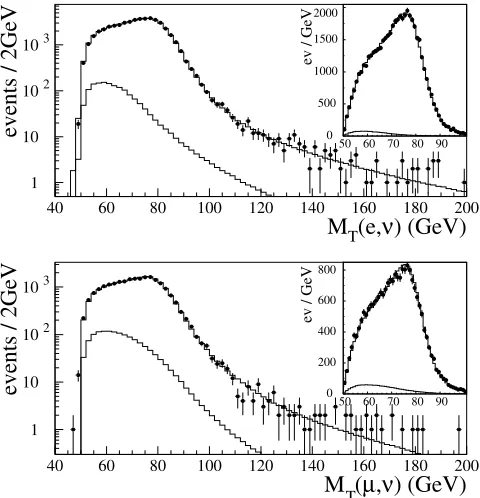
1.7806 0.195共stat兲 GeV for the muon channel. Figure 1 shows the data with the best fits and normalized back-ground shapes superimposed.
The systematic uncertainties in this measurement of theW width are due to effects that alter the shape of the transverse mass distribution. The most important sources of uncertainty are nonlinearity of the CEM ET
measure-ment (relevant only for electrons), recoil modeling, theW transverse-momentum spectrum, and backgrounds. To estimate the uncertainties due to these effects, these parameters are varied in the simulation and the simulated transverse mass spectra with the varied input parameters are fit to the nominal templates.
Linearity of the CEM energy measurement is studied by comparing CEM energies to CTC momenta over the range of energies spanned by electrons from the W and Z data samples. A fit to the form Emeas兾Etrue 苷11 e共ETmeas 2 具ET典兲yieldse 苷共2.961.3兲3 1024GeV21;
a study of c !ee and Y ! ee events yields a consis-tent value of e. CEM energies in the data are corrected event-by-event for this effect. Taking the uncertainty on e to be 62.931024 GeV21 shifts GW in the
simula-tion by 760MeV. A study ofc ! mm,Y !mm, and Z !mmresonances finds no evidence for nonlinearity in the momentum measurement. Varying the linearity of the momentum measurement within the bounds allowed by the
M
TT
(e,
ν
) (GeV)
events / 2GeV
1 10 102 103
40 60 80 100 120 140 160 180 200
ev / GeV
0 500 1000 1500 2000
50 60 70 80 90
M (
µ
,
ν
) (GeV)
events / 2GeV
1 10 102 103
40 60 80 100 120 140 160 180 200
ev / GeV
0 200 400 600 800
50 60 70 80 90
FIG. 1. Transverse mass spectra (filled circles) for W !en
(upper) andW !mn(lower) data, with best fits superimposed as a solid curve. The lower curve in each graph shows the sum of estimated backgrounds. Each inset shows the 50 –100 GeV region on a linear scale.
data changes the muon-channelW width by only 5 MeV in the simulation.
The parameters of the recoil model are varied accord-ing to the covariance matrices obtained in the fits of u as a function ofPᐉᐉT in theZ data. Because the eandm
analyses use independent fits to their respectiveZ !ᐉ1ᐉ2
samples, the uncertainties are different for the two chan-nels and are statistically independent. The effect on GW
is 60 MeV in the electron channel and 90 MeV in the muon channel. Similarly, the statistical uncertainty in the fits to the transverse-momentum spectra of the twoZ bo-son samples yields a GW error of 55 MeV in the electron
channel and 70 MeV in the muon channel. Varying the background predictions within the errors quoted in Table I changes the electron result by 30 MeV and the muon result by 50 MeV.
Varying the muon identification cuts in the data and the muon acceptance model in the simulation yield a com-binedGWerror of 40 MeV. The muon rapidity distribution,
which is modified by the acceptance of the trigger system, is fairly well modeled in the simulation [9,10], and the un-certainty quoted above represents an extreme variation in muon acceptance vs rapidity. To check the detector simu-lation used in the electron analysis, a sample generated using an independent simulation program is fit with the standard GW templates and found to agree; the statistical
precision of the check, 30 MeV, is taken as a systematic uncertainty.
Fits to theZ !ᐉ1ᐉ2 mass spectra determine both the
CEM energy and CTC momentum scales to 0.1%. Varying these scales by 0.1% in the simulation changes GW by
20 and 15 MeV, respectively, in the electron and muon analyses. Varying the CEM and CTC resolutions within the uncertainties allowed by fits to the Z mass spectra variesGW by 10 and 20 MeV, respectively.
Monte Carlo spectra have been generated using a va-riety of modern parton distribution functions, including a set whose d兾uratio was modified [13] to span the range allowed by CDF measurements of the rapidity asymmetry inW !ᐉndecay. The rms shift inGWis 15 MeV in both
channels. Varying theW mass by the current world aver-age uncertainty of 40 MeV [4,14] from the central value 80.40 GeV changesGW by 10 MeV in each channel.
Fi-nally, a study comparing W ! ᐉng andW !ᐉngg in thePHOTOS[15] simulation yields a systematic uncertainty of 10 MeV. These three final sources of uncertainty are common to both analyses.
Uncertainties have been calculated separately for the fit regions MT . 90, 100, and 110 GeV. While the
sta-tistical uncertainty decreases as the cut value is lowered, the systematic uncertainty increases. TheMT .100GeV
fit minimizes the total uncertainty. The results of the MT .100and 110 GeV fits differ by 10 MeV in the
elec-tron channel and 60 MeV in the muon channel.
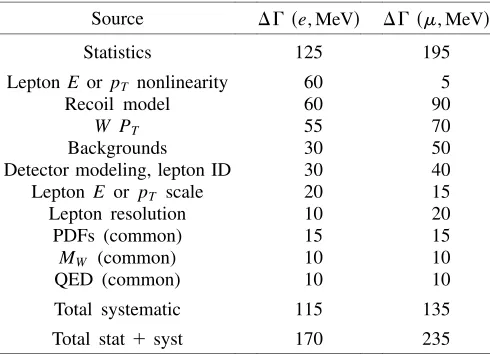
TABLE II. The sources of uncertainty onGW for theW !en
andW !mn measurements. The last three uncertainties are common to the electron and muon analyses.
Source DG共e,MeV兲 DG共m,MeV兲
Statistics 125 195
LeptonE orpT nonlinearity 60 5
Recoil model 60 90
W PT 55 70
Backgrounds 30 50
Detector modeling, lepton ID 30 40 LeptonE orpT scale 20 15
Lepton resolution 10 20
PDFs (common) 15 15
MW (common) 10 10
QED (common) 10 10
Total systematic 115 135
Total stat1syst 170 235
common error of 25 MeV, yields GW 苷 2.046
0.11共stat兲 60.09共syst兲 GeV. Including the previously published CDF electron result [5] with the same common error yields GW 苷 2.056 0.10共stat兲 60.08共syst兲GeV.
The result is in good agreement with the standard model value.
The vital contributions of the Fermilab staff and the technical staffs of the participating institutions are grate-fully acknowledged. This work is supported by the U.S. Department of Energy, the National Science Foundation, the Natural Sciences and Engineering Research Council of Canada, the Instituto Nazionale di Fisica Nucleare of Italy, the Ministry of Education, Science and Culture of Japan, the National Science Council of the Republic of China, and the A. P. Sloan Foundation.
[1] J. Rosner, M. Worah, and T. Takeuchi, Phys. Rev. D49,
1363 (1994).
[2] Particle Data Group, C. Caso et al.,Eur. Phys. J. C 3,1 (1998).
[3] N. Cabibbo, in Proceedings of the III Topical Workshop on Proton-Antiproton Collider Physics, Rome, Italy, 1983,
edited by C. Bacci and G. Salvini [CERN Report 83-04, Geneva, Switzerland, 1983 (unpublished)]; F. Halzen and M. Marsula, Phys. Rev. Lett.51,857 (1983).
[4] D0 Collaboration, B. Abbott et al., Phys. Rev. D 61,
072001 (2000); M. Lancaster, in Proceedings of the XIX International Symposium on Lepton and Photon Interac-tions at High Energies, Palo Alto, CA, 1999, edited by M. Peskin (to be published).
[5] CDF Collaboration, F. Abeet al.,Phys. Rev. Lett.74,341 (1995).
[6] OPAL Collaboration, G. Abbiendi et al., Phys. Lett. B 453, 138 (1999); DELPHI Collaboration, P. Abreuet al.,
CERN-EP/99-79 (to be published); L3 Collaboration, M. Acciarriet al.,Phys. Lett. B454,386 (1999). [7] The Collider Detector at Fermilab uses a cylindrical
coor-dinate system in whichfis the azimuthal angle,uis the polar angle, andz points in the proton beam direction and is zero at the center of the detector. The pseudorapidityh
is defined ash ⬅tanh21共cosu兲. The transverse plane is
the plane perpendicular to the z axis. The transverse en-ergy is defined to beET 苷Esinu.
[8] CDF Collaboration, F. Abe et al., Nucl. Instrum. Methods A271,387 (1988).
[9] CDF Collaboration, F. Abeet al.,hep-ex/0007044. [10] W. J. Ashmanskas, Ph.D. thesis, U.C. Berkeley, 1998; A. D.
Hardman, Ph.D. thesis, Purdue University, 1999.
[11] A. D. Martin, R. G. Roberts, and W. J. Stirling, Phys. Lett. B387,419 (1996).
[12] R. K. Ellis, D. A. Ross, and S. Veseli, Nucl. Phys. B503,
309 (1997); G. A. Ladinsky and C. P. Yuan, Phys. Rev. D 50,4239 (1994), and references therein.
[13] U. K. Yang and A. Bodek, Phys. Rev. Lett. 82, 2467 (1999).
[14] LEP Electroweak Working Group, D. Abbaneo et al.,
CERN-EP/99-15.