About Low DFR for QC-MDPC Decoding
?Nicolas Sendrier1 and Valentin Vasseur12
1
Inria, Paris, France [email protected], 2
Universit´e de Paris, Paris, France.
Abstract McEliece-like code-based key exchange mechanisms using QC-MDPC codes can reach IND-CPA security under hardness assumptions from coding theory, namely cyclic syndrome decoding and quasi-cyclic codeword finding. To reach higher security requirements, like IND-CCA security, it is necessary in addition to prove that the decoding failure rate (DFR) is negligible, for some decoding algorithm and a proper choice of parameters. Getting a formal proof of a low DFR is a difficult task. Instead, we propose to ensure this low DFR under some additional security assumption on the decoder. This assumption relates to the asymptotic behavior of the decoder and is supported by several other works. We define a new decoder, Backflip, which features a low DFR. We evaluate the Backflip decoder by simulation and extrapolate its DFR under the decoder security assumption. We also measure the accuracy of our simulation data, in the form of confidence intervals, using standard techniques from communication systems.
1
Introduction
Moderate Density Parity Check (MDPC) codes were introduced for cryptography3 in [17]. They are related to Low Density Parity Check (LDPC) codes, but instead of admitting a sparse parity check matrix (with rows of small constant weight) they admit a somewhat sparse parity check matrix, typically with rows of Hamming weightO(√n) and lengthn. Together with a quasi-cyclic structure they allow the design of a McEliece-like public-key encryption scheme [16] with reasonable key size and a security that provably reduces to generic hard problems over quasi-cyclic codes, namely the hardness of decoding and the hardness of finding low weight codewords.
Because of these features, QC-MDPC have attracted a lot of interest from the cryptographic community. In particular, the BIKE suite of key exchange mechan-isms has been selected to the second round of the NIST call for standardization of quantum safe cryptographic primitives 4. The second round BIKE document [1]
?This work was supported by the ANR CBCRYPT project, grant ANR-17-CE39-0007
of the French Agence Nationale de la Recherche.
3 MDPC were previously defined, in a different context, by Ouzan and Be’ery in 2009,
http://arxiv.org/abs/0911.3262 4
mentions the Backflip decoder, a new variant of bit flipping decoding, as well as claims about its DFR. The low DFR is an essential feature to achieve IND-CCA security, and incidentally to resist to the GJS key recovery attack [11] which exploits decoding failures.
The Backflip algorithm and its DFR claims were never fully described in an academic work. We provide here the rationale and a precise description of Backflip as well as a justification and a description of the simulation methodology and assumptions that were used for estimating the DFR.
The decoding of MDPC codes can be achieved, as for LDPC codes, with iterative decoders [10] and in particular with the (hard decision) bit flipping algorithm. The Backflip algorithm will introduce soft information (i.e.reliability information) by flipping coordinates for a limited time which depends on the confidence we have in each flipping decision. This confidence is measured from quantities that were already computed in bit flipping decoders and are thus avail-able at no extra cost. This way, the new decoder will use soft decision decoding, as in [2, 14] for instance, while keeping the very simple logic and arithmetic which makes it suited to hardware and embedded device implementations [13].
No theoretical argument is known to guaranty a low DFR for the Backflip decoder. We will resort to simulation. However proving a very low DFR (e.g.
2−128) cannot be achieved by simulation alone. Instead, we will use simulation data to extrapolate the DFR in a region of parameters where it is too small to be estimated by simulation. This extrapolation technique for the DFR is valid under an additional assumption on the asymptotic behavior of the decoder.
The paper is organized as follows. The§2 will state and comment the security assumption related to decoding. The §3 will describe the Backflip algorithm and explain its rationale. The§4 will explain, under the decoder security assumption, how to obtain DFR estimates with accurate simulation data.
Notation. For any binary vector v, we denotevi itsi-th coordinate and|v|its
Hamming weight. Moreover, we will identify v with its support, that is i∈v if and only if vi = 1. Given two binary vectors u and v of same length, we will
denote u∩v the set of all indices that belong to both u and v, or equivalently their component-wise product as vectors.
1.1 Previous Works
A binary Quasi-Cyclic Moderate Density Parity Check (QC-MDPC) code, is a quasi-cyclic code which admits a parity check matrix of density proportional to 1/√nwherenis the code length. A QC-MDPC code can efficiently correct an error of Hamming weighttproportional to√nthanks to bit flipping decoding (Algorithm 1). A (2r, r, w, t)-QC-MDPC-McEliece is an instance of the McEliece scheme [16] using an QC-MDPC code of index 2 correctingterrors. Such a code admits a parity check matrix consisting of two sparse circulant blocks of size r×rand row weightw/2 proportional to√n.
and of two polynomialsh0, h1ofRof Hamming weightw/2. Its security relates to the following hard problems.
Problem 1. (2,1)-QC Syndrome Decoding Instance:s, hinR, an integert >0.
Property: There existse0, e1 inRsuch that|e0|+|e1| ≤tande0+e1h=s.
Problem 2. (2,1)-QC Codeword Finding Instance:hin R, an integer w >0.
Property: There existsh0, h1 inRsuch that|h0|+|h1|=wandh1+h0h= 0.
In the rest of§1.1 we will consider an instance of a (2r, r, w, t)-QC-MDPC-McEliece scheme. The code length isn= 2r, its dimension isk=r, and we will denoted=w/2.
Security Assumptions. The security of QC-MDPC-McEliece for QC codes of index 2 (and rate 1/2) relies on two assumptions.
Assumption 1 Problem 1 is hard on average overs, hin R.
Assumption 2 Problem 2 is hard on average overhinR.
The above assumptions are enough to guaranty the one-wayness of the underlying encryption primitive. With the ad-hoc conversion they will also be enough to prove that the related Key Encapsulation Mechanism (KEM) is IND-CPA (see [1]). To go further and design and prove an IND-CCA KEM, a further assumption on the decoding failure rate (DFR) is required. This will be examined later in the paper.
Tightness and Best Known Attacks. The security proofs for QC-MDPC code-based schemes are tight in the following sense: the proofs require the decisional versions of Problem 1 and 2 to be hard on average for the size (r, t) and (r, w) while the best known attacks only require to solve the search version of either Problem 1 or 2 for the same size (r, t) or (r, w). Note that there is a search to decision reduction for Syndrome Decoding [9] but it has not been transferred so far to the quasi-cyclic case. The best solvers for Problem 1 and 2 use Information Set Decoding (ISD). As explained in [17], it is possible to make use of the quasi-cyclicity together with the multitarget variant of ISD [20] to slightly improve the decoding. If WF(n, k, t) is the expected cost of the best ISD solver for the decoding t errors in a binary linear [n, k] code, the cost of the best solver for Problem 1 and Problem 2 is upper bounded respectively by WF(2√r,r,t)
r and
WF(2r,r,w)
r . When
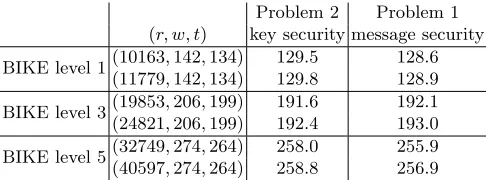
QC-MDPC-McEliece Practical Security. The security of an instance of the (2r, r, w, t)-QC-MDPC-McEliece scheme reduces to Problem 1 with parameters (r, t) and Problem 2 with parameters (r, w). We give in Table 1 the security
ex-ponents for the message and key securities, respectively WF(2√r,r,t)
r and
WF(2r,r,w)
r
when the workfactor is computed for the BJMM variant of ISD [3] using the methodology described in [12]. We remark that, as expected, the security
expo-Problem 2 Problem 1 (r, w, t) key security message security
BIKE level 1(10163,142,134) 129.5 128.6 (11779,142,134) 129.8 128.9
BIKE level 3(19853,206,199) 191.6 192.1 (24821,206,199) 192.4 193.0
BIKE level 5(32749,274,264) 258.0 255.9 (40597,274,264) 258.8 256.9
Table 1.Security exponent of (2r, r, w, t)-QC-MDPC-McEliece (BIKE parameters)
nent grows very slowly with the block sizer. The parameters of Table 1 are those of the NIST proposal BIKE [1]. For each security level, the first and second rows correspond respectively to the IND-CPA and IND-CCA variants.
Bit Flipping Decoding. All decoders for QC-MDPC codes derive from the bit flipping decoder given in Algorithm 1 in its syndrome decoding variant. In Algorithm 1, the counter|s0∩hj|is the number of unsatisfied equations involving
j. Positions with high counter values are flipped. If s0= s−eH|for some (e,s0), withH, s0 and e sparse enough, then the algorithm return e with high probability. The variant presented allows noisy syndrome withu >0 (as needed for BIKE-3),
Algorithm 1Bit Flipping Algorithm, (Noisy-)Syndrome Decoding Variant
Require: H∈F2(n−k)×n, s∈F
n−k
2 , integeru≥0 //u >0for noisy syndrome
Ensure: s−e0H|
≤uor time>max time
e0←0; time←1
whiles−e0H
|
> uandtime≤max timedo
time←time + 1 s0←s−e0H|
T ←threshold(context)
forj∈ {0, . . . , n−1}do
if |s0∩hj| ≥T then //hj thej-th column ofH e0j←1−e
0 j
returne0
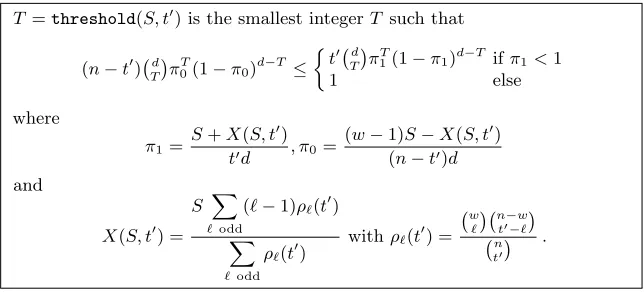
Threshold Selection. Selecting the proper threshold is an essential step of the bit flipping algorithm. In the current state of the art [5, 21] the optimal threshold is given as a function of the syndrome weight and of the error weight. We consider an execution of Algorithm 1. At any time, let e denote the (remaining) error vector, the syndrome is s0= eH|= s−e0H|. The optimal threshold is defined as
T =threshold(S, t0) is the smallest integerT such that
(n−t0) Td
π0T(1−π0)
d−T
≤
t0 Td
πT1(1−π1)d−T ifπ1<1
1 else
where
π1=
S+X(S, t0)
t0d , π0=
(w−1)S−X(S, t0) (n−t0)d
and
X(S, t0) =
S X
`odd
(`−1)ρ`(t0)
X
`odd
ρ`(t0)
withρ`(t0) =
w `
n−w t0−`
n t0
.
Figure 1.Threshold function
in Figure 1 with the callthreshold(|eH||,|e|). Note that the syndrome weight S=|eH||=|s−e0H||is always known by the the decoder while the error weight t0 = |e| is only known at the first iteration, since |e| = t by design. Later on the exact error weight is unknown and a value fort0 has to be chosen somehow. One possibility is to guess it by using the fact that the expected value ofS is a fonction oft0, E(S) =rPρ2`+1(t0). Though this identity is only exact at the first iteration, it provides a good enough estimate oft0 as a function ofS. Finally, even though the procedure for computing the threshold seems involved, it is not the case in practice. For a given set of parameters, the threshold is a function of S which can be precomputed and is usually well approximated by an affine function.
Attacks on the Decoder. The bit flipping algorithm is iterative and probab-ilistic. In particular, it has a small but positive Decoding Failure Rate (DFR). This is not an issue if the scheme uses ephemeral keys (e.g. TLS using BIKE specification) but creates a threat when static keys are used. It was shown in [11] how to exploit the decoding failures to recover the secret key. This stresses the importance of reducing the DFR to a negligible value. This is mandatory to reach CCA security and requires an evolution of the decoder, an increase of the parameters, an accurate estimate of the DFR, and arguments to support the accuracy of this estimate.
latter attack stresses the need of a constant-time implementation when static keys are used. Allowing constant-time implementation may in turn require an evolution of the decoder and of the system parameters.
1.2 Related Works
The Backflip decoding algorithm and claims about its DFR were given in [1]. The purpose of this work is to detail and support those claims. A simplified bit flipping variant, the step-by-step decoder, is modelled with a Markov chain in [21], the model has a DFR which decreases provably exponentially with the block size. The asymptotic analysis of [22] of QC-MPDC also predicts an exponential decrease in the range of interest for cryptography, but the analysis is made in a specific setting and cannot be directly applied to practical BIKE decoder and parameters. Another recent work [7] explores another decoder variant for BIKE to reach simultaneously a low DFR and a constant-time implementation.
2
An Additional Security Assumption
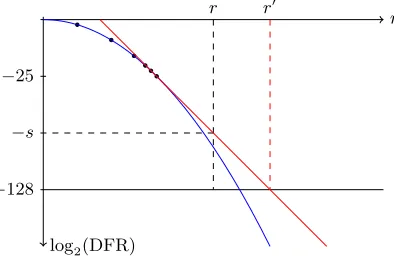
Preliminary: Tangent Extrapolation. When observing the plot of the logarithm of the simulated DFR versus the block size r(the other parameterswandtare fixed), one observes that it is always concave. It seems rather natural to assume that it will remain so and to extrapolate the DFR accordingly. The strategy will then consist in making a simulation for the largest possiblerto accurately measure the tangent of the lowest possible point of the curve. For instance in
r
log2(DFR)
−128
r0 r
−s
−25
Figure 2.DFR Tangent Extrapolation
Figure 2, suppose the low curve (blue) is giving the log2(DFR) and we are able to make accurate simulation as long as the DFR is above 2−25(black dots). Taking the tangent at the last point gives us the red line from which we derive an upper boundr0 for a block size with a DFR below 2−128as well as an upper bound 2−s
2.1 Target Parameters
We will consider here three levels of security named according to the NIST postquantum security nomenclature. For each security levelλbelow, we denote rCPA
λ the block size of the IND-CPA variants of BIKE (1 and 2).
Level 1: (w, t) = (142,134) forλ= 128 bits of classical security,rCPA
λ = 10 163 Level 3: (w, t) = (206,199) forλ= 192 bits of classical security,rCPA
λ = 19 853 Level 5: (w, t) = (274,264) forλ= 256 bits of classical security,rCPA
λ = 32 749
As mentionned previously, the security of the (2r, r, w, t)-QC-MDPC-McEliece scheme only marginally depends of the block size r. To reach IND-CCA security the block size must be increased slightly, at most 25% [1]. To allow constant-time implementation, the current state-of-art [7] suggests an extra 10%. We thus expect that for any security levelλthe values of interest for the block size rlie in the interval [rCPA
λ ,2r CPA λ ].
2.2 The Decoder Security Assumption
By decoder, say we denote itD, we mean a family of decoding algorithms which can be applied to QC-MDPC codes corresponding to various security levelsλ, including the three levels above, and to any block size rCPA
λ /2 ≤ r ≤ 2r CPA λ .
For a given security level λ, corresponding to a value of (w, t), we will denote DFRD,λ(r) the decoding failure rate when the decoderDis applied to an instance
of (2r, r, w, t)-QC-MDPC-McEliece.
Assumption 3 For a given decoderD, and a given security levelλ, the function
r7→log(DFRD,λ(r))is decreasing and is concave if DFRD,λ(r)≥2−λ.
2.3 Validity of the Concavity Assumption
Error Floors for QC-MDPC. The mappingr7→log(DFRD,λ(r)) cannot be
concave in the whole range r ∈[0,∞[. As explained in appendix, there is an additive term Pλ(r) in DFRD,λ(r), coming from the code weight distribution,
whose logarithm is asymptotically equivalent toCλ−(w/2−1) log2r. This term will dominate whenr grows but only for very large values ofr. We have
λ= 128,log2Pλ(rλCPA) =−396.8,and log2Pλ(r)≈535.0−70 log2r λ= 192,log2Pλ(rλCPA) =−618.5,and log2Pλ(r)≈837.8−102 log2r λ= 256,log2Pλ(rλCPA) =−868.7,and log2Pλ(r)≈1171.2−136 log2r
and this will not affect the DFR for values ofrrelevant for Assumption 3.
some threshold. The model can be computed for arbitrary large values ofrand we observe that in the range of interest forrthe log(DFR) is first strictly concave and eventually decreases linearly with r. This observation is consistent with Assumption 3. Note that the model does not capture the contribution of the weight distribution to the DFR.
Another work explores the asymptotic behavior of QC-MDPC decoding [22]. The asymptotic formula it provides for the DFR cannot be used directly because the setting is different (wandtvary withr), and also the conditions under which it can be proven are not relevant for decoders and parameters of practical interest. However the indication provided by the formula is consistent, the dominant term in the exponent decreases linearly withr.
To conclude this section, the Assumption 3 is and remains an assumption in the current state-of-the-art. We point out though that, for all variants of bit flipping decoding, every related theoretical and simulation results are consistent with it.
3
Backflip: a New Decoder for QC-MDPC Codes Using
Reliability
Design Rationale: Positions with higher counters in Algorithm 1 have higher probabilities to be erroneous. Positions are flipped when the counter is above a threshold, how much above doesn’t matter and a part of the reliability information is lost. Better performance are achieved with soft-decision decoders such as the belief propagation algorithm for LDPC codes. These decoders work by propagating probabilities back and forth between variable nodes and check nodes in the Tanner graph until the confidence on all values is high enough. Their logic and arithmetic are more complex though. See [2, 14] for examples of soft-decision MDPC decoding. The idea of Backflip is to use the reliability information while keeping the simplicity of the bit flipping decoder.
Among the flip decisions, most are good (an error is removed) and some are bad (an error is added). Bad decisions tend to induce more bad decisions and may lead to a failure. To exploit the reliability information a decoder could lessen the impact of the least reliable decisions and strengthen the impact of the most reliable ones. We propose Backflip, a new bit flipping algorithm which uses time to leverage the reliability information given by the counters on each flip. Every flip gets a (finite) time-to-live (an iteration count). When its time is over, the flip is canceled. Positions with a higher counter stay flipped for a longer time than positions with a counter just above the threshold. The design of Backflip is based on the following principles:
– the most reliable decisions will have more influence in the decoding process,
– all bad decisions will be cancelled at some point,
– conservative threshold selection hinders bad decisions in cascade.
for thethreshold, thettlis very well approximated by an affine fonction for any fixed set of parameters and its computation has a negligible cost in practice.
Algorithm 2Backflipping Algorithm
Require: H∈F2(n−k)×n, s∈F
n−k
2 , integeru≥0 //u >0for noisy syndrome
Ensure: s−e0H|
≤uor time>max time
e0←0; time←1; D←0 //Dj=time-of-death ofj
whiles−e0H
|
> uandtime≤max timedo //heremax timeis 100, 10 or 11 forjsuch thatDj= timedoe0j←0 //Undo flips at time-of-death
time←time + 1 s0←s−e0H|
T ←threshold(|s0|, t− |e0|)
forj∈ {0, . . . , n−1}do
if |s0∩hj| ≥T then //hj thej-th column ofH e0j←1−e0j;Dj←time +ttl(|s0∩hj| −T)
returne0
Threshold Selection Rule threshold(S, t0). As the time-to-live of a flip is always finite, a bad flip will always be canceled eventually. However, it is necessary to avoid adding more bad flips during the period during which it remains flipped. To achieve this, thresholds from Figure 1 are used withS =|s0| andt0=t− |e0|. This is the best case estimate for the error weight, it supposes that every flip removed an error. When many errors were added, the corresponding threshold is higher than for the usual bit flipping algorithm, this will slow down the decoding process, leaving time to cancel the bad decisions while making only very reliable new flips. In the typical case, most flip decisions were good, the threshold is close to optimal, and the decoding converges quickly.
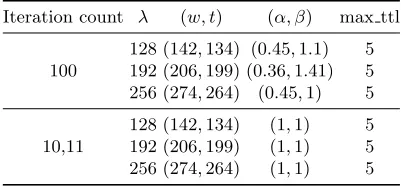
Time-to-live Rulettl(δ). Empirically, it appears that the time-to-live should be increasing with the differenceδbetween the position’s counter and the iteration threshold. It should also be finite because otherwise outlier counter values could lead to adding errors that are harder to detect: correct positions with a high counter will become errors with a low counter once flipped, their counter will have to change drastically before it is corrected by an algorithm relying solely on a threshold. Thettlfunction depends on the code parameters (especiallywand t) as well as the maximum number of iterations of the decoder. In practice, a saturating affine function inδ can be used.
ttl(δ) = max(1,min(max ttl,bα δ+βc)).
method (such as Nelder-Mead’s) is then used to find values for αandβ that minimize the DFR.
Iteration count λ (w, t) (α, β) max ttl
100
128 (142,134) (0.45,1.1) 5 192 (206,199) (0.36,1.41) 5 256 (274,264) (0.45,1) 5
10,11
128 (142,134) (1,1) 5 192 (206,199) (1,1) 5 256 (274,264) (1,1) 5
Table 2.ttlfunction parameters
Complexity and Constant Time Implementation. Backflip was primarily designed to work with a maximum of 100 iterations. Reducing this number to 10 is possible and requires an adjustment to thettlfunction. However it increases significantly the estimated DFR (see§4). Nevertheless, in both cases, the average number of iterations is much smaller, between 2.03 for (r, w, t) = (24821,206,199) and 4.38 for (r, w, t) = (32749,274,264).
The interest of reducing max time is to allow constant time implementation. The Backflip iteration can be implemented in constant time [7], but to mask the effective number of iterations and keep the DFR claims, the algorithm has to execute exactly max time iterations.
4
Estimating the DFR from Simulation
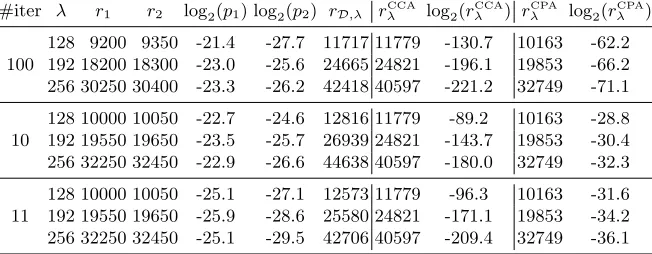
Under Assumption 3 for a decoderDand a security levelλ, we may extrapolate the DFR by accurately estimating the tangent of the functionr7→log2(DFR(r)) for some value of r. We obtain an estimate of the tangent by taking the line joining the values for two pointsr1< r2. Note that, except for a possible lack of accuracy (discussed below), this will provide upper bounds for the extrapolated DFRs. Results are presented in Table 3, we denote rD,λ the smallest r such
that DFRD,λ(r)≤2−λ. We denoterCPAλ andrCCAλ the blocks sizes in BIKE for
CPA and CCA security. Known asymptotic analysis [21, 22] indicate that the log2(DFR) is ultimately decreasing linearly, but this linear regime probably starts much beyond the simulated region. Thus it is best to chooser1, r2 as large as possible, but not too large else we would decrease the accuracy.
Finally note that a significant computational effort was needed to compute the data of Table 4, a total of several years of CPU time (on a single core).
#iter λ r1 r2 log2(p1) log2(p2) rD,λ r
CCA λ log2(r
CCA
λ ) rCPAλ log2(r
CPA λ )
100
128 9200 9350 -21.4 -27.7 11717 11779 -130.7 10163 -62.2 192 18200 18300 -23.0 -25.6 24665 24821 -196.1 19853 -66.2 256 30250 30400 -23.3 -26.2 42418 40597 -221.2 32749 -71.1
10
128 10000 10050 -22.7 -24.6 12816 11779 -89.2 10163 -28.8 192 19550 19650 -23.5 -25.7 26939 24821 -143.7 19853 -30.4 256 32250 32450 -22.9 -26.6 44638 40597 -180.0 32749 -32.3
11
128 10000 10050 -25.1 -27.1 12573 11779 -96.3 10163 -31.6 192 19550 19650 -25.9 -28.6 25580 24821 -171.1 19853 -34.2 256 32250 32450 -25.1 -29.5 42706 40597 -209.4 32749 -36.1
Table 3.DFR estimation for Backflip limited to max time iterations.
normal distribution gives a good approximation of this distribution in which the standard deviation for F is pp(1−p)N. For p1 (the case of interest) we
have
ˆ
p−p p
≤ε=z/
√
pN with probability 1−α≈0.68,0.95,0.997 forz= 1,2,3
respectively. We observe that the precision decreases asz/√F whereF is the number of failures observed andz will be determined by the confidence we wish to achieve. Note that for the same confidence,|log ˆp−logp| ≤ε. In our case, we use Clopper–Pearson intervals [6] which are exact (they use the correct bino-mial distribution and not an approximation). Those intervals are not symmetric, the confidence interval is ε− below and ε+ above the measured values. In the
#iter λ r1 F1 N1 log2p1 ε− ε+ r2 F2 N2 log2p2 ε− ε+
100
128 9200 1253 3.45 109-21.4 0.107 0.104 9350 102 2.30 1010-27.7 0.390 0.361 192 18200 499 4.13 109-23.0 0.171 0.165 18300 90 4.57 109 -25.6 0.416 0.383 256 30250 282 2.96 109-23.3 0.229 0.219 30400 80 6.14 109 -25.3 0.443 0.407
10
128 10000 1074 7.29 109-22.7 0.115 0.113 10050 282 6.99 109 -24.6 0.229 0.219 192 19550 440 5.08 109-23.5 0.182 0.176 19650 81 4.55 109 -25.7 0.440 0.404 256 32250 513 3.91 109-22.9 0.168 0.163 32450 37 3.83 109 -26.6 0.673 0.591
11
128 10000 200 7.29 109-25.1 0.274 0.259 10050 48 6.99 109 -27.1 0.584 0.522 192 19550 83 5.08 109-25.9 0.435 0.399 19650 11 4.55 109 -28.6 1.348 1.054 256 32250 109 3.91 109-25.1 0.376 0.350 32450 5 3.83 109 -29.5 2.214 1.501
Table 4.Raw simulation data with confidence intervals (α= 0.01)
provide interesting trade-offs between complexity and DFR for constant time implementations.
Additional Comments. In [21], the BIKE round 1 algorithm was estimated to have a DFR around 2−47.5 for (r, w, t) = (32 749,274,264). A significant improvement is made with Backflip as its DFR is estimated around 2−71.1 for the same parameters, with a smaller complexity on average.
Finally, note that the suggested parameters for the CCA variant of BIKE Level 5 (λ= 256) have not been correctly estimated. The extrapolated block size to reach a DFR of 2−256 is 42418 rather than 40597 in [1]. This is due to the imprecision of the measures at the time. To mitigate this issue, it is very likely that the tangent we are using is pessimistic and that the actual DFR is much lower than the extrapolated value given here.
5
Conclusion
We have given in this paper the description and the rationale of the Backflip decoder of BIKE [1]. We also explain how the DFR claims were obtained by extrapolating simulation data. To justify the extrapolation technique we introduce a new security assumption, related to the decoder, under which the DFR claims are valid. The assumption is supported by other works analyzing the asymptotic behavior of the bit flipping decoding for QC-MDPC codes. Under this additional assumption, it is possible to prove that the BIKE KEMs, derived from QC-MDPC codes, are IND-CCA. Doing this requires extensive simulations in order to obtain accurate simulation data.
Backflip with 100 iterations would hardly produce efficient constant time implementations. Reducing the number of iterations to 10 increases the DFR and would require larger block size to reach a low enough DFR for IND-CCA security. This was remarked in another independent work [7] which considers another variant of the bit flipping algorithm, closer to the round 1 BIKE decoder, and which is more efficient when the number of iterations is bounded to a small number. The methodology we develop here is valid for other variants of bit flipping and can be used to justify the conclusions of [7]: we may produce efficient constant time variants of BIKE with provably low DFR (under Assumption 3) but it requires a small increase of the block size, in the order of 5% to 10%.
Finally, there is one extra feature of the tangent extrapolation technique. With a larger amount a computational effort for the simulation, it should be possible, under the same assumptions, to get the same security guaranty (e.g.
References
1. Carlos Aguilar Melchor, Nicolas Aragon, Paulo Barreto, Slim Bettaieb, Lo¨ıc Bidoux, Olivier Blazy, Jean-Christophe Deneuville, Philippe Gaborit, Shay Gueron, Tim G¨uneysu, Rafael Misoczki, Edoardo Persichetti, Nicolas Sendrier, Jean-Pierre Tillich, and Gilles Z´emor. BIKE. Second round submission to the NIST post-quantum cryptography call, April 2019.
2. Marco Baldi, Paolo Santini, and Franco Chiaraluce. Soft mceliece: MDPC code-based mceliece cryptosystems with very compact keys through real-valued inten-tional errors. InProc. IEEE Int. Symposium Inf. Theory - ISIT, pages 795–799. IEEE Press, 2016.
3. Anja Becker, Antoine Joux, Alexander May, and Alexander Meurer. Decoding random binary linear codes in 2n/20: How 1 + 1 = 0 improves information set decoding. InAdvances in Cryptology - EUROCRYPT 2012, LNCS. Springer, 2012. 4. Rodolfo Canto-Torres and Nicolas Sendrier. Analysis of information set decoding for a sub-linear error weight. InPost-Quantum Cryptography 2016, LNCS, pages 144–161, Fukuoka, Japan, February 2016.
5. Julia Chaulet. Etude de cryptosyst`´ emes `a cl´e publique bas´es sur les codes MDPC quasi-cycliques. PhD thesis, University Pierre et Marie Curie, March 2017. 6. C. J. Clopper and E. S. Pearson. The Use of Confidence or Fiducial Limits
Illustrated in the case of the Binomial. Biometrika, 26(4):404–413, 12 1934. 7. Nir Drucker, Shay Gueron, and Dusan Kostic. On constant-time QC-MDPC
decoding with negligible failure rate. Cryptology ePrint Archive, Report 2019/1289, 2019. https://eprint.iacr.org/2019/1289.
8. Edward Eaton, Matthieu Lequesne, Alex Parent, and Nicolas Sendrier. QC-MDPC: A timing attack and a CCA2 KEM. InPost-Quantum Cryptography - 9th Interna-tional Conference, PQCrypto 2018, Fort Lauderdale, FL, USA, April 9-11, 2018, Proceedings, pages 47–76, 2018.
9. Jean-Bernard Fischer and Jacques Stern. An efficient pseudo-random generator provably as secure as syndrome decoding. In Ueli Maurer, editor, Advances in Cryptology - EUROCRYPT’96, volume 1070 ofLNCS, pages 245–255. Springer, 1996.
10. Robert G. Gallager. Low Density Parity Check Codes. M.I.T. Press, Cambridge, Massachusetts, 1963.
11. Qian Guo, Thomas Johansson, and Paul Stankovski. A key recovery attack on MDPC with CCA security using decoding errors. In Jung Hee Cheon and Tsuyoshi Takagi, editors,Advances in Cryptology - ASIACRYPT 2016, volume 10031 of LNCS, pages 789–815, 2016.
12. Yann Hamdaoui and Nicolas Sendrier. A non asymptotic analysis of inform-ation set decoding. IACR Cryptology ePrint Archive, Report2013/162, 2013. http://eprint.iacr.org/2013/162.
13. Stefan Heyse, Ingo von Maurich, and Tim G¨uneysu. Smaller keys for code-based cryptography: QC-MDPC McEliece implementations on embedded devices. In Guido Bertoni and Jean-S´ebastien Coron, editors,Cryptographic Hardware and Embedded Systems - CHES 2013, volume 8086 ofLNCS, pages 273–292. Springer, 2013.
15. David J. C. MacKay and Michael S. Postol. Weaknesses of margulis and ramanujan-margulis low-density parity-check ccodes. Electr. Notes Theor. Comput. Sci., 74:97–104, 2002.
16. Robert J. McEliece.A Public-Key System Based on Algebraic Coding Theory, pages 114–116. Jet Propulsion Lab, 1978. DSN Progress Report 44.
17. Rafael Misoczki, Jean-Pierre Tillich, Nicolas Sendrier, and Paulo S. L. M. Barreto. MDPC-McEliece: New McEliece variants from moderate density parity-check codes. InProc. IEEE Int. Symposium Inf. Theory - ISIT, pages 2069–2073, 2013. 18. Eugene Prange. The use of information sets in decoding cyclic codes. IRE
Transactions on Information Theory, 8(5):5–9, 1962.
19. Tom Richardson. Error floors of LDPC codes. InProc. of the 41th Annual Allerton Conf. on Communication, Control, and Computing, 2003.
20. Nicolas Sendrier. Decoding one out of many. InPost-Quantum Cryptography 2011, volume 7071 ofLNCS, pages 51–67, 2011.
21. Nicolas Sendrier and Valentin Vasseur. On the decoding failure rate of QC-MDPC bit-flipping decoders. In Jintai Ding and Rainer Steinwandt, editors,Post-Quantum Cryptography 2019, volume 11505 ofLNCS, pages 404–416, Chongquing, China, May 2019. Springer.
22. Jean-Pierre Tillich. The decoding failure probability of MDPC codes. In 2018 IEEE International Symposium on Information Theory, ISIT 2018, Vail, CO, USA, June 17-22, 2018, pages 941–945, 2018.
A
Error Floors For QC-MDPC
The DFR study we are making here differs from what is done for communication systems where the code is fixed and the signal to noise ratio increases (i.e.the bit error probability decreases). We expect to observe the same kind of DFR behavior here for QC-MDPC when we fix (w, t) and letrgrow. Some classes of error correcting codes, namely turbo-codes and LDPC codes to which MDPC codes are akin, suffer from a phenomenon known as error floor. The log(DFR) curve is first concave and quickly decreasing (thewaterfall). Then at some point the concavity changes and the DFR decreases much more slowly, this is known as theerror floor[15, 19]. This could contradict the Assumption 3, but fortunately error floors usually occur very low in DFR curves. The error floors are due to the existence of low weight codewords, in the case of turbo codes, or, for LDPC codes, to the existence of specific error configurations known as near-codewords. An (u, v)-near-codeword is an error pattern of relatively small weightuwith a syndrome of small weightv (the syndrome is computed with the sparse parity check matrix). Intuitively, it can be seen as a cluster of errors which are less visible because, together, they only invalidate a few parity equations. If the initial error pattern contains a near-codeword the decoder is more prone to fail. If many near-codewords exist it may cause an error floor.
syndrome weight. The probability that such a near-codeword exists when the QC-MDPC is chosen at random is extremely small. A very small number of QC-MDPC codes may admit such words, but if they do there will be few of them. Moreover, the decoding of the few error patterns containing near-codewords will not automatically fail, the DFR will just increase a bit, with little impact on the average DFR. Unless there is an algebraic structure which is not immediately apparent, we do not expect near-codewords to have an impact on QC-MDPC DFR.
Error Floors From Low Weight Codewords. Regardless of the algorithm, the decoding of a noisy codeword will almost certainly fail if the noisy codeword comes closer to a codeword c1different from the original one c0. For a given error e of weightt, and two codewords c0 and c1 at distancewfrom one another, the decoding will fail if|c0+ e−c1| ≤ |e|, which happens with probability
Pw= w X
i=w/2
w i
n−w t−i
n t
. (1)
An index 2 QC-MDPC code with block sizerand parity check matrix row weight wwill generally have exactlyrcodewords of weightw. IfH= (H0|H1) is the sparse parity check matrix, with two circulant blocksH0,H1, thenG= (H|1 |H|0) is a generator matrix of the code. With overwhelming probability, the r rows of that generator matrix are the only minimal weight codewords. Let us denote Pλ(r)≈rPw the failure probability due to those codewords. A simple analysis
shows that log2Pλ(r)∼r→∞Cλ−(w/2−1) log2rwhereCλonly depends of w
andt. We have DFRD,λ(r)≥Pλ(r) for any decoder, this term will dominate
whenrgrows and thus the logarithm of the DFR isnot concavein the whole ranger∈[0,∞[. However the change of slope only happens for very large values ofr. We have
λ= 128,log2Pλ(rλCPA) =−396.8,and log2Pλ(r)≈535.0−70 log2r λ= 192,log2Pλ(rλCPA) =−618.5,and log2Pλ(r)≈837.8−102 log2r λ= 256,log2Pλ(rλCPA) =−868.7,and log2Pλ(r)≈1171.2−136 log2r