Journal of
d Volume 11, Number 5 September, 1958RANGE
MANAGEMENT
Past Performance and Future Potential of Black
Grama for Southwestern Ranges’
NEAL WRIGHT AND L. J. STREETMAN
Research Agronomists, Crops Research Division, Agri- cultural Research Service, U. S. Department of Agri-
culture, Tucson, Arizona
The possibilities of improving range and forage grass species for use in grassland farming is receiving renewed attention ac- cording to Beard (3) 2. The need for range improvement in all aspects of grass improvement, brush and weed control, reseed- ing techniques, and management practices is generally accepted for the southwestern United
States. Black grama, Boute-
Zoua eropoda (Torr.) Torr., is one of the most important grass- es of the arid and semiarid des- ert grassland. This paper is a review of the previous work on this grass to appraise its status, evaluate the factors limiting its use, and propose objectives nec- essary for improvement.
Descriptive Characferisfics Black grama is believed to be the most important forage grass on the 89 million acres of desert grasslands in Arizona, New Mex- ico, and parts of Texas, Okla-
IContribution from the Crops Re- search Division, Agricultural Re- search Service, U. S. Dept. of Agri- culture, in cooperation with the De- partment .of Agronomy, Arizona Ag- ricultural Experiment Station, Tucson. Ark Agr. Exp. Sta. Techni- cal Paper No. 447.
2Numbers in parentheses refer to Literature Cited.
homa, Colorado, Utah, Nevada, and California (10) . Black grama is a major species in Arizona and New Mexico, adjacent parts of Mexico, and possibly in south- western Texas. The reviewers are of the opinion that it is of minor importance in the other areas of the Southwest. Hoover (42) presents a map showing the areas of major and minor dis- tribution of black grama.
Black grama, a native grass, occurs abundantly over a wide altitudinal range and throughout the Southwest area and south into Mexico (19, 20, 40, 41, 45, 46, 47, 51, 52, 56, 57, 64, 77, 78, 81). It forms pure stands over wide areas of the region (29)
and according to Humphrey
(44)) is dominant within the des- ert grassland which is sub-cli- max to a desert shrub climax (5). It is drouth tolerant both during seedling establishment, and as a mature plant, a quality indispensable to the establish- ment and maintenance of any of the major forage plants growing under prevailing arid and semi- arid climatic conditions. It is palatable and nutritious, both in summer and winter, consequent- ly it is particularly outstanding
FIGURE 1. Black grama-tobosa-yucca range in good condition in southwestern New Mexico. Black grama is a key species on many Southwestern ranges and was originally the mainstay of the range in many areas. The development of methods of increasing this grass on present ranges is an important objective of current research programs. (Photo by R. R. Humphrey).
208 NEAL WRIGHT AND L. J. STREETMAN
as a year-round forage plant. Black grama, also referred to as wooly-foot or crow-foot grama
(10, 36) is a tufted, branching, strong-rooted, long-lived peren- nial grass. It is readily recog- nized by the wiry, wooly-pube- scent, usually geniculate and
spreading culms (30) . The
creeping runners or stolons, which root at the joints and send up new shoots that later become separate plants, make the grass valuable for soil protection (10, 25). Technical classifications and descriptions of black grama have been presented by several work- ers (30, 35, 41). A practical de- scription is presented by Hum- phrey, Brown and Everson (47). Black Grama Range Research
History
The need for range studies and experimentation was recognized at an early date. Shear (68) pre- sents a review and summary of the work of investigating the various problems relating to the grasses and forage plants of the United States by the Department
of Agriculture, Division of
Agrostology, from the time of its organization in 1895 to 19M. He states that the southwestern re- gion presents difficult conditions and problems and that Bouteloua eriopoda, “wooly-foot grama,” is one of the most valuable range grasses in the region.
In 1900 an area of mesa land near Tucson was set aside by presidential proclamation for ex- perimental range studies (31). This small range reserve was a cooperative project of the U. S. Department of Agriculture and the University of Arizona Agri- cultural Experiment Station. In 1902 the Santa Rita Range Re- serve near Tucson was set aside by presidential proclamation
(71). The Jornada Experimental Range near Las Cruces, New Mexico, was established by exec- utive order in 1912. The Bureau of Plant Industry operated these ranges until 1915 when the ad- ministration of both ranges was
shifted to the Research Branch of the U. S. Forest Service. Pre- sently, the Santa Rita Range Re- serve is used by the Forest Serv- ice, the Agricultural Research Service, and is available to the University of Arizona Agricul- tural Experiment Station. The Jornada Range Reserve is admin- istered by the Agricultural Re- search Service. Previous work with black grama has been large- ly conducted at these experi- mental range reserves, where black grama is a major species of the native grass composition.
The U. S. Soil Conservation Service set up an evaluation pro- gram including the establish- ment of plant nurseries in Ari- zona and New Mexico in 1934. The primary purpose of this pro- gram was to study revegetation of rangelands in respect to soil and water conservation and flood control, with black grama being one of the species receiving at- tention for these uses. Operation of the Arizona Soil Conservation Service Nursery was delegated to the University of Arizona Agricultural Experiment Station in 1953, and at the same time the New Mexico Nursery at Albu- querque was disbanded.
Liferafuri Review The literature reveals that black grama has been under ob- servation for many years. Most of the work on this grass has been concerned with facts per- taining directly to or associated
with management. There have
been few basic studies pertaining to the fundamental aspects of growth and reproduction. A se- lected bibliography on manage- ment of western ranges, live- stock, and wildlife has been com- piled (65) which includes the published work on black grama to that date. I
Management
Griffiths (31) and Thornber (71) concluded that the poor condition of the Southwestern grama grass ranges at the time, near the turn of the century, had
been brought about by over- stocking.
In 1916 Wooton (80) presented the results of several years’ work on black grama originally started by others (32, 33, 35). The author concludes that with complete protection from graz- ing the range recovered rapidly at first, with large gains being made in the first two or three years, and that complete recov- ery was reached in approxi- mately 10 to 12 years. He points out that even light stocking re- sulted in doubling the time re- quired for complete recovery as
compared to completely pro-
tected areas.
A study reported by Jardine and Forsling (49) showed that on predominantly black grama ranges, drouth alone, if prolong- ed beyond the second year, killed 40 percent of the black grama plants and reduced the quantity of forage produced by the re- maining plants by approximately 50 percent. Grazing tends to in- crease the effect of drouth; how- ever, the authors (49) suggest that desired results may be ob- tained by reduction of stocking to 85 percent of the original car- rying capacity the first year, to 60 percent the second, and to 50 percent the third. The ill effects of drouth on black grama are presented by Canfield (14) for a 21-year period. He found ample indication that a part of the for- age produced in the more bounti- ful seasons could be carried over and used to supplement the less productive years. The ungrazed stems of black grama remain green for two or more seasons, making it, unlike its associates, a natural source of reserve feed. Canfield (16) later states that semi-deferred grazing provides for recovery after misuse, pro- tection against drouth, utiliza- tion of the seasonally palatable forage, and a more stable carry- ing capacity.
BLACK GRAMA FOR SOUTHWESTERN RANGES 209
itation and grazing upon black grama grass range and concludes that the test emphasized the abil- ity of black grama to survive two drouth periods (1916-18, 1921-26). Ordinarily one favor- able growing season appeared necessary to restore the vigor of weakened plants before marked improvement in the stand be- gan. Black grama was found to compete successfully with as- sociated species after depletion of stand by drouth, and to with- stand conservative utilization by livestock, while heavy grazing resulted in gradual or extreme deterioration.
A summary of the records of studies of the effects of climate and grazing on black grama un- der three grazing intensities, con- servative, moderate, and heavy, and on protected plots for the period 1916-56 are reported by
Paulsen (62). He emphasizes
the following points: a. the pre- cipitation shows no general long- time upward or downward trend; b. at approximately 20-year in- tervals, rainfall was alternately about 10 percent above and be- low average; c. irrespective of the degree of grazing use, dens- ity was reduced to about the
same point during extended
drouths; d. density during years of more abundant rainfall is greatest on areas conservatively grazed; and e. the rate of recov- ery after drouth depends on the stand that remains to revegetate the area at the end of the drouth.
The most beneficial precipita- tion distribution for both density change and height growth con- sists of relatively dry winters between relatively wet autumns and springs (50). According to McGinnies and Arnold (51) the desert grassland group of grass- es, including black grama, are very similar as to their water re- quirements.
It has been proposed (11) that types of stem structure reflect the moisture requirements and periods of growth of grasses. The
Bouteloua species have solid stems, a characteristic that aids these species in surviving arid and semiarid conditions. Can- field (11) further concludes that this stem character is a criterion which may be employed in the selection of grasses for introduc- tion into the Southwest.
Campbell (8) and Campbell and Crafts (10) state that proper utilization of black grama is es-
sential to good growth and
spreading, which means utiliza- tion of about 50 percent of the total growth on a weight basis or 70-85 percent of the height growth. He concludes that black grama should not be grazed until summer growth is complete if other areas are available for grazing. Making use of the win- ter and spring palatability of black grama encourages spread and promotes the use of other species palatable only when green (8, 10). The aim should be to graze moderately in good years and to reduce grazing in poor years in relation to produc- tion.
Campbell and Bomberger (9) conclude that at least two inches of stubble and 15 percent of the flower stalks must be left on the ground each year if a reasonably good stand is to be maintained. A 25 to 30 percent reserve left
ungrazed at the beginning of the new growing season is rec- ommended by Canfield (12). As a result of further studies, Can- field (14, 17) suggests a 15 to 25 percent balance of ungrazed for- age at the close of the growing season as the best insurance against range deterioration and livestock losses due to drouth. He suggests that stocking on a sus- tained yield basis materially in- creases herd earnings and that a 20 percent reserve of forage is advisable as insurance against drouth. Culley (22) concludes that black grama should not be grazed closer than to within three inches of ground level. The differences of percentage of op-
timum ungrazed forage suggest- ed by the various authors may be accounted for by variation of seasonal climatic conditions. Per- haps 25 percent of the forage produced may be the optimum reserve. An economic study by Culley (21) shows the year- round carrying capacity of pre- dominantly black grama ranges varies from one cow to 23 acres to one cow to 60 acres. The re- sults of clipping experiments on semidesert black grama range have been presented by Canfield
(15). He concludes that persis- tent clippings of all herbage to a height of 2 inches or less ulti- mately results in critical deteri- oration through excessive wind and water erosion. The need for balanced livestock and forage production is presented by Dar- row (24).
Canfield (12) reports on the desirability of semi-deferred grazing. He states that semi-de- ferred grazing by light stocking during the summer grazing sea- son and heavier stocking during
autumn, winter and spring
months provided for yearlong use, and gave satisfactory results on extensive areas of black grama range. The effects of thirty years protection from grazing of mixed gramas and other species have been present- ed by Gardner (27). Little dif- ference in species was noted be- tween protected and unprotected areas although grass density on the protected area was 110 per- cent higher than on the unpro- tected areas.
210 NEAL WRIGHT AND L. J. STREETMAN
weight basis. Several methods of establishing proper utilization of important forage species are dis-
cussed by Campbell (7). He
states that regardless of the method of determining utiliza- tion, the figure obtained on a range must be compared with a predetermined proper utilization percentage for the important forage species. Also very careful observation of soil erosion, dis- turbance, and range condition are necessary for an adequate picture of utilization and its ef- fects on the range.
Measuring utilization of range grasses including black grama by use of clipped quadrats is dis- cussed by Culley, Campbell, and Canfield (23). The authors con- clude that the method fails to completely simulate grazing by livestock, yet valuable indica- tions may be obtained as to what constitutes proper utilization.
Reynolds and Bohning (67) re- port that black grama density was seriously affected by June burning, and it did not recover during the period of the study
(1952-1954). The effects of- mes- quite density on the density of associated black grama are re- ported by Parker and Martin
(60). On untreated areas for an eight-year period, grass density gradually decreased to a neg- ligible percent, while the best herbage yields were obtained when mesquite alone was killed. Paulsen (61) found that soil physical properties were more
favorable under black grama
cover than under mesquite
bushes. The soil under mesquite bushes was coarser, had a lower pore volume, was less favorable in respect to moisture relations for plant growth, and was more unstable.
Nutrition
Watkins (75) presents a re- view of literature dealing with the nutritive value of range for- age grasses and concludes that it is known to vary widely. He states that these variations are
due to a number of factors, such as species, stage of maturity, sea- sonal changes, fertility of the soil, elevation, moisture content, weathering and leaching, distri- bution of rainfall, and tempera- ture. According to Stanley (70) there is a decline in protein, cal- cium, phosphorus, and carotene during the winter periods in Ari- zona range grasses including black grama.
A study by Watkins (73)
shows phosphorus and calcium highest during the growing sea- son, with approximately 75 per- cent of the phosphorus and 25 percent of the calcium lost dur- ing the winter months for many grass species analyzed. The an- alyses, which included black grama, indicate a greater defi- ciency of phosphorus than cal- cium in the range grasses of New Mexico. A later study by Wat- kins (74) showed that carotene content of black grama is mod- erately high during the growing season with sufficient carotene to satisfy the vitamin “A” re- quirements of range cattle. Wat- kins (75) concludes that the easily digested carbohydrate does not decrease and is not lost in the wintering and leaching process, making black grama a valuable roughage. Protein con- tent was found to be high during the growing season. An average loss of 37 percent protein was
found between October and
March. Watkins (75, 76) further found that the phosphorus con- tent was not sufficient to meet the requirements of cattle except for a short period at the peak of the growing season, while caro- tene levels were sufficient for beef cows even during the gesta- tion and lactation periods. Wat- kins (75) indicates there is a re- lationship between available soil phosphates and the phosphorus of the forage. He suggests (75) that the quantity of amido pro* tein present is a measure of win- tertime plant activity.
Moderately high protein
values for black grama are usu- ally found during the winter, due largely to the light precipitation during the season (76). An early report (36) also shows the de- sirable nutritional qualities of black grama.
Cyfology and Growth Behavior Fults (26) reported 2n=21 while investigating three differ- ent seed sources of Bouteloua eriopoda. He reports many aneu-
ploid chromosome numbers in
this genus. According to Brown (6) the basic number of chromo- somes x=7 was found for six species; (Bouteloua chondrisio- ides, 2n=24), (B. eriopoda, 2n=28), (B. filiformis, 2n=14),
(B. regidiseta, 2n=28), (B. trif- ida, 2n=28) and (B. breviseta, 2n=28). He reports that these studies do not confirm the con- clusions of Fults that the species of Bouteloua are largely aneu- ploid. Both authors point out that since relatively few plants have been studied, variation in
chromosome numbers may be
found by further search. Recent investigations indicate that the basic chromosome number is 10, rather than the previously re- ported 7 for the Bouteloua gen- era, although some forms with
x-7 have been demonstrated
(38, 39). Fults (26) states that the length of chromosome ranged
from 0.25 to 1.50 microns with an average length of 1.00 micron, and there appeared in each com- plement two small spherical chromosomes which appeared to be characteristic.
From his studies Fults (26) concluded that the Southwest is near the center of distribution of the genus Bouteloua due to the predominance of low chromo- some numbers coupled with the fact that the species are often dominant. Myers (54) points out the possibility of apomixis in some Bouteloua species due to the common occurrence of aneu- ploid numbers.
Growth and flowering re-
BLACK
iod for several of the species of Bouteloua have been reported by Olmsted (58, 59). He states that black grama should be regarded as a short day plant as defined by Allard and Garner (1). It was found (58, 59) that the total number of tillers, tillers bearing inflorescences, and crown roots were inversely correlated with length of photoperiod; while average maximum height, aver- age dry weights of roots and tops, and vigor of individual in- florescences were correlated pos- itively with length of photoper- iod. He states that experiments have indicated that winter chill- ing is unnecessary to bring about reproductive activity. According to Olmsted (58) the photoper- iodic responses of black grama should be investigated in greater detail.
Reseeding
There are many range reseed- ing techniques and problems (2) . Black grama has been little used for reseeding because supplies of good seed have been scarce and are not commercially produced due to poor seed production qual- ities (2, 25, 28, 42, 55, 69, 79) . Campbell (8) points out that re- seeding costs are high because seed is obtainable only from na- tive stands where seed produc- tion is characteristically poor. Jackson (48) in studies with na- tive seed obtained 0 percent germination, and an examina- tion of the material revealed that there were no caryopses present, which emphasizes the poor seed producing capabilities of black grama. Black grama is slow to become established; however, plantings made on very dry sites have persisted through several drouth years (2).
Bridges (4) points out from his studies that failure to produce stands in the field is not due to lack of seed viability but to the lack of proper conditions for ger- mination. Wilson (79) reports an average percentage of germina- tion of 3.72 for two lots of 100
GRAMA FOR SOUTHWESTERN RANGES 211
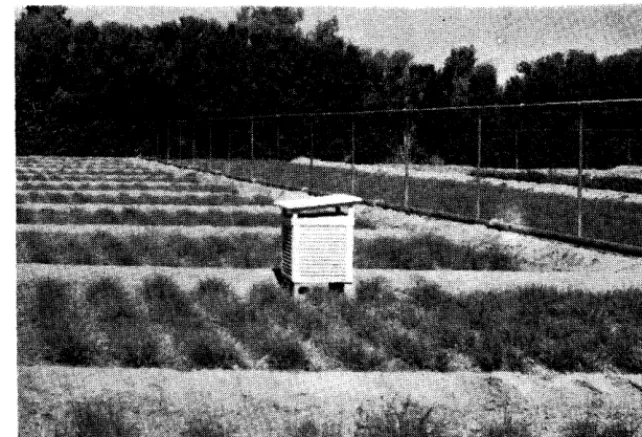
FIGURE 2. Black grama research plots at Tucson, Arizona. Studies are being conducted here to determine the factors affecting seed set. The seed habits of this grass are ex- tremely variable, and the seed crop produced by native stands generally has low viability.
seed, each tested in duplicate and retested. Germination of 22 percent and purity of 37 percent have been reported (82) along with an intermediate seed lon- gevity classification, Hulling or processing seed improves purity to 90 percent and germination to 65 percent (82). These varying results might indicate that labo- ratory germination procedures warrant further investigation.
Flory and Marshall (25) state that black grama seed cannot be separated readily from the straw, resulting in variability in qual- ity. Although there are about 1,300,OOO seeds in a pound, a pound of average quality bulk planting material may contain as few as 100,000 pure live seeds. A figure of 1,335,OOO seeds per
pound along with values of
300,000 seeds per pound when cleaned, and 500,000 as hulled or further cleaned have been re- ported (82).
Due to the generally arid con- ditions in black grama areas, planting in contour furrows or in connection with other water spreading, water concentrating, or water saving structures is a prerequisite for successful estab-
lishment (2, 25). About 12
pounds per acre of average bulk planting material is suggested
(25)) and a rate of lo-15 pounds per acre of unspecified quality has been proposed (82).
The transplanting of clumps of black grama as a means of revegetation of ranges is pro- posed by Glendening (28). He
states that success can be
achieved if a few simple rules are followed. Transplanting of clumps yields best results when done during July or August, when soil temperatures are rea- sonably high and the soil is well moistened to a depth of at least six inches. The use of the trans- planting technique is also dis- cussed but not recommended by Goodding (29) and Wilson (79) . Both authors state transplanting is not practical for range im- provement.
One of the difficulties of arti- ficial range reseeding is pointed out by Reynolds (66). Rodents can cause damage; however, Rey- nolds (66) suggests that seed as small or smaller than black grama are not likely to be dis- covered and dug out. He further concludes that low perennial grass densities are associated with high kangaroo rat densities.
212 NEAL WRIGHT AND L. J. STREETMAN
Status
Black grama possesses many desirable characteristics, making it an outstanding range grass of the arid and semiarid grasslands of southwestern United States. Black grama is a well adapted native, long-lived perennial. It can be maintained on the range. Although it is not as abundant as in previous years, its spread can be slowly accomplished by prop- er utilization and management practices. Black grama’s soil pro- tection qualities are most desir- able due to the ability of the stem joints to take root, result- ing in new plants, making not only a valuable soil protector but providing a means for spreading and revegetation. The drouth tolerance of this grass is excep- tional in that this characteristic is effectively demonstrated through all growth stages; how- ever, continued use and drouth can seriously deplete stands. It is a dependable forage plant with the ability to perform well under grazing. The literature indicates highest yield performance and persistence when deferred graz- ing is used, as compared to non- use or heavy grazing.
The grass is characteristically nutritious at all times of the year, and in comparison with other forage species, the winter and spring nutritional values make black grama outstanding. It is a palatable forage and high- ly relished throughout the year, and is of particular importance during the dry spring period when other range species are harsh and parched. Unlike most of its associates, black grama is a natural source of reserve feed, since the ungrazed stems remain green for two or more seasons. This feature, coupled with man- agement, minimizes drouth haz- ard and provides a more stable carrying capacity.
Evaluation and Ob jecfives This review indicates that many of the principles of black
grama range management have
been studied and that there has been a minimum of research on the more basic aspects of growth and reproduction. An evaluation of this information indicates that the one characteristic limiting the widespread use of this grass for range reseeding is its ex- tremely poor and unreliable seed setting capabilities. Obviously, the key to its widespread use for reseeding hinges on the improve- ment of seed production.
In this instance the aim of the plant breeder should be to main- tain the many desirable charac- ters while improving seed pro- duction (37). Once the factor or factors limiting seed set can be determined, research will be needed on the cultural tech- niques necessary to produce seed in sufficient quantity for an eco- nomic product.
There is need for further in- vestigation of the physiology, cytology, mode of reproduction, breeding behavior, and cultural practices of this grass in order to utilize the most advantageous breeding procedures.
There are no recorded data on the use of fertilizer in relation to reseeding or the effect on yield and nutritive value of black grama. Seed quality factors such as purity, germination, and lon- gevity, reseeding practices, man- agement techniques, and seed processing problems should be considered following the im- provement of seed setting along with the development of breed- ing procedures. The elimination of seed production barriers, which at present are limiting, along with methods of establish- ing stands in hot, dry areas would allow black grama to take a prominent role in revegetation of the desert grasslands of the southwestern United States.
LITERATURE CITED
1. ALLARD, H. A., AND W. W. GARNER. 1940. Further observations on the response of various species of plants to length of day. U. S.
2.
3.
4.
5.
6.
7.
8.
9.
10.
11.
12.
13.
14.
15.
Dept. Agr. Tech. Bul. 727. 64 pp. ANDERSON, D., L. P. HAMILTON, H. G. REYNOLDS AND R. R. HUM- PHREY. 1953. Reseeding desert grassland ranges in southern Ari- zona. Ariz. Agr. Exp. Sta. Bul. 249, 32 pp.
BEARD, D. F., 1955. The great need for grassland research. Joint Comm. Grassland Farming. Proc. 1955: 48-52.
BRIDGES, J. 0. 1941. Reseeding trials on arid range lands. N. Mex. Agr. Exp. Sta. Bul. 278. 48 pp. BROWN, A. 1950 Shrub invasion of southern Arizona Desert Grass- land. Jour. Range Mangt. 3: 172- 177.
BROWN, W. V. 1950. A cytological study of some Texas Graminaeae. Bull. Torry Bot. Club. 77: 63-76. CAMPBELL, R. S. 1943. Progress in utilization standards for western ranges. Wash. Acad. Sci. Jour. 33: 161-169.
__________.__.______--~---~.~--~~~--. 1948. How to keep and increase black grama on southwestern ranges. U. S. Dept. Agr. Leaflet 180. Sec. Ed. 8 pp. _._______.____-__--_---.---.----, AND E. H. BOM- BERGER. 1934. The occurrence of Gutierrezia sarothrae on (Boute- lona) eriopoda ranges in southern New Mexico. Ecology 15: 49-61.
___.__---..--.---.--.-, AND E. C. CRAFTS. 1939. How to keep and increase black grama on southwestern ranges. U. S. Dept. Agr. Leaflet 180. 8 pp.
CANFIELD, R. H. 1934. Stem structure of grasses on the Jor- nada Experimental Range. Bot. Gaz. 95: 636-648.
____________________--~--_~---, 1938. Vegeta- tional density and composition of black grama type ranges as influenced by semi-deferred grazing. U. S. Forest Serv., Southwestern Forest and Range Exp. Sta. Res. Note 35. 2 pp. _._______________.._-.---~---. 1939. Main- taining the balance between summer and winter forage on black grama ranges under year- long grazing use. U. S. Forest Serv. Southewestern Forest and Range Exp. Sta. Res. Note 81. 8 PP.
_____________._______.___-__-~~-~..--~. 1939. Ways and means to minimize the ill effects of drought on black grama ranges. U. S. Forest Serv., Southwestern Forest and Range Exp. Sta. Res. Note 82 7 PP.
BLACK GRAMA FOR SOUTHWESTERN RANGES 213 16. 17. 18. . 19. 20. 21. 22. 23. 24. 25. 26. 27. 28. 29. 30. 31.
___._______.__..__..~~~~~~~~..-.~~~~ 1940. Semi- deferred grazing as a restorative measure for black grama ranges. U. S. Forest Serv., Southwestern Forest and Range Exp. Sta. Res. Note 80. 4 pp.
.______.__..____________________________ 1942. The relative grazing preference of cattle for the common semi- desert grasses in southern Ari- zona. U. S. Forest Serv. South- western Forest and Range Exp. Sta. Res. Not 102. 3 pp.
CARPENTER, J. R. 1940. The grass- land biome. Ecol. Monog. 10: 618- 684.
COTTLE, H. J. 1932. Vegetation on north and south slopes of mountains in southwestern Texas. Ecology 13: 121-134. CULBERT, J. I. 1941. Pinto beans in the Estancia Valley of New Mexico. Econ. Georgr. 17: 50-60. CULLEY, M. J. 1937. An economic study of cattle business on a southwestern semidesert range. U. S. Dept. Agr. Cir. 448. 24 pp. ___.____________________________________. 1944. The Santa Rita Experimental Range. U. S. Forest Serv., Southwestern Forest and Range Exp. Sta. Publ. 10 pp.
~.-“~~‘--‘~-~‘--~‘~-~---~-~-..-~.~~~-..~.._.~__, R. S. CAMPBELL AND R. H. CANFIELD. 1933. Values and limitations of clipped quadrats. Ecology 14: 35-
39.
DARROW, R. A. 1944. Arizona range resources and their utiliz- ation. I. Cochise County. Ariz. Agr. Exp. Sta. Tech. Bul. 103. 366 pp.
FLORY, E. L. AND C. G. MARSHALL. 1942. Regrassing for soil protec- tion in the Southwest. U. S. Dept. Agr. Farmers’ Bul. 1913. 60 PP.
FULTS, J. L. 1942. Somatic chro- mosome complements in Boute- Zoua. Am. Jour. Bot. 29:45-55. GARDNER, J. L. 1950. Effects of thirty years of protection from grazing in desert grassland. Ecology 31: 44-50.
GLENDENING, G. E. 1939. How to establish black grama on de- pleted semi-desert ranges. U. S. Forest Serv., Southwestern For- est and Range Exp. Sta. Res. Note 52. 4 pp.
GOODDING, L. N. 1938. Notes on native and exotic plants. U. S. Dept. Agr., Soil Conservation Serv., Publ. 247. Albuquerque, N. M.
GOULD, F. W. 1951. Grasses of southwestern United States. Univ. Ariz. Biol. Sci. Bul. 7. 343 PP.
GRIFFITHS, D. 1901. Range im- provement in Arizona. U. S.
32. 33. 34. 35. 36. 37. 38. 39. 40. 41. 42. 43. 44. 45. 46.
Dept. Agr., Bur. Plant Indus. Bul. 4. 31 pp.
_______.___._._~.__..-.---.-..-.-. 1904. Range investigations in Arizona. U. S. Dept. Agr., Bur. Plant Indus. Bul. 67. 62 pp.
______________._.__.____________________. 1907. The reseeding of depleted range and native pastures. U. S. Dept. Agr. Bur. Plant Indus. Bul. 117. 27 pp. ______._.__.__.._.__-~~--~.~.~~~. 1910. A pro- tected stock range in Arizona. U. S. Dept. Agr., Bul. Plant Indus. Bul. 177. 28 pp.
_______.._____.__._.____________________. 1912. The grama grasses: Bouteloua and related genera. U. S. Natl. Herb. Publ. 14: 343-428.
‘_.._.‘.‘._.__.-“~‘._.._..-.~~.._.__..~, G. L. BID- WELL AND C. E. GOODRICH. 1915. Native pasture grasses of the United States. U. S. Dept. Agr. Bul. 201: 12-13.
HANSON, A. A. AND H. L. CARNA- HAN. 1956. Breeding perennial forage grasses. U. S. Dept. Agr. Tech. Bul. 1145. 116 pp. HARLAN, J. R. 1956. Theory and dynamics of grassland agricul- ture. D. Van Nostrand Co., Inc., Princeton, N. J.
-....‘-‘--“‘..‘.--.~~.--) L. A. SNYDER AND R. P. CELARIER. 1952. Cyto- logical studies of southern Great Plains grasses. Proc. Sixth In- ternat. Grassland Congress. 2 vols. Penn. State College, State College, Pa.
HINCKLEY, L. C. 1947. Contrasts in the vegetation of Sierra Tierra Vieja in Trans-Pecos Texas. Am. Mid. Nat. 37: 162-178.
HITCHCOCK, A. S. 1951. Manual of the grasses of the United States. U. S. Dept. Agr. Misc. Publ. 200. 1051 pp. 2nd Ed. Re- vised by Agnes Chase.
HOOVER, M. M. 1939. Native and adapted grasses for conservation of soil and moisture in the Great Plains and Western States. U. S. Dept. Agr. Farmers’ Bul. 1812. 43 PP.
HUMPHREY, R. R. 1950. Arizona range resources. II. Yavapai County. Ariz. Agr. Exp. Sta. Bul. 229. 55 pp.
~-____.-~~.._.--~.-.--.~~.~..-..-.-~.._____. 1953. The desert grassland, past and pres- ent. Jour. Range Mangt. 6: 159- 164.
______._______.__._____..--.~..~... 1955. Forage production on Arizona ranges III. Mohave County, Arizona. Ariz. Agr. Exp. Sta. Bul. 244. 79 PP.
_____________._..__._._-..-...~.. 1955. Forage production on Arizona ranges. IV. Coconino, Navajo, Apache Counties. A study in range con- dition. Ariz. Agr. Exp. Sta. Bul.
47. 48. 49. 50. 51. 52. 53. 54. 55. 56. 57. 58. 59. 60. 61. 62.
266, 84 pp.
___.~“~‘__‘-~‘~-‘~‘._.--.-.--.-, A. L. BROWN AND A. C. EVERSON. 1956. Com- mon Arizona range grasses, their description, forage value and management. Ariz. Agr. Exp. Sta. Bul. 243. 77 pp. Re- printed.
JACKSON, C. W. 1928. Seed ger- mination in certain New Mexico range grasses. Bot. Gaz. 86:270- 294.
JARDINE, J. T. AND C. L. FOR- SLING. 1922. Range and cattle management during drought. U. S. Dept. Agr. Dept. Bul. 1031. 83 PP.
LISTER, P. M. AND F. X. SCHU- MACKER. 1937. The influence of rainfall upon tuft area and height growth of three semi- desert range grasses in southern Arizona. Jour. Agr. Res. 54: 109- 121.
LITTLE, E. L. AND P. S. CAMP- BELL. 1943. Flora of Jornada Ex- perimental Range, New Mexico. Am. Mid. Nat. 30: 626-760. MESERVE, M. F. 1939. Grasses of Colorado. Univ. of Colo. Studies. 26: 93-95.
MCGINNIES, W. G. AND J. F. ARNOLD. 1939. Relative water re- quirements of Arizona range plants. Ariz. Agri. Exp. Sta. Tech. Bul. 80: 167-246.
MYERS, W. M. 1947. Cytology and genetics of forage grasses. Bot. Rev. 13: 319-421.
NELSON, E. W. 1934. The influ- ence of precipitation and graz- ing upon black grama grass range. U. S. Dept. Agr. Tech. Bul. 409. 32 pp.
NICHOL, A. A. 1937. The natural vegetation of Arizona. Ariz. Agr. Exp. Sta. Tech. Bul. 68: 181-222. __.._.___---.____.--~__.~.. 1952. The natural vegetation of Arizona. Ariz. Agr. Exp. Sta. Tech. Bul. 127: 188-230. OLMSTEAD, C. E. 1943. Growth and development in range grasses. III. Photoperiodic re- sponses in the genus Bouteloua. Bot. Gaz. 105: 165-181.
___________________._______. 1952. Photoperi- odism in native range grasses. Proc. Sixth Internat‘l. Grassland Congress. 2 ~01s. Penn State Col- lege, State College, Pa.
214 NEAL WRIGHT AND L. J. STREETMAN
63.
64.
65.
66.
67.
68.
Range Exp. Sta., Ranch Day. 1956: 17-25.
PEARSE, C. K. 1950. Measuring utilization of a black grama range. Southwestern Forest and Range Exp. Sta., Ranch Day. 1950: 16-20.
RECHENTHIN, C. A. 1950. Range grasses: a discussion of the gramas. Cattleman 36: 66-67. RENNER, F. G., E. C. CRAFTS, T. C. HARTMAN AND L. ELLISON. 1938. A selected bibliography on management of western ranges, livestock, and wildlife. U. S. Dept. Agr. Misc. Publ. 281. 468 PP.
REYNOLDS, H. G. 1950. Relation of Merriam kangaroo rats to range vegetation in southern Arizona. Ecology 31: 456-463. .---.--.-_________.-._______, AND J. W. BOHN- ING. 1956. Effects of burning on a desert grass-shrub range. Eco- logy 37: 769-777.
SHEAR, C. L. 1901. Field work of the Division of Agrostology: A review and summary of the work done since the organiza- tion of the Division, July 1, 1895. U. S. Dept. Agr. Bul. 25. 67 pp.
69.
70.
71.
72.
73.
74.
75.
SPALLER, T. F. 1954. Digest of nursery plant observations, 1949-
53. Soil Conservation Service 76. Nursery, Albuquerque, N. M. 34 PP.
STANLEY, E. B. 1938. Nutritional studies with cattle on a grass- land-type range in Arizona. Ariz. Agr. Exp. Sta. Tech. Bul. 77. 79: 129-164.
THORNBER, J. J. 1910. The graz- ing ranges of Arizona. Ariz. Agr. Exp. Sta. Bul. 65. 360 pp. 78. VALENTINE, K. A. 1946. Deter- mining the grazing use of grasses by scaling. Jour. Forestry
44: 528-530. 79.
WATKINS, W. E. 1937. The cal- cium and phosphorus contents of important New Mexico range forages. N. Mex. Agr. Exp. Sta. 80. Tech. Bul. 246. 75 pp.
_____________________________~_. 1939. Monthly variation in carotene content of two important range grasses, 81. Sporobolus jlexuosus and Boute-
Zoua eriopoda. Jour. Agr. Res. 58: 695-699.
--__-___________________. 1943. Composition 82. of range grasses and browse at varying stages of maturity. N.
Mex. Agr. Exp. Sta. Tech. Bul. 311. 43 pp.
-_._._________---.--.---‘) AND J. H. KNOX. 1945. The monthly protein and phosphorus contents of two im- portant range grasses of south- ern New Mexico. Jour. Anim. Sci. 4: 297-305.
WHITFIELD, C. J. AND H. L. AN- DERSON. 1938. Secondary succes- sion in the desert plains grass- land. Ecology 19: 171-180.
--~---~~‘~_~-‘-~~__~_, AND E. I. BEUTNER. 1938. Natural vegetation in desert plains grassland. Ecology 19: 26-37.
WILSON, C. P. 1931. The artifi- cial reseeding of New Mexico ranges, N. Mex. Agr. Exp. Sta. Bul. 189. 37 pp.
WOOTON, E. 0. 1916. Carrying capacity of grazing ranges in southern Arizona. U. S. Dept. Agr. Dept. Bul. 367. 40 pp. “-~---_________, AND P. C. STANDLEY. 1912. The grasses and grasslike plants of New Mexico. N. Mex. Agr. Exp. St. Bul. 81. 175 pp. YEARBOOK OF AGRICULTURE - GRASS. 1948. Grass in charts and tables. 1948: 741-820.
Range Management Education Reprint Series
Many of you wil remember the Range Management Education Panel at the 9th annual meeting of the American Society of Range Manage- ment, Denver, Colorado, January 1956. This series of reprints is avail- able for distribution in a single bind- ing. The series consists of: I. The Problem, by Charles E. Poulton, Panel Moderator; II. College Train- ing in Range Management, by E. W. Tisdale, University of Idaho; III. Animal Husbandry Training for the Range Livestock Producer, by T. B. Keith, University of Idaho; IV. The Educational Problem Common to Range Management and Animal Husbandry, by L. E. Washburn, Colorado State University; V. Col- lege Training for Range Manage- ment Students: An Employer’s View, by David F. Costello, Pacific North- west Forest and Range Experiment Station; VI. A Rancher’s View, by J. W. Southworth, Rancher, Seneca, Oregon. Copies were purchased and are available from the following: Range Management, Oregon State College, Corvallis, Oregon; School of Forestry, University of California, Berkeley, California; School of For- estry, University of Montana, Mis-
soula, Montana; and Pacific North- west Forest and Range Experiment Station, Portland, Oregon. Publica- tion of this series was made possible by a small but important contribu- tion from the American Society of Range Management in addition to the contributions of the above pur- chasers.
As all of you know, the need for recruiting of well-qualified students to train for a professional career in range management is great. You also appreciate the importance of sending a larger percentage of college- trained men back to the ranching business with a good background for managing their basic range re- sources. The colleges and universi- ties cannot do this recruiting job without your help. Each of you has an obligation to your profession to recruit well-qualified young men. You can do this by talking to young men, to their parents and to their high school student bodies on “Ca- reer Day” and similar occasions. One of the major values of this re- print series may be as a source of information and ideas for you to draw upon as you help the range profession grow by meeting your
obligation as a recruiter of promis- ing young men.
Another important area of service is that of informing lay people as to what range management is all about. This reprint series was not designed for distribution to such groups, but out of it you may get some ideas to help you pass the word.
Five-hundred copies of our re- prints will not go far if the demand is great throughout the service area of our Society. A widespread pos- sible use for the series is to put a copy in the hands of selected high school counselors who will make good use of it as background infor- mation when advising their own stu- dents. If you know an outstandingly good high school advisor who will make effective use of the reprint series, it is suggested that you order a copy for him. Let’s make our re- print series on “Range Management Education” work for us. Will you help us by making sure that each copy you order is well placed and well used?
Some Characteristics of Soils and Associated
Vegetation Infested with Halogeton’
W. C. ROBOCKER
Research Agronomist 2, Agricultural Research Service, U. S. Department of Agriculture, Washington Agri- cultural Experiment Station, Pullman, Washington
Among the important prob-
lems in the entry of an exotic plant into a new area, whether it be for economic use or as an
undesirable migrant, are its
adaptability and the range of its adaptability in its new environ- ment. Equally important is the synecology of the plant: its rela- tions with other introduced and endemic vegetation and its posi- tion in the plant community where its ability to persist and reproduce will ultimately be stabilized.
Principles and theories con- cerning the geographic distribu- tion of plants have been ad-
vanced and investigated for
many years (4, 10, 11, 14, 19). An effort has been made to bring these studies together by Cain
(7) and a statement of factors in
plant ecology reduced to a
mathematical expression of re- lations has been proposed by Major (13).
Specific attempts have been made to relate distribution of vegetation to the effects of in- dividual environmental factors. Likewise, the use of plant indi- cators as a guide to environ- mental characteristics of a given
lcooperative investigations o j the Crops Research Division, Agricul- tural Research Service, U. S. De-
partment of Agriculture, and the N e v a da Agricultural Experiment Station. Paper presented at the Tenth Annual Meeting, American Society of Range Management, Great Falls, Montana, January 29-Febru- ary 1, 1957.
“Formerly Research Agronomist, CRD, ARS, U.S.D.A., Nevada Agr. Exp. Sta., Reno, Nevada.
site has been investigated a num- ber of times, and the status of the approach was evaluated by Sampson (20) in 1939.
Effects and limitations of the edaphic factor of environment were dealt with from a theoreti- cal viewpoint by Mason (15, 16). Studies on the relations between vegetation and soil character- istics have been emphasized in the Western States because of the salinity and alkali problems which have occurred with utili- zation of arid lands. Kearney et al. (12) published the results
of one such study in 1914.
Among subsequent investiga-
tions are those of Shantz and Piemeisel in 1924 and 1940 (22, 23) and of Shantz in 1925 (21). More recent investigations have been made by Billings (1, 2, 3)) Fireman and Hayward (8) and Gates et al. (10).
It has generally been found that the highest pH and salinity conditions occur in the “flats” occupied by greasewood (Sarco- batus vermiculutus) and Nut- tal’s saltbush (A-triplex nuttul- Zii), and that the lowest pH and salinity are found in areas of big sagebrush (Artemisiu tridentu- tu). The pH and salt content of soils occupied by shadscale
(Atriplex confertifoliu) have generally been intermediate be- tween those of big sagebrush and greasewood.
It was apparent in comparing results of the investigations previously mentioned that each species and association had a rather broad range of tolerance for variations in edaphic factors
215
and that the soils were extreme- ly variable and heterogeneous. The modification of edaphic fac- tors by existing vegetation (17) and local climatic conditions may have been considerable. The ex- tent of changes in soil charac- teristics which have accompanied the changes in vegetation in Utah and Nevada in the last century is not known. Changes were noted (18, 25) more than 50 years ago, however, and those changes have been in the direc- tion of worthless perennials, an- nual grasses and forbs on the one hand and loss of topsoil and accelerated soil erosion on the other.
Among those weedy annual in- vaders has been one of conspic- uous note, Hulogeton gZomerutus. Following discovery of its poi- sonous properties in 1942 (9)) it received widespread and immed- iate attention as a result of some sensational losses of sheep in- gesting lethal quantities. At pres- ent, halogeton infests in vary- ing degrees an estimated 11 mil- lion acres in the states of Cali- fornia, Colorado, Idaho, Oregon,
Montana, Nevada, Utah and
Wyoming. The area of infesta- tion still appears to be increas- ing.
A study of the soils occupied by halogeton and some aspects of the vegetation endemic to those soils in Nevada and on the perimeter of the infestation was begun in 1954 as a part of an ecological investigation of the plant. The data presented here are the results of a study dealing with soils in particular and the vegetation in general. The cli-
matic requirements and re-
sponses of halogeton and its more detailed relations with the associated vegetation are still under investigation.
216
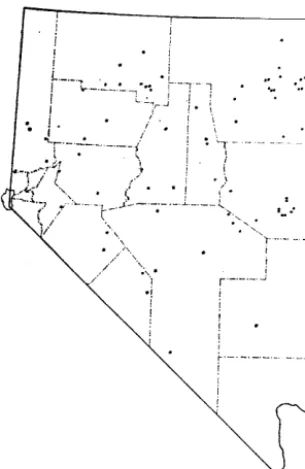
FIGURE 1. Sites in Nevada where soil sam- ples and notes on vegetation were taken. Halogeton occurred or had occurred at all sites.
ations in each of the six regions where halogeton had been found. It had not been found in the seventh region, which included the southern desert shrub type of southern Nevada. In practice, the proposed procedure could not readily be followed since the native vegetation and halogeton were not uniformly distributed throughout the regions set up. The procedure was then modi- fied to take samples of the soils where an important vegetation change occurred as well as from the vegetation associations ocur- ring in each region. A prerequis- ite of all sampling was that halo- geton should-occur on the samp- ling site.
It is characteristic of halogeton to occupy the soils of disturbed areas, as one would expect of a ruderal plant. These areas are amply provided by usual yearly “blading” of road shoulders and barrow pits by highway main- tenance graders. These areas also occur in gravel pits, water courses and drainage ditches, and on stock trails and bed grounds. Spots of pronounced soil disturbance were avoided in
W. C. ROBOCKER
this investigation, however, and samples were taken from adja- cent sites.
The sampling sites in Nevada are shown in Figure 1. Areas of ecotones, and especially of al- ternes, are easily recognized by the clustered dots. In all sites sampled, halogeton occurred either as a general infestation or as an isolated spot. Vegetation associations or faciations ar- ranged in order of the frequency
of sampling were shadscale,
sagebrush, greasewood, winter- fat, juniper and Nuttall’s salt- bush. The area occupied by halo- geton in 1957 included most of the Great Basin, in which the vegetation was predominantly of the Basin sagebrush formation.
The sampling was also done outside of Nevada in 1955 to the then existing perimeter of the area occupied by halogeton. This included most of Utah, western Colorado, the western part of Wyoming, the northern tip of the Bighorn Basin in southern Mon- tana, the southern third of Idaho, the northeast corner of Californ- ia east of the Sierra Nevada, and Oregon on the Nevada-Oregon boundary near Denio, Nevada.
On the northeastern edge of the perimeter in Montana, halo- geton was found on a bed ground in a depleted stand of blue grama (Bouteloua gracilis) . It was in a shadscale association in west- ern Colorado on its eastern boun- dary and the same association had also been invaded on the southernmost extension of its area in southwest Utah. It was in both sagebrush and shadscale vegetation on its western edge. In the higher elevations, it enter- ed into juniper-sagebrush associ- ations. None was found in mon- tane or sub-alpine vegetation.
Soil samples were taken at O-6 inches and 6-18 inches, and the
classification was made by
screening out the gravel with a l-mm. sieve. The texture of the remaining soil was then deter- mined by the Bouyoucos hydro-
meter method (5). Electrical conductivity of the saturation ex- tract (E.C.) was determined by use of a bridge (methods 3a and 4b of the U. S. Salinity Labora- tory) (26)) and pH on a soil sus- pension was determined by use
of a glass electrode meter
(method 21b). The soil was clas- sified on the basis of mechani- cal separates according to the Soil Survey Manual classif ica- tion (27). Range condition was expressed as an estimate of the amount of forage produced as
compared with the maximum
possible for the site (6) as fol- lows: Excellent, 75-100 per cent; good, 50-75 per cent; fair, 25-50 per cent; and poor, O-25 per cent. The degree of soil erosion was arbitrarily divided into four classes as follows:
None:
Slight:
Moderate:
Severe:
No evidence of soil
movement away
from or around crown of perennial vegetation. Litter
essenti&lly in place.
Pedestal develop- ment clear, little evidence of active soil movement. Litter concentrat- ed under plants. Pronounced pedes- tal development,
active rilling and cutting of soil sur- face, but no deep channels.
Crown and roots of plants exposed. Pronounced rill- ing, cutting and channeling of soil surface.
comparison of con- the saturation ex- Statistical
ductivity of
CHARACTERISTICS OF SOILS AND VEGETATION INFESTED WITH HALOGETON 217
Table 1. Summary of chracteristics of soils in Nevada and on the prim- efer of the area occupied by halogefon.
_ -_ Type of vegetation Juniper
Sagebrush
Winterfat
Shadscale
Nuttall’s saltbush Greasewood
Depth
(in.) PH*
E.C. x 10””
Gravel (%)
Predominant soil type
Number of samples
0- 6 8.1 0.8 36 Loam 4
6-18 7.9 3.5 40 Loam 4
0- 6 8.2 0.9 20 Loam 24
6-18 8.1 1.6 29 Loam 24
0- 6 8.4 1.1 8 Loam 7
6-18 8.4 2.4 9 Loam 7
0- 6 8.7 1.6 19 Sandy loam 35
6-18 8.8 2.9 25 Sandy loam 35
0- 6 8.6 2.8 5 Loam 3
6-18 8.4 5.2 3 Loam 3
0- 6 9.3 5.6 7 Loam 10
6-18 9.4 10.7 8 Sandy loam 10
No perennial 0- 6 8.3 1.2 2 Sandy loam 3
vegetation 6-18 8.6 1.2 1 Sandy loam 3
Average 0- 6 8.7 1.5 14 Loam 86
(or total) 6-18 ~_____ 8.8 2.5 16 Loam 86
__-
* pH is based on an arithmetic mean and conductivity on a logarithmic mean.
recommendations of Snedecor
(24) in order to satisfy require- ments for a valid analysis of ’ variance. A separate least signif-
icant difference was computed for each comparison.
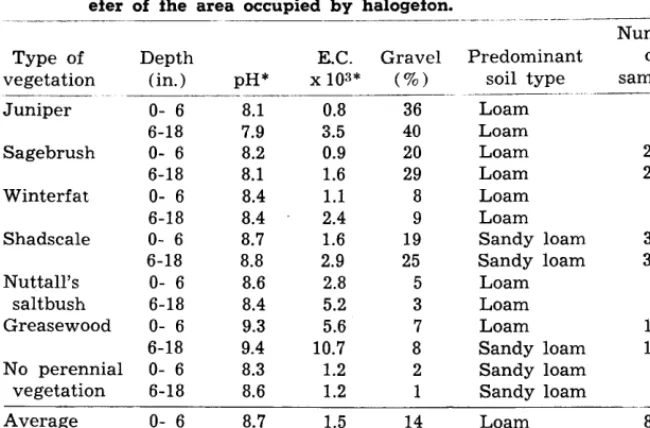
Results and Discussion It is to be noted in Table 1 that the numbers of samples in the various vegetation types dif- fered, but the number of sites sampled in each vegetation type is similar in proportion to the relative sizes of the areas of the various vegetation types. The highest percentage of gravel in both of the sampling depths was in the juniper type, and the soil in general was in the classifica- tions of loam and sandy loam.
Halogeton was not found on the sandiest, class of soils, on which such species as Nevada dalea (Dalea polyadenia) , hairy horsebrush (Tetradymiu c o m - osu) , Indian ricegrass (Oryzop- sis hymenoides), and desert eve- ning primrose (Oenotheru cues- pitosu) are found, although the opportunity for invasion was present in many cases. It might be assumed from this absence that halogeton required a soil of somewhat finer texture. A break-
down of the soils according to class showed a predominance of the medium-textured soils in the samples taken.
A tabulation of soil classifica- tion of sites occupied by halo- geton (Table 2) indicated that sandy loam accounted for 32 and loam for 28 of the 86 observa- tions (37 and 33 per cent, respec- tively) , or taken as a group, loam and sandy loam accounted for 70 per cent of the total of the classes in the 0- to 6-inch depth. The same two classes included 49 (57 per cent) of the 86 observations in the 6- to l&inch zone. Ap- proximately 10 to 15 per cent of
Table 2. The relative frequency of occurrence of various soil classes on sites occupied by halogeion.
Depth (in.)
Class O-6 6-18
Sand -__-__ 0 1
Loamy sand 7 8
Sandy loam 32 29
Loam 28 20
Sandy clay loam 6 10
Silt loam 5 6
Clay loam 6 7
Silty clay loam 0 2
Clay ---_ _____ 2 3
Total 86 86
the sites had soils in the heavier clay loam to clay classes. How- ever, since halogeton was found in soil classes ranging from loamy sand to clay in texture, it is assumed that it will grow in all these classes. The coarser soils appear to be more abundant in the Western States and this may partially account for the higher frequency of sandy loam and loam soils in sites supporting halogeton.
The distribution of pH (Figure 2) showed a definite mode-37 of the 86 observations in the O- to 6-inch layer, with a similar distribution in the 6- to 18-inch zone-or 43 per cent, in the range of 8.2 to 8.5, corresponding roughly to the average pH of sagebrush and winterfat soils. This distribution class (8.2-8.5) together with the class immedi- ately preceding (7.8-8.1) and the one following (8.6-8.9) roughly included the range of pH of soils in the sagebrush and shadscale associations. From this figure it would appear that halogeton had an optimum pH in the range of 7.8 to 8.9.
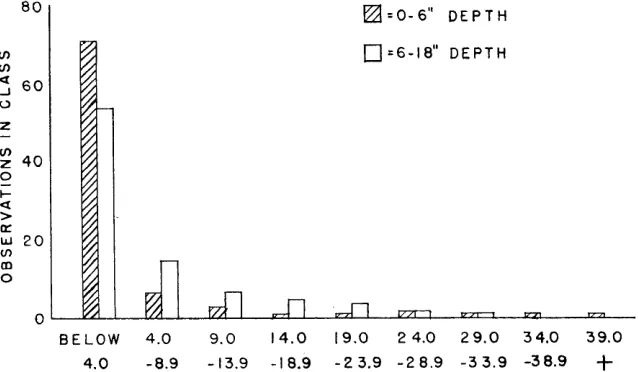
The conductivity of the satu- ration extract of the soils was generally below four millimhos or approximately in the range of j uniper, sagebrush, winterfat, and shadscale in both depth zones (Figure 3). Examination of the summary tabulation
(Table 1) shows that the pre- dominant soil type under both
sagebrush and winterfat was
218
W. C. ROBOCKER
40
c/3 2 30
s
Z
v) 20 Z 0 i=
a z IO : :
0
BELOW 7.0 7.4 7.8
7.0 -7.3 -7.7 -8. I
8.2 8.6 9.0 9.4
?d=O-6” DEPTH
n = 6-18” DEPTH
-8.5 -0.9 -9.3 +
FIGURE 2. Distribution of pH of soils occupied by halogeton.
pit.
An examination of Table 3 in- dicates that in practically all cases where halogeton occurred, the perennial vegetation was not in vigorous condition and that on 70 per cent of the sites the condition was classified as fair or poor. The soil showed erosion from none to severe, and in 65 per cent of the observations it was either moderately or severe- ly eroded. The halogeton plants were largest in shadscale and sagebrush, and the distribution of plants inclined more to speci- fic spots than to a general dis- tribution when a limited area
was examined. It should be
pointed out that occurrence of halogeton in vegetation classi- fied as being in good or fair con- dition occurred most often in small areas of local disturbance. The exceptions to this were in winterfat, where a general infes- tation appeared to be the rule. This was true to a less extent in Nuttall’s saltbush. However, the small number of areas of Nut- tall’s saltbush encountered in Nevada makes any general con- clusion as to the competitive abil- ity of that species questionable.
Statistical comparison of eiec-
trical conductivity and pH
(Table 4) showed sagebrush
soils to differ significantly and highly significantly from shad- scale soils in the 0- to 6-inch depth and 6- to 18-inch depth, respectively, an d significantly from Nuttall’s saltbush soils in the 6- to 18-inch zone. In pH, the difference was significant be- tween soils of shadscale and sagebrush at the 6- to 18-inch depth. Differences in soils for both electrical conductivity and pH were significant or highly significant under juniper, sage- brush, winterfat and shadscale, in both depths, when compared with greasewood. Nuttall’s salt- bush soils showed no significant difference from those of grease- wood in either pH or conductiv- ity. In comparison of the upper with the lower layer of soil in all vegetation types, there was a significant difference between the two only for the shadscale soils in conductivity. There was no significant difference in pH between the two zones.
It should be emphasized that the statistical interpretation of the data was based on only three sites in Nuttall’s saltbush and a small number in both juniper and winterfat. If a larger num- ber of samples had been taken in these three vegetation types, the difference probably would
Table 3. Condition of competitive vegetation. degree of soil erosion, and distribution and height of halogefon in each vegetation type sampled.
Type of vegetation
Condition of vegetation Soil erosion _- Halogeton obser- Total
Excel- Mod- Height Distribution vations
lent Good Fair Poor None Slight erate Severe (in.) General Spot per type
Juniper Sagebrush Winterfat Shadscale Nuttall’s
saltbush Greasewood
0 2 1 1 1 1 0 2 7 1 3 4
3 3 7 11 2 4 8 10 8* 9 15 24
1 0 4 2 2 1 3 1 4 6 1 7
4 7 16 8 6 6 12 11 8* 14 21 35
2 0 0 1 3 0 0 0 6 1 2 3
0 3 3 4 2 1 3 4 6* 5 5 10
Total Percentage of total observa- tions per at- tribute
10 15 31 27 16 13 26 28 - 36 47 83
12 18 37 33 19 16 31 34 - 43 57
CHARACTERISTICS OF SOILS AND VEGETATION INFESTED WITH HALOGETON 219
a=O-6” DEPTH
q
=6-18” DEPTHBELOW 4.0 9.0 14.0 19.0 2 4.0 29.0 3 4.0 39.0 4.0 -8.9 - 13.9 -I 8.9 - 2 3.9 -28.9 -3 3.9 -38.9 + FIGURE 3. Distribution of electrical conductivity, expressed as millimhos (E.C. x lOs),
of soils occupied by halogeton.
have been significant or highly significant in comparison of E. C. in juniper and winterfat soils with those of Nuttall’s saltbush.
An attempt to define an opti- mum pH or range of pH as well as an optimum concentration or range of tolerance of soluble salts as well as other soil charac- teristics by a habitat study method is complicated by fac- tors other than the edaphic one. These are considered of primary importance in investigating eco- logical relations of annual plants in perennial vegetation. The first
of these factors is the dependence upon sufficient seed in a given area during a particular growing season to insure a stand of an annual species, for the point in- evitably arises in attempting to determine competitive relations as to whether the restriction or absence of an annual is a matter of competition or of inadequate seed dispersal when other con- ditions are favorable. A second factor is the amount and distri- bution of effective precipitation in that area during the given sea- son. A third is the condition,
density and type of competing vegetation, with its own particu- lar seasonal demand for mois- ture. This last factor, together with the pH and soluble salt con- tent, is directly related to pre- cipitation and may be strongly modified by physiographic, bio- tic, and other climatic influ- ences.
Summary and Conclusions A sampling of Nevada soils during 1954 and 1955 on all ma- jor vegetation types infested with halogeton, together with ad- ditional sampling on the perim- eter of the infestation in 1955, showed the plant to be practical- ly confined at present to the northern desert shrub type. This does not, however, preclude its ability to grow in other forma- tions under conditions favorable to its germination and develop- ment.
Halogeton was most oft en found on soils characterized by rather high pH, low salt concen- trations, and medium texture and in the absence or reduced competition of other vegetation, particularly perennial shrubs.
The most frequent occurrence was on loams and sandy loams and in areas having big sage-
Table 4. Sfaiisfical comparison of pH and conducfivify (E.C. x 103) of soils occupied by halogefon in different
vegetation types. -~
Nuttall’s Grease- Type of
vegetation Juniper
Sagebrush
Winterfat
Shadscale
Nuttall’s saltbush Greasewood
Depth (in.>1
Mean Mean Sagebrush Winterfat Shadscale saltbush wood
PH” E.C.2 pH E-C. pH E.C. pH E.C. pH E.C. PH E-C.
0- 6 8.0 2.7
6-18 7.9 3.1
0- 6 8.0 2.7
6-18 8.0 2.8
0- 6 8.4 2.8
6-18 8.3 3.1
0- 6 8.6 3.0
6-18 8.5 3.3
0- 6 8.5 3.2
6-18 8.4 3.5
0- 6 8.6 3.5
6-18 9.9 3.8
03 0 0 0 * 0 0 0 * *
0 0 0 0 ** 0 0 0 ** *
* ** **
- - 0 0 0 0 0
0 0 * ** 0 * ** **
- -
**
- - - - 0 0 0 0 0
- - - - 0 0 0 0 * **
**
- - - -
- - 0 0 0
* **
- - - - -
- 0 0
- - - -
- - 0 0
- - - -
- 0 0
- - - -
- -
___-- __--- --
lComparisons for each depth were calculated separately.
“Means are logarithmic. Averages on Table 1 are logarithms of arithmetic means for pH and antilogarithms of logarithmic means for conductivity.
30 Indicates no significant difference. * Significant at 5% level