A multimodal interpreter for 3D visualization and animation of verbal concepts
Coline Claude-Lachenaud
1,2, Éric Charton
1, Benoît Ozell
1, Michel Gagnon
11École Polytechnique de Montréal
Montréal, H3T 1J4 , Québec (Canada)
{coline.claude-lachenaud, eric.charton, benoit.ozell, michel.gagnon}@polymtl.ca
2École des Mines de Nantes
Nantes, (France)
Abstract
We present an algorithm intended to visually represent the sense of verb related to an object described in a text sequence, as a movement in 3D space. We describe a specific semantic analyzer, based on a standard verbal ontology, dedicated to the interpretation of action verbs as spatial actions. Using this analyzer, our system build a generic 3D graphical path for verbal concepts allowing space representation, listed as SelfMotion concepts in the FrameNet ontology project. The object movement is build by first extracting the words and enriching them with the semantic analyzer. Then, weight tables, necessary to obtain characteristics values (orientation, shape, trajectory...) for the verb are used in order to get a 3D path, as realist as possible. The weight tables were created to make parallel between features defined for SelfMotion verbal concept (some provided by FrameNet, other determined during the project) and values used in the final algorithm used to create 3D moving representations from input text. We evaluate our analyzer on a corpus of short sentences and presents our results.
Keywords:FrameNet, 3D visualization, animation, SelfMotion, verbal concept, multimodality
1.
Introduction
Multimodality can be seen as a way to express textual content in alternate representations like audio or visual animations. Recently, this field of research received an increasing interest from both community of Natural Language Processing (NLP) and Imaging according to its potential use in many user interface oriented applications. As investigated by (Adorni et al., 1984), the relation between language and space has long been an area of active research. The multimodality in the context of text conversion into animation or graphical representation have been studied in various way. A milestone was the WordsEye (Coyne and Sproat, 2001) system. It provides a blank slate where the user can paint a picture with words: the description may consist not only of spatial relations, but also actions performed by objects in the scene. In its first evolution the multimodal engine of WordsEye is able to treat a sentence, identify objects in it with their attributes. Like most of those first period applications, the static nature of WordsEye offers no possibilities to treat neither the question of verbal trajectories describing motion. The next generation of such systems tried to introduce animation as a multimodal feature. Carsim (Dupuy et al., 2001; Nugues et al., 2004), is dedicated to the visualization and animation of 3D scenes produced from car accident written reports. E-Hon (Sumi and Nagata, 2006) uses animations to help children to understand a textual content. It provides storytelling in the form of animation and dialogue translated from original text. The text can be a free on-the-fly input from a user. The animation engine of Confucius (Ma, 2006) accepts a semantic representation of texts and uses visual knowledge to generate 3D
ani-mations. In a recent work Roth (Roth and Frank, 2009) describes an online application that uses Natural Language Generation (NLG) methods to generate walking directions in combination with dynamic 2D visualization. In this communication, we introduce an algorithm whose purpose is to visually represent the sense of verb related to an object and its derivative representation as an animated sequence in 3D space. We specially want to study the possibility, according to a standard verbal ontology, to build a generic 3D graphical path which allows the representation of verbal concepts in a 3D virtual space. This also implies to identify verbal concepts - according to their meaning in a particular context - that can be linked to an animated 3D graphical representation.
This article is structured as follows : in section 2. we inves-tigate the specific nature of verbal action concepts and their relation with their possible representation in space. In sec-tion 3. we present our proposed system to solve this prob-lem. In section 4. we describe the text to trajectory inter-preter we developed to transform verbal expression into vi-sual representation. In section 6. we experiment the system using sentences and verify its visual results.
2.
Related work
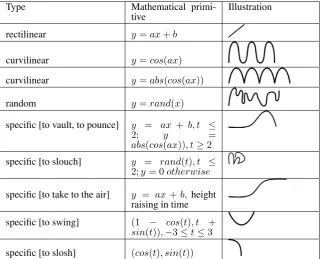
Type Mathematical primi-tive
Illustration
rectilinear y=ax+b
curvilinear y=cos(ax)
curvilinear y=abs(cos(ax))
random y=rand(x)
specific [to vault, to pounce] y = ax + b, t ≤
2; y =
abs(cos(ax)), t≥2
specific [to slouch] y = rand(t), t ≤ 2;y= 0otherwise
specific [to take to the air] y = ax +b, height raising in time
specific [to swing] (1 − cos(t), t + sin(t)),−3≤t≤3
specific [to slosh] (cos(t), sin(t))
Table 1: Primitive mathematical functions used to describe the shape of a trajectory
In the present article, we based our application on
SelfMotionconcept. This concept is defined as: The Selfmover, a living being, moves under its own direction along a Path. In FrameNet the concept ofSelfMotionis represented as a frame to whom are linked frame elements also called features. ForSelfMotionconcept, FrameNet associates four principal frame elements: Direction, Goal, Path and Source. Words that evoke this frame (to walk,
to run, to jump, to swing) are called lexical units of the
SelfMotionframe.
Based on this work we started our development by char-acterizing each verbal concept with frame elements. For example, run is associated to an advance direction, forward goal, rectilinear path and actual place of the entity source. The features used as weight tables for each verbs were im-proved by iterations. To make differences between verbs having same characteristics, for example to walk and to run had same characteristics with the fourth first features ( direction, goal, path, source), we determine a speed fea-ture, useful to distinguish between the two verbal concept. Height weighting was necessary to distinguish lexical units asto fly orto crawl. Gradually we were able to construct our correspondence tables used next to build our 3D rep-resentation. The more features we had, the more accurate was the visualization.
The text-to-trajectory interpreter aims at constructing a 3D representation using the following correspondence table.
1. Orientation of a trajectory
2. Shape of a trajectory
3. Speed along a trajectory
4. Speed modulation according to adjectives
5. Amplitude and height modulation
4.1. Orientation of a trajectory
We first defined a direction to each verbal concept as in Table 2. Our experiment shows that three different major orientations are required to distinguish between the possi-ble orientations of the verbal concept: forward movement, backward movement, and stationary movement. Stationary movement makes use to verb asto dance,to jump,to swing since the entity is moving around the initial position.
Orientation Examples forward advance, move forward
backward go back, retreat
stationary swing, dance
Table 2: Values used to describe the orientation of a trajec-tory
4.2. Shape of a trajectory
SelfMotion Main Shape Secondary Shape Amplitude modulation Verbal-concept Orientation Horizontal Vertical Horizontal Vertical Speed Horizontal Vertical
advance forward rectilinear - random - 5 0 3
amble forward rectilinear - random - 4 0 3
back backward rectilinear - - - 5 0 3
barge forward rectilinear - - - 7 0 3
bop forward rectilinear - random random 6 0 3
bound forward rectilinear curvilinear random random 7 3 11
burrow forward rectilinear rectilinear random - 4 0 -1
bustle forward random - rectilinear - 7 5 3
canter forward rectilinear curvilinear random - 8 3 4
caper forward random - rectilinear - 6 2 3
clamber forward - random - rectilinear 2 2 11
climb forward - random - rectilinear 4 2 11
clomp forward rectilinear - random - 4 0 3
coast forward rectilinear - - - 3 0 3
Table 6: Samples from the global correspondence table used by the interpreter.
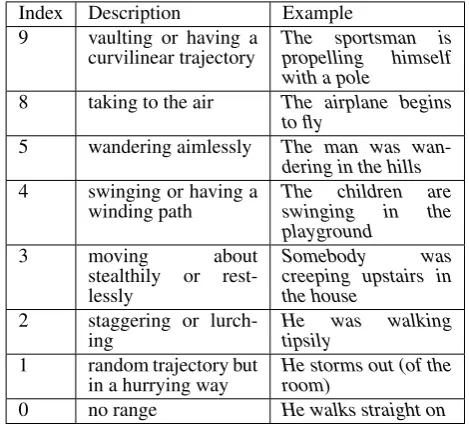
Height Description Example 11 height increasing in
time
The man is climbing
10 fly in the sky The plane is flying
5 walking by bound-ing, making leap
The kangaroo is
bounding
4 person on motorbike, riding a horse
The man is on a mo-torbike
3 adult walking on
ground
He is standing up
2 adult walking with a stoop
He stoops in order to make himself look shorter
1 grazing the ground The bird skims on the surface of the lake
0 crawling or lying on the ground
The man is swim-ming at the surface of the water
-1 digging a hole,
height decreasing in time
He is burrowing a hole in the ground
Table 7: Vertical amplitude modulation (height)
5.
Software implementation
Using those interpretation features, we built a unique ta-ble called Verb to Motion Tata-ble (VMT) containing all
SelfMotion verbal concepts associated to frame ele-ments. In this table, each motion verbal concept accord-ing to the FrameNet ontology is described with at least one specific characteristic movement definition. An sample of this table is shown in Table 6. The interpretation process will consist in determining what entry from the VMT, ac-cording to the motion detected in the sentence, will be used to generate the graphic animation. This is done through a set of rules that find the correspondence between a lexical unit from FrameNet matching the verb surface form in the sentence. If this lexical unit matches more than one verbal-Concept of FrameNet, a disambiguation process is applied. This process evaluates the similarity between words con-tained in the FrameNet sentences samples related to each Verbal-Concepts and the words from the sentence to ana-lyze.
We implemented this global table in a 3D animation soft-ware using OpenGL4. This software prototype can receive a series of short sentences and process them. For each analyzed sentence, the global table is searched to obtain the characteristics of the related trajectory, to allocate the right feature values to the entity and finally using them into 3D spatial visualization.
6.
Evaluation and experiments
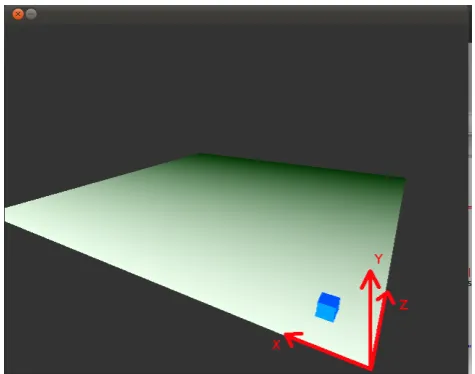
The goal of our experiments was to evaluate the accuracy of trajectory selected by our software prototype according to a given sentence. As our software is not restricted to valid semantic productions that do not violate common-sense and physical laws (see (Charton et al., 2010) for dis-cussion about the commonsense problem), we did not focus on entity realism: subjects of sentences where symbolized as a cube when no drawing model was available for repre-sentation (see Figure 3).
Figure 3: Base tray in three-dimensional mark
4
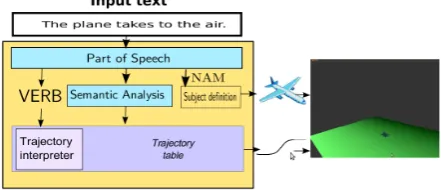
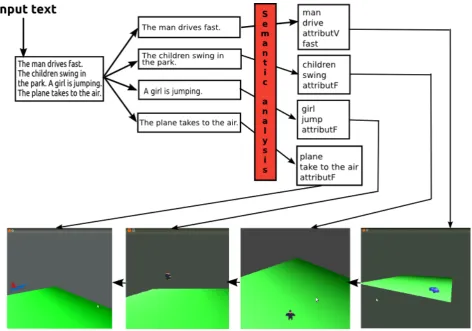
Figure 2: Samples of interpretation and their result as visualization.
Then we improved our model by adding some basic 3D objects in the scene in order to obtain more realistic representation (see Figure 2). The evaluation has been conducted manually. Each sentence has been launched one time in order to obtain the corresponding 3D animation and comparison was made with the sentence provided as input to the algorithm. We only evaluated the accuracy of the taken path, and not the environment and object used in the representation since it was not the goal of our study.
To validate the architecture of our system we proceeded in two steps:
1. First, we submitted a small group of single sentences to the interpreter and then adjust the values in tables (Table 6).
2. Then, we submitted the full set of sentences contained in corpus to the system, and evaluated visually the ac-curacy of the animation.
The corpus used for development and testing was built manually and contains 400 sentences made of a minimum of one subject and a SelfMotionverb. To build this corpus, we selected verbal-concepts described by Framenet
SelfMotionand associated each of them with a subject. For example, the subject can be referred to a person (she, he) or an object (it, the plane). We also treated plural cases: when the sentence subject was in plural form, likemen, the animated entity corresponding is a group of several man
objects.
This test corpus was divided in two sets of 100 and 300 sen-tences. The first set of 100 sentences was submitted to the system and used to adjust values in the tables of the text-to-trajectory interpreter. Then, we submitted the second set of 300 sentences to the system and evaluated visually the ac-curacy of the animation. We considered a sentence as suc-cessfully represented when its trajectory was relevant and took the proper path according to a commonsense interpre-tation of the sentence acknowledged by the two evaluators.
6.1. Results.
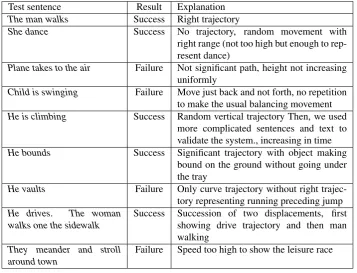
Around 70 out of 300 were classified as failuresince the produced trajectory was not relevant. Errors of repre-sentations mainly happened for verbs which had specific complex trajectories such as to slosh, to vault, to take to the air.
Test sentence Result Explanation
The man walks Success Right trajectory
She dance Success No trajectory, random movement with
right range (not too high but enough to rep-resent dance)
Plane takes to the air Failure Not significant path, height not increasing
uniformly
Child is swinging Failure Move just back and not forth, no repetition
to make the usual balancing movement
He is climbing Success Random vertical trajectory Then, we used
more complicated sentences and text to validate the system., increasing in time
He bounds Success Significant trajectory with object making
bound on the ground without going under the tray
He vaults Failure Only curve trajectory without right
trajec-tory representing running preceding jump
He drives. The woman
walks one the sidewalk
Success Succession of two displacements, first showing drive trajectory and then man walking
They meander and stroll around town
Failure Speed too high to show the leisure race
Table 8: Sample of sentences from the test corpus, results of our interpreter and comment about this result.
in the project. This values were evaluated manually, by one person, which implies a necessary correction. Having only one person to evaluate the verbal concept and to attribute a value can be source of mistake. The perception of each verbal concept is not the same in all human mind which means we need to define a more rigorous method to con-struct the different weight tables. There are lot of verbal concepts which implies that some verbal concept may have been treated quickly and without same consideration as an-other verbal concept. We provide an extract of those results in Table 8.
7.
Conclusions and perspectives
In this paper, we presented a multimodal system dedicated to animated representation of verbal concept contained in a text, using the Framenet ontology. Our results show that a motion related verbal concept can be associated to a com-bination of basic trajectories to automatically produce a 3D animation. We validated the principle of the association of trajectories to motion verbs to produce a realistic spatial representation of a text sentence. This approach can open new possibilities to create novel architecture dedicated to animated graphic representation of text. We plan to apply this system to open corpus, not limited to representable sen-tences and to include disambiguation techniques in the in-terpretation process. We specially want to focus on disam-biguation of metaphoric texts and common sense validity.
Reproducibility
The software code, developed in C++, the corpus, the visualization objects and the interpretation tables are re-leased publicly at the following url: http://gitan. polymtl.ca.
8.
References
Adorni, G., Di Manzo, M., and Giunchiglia, F. (1984). Natural language driven image generation. In Proceed-ings of COLING, pages 495–500, Hillsdale, NJ. 10th International Conference on Computational Linguistics and 22nd annual meeting on Association for Computa-tional Linguistics.
Baker, Collin F., Fillmore, Charles J., and Lowe, John B. (1998). The berkeley framenet project. Proceedings of the 36th annual meeting on Association for Computa-tional Linguistics -, page 86.
Bateman, J.A., Hois, Joana, Ross, Robert, and Tenbrink, Thora. (2010). A linguistic ontology of space for natural language processing. Artificial Intelligence, jun. Charton, Eric, Gagnon, Michel, and Ozell, Benoit. (2010).
A preprocessing system to include imaginative anima-tions according to text in educational applicaanima-tions. In Mog 2010, Dublin.
Coyne, B. and Sproat, R. (2001). Wordseye: An automatic text-to-scene conversion system. InProceedings of the 28th annual conference on Computer graphics and in-teractive techniques, volume ternetchap, pages 487–496. ACM New York, NY, USA.
Dupuy, Sylvain, Egges, Arjan, Legendre, Vincent, and Nugues, Pierre. (2001). Generating a 3d simulation of a car accident from a written description in natural lan-guage. Proceedings of the workshop on Temporal and spatial information processing -, pages 1–8.
Johnson-Laird, PN. (1998). Imagery, visualization, and thinking. Perception and Cognition at Century’s End, pages 441–467.
Liu, Hugo and Singh, Push. (2004). Commonsense reason-ing in and over natural language. InKnowledge-Based Intelligent Information and Engineering Systems, pages 293–306. Springer.
Ma, M. (2006). Automatic conversion of natural language to 3D animation. Thesis, University of Ulster, Faculty of Engineering.
Nugues, Pierre, Dupuy, Sylvain, and Egges, A. (2004). Carsim: un système pour convertir des textes en scènes tridimensionnelles animées. 14e congrès de l’AFRIF-AFIA, Reconnaissance des formes et Intelligence artifi-cielle, Toulouse,.
Piwek, P. (2003). A flexible pragmatics-driven language generator for animated agents. InProc. of EACL, page 151, Morristown, NJ, USA. Association for Computa-tional Linguistics.
Roth, M. and Frank, A. (2009). A nlg-based application for walking directions. InCompanion Volume to the Pro-ceedings of the 47th Annual Meeting of the Association for Computational Linguistics and the 4th International Joint Conference on Natural Language Processing of the Asian Federation of Natural Language Processing, Sin-gapore, pages 2–7.
Ruhlmann, Laurent, Ozell, Benoit, Gagnon, Michel, Bour-goin, Steve, and Charton, Eric. (2010). Improving com-munication using 3d animation. In KES2010 14th In-ternational Conference on Knowledge-Based and Intel-ligent Information & Engineering Systems, Cardiff. Sumi, Kaoru and Nagata, Mizue. (2006). Animated
sto-rytelling system via text. In Proceedings of the 2006 ACM SIGCHI international conference on Advances in computer entertainment technology, volume Proceeding. ACM SIGCHI international conference on Advances in computer entertainment technology.
Tversky, Barbara, Morrison, J.B., and Betrancourt, Mireille. (2002). Animation: can it facilitate? Interna-tional Journal of Human-Computer Studies, 57(4):247– 262.