Recognition of Sarcasm in Tweets Based on Concept Level Sentiment
Analysis and Supervised Learning Approaches
Piyoros Tungthamthiti, Kiyoaki Shirai, Masnizah Mohd Japan Advanced Institute of Science and Technology
1-1, Asahidai, Nomi City, Ishikawa, Japan 923-1292 Email: {s1320204,kshirai,masnizah}@jaist.ac.jp
Abstract
Sarcasm is a form of communication that is intended to mock or harass someone by us-ing words with the opposite of their literal meaning. However, identification of sarcasm is somewhat difficult due to the gap between its literal and intended meaning. Recognition of sarcasm is a task that can potentially pro-vide a lot of benefits to other areas of nat-ural language processing. In this research, we propose a new method to identify sarcasm in tweets that focuses on several approaches: 1) sentiment analysis, 2) concept level and common-sense knowledge 3) coherence and 4) machine learning classification. We will use support vector machine (SVM) to classify sarcastic tweet based on our proposed features as well as ordinary N-grams. Our proposed classifier is an ensemble of two SVMs with two different feature sets. The results of the experiment show our method outperforms the baseline method and achieves 80% accuracy.
1 Introduction
Recognition of sarcasm is one of the most difficult tasks in natural language processing (NLP). It is a problem of determining if the actual meaning of a word is intended in a given context. Sarcasm is normally represented in a form of ironic speech in which the speakers convey an implicit message to criticize a particular person. Thus, tone of voice plays a significant role in the communication. There are many communication programs (e.g. Line, Face-book, Twitter), which allow to communicate to-gether through only text characters. It is very diffi-cult to determine the actual meaning by just looking at the text itself. Recognition of sarcasm prevents us
from misinterpreting sentences whose meaning are opposite to their literal meaning. It is also a task that is potentially applicable for many other areas of NLP, for example, machine translation, information retrieval, information extraction and knowledge ac-quisition.
Twitter is an online social networking service that allows users to post and read short messages, called “tweets”. However, Twitter allows users to write short messages, i.e. 140 characters per tweet. Also, users usually post a lot of tweets in complex sen-tence structures. Regarding to these issues, a new method is created to detect sarcasm in tweets.
Sarcasm is known as “the activity of saying or writing the opposite of what you mean, or of speak-ing in a way intended to make someone else feel stupid or show them that you are angry” (Macmil-lan, 2007). According to this definition, we can rec-ognize sarcasm by evaluating the polarity of the sen-tences. In other words, a sarcastic sentence contains two or more words, which may cause conflict in sen-timent polarities (both positive and negative) in a sentence, whereas a normal sentence should contain at most one polarity. Let us consider the example sentence “I love being ignored.” The sentence con-tains both positive (“love”) and negative word (“ig-nored”) in a sentence. Therefore, it can be classified as a sarcastic sentence.
the word “better” is recognized as a positive word from the whole tweet. However, our approach can recognize it as a sarcastic tweet by using the con-cept level knowledge. That is, we can know “bad weather” is one of the related concepts of “raining” from an extra lexical resource, then we have a new concept “bad” (negative) together with the original word “better” (positive) to catch the contradiction in sentiment polarity in the sentence.
In addition, we also consider “coherence”; that is, the relationships across multiple sentences. Gen-erally, sarcastic tweets should contain expressions which clearly show the relationships or references to some words across sentences. For example, in the tweet “And I just found out that my other pap fell and broke his hip. Awesome day thus far”, the word “awesome” (positive) refers to the action “fell” and “broke” (both are negative words), that is con-tradiction of sentiments in the sarcastic tweet. How-ever, when a tweet contains contradiction of senti-ment polarity without coherence between them, it could be regarded as non-sarcastic tweet. For exam-ple, in the tweet “He likes dogs. She hates cats.”, the word “love” (positive) and “hates” (negative) refer to the different subjects in two sentences. Although the tweet contains contradictions in sentiment polar-ity, the two sentences are not coherent. Therefore, it should not be classified as a sarcastic tweet. In this way, coherence is important for the recognition of sarcasm.
Finally, Support Vector Machine is used to train a classifier that judges if a tweet is sarcastic. Two SVMs will be trained with two different feature sets. One is N-gram, the other is features based on the sentiment score, coherence and punctuation. Then we will combine two SVMs, that is, more reliable judgment between two classifiers are chosen as the final result.
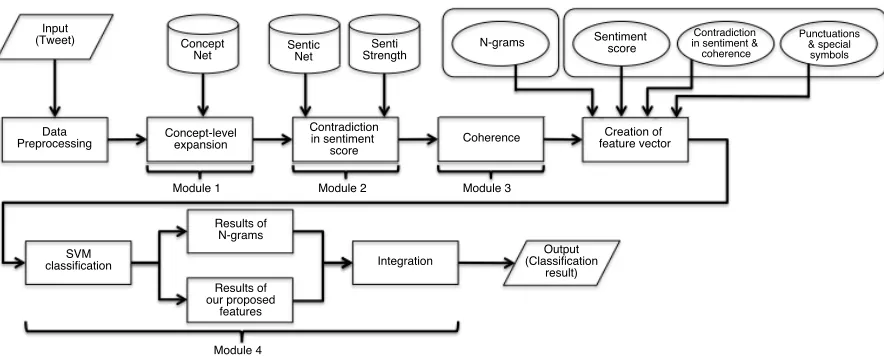
In this paper, we propose a new method to utilize several major modules, including 1) sentiment anal-ysis, 2) expansion of concept level and common-sense knowledge 3) coherence identification and 4) machine learning classification. Figure 1 represents the overall process of our method. The method will try to merge our newly introduced features obtained from the module 1, 2 and 3 together with the com-monly used features (e.g. N-grams) to enhance the classification performance in sarcastic tweets. Using
the data consisting of 50,000 tweets, we will eval-uate our results by comparing against two baseline methods derived from definition of sarcasm and su-pervised learning algorithm based on N-gram fea-tures.
2 Related work
Currently, there are several researches related to the recognition of sarcasm. A variety of methods have been proposed based on various kinds of techniques, including statistical models, sentiment analysis, pat-tern recognition, supervised or unsupervised ma-chine learning. However, the intelligence system and computation process are not sufficient to be re-lied on for sarcasm recognition. It also requires the development of understanding forms of language in both psychological and linguistic aspects.
According to Stingfellow (1994) and Gibbs et al. (2007), the use of irony and sarcasm is studied to derive a definition and demonstrate some character-istics of sarcasm. Both studies agree on the similar basis that irony and sarcasm arise from the contra-dictory intentions represented by the opposed mean-ing of an ironic or sarcastic statement. These studies also discover the theories of verbal irony compre-hension 1) that verbal irony requires a violation of expectations, and 2) that it requires violation of fe-licity conditions for speech acts. Thus, if we observe both contradictory intentions and violation of felic-ity conditions within a context, we can recognize a sarcastic context.
�����������
��������
�������� �������� ��������
������ ��������������
�������
������� ��������������� ��������������������������� ����������
������������ ���������
�������
��� �������������
���������� �������
���������� ������������
�������� �����
�������
����
������������� ����������������������
������������� �������������
����� �������
��� ���������
����� ��������
��������� ��������������������������
Figure 1: Flowchart of overall process of our method
patterns; this method relies on the syntactic level of natural language processing.
Ellen et al. (2013) introduce a method to iden-tify sarcasm in tweets that arises from a contrast be-tween a positive sentiment referring to a negative situation. In order to learn phrases corresponding to positive sentiments and negative situations, this method uses a bootstrapping algorithm that keeps it-eration between two steps. The first step is learning negative situation phrases following positive senti-ment, where “love” is used as an initial seed word. Then, the second step will learn positive sentiment phrases that occur near negative situation phrases. After multiple iteration processes, the obtained list of negative situations and positive sentiment phrases are used to recognize sarcasm in tweets by identi-fying contexts that contain a positive sentiment in close proximity (occurring nearby) to a negative sit-uation phrase. This method relies on the assump-tion that many sarcastic tweets contains the follow-ing structure:
[+V ERB P HRASE][ SIT U AT ION P HRASE] However, the method has some limitations since it cannot identify sarcasm across multiple sentences.
Coreference resolution is a task in natural lan-guage processing to identify multiple words or phrases that refer the same entity such as person, place or thing. Soon et al. (2001) introduce a ma-chine learning approach to link coreferring noun phrases both within and across sentences. They
construct a feature vector consisting of 12 fea-tures. The features include distance, antecedent pro-noun, anaphor-propro-noun, string matching, definite noun phrase, demonstrative noun phrase, number agreement, semantic class agreement, gender agree-ment, both-proper-names, alias and appositive fea-tures. Then, a classifier will be trained based on the feature vectors generated from the training docu-ments. C5 (Quinlan, 1993; Quinlan, 2007) is used as the learning algorithm in this study. This research is the first machine-learning based system that offers performance comparable to that of state of the art non-learning based systems on MUC-6 and MUC-7 standard datasets. In this study, a simple coreference resolution method is applied to identify coherence of multiple sentences.
va-riety of different online contexts. One part of this research discusses the usage of punctuations in vari-ous contexts. It focuses on the sentence that contains a single punctuation, repetitive punctuation marks, question marks and exclamation marks. Their result shows that punctuation plays a key role to boost the sentiment score.
The characteristic of our method is that we at-tempt to combine multiple approaches in both psy-chological and linguistic aspects to develop an in-novative strategy. Our method takes various ap-proaches into account, including sentiment analysis, concept level knowledge expansion, coherence and N-gram of words. Tweets are represented by feature vectors based on these methods. Then classifiers for sarcasm identification are trained by supervised ma-chine learning.
3 Data
In this section, the procedures of data collection and data preprocessing will be explained.
3.1 Source
We first prepare a collection of tweets by us-ing Twitter4J1 as a tool to retrieve tweets
data. Tweets are not just simple text data since they contain URL addresses, twitter user-names (mentions) or hashtags. For example, in the tweet “Congrats to @Kelly clarkson on the birth of her baby GIRL! http://eonli.ne/1vgXVOU #gorgeous”, “@Kelly clarkson” is a username, “http://eonli.ne/1vgXVOU” is an URL and “#gor-geous” is a hashtag. Users can attach an URL to the tweet when they want provide more information or show an image related to the post. Twitter also contains a mention feature (e.g. @<username>), which allows the notification of other users about the tweet. Hashtags (e.g. #<texts>) are used to mark keywords or topics in a tweet. Although the usage of these meta tags is optional, they frequently appeared in a lot of tweet messages.
Two datasets are required in our study: 1) sarcas-tic tweets and 2) normal tweets. Different query key-words will be used for each datasets. To collect sar-castic tweets, the hashtag “#sarcasm” is used. That is, tweets with #sarcasm are retrieved via Twitter
1http://twitter4j.org/en/index.html
API. Normal tweets are retrieved based on randomly selected keywords from WordNet lexicon (Miller, 1995).
3.2 Preprocessing
Two kinds of preprocessing are performed on tweet datasets: 1) lemmatization and 2) usernames, URLs and hashtags removal. For lemmatization, we use the Standford Lemmatizer2. Usernames, URLs and
hashtags are removed from tweets as they do not provide any information about the concepts or senti-ments of the words and might be noise for the clas-sification process.
4 Proposed method
Below we propose our method based on four major modules. They are the modules to generate a set of classification features or to classify a tweet if it is sarcastic.
4.1 Concept level and common-sense knowledge
Concept level and common-sense knowledge are the ability to perceive, understand and acknowl-edge things, which are shared through the common knowledge or facts that can be reasonably realized. In this research, we focus on the semantic analysis of tweets using the semantic network consisting of concepts of words to obtain more affective informa-tion. Let us consider an example sarcastic sentence “I love going to work on holidays.” The system may misclassify it as a normal sentence due to the lack of sentiment information. From this sentence, only the word “love” has positive sentiment score, while the other words have no polarity. However, using concept level and common-sense knowledge, we can know that the word “work” would refer to a tiring or stressful situation and the word “holiday” would re-fer to “time for rest”. Now a contradiction of the po-larity in this sentence could be found since [“love” and “holiday”] and [“work”] are positive and nega-tive words, respecnega-tively. The sentence could then, be classified as sarcastic.
In this study, we use a concept lexicon called ConceptNet3. ConceptNet is a semantic network
con-4.3 Sentence coherence
Since our study focuses on contradiction in the sen-timent score, coherence is another issue that we need to consider. Assume that a tweet consists of multiple sentences with sentiment contradiction. If all sen-tences are independent on each other, it is not obvi-ous to say that the tweet is sarcastic. Therefore, we introduce a set of heuristic rules to identify coher-ence across multiple sentcoher-ences.
In this study, coherence between two sentences is identified by simply checking coreference between subjects or objects of sentences. Let us suppose that sentences1precedess2, and wordw1andw2are the subject (or object) ofs1 ands2, respectively. Ifw1 is an antecedent ofw2, we regard the two sentences as coherent. We created the following five rules to check coreference betweenw1andw2:
1. Pronoun match feature -w1 andw2are identi-cal pronouns, including reflexive pronouns, personal pronouns and possessive pronouns.
2. String match feature -w1 andw2 are identical. Note that stopwords are ignored in string matching.
3. Definite noun phrase feature - w2 starts with the word “the”.
4. Demonstrative noun phrase feature -w2 starts with the “this”, “that”, “these” and “those”.
5. Both proper names feature -w1andw2are both named entities.
Two sentences are regarded as coherent if they fulfill one of the above rules. If one pair of w1 andw2 satisfies our rules among all combination ofw1 and w2 in multiple sentences in a tweet, we regard the overall tweet as coherent.
Obviously our method is too simple to identify coherence within sentences. In future, a more so-phisticated method should be incorporated into our coherence identification module.
4.4 Creation of feature vector
In this section, we will explain how to represent a tweet as a feature vector to train a classifier for sar-casm identification.
4.4.1 N-grams feature
N-gram refers to a sequence of words within a tweet, whereNindicates the size (number of words) of a sequence. The common used sizes of N-gram
are uni-gram (N = 1), bi-gram (N = 2) and tri-gram (N = 3).
In our dataset, we will divide each tweet into a single word, a sequence of two words and a se-quence of three words. They will be used as fea-tures. The weights of N-gram features are binary: 1 if N-gram is present in a tweet, 0 if absent.
4.4.2 Contradiction feature
As discussed earlier, contradiction in the senti-ment score and coherent within multiple sentences are useful for sarcasm identification. Therefore, we introduce two new binary features, contraand contra+coher, considering contradiction of polar-ity and coherence in the tweet. The featurecontra is activated if (1) the tweet consists of one sen-tence and (2) contradiction of the sentiment score is found by the method described in Subsection 4.2. contra+coheris activated if (1) the tweet consists of two or more sentences, (2) contradiction of polar-ity is detected and (3) the tweet is judged as coherent by the method described in Subsection 4.3.
4.4.3 Sentiment feature
We also provide sentiment score features for both positive and negative sentiment phrases. In this case, we use three classes (low,mediumandhigh) to in-dicate the degree of positive and negative polarity of the tweet. After conducting a preliminary experi-ment to find the optimum range of sentiexperi-ment scores, three positive sentiment features are defined as fol-lows:
pos low:activated ifsum pos score 1 pos medium: activated if 0 sum pos score 1
pos high:activated ifsum pos score 2 neg low, neg mediumand neg high are defined in the same way. Note that weights of these 6 senti-ment features are binary.
4.4.4 Punctuation and special symbols feature We also consider punctuation as one of the main features in this study. Many studies have shown that punctuation has a lot of influence in text classifi-cation, especially in the area of sentiment analysis. We consider the following 7 indicators to introduce punctuation features:
P1. Number of emoticons
punctua-�����
������
�������
�
�������
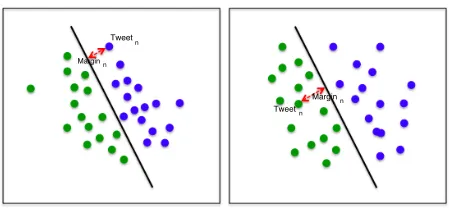
Figure 2: Example of margin based SVM classification approach
tions
P3. Number of repetitive sequence of characters
P4. Number of capitalized word
P5. Number of slang and booster words4
P6. Number of exclamation marks
P7. Number of idioms5
We uselow,mediumandhighas features to
indi-cate the range of number of punctuation and sym-bols. Through our preliminary experiment to check various range of values from 0 to 7, we found the optimum range to be:
Pi low:activated ifnumber= 0
Pi medium:activated if 1number3
Pi high:activated ifnumber 4
Thus we introduce 7⇥3 = 21 new features. Note
that these features are binary.
4.5 Classification algorithm
A machine learning algorithm based on the feature vectors generated from the tweets data was used to train a classifier. The classification algorithm used is support vector machine (SVM) due to its simplic-ity and effectiveness in binary classification. We use the linear kernel to perform the classification task because it does not consume as much time and re-sources on a large amount of data as polynomial ker-nel.
To combine our features described from 4.4.2 to 4.4.4 with N-gram feature, we choose an approach in which two feature sets are used separately to train two different SVMs and combine them to get final decision. First, we perform the classification task
4SentiStrength is used as a lexicon of slang and booster
words.
5
http://www.englishcurrent.com/idioms/esl-idioms-intermediate-advanced/
twice (once for n-grams and once for our features) and obtain two sets of results. Then, we determine the final result by comparing the classification out-puts of all data. For each tweet, if the judgments of two SVMs agree, it simply becomes the final result. However, if they do not agree, we need to consider the classification margin for each classifier. Figure 2 demonstrates a situation where two classifiers obtain different classification results for the same tweet. In this case, we need to compare the margin (distance between the data and separate hyperplane) of both classifiers. Usually, the higher the margin, the more reliable the output. Therefore, we take the output from the classifier with higher margin as the final result.
5 Experiment
In our experiment, we retrieved 50,000 tweets from Twitter for our datasets. 25,000 tweets were ran-domly selected as normal tweets, whereas the other 25,000 tweets are sarcastic tweets. Then, we classi-fied the tweets based on variety of features, includ-ing N-grams and our proposed features. The results of the proposed method are compared against two baseline methods. The first baseline is based on the definition of sarcasm. The second baseline uses N-gram features to train an SVM classifier for sarcasm identification.
5.1 Baseline 1
Since sarcasm normally emerges in a sentence that expresses the meaning opposite to the intended meaning, we will consider tweets where both pos-itive and negative scores (Equation (1) and (2)) are greater than 0 to be sarcastic.
5.2 Baseline 2
The other baseline is SVM trained with N-gram fea-tures. We prepare two baseline systems: one is SVM with gram features, the other is SVM with uni-gram, bi-gram and tri-gram features.
5.3 Evaluation procedure
tweet dataset. Recall, precision, F-measure and ac-curacy are measured to evaluate the performance of sarcasm identification.
6 Results and discussion
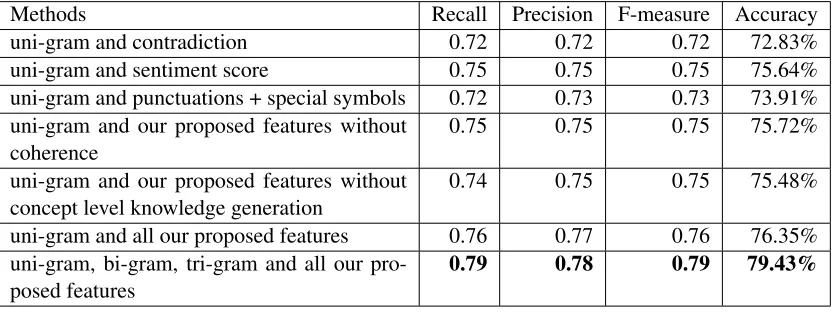
Table 1 shows the results of Baseline 1. The perfor-mance is relatively high, although Baseline 1 does not rely on supervised machine learning, but on the sentiment lexicon only. Table 2 reveals results of single SVMs with our proposed features (contradic-tion, sentiment and punctuation features) and Base-line 2. The accuracy of our proposed method is 63.42%, which is better than Baseline 1 but worse than Baseline 2. We found that N-gram features were still powerful for classification of sarcasm. Ta-ble 3 shows the results of the combination of two SVMs. In this table, our individual features are com-bined with uni-gram separately to evaluate the effec-tiveness of each feature. The fifth row in Table 3 is the system where coherence in a tweet is not con-sidered6, while the sixth row indicates the system
where ConceptNet is not used for concept expan-sion. We can find that the combination of N-gram features and all our proposed features improve the accuracy 3% against Baseline 2 with N-grams. It in-dicates that several sarcastic tweets can be found by our approach but not by N-gram features. Examples of such sarcastic tweets are shown below, where po-larity words are in bold:
1. I amthrilling. Thestormin my area 2. Anicesunny day to gopaysomebills... 3. It’s brilliant to realize when your best asset
screweverything up
4. I reallyenjoyrunning on the treadmill. So
ex-hausted!!
5. It has beenfreezingandsnowingall week. The weather is sogorgeous
Although polarity words in these tweets are effec-tive features, they do not frequently appear in the training data. SVM trained with N-gram features fails to classify them as sarcastic due to data sparse-ness. Our sentiment, contradiction and punctuation features are rather abstract and appear many times in the training data. Therefore, our method can classify these sarcastic tweets correctly.
6contra+coherfeature is activated even when coherence
in a tweet is not confirmed.
6.1 Contribution of our proposed features
In this subsection, we further discuss the contribu-tion of each proposed feature.
6.1.1 Punctuations and special symbols
As can be seen from Table 3, punctuations and special symbols contribute only a slight improve-ment. The accuracy is increased by only 0.1% when they are combined with uni-gram. This may be be-cause punctuations and special symbols are also in-corporated in uni-gram feature set, that is, our pro-posed feature is partially duplicated with uni-gram. Nevertheless, the feature provides some improve-ment to the overall result.
6.1.2 Concept level knowledge expansion
The results show that concept level knowledge ex-pansion can enhance the quality of the sentiment score features from 75.48% to 76.35%. Tweets are unstructured and context free data. There are a lot of unknown words and slang that are very difficult to handle. From this reason, concept level and com-mon sense knowledge can be applied to improve our method.
6.1.3 Effectiveness of coherent identification
Table 1: The result of contradiction in sentiment score approach
Methods Recall Precision F-measure Accuracy
Contradiction in sentiment score (Baseline 1) 0.55 0.56 0.56 57.14%
Table 2: The result of SVM classification based on various features
Methods Recall Precision F-measure Accuracy
Our proposed features 0.64 0.63 0.63 63.42%
Uni-gram features (Baseline 2) 0.72 0.73 0.73 73.81%
Uni-gram, bi-gram and tri-gram features
(Baseline 2) 0.76 0.76 0.76 76.40%
Table 3: The result of marjority vote and margin based SVM classification
Methods Recall Precision F-measure Accuracy
uni-gram and contradiction 0.72 0.72 0.72 72.83%
uni-gram and sentiment score 0.75 0.75 0.75 75.64%
uni-gram and punctuations + special symbols 0.72 0.73 0.73 73.91%
uni-gram and our proposed features without
coherence 0.75 0.75 0.75 75.72%
uni-gram and our proposed features without
concept level knowledge generation 0.74 0.75 0.75 75.48%
uni-gram and all our proposed features 0.76 0.77 0.76 76.35%
uni-gram, bi-gram, tri-gram and all our
pro-posed features 0.79 0.78 0.79 79.43%
contradiction of polarity in an incoherent tweet does not indicate sarcasm.
6.2 Limitation of our approaches
There are some limitations in our method. First, there are a lot of ambiguous words in concept knowl-edge expansion, which may lead to misclassification of sarcastic tweets. Inappropriate concept expan-sion causes erroneous detection of contradiction in the sentiment score. For example, the sentence “I love when its raining.” contains a positive sentiment word “love” and also negative situation word “rain” whose concept is “bad weather”. However, it is not always true that the word “rain” refers to a negative situation. It may cause misclassification. Second, in our dataset, some normal sentences retrieved by ran-dom sampling are actually sarcastic although there is no hashtag “#sarcasm”. It is rather difficult to pre-vent it. It means that our collection of tweets is noisy data. Finally, there are a lot of sarcastic sentences, which provide absolutely no clues. An illustrative
example is “I feel great #sarcasm”. Without “#sar-casm” hashtag, there is no way that we can realize it as a sarcastic tweet.
7 Conclusion
classi-fiers, then a more reliable judgment between them is chosen as the final result.
We compared our results against two strong base-lines. One of them is derived based on the defini-tion of sarcasm and the other is SVM trained with N-gram features. The results show that our method has the greatest accuracy, when we combine our pro-posed features with N-gram. Although the model with the proposed features achieves only 63.42% ac-curacy, the results clearly show that our features can help to classify some tweets that the model using only N-gram features cannot identify.
Even for human, it is not easy to identify sar-casm in tweets because sarsar-casm often depends on common-sense knowledge associated with the con-text of tweets. It makes automatic identification of sarcasm difficult. We think that about 80% accuracy could be considered a satisfying result.
7.1 Future work
For the future work, we plan to improve the effi-ciency of our method based on three major issues: 1) coherence and 2) word sense disambiguation 3) evaluation using real data.
In this research, we have provided some heuris-tic rules to determine coherence within multiple sen-tences. Coherence may have a lot of influence in the classification, however, the improvement by coher-ence scheme was not so great in our experiment. We should investigate a better way to identify and incor-porate the coherence feature in our model.
Word sense disambiguation is another issue that we need to consider. In our method, we always pand five concepts for each word, that does not ex-ist in SentiStrength or SenticNet lexicon. However, some expanded concepts may be irrelevant with the context of the tweet. Therefore, if we can obtain only the suitable concepts for each word, the perfor-mance of our method might increase.
Finally, we tested our system on balanced datasets, where the number of sarcastic and non-sarcastic tweets are equal. However, this situation rarely occurs in a real situation, since the number of non-sarcastic tweets may be much higher than the number of sarcastic tweets. We also need to evalu-ate our method on an unbalanced dataset and a real dataset.
References
Ellen R., Ashequl Q., Prafulla S., Lalindra S., Gilbert D. S., Gilbert N., Ruihong H. 2013 Sarcasm as Contrast between a Positive Sentiment and Negative Situation Proceedings of the Conference on Empirical Methods on Natural Language Processing (EMNLP), pages 704–714, Seattle, Washington
Gibbs, R. W., Colston, H. L. 2007 Irony in Language and Thought: A Cognitive Science Reader Lawrence Erlbaum Associates, eds. 2007.
Macmillan, E. D. 2007. Macmillan English Dictionary, Macmillan Education, 2 edition.
Miller A. G. 1995 WordNet: A Lexical Database for English Communications of the ACM, Vol. 38, No. 11: 39-41.
Quinlan, R. J. 1993.C4.5: Programs for machine learn-ing, Morgan Kaufmann San Francisco, CA
Quinlan, R. J. 2007.C5 Available: http://rulequest.com Soon W. M., Ng H. T, Lim D. C. Y. 2001 A
Ma-chine Learning Approach to Coreference Resolution of Noun Phrases Computational Linguistics, pages 521–544, Cambridge, MA, USA
Stringfellow, F. J. 1994. The Meaning of Irony
NewYork: State University of NY.
Tepperman, J., Traum, D., Narayanan, S. 2006 Sar-casm Recognition for Spoken Dialogue Systems In-terspeech 2006, Pittsburgh, PA, USA
Thelwall, M., Buckley, K., Paltoglou, G. 2012 Sentiment Strength Detection For The Social Web Journal of the American society for information science and technol-ogy, 63(1):163–173
Tsur O., Davidov D. 2010 Icwsm - a great catchy name: Semi-supervised recognition of sarcastic sentences in product reviews In International AAAI Conference on Weblogs and Social
Tsur O., Davidov D., Rappoport A. 2010