Twist functions in mouse development
MEREDITH P. O’ROURKE and PATRICK P.L. TAM*
Embryology Unit, Children’s Medical Research Institute, University of Sydney, Wentworthville NSW, Australia
ABSTRACT The remarkable similarity in the profile of genetic activity and the frequent association
of developmental defects of limb and craniofacial structures in mouse mutant and hereditary disorders point to the possibility that the development of the head and limb involves common morphogenetic mechanisms. Our recent studies on the impact of the loss of Twist function has highlighted the essential role of the basic helix-loop-helix transcription factor encoded by this gene on the development of both body parts. We have summarized in this review our findings on the molecular pathways that are disrupted in Twist mutant mouse embryos. Our results revealed an evolutionarily conserved function for Twist in mesodermal differentiation, and previously unrecog-nised effects of the loss-of-function mutation of this gene in the outgrowth and patterning of the limb and branchial arches, and neural crest cell migration. An important outcome of our study is the demonstration of a differential requirement for Twist in forelimb versus hindlimb development, and its functional interaction with Gli3 in specifying anterior digit formation. Further evidence of the conservation of the function of Twist in different species is highlighted by similarity in the spectrum of potential downstream targets and interacting genes of Twist that have been identified by genetic, functional and microarray analysis.
KEY WORDS:
mouse, Twist, limb, branchial arch, morphogenesis, mouse embryo
0214-6282/2002/$25.00
© UBC Press Printed in Spain www.ijdb.ehu.es
*Address correspondence to: Dr. Patrick P.L. Tam. Embryology Unit, Children’s Medical Research Institute, Locked Bag 23, Wentworthville NSW 2145, Australia. Fax: +61-2-9687-2120. email: [email protected]
Abbreviations used in this paper: AER, apical ectodermal ridge; bHLH, basic
helix-loop-helix factor; BMP, bone morphogenetic protein; C. elegans,
Caenorhabditis elegans; E, embryonic day for staging embryos; FGF, fibroblast
growth factor; FGFR, fibroblast growth factor receptor; HH, Hedgehog; NCC, neural crest cells; SHH, Sonic hedgehog; WNT, Wingless-related factor.
Twist and TWIST
The Twist gene was first identified in Drosophila by the presence of a twisted torso of embryos that lacked the activity of this gene (Simpson, 1983; Nusslein-Volhard et al., 1984). In the fly, twist activity is crucial for the establishment of dorsoventral tissue pattern in the gastrulating embryo and the specification of mesodermal fates during cell differentiation (Thisse et al., 1987). twist orthologs have subsequently been identified in other species including jellyfish (Spring et al., 2000), C. elegans (Harfe et al., 1998; Corsi et al., 2000), leech (Soto et al., 1997), lancelet (Yasui et al., 1998), zebrafish (Kim and Chitnis, 1999 in Genbank), Xenopus (Hopwood et al., 1989), chick (Spicer et al., 1996), mouse (Wolf et al., 1991), rat (Bloch-Zupan et al., 2001) and human (Wang et al., 1997).
The protein encoded by the Twist gene belongs to a diverse group of putative transcription factors that share a common basic helix-loop-helix (bHLH) configuration. Such bHLH structure was first recognised in the DNA binding proteins E12 and E47, and subse-quently in the proteins encoded by many genes that are essential for cell fate specification, tissue differentiation and growth regulation, such as Myod1, Hes7, Mash, Neurogenin and Mesp. Amino acid sequences within the bHLH domains of Twist are conserved be-tween vertebrates and invertebrates, along with other sequences at the amino and carboxy termini (Rose and Malcolm, 1997). Critical to
Impact of Twist Activity on Cell Differentiation and
Embryonic Development
The functional role of Twist in cell differentiation and develop-ment has been investigated using a combination of two well-established experimental paradigms: correlation of the expression pattern with events of differentiation and morphogenesis, and the elucidation of the effects of a gain- or a loss-of-function.
A Conserved Role for Twist in Mesodermal Differentiation An early hint of a role for Twist in the specification of tissue fates came from analysis of twist expression patterns in the Drosophila embryo and the finding that the expression of several genes involved in myogenesis requires cooperating twist activity (Baylies and Bate, 1996; Castanon et al., 2001). In Drosophila, twist is initially detected throughout the mesoderm. As the mesoderm separates into somatic and visceral components, twist expression is concentrated in the progenitors of the somatic muscles and dramatically decreases in the visceral region. Subsequently, expression rapidly disappears in differentiating embryonic muscle precursors but is retained in adult muscle precursors set aside during embryogenesis (Baylies and Bate, 1996), suggesting that twist may be required to maintain myoblasts in an undifferentiated state. The C. elegans Twist ho-molog, hlh-8, plays a critical role in the formation of non-striated muscles (Corsi et al., 2000). The specification of subsets of myogenic tissues by Twist, may therefore be an evolutionarily conserved function. That such conservation of function occurs may be the result of conservation of the whole pathway, with the regulatory mesoderm genes that Twist controls being conserved in sequence and function between vertebrates and invertebrates, as well as Twist itself (Fur-long et al., 2001). The functional significance of this modulating expression pattern has been tested in the post-gastrulation fly embryo (Baylies and Bate, 1996). Maintaining high levels of twist expression in cells blocked heart and visceral muscle formation while development of somatic muscles proceeded normally. In addition, ectopic expression of twist in the ectoderm promoted a switch from epidermal and nervous system differentiation to a myogenic pro-gram, thus establishing a requirement for twist in cell-fate choice. Further evidence of a role for twist in mesoderm specification came from a study of twist function during development of the adult flight muscles in Drosophila (Anant et al., 1998). Unlike the somatic muscles of the embryo, a reduction in twist levels was found to be required specifically for the differentiation of the indirect flight muscles but not the direct flight muscles.
The gene expression pattern in Drosophila and the effect of enforced expression of Twist in mammalian cells point to an apparent inconsistency in the role of Twist activity in muscle differentiation in different animal models. Whereas in Drosophila, a high level of twist activity enhanced the differentiation of somatic muscles, in mamma-lian cells, constitutive over-expression of Twist can inhibit muscle differentiation and down-regulate Myf5 activity in mouse C2C12 cells in vitro and suppresses myocyte and myotube differentiation in BLC6 embryonic stem cells (Hebrok et al., 1994, 1997; Rohwedel et al., 1995). However, it is not entirely clear whether the twist-expressing somatic muscle precursors of the fly are the functional equivalent of the non-expressing myotome of the vertebrate embryo. It is also possible that the TWIST factor may be interacting with different bHLH partner proteins in different species resulting in contrasting activating and repressing activities in myogenesis.
In the mouse and rat, Twist mRNA is present in the mesoderm of the gastrulating embryo (Fuchtbauer, 1995; Stoetzel et al., 1995) and in the presomitic mesoderm, somites, cranial mesenchyme and the limb bud mesenchyme of the organogenesis stage embryo (Wolf et al., 1991; our unpublished observations). It is also ex-pressed in the mesenchyme of the palate, the tooth bud and the sutural tissues of the skull (Bloch-Zupan et al., 2001; Rice et al., 2000). However, appearance of the protein is not apparent in the paraxial mesoderm until E8.25 (Gitelman, 1997). As the somite matures, the Twist expression domain becomes confined to the dermomyotome (the precursor of muscles and dermis) and sclero-tome in the ventral part of the somite (mouse: Wolf et al., 1991; Fuchtbauer, 1995; chick: Tavares et al., 2001). Of specific interest is the lack of Twist activity in the myotome where MyoD and MEF2 are both expressed. This has led to the hypothesis that the normal function of Twist is the suppression of myogenic differentiation by counteracting the activity of myogenic regulators. Twist, however, is expressed in the lateral plate mesoderm of the mouse and chick embryo (Stoetzel et al., 1995; Tavares et al., 2001) from which the visceral muscles of the splanchnopleure are derived. Twist activity therefore highlights the compartmentalization of musculature de-velopment in the fly and vertebrates.
Loss of Twist Function in the Mouse causes Pleiotropic Defects in Growth and Patterning
Further clues to the function of Twist come from the study of the effect of loss of gene function. Homozygous mutant fly embryos fail to form the ventral furrow at gastrulation resulting in absence of all mesoderm-derived internal organs (Thisse et al., 1988). Embryos are also partially dorsalized indicating a function for twist in the establishment of dorsoventral pattern (Thisse et al., 1987).
Ablation of the Twist gene in the mouse (Chen and Behringer, 1995) results in a dose-related mutant phenotype. Heterozygous mutant mice are viable but display abnormal craniofacial structures (such as delayed ossification, poor sutural growth and asymmetri-cal facial skeleton) and preaxial polydactyly specifiasymmetri-cally in the hindlimb (Bourgeois et al., 1998). A strong indication of the relation-ship between haplo-insufficiency of TWIST and abnormal morpho-genesis is revealed by the phenotype of the dominantly inherited Saethre-Chotzen syndrome (El Ghouzzi et al., 1997). Loss-of-function mutation in one allele of the TWIST genes is associated with variable physical abnormalities including craniosynostosis (premature fusion of cranial sutures), facial anomalies and limb defects (syndactyly and polydactyly), but no evident muscular deficiency.
The homozygous mutant mouse embryo, in contrast to the fly mutant, undergoes normal gastrulation but dies at E10.5-11 (Chen and Behringer, 1995), consistent with the absence of TWIST homozygous individuals in the postnatal human population. This difference in mutant phenotype may reflect an earlier requirement for Twist in mesoderm specification in Drosophila, than in mice and worms (Borkowski et al., 1995; Corsi et al., 2000). Twist-/- mutant
Impaired growth and differentiation of the branchial arches. At E9.5, the mandibular arches of Twist null mutant embryos lack the normal curvature and appear foreshortened (Chen and Behringer, 1995). Histological abnormalities are detected in the arches half a day earlier with disorganization of the mesenchyme and expansion of the intercellular space in the branchial arch. The early lethality of the mutant precludes a complete analysis of the developmental defects of the branchial arches. However, analysis of gene activity reveals that markers for myogenic precursors (RBP-lacZ) and skeletogenic tissues (Gsc) are not expressed, Sox10 activity fails to be consolidated to the neurogenic population of the neural crest cells, and Dlx and Alx genes in the mesenchyme are either significantly down-regulated or not expressed. Together with the poor ability of the arch tissues to differentiate into muscle and bone when they are grown as teratomas, this strongly suggests that Twist function may be critical for differentiation of the arch tissues that are derived from both the paraxial mesoderm and the cranial neural crest cells. Furthermore, the diminished potency to form teeth, especially molars, is concordant with the poor differentiation of the neural crest cells and the formation of a truncated arch in which only the proximal portion is formed properly.
Altered neural crest cell migration and differentiation. Analysis of expression of the neural crest cell (NCC) marker shows that Ap2 expression is still detected in the craniofacial region of the E9.5
Fig. 1.The putative functional relationship of Twist and the signalling pathways in head tissues, the limb bud and the branchial arch implied
by changes in downstream gene activity in Twist mutant mouse embryos (O’Rourke et al., 2002; Soo et al., 2002; Rice et al., 2000; Xu et al., 1998).
Potential interactions between the genes or molecules involve the activation or maintenance of the expression of downstream genes, the positive modulation of the signalling activity, the process of gene regulation (line with dot), and the suppression of signalling or gene activity (line with end-bar; interactions involving Twist are coloured purple). Expression of some genes in the ectodermal compartment of the three embryonic structures is regionalized (expression domains are indicated by bars for genes of matching colour) along one of the major axes of asymmetry (double-ended arrows). In the head tissues (Left), Twist plays a central role in the induction of several transcription factors and signalling receptors in both the paraxial mesenchyme and the neural tube. The effect of Twist on the dorsoventral patterning of the fore- and midbrain may be mediated through its regulation of Gli3 activity, which counteracts the ventralising activity of SHH and its downstream factors. Twist may influence the migration of the cranial neural crest by affecting the level of Cdh11-mediated interaction between the cranial mesenchyme and the neural crest cells. The FGF-Twist-FGFR pathway has been shown to be essential for the formation of calvarial bone and suture development (Rice et al., 2000). In the branchial arch (Middle), Twist function is essential for regulating the activity of several transcription factors encoded by the Alx, Dlx and Pitx family (not shown). Twist activity may be involved in the modulation of the activity of the FGF, SHH and BMP-signalling cascades which mediate the epithelial-mesenchymal interactions responsible for arch outgrowth and tissue patterning. . In the limb bud (Right), Twist activity in the mesenchyme is required to sustain FGF8-FGF10-FGFR2 signalling. This signalling activity induces apical ectodermal ridge (AER) formation and initiates limb bud outgrowth. FGF signalling from the AER specifies regionalization of the activity of Bmp4 and its downstream target, Msx1, and induces and/or maintains SHH expression in the zone of polarizing activity. The positive feedback loop between SHH and AER-FGFs is established either directly, or indirectly via FGFR2 activity in the mesenchyme, and maintains the AER to support limb growth. SHH activity, which is mediated via downstream activators/repressors such as Ptch, Gli1, -2 and -3, is essential for anterior-posterior patterning. Twist is involved with the regulation of the expression of Gli2 and Gli3, and influences the repressor activity of Gli3. Twist may therefore play a key role in establishing a pattern of graded strength of SHH signalling across the anterior-posterior dimension of the limb bud.
of the mouse embryo. We have extended previous analyses of the Twist mutant phenotypes to study the impact of the loss of Twist function on the differentiation and patterning of tissues in the affected organs. Our findings (O’Rourke et al., 2002; Soo et al., 2002; Loebel et al., 2002) are summarised below.
Defective dorso-ventral patterning of cranial neural tube. Analysis of the molecular characteristics of the malformed neural tube reveals that the brain is correctly regionalized along the anterior-posterior axis with all the major brain regions present in the appropriate order, but there is significant reduction in forebrain size and an expansion of the midbrain. In the forebrain and rostral midbrain, molecular markers that normally signify the tissues in the dorsal part of the neural tube are absent and ventral tissue markers are expressed in a much broader domain. Therefore, the loss of Twist function in the cranial mesenchyme has apparently led to the loss of dorsal tissue characteristics with more tissues acquiring a ventral phenotype, suggesting that the Twist-expressing paraxial mesoderm is critical to act in concert with the axial mesoderm in the dorsoventral patterning of the brain. Consistent with the impact of Twist on the patterning of the neural tube in the mouse, twist has been shown to be critical for the transcription of single-minded, which putatively is involved with the specification of the midline tissues in the nerve cord of the fly (Kasai et al., 1998), and loss of twist leads to partial dorsalization of the body tissues (Thisse et al., 1987).
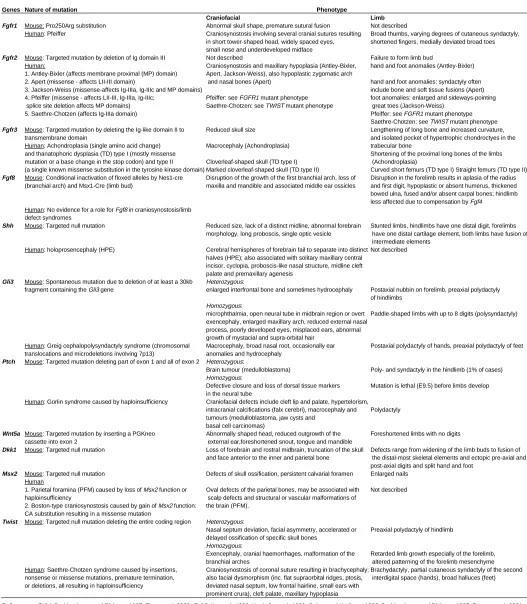
TABLE 1
MUTATIONS THAT AFFECT CRANIOFACIAL AND LIMB DEVELOPMENT
Genes Nature of mutation Phenotype
Craniofacial Limb Fgfr1 Mouse: Pro250Arg substitution Abnormal skull shape, premature sutural fusion Not described
Human: Pfeiffer Craniosynostosis involving several cranial sutures resulting Broad thumbs, varying degrees of cutaneous syndactyly,
in short tower-shaped head, widely spaced eyes, shortened fingers, medially deviated broad toes
small nose and underdeveloped midface
Fgfr2 Mouse: Targeted mutation by deletion of Ig domain III Not described Failure to form limb bud
Human: Craniosynostosis and maxillary hypoplasia (Antley-Bixler, hand and foot anomalies (Antley-Bixler)
1. Antley-Bixler (affects membrane proximal (MP) domain) Apert, Jackson-Weiss), also hypoplastic zygomatic arch
2. Apert (missense - affects LII-III domain) and nasal bones (Apert) hand and foot anomalies: syndactyly often
3. Jackson-Weiss (missense-affects Ig-IIIa, Ig-IIIc and MP domains) include bone and soft tissue fusions (Apert)
4. Pfeiffer (missense - affects LII-III, Ig-IIIa, Ig-IIIc; Pfeiffer: see FGFR1 mutant phenotype foot anomalies: enlarged and sideways-pointing
splice site deletion affects MP domains) Saethre-Chotzen: see TWIST mutant phenotype great toes (Jackson-Weiss)
5. Saethre-Chotzen (affects Ig-IIIa domain) Pfeiffer: see FGFR1 mutant phenotype
Saethre-Chotzen: see TWIST mutant phenotype
Fgfr3 Mouse: Targeted mutation by deleting the Ig-like domain II to Reduced skull size Lengthening of long bone and increased curvature,
transmembrane domain and isolated pocket of hypertrophic chondroctyes in the
Human: Achondroplasia (single amino acid change) Macrocephaly (Achondroplasia) trabecular bone
and thanatophoric dysplasia (TD) type I (mostly missense Shortening of the proximal long bones of the limbs
mutation or a base change in the stop codon) and type II Cloverleaf-shaped skull (TD type I) (Achondroplasia)
(a single known missense substitution in the tyrosine kinase domain) Marked cloverleaf-shaped skull (TD type II) Curved short femurs (TD type I) Straight femurs (TD type II)
Fgf8 Mouse: Conditional inactivation of floxed alleles by Nes1-cre Disruption of the growth of the first branchial arch, loss of Disruption in the forelimb results in aplasia of the radius
(branchial arch) and Msx1-Cre (limb bud) maxilla and mandible and associated middle ear ossicles and first digit, hypoplastic or absent humerus, thickened
bowed ulna, fused and/or absent carpal bones; hindlimb less affected due to compensation by Fgf4
Human: No evidence for a role for Fgf8 in craniosynostosis/limb defect syndromes
Shh Mouse: Targeted null mutation Reduced size, lack of a distinct midline, abnormal forebrain Stunted limbs, hindlimbs have one distal digit, forelimbs
morphology, long proboscis, single optic vesicle have one distal cartilage element, both limbs have fusion of
intermediate elements
Human: holoprosencephaly (HPE) Cerebral hemispheres of forebrain fail to separate into distinct Not described
halves (HPE); also associated with solitary maxillary central incisor, cyclopia, proboscis-like nasal structure, midline cleft palate and premaxillary agenesis
Gli3 Mouse: Spontaneous mutation due to deletion of at least a 30kb Heterozygous:
fragment containing the Gli3 gene enlarged interfrontal bone and sometimes hydrocephaly Postaxial nubbin on forelimb, preaxial polydactyly
of hindlimbs Homozygous:
microphthalmia, open neural tube in midbrain region or overt Paddle-shaped limbs with up to 8 digits (polysyndactyly)
exencephaly, enlarged maxillary arch, reduced external nasal process, poorly developed eyes, misplaced ears, abnormal growth of mystacial and supra-orbital hair
Human: Greig cephalopolysyndactyly syndrome (chromosomal Macrocephaly, broad nasal root, occasionally ear Postaxial polydactyly of hands, preaxial polydactyly of feet
translocations and microdeletions involving 7p13) anomalies and hydrocephaly
Ptch Mouse: Targeted mutation deleting part of exon 1 and all of exon 2 Heterozygous:
Brain tumour (medulloblastoma) Poly- and syndactyly in the hindlimb (1% of cases)
Homozygous:
Defective closure and loss of dorsal tissue markers Mutation is lethal (E9.5) before limbs develop
in the neural tube
Human: Gorlin syndrome caused by haploinsufficiency Craniofacial defects include cleft lip and palate, hypertelorism,
intracranial calcifications (falx cerebri), macrocephaly and Polydactyly
tumours (medulloblastoma, jaw cysts and basal cell carcinomas)
Wnt5a Mouse: Targeted mutation by inserting a PGKneo Abnormally shaped head, reduced outgrowth of the Foreshortened limbs with no digits
cassette into exon 2 external ear,foreshortened snout, tongue and mandible
Dkk1 Mouse: Targeted null mutation Loss of forebrain and rostral midbrain, truncation of the skull Defects range from widening of the limb buds to fusion of
and face anterior to the inner and parietal bone the distal-most skeletal elements and ectopic pre-axial and
post-axial digits and split hand and foot
Msx2 Mouse: Targeted null mutation Defects of skull ossification, persistent calvarial foramen Enlarged nails
Human
1. Parietal foramina (PFM) caused by loss of Msx2 function or Oval defects of the parietal bones, may be associated with Not described
haploinsufficiency scalp defects and structural or vascular malformations of
2. Boston-type craniosynostosis caused by gain of Msx2 function: the brain (PFM).
CA substitution resulting in a missense mutation
Twist Mouse: Targeted null mutation deleting the entire coding region Heterozygous:
Nasal septum deviation, facial asymmetry, accelerated or Preaxial polydactyly of hindlimb
delayed ossification of specific skull bones Homozygous:
Exencephaly, cranial haemorrhages, malformation of the Retarded limb growth especially of the forelimb,
branchial arches altered patterning of the forelimb mesenchyme
Human: Saethre-Chotzen syndrome caused by insertions, Craniosynostosis of coronal suture resulting in brachycephaly; Brachydactyly, partial cutaneous syndactyly of the second
nonsense or missense mutations, premature termination, also facial dysmorphism (inc. flat supraorbital ridges, ptosis, interdigital space (hands), broad halluces (feet)
or deletions, all resulting in haploinsufficiency deviated nasal septum, low frontal hairline, small ears with
prominent crura), cleft palate, maxillary hypoplasia
Twist-/- embryos, suggesting that Twist-/- NCC are formed and may
be able to migrate to the various craniofacial regions (Chen and Behringer, 1995). However, our study on the pattern of Sox10 activity has revealed some previously unrecognised defects of the neural crest cells in the mutant embryo. Sox10-expressing neural crest cells that are migrating from the 2nd and 4th rhombomeres of
the hindbrain to the first two branchial arches fail to remain segregated as discrete streams, leading to the filling of the NCC-free gap normally found at the level of rhombomere 3 by Sox10-expressing cells. Cell transplantation studies have revealed that the Twist-deficient paraxial mesoderm fails to restrain the neural crest cells along specific paths as they migrate to the branchial arches, and although Twist-deficient neural crest cells are able to home in to the correct branchial arch, they are unable to colonize the correct tissue compartment within the arch. It may be significant that neural tissues are absent in the teratomas derived from somites of Twist-/- embryos, pointing to a lack of neural crest cells
in the somite. This may be due to the inability of the neural crest cells to colonise the Twist-deficient somite because of the lack of guidance signal, or to the failure of the neural crest cells to undergo neurogenic differentiation. A possible cause of this abnormal pattern of NCC migration and regionalization is the alteration of cell adhesion properties. This hypothesis is supported by the fact that (1) there are significant overlaps in the expression domains of Cdh11 and Twist in the paraxial mesoderm and the branchial arches (Kimura et al., 1995), (2) loss of Twist activity is associated with down-regulation of Cdh11 expression in the cranial mesen-chyme and the branchial arches, and (3) over-expressing Cdh11 in the Xenopus embryo inhibits the migration of the neural crest cells (Borchers et al., 2001).
Abnormal somite differentiation. Consistent with the presumptive role of Twist in mesoderm differentiation, genes that are associated with the differentiation of the dermomyotome, myotome and scle-rotome are expressed at a lower level, or not at all, in mutant mice. The architecture of the somites is disorganised. Mutant somites show poor capacity to differentiate into bone and striated muscle when tested in teratoma studies. Extensive cell death is observed at the time of the demise of the embryo, especially in the sclero-tome, indicating a possible role for Twist in cell growth or survival (Chen and Behringer, 1995). Evidence of a potential role in cell viability has since been suggested by another study where Twist was shown to promote colony formation of Ras-transformed cells and can inhibit myc-induced apoptosis (Maestro et al., 1999).
Limb defects are dose-dependent and limb type-specific. In the limb bud of the mouse embryo, Twist is expressed in a dynamic manner during development. Early on the transcript is distributed widely throughout the limb bud mesenchyme and in the adjacent lateral mesoderm. Expression is then down-regulated in the core mesen-chyme and becomes restricted to the apical mesenmesen-chyme and to the pre- and postaxial mesenchyme flanking the prospective constriction that develops later at the base of the paddle-shape limb bud. Late expression is restricted to the interdigital tissues and the perichondrium of the digital cartilage. With such a dynamic and protracted expression pattern, which is similar to that in chick limbs (Tavares et al., 2001), it is not surprising that a major impact of the loss of Twist activity in the mesoderm is an effect on limb growth and patterning. What is perhaps surprising is the differential role
that Twist appears to play in forelimb and hindlimb development considering its identical expression domain in both limb types.
Forelimb development appears to be less sensitive to Twist gene dosage than hindlimb development. Twist+/- forelimbs are
morphologically normal. In contrast, loss of just one functional copy of the Twist gene is sufficient to result in polydactyly of the hindlimb, which is heralded by an ectopic Shh domain in the anterior limb mesenchyme. Twist-/- forelimbs are severely retarded and have a
diminished histogenetic capacity for bone and muscle differentia-tion. The defective development of homozygous mutant forelimbs is associated with the loss of a morphologically identifiable apical ectodermal ridge, and altered expression of many mesodermal and ectodermal patterning genes. Intriguingly, in the complete absence of Twist activity, the early development of the hindlimb bud is less affected than that of the forelimb bud. Because of embryonic lethality of the homozygous mutant, it is not known whether the hindlimb bud may exhibit defective tissue patterning similar to the polydactyly of the Twist+/- hindlimb, however the
observation of expanded Fgf4 expression to the anterior AER indicates that this might be the case should these embryos survive longer.
Since Twist homozygosity causes embryonic lethality at a later stage in mouse than in Drosophila, additional insight has been gained into the diverse functions of Twist through analysis of the specific variety of organs affected in the mutant mice. However, despite the divergent features, it is clear that the primary action of Twist is to regulate the differentiation of mesodermal tissue, which in turn influences the ability of the mesoderm to impose morphoge-netic controls on other embryonic tissues during organogenesis.
Twist Function is Critical for Cell Signalling in the
Branchial Arch and the Limb Bud
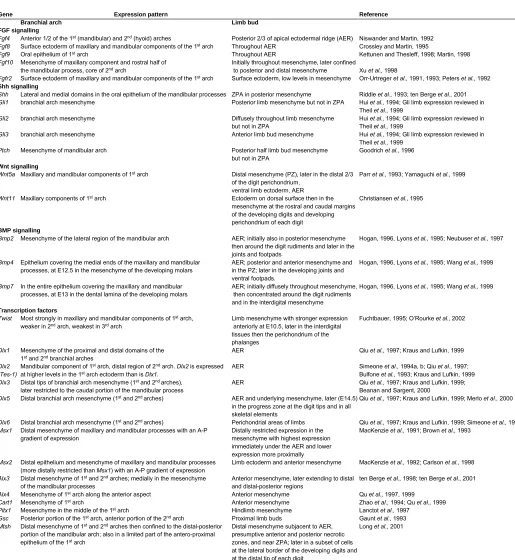
TABLE 2
GENES THAT ARE EXPRESSED IN BOTH THE BRANCHIAL ARCH AND THE LIMB BUD DURING MORPHOGENESIS
Gene Expression pattern Reference Branchial arch Limb bud
FGF signalling
Fgf4 Anterior 1/2 of the 1st
(mandibular) and 2nd
(hyoid) arches Posterior 2/3 of apical ectodermal ridge (AER) Niswander and Martin, 1992 Fgf8 Surface ectoderm of maxillary and mandibular components of the 1st
arch Throughout AER Crossley and Martin, 1995
Fgf9 Oral epithelium of 1st arch Throughout AER Kettunen and Thesleff, 1998; Martin, 1998
Fgf10 Mesenchyme of maxillary component and rostral half of Initially throughout mesenchyme, later confined the mandibular process, core of 2nd
arch to posterior and distal mesenchyme Xu et al., 1998
Fgfr2 Surface ectoderm of maxillary and mandibular components of the 1st arch Surface ectoderm, low levels in mesenchyme Orr-Urtreger et al., 1991, 1993; Peters et al., 1992
Shh signalling
Shh Lateral and medial domains in the oral epithelium of the mandibular processes ZPA in posterior mesenchyme Riddle et al., 1993; ten Berge et al., 2001 Gli1 branchial arch mesenchyme Posterior limb mesenchyme but not in ZPA Hui et al., 1994; Gli limb expression reviewed in
Theil et al., 1999
Gli2 branchial arch mesenchyme Diffusely throughout limb mesenchyme Hui et al., 1994; Gli limb expression reviewed in
but not in ZPA Theil et al., 1999
Gli3 branchial arch mesenchyme Anterior limb bud mesenchyme Hui et al., 1994; Gli limb expression reviewed in Theil et al., 1999
Ptch Mesenchyme of mandibular arch Posterior half limb bud mesenchyme Goodrich et al., 1996 but not in ZPA
Wnt signalling
Wnt5a Maxillary and mandibular components of 1st arch Distal mesenchyme (PZ), later in the distal 2/3 Parr et al., 1993; Yamaguchi et al., 1999
of the digit perichondrium, ventral limb ectoderm, AER
Wnt11 Maxillary components of 1st arch Ectoderm on dorsal surface then in the Christiansen et al., 1995
mesenchyme at the rostral and caudal margins of the developing digits and developing perichondrium of each digit
BMP signalling
Bmp2 Mesenchyme of the lateral region of the mandibular arch AER; initially also in posterior mesenchyme Hogan, 1996, Lyons et al., 1995; Neubuser et al., 1997 then around the digit rudiments and later in the
joints and footpads
Bmp4 Epithelium covering the medial ends of the maxillary and mandibular AER; posterior and anterior mesenchyme and Hogan, 1996, Lyons et al., 1995; Wang et al., 1999 processes, at E12.5 in the mesenchyme of the developing molars in the PZ; later in the developing joints and
ventral footpads.
Bmp7 In the entire epithelium covering the maxillary and mandibular AER; initially diffusely throughout mesenchyme, Hogan, 1996, Lyons et al., 1995; Wang et al., 1999 processes, at E13 in the dental lamina of the developing molars then concentrated around the digit rudiments
and in the interdigital mesenchyme
Transcription factors
Twist Most strongly in maxillary and mandibular components of 1st arch, Limb mesenchyme with stronger expression Fuchtbauer, 1995; O’Rourke et al., 2002
weaker in 2nd
arch, weakest in 3rd
arch anteriorly at E10.5, later in the interdigital tissues then the perichondrium of the phalanges
Dlx1 Mesenchyme of the proximal and distal domains of the AER Qiu et al., 1997; Kraus and Lufkin, 1999 1st
and 2nd
branchial arches
Dlx2 Mandibular component of 1st arch, distal region of 2nd arch. Dlx2 is expressed AER Simeone et al., 1994a, b; Qiu et al., 1997;
(Tes-1)at higher levels in the 1st
arch ectoderm than is Dlx1. Bulfone et al., 1993; Kraus and Lufkin, 1999
Dlx3 Distal tips of branchial arch mesenchyme (1st
and 2nd
arches), AER Qiu et al., 1997; Kraus and Lufkin, 1999;
later restricted to the caudal portion of the mandibular process Beanan and Sargent, 2000
Dlx5 Distal branchial arch mesenchyme (1st
and 2nd
arches) AER and underlying mesenchyme, later (E14.5) Qiu et al., 1997; Kraus and Lufkin, 1999; Merlo et al., 2000 in the progress zone at the digit tips and in all
skeletal elements Dlx6 Distal branchial arch mesenchyme (1st
and 2nd
arches) Perichondrial areas of limbs Qiu et al., 1997; Kraus and Lufkin, 1999; Simeone et al., 1994a Msx1 Distal mesenchyme of maxillary and mandibular processes with an A-P Distally restricted expression in the MacKenzie et al., 1991; Brown et al., 1993
gradient of expression mesenchyme with highest expression
immediately under the AER and lower expression more proximally
Msx2 Distal epithelium and mesenchyme of maxillary and mandibular processes Limb ectoderm and anterior mesenchyme MacKenzie et al., 1992; Carlson et al., 1998 (more distally restricted than Msx1) with an A-P gradient of expression
Alx3 Distal mesenchyme of 1st
and 2nd
arches; medially in the mesenchyme Anterior mesenchyme, later extending to distal ten Berge et al., 1998; ten Berge et al., 2001
of the mandibular processes and distal-posterior regions
Alx4 Mesenchyme of 1st
arch along the anterior aspect Anterior mesenchyme Qu et al., 1997, 1999
Cart1 Mesenchyme of 1st
arch Anterior mesenchyme Zhao et al., 1994; Qu et al., 1999
Pitx1 Mesenchyme in the middle of the 1st arch Hindlimb mesenchyme Lanctot et al., 1997
Gsc Posterior portion of the 1st
arch, anterior portion of the 2nd
arch Proximal limb buds Gaunt et al., 1993
Mtsh Distal mesenchyme of 1st
and 2nd
arches then confined to the distal-posterior Distal mesenchyme subjacent to AER, Long et al., 2001 portion of the mandibular arch; also in a limited part of the antero-proximal presumptive anterior and posterior necrotic
epithelium of the 1st
arch zones, and near ZPA; later in a subset of cells
at the lateral border of the developing digits and at the distal tip of each digit
et al., 1988; Ferguson et al., 2000; Moerlooze et al., 2000; Martin, 2001), which is mediated by cell-cell signalling. The response to these signals appears to be interchangeable between the limb and arch tissues. Recombination experiments in chick have shown that the epithelium is essentially interchangeable. Limb bud ectoderm
Shh-expressing facial epithelia were able to induce digit duplications when transplanted to the anterior region of early limb buds (Helms et al., 1997). Our study on the expression of genes associated with FGF, SHH and BMP signalling activity in the Twist-/- embryo (O’Rourke
et al., 2002; Soo et al., 2002) reveals that the loss of Twist function impacts on similar signalling pathways in the head tissues, branchial arch and the limb bud (Fig. 1).
FGF signalling. To date, the FGF family in mammals consists of 23 members that signal through four transmembrane tyrosine kinase receptors, Fgfr1-4 (Ornitz and Itoh, 2001). At least 4 FGFs are expressed in both the branchial arches and the limbs: three in the ectoderm (Fgf4, -8, -9) and one (Fgf10) in the mesenchyme (Table 2). In addition to these four FGFs, Fgf1, -2, -5 and –12 are also expressed in the branchial arches (Francis-West et al., 1998). Two isoforms of Fgfr2 (Fgfr2b in the apical ectoderm ridge (AER) and Fgfr2c in the mesenchyme) are expressed in the limb bud. Three FGFRs (Fgfr1, -2, -3) are expressed in the facial primordia and one (Fgfr2) specifically in the branchial arch ectoderm (Table 2). Fgfr2b can bind Fgf2, -3 and -10, suggesting that some of these ligands are involved in facial development (Francis-West et al., 1998). FGF signalling plays a critical role in the initiation of limb bud outgrowth by the inductive activity of Fgf10 in the lateral mesoderm mediated through a signalling loop involving reciprocal activation in the AER and mesenchyme of Fgfr2-IIIb to Fgf4/Fgf8 to Fgfr2-IIIc (Xu et al., 1998; Revest et al., 2001). In the developing limb bud, Fgf4 expression is confined to the posterior (post-axial) part of the AER, whereas Fgf8 is expressed in the entire AER with Fgf10 in the distal mesenchyme. In the forelimb bud, complete loss of Twist activity does not significantly alter Fgfr2 expression but leads to the down-regulation of Fgf10 in the posterior mesenchyme and the absence of Fgf4 and Fgf8 expression in the posterior AER. Twist therefore is likely to act downstream of Fgfr2-IIIc in the mesenchyme but is critical for the activation of Fgfr2-IIIb, Fgf4 and –8 in the posterior AER and Fgf10 in the posterior mesenchyme. Expression of Fgf8 in the anterior AER and Fgf10 in the anterior mesenchyme is apparently independent of Twist. Interestingly, a much less dra-matic change in FGFR/FGF activity is found in the hindlimb bud with Fgf4 the only gene significantly affected, showing expansion of expression anteriorly. This limb-specific response of FGF signal-ling to Twist absence may underpin the differential effect of the mutation on the extent of limb bud outgrowth. The complete loss of Fgf4 and the more restricted expression of Fgf8 in the forelimb bud may lead to a more drastic arrest in growth. Conditional gene inactivation experiments have shown that in the absence of Fgf8 activity in the AER, forelimb bud growth is more affected than that of the hindlimb because of the longer duration that the forelimb bud is subjected to lack of FGF signalling before Fgf4 is activated to restore the inductive function in the AER (Lewandowski et al., 2000). A more refractory response of the forelimb bud tissues to activate Shh expression in response to Fgf4 stimulation is found in the avian embryo, again highlighting the difference in competence of limb bud mesenchyme to respond to FGF signalling (Wada and Nohno, 2001).
Similar down-regulation of FGF signalling activity may also occur in the Twist-deficient branchial arches. Analogous to its function in the limb, Fgf8 is one of the key players in the oral epithelium which is capable of inducing and/or maintaining expres-sion of mesenchymal genes in the mandibular arch (Neubuser et
al., 1997; Kettunen and Thesleff, 1998; Ferguson et al., 1998; Tucker et al., 1999), where it is also responsible for establishing and maintaining rostral-caudal polarity (Tucker et al., 1999; Francis-West et al., 1998). The mutant embryo completely loses the expression of Fgfr2, Fgf4 and Fgf10 in both first and second arches. Fgf8 expression is lost in the distal anterior ectoderm of the mandibular component of the first arch and is markedly reduced in the second arch. That truncated arches can be formed in the Twist -/- embryo suggests that the residual Fgf8 activity is sufficient to
initiate the outgrowth of the arch (Trumpp et al., 1999). The failure to sustain more growth could be due to the reduction in overall signalling activity in the absence of Twist function similar to that in the limb bud. Thus of all the FGFs, FGF8 function is particularly critical for the development of both the branchial arch and the limb (Fig. 1).
Shh activity and downstream factors. Shh is expressed in the zone of polarising activity in the posterior mesenchyme of the limb buds where it is responsible for anterior-posterior patterning of the digits (Laufer et al., 1994; Niswander et al., 1994). A similar role for Shh in pattern formation of the branchial arches has been proposed (Wall and Hogan, 1995; Helms et al., 1997). Shh expression is localized to the distal anterior epithelium of the mandibular compo-nent of the first branchial arch (Table 2) where it is required for the regionalization of Prx1 and –2 activities in the mesenchyme (ten Berge et al., 2001). Similar to its morphogenetic role in the limb, Shh has been found to stimulate growth and shaping of the mandibular processes by its regionalized mitogenic activity on the mesenchyme (ten Berge et al., 2001) and the maintenance of cell viability (Ahlgren and Bronner-Fraser, 1999). Null mutation of Shh in mice results in almost complete absence of craniofacial skeletal elements despite apparently normal development of the branchial arches until E9.5 (Chiang et al., 1996), indicating that Shh is needed to sustain but not to initiate outgrowth. Akin to its role in imparting positional information in the limb, Shh activity also specifies the dental pattern in the mesial part of the jaw well before the initiation of incisor development (ten Berge et al., 2001).
Shh activity is completely lost in the posterior mesenchyme in the Twist-/- forelimb bud and is markedly diminished in the branchial
The three GLI zinc-finger genes, Gli1, -2 and -3, are implicated in transduction of SHH signals: Gli1 and -2 are thought to be the activators of SHH signalling while Gli3 is the major repressor which acts in a SHH-independent manner (Aza-Blanc et al., 2000). The loss of Gli3 expression and the ectopic expression of Gli1 and Ptch in the anterior mesenchyme is coincidental to the loss of Twist in the same tissue. That Gli1 and Ptch are expressed in the absence of Shh suggests that both factors are activated by default widely in the limb mesenchyme but their final pattern of activity is maintained by Shh in the posterior mesenchyme and repressed by Gli3 in the anterior mesenchyme. One of the roles of Twist is likely to activate or maintain a graded pattern of Gli3 activity to suppress SHH signalling in the anterior mesenchyme and thereby pattern the limb mesenchyme. A possible disruption in tissue pattern of the mutant forelimb is revealed by the loss of Bmp4 and Msx1 expression in the posterior limb tissue and the shift of Hoxd13 expression to the anterior mesenchyme. The changes in activity of the SHH signal-ling pathway in the Twist-/- branchial arch may also be related to the
loss of FGF activity and the lack of repression of downstream SHH signalling by Gli3, and may be responsible for the loss of distal jaw structures in the truncated first arch. Whilst Gli2 and -3 are expressed in migrating neural crest and all three Gli genes are found in the mesenchyme of the branchial arch (Hui et al., 1994; Walterhouse et al., 1993), their effect on SHH signalling in the craniofacial tissues remains to be clarified (Francis-West et al., 1998). The experimental evidence, however, has strongly sup-ported the postulation that Twist influences SHH signalling in both the arch and the limb indirectly via its effect on FGF activity and the upstream regulation of Gli2 and Gli3 expression (Fig. 1).
BMP signalling. Three vertebrate bone morphogenetic protein (BMP) family members, Bmp2, -4, and -7, are expressed in both the ectoderm and mesenchyme of the limbs and the 1st branchial arch (Table 2). In the limb their broad expression domains encompass the mesenchyme of the anterior, posterior, and interdigital necrotic
zones, which subsequently undergoes apoptosis, contributing to the widely-held belief that BMPs are the signals responsible for cell death in the limb (Zou and Niswander, 1996). BMPs also promote the regression of the AER at the end of the outgrowth phase (Ganan et al., 1998; Pizette and Niswander, 1999), regulate chondrogenic differentiation (Duprez et al., 1996a; Macias et al., 1997; Merino et al., 1998; Enomoto-Iwamoto et al., 1998), control muscle formation (Duprez et al., 1996b; Amthor et al., 1998), and influence the morphological identity of the digits (Dahn and Fallon, 2000). Loss of Twist activity results in the down-regulation of Bmp4 in the surface ectoderm of the mandibular component of the first arch and in the posterior AER and subjacent mesenchyme of the forelimb bud (Fig. 1). These changes in Bmp4 expression are accompanied by the down-regulation of the putative downstream Msx1 gene in the mesenchyme of the branchial arches and the limb bud. Twist-deficiency, however, has no effect on the expression of Bmp4 and Msx1 in the hindlimb. Attempts to assess the specific function of Bmp2, -4 and -7 by knockout mutation have been hampered by early embryonic lethality (Bmp2, -4: Winnier et al., 1995; Zhang and Bradley, 1996) or functional redundancy (Bmp7: Dudley et al., 1995; Luo et al., 1995; Dudley et al., 1995). However examination of Bmp4+/- mice has revealed shorter frontal and nasal
bones, and hindlimb polydactyly (Dunn et al., 1997). Whether Twist activity may be altered by the loss of BMP in these mice has not been investigated.
Downstream and Interacting Factors
Analysis of downstream targets of Twist in the worm and the fly has revealed that they are predominantly associated with the specification and patterning of the mesodermal tissues. In C. elegans, ceTwist in conjunction with another bHLH E-protein, Daughterless, can activate two target genes, ceh-24 and egl-15, which encode an NK-2 class homeodomain and a homolog of FGF receptor (Harfe et al., 1998). Both genes are expressed in the M
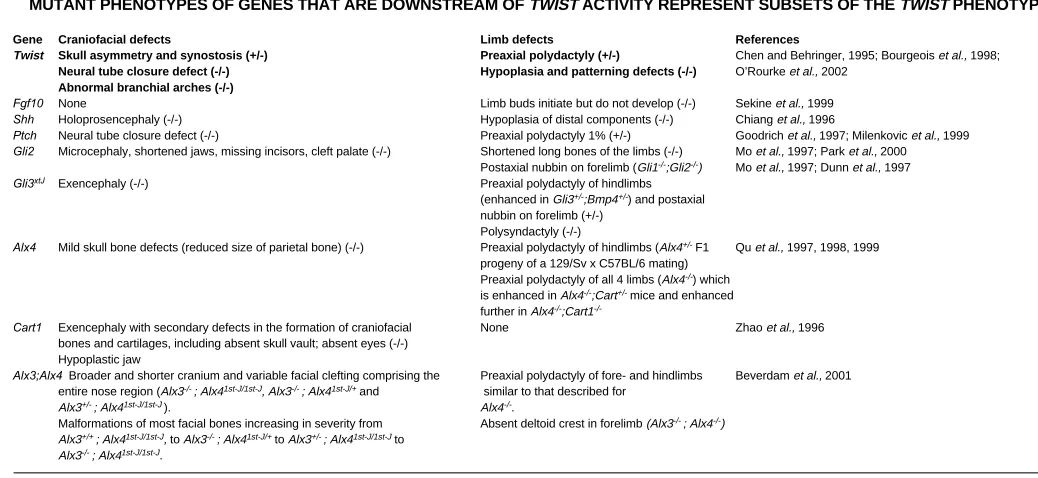
TABLE 3
MUTANT PHENOTYPES OF GENES THAT ARE DOWNSTREAM OF TWIST ACTIVITY REPRESENT SUBSETS OF THE TWIST PHENOTYPE
Gene Craniofacial defects Limb defects References
Twist Skull asymmetry and synostosis (+/-) Preaxial polydactyly (+/-) Chen and Behringer, 1995; Bourgeois et al., 1998;
Neural tube closure defect (-/-) Hypoplasia and patterning defects (-/-) O’Rourke et al., 2002
Abnormal branchial arches (-/-)
Fgf10 None Limb buds initiate but do not develop (-/-) Sekine et al., 1999
Shh Holoprosencephaly (-/-) Hypoplasia of distal components (-/-) Chiang et al., 1996
Ptch Neural tube closure defect (-/-) Preaxial polydactyly 1% (+/-) Goodrich et al., 1997; Milenkovic et al., 1999
Gli2 Microcephaly, shortened jaws, missing incisors, cleft palate (-/-) Shortened long bones of the limbs (-/-) Mo et al., 1997; Park et al., 2000
Postaxial nubbin on forelimb (Gli1-/-;Gli2-/-) Mo et al., 1997; Dunn et al., 1997
Gli3xtJ Exencephaly (-/-) Preaxial polydactyly of hindlimbs
(enhanced in Gli3+/-;Bmp4+/-) and postaxial
nubbin on forelimb (+/-) Polysyndactyly (-/-)
Alx4 Mild skull bone defects (reduced size of parietal bone) (-/-) Preaxial polydactyly of hindlimbs (Alx4+/- F1 Qu et al., 1997, 1998, 1999
progeny of a 129/Sv x C57BL/6 mating) Preaxial polydactyly of all 4 limbs (Alx4-/-) which
is enhanced in Alx4-/-;Cart+/- mice and enhanced
further in Alx4-/-;Cart1
-/-Cart1 Exencephaly with secondary defects in the formation of craniofacial None Zhao et al., 1996 bones and cartilages, including absent skull vault; absent eyes (-/-)
Hypoplastic jaw
Alx3;Alx4 Broader and shorter cranium and variable facial clefting comprising the Preaxial polydactyly of fore- and hindlimbs Beverdam et al., 2001
entire nose region (Alx3-/- ; Alx41st-J/1st-J, Alx3-/- ; Alx41st-J/+ and similar to that described for
Alx3+/- ; Alx41st-J/1st-J ). Alx4-/-.
Malformations of most facial bones increasing in severity from Absent deltoid crest in forelimb (Alx3-/- ; Alx4-/-)
Alx3+/+ ; Alx41st-J/1st-J, to Alx3-/- ; Alx41st-J/+ to Alx3+/- ; Alx41st-J/1st-J to
blast cell that gives rise to subsets of non-striated muscles and the activation of these genes is brought about by response of the cis-acting element in the promoter to ceTwist. A conserved molecular pathway has been described in the fly, where twist activity is mediated by activation of the FGFR homologue, heartless, and the NK domain gene, tinman (also called NK-4 and msh-2; Yin et al., 1997). In the fly, twist acts as a positive regulator of mesoderm differentiation by promoting the expression of PS2 and how (held out wings) in the invaginating mesoderm and limiting that of crumbs in the lateral ectoderm (Leptin, 1991; Zaffran et al., 1997). twist activates the NK-2 gene in the posterior portion of the embryo and acts with dorsal to activate snail expression (Mellerick and Nirenberg, 1995; Ip et al., 1992). Tinman is a direct transcriptional target for twist and its own gene product in visceral mesodermal cells, supporting the idea that twist and tinman participate in the subdi-vision of the mesoderm during embryogenesis (Lee et al., 1997). The tinman gene is activated by a number of discrete enhancer elements respectively for the early mesoderm, the dorsal meso-derm and the cardioblasts. Early tinman expression can only be achieved by a direct interaction of twist on the early-acting en-hancer element (Bodmer et al., 1990; Yin et al., 1997). MEF2, a myogenic regulatory gene, is also a direct target for transcriptional activation by twist during myogenesis of the somatic mesoderm (Lilly et al., 1994; Taylor et al., 1995; Cripps et al., 1998). In zebrafish, expression of zfh-1, a zinc-finger- and homeobox-containing gene that is expressed in the early mesoderm and later in the forming heart mesoderm, requires activity of twist and snail (Lai et al., 1991). Whether this myogenic gene is a direct target is not known.
A recent genome-wide surveillance of the transcriptional profile of Drosophila embryos has identified numerous genes whose activity has been significantly altered in response to either loss of twist function or constitutive up-regulation of twist by expressing a gain-of-function Toll10B allele (Furlong et al., 2001). These genes
encode transcription factors, signal transduction molecules, ki-nases and pioneer proteins that are required for stage-related mesoderm specification and differentiation. However, there are also non-mesodermal factors among the responding genes.
That the expression of myogenin and Myf5 is maintained (Chen and Behringer, 1995; our unpublished observations) in the ab-sence of Twist strongly suggest that Twist is not required to activate myogenic factors in the muscle precursor cells. Ectopic expression of Twist inhibits myogenesis by blocking DNA binding by MyoD, by titrating E proteins, and by inhibiting trans-activation by MEF2 by heterodimerization with E proteins. Thus, Twist may act directly on the myogenic factors by repressing their transcriptional activity in non-myogenic tissues (Spicer et al., 1996).
Our approach of analysing expression of candidate down-stream target genes in craniofacial tissues, somites and limb buds reveals that Twist activity may influence SHH and FGF signalling activity. In the forelimb bud, loss of Twist is accompanied by the loss of Shh, Gli2 and Gli3 expression. Expression of Gli1 and Ptch is down-regulated in the post-axial mesenchyme, but is found ectopically in the pre-axial mesenchyme. SHH signalling is known to be modulated by a combination of positive and negative factors, and in the limb bud, the processing of the GLI3 factor establishes a pre- to post-axial repressor gradient that constrains the SHH signalling activity to the post-axial mesenchyme. The loss of GLI3 and GLI2 activity may cause the failure to suppress the default
SHH-activating GLI1 and PTCH activity in the pre-axial mesen-chyme and the initiation and/or maintenance of SHH signalling activity in the post-axial mesenchyme. It is not known whether Twist has a direct effect on transcription of the Gli genes, however the microarray analysis in Drosophila has identified an invertebrate Gli homologue (gleeful) that is critical for muscle differentiation (Furlong et al., 2001). Furthermore, the demonstration of an enhanced polydactylous phenotype in the limbs of compound Twist;Gli3 mutant mouse embryos (O’Rourke et al., 2002) has provided direct evidence of a genetic interaction between the activity of Twist and Gli3 in limb patterning, and therefore that Twist may be acting synergistically with SHH signalling.
In contrast to Drosophila, a direct interaction between verte-brate TWIST and FGFR genes has not yet been established. Analysis of the pattern of gene expression in the sutural mesen-chyme of the skull shows that Twist expression precedes that of FGFR genes when suture formation initiates, and that there is subsequently some overlap in expression domains of Twist and Fgfr2 (Johnson et al., 2000; Morriss-Kay et al., 2001). The precise position of Twist in the FGF signalling cascade is not fully known. In the Twist-/- mutant forelimb bud, expression of Fgf4 in the apical
ectoderm ridge is absent, while that of Fgf8, Fgf10 and Fgfr2 is much reduced. In branchial arches and brain, Fgf8 and Fgfr2 expression is found in ectopic sites, but Fgf8 and Fgfr2 activity in the paraxial mesoderm is unchanged. In the chick wing bud, removal of the apical ectoderm ridge leads to loss of Twist expression but replenishing Fgf4/8 maintains Twist in the AER-ablated limb (Tavares et al., 2001). Fgf2/8 can also induce ectopic Twist expression in the flank of the body (Isaac et al., 2000). A similar inductive effect of Fgf2 on Twist expression is found in fetal calvarial tissues (Rice et al., 2000). These findings are consistent with the notion that Twist and FGF are integrated in a reciprocally interactive pathway whereby FGF induces Twist, which in turn regulates FGFR activity (Fig. 1).
Functional interactions between FGFs and WNTs have been shown to take place in a variety of organs including development of the tooth, kidney, brain, and limb (reviewed in Moon et al., 1997), and initiation of the inner ear (Ladher et al., 2000). In chick limb, Wnt2b and Wnt8c induce Fgf10 activity in the mesoderm, an event that is essential to initiate limb bud outgrowth. Fgf10 acting in concert with Wnt3a then induces formation of the AER (Kawakami et al., 2001; Huelsken and Birchmeier, 2001; reviewed in Martin, 2001). Wnt7a in the dorsal ectoderm and En1 in the ventral ectoderm are responsible for dorso-ventral subdivision of the limb bud (Yang and Niswander, 1995; Parr and McMahon, 1995). The impact of TWIST on WNT signalling has yet to be investigated but it is of interest to note that Wnt6 expression in the dorsal myotome is altered in the absence of Twist activity (O’Rourke and Tam, unpublished).
Loss of Twist function disrupts the expression of genes encod-ing the ALX transcription factors (Loebel et al., 2002). A compari-son of the effects of loss of function of these genes shows that the pleiotropic phenotype of the Twist mutant might represent the summation of the phenotypic consequences of these individual gene mutations (Table 3), suggesting that they are potential downstream genes. The overlapping phenotypic outcome of Alx and Twist mutations, the universal repression of Alx gene activity in the Twist-/- mutant, and the presence of possible E-box like HLH
and human Alx4 orthologues (Loebel et al., 2002) argue that the Alx genes may even be direct targets. Twist and another bHLH factor (Dermo1) can inhibit oncogene- and p53-dependent cell death (Maestro et al., 1999). This effect correlates with an ability of Twist to interfere with activation of a p53-dependent reporter and to suppress the induction of p53 target genes in response to DNA damage. It has been postulated that Twist may interfere with the p53 tumor-suppressor pathway indirectly through modulation of the ARF/MDM2/p53 activity (Maestro et al., 1999).
The investigation of the effects of gain or loss of gene activity on embryonic development and mesodermal differentiation has pro-vided significant insight into the function of the Twist gene. It also reveals that the translation of the transcriptional regulation to the control of morphogenesis and tissue differentiation requires the activation or repression of molecular pathways that are down-stream of, and/or interacting with, Twist. The identification of downstream factors is achieved by assessing whether the expres-sion of specific genes may be altered by ectopically expressing or over-expressing Twist, or by interference with Twist activity. The analysis has taken two different approaches: first, specific sets of genes that are known to be involved with tissue morphogenesis and differentiation may be examined for being candidates of the downstream genes affected by Twist expression; second, a ge-nome-wide screening without any predilection of the response of all the expressing genes to the alteration of Twist activity (Furlong et al., 2001). Neither approach, however, could distinguish be-tween direct target genes and genes that are secondarily regulated by Twist downstream factors, without additional validation of transcriptional interaction. Further elucidation of the differential transcriptional activity of wild type and Twist mutant embryonic tissues coupled with functional tests of the candidate genes is crucial for a proper understanding of the molecular pathways regulated by TWIST, and to ascertain whether this transcription factor acts primarily as a repressor or as an activator.
Acknowledgements
We thank Peter Rowe and David Loebel for comments on the manu-script. Our work is supported by the National Health and Medical Research Council (NHMRC) of Australia, the Dental Board of NSW and Mr. James Fairfax. M.P.O’R. is a NHMRC Dental Postgraduate Scholar and P.P.L.T. is a NHMRC Senior Principal Research Fellow.
References
AHLGREN, S.C. and BRONNER-FRASER, M. (1999). Inhibition of Sonic hedgehog signaling in vivo results in craniofacial neural crest cell death. Curr. Biol. 9: 1304-1314.
AMTHOR, H., CHRIST, B., WEIL, M. and PATEL, K. (1998). The importance of timing differentiation during limb muscle development. Curr. Biol. 8: 642-652.
ANANT, S., ROY, S. and VIJAYRAGHAVAN, K. (1998). Twist and Notch negatively regulate adult muscle differentiation in Drosophila. Development 125: 1361-1369.
AZA-BLANC, P., LIN, H.Y., RUIZ I ALTABA, A. and KORNBERG, T.B. (2000). Expression of the vertebrate Gli proteins in Drosophila reveals a distribution of activator and repressor activities. Development 127: 4293-4301.
BAYLIES, M.K. and BATE, M. (1996). Twist: a myogenic switch in Drosophila. Science 272: 1481-1484.
BEANAN, M.J. and SARGENT, T.D. (2000). Regulation and function of Dlx3 in vertebrate development. Dev. Dyn. 218: 545-553.
BEVERDAM, A., BROUWER, A., REJNEN, M., KORVING, J. and MEIJLINK, F. (2001). Severe nasal clefting and abnormal embryonic apoptosis in Alx3/Alx4 double mutant mice. Development 128: 3975-3986.
BLOCH-ZUPAN, A., HUNTER, N., MANTHEY, A. and GIBBINS, J. (2001). R-twist gene expression during rat palatogenesis. Int. J. Dev. Biol. 45: 397-404.
BODMER, R., JAN, L.Y. and JAN, Y.N. (1990). A new homeobox-containing gene, msh-2, is transiently expressed early during mesoderm formation of Drosophila. Development 110: 661-9.
BORCHERS A., DAVID, R. and WEDLICH, D. (2001). Xenopus cadherin-11 restrains cranial neural crest migration and influences neural crest specification. Develop-ment 128: 3049-3060.
BORKOWSKI, O.M., BROWN, N.H. and BATE, M. (1995). Anterior-posterior subdivision and the diversification of the mesoderm in Drosophila. Development 121: 4183-4193.
BOURGEOIS, P., BOLCATO-BELLEMIN, A-L., DANSE, J-M., BLOCH-ZUPAN, A., YOSHIBA, K., STOETZEL, C. and PERRIN-SCHMITT, F. (1998). The variable expressivity and incomplete penetrance of the twist-null heterozygous mouse phenotype resemble those of human Saethre-Chotzen syndrome. Human Mol. Genet. 7: 945-957.
BROWN, J.M., WEDDEN, S.E., MILLBURN, G.H., ROBSON, L.G., HILL, R.E., DAVIDSON, D.R. and TICKLE, C. (1993). Experimental analysis of the control of expression of the homeobox-gene Msx-1 in the developing limb and face. Develop-ment 119: 41-48.
BULFONE, A., KIM, H.G., PUELLES, L., PORTEUS, M.H., GRIPPO, J.F. and RUBENSTEIN, J.L. (1993). The mouse Dlx-2 (Tes-1) gene is expressed in spatially restricted domains of the forebrain, face and limbs in midgestation mouse embryos. Mech. Dev. 40: 129-140.
CARLSON, M.R.J., BRYANT, S.V. and GARDINER, D.M. (1998). Expression of Msx-2 during development, regeneration, and wound healing in axolotl limbs. J. Exp. Zoo. 282: 715-723.
CASTANON, I., VON STETINA, S., KASS, J. and BAYLIES, M.K. (2001). Dimerization partners determine the activity of the Twist bHLH protein during Drosophila mesoderm development. Development 128: 3145-3159.
CHEN, Z-F. and BEHRINGER, R. R. (1995). twist is required in head mesenchyme for cranial neural tube morphogenesis. Genes Dev. 9: 686-699.
CHIANG, C., LITINGTUNG, Y., LEE, E., YOUNG, K.E., CORDEN, J.L., WESTPHAL, H. and BEACHY, P.A. (1996). Cyclopia and defective axial patterning in mice lacking Sonic hedgehog gene function. Nature 383: 407-413.
CHRISTIANSEN, J.H., DENNIS, C.L., WICKING, C.A., MONKLEY, S.J., WILKINSON, D.G. and WAINWRIGHT, B.J. (1995). Murine Wnt-11 and Wnt-12 have temporally and spatially restricted expression patterns during embryonic development. Mech. Dev. 51: 341-350.
COHEN, M.M. Jr (2000). Craniofacial disorders caused by mutations in homeobox genes MSX1 and MSX2. J. Craniofac. Genet. Dev. Biol. 20: 19-25.
COHEN, M.M. and KREIBORG, S. (1996). A clinical study of the craniofacial features in Apert syndrome. Int. J. Oral Maxillofac. Surg. 25: 45-53.
COLVIN, J.S., BOHNE, B.A., HARDING, G.W., McEWEN, D.G. and ORNITZ, D.M. (1996). Skeletal overgrowth and deafness in mice lacking fibroblast growth factor receptor-3. Nat. Genet. 12: 390-397.
CORSI, A. K., KOSTAS, S. A., FIRE, A. and KRAUSE, M. (2000). Caenorhabditis elegans Twist plays an essential role in non-striated muscle development. Devel-opment 127: 2041-2051.
CRIPPS, R.M., BLACK, B.L., ZHAO, B., LIEN, C.L., SCHULZ, R.A. and OLSON, E.N. (1998). The myogenic regulatory gene Mef2 is a direct target for transcriptional activation by Twist during Drosophila myogenesis. Genes Dev. 12: 422-434.
CROSSLEY, P.H. and MARTIN, G.R. (1995). The mouse Fgf8 gene encodes a family of polypeptides and is expressed in regions that direct outgrowth and patterning in the developing embryo. Development 121: 2439-2451.
DAHN, R.D. and FALLON, J.F. (2000). Interdigital regulation of digit identity and homeotic transformation by modulated BMP signaling. Science 289: 438-441.
DE MOERLOOZE, L. and DICKSON, C. (1997). Skeletal disorders associated with fibroblast growth factor receptor mutations. Curr. Opin. Genet. Dev. 7: 378-385.
DE MOERLOOZE L., SPENCER-DENE, B., REVEST, J., HAJIHOSSEINI., M., ROSEWELL, I. And DICKSON, C. (2000). An important role for the IIIb isoform of fibroblast growth factor receptor 2 (FGFR2) in mesenchymal-epithelial signal-ling during mouse organogenesis. Development 127: 483-492.
DUDLEY, A., LYONS, K. and ROBERTSON, E.J. (1995). A requirement for bone morphogenetic protein-7 during development of the mammalian kidney and eye. Genes Dev. 9: 2795-2807.
DUNN, N.R., WINNIER, G.E., HARGETT, L.K., SCHRICK, J.J., FOGO, A.B. and HOGAN, B.L.M. (1997). Haploinsufficient phenotypes in Bmp4 heterozygous null mice and modification by mutations in Gli3 and Alx4. Dev. Biol. 188: 235-247.
DUPREZ, D.M., BELL, E.J., RICHARDSON, M., ARCHER, C.W., WOLPERT, L., BRICKELL, P.M. and FRANCIS-WEST, P.H. (1996a). Overexpression of BMP-2 and BMP-4 alters the size and shape of developing skeletal elements in the chick limb. Mech. Dev. 57: 145-157.
DUPREZ, D., COLTEY, M., AMTHOR, H., BRICKELL, P.M. and TICKLE, C. (1996b). Bone morphogenetic protein-2 (BMP-2) inhibits muscle develop-ment and promotes cartilage formation in chick limb bud cultures. Dev. Biol. 174: 448-452.
EL GHOUZZI, V., LE MERRER, M., PERRIN-SCHMITT, F., LAJEUNIE, E., BENIT, P., RENIER, D., BOURGEOIS, P., BOLCATO-BELLEMIN, A-L., MUNNICH, A. and BONAVENTURE, J. (1997). Mutations of the TWIST gene in the Saethre-Chotzen syndrome. Nature Genet. 15: 42-46.
ENOMOTO-IWAMOTO, M., IWAMOTO, M., MUKUDAI, Y., KAWAKAMI, Y., NOHNO, T., HIGUCHI, Y., TAKEMOTO, S., OHUCHI, H., NOJI, S., and KURISU, K. (1998). Bone morphogenetic protein signalling is required for maintenance of differentia-tion phenotype, control of proliferadifferentia-tion, and hypertrophy in chondrocytes. J. Cell Biol. 140: 409-418.
FERGUSON, C.A., TUCKER, A.S., CHRISTENSEN, L., LAU, A.L., MATZUK, M.M. and SHARPE, P.T. (1998). Activin is an essential early mesenchymal signal in tooth development that is required for patterning of the murine dentition. Genes Dev. 12: 2639-2649.
FERGUSON, C.A., TUCKER, A.S. and SHARPE, P.T. (2000). Temporospatial cell interactions regulating mandibular and maxillary arch patterning. Development 127: 403-412.
FRANCIS-WEST, P., LADHER, R., BARLOW, A. and GRAVESON, A. (1998). Signal-ling interactions during facial development. Mech. Dev. 75: 3-28.
FUCHTBAUER, E-M. (1995). Expression of M-Twist during postimplantation develop-ment of the mouse. Dev. Dyn. 204: 316-322.
FURLONG, E.E.M., ANDERSEN, E.C., NULL, B., WHITE, K.P. and SCOTT, M.P. (2001). Patterns of gene expression during Drosophila mesoderm development. Science 293: 1629-1633.
GANAN, Y., MACIAS, D., BASCO, R.D., MERINO, R. and HURLE, J.M. (1998). Morphological diversity of the avian foot is related with the pattern of msx gene expression in the developing autopod. Dev. Biol. 196: 33-41.
GAUNT, S.J., BLUM, M. and DE ROBERTIS, E.M. (1993). Expression of the mouse goosecoid gene during mid-embryogenesis may mark mesenchymal cell lineages in the developing head, limbs and body wall. Development 117: 769-78.
GITELMAN, I. (1997). Twist protein in mouse embryogenesis. Dev. Biol. 189: 205-214.
GOODRICH, L.V., JOHNSON, R.L., MILENKOVIC, L., MCMAHON, J.A. and SCOTT, M.P. (1996). Conservation of the hedgehog/patched signaling pathway from flies to mice: induction of a mouse patched gene by Hedgehog. Genes Dev. 10: 301-312.
GOODRICH, L.V., MILENKOVICH, L., HIGGINS, K.M. and SCOTT, M.P. (1997). Altered neural cell fates and medulloblastoma in mouse patched mutants. Science 277: 1109-1113.
HARFE, B. D., VAZ GOMES, A., KENYON, C., LIU, J., KRAUSE, M. and FIRE, A. (1998). Analysis of a Caenorhabditis elegans Twist homolog identifies conserved and divergent aspects of mesodermal patterning. Genes Dev. 12: 2623-2635.
HEBROK, M., WERTZ, K. and FUCHTBAUER, E.M. (1994). M-twist is an inhibitor of muscle differentiation. Dev. Biol. 165: 537-544.
HEBROK, M., FUCHTBAUER, A. and FUCHTBAUER, E.M. (1997). Repression of muscle-specific gene activation by the murine Twist protein. Exp. Cell Res. 232: 295-303.
HELMS, J.A., KIM, C.H., HU, D., MINKOFF, R., THALLER, C. and EICHELE, G. (1997). Sonic hedgehog participates in craniofacial morphogenesis and is down-regulated by teratogenic doses of retinoic acid. Dev. Biol. 187: 25-35.
HOGAN, B.L.M. (1996). Bone morphogenetic proteins: multifunctional regulators of vertebrate development. Genes Dev. 10: 1580-1594.
HOPWOOD, N. D., PLUCK, A. and GURDON, J. B. (1989). A Xenopus mRNA related to Drosophila twist is expressed in response to induction in the mesoderm and the neural crest. Cell 59: 893-903.
HUELSKEN, J. and BIRCHMEIER, W. (2001). New aspects of Wnt signaling pathways in higher vertebrates. Curr. Opin. Gen. Dev. 11: 547-553.
HUI, C-c and JOYNER, A.L. (1993). A mouse model of Greig cephalopolysyndactyly syndrome: the extra-toesJ mutation contains an intragenic deletion of the Gli3 gene. Nature Genet. 3: 241-246.
HUI, C.C., SLUSARSKI, D., PLATT, K., HOLMGREN, R. and JOYNER, A.L. (1994). Expression of three mouse homologs of the Drosophila segment polarity gene cubitus interruptus, Gli, Gli-2, and Gli-3, in ectoderm- and mesoderm-derived tissues suggests multiple roles during postimplantation development. Dev. Biol. 162: 402-413.
IP, Y.T., PARK, R.E., KOSMAN, D., BIER, E. and LEVINE, M. (1992). The dorsal gradient morphogen regulates stripes of rhomboid expression in the presumptive neuroectoderm of the Drosophila embryo. Genes Dev. 6: 1728-1739.
ISAAC, A., COHN, M.J., ASHBY, P., ATALIOTIS, P., SPICER, D.B., COOKE, J. and TICKLE, C. (2000). FGF and genes encoding transcription factors in early limb specification. Mech. Dev. 93: 41-48.
JABS, E.W., MULLER, U., LI, X., MA, L., LUO, W., HAWORTH, I.S., KLISAK, I., SPARKES, R., WARMAN, M.L., MULLIKEN, J.B. SNEAD, M.L. and MAXSON, R. (1993). A mutation in the homeodomain of the human Msx2 gene in a family affected with autosomal dominant craniosynostosis. Cell 75: 443-450.
JOHNSON, D., ISEKI, S., WILKIE, A.O. and MORRISS-KAY, G.M. (2000). Expression patterns of Twist and Fgfr1, -2 and -3 in the developing mouse coronal suture suggest a key role for twist in suture initiation and biogenesis. Mech. Dev. 91: 341-345.
KASAI, Y., STAHL, S. and CREWS, S. (1998). Specification of the Drosophila CNS midline cell lineage: direct control of single-minded transcription by dorsal/ventral patterning genes. Gene Expr, 7: 171-189.
KAWAKAMI, Y., CAPDEVILA, J., BUSCHER, D., ITOH, T., ESTEBAN, C.R. and BELMONTE, J.C. (2001). Wnt signals control fgf-dependent limb initiation and AER induction in the chick embryo. Cell 104: 891-900.
KETTUNEN, P. and THESLEFF, I. (1998). Expression and function of FGFs-4, -8, and -9 suggest functional redundancy and repetitive use as epithelial signals during tooth morphogenesis. Dev. Dyn. 211: 256-268.
KIMURA, Y., MATSUNAMI, H., INOUE, T., SHIMAMURA, K., UCHIDA, N., UENO, T., MIYAZAKI, T. and TAKEICHI, M. (1995). Cadherin-11 expressed in association with mesenchymal morphogenesis in the head, somite, and limb bud of early mouse embryos. Dev. Biol. 169: 347-358.
KRAUS, P., FRAIDENRAICH, D. and LOOMIS, C.A. (2001). Some distal limb structures develop in mice lacking Sonic hedgehog signalling. Mech. Dev. 100: 45-58.
KRAUS, P. and LUFKIN, T. (1999). Mammalian Dlx homeobox gene control of craniofacial and inner ear morphogenesis. J. Cell. Biochem. Supp. 32/ 33:133-140.
LADHER, R.K., ANAKWE, K.U., GURNEY, A.L., SCHOENWOLF, G.C. and FRANCIS-WEST, P.H. (2000). Identification of synergistic signals initiating inner ear devel-opment. Science 290: 1965-1967.
LAI, Z.C., FORTINI, M.E. and RUBIN, G.M. (1991). The embryonic expression patterns of zfh-1 and zfh-2, two Drosophila genes encoding novel zinc-finger homeodomain proteins. Mech. Dev. 34: 123-34.
LANCTOT, C., LAMOLET, B. and DROUIN, J. (1997). The bicoid-related homeoprotein Ptx1 defines the most anterior domain of the embryo and differentiates posterior from anterior lateral mesoderm. Development 124: 2807-2817.
LAUFER, E., NELSON, C.E., JOHNSON, R.L., MORGAN, B.A. and TABIN, C. (1994). Sonic hedgehog and Fgf-4 act through a signaling cascade and feedback loop to integrate growth and patterning of the developing limb bud. Cell 79: 993-1003.
LEE, Y.M., PARK, T., SCHULZ, R.A. and KIM, Y. (1997). Twist-mediated activation of the NK-4 homeobox gene in the visceral mesoderm of Drosphila requires two distinct clusters of E-box regulatory elements. J. Biol. Chem. 272: 17531-17541.
LEPTIN, M. (1991). Twist and snail as positive and negative regulators during Drosophila mesoderm development. Genes Dev. 5: 1568-1576.
LEWANDOSKI, M., SUN, X. and MARTIN, G. R. (2000). Fgf8 signalling from the AER is essential for normal limb development. Nature Genet. 26: 460-463.