Temporal Annotation: A Proposal for Guidelines and an Experiment with
Inter-annotator Agreement
Andr´e Bittar
1, Caroline Hag`ege
1, V´eronique Moriceau
2, Xavier Tannier
2, Charles Teiss`edre
3(1) Xerox Research Centre Europe (2) LIMSI-CNRS (3) MoDyCo-CNRS - UMR 7114
6 chemin de Maupertuis University Paris-Sud 11 Universit´e Paris Ouest Nanterre La D´efense
38240 Meylan B.P. 133 - 91403 Orsay Cedex Bˆatiment A - Bureau 401B
France France 200, avenue de la R´epublique
[email protected] [email protected] 92001 Nanterre Cedex
France
Abstract
This article presents work carried out within the framework of the ongoing ANR (French National Research Agency) project Chrono-lines, which focuses on the temporal processing of large news-wire corpora in English and French. The aim of the project is to create new and innovative interfaces for visualizing textual content according to temporal criteria. Extracting and normalizing the temporal information in texts through linguistic annotation is an essential step towards attaining this objective. With this goal in mind, we developed a set of guidelines for the annotation of temporal and event expressions that is intended to be compatible with the TimeML markup language, while addressing some of its pitfalls. We provide results of an initial application of these guidelines to real news-wire texts in French over several iterations of the annotation process. These results include inter-annotator agreement figures and an error analysis. Our final inter-annotator agreement figures compare favorably with those reported for the TimeBank 1.2 annotation project.
Keywords:temporal annotation, annotation guidelines, inter-annotator agreement
1.
Introduction
The processing of temporal information in natural lan-guage texts is essential for full text understanding and this area of research has received increasing attention over
re-cent years. Previous work has resulted in the
develop-ment of annotation schemata (Ferro et al., 2005), and an-notated corpora (Bittar, 2010) (Pustejovsky et al., 2003a; Russo et al., 2011), most notably within the framework of TimeML (Pustejovsky et al., 2003b). The work presented here was carried out as part of the ongoing ANR
Chrono-lines project1which focuses on the temporal processing of
large news-wire corpora in English and French. The main objective of the project is to create innovative interfaces for visualizing textual content according to temporal criteria. Within this framework, the aim of the work presented here is to render explicit the temporal information that is guistically realized in texts. Our aim is to annotate all lin-guistic expressions that convey any kind of temporal infor-mation. Expressions that designate a temporal anchoring (unique or multiple) on a timeline, or expressions convey-ing the idea of temporal duration needed to be considered. One specificity of our approach is that it is not limited
sim-ply to date expressions2. We also deal with prepositional
phrases and embedded clauses headed by nominal or verbal events, when these expressions convey temporal
informa-tion (e.g. after he came,during the pope’s visit, etc). This
work draws on preceding research efforts, and is intended
1
ANR-10-CORD-010, http://www.chronolines.fr. Thanks to the Agence France Presse (AFP) for providing the cor-pus.
2
As “date” we consider calendar dates, referential expressions liketomorrow,three weeks afterand expressions headed by a lex-ical trigger, such as a day or month name, etc.
to be compatible with TimeML, while addressing some of its pitfalls. First, we present the main points of our anno-tation guidelines (the entire annoanno-tation guide is available as a deliverable of French ANR project Chronolines) and then report results of an annotation experiment according to these guidelines.
2.
Motivation
Our motivation is to focus on what we consider to be im-portant for dealing with temporal objects. In particular:
1. We consider that temporal annotation can only be car-ried out properly by taking into account the full con-text of expressions, as opposed to TimeML, which aims for surface-based annotation. This aspect has been stressed in previous work (Ehrmann and Hag`ege, 2009).
2. Our choices are linguistically founded. We provide linguistic tests in order to help annotators in the anno-tation task.
3. We provide an annotation schema that is flexible enough to accommodate or integrate other approaches, for example, a functional approach (see Section 5.).
4. As work is being done on both English and French, we ensure that our proposal is applicable to both these languages (and hopefully to other languages as well).
Temporal Expressions <SIGNAL> <EVENT>
GLOBAL <TEMPEX>
(dates, durations, aggregates)
<CONNECT> (ETEs)
F1 κ F1 κ F1 κ F1 κ F1 κ
Pair1 0.76 0.44 0.85 0.67 0.67 0.2 0.62 0.15 0.73 0.36
Pair3 0.75 0.41 0.84 0.63 0.66 0.19 0.80 0.55 0.74 0.39
Pair4 0.84 0.62 0.88 0.72 0.79 0.51 0.86 0.68 0.80 0.55
Pair6 0.76 0.45 0.80 0.55 0.72 0.34 0.64 0.14 0.72 0.35
Average Round 2 0.78 0.48 0.84 0.64 0.71 0.31 0.73 0.38 0.75 0.41
Improvement 0.18 0.19 0.04 0.10 0.32 0.27 0.21 0.45 0.52 0.44
Table 2: Inter-annotator agreement scores (F-score and Kappa) for Annotation Round 2.
different boundaries, reflecting a difference in the way each applied guidelines. Several examples of partial disagree-ments encountered are given in Table 4.
Annotator 1 Annotator 2
dans la nuit de jeudi `a vendredi dans la nuit
Mercredi `a 01H45 GMT `a 01H45 GMT
vendredi vendredi et samedi
Table 4: Examples of annotated expressions yielding partial disagreements between two annotators.
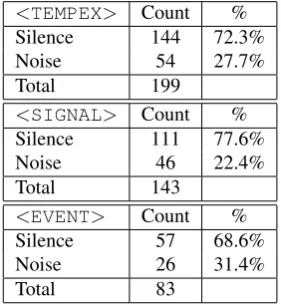
141 partial disagreements occurred for the <TEMPEX>
tag. Due to the fact that this tag can span multiple word tokens, it was the most frequent source of errors. 30 partial
disagreements were found on the<SIGNAL>tag. No
par-tial disagreements occurred for event expressions as these nearly always covered a single word token.
4.3. Annotation Round 3
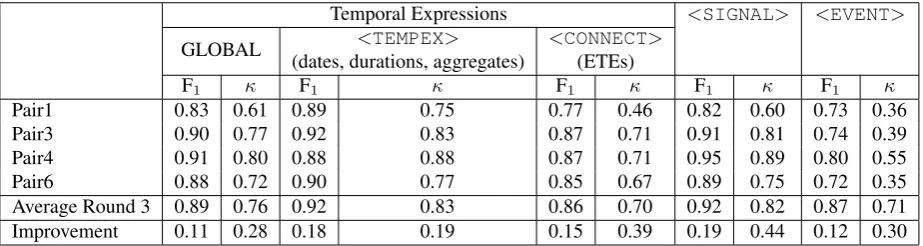
A third and final round of annotations was carried out with the same annotators as Round 2 and the same corpus. This time a marked improvement was to be expected, as anno-tators had already seen the texts, although they were not made aware of the errors they may have made in the previ-ous round. Agreement figures for this final round of anno-tation are represented in Table 5 (page 5).
A marked increase in agreement was noticed, as was ex-pected. Agreement had reached an acceptable level (¿0.85 F-score) for each of the markables. At this stage, we could start thinking about constituting a reference corpus to use for evaluation purposes.
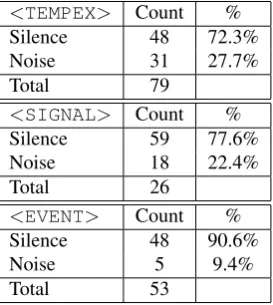
Complete disagreement: Complete disagreement dimin-ished greatly in Round 3. This indicated a greater consen-sus on what to annotate and a more coherent application of the guidelines on the part of the annotators. Table 6 shows figures for disagreement types across markables.
Partial disagreement: For temporal expressions there were 59 partial disagreements, due either to segmentation differences (1 annotation or 2), or left or right annotation boundary. Only 8 partial disagreements occurred for rela-tion markers. Finally, there were no partial disagreements on events as events only cover, in the vast majority of cases, a single word token.
<TEMPEX> Count %
Silence 48 72.3%
Noise 31 27.7%
Total 79
<SIGNAL> Count %
Silence 59 77.6%
Noise 18 22.4%
Total 26
<EVENT> Count %
Silence 48 90.6%
Noise 5 9.4%
Total 53
Table 6: Types of disagreement for markables in Round 3.
4.4. Comparison with TimeBank 1.2
Although the elements to be annotated were not exactly the same as the markables of TimeML, there are certain similarities that warrant a comparison with the TimeBank
1.2 corpus. The <TEMPEX> tag (atomic temporal
ex-pressions) corresponds roughly to the<TIMEX3>tag in
TimeML, while the<SIGNAL>tag is used identically to
that in TimeML, the<EVENT>tag has not been used in
the same way and therefore is not comparable at this stage. Figures compare favourably to those reported for the Time-Bank 1.2 corpus, presented below in Table 7 (the corre-sponding figures for our experiment are given in brackets for direct comparison).
TimeML tag Agreement (F1)
<TIMEX3> 0.83 (0.89) <SIGNAL> 0.77 (0.92)
Table 7: Reported inter-annotator agreement for TimeBank 1.2.
Temporal Expressions <SIGNAL> <EVENT>
GLOBAL <TEMPEX>
(dates, durations, aggregates)
<CONNECT> (ETEs)
F1 κ F1 κ F1 κ F1 κ F1 κ
Pair1 0.83 0.61 0.89 0.75 0.77 0.46 0.82 0.60 0.73 0.36
Pair3 0.90 0.77 0.92 0.83 0.87 0.71 0.91 0.81 0.74 0.39
Pair4 0.91 0.80 0.88 0.88 0.87 0.71 0.95 0.89 0.80 0.55
Pair6 0.88 0.72 0.90 0.77 0.85 0.67 0.89 0.75 0.72 0.35
Average Round 3 0.89 0.76 0.92 0.83 0.86 0.70 0.92 0.82 0.87 0.71
Improvement 0.11 0.28 0.18 0.19 0.15 0.39 0.19 0.44 0.12 0.30
Table 5: Inter-annotator agreement scores (F-score and Kappa) for Annotation Round 3.
(Battistelli et al., 2008). It will also be interesting to see to what point the approach we have presented is transferable to other languages.
6.
References
Emmon Bach. 1986. The Algebra of Events. Linguistics
and Philosophy, 9(1):5–16.
Delphine Battistelli, Javier Couto, Jean-Luc Minel, and Sylviane Schwer. 2008. Representing and
Visualiz-ing Calendar Expressions in Texts. In Proceedings of
STEP’08 (Symposium on Semantics in Systems for Text Processing), Venice, September.
Andr´e Bittar. 2010. Building a TimeBank for French:
a Reference Corpus Annotated According to the ISO-TimeML Standard. Ph.D. thesis, Universit´e Paris Diderot, Paris, November.
Jacob Cohen. 1960. A Coefficient of Agreement for
Nom-inal Scales. Educational and Psychological
Measure-ment, 43(6):551–558.
Maud Ehrmann and Caroline Hag`ege. 2009. Proposition de caract´erisation et de typage des expressions
tem-porelles en contexte. InTALN 2009 (Traitement
Automa-tique des Langues Naturelles), Senlis, France, June. Lisa Ferro, Laurie Gerber, Inderjeet Mani, Beth Sundheim,
and George Wilson, 2005. TIDES 2005 Standard for the
Annotation of Temporal Expressions, September. Caroline Hag`ege and Xavier Tannier. 2008. XTM: A
Ro-bust Temporal Text Processor. In Computational
Lin-guistics and Intelligent Text Processing, proceedings of 9th International Conference CICLing 2008, pages 231– 240, Haifa, Israel. Springer Berlin / Heidelberg.
James Pustejovsky, Jos´e Casta˜no, Robert Ingria, Roser Saur´ı, Robert Gaizauskas, Andrea Setzer, and Graham Katz. 2003a. TimeML: Robust Specification of Event
and Temporal Expressions in Text. In Proceedings of
IWCS-5, Fifth International Workshop on Computational Semantics.
James Pustejovsky, Patrick Hanks, Roser Saur´ı, An-drew See, Robert Gaizauskas, Andrea Setzer, Dragomir Radev, Beth Sundheim, David Day, Lisa Ferro, and
Mar-cia Lazo. 2003b. The TIMEBANK Corpus. In
Proceed-ings of Corpus Linguistics 2003, pages 647–656. Irene Russo, Tommaso Caselli, and Francesco Rubino.
2011. Recognizing Deverbal Events in Context. In
Pro-ceedings of 12th International Conference on Intelli-gent Text Processing and Computational Linguistics
(CI-CLing 2011), poster session, Tokyo, Japan, February. Springer.
Antoine Widl¨ocher and Yann Mathet. 2009. La
plate-forme Glozz : environnement d’annotation et
d’exploration de corpus. InActes de TALN 2009,